REVIEW 4 major objections 5 minor 1 cited by
Evaluating LLMs and Prompting Strategies for Automated Hardware Diagnosis from Textual User-Reports
T0 review · 4 major / 5 minor · reviewed 2026-08-06 · deepseek-v4-flash
Pith's one-line read Open-source LLMs can identify faulty PC hardware from user text at F1 up to 0.76, with a 2B-parameter model nearly matching a 24B-parameter model.
desk verdict A large, practically useful LLM benchmark for hardware fault triage whose central small-model recommendation is plausible but needs explicit train/test separation and few-shot provenance disclosure. read the letter →
The pith
A machine-rendered reading of the paper's core claim, the machinery that carries it, and where it could break.
The reading
What carries the argument
The mechanism that carries the argument has three parts: a fixed prompting protocol, a labeled dataset, and a Pareto-frontier evaluation. The prompting protocol begins with a 'Common Prompt' that defines the eight-component taxonomy and demands a single Python dictionary as output, optionally augmented by a 'Chain of Thoughts' frame and a 'Few-Shot' frame containing three worked examples (Memory, Audio, Storage). The FACTO dataset supplies the 853 labeled user reports every model is scored on, and the evaluation parses the dictionary outputs into component labels, computing F1 with bootstrap error bars and then tracing the Pareto frontier in the F1-versus-parameter-count plane. The dictionary-output constraint is doing critical work: models that identify the right component but wrap it in prose are scored as failures, which is why few-shot examples rescue small models.
What would settle it
Re-run the Few-Shot and CoT+FS evaluations with the three example reports (Memory, Audio, Storage) removed from the FACTO test set, or replaced by held-out reports; if qwen2.5-1.5b no longer jumps from 0.000 to 0.673 and stablelm-zephyr-3b no longer jumps from 0.474 to 0.708, the few-shot advantage for small models is an artifact of example overlap.
Extended reading notes
Core claim
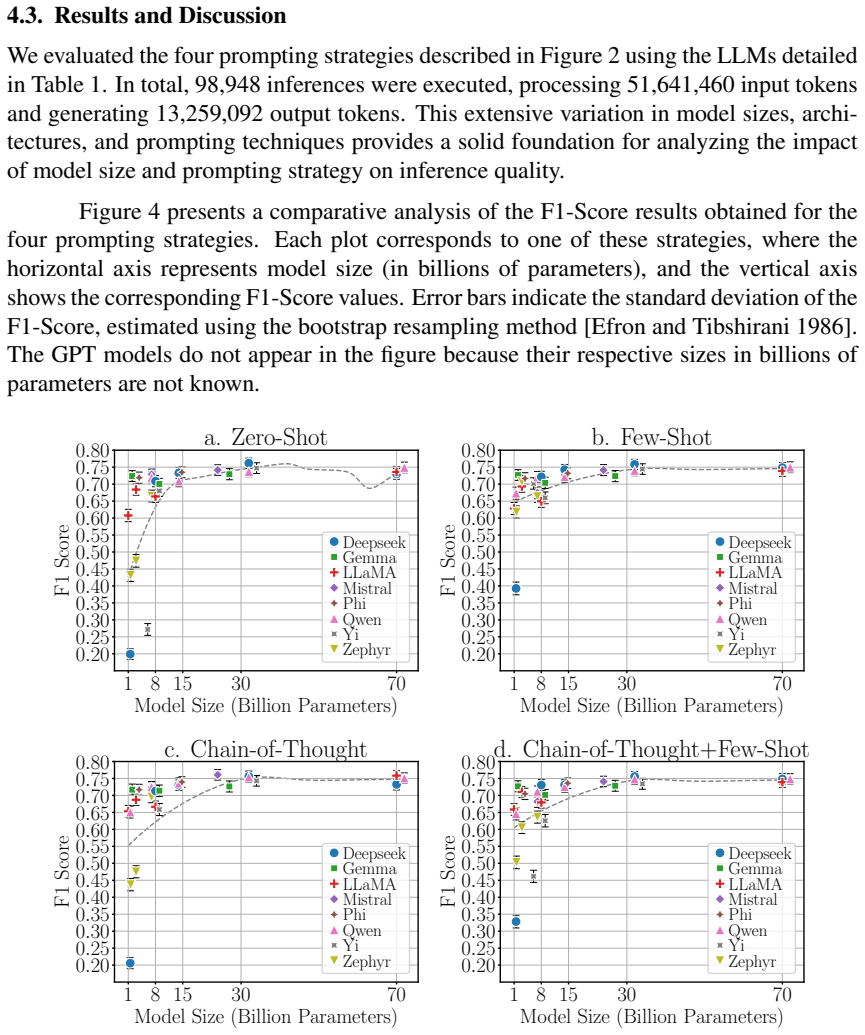
On the paper's own terms, the discovery is that mapping a report like 'my connection keeps timing out' to one of eight hardware components is solvable by instruction-tuned open-source LLMs at a practical level, and the size–performance frontier is surprisingly flat: the 2B-parameter gemma-2-2b-it achieves an F1 of 0.7269, while the 24B mistral-small-24b-instruct-2501 achieves 0.7608 and the 1B llama-3.2-1b-instruct reaches 0.659 under CoT+FS. The authors identify these three as Pareto-optimal, meaning no other tested model is both smaller and more accurate. They further find that prompt design shifts results more for small models than for large ones: qwen2.5-1.5b-instruct goes from 0.000 F1 under zero-shot to 0.673 under few-shot because zero-shot outputs fail to conform to the required dictionary format, while gpt-4o gains most from chain-of-thought, reaching 0.767.
Load-bearing premise
The load-bearing premise is that the three worked examples shown in the Few-Shot and CoT+FS prompts were not taken from the same 853-report FACTO set used for scoring; if they were, the few-shot results are partially contaminated by test-set labels and the reported small-model gains are inflated.
Editorial extensions
If this is right
- Hardware manufacturers can deploy local, on-device LLM triage for user reports without cloud APIs: a 2B model at about 4.2 GB VRAM reaches F1 0.727, and a 1B model at 2.8 GB reaches 0.659.
- For large models, chain-of-thought is the strongest single strategy (gpt-4o 0.767, mistral-small-24b 0.761), while for models under about 7B parameters, few-shot examples are the difference between a usable classifier and one that fails to format output at all.
- The performance plateau near 30B parameters means most of the diagnostic value is available at far lower compute; scaling beyond that buys little on this eight-class task.
- The Pareto frontier gives practitioners a concrete shortlist—llama-3.2-1b-instruct, gemma-2-2b-it, and mistral-small-24b-instruct—for choosing a model based on available memory and target accuracy.
- These results position the high-scoring models as teacher candidates for knowledge distillation into compact NPU-friendly student models for real-time on-device diagnostics.
Reading between the lines
- If the three worked examples shown in the Few-Shot and CoT+FS prompts were drawn from the same 853-report FACTO set used for evaluation—the paper does not state where they came from—the few-shot results are partially contaminated by test-set labels, and the reported small-model gains (e.g., qwen2.5-1.5b jumping from 0.000 to 0.673) could be inflated.
- Because the evaluation requires a dictionary output, the F1 scores conflate diagnosis quality with formatting compliance; a more forgiving parser that extracts the component name from prose would likely raise the zero-shot scores of small models and could change the model ranking.
- The few-shot examples use the same eight label names as the taxonomy, so a model could pass by label-matching rather than by reasoning; rephrasing the examples or using previously unseen symptom phrasings would test whether the gains generalize.
- If the observed plateau holds on other hardware failure types, a small specialized model distilled from mistral-small-24b or qwen2.5-32b could plausibly approach the 0.76 ceiling on a phone NPU, making fully local diagnostics standard in support applications.
Editorial analysis
A structured set of objections, weighed in public.
Referee Report
Summary. The paper benchmarks 29 LLMs (27 open-source models from 1B to 72B parameters, plus GPT-4o and GPT-4o-mini) on an eight-class hardware fault diagnosis task using the FACTO dataset of 853 user reports. Four prompting strategies are compared: Zero-Shot, Few-Shot, Chain-of-Thought, and CoT combined with Few-Shot. Performance is measured with F1-score, and a Pareto frontier analysis of model size versus F1 is used to recommend llama-3.2-1b-instruct, gemma-2-2b-it, and mistral-small-24b-instruct as the best size/performance trade-offs. The paper claims an F1-score of up to 0.76.
Significance. This is a large-scale empirical benchmark: 98,948 inferences over 29 models, with bootstrap error bars and a clear Pareto analysis. If the evaluation is methodologically sound, the finding that 1B-2B models can reach F1 around 0.72 close to a 24B model is practically relevant for on-device hardware fault triage. The paper explicitly targets deployment constraints such as VRAM and NPU compatibility, which makes the study directly useful to practitioners. However, the lack of a described held-out split and the undisclosed provenance of the few-shot examples place the central deployment recommendation at risk.
major comments (4)
- [Section 4.1 and Section 3.2, Figure 2] The evaluation uses all 853 FACTO reports as inference examples, and the three few-shot examples (Memory, Audio, Storage) shown in Figure 2 are not stated to be disjoint from this set. Since no train/validation/test split is described, it is impossible to rule out that the few-shot demonstrations came from the same 853 reports that are scored. This contaminates the FS and CoT+FS results for every model. The impact is largest for small models: Table 2 shows qwen2.5-1.5b jumping from 0.000 (ZS) to 0.673 (FS) and yi-6b from 0.272 (ZS) to 0.702 (FS). Please state the provenance of the few-shot examples and, ideally, re-run the evaluation on a held-out split or with demonstrations drawn from an independent source.
- [Section 4.2, Evaluation Setup] The paper does not report decoding parameters (temperature, top-p, max tokens, seed) for llama.cpp or for the proprietary GPT API calls. F1 differences between models and strategies could be an artifact of decoding choices rather than model capability. Please provide these settings for all models and both proprietary APIs, including model version identifiers, to make the benchmark reproducible and the comparisons fair.
- [Section 3.3 and Table 2] The paper defines F1 for binary classification but applies it to an eight-class problem without specifying whether the reported F1 is macro-averaged, micro-averaged, or weighted. Because the dataset is described as class-imbalanced, this choice materially affects the reported numbers and the ranking of models. Please state the averaging method and, ideally, report per-class F1 or a confusion matrix in an appendix.
- [Figure 5 and Section 4.3] The Pareto frontier in Figure 5 does not state which F1 value is plotted for each model: the best F1 across the four prompting strategies, or the F1 from a single fixed strategy. Since the text identifies llama-3.2-1b and gemma-2-2b as frontier models, the figure must be explicit about this choice. If the best-over-strategies value is used, report the strategy that achieves each frontier point; otherwise, the central recommendation cannot be verified from the reported results.
minor comments (5)
- [Section 5] The conclusion states that 'the observed trends suggest generalizability to other failure types with similar diagnostic patterns,' but no cross-domain or out-of-distribution experiment is presented. This overclaims beyond the evidence; please soften or remove the generalization statement.
- [Figure 4] The x-axis in Figure 4 lists values 1, 8, 15, 30, 70 without indicating that the scale is custom or logarithmic. Please clarify the axis scale to avoid misleading visual spacing.
- [Table 1] The model name 'stablelm-zephyr-1 6b' appears malformed; please correct it to 'stablelm-zephyr-1.6b' or as appropriate.
- [Section 4.3] The Nadaraya-Watson non-parametric regressions are said to be estimated, but the bandwidth selection rule is not stated. Please report the bandwidth or the method used to choose it.
- [Section 4.1] Please state whether the FACTO dataset is publicly available and, if so, provide a URL or access instructions, as the paper currently only cites a workshop paper.
Circularity Check
No significant circularity: the paper reports measured F1 scores on a fixed dataset, with no fitted prediction or derivation that reduces to its own inputs.
full rationale
The paper's central claims are empirical: F1-scores are computed by running frozen pre-trained LLMs over the 853 FACTO reports and comparing predicted component labels with the dataset labels (Sections 4.1 and 4.3). No model parameter is fitted to the evaluation set, and the models are not trained or tuned on FACTO. The 'best balance' recommendation is a Pareto-frontier ordering of the measured F1-size pairs, which is a definitional post-processing of measurements rather than a prediction derived from its own inputs. The only same-group citations (Silva et al. 2024 for the FACTO dataset and Silva et al. 2025 for related work) supply the evaluation corpus and background; citing the dataset does not by itself entail any F1 value. The provenance of the three few-shot examples in Figure 2 is not disclosed, so whether they overlap the evaluation reports is a possible experimental-validity concern, but the paper provides no evidence that they do; even if they did, that would be data contamination rather than circular derivation. Therefore no step in the paper reduces a claimed result to its own input by construction.
Assumptions & free parameters
assumptions (3)
- domain assumption The FACTO dataset labels are accurate ground truth for the faulty hardware component.
- domain assumption F1-score is an appropriate metric for this imbalanced classification task.
- standard math Bootstrap resampling (Efron and Tibshirani 1986) produces valid confidence intervals for the F1 scores.
Cite this review
Pith. "Pith review of Evaluating LLMs and Prompting Strategies for Automated Hardware Diagnosis from Textual User-Reports." pith.science (2026). https://pith.science/paper/SMRC6RPW
@misc{pith2026250700742,
  author       = {Pith},
  title        = {Pith review of: Evaluating LLMs and Prompting Strategies for Automated Hardware Diagnosis from Textual User-Reports},
  year         = {2026},
  howpublished = {\url{https://pith.science/paper/SMRC6RPW}},
  note         = {Machine review of arXiv:2507.00742}
}
read the original abstract
Computer manufacturers offer platforms for users to describe device faults using textual reports such as "My screen is flickering". Identifying the faulty component from the report is essential for automating tests and improving user experience. However, such reports are often ambiguous and lack detail, making this task challenging. Large Language Models (LLMs) have shown promise in addressing such issues. This study evaluates 27 open-source models (1B-72B parameters) and 2 proprietary LLMs using four prompting strategies: Zero-Shot, Few-Shot, Chain-of-Thought (CoT), and CoT+Few-Shot (CoT+FS). We conducted 98,948 inferences, processing over 51 million input tokens and generating 13 million output tokens. We achieve f1-score up to 0.76. Results show that three models offer the best balance between size and performance: mistral-small-24b-instruct and two smaller models, llama-3.2-1b-instruct and gemma-2-2b-it, that offer competitive performance with lower VRAM usage, enabling efficient inference on end-user devices as modern laptops or smartphones with NPUs.
Figures


Figures from the paper (2 more)

Forward citations
Cited by 1 Pith paper
-
Large Language Models Reasoning Abilities Under Non-Ideal Conditions After RL-Fine-Tuning
RL fine-tuning of LLMs improves clean-benchmark accuracy while degrading accuracy under three injected-distractor evaluation scenarios, though one of the three scenarios contradicts the headline claim.
Reference graph
Works this paper leans on
-
[1]
write newline
" write newline "" before.all 'output.state := FUNCTION fin.entry add.period write newline FUNCTION new.block output.state before.all = 'skip after.block 'output.state := if FUNCTION new.sentence output.state after.block = 'skip output.state before.all = 'skip after.sentence 'output.state := if if FUNCTION not #0 #1 if FUNCTION and 'skip pop #0 if FUNCTIO...
-
[2]
Abburi, H., Suesserman, M., Pudota, N., Veeramani, B., Bowen, E., and Bhattacharya, S. (2023). Generative ai text classification using ensemble llm approaches. arXiv preprint arXiv:2309.07755
arXiv 2023
-
[3]
Almeida, F. C. and Caminha, C. (2024). Evaluation of entry-level open-source large language models for information extraction from digitized documents. In Symposium on Knowledge Discovery, Mining and Learning (KDMiLe) , pages 25--32. SBC
work page 2024
-
[4]
Bastos, Z., Freitas, J. D., Franco, J. W., and Caminha, C. (2025). Prompt-driven time series forecasting with large language models. In Proceedings of the 27th International Conference on Enterprise Information Systems , pages 309--316
work page 2025
-
[5]
Efron, B. and Tibshirani, R. (1986). Bootstrap methods for standard errors, confidence intervals, and other measures of statistical accuracy. Statistical science , pages 54--75
work page 1986
-
[6]
U., Qureshi, R., Shah, A., Irfan, M., Zafar, A., Shaikh, M
Hadi, M. U., Qureshi, R., Shah, A., Irfan, M., Zafar, A., Shaikh, M. B., Akhtar, N., Wu, J., Mirjalili, S., et al. (2023). A survey on large language models: Applications, challenges, limitations, and practical usage. Authorea Preprints , 3
work page 2023
-
[7]
Ishizaka, A. and Nemery, P. (2013). Multi-criteria decision analysis: methods and software . John Wiley & Sons
work page 2013
-
[8]
Karl, A. L., Fernandes, G. S., Pires, L. A., Serpa, Y. R., and Caminha, C. (2024). Synthetic ai data pipeline for domain-specific speech-to-text solutions. In Simp \'o sio Brasileiro de Tecnologia da Informa c \ a o e da Linguagem Humana (STIL) , pages 37--47. SBC
work page 2024
Show all 23 references
-
[9]
Li, Y., He, Y., Lian, R., and Guo, Q. (2023). Fault diagnosis and system maintenance based on large language models and knowledge graphs. In 2023 5th international conference on robotics, intelligent control and artificial intelligence (RICAI) , pages 589--592. IEEE
2023
-
[10]
Lotov, A. V. and Miettinen, K. (2008). Visualizing the pareto frontier. In Multiobjective optimization: interactive and evolutionary approaches , pages 213--243. Springer
2008
-
[11]
and Mohammcd, A
Makram, M. and Mohammcd, A. (2024). Ai applications in medical reporting and diagnosis. In 2024 International Mobile, Intelligent, and Ubiquitous Computing Conference (MIUCC) , pages 185--192. IEEE
2024
-
[12]
Nadaraya, E. A. (1964). On estimating regression. Theory of Probability & Its Applications , 9(1):141--142
1964
-
[13]
Nam, D., Macvean, A., Hellendoorn, V., Vasilescu, B., and Myers, B. (2024). Using an llm to help with code understanding. In Proceedings of the IEEE/ACM 46th International Conference on Software Engineering , pages 1--13
2024
-
[14]
Nathani, M., Soni, R., and Mishra, R. (2024). Knowledge distillation in mixture of experts for multi-modal medical llms. In 2024 IEEE International Conference on Big Data (BigData) , pages 4367--4373. IEEE
2024
-
[15]
Pereira, F. L. F., Chaves, I. C., Gomes, J. P. P., and Machado, J. C. (2020). Using autoencoders for anomaly detection in hard disk drives. In 2020 international joint conference on neural networks (IJCNN) , pages 1--7. IEEE
2020
-
[16]
P., Rodrigues, F
Queiroz, L. P., Rodrigues, F. C. M., Gomes, J. P. P., Brito, F. T., Brito, I. C., and Machado, J. C. (2016a). Fault detection in hard disk drives based on mixture of gaussians. In 2016 5th Brazilian Conference on Intelligent Systems (BRACIS) , pages 145--150. IEEE
2016
-
[17]
P., Rodrigues, F
Queiroz, L. P., Rodrigues, F. C. M., Gomes, J. P. P., Brito, F. T., Chaves, I. C., Paula, M. R. P., Salvador, M. R., and Machado, J. C. (2016b). A fault detection method for hard disk drives based on mixture of gaussians and nonparametric statistics. IEEE Transactions on indus...
2016
-
[18]
Rasal, S. (2024). Llm harmony: Multi-agent communication for problem solving. arXiv preprint arXiv:2401.01312
2024 arXiv
-
[19]
Silva, M. d. L. M., Mendonça, A. L. C., Neto, E. R. D., Chaves, I. C., Brito, F. T., Farias, V. A. E., and Machado, J. C. (2025). Classification of user reports for detection of faulty computer components using nlp models: A case study
2025
-
[20]
Silva, M. d. L. M., Mendonça, A. L. C., Neto, E. R. D., Chaves, I. C., Caminha, C., Brito, F. T., Farias, V. A. E., and Machado, J. C. (2024). Facto dataset: A dataset of user reports for faulty computer components. In Dataset Showcase Workshop (DSW) , pages 91--102. SBC
2024
-
[21]
Tao, L., Liu, H., Ning, G., Cao, W., Huang, B., and Lu, C. (2025). Llm-based framework for bearing fault diagnosis. Mechanical Systems and Signal Processing , 224:112127
2025
-
[22]
Wang, L., Bi, W., Zhao, S., Ma, Y., Lv, L., Meng, C., Fu, J., Lv, H., et al. (2024). Investigating the impact of prompt engineering on the performance of large language models for standardizing obstetric diagnosis text: comparative study. JMIR formative research , 8(1):e53216
2024
-
[23]
Zheng, S., Pan, K., Liu, J., and Chen, Y. (2024). Empirical study on fine-tuning pre-trained large language models for fault diagnosis of complex systems. Reliability Engineering & System Safety , 252:110382
2024
Reviewed August 6, 2026 · model on record in the stance chip above.
Discussion (0). Sign in to comment.