REVIEW 3 major objections 6 minor 79 references
Light Neutral Higgs-Boson Production at $e^+e^-$ Colliders in the Complex MSSM and NMSSM: A Full One-Loop Analysis
T0 review · 3 major / 6 minor · reviewed 2026-08-06 · deepseek-v4-flash
Pith's one-line read This paper presents the first full one-loop calculation of $e^+e^- \to h_1 Z$ Higgs-strahlung in the cNMSSM, finding corrections of about $-10\%$ at 250 GeV, above $+20\%$ at 1000 GeV, and NMSSM-MSSM deviations below $0.1\%$ once the…
desk verdict First full one-loop cNMSSM Higgs-strahlung calculation, with real internal checks but an over-sold sub-0.1% NMSSM-MSSM agreement and an unvalidated renormalization scheme. read the letter →
The pith
A machine-rendered reading of the paper's core claim, the machinery that carries it, and where it could break.
The reading
What carries the argument
The argument is carried by the combined one-loop renormalization of the c(N)MSSM sectors needed for $e^+e^- \to h_1 Z$: the on-shell fermion renormalization, the electric charge renormalization through $\delta Z_e$, the DR-to-OS conversions of the NMSSM parameters ($\lambda$, $\kappa$, $A_\kappa$, $t_\beta$, $\mu_{\rm eff}$), and the manual external-Higgs wave-function renormalization implemented through Eqs. (21) and (22), including the $Z$/Goldstone/Higgs--Higgs self-energy transitions. The diagrammatic evaluation uses the (N)MSSM model and counterterms of Refs. [15,57] with automated diagram and amplitude generators, and the Higgs-boson masses are taken from a two-loop calculation at $\mathcal{O}(\alpha_t \alpha_s + \alpha_t^2)$. Infrared and collinear divergences are handled by a photon-mass regulator plus a phase-space slicing method with soft and angular cutoffs, and cutoff independence is checked numerically. The tree-level cross section is proportional to the $Z$--$Z$--$h_1$ coupling combination $c_\beta Z^{\rm mix}_{11} + s_\beta Z^{\rm mix}_{12}$, which controls the decoupling behaviour; this is the object whose loop corrections the calculation determines.
What would settle it
An independent full one-loop calculation of $e^+e^- \to h_1 Z$ in the cNMSSM, performed with a different renormalization scheme (for example a complex-mass scheme) and preferably encoded in a separate program, would settle the matter: a disagreement with the $-10\%$ (at $\sqrt{s}=250$ GeV) and $+22\%$ (at $\sqrt{s}=1000$ GeV) corrections beyond the expected scheme uncertainty would falsify the central claim. A cheaper check is to convert the input scheme of the effective-potential calculation of Ref. [55] to the one used here and compare at a common benchmark point.
Extended reading notes
Core claim
On the paper's own terms, the result is that a full one-loop computation of $e^+e^- \to h_1 Z$ in the cNMSSM is feasible and that its predictions are numerically substantial but nearly degenerate with the MSSM. In the benchmark scenario the tree-level cross section peaks around 203 fb near $\sqrt{s} \approx 255$ GeV; loop corrections are about $-10\%$ at 250 GeV, rise to about $+22\%$ at 1000 GeV, and reach roughly $-30\%$ at the production threshold, outside the region where nonrelativistic corrections would be needed. Varying the genuine NMSSM parameters $\lambda$, $\kappa$, $A_\kappa$, $\mu_{\rm eff}$ and the phases $\varphi_\lambda$, $\varphi_\kappa$, $\varphi_{\mu_{\rm eff}}$, $\varphi_{A_t}$ produces almost no genuine NMSSM-specific loop effect: the visible variations are kinematic, following the small allowed movement of $m_{h_1}$ around 125 GeV, and the largest genuine differences between NMSSM and MSSM appear in stop-sector dependences at well below the percent level. The authors conclude that a precise prediction of this channel requires the full one-loop treatment, and that the corrected cross sections are suitable for coupling determinations at future $e^+e^-$ colliders.
Load-bearing premise
The result stands or falls on whether the adopted one-loop renormalization scheme of the complex (N)MSSM is complete and consistent for this production process; the paper tests this only through internal consistency checks and by reproducing its own earlier MSSM result, with no independent numerical cross-check.
Editorial extensions
If this is right
- At $\sqrt{s}=250$ GeV the one-loop correction shifts the Higgs-strahlung cross section downward by about $10\%$, so coupling extractions that rely on tree-level rates would be biased at the percent level.
- At $\sqrt{s}=1000$ GeV the relative correction exceeds $+20\%$, so the energy dependence of the correction matters for higher-energy linear-collider programs.
- Because the NMSSM and MSSM predictions agree to better than $0.1\%$ once $m_{h_1}$ is fixed to 125 GeV, the $e^+e^- \to h_1 Z$ channel will not discriminate between the two models at the anticipated precision.
- The corrected cross sections are intended for implementation into a public computer code, making them available for future global Higgs analyses.
- Near thresholds the computation is not reliable and would require nonrelativistic or complex-mass treatments.
Reading between the lines
- If the roughly $-10\%$ correction at 250 GeV is confirmed, global electroweak fits that currently use tree-level $e^+e^- \to h Z$ cross sections for the 125 GeV Higgs should be re-run with the one-loop rate, since the shift exceeds the precision goals of some proposed colliders.
- The sub-$0.1\%$ NMSSM--MSSM agreement suggests that Higgs-strahlung is a poor discriminator of the singlet sector; distinguishing the cNMSSM will likely have to come from other observables, such as decays or production of the heavier, singlet-dominated states.
- A testable extension is to repeat the calculation in a complex-mass scheme near the $h_1 Z$ threshold, which would replace the current unreliability there with a well-defined width treatment and map the $-30\%$ threshold behaviour onto a physical line shape.
- The non-converging $A_t$ conversion near $A_t \sim -400$ GeV indicates that a fully iterated DR-to-OS conversion is worth testing; whether the claimed genuine stop-sector loop effects survive that change would say something about scheme dependence.
Editorial analysis
A structured set of objections, weighed in public.
Referee Report
Summary. This paper presents a full one-loop calculation of the Higgs-strahlung process e+e- -> h1 Z in the complex NMSSM, treating the complex MSSM as a limiting case. The calculation includes virtual electroweak corrections and soft, hard, and collinear photon radiation; ultraviolet, infrared, and collinear divergences are shown to cancel. The Higgs-sector renormalization is adopted from earlier work, the external-Higgs wave-function corrections are implemented by hand through Eqs. (21) and (22), and the Higgs masses are taken from NMSSMCALC at two-loop order. The numerical analysis reports relative corrections of about -10% at sqrt(s)=250 GeV, larger than +20% at 1000 GeV, and states that the NMSSM and MSSM predictions agree to better than 0.1% once the Higgs mass is fixed to 125 GeV. The paper also compares the NMSSM result with its MSSM limit and with a tree-level formula, and it discusses why comparisons with Refs. [55,56] are not performed.
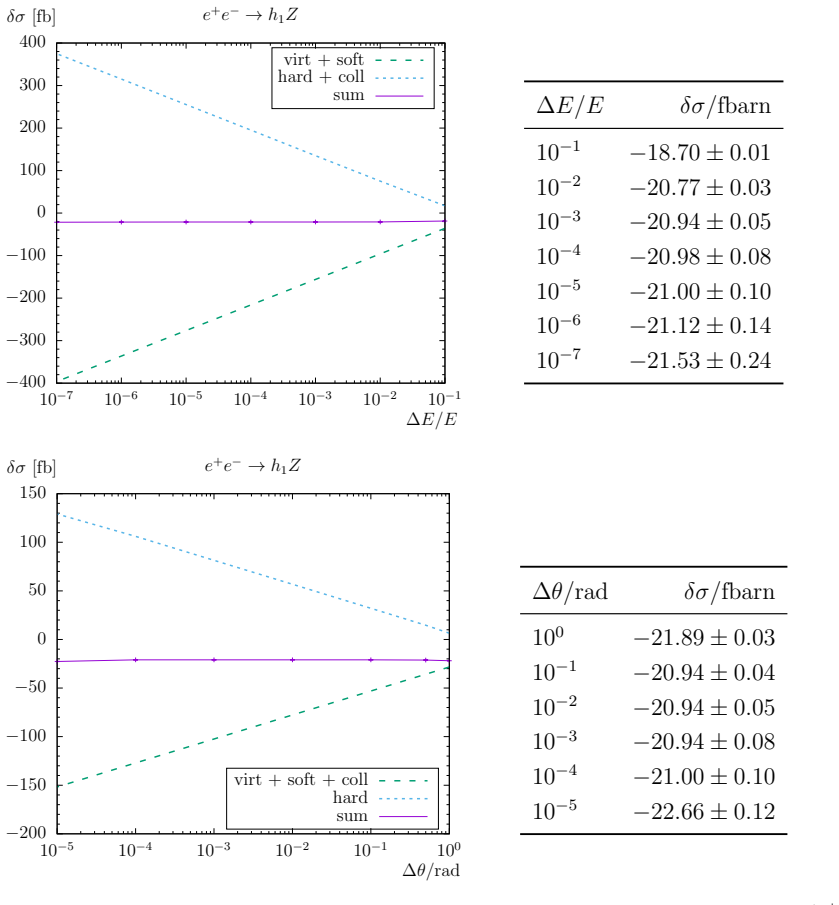
Significance. Providing a full one-loop prediction for cNMSSM Higgs-strahlung is a valuable step. If the result is correct, it fills a genuine gap in the literature and is directly relevant for precision coupling measurements at future e+e- colliders. The technical execution is credible: the internal consistency checks (UV, IR, and collinear cancellation; independence of the soft and collinear slicing parameters over several orders of magnitude in Fig. 2) are exactly what one would want for such a calculation, and the plan to implement the result in FeynHiggs would make it useful to the community. However, the two headline claims are not equally supported. The -10% and +22% corrections are clearly demonstrated by the numerical results, whereas the sub-0.1% NMSSM-MSSM statement is an extrapolation from plots in which the two models have slightly different m_h1 values.
major comments (3)
- [Section 4.2.3 and Section 5] The abstract, Section 4.2.3, and Section 5 state that the NMSSM-MSSM deviation is 'below the level of 0.1%' once the Higgs-boson mass is fixed to 125 GeV. The numerical results quoted in the text instead show relative-correction differences of 0.64% (|kappa| at |kappa|≈0.31), 0.4% (|mu_eff| at ≈1203 GeV), 0.2% (M_H± at 1800 GeV), 0.14% (|A_kappa|), and 1.1% (tan beta at 50), all attributed to differences between m_h1 and M_h. Since no fixed-mass comparison is shown, the sub-0.1% claim is an extrapolation rather than a demonstrated result. I request either a dedicated computation with m_h1 and M_h set to exactly the same value (e.g., 125 GeV) or a weakening of the claim to something like 'well below the percent level once the light Higgs mass is fixed.'
- [Section 3 (Eqs. (8)-(12), (20)-(22))] The 'full and consistent one-loop' claim is supported almost entirely by internal consistency checks. The renormalization of the cNMSSM-specific sectors is inherited from Refs. [15,57], the DR-to-OS conversions in Eqs. (8)-(12) use the ad hoc scale Q = m_h1 + M_Z, and the external h1-hi wave-function corrections are implemented by hand via Eqs. (21)-(22). The tests in Section 3.5 (tree-level formula, MSSM limit, h1->tau+tau- comparison) do not provide an independent check of these NMSSM-specific pieces. I ask for at least one additional validation, for example a scan over the conversion scale Q, a comparison with an independent calculation in a simplified NMSSM limit (e.g., decoupled singlet or lambda->0), or a demonstration that the result is independent of the choices encoded in Eqs. (21)-(22) at the permille level.
- [Section 4.2.1 (At variation)] The paper states that the structure around A_t ≈ -400 GeV is caused by a non-converging conversion from A_DR_t to A_OS_t and that a simplified, non-iterated conversion is used there. This means the cross-section in that region is a calculational artifact, not a prediction. The text should either quantify the systematic uncertainty introduced by this simplified conversion or explicitly exclude the affected interval from the analysis; as it stands, the At-dependence plot and the associated conclusions mix artifact and physics.
minor comments (6)
- [Abstract] The word 'intemeasurements' appears to be a typo; it should likely be 'interpretation of measurements'.
- [Figure 2 caption] The caption says the upper plot uses fixed Δθ/rad = 10^-2 and the lower plot fixed ΔE/E = 10^-3, but the axes show the opposite (upper x-axis is ΔE/E, lower x-axis is Δθ/rad).
- [Section 4.2.1 (M_tilde_Q3 paragraph)] The phrase 'the lower bound of m_tilde_t1 < 1310 GeV' should be rephrased, e.g., 'the lower bound on m_tilde_t1 of 1310 GeV'.
- [Section 4.2.1 and Section 4.2.3] The differences between the NMSSM and MSSM are repeatedly called 'numerical artefacts'; they are physical kinematic effects arising from different Higgs-boson masses. The terminology should be corrected.
- [Section 3.5] The level of agreement in the h1->tau+tau- comparison with Ref. [15] is not stated; giving a quantitative agreement (e.g., to how many digits) would make the check more informative.
- [Section 4] All numerical results are presented only in figures; a table with the benchmark-scenario cross sections would improve reproducibility and make the fixed-mass comparison easier to verify.
Assumptions & free parameters
free parameters (4)
- Baseline cNMSSM scenario (Table 1, OS column) =
t_beta=7, lambda=0.25, kappa=0.48, A_kappa=300, mu_eff=300, M_H+/-=1000, stops=1500, At=2000, M1/2/3=600/400/2500 GeV
- Exclusion cut on the light Higgs mass =
m_h1 (and M_h) >= 123.5 GeV
- DR-to-OS conversion scale Q =
m_h1 + M_Z = 216.26 GeV
- PSS slicing parameters =
delta_s = 1e-3, delta_theta/rad = 1e-2
assumptions (6)
- domain assumption The cMSSM renormalization scheme of Ref. [57] (OS fermions, OS Z mass, delta_sw) transfers unchanged to the cNMSSM one-loop calculation for e+e- -> h1Z
- domain assumption The cNMSSM-specific renormalization of Ref. [15] (phases of delta_A_kappa and delta_A_lambda fixed by singlet tadpole conditions, |A_kappa| fixed by the triple CP-even singlet vertex, remaining parameters DR) is consistent for the production process
- standard math Constrained differential renormalization is equivalent to dimensional reduction at one loop and preserves the SUSY relations among couplings
- domain assumption Two-loop corrected Higgs masses from NMSSMCALC 5.0 at O(alpha_t alpha_s + alpha_t^2) with OS renormalization in the stop sector are the correct external masses for the one-loop cross-section
- domain assumption Electron-Higgs couplings and terms of order m_e are numerically negligible for this cross-section
- domain assumption No prior full one-loop cNMSSM calculation for e+e- -> h1Z exists
Cite this review
Pith. "Pith review of Light Neutral Higgs-Boson Production at $e^+e^-$ Colliders in the Complex MSSM and NMSSM: A Full One-Loop Analysis." pith.science (2026). https://pith.science/paper/SMDXQQIT
@misc{pith2026250700931,
  author       = {Pith},
  title        = {Pith review of: Light Neutral Higgs-Boson Production at $e^+e^-$ Colliders in the Complex MSSM and NMSSM: A Full One-Loop Analysis},
  year         = {2026},
  howpublished = {\url{https://pith.science/paper/SMDXQQIT}},
  note         = {Machine review of arXiv:2507.00931}
}
abstract
For future precision analyses of the Higgs boson at $\approx 125$ GeV, $h_{125}$, a precise knowledge of its production and decay properties is mandatory. While in the Standard Model (SM) these calculations are quite advanced, in many models beyond the SM (BSM) a precise calculation is missing so far. We present the calculation of the Higgs-strahlung cross-sections at $e^+e^-$ colliders for the light neutral Higgs boson production in the Next-to-Minimal Supersymmetric SM (NMSSM) with complex parameters (cNMSSM). The evaluation is based on a full one-loop calculation of the production mechanism $e^+e^- \to h_1 Z$, including soft, hard, and collinear photon radiation. The dependence of the Higgs boson production cross-sections on the relevant cNMSSM parameters is analyzed numerically. In certain scenarios we find sizable corrections to the Higgs-strahlung cross-section. Normally, they reach about $10%$ of the tree-level results, but can also exceed 20%. Finally, the calculation is compared to the corresponding one in the Minimal Supersymmetric SM (MSSM). The knowledge of the full one-loop contributions to the Higgs-boson production is particularly important for a sound theoretical intemeasurements at future $e^+e^-$ colliders such as the ILC, CLIC, LCF, FCC-ee, or CEPC. It is planned to implement the evaluation of the Higgs boson production cross-sections into an add-on package to the code FeynHiggs.
Figures


Figures from the paper (6 more)


Reference graph
Works this paper leans on
- [1]
-
[2]
S. Chatrchyan et al. [CMS Collaboration], Phys. Lett.B 716(2012) 30 [arXiv:1207.7235 [hep-ex]]
arXiv 2012
- [3]
-
[4]
A. Tumasyan et al. [CMS], Nature 607 (2022) no.7917, 60-68 [erratum: Nature 623 (2023) no.7985, E4] [arXiv:2207.00043 [hep-ex]]. 23
arXiv 2022
-
[5]
H. Nilles, Phys. Rept.110 (1984) 1; R. Barbieri, Riv. Nuovo Cim.11 (1988) 1
work page 1984
- [6]
- [7]
- [8]
Show all 79 references
-
[9]
496 (2010) 1 [arXiv:0910.1785 [hep-ph]]
Ulrich Ellwanger, Cyril Hugonie, and A.M.Teixeira, Phys.Rept. 496 (2010) 1 [arXiv:0910.1785 [hep-ph]]
2010 arXiv
-
[10]
Kim and H.P
J.E. Kim and H.P. Nilles, Phys. Lett.B 138(1984) 150
1984
-
[11]
Pilaftsis, Phys
A. Pilaftsis, Phys. Rev.D 58(1998) 096010 [arXiv:hep-ph/9803297]; A. Pilaftsis, Phys. Lett.B 435(1998) 88 [arXiv:hep-ph/9805373]
1998 arXiv
- [12]
-
[13]
Pilaftsis and C
A. Pilaftsis and C. Wagner, Nucl. Phys. B 553(1999) 3 [arXiv:hep-ph/9902371]
1999 arXiv
- [14]
-
[15]
Domingo, P
F. Domingo, P. Drechsel and S. Paßehr, Eur. Phys. J.C 77(2017) no.8, 562 [arXiv:1706.00437 [hep-ph]]
2017 arXiv
-
[16]
Heinemeyer, O
S. Heinemeyer, O. St ˚ al and G. Weiglein,Phys. Lett.B 710(2012) 201 [arXiv:1112.3026 [hep-ph]]
2012 arXiv
-
[17]
Slavich, S
P. Slavich, S. Heinemeyer (eds.), E. Bagnaschi et al., Eur. Phys. J.C 81(2021) no.5, 450 [arXiv:2012.15629 [hep-ph]]
2021 arXiv
-
[18]
See: https://home.cern/science/accelerators/future-circular-collider
-
[19]
See: http://cepc.ihep.ac.cn
-
[20]
See: https://www.linearcollider.org
-
[21]
Moortgat-Pick et al., Eur
G. Moortgat-Pick et al., Eur. Phys. J.C 75(2015) 8, 371 [arXiv:1504.01726 [hep-ph]]
2015 arXiv
-
[22]
Atti´ eet al
D. Atti´ eet al. [Linear Collider Vision], [[arXiv:2503.19983 [hep-ex]]; A. Subba et al. [Linear Collider Facility at CERN], [[arXiv:2503.24049 [hep-ex]]
-
[23]
See: https://clic.cern
-
[24]
Heinemeyer and C
S. Heinemeyer and C. Schappacher, Eur. Phys. J.C 76(2016) 4, 220 [arXiv:1511.06002 [hep-ph]]
2016 arXiv
-
[25]
F. Arco, S. Heinemeyer and C. Schappacher, [arXiv:2002.06905 [hep-ph]]
2002 arXiv
-
[26]
Kanemura, K
S. Kanemura, K. Mawatari and K. Sakurai, Phys. Rev. D99 (2019) no.3, 035023 [arXiv:1808.10268 [hep-ph]]
2019 arXiv
-
[27]
de Blas et al., JHEP 01 (2020), 139 [arXiv:1905.03764 [hep-ph]]
J. de Blas et al., JHEP 01 (2020), 139 [arXiv:1905.03764 [hep-ph]]. 24
2020
-
[28]
Williams, H
K. Williams, H. Rzehak, and G. Weiglein, Eur. Phys. J.C 71(2011) 1669 [arXiv:1103.1335 [hep-ph]]
2011 arXiv
-
[29]
Heinemeyer and C
S. Heinemeyer and C. Schappacher, Eur. Phys. J.C 75(2015) 5, 198 [arXiv:1410.2787 [hep-ph]]
2015 arXiv
-
[30]
Heinemeyer and C
S. Heinemeyer and C. Schappacher, Eur. Phys. J.C 75(2015) 5, 230 [arXiv:1503.02996 [hep-ph]]
2015 arXiv
-
[31]
Heinemeyer, W
S. Heinemeyer, W. Hollik and G. Weiglein, Eur. Phys. J.C 16(2000) 139 [arXiv:hep-ph/0003022]
2000 arXiv
-
[32]
Hempfling, Phys
R. Hempfling, Phys. Rev.D 49(1994) 6168; L. Hall, R. Rattazzi and U. Sarid, Phys. Rev.D 50(1994) 7048 [arXiv:hep-ph/9306309]; M. Carena, M. Olechowski, S. Pokorski and C. Wagner, Nucl. Phys. B 426(1994) 269 [arXiv:hep-ph/9402253]; M. Carena, D. Garcia, U. Nierste and C. Wagner...
1994 arXiv
-
[33]
Noth and M
D. Noth and M. Spira, Phys. Rev. Lett.101 (2008) 181801 [arXiv:0808.0087 [hep-ph]]; D. Noth and M. Spira, JHEP 1106 (2011) 084 [arXiv:1001.1935 [hep-ph]]
2008 arXiv
-
[34]
Hollik and J
W. Hollik and J. Zhang, Phys. Rev.D 84(2011) 055022 [arXiv:1109.4781 [hep-ph]]
2011 arXiv
-
[35]
Bredenstein, A
A. Bredenstein, A. Denner, S. Dittmaier and M. Weber, Phys. Rev.D 74(2006) 013004 [arXiv:hep-ph/0604011]; A. Bredenstein, A. Denner, S. Dittmaier and M. Weber, JHEP 0702 (2007) 080 [arXiv:hep-ph/0611234]; A. Bredenstein, A. Denner, S. Dittmaier, A. M¨ uck and M. Weber, see: ht...
2006 arXiv
-
[36]
Frank, T
M. Frank, T. Hahn, S. Heinemeyer, W. Hollik, H. Rzehak and G. Weiglein, JHEP 0702 (2007) 047 [arXiv:hep-ph/0611326]
2007 arXiv
-
[37]
Heinemeyer, W
S. Heinemeyer, W. Hollik and G. Weiglein, Comput. Phys. Commun.124 (2000) 76 [arXiv:hep-ph/9812320]; T. Hahn, S. Heinemeyer, W. Hollik, H. Rzehak and G. Weiglein, Comput. Phys. Commun. 180 (2009) 1426; H. Bahl, T. Hahn, S. Heinemeyer, W. Hollik, S. Paßehr, H. Rzehak and G. Wei...
2000 arXiv
-
[38]
Heinemeyer, W
S. Heinemeyer, W. Hollik and G. Weiglein, Eur. Phys. J.C 9(1999) 343 [arXiv:hep-ph/9812472]
1999 arXiv
-
[39]
Degrassi, S
G. Degrassi, S. Heinemeyer, W. Hollik, P. Slavich and G. Weiglein, Eur. Phys. J.C 28(2003) 133 [arXiv:hep-ph/0212020]
2003 arXiv
-
[40]
T. Hahn, S. Heinemeyer, W. Hollik, H. Rzehak and G. Weiglein, Phys. Rev. Lett.112 (2014) 141801 [arXiv:1312.4937 [hep-ph]]. 25
2014 arXiv
-
[41]
Bahl and W
H. Bahl and W. Hollik, Eur. Phys. J.C 76(2016) no.9, 499 [arXiv:1608.01880 [hep-ph]]; H. Bahl, S. Heinemeyer, W. Hollik and G. Weiglein, Eur. Phys. J.C 78(2018) no.1, 57 [arXiv:1706.00346 [hep-ph]]
2016 arXiv
-
[42]
Djouadi, J
A. Djouadi, J. Kalinowsli and M. Spira, Comput. Phys. Commun.108 (1998) 56 [arXiv:hep-ph/9704448]; M. Spira, Fortschr. Phys.46 (1998) 203 [arXiv:hep-ph/9705337]
1998 arXiv
-
[43]
Djouadi, J
A. Djouadi, J. Kalinowski, M. M¨ uhlleitner and M. Spira, [arXiv:1003.1643 [hep-ph]]
-
[44]
Heinemeyer et al
S. Heinemeyer et al. [LHC Higgs Cross Section Working Group], [arXiv:1307.1347 [hep-ph]]
-
[45]
Domingo, S
F. Domingo, S. Heinemeyer, S. Paßehr and G. Weiglein, Eur. Phys. J.C 78(2018) no.11, 942 [arXiv:1807.06322 [hep-ph]]
2018 arXiv
-
[46]
Domingo and S
F. Domingo and S. Paßehr, Eur. Phys. J.C 79(2019) no.11, 905 [arXiv:1907.05468 [hep-ph]]
2019 arXiv
-
[47]
Baglio, T
J. Baglio, T. N. Dao and M. M¨ uhlleitner, Eur. Phys. J.C 80(2020) no.10, 960 [arXiv:1907.12060 [hep-ph]]
2020 arXiv
-
[48]
T. N. Dao, L. Fritz, M. Krause, M. M¨ uhlleitner and S. Patel, Eur. Phys. J.C 80(2020) no.3, 292 [arXiv:1911.07197 [hep-ph]]
2020 arXiv
-
[49]
Domingo and S
F. Domingo and S. Paßehr, Eur. Phys. J.C 80(2020) no.12, 1124 [arXiv:2007.11010 [hep-ph]]
2020 arXiv
-
[50]
T. N. Dao, M. Muhlleitner, S. Patel and K. Sakurai, Eur. Phys. J.C 81(2021) no.4, 340 [arXiv:2012.14889 [hep-ph]]
2021 arXiv
-
[51]
T. N. Dao, M. Muhlleitner, S. Patel and K. Sakurai, [arXiv:2105.08454 [hep-ph]]
-
[52]
Domingo and S
F. Domingo and S. Paßehr, Eur. Phys. J.C 82(2022) no.10, 962 [arXiv:2207.05776 [hep-ph]]
2022 arXiv
- [53]
-
[54]
Baglio, R
J. Baglio, R. Gr¨ ober, M. M¨ uhlleitner, D.T. Nhung, H. Rzehak, M. Spira, J. Streicher and K. Walz, Comput. Phys. Commun.185 (2014) 12 [arXiv:1312.4788 [hep-ph]]; K. Ender, T. Graf, M. M¨ uhlleitner, H. Rzehak,Phys. Rev.D85 (2012) 075024 [arXiv:1111.4952 [hep-ph]]; T. Graf, R...
2014 arXiv
-
[55]
S. W. Ham, S. H. Kim, S. k. Oh and D. Son, Phys. Rev.D 76(2007), 115013 [arXiv:0708.2755 [hep-ph]]
2007 arXiv
-
[56]
J. Cao, C. Han, J. Ren, L. Wu, J. M. Yang and Y. Zhang, Chin. Phys. C 40(2016) no.11, 113104 [arXiv:1410.1018 [hep-ph]]. 26
2016 arXiv
-
[57]
Fritzsche, T
T. Fritzsche, T. Hahn, S. Heinemeyer, F. von der Pahlen, H. Rzehak and C. Schappacher, Comput. Phys. Commun.185 (2014) 1529 [arXiv:1309.1692 [hep-ph]]
2014 arXiv
-
[58]
Heinemeyer, H
S. Heinemeyer, H. Rzehak and C. Schappacher, Phys. Rev.D 82(2010) 075010 [arXiv:1007.0689 [hep-ph]]; S. Heinemeyer, H. Rzehak and C. Schappacher, PoSCHARGED 2010 (2010) 039 [arXiv:1012.4572 [hep-ph]]
2010 arXiv
-
[59]
Fritzsche, S
T. Fritzsche, S. Heinemeyer, H. Rzehak and C. Schappacher, Phys. Rev.D 86(2012) 035014 [arXiv:1111.7289 [hep-ph]]
2012 arXiv
-
[60]
Heinemeyer and C
S. Heinemeyer and C. Schappacher, Eur. Phys. J.C 72(2012) 1905 [arXiv:1112.2830 [hep-ph]]
2012 arXiv
-
[61]
Heinemeyer and C
S. Heinemeyer and C. Schappacher, Eur. Phys. J.C 72(2012) 2136 [arXiv:1204.4001 [hep-ph]]
2012 arXiv
-
[62]
Heinemeyer, F
S. Heinemeyer, F. von der Pahlen and C. Schappacher, Eur. Phys. J.C 72(2012) 1892 [arXiv:1112.0760 [hep-ph]]; S. Heinemeyer, F. von der Pahlen and C. Schappacher, arXiv:1202.0488 [hep-ph]
2012 arXiv
-
[63]
Bharucha, S
A. Bharucha, S. Heinemeyer, F. von der Pahlen and C. Schappacher, Phys. Rev.D 86(2012) 075023 [arXiv:1208.4106 [hep-ph]]
2012 arXiv
-
[64]
Bharucha, S
A. Bharucha, S. Heinemeyer and F. von der Pahlen, Eur. Phys. J.C 73(2013) 2629 [arXiv:1307.4237 [hep-ph]]
2013 arXiv
-
[65]
K¨ ublbeck, M
J. K¨ ublbeck, M. B¨ ohm and A. Denner,Comput. Phys. Commun.60 (1990) 165; T. Hahn, Comput. Phys. Commun.140 (2001) 418 [arXiv:hep-ph/0012260]; T. Hahn and C. Schappacher, Comput. Phys. Commun.143 (2002) 54 [arXiv:hep-ph/0105349]. Program, user’s guide and model files are avai...
1990 arXiv
-
[66]
Hahn and M
T. Hahn and M. P´ erez-Victoria,Comput. Phys. Commun.118 (1999) 153 [arXiv:hep-ph/9807565]. Program and user’s guide are available via: https://www.feynarts.de/formcalc/
1999 arXiv
-
[67]
Domingo and S
F. Domingo and S. Paßehr, Eur. Phys. J.C 81(2021) no.7, 661 [arXiv:2105.01139 [hep-ph]]
2021 arXiv
-
[68]
Denner, S
A. Denner, S. Dittmaier, M. Roth and D. Wackeroth, Nucl. Phys. B560 (1999) 33 [arXiv:hep-ph/9904472]
1999 arXiv
-
[69]
del Aguila, A
F. del Aguila, A. Culatti, R. Mu˜ noz-Tapia and M. P´ erez-Victoria,Nucl. Phys. B 537(1999) 561 [arXiv:hep-ph/9806451]
1999 arXiv
-
[70]
Siegel, Phys
W. Siegel, Phys. Lett.B 84(1979) 193; D. Capper, D. Jones, and P. van Nieuwenhuizen, Nucl. Phys. B 167(1980) 479
1979
-
[71]
St¨ ockinger,JHEP 0503 (2005) 076 [arXiv:hep-ph/0503129]
D. St¨ ockinger,JHEP 0503 (2005) 076 [arXiv:hep-ph/0503129]
2005 arXiv
-
[72]
Hollik and D
W. Hollik and D. St¨ ockinger,Phys. Lett.B 634(2006) 63 [arXiv:hep-ph/0509298]
2006 arXiv
- [73]
-
[74]
Fabricius, I
K. Fabricius, I. Schmitt, G. Kramer and G. Schierholz, Zeit. Phys. C 11(1981) 315; G. Kramer and B. Lampe, Fortschr. Phys.37 (1989) 161; H. Baer, J. Ohnemus and J. Owens, Phys. Rev.D 40(1989) 2844; B. Harris and J. Owens, Phys. Rev.D 65(2002) 094032 [arXiv:hep-ph/0102128]
1981 arXiv
-
[75]
Hahn, Comput
T. Hahn, Comput. Phys. Commun.168 (2005) 78 [arXiv:hep-ph/0404043]; T. Hahn, arXiv:1408.6373 [physics.comp-ph]. The program is available via: https://www.feynarts.de/cuba/
2005 arXiv
-
[76]
Workman et al
R.L. Workman et al. (Particle Data Group), Prog. Theor. Exp. Phys.2022, 083C01
2022
-
[77]
Fr` ere, D
J. Fr` ere, D. Jones and S. Raby,Nucl. Phys. B 222(1983) 11; M. Claudson, L. Hall and I. Hinchliffe, Nucl. Phys. B 228(1983) 501; C. Kounnas, A. Lahanas, D. Nanopoulos and M. Quiros, Nucl. Phys. B 236(1984) 438; J. Gunion, H. Haber and M. Sher, Nucl. Phys. B 306(1988) 1; J. Ca...
1983 arXiv
-
[78]
Dimopoulos and S
S. Dimopoulos and S. Thomas, Nucl. Phys. B 465(1996) 23 [arXiv:hep-ph/9510220]
1996 arXiv
-
[79]
Dugan, B
M. Dugan, B. Grinstein and L. Hall, Nucl. Phys. B 255(1985) 413. 28
1985
Reviewed August 6, 2026 · model on record in the stance chip above.
Discussion (0). Sign in to comment.