REVIEW 4 major objections 4 minor 77 references
Inverse Velocity Dispersion of Solar Energetic Protons Observed by Solar Orbiter and Its Shock Acceleration Explanation
T0 review · 4 major / 4 minor · reviewed 2026-08-06 · deepseek-v4-flash
Pith's one-line read Solar Orbiter observations of ten solar energetic proton events show inverse velocity dispersion: higher-energy protons arrive later, and the paper explains this as sequential release from a CME shock undergoing diffusive shock…
desk verdict A credible 10-event catalog of inverse velocity dispersion, but the DSA explanation rests on an unvalidated path-length assumption that shapes the very release-time curve it claims to explain. read the letter →
The pith
A machine-rendered reading of the paper's core claim, the machinery that carries it, and where it could break.
The reading
What carries the argument
The central object is the energy-dependent release time $t_{\mathrm{release}}(E')$ obtained from the onset equation $t_{\mathrm{onset}}(E') = t_{\mathrm{release}}(E') + (8.33\,\mathrm{min/au})\, L(E')/\beta(E')$, where $L(E')$ is the particle path length and $\beta(E')$ the proton speed in units of $c$. For the low-energy VD part, $L$ and the release time are fitted by the standard velocity dispersion analysis; the paper's innovation is to iterate the high-energy part with the path shortened by the shock distance $R(t_{\mathrm{release}}(E'))$ taken from a drag-based model of CME propagation. The physical mechanism invoked is diffusive shock acceleration (DSA), first-order Fermi acceleration at a quasi-parallel shock, whose mean acceleration time $\tau_a(E') = \frac{3}{u_u-u_d} \int \kappa_{rr} (1/u_u + 1/u_d)\, dp'/p'$ produces longer acceleration times for higher final energies. The comparison of observed release delays with this formula is what lets the authors infer the otherwise unobservable mean free path and diffusion coefficient at the shock.
What would settle it
Take any one of the ten events and recompute the high-energy release times without subtracting $R(t_{\mathrm{release}}(E'))$ from the path length, forcing all protons onto a single shared path as in the standard VD analysis; if the high-energy onsets then fall on the same linear relation as the low-energy ones, the IVD would be an artifact of the path-length modification rather than delayed release. Alternatively, a single shock observed as a clear IVD event at one spacecraft and as normal VD at another well-connected spacecraft could test whether the energy-dependent release time is a common source property.
Extended reading notes
Core claim
The central claim is that the inverse velocity dispersion (IVD) seen by Solar Orbiter is caused by delayed, energy-dependent release of protons from a CME-driven shock undergoing diffusive shock acceleration. In each of the ten events the low-energy part shows normal velocity dispersion with a common release time and path length, while the high-energy part, above roughly 7 MeV, has onset times that increase with energy. Applying the iterative IVD analysis, the paper derives release times $t_{\mathrm{release}}(E')$ that grow from lowest to highest energy, with the shock located between about 0.05 and 0.38 au at release. The observed release-time-versus-energy relation is then compared with the diffusive shock acceleration (DSA) acceleration-time formula, and the agreement fixes the mean free path at the shock, $\lambda_0 \sim 10^{-4}$ au, the diffusion coefficient $\sim 10^{13}$ m$^2$/s, and the shock compression ratio around 1.5. The paper argues that DSA, rather than magnetic reconnection or changing magnetic connectivity, is the most likely dominant mechanism producing these tens-of-MeV protons.
Load-bearing premise
The load-bearing premise is that the high-energy protons travelled the same path length as the low-energy protons minus the drag-based-model shock distance at release, and that the shock conditions did not change appreciably between roughly 0.05 and 0.38 au.
Editorial extensions
If this is right
- If the interpretation is right, IVD is a common SEP feature rather than a rare close-to-the-Sun curiosity: ten events by 2024, at a wide range of heliocentric distances and observer-source longitudes.
- Energy-dependent release times mean that multi-MeV proton onset at an observer is not a direct measure of flare or CME launch time; the onset delay itself encodes the shock acceleration time.
- The inferred mean free path near the shock ($\lambda_0$ of order $10^{-4}$ au) is much shorter than quiet-solar-wind values, implying strong self-generated turbulence around the accelerating shock.
- Because the acceleration time grows with final energy, radiation-risk assessments for tens-of-MeV protons must fold in shock acceleration time, not just transport time.
- The connectivity-change alternative is disfavoured as a general explanation, since IVD events occur over a wide range of observer-source longitudinal separations.
Reading between the lines
- If this interpretation survives, a testable extension is to compare IVD events observed by two spacecraft at different longitudes: DSA delayed release predicts the same energy-dependent release time for the same shock, whereas the connectivity scenario predicts different onset patterns for observers connected to different shock regions.
- The derived $\lambda_0$ near shocks could be cross-checked against direct measurements of magnetic turbulence and energetic-particle mean free paths made by close-in spacecraft, rather than only against e-folding-derived values at 0.66–0.94 au.
- Applying the same analysis to heavy ions or to electrons would test whether the inferred acceleration time scales with rigidity as DSA predicts; a different scaling would point toward a different acceleration process.
- The path-length correction $L(E') - R(t_{\mathrm{release}}(E'))$ assumes the shock position sets the release point; a future model that computes particle trajectories through the expanding shock layer could test whether this simplification changes the inferred release ordering.
Editorial analysis
A structured set of objections, weighed in public.
Referee Report
Summary. The paper reports 10 solar energetic proton events observed by Solar Orbiter in which the onset pattern shows normal velocity dispersion (VD) at low energies and inverse velocity dispersion (IVD) above a few MeV, meaning that higher-energy protons arrive later. For three well-observed events (2023-11-09, 2023-12-24, 2023-12-31), the authors combine a standard velocity-dispersion analysis for low-energy protons with an iterative inversion of Eq. (8) in which the propagation path at each energy is shortened by the drag-based-model shock distance at the derived release time. This yields energy-dependent release times that increase with energy and release distances of 0.05-0.38 au. The authors interpret this as evidence for diffusive shock acceleration (DSA) at the propagating CME shock, and use the observed spectral indices plus DSA expressions to infer shock compression ratios, acceleration times, and reference mean free paths near the shock. The paper also discusses an alternative connectivity-change scenario and argues that it cannot explain all events.
Significance. The observational discovery is valuable and timely. The manuscript carefully documents 10 IVD events with clear dynamic spectra, provides multi-spacecraft context, checks sunward anisotropy at onset, and presents a useful parameter table. If the delayed high-energy release were established independently of the transport-path assumption, the inferred energy-dependent release times would be a genuinely new probe of shock acceleration in the inner heliosphere, and the fitted mean free paths near 10^-4 au would be an important quantitative constraint. The paper is also honest about several limitations, including possible shock evolution and the need for future coupled MHD-particle modeling. However, the central quantitative result is currently conditional on a path-length subtraction rule that is not independently validated, and the 'evidence for DSA' wording in Supplementary Section C overstates what the analysis can establish. The work is therefore suitable for a major revision rather than acceptance in its present form.
major comments (4)
- [Methods 4.2, Eq. (8), step 2] The derivation of energy-dependent release times is load-bearing, but it relies entirely on the unvalidated path-length rule L(E') = L0 - R(t_release(E')), with R taken from the DBM shock propagation. The observed quantity is only t_onset(E'); Eq. (8) contains two unknowns per energy. Step 2 of the iteration imposes a specific moving-source path model rather than measuring it. If high-energy protons instead travel along a longer or differently shaped path (for example, because the cobpoint slides along the shock or because cross-field transport lengthens their trajectory), the observed later arrival of higher energies could be produced without any energy-dependent release time. The paper should either validate this path rule with independent constraints (e.g., modeled field-line connectivity to the shock nose versus cobpoint, or multi-spacecraft comparisons) or present a sensitivity study showing how the release-time ordering, and hence the DSA conclusion, changes under alternative path assumptions. Table 2's wide range of source-observer separations weakens a simple connectivity explanation, but it does not validate the path subtraction.
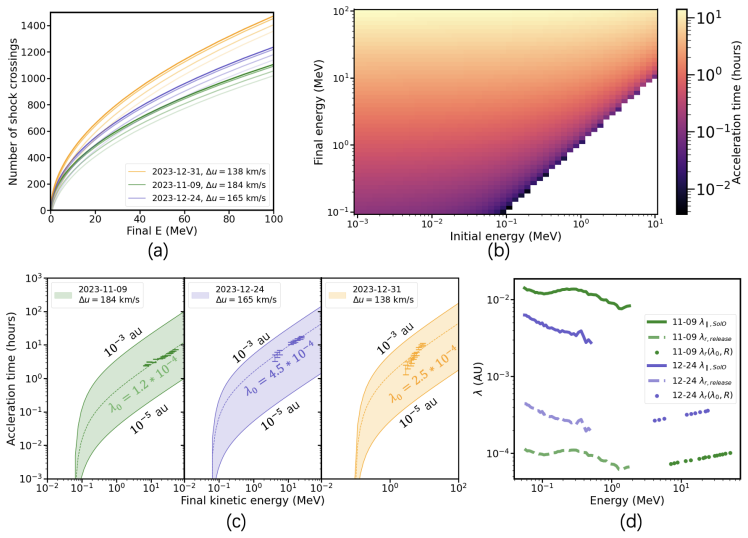
- [Section 3.1 and Fig. 3(c); Fig. 2(b)] The apparent agreement between the observation-derived release times and the DSA curve is a fit, not an independent prediction. The reference mean free path lambda_0 is not predicted a priori; it is fitted so that the theoretical acceleration time tau_a(E') matches the observation-derived t_release(E') markers in Fig. 3(c), and the same fitted lambda_0 is then used to draw the dotted curve in Fig. 2(b). Additionally, the compression ratio r used in Eq. (5) is derived from the observed IVD spectral index using the DSA formula itself, so the consistency between the observed spectrum and DSA is partly built in by construction. To support the central claim, the authors should show a test that does not use the IVD release times to determine the DSA parameters, for example by predicting the release-time slope from independently constrained shock parameters and transport conditions, or by reporting the goodness of fit of the DSA curve against a null model with no energy-dependent release.
- [Methods 4.2, onset-time determination] The IVD onset times are selected manually from the 2-d flux histograms, with the paper stating only that the process was 'repeated multiple times until the result is stabilised.' Because the derived t_release(E') and all subsequent DSA parameters depend linearly on these onsets, manual selection is a load-bearing part of the analysis. The manuscript should provide a quantitative reproducibility assessment: for example, independent selections by two or more observers, Monte Carlo perturbations of the chosen onset times within the 5-minute resolution, or comparison with an objective automated onset algorithm adapted to low count rates. Without this, it is difficult to judge whether the increasing release-time ordering in Fig. 2(b) is robust or partly an artifact of the selection procedure.
- [Section 3.1, Eqs. (4)-(6)] The inference of near-Sun shock parameters uses the in-situ upstream flow speed u_u measured at SolO after shock arrival, together with IVD spectral indices, to derive the compression ratio and downstream speed for shock distances of only 0.05-0.14 au. The paper acknowledges the assumption that shock properties and seed spectra do not evolve between these distances, but this assumption is central to the quantitative claims about acceleration times and mean free paths. A short assessment of how much the inferred lambda_0 values would change under plausible evolution of the compression ratio (for example, r varying between 1.3 and 2.0) would materially strengthen the paper and should be added.
minor comments (4)
- [Supplementary Section E, Fig. 9 caption and text] The text says 'In panel (b) we plot the 3-hour-integrated spectra' while the caption describes panel (b) as the release-time/path-length result and panel (c) as the spectra; this labeling should be corrected for consistency.
- [Section 4.2, text after Eq. (8)] There are several missing spaces and typos in the paragraph beginning 'With both trelease(E') and L(E') being variables,' including 'First, based on the initial properties' and the later 'withtheconsiderationthatthao' run-together words; the section needs a careful proofread.
- [Section 3.1, Eq. (6) and Fig. 3(d)] The definition of lambda_rr should be clarified: Eq. (6) and the following sentence introduce the radial mean free path lambda_rr and equate it to lambda_0 (R/R0)^(1/3), but later lambda_r is written as lambda_parallel cos^2 Psi and compared to lambda_rr. The relationship between the radial mean free path used in the acceleration-time formula and the parallel mean free path used in the ESP analysis should be stated more precisely.
- [Table 2, event 9] For the 2023-08-07 event, the table lists onset IVD duration 8 and associated source angle 83 degrees, but the supplementary text notes that the onset phase 'could not be determined using CUSUM or manual selection'; the table and the supplementary text should be reconciled so that readers know which entries are uncertain.
Circularity Check
The DSA 'agreement' is partly constructed: λ0 is fitted to the same release-time points that are then shown as matching the DSA curve, and r is derived from the observed spectrum through DSA.
-
fitted input called prediction
[Section 3.1, Fig. 3(c) analysis (paragraph beginning 'Type II radio bursts are signals...') and Fig. 2(b) caption.]
"Results of τa(E′) derived from two possible choices of τ0 are plotted as error bars in Fig. 3 (c) and the data can be fitted with a fixed λ0 (listed in Table 1) shown by the dashed lines. The theoretical release time (τ0 plus τa fitted from λ0) for the first event is also plotted in Figure 2(b) as the black-dotted curve which agrees nicely with the observation-derived release time (orange circles)."
In Eq. 6 the DSA acceleration time is proportional to λ0 through κrr = (v/3)λ0(R/R0)^(1/3). Fitting λ0 to the observation-derived trelease(E′) points and then displaying the 'theoretical release time ... fitted from λ0' as agreement means that the plotted curve is calibrated by the same data it is said to match; the match is a one-parameter fit, not an independent prediction. The shock parameters entering Eq. 6 (r and ud) are themselves obtained from the observed IVD spectral index via the DSA spectral relation (Eqs. 4-5), so the DSA model is constrained by the same event's spectrum and timing. The raw IVD observation remains independent, but the quantitative 'agreement' with DSA is partly constructed by the fit.
full rationale
The derivation is not globally circular. The 10-event IVD catalogue is an independent observational result, and the onset-time ordering is measured rather than generated by the model. The main circularity is localized to the DSA comparison: λ0 is fitted to the release-time data, and r is inferred from the spectral index through DSA, so the plotted DSA curve is a calibrated representation rather than a first-principles prediction. The Methods 4.2 path-length reduction L(E′) = L0 − R(trelease(E′)) is an unvalidated assumption whose failure could change the derived release-time ordering, but it is not circular: it is an external input from DBM remote-sensing modelling, not an output of the DSA calculation being tested. The self-citation to Ding et al. [52] is not load-bearing for the central derivation. Thus the paper has partial circularity in the quantitative DSA validation but retains independent observational content.
Assumptions & free parameters
free parameters (2)
- λ0 (reference mean free path at 1 GV near the shock) =
1.2e-4 au (2023-11-09), 4.5e-4 au (2023-12-24), 2.5e-4 au (2023-12-31)
- DBM drag parameter γ =
0.1e-7 km^-1 (with 50% uncertainty)
assumptions (4)
- domain assumption Standard DSA theory (Bell 1978, Drury 1983, Jones 1991) gives the accelerated spectrum f(p) ∝ p^-σ with σ=(r+2)/(r-1) and the mean acceleration time of Eq. 6.
- domain assumption The spectra of first-arriving particles represent the spectra close to the acceleration site (i.e., transport effects are small for the early particles).
- domain assumption Shock properties and seed particle spectra do not change over the distance from about 0.05 to 0.14 au.
- domain assumption IVD protons travel the same path length as VD protons minus the DBM-modeled shock distance at the release time (L(E′) = L0 − R(trelease(E′))).
Cite this review
Pith. "Pith review of Inverse Velocity Dispersion of Solar Energetic Protons Observed by Solar Orbiter and Its Shock Acceleration Explanation." pith.science (2026). https://pith.science/paper/UCF4VYKS
@misc{pith2026250700954,
  author       = {Pith},
  title        = {Pith review of: Inverse Velocity Dispersion of Solar Energetic Protons Observed by Solar Orbiter and Its Shock Acceleration Explanation},
  year         = {2026},
  howpublished = {\url{https://pith.science/paper/UCF4VYKS}},
  note         = {Machine review of arXiv:2507.00954}
}
read the original abstract
The particle acceleration and transport process during solar eruptions is one of the critical and long-standing problems in space plasma physics. Through decades of research, it is well accepted that particles with higher energies released during a solar eruption arrive at observers earlier than the particles with lower energies, forming a well-known structure in the dynamic energy spectrum called particle velocity dispersion (VD), as frequently observed by space missions. However, this picture is challenged by new observations from NASA's Parker Solar Probe and ESA's Solar Orbiter which show an unexpected inverse velocity dispersion (IVD) phenomenon, where particles with higher-energies arrive later at the observer. Facing on the challenge, we here report the recent discovery of such IVD structures with 10 solar energetic proton events observed by Solar Orbiter, and then analyze the mechanisms causing this unusual phenomenon. We suggest that shock diffusive acceleration, with respect to magnetic reconnection, is probably a dominant mechanism to accelerate protons to tens of MeV in such events where particles need longer time to reach higher energies. And we determine, innovatively, the physical conditions and time scales during the actual shock acceleration process that cannot be observed directly.
Figures


Figures from the paper (9 more)


Reference graph
Works this paper leans on
-
[1]
Donald V. Reames. The Two Sources of Solar Energetic Particles.Space Sci. Rev., 175(1-4):53–92, June 2013
work page 2013
-
[2]
Acceleration and Propagation of Solar Energetic Particles.Space Sci
Karl-Ludwig Klein and Silvia Dalla. Acceleration and Propagation of Solar Energetic Particles.Space Sci. Rev., 212(3-4):1107–1136, Novem- ber 2017
work page 2017
-
[3]
Bain, Christina Cohen, Silvia Dalla, Mateja Dumbovic, Miho Janvier, Insoo Jun, Janet Luhmann, Olga E
Jingnan Guo, Bingbing Wang, Kathryn Whitman, Christina Plainaki, Lingling Zhao, Hazel M. Bain, Christina Cohen, Silvia Dalla, Mateja Dumbovic, Miho Janvier, Insoo Jun, Janet Luhmann, Olga E. Ma- landraki, M. Leila Mays, Jamie S. Rankin, Linghua Wang, and Yihua Zheng. Particle Radiation Environment in the Heliosphere: Status, lim- itations and recommendati...
work page 2024
-
[4]
T. Laitinen, K. Huttunen-Heikinmaa, E. Valtonen, and S. Dalla. Cor- recting for Interplanetary Scattering in Velocity Dispersion analysis of Solar Energetic Particles.Astrophys. J., 806(1):114, June 2015
work page 2015
-
[5]
R. Gómez-Herrero, D. Pacheco, A. Kollhoff, F. Espinosa Lara, J. L. Freiherr von Forstner, N. Dresing, D. Lario, L. Balmaceda, V. Kru- par, O. E. Malandraki, A. Aran, R. Bučík, A. Klassen, K. L. Klein, I. Cernuda, S. Eldrum, H. Reid, J. G. Mitchell, G. M. Mason, G. C. Ho, J. Rodríguez-Pacheco, R. F. Wimmer-Schweingruber, B. Heber, L. Berger, R. C. Allen, N...
work page 2021
-
[6]
A. Kollhoff, A. Kouloumvakos, D. Lario, N. Dresing, R. Gómez-Herrero, L. Rodríguez-García, O. E. Malandraki, I. G. Richardson, A. Posner, K. L. Klein, D. Pacheco, A. Klassen, B. Heber, C. M. S. Cohen, T. Laiti- nen, I. Cernuda, S. Dalla, F. Espinosa Lara, R. Vainio, M. Köberle, 24 R. Kühl, Z. G. Xu, L. Berger, S. Eldrum, M. Brüdern, M. Laurenza, E. J. Kil...
work page 2020
-
[7]
Robert F. Wimmer-Schweingruber, Lars Berger, Alexander Kollhoff, Patrick Kühl, Bernd Heber, Liu Yang, Verena Heidrich-Meisner, Andreas Klassen, Raúl Gomez-Herrero, Javier Rodriguez-Pacheco, George C. Ho, Glenn M. Mason, Nils P. Janitzek, Athanasios Kouloum- vakos, Linghua Wang, Alexander Warmuth, David Lario, Fernando Car- caboso, Christopher J. Owen, Rad...
work page 2023
-
[8]
RamiVainio, EinoValtonen, BerndHeber, OlgaE.Malandraki, Athana- sios Papaioannou, Karl-Ludwig Klein, Alexander Afanasiev, Neus Agueda, Henry Aurass, Markus Battarbee, Stephan Braune, Wolfgang Dröge, Urs Ganse, Clarisse Hamadache, Daniel Heynderickx, Kalle Huttunen-Heikinmaa, Jürgen Kiener, Patrick Kilian, Andreas Kopp, Athanasios Kouloumvakos, Sami Maisal...
work page 1996
Show all 77 references
-
[9]
O. E. Malandraki, N. Agueda, A. Papaioannou, K. L. Klein, E. Val- tonen, B. Heber, W. Dröge, H. Aurass, A. Nindos, N. Vilmer, B. Sanahuja, A. Kouloumvakos, S. Braune, P. Preka-Papadema, K. Tziotziou, C. Hamadache, J. Kiener, V. Tatischeff, E. Riihonen, Y. Kartavykh, R. Rodrígu...
2005
-
[10]
Müller, O
D. Müller, O. C. St. Cyr, I. Zouganelis, H. R. Gilbert, R. Marsden, T. Nieves-Chinchilla, E. Antonucci, F. Auchère, D. Berghmans, T. S. Horbury, R. A. Howard, S. Krucker, M. Maksimovic, C. J. Owen, P. Rochus, J. Rodriguez-Pacheco, M. Romoli, S. K. Solanki, R. Bruno, M. Carlsso...
2020
-
[11]
A. Aran, D. Pacheco, M. Laurenza, N. Wijsen, D. Lario, S. Benella, I. G. Richardson, E. Samara, J. L. Freiherr von Forstner, B. Sanahuja, L. Ro- driguez, L. Balmaceda, F. Espinosa Lara, R. Gómez-Herrero, K. Stein- vall, A. Vecchio, V. Krupar, S. Poedts, R. C. Allen, G. B. Andr...
2020
-
[12]
Lario, N
D. Lario, N. Wijsen, R. Y. Kwon, B. Sánchez-Cano, I. G. Richard- son, D. Pacheco, E. Palmerio, M. L. Stevens, A. Szabo, D. Heyner, N. Dresing, R. Gómez-Herrero, F. Carcaboso, A. Aran, A. Afanasiev, 26 R. Vainio, E. Riihonen, S. Poedts, M. Brüden, Z. G. Xu, and A. Kollhoff. Inf...
2021
-
[13]
J., 934(1):55, July 2022
Astrophys. J., 934(1):55, July 2022
2022
-
[14]
L. Yang, V. Heidrich-Meisner, W. Wang, R. F. Wimmer-Schweingruber, L. Wang, A. Kollhoff, L. Berger, D. Pacheco, Z. Xu, J. Rodríguez- Pacheco, and G. C. Ho. Dynamic acceleration of energetic protons by an interplanetary collisionless shock. Astron. Astrophys., 686:A132, June 2024
2024
-
[15]
C. M. S. Cohen, R. A. Leske, E. R. Christian, A. C. Cummings, G. A. de Nolfo, M. I. Desai, J. Giacalone, M. E. Hill, A. W. Labrador, D. J. McComas, R. L. McNutt, R. A. Mewaldt, D. G. Mitchell, J. G. Mitchell, G. D. Muro, J. S. Rankin, N. A. Schwadron, T. Sharma, M. M. Shen, J....
2022
-
[16]
Kouloumvakos, N
A. Kouloumvakos, N. Wijsen, I. C. Jebaraj, A. Afanasiev, D. Lario, C. M. S. Cohen, P. Riley, D. G. Mitchell, Z. Ding, A. Vourlidas, J. Gi- acalone, X.Chen, andM.E.Hill. ShockandSEPModelingStudyforthe 5 September 2022 SEP Event.arXiv e-prints, page arXiv:2501.03066, January 2025
2022 arXiv
-
[17]
Rodríguez-Pacheco, R
J. Rodríguez-Pacheco, R. F. Wimmer-Schweingruber, G. M. Mason, G. C. Ho, S. Sánchez-Prieto, M. Prieto, C. Martín, H. Seifert, G. B. Andrews, S. R. Kulkarni, L. Panitzsch, S. Boden, S. I. Böttcher, I. Cer- nuda, R. Elftmann, F. Espinosa Lara, R. Gómez-Herrero, C. Terasa, J. Alm...
2020
-
[18]
R. F. Wimmer-Schweingruber, N. P. Janitzek, D. Pacheco, I. Cernuda, F. Espinosa Lara, R. Gómez-Herrero, G. M. Mason, R. C. Allen, Z. G. Xu, F. Carcaboso, A. Kollhoff, P. Kühl, J. L. Freiherr von Forstner, L. Berger, J. Rodriguez-Pacheco, G. C. Ho, G. B. Andrews, V. An- gelini,...
2021
-
[19]
M. L. Kaiser, T. A. Kucera, J. M. Davila, O. C. St. Cyr, M. Guhathakurta, and E. Christian. The STEREO Mission: An In- troduction. Space Sci. Rev., 136(1-4):5–16, April 2008
2008
-
[20]
Domingo, B
V. Domingo, B. Fleck, and A. I. Poland. The SOHO Mission: an Overview. Sol. Phys., 162:1–37, December 1995
1995
-
[21]
Interplanetary propagation behavior of the fast coronal mass ejection on 23 july 2012.Solar Phys., 290(3):919– 932, 2015
Manuela Temmer and NV Nitta. Interplanetary propagation behavior of the fast coronal mass ejection on 23 july 2012.Solar Phys., 290(3):919– 932, 2015
2012
-
[22]
Freiherr von Forstner, Daniel J
Jan Gieseler, Nina Dresing, Christian Palmroos, Johan L. Freiherr von Forstner, Daniel J. Price, Rami Vainio, Athanasios Kouloumvakos, Laura Rodríguez-García, Domenico Trotta, Vincent Génot, Arnaud Masson, Markus Roth, and Astrid Veronig. Solar-mach: An open-source 28 tool to ...
2023
-
[23]
Particle acceleration at the Sun and in the helio- sphere
Donald V Reames. Particle acceleration at the Sun and in the helio- sphere. Space Sci. Rev., 90:413–491, October 1999
1999
-
[24]
A. J. Prise, L. K. Harra, S. A. Matthews, D. M. Long, and A. D. Aylward. An Investigation of the CME of 3 November 2011 and Its Associated Widespread Solar Energetic Particle Event. Sol. Phys., 289(5):1731–1744, May 2014
2011
-
[25]
J. R. Jokipii. Cosmic-Ray Propagation. I. Charged Particles in a Ran- dom Magnetic Field.Astrophys. J., 146:480, November 1966
1966
-
[26]
J. C. Kasper, S. D. Bale, J. W. Belcher, M. Berthomier, A. W. Case, B. D. G. Chandran, D. W. Curtis, D. Gallagher, S. P. Gary, K. Goetz, J. S. Halekas, and et al. Alfvénic velocity spikes and rotational flows in the near-sun solar wind.Nature, 576:228–231, 2019
2019
-
[27]
Alejandro Sáiz, Paul Evenson, David Ruffolo, and John W. Bieber. On the Estimation of Solar Energetic Particle Injection Timing from Onset Times near Earth.Astrophys. J., 626(2):1131–1137, June 2005
2005
-
[28]
Gen Li and Martin A Lee. Scatter-dominated interplanetary transport of solar energetic particles in large gradual events and the formation of double power-law differential fluence spectra of ground-level events during solar cycle 23.Astrophys. J., 810(1):82–96, 2015
2015
-
[29]
Statistical study of the peak and flu- ence spectra of solar energetic particles observed over four solar cycles
Yubao Wang and Jingnan Guo. Statistical study of the peak and flu- ence spectra of solar energetic particles observed over four solar cycles. Astron. Astrophys., 691:A54, November 2024
2024
-
[30]
G. M. Mason and G. Gloeckler. Power Law Distributions of Suprather- mal Ions in the Quiet Solar Wind.Space Sci. Rev., 172(1-4):241–251, November 2012
2012
-
[31]
SHOCKGEOMETRYANDSPECTRAL BREAKS IN LARGE SEP EVENTS
G.Li, G.P.Zank, OlgaVerkhoglyadova, R.A.Mewaldt, C.M.S.Cohen, G.M.Mason, andM.I.Desai. SHOCKGEOMETRYANDSPECTRAL BREAKS IN LARGE SEP EVENTS. 702(2):998–1004. 29
-
[32]
M. I. Desai, G. M. Mason, M. A. Dayeh, R. W. Ebert, M. A. Lee, C. M. S. Cohen, et al. Spectral properties of large gradual solar energetic particle events—i. event-to-event variations.The Astrophysical Journal, 828(2):106, 2016
2016
-
[33]
Vainio.Diffusive Shock Acceleration
R. Vainio.Diffusive Shock Acceleration. Obserwatorium Astronomiczne, Uniwersytet Jagielloński, Kraków, Poland, 1999. Proceedings of the International Conference, Cracow (Poland), 5–10 September 1999
1999
-
[34]
An introduction to the theory of diffusive shock acceler- ation of energetic particles in tenuous plasmas.Reports on Progress in Physics, 46(8):973–1027, August 1983
L O’C Drury. An introduction to the theory of diffusive shock acceler- ation of energetic particles in tenuous plasmas.Reports on Progress in Physics, 46(8):973–1027, August 1983
1983
-
[35]
A. R. Bell. The acceleration of cosmic rays in shock fronts - I.Mon. Not. R. Astron. Soc., 182:147–156, January 1978
1978
-
[36]
The plasma physics of shock acceleration
Frank C Jones. The plasma physics of shock acceleration. 1991
1991
-
[37]
Ellison, Frank C
Donald C. Ellison, Frank C. Jones, and Stephen P. Reynolds. First- Order Fermi Particle Acceleration by Relativistic Shocks.Astrophys. J., 360:702, September 1990
1990
-
[38]
P. L. Prinsloo, R. D. Strauss, and J. A. Le Roux. Acceleration of So- lar Wind Particles by Traveling Interplanetary Shocks.Astrophys. J., 878(2):144, June 2019
2019
-
[39]
Gang Li, G. P. Zank, and W. K. M. Rice. Acceleration and transport of heavy ions at coronal mass ejection-driven shocks.Journal of Geophys- ical Research: Space Physics, 110(A6):2004JA010600, June 2005
2005
-
[40]
J. R. Jokipii. Particle acceleration at a termination shock 1. Application to the solar wind and the anomalous component. J. Geophys. Res.: Space Phys., 91(A3):2929–2932, March 1986
1986
-
[41]
Donald V. Reames. Solar Energetic Particles: A Modern Primer on Understanding Sources, Acceleration and Propagation. Lecture Notes in Physics. Springer Cham, 2 edition, 3 2021
2021
-
[42]
Li and G
G. Li and G. P. Zank. Mixed particle acceleration at CME-driven shocks and flares. Geophys. Res. Lett., 32(2):L02101, January 2005. 30
2005
-
[43]
Beeck and T
J. Beeck and T. R. Sanderson. Mean free path of low-energy protons upstream of selected interplanetary shocks.Journal of Geophysical Re- search: Space Physics, 94(A7):8769–8781, July 1989
1989
-
[44]
Solar modulation of cosmic proton and helium with AMS-02.Phys
Bing-Bing Wang, Xiao-Jun Bi, Kun Fang, Su-Jie Lin, and Peng-Fei Yin. Solar modulation of cosmic proton and helium with AMS-02.Phys. Rev. D, 106(6):063006, September 2022
2022
-
[45]
Xiaohang Chen, Joe Giacalone, Fan Guo, and Kristopher G. Klein. Par- allel diffusion coefficient of energetic charged particles in the inner he- liosphere from the turbulent magnetic fields measured by parker solar probe. Astrophys. J., 965(1):61, April 2024
2024
-
[46]
Giacalone, J
J. Giacalone, J. R. Jokipii, and J. Kóta. Particle acceleration in solar wind compression regions. The Astrophysical Journal, 573(2):845–850, 2002
2002
-
[47]
Giacalone, J
J. Giacalone, J. R. Jokipii, and J. Kóta. Particle acceleration in so- lar wind compression regions. In The Physics of Collisionless Shocks: Space Plasma Shock Waves, volume 156 ofGeophysical Monograph Se- ries, pages 41–54. American Geophysical Union, 2005
2005
-
[48]
O.Malandraki, C.M.S.Cohen, J.Giacalone, J.G.Mitchell, R.Chhiber, D. J. McComas, J. Rodríguez-Pacheco, R. Wimmer-Schweingruber, G. C. Ho, N. Janitzek, and M. Desai. Unexpected energetic particle ob- servations near the sun by parker solar probe and solar orbiter.Physics of Plas...
2023
-
[49]
A. M. Heras, B. Sanahuja, D. Lario, Z. K. Smith, T. Detman, and M. Dryer. Three Low-Energy Particle Events: Modeling the Influence of the Parent Interplanetary Shock.Astrophys. J., 445:497, May 1995
1995
-
[50]
Modelling large solar proton events with the shock-and-particle model
Jens Pomoell, Angels Aran, Carla Jacobs, Rosa Rodríguez-Gasén, Ste- faan Poedts, and Blai Sanahuja. Modelling large solar proton events with the shock-and-particle model. Extraction of the characteristics of the MHD shock front at the cobpoint.Journal of Space Weather and Spac...
2015
-
[51]
Nitta, and Christina M
Meng Jin, Nariaki V. Nitta, and Christina M. S. Cohen. Assessing the Influence of Input Magnetic Maps on Global Modeling of the Solar Wind 31 and CME-Driven Shock in the 2013 April 11 Event. Space Weather, 20(3):e2021SW002894, March 2022
2013
-
[52]
Bruno, G
Gang Li, Meng Jin, Zheyi Ding, A. Bruno, G. A. de Nolfo, B. M. Randol, L. Mays, J. Ryan, and D. Lario. Modeling the 2012 May 17 Solar Ener- getic Particle Event Using the AWSoM and iPATH Models.Astrophys. J., 919(2):146, October 2021
2012
-
[53]
Zheyi Ding, R. F. Wimmer-Schweingruber, A. Kollhoff, P. Kühl, L. Yang, L. Berger, A. Kouloumvakos, N. Wijsen, J. Guo, D. Pacheco, Y. Li, M. Temmer, J. Rodriguez-Pacheco, R. C. Allen, G. C. Ho, G. M. Mason, Z. Xu, and S. Gunaseelan. Investigation of the inverse velocity dispers...
2025 arXiv
-
[54]
Farrugia, Reka M
Noé Lugaz, Charles J. Farrugia, Reka M. Winslow, Colin R. Small, Thomas Manion, and Neel P. Savani. Importance of CME Radial Ex- pansion on the Ability of Slow CMEs to Drive Shocks.Astrophys. J., 848(2):75, October 2017
2017
-
[55]
Particle acceleration at a pair of parallel shocks near the Sun.Journal of Geophysical Research: Space Physics, 119(8):6106–6119, August 2014
Lulu Zhao and Gang Li. Particle acceleration at a pair of parallel shocks near the Sun.Journal of Geophysical Research: Space Physics, 119(8):6106–6119, August 2014
2014
-
[56]
On the origin of impulsive electron events observed at 1 au.Astrophys
Säm Krucker, Davin E Larson, Robert P Lin, and Barbara J Thompson. On the origin of impulsive electron events observed at 1 au.Astrophys. J., 519(2):864–875, 1999
1999
-
[57]
First Solar energetic par- ticles measured on the Lunar far-side.Astrophys
Zigong Xu, Jingnan Guo, Robert F Wimmer-Schweingruber, Johan L Freiherr von Forstner, Yuming Wang, Nina Dresing, Henning Lohf, Shenyi Zhang, Bernd Heber, and Mei Yang. First Solar energetic par- ticles measured on the Lunar far-side.Astrophys. J. Lett., 902(2):L30, 2020
2020
-
[58]
Huttunen-Heikinmaa, E
K. Huttunen-Heikinmaa, E. Valtonen, and T. Laitinen. Proton and heliumreleasetimesinSEPeventsobservedwithSOHO/ERNE. Astron. Astrophys., 442(2):673–685, November 2005
2005
-
[59]
Vršnak, T
B. Vršnak, T. Žic, D. Vrbanec, M. Temmer, T. Rollett, C. Möstl, A. Veronig, J. Čalogović, M. Dumbović, S. Lulić, Y. J. Moon, and 32 A. Shanmugaraju. Propagation of Interplanetary Coronal Mass Ejec- tions: The Drag-Based Model.Sol. Phys., 285(1-2):295–315, July 2013
2013
-
[60]
B.Vršnak, M.Temmer, T.Žic, A.Taktakishvili, M.Dumbović, C.Möstl, A. M. Veronig, M. L. Mays, and D. Odstrčil. Heliospheric Propa- gation of Coronal Mass Ejections: Comparison of Numerical WSA- ENLIL+Cone Model and Analytical Drag-based Model.Astrophys. J. Suppl., 213(2):21, August 2014
2014
-
[61]
Drag-Based Model (DBM) Tools for Forecast of Coronal Mass Ejection Arrival Time and Speed
Mateja Dumbović, Jaša Čalogović, Karmen Martinić, Bojan Vršnak, Davor Sudar, Manuela Temmer, and Astrid Veronig. Drag-Based Model (DBM) Tools for Forecast of Coronal Mass Ejection Arrival Time and Speed. Frontiers in Astronomy and Space Sciences, 8:58, May 2021
2021
-
[62]
GOES I-M Databook, Revision 1
Space-Systems-Loral, editor. GOES I-M Databook, Revision 1. 1996
1996
-
[63]
Lemen, Alan M
James R. Lemen, Alan M. Title, David J. Akin, Paul F. Boerner, Catherine Chou, Jerry F. Drake, Dexter W. Duncan, Christopher G. Edwards, Frank M. Friedlaender, Gary F. Heyman, Neal E. Hurl- burt, Noah L. Katz, Gary D. Kushner, Michael Levay, Russell W. Lindgren, Dnyanesh P. Ma...
2012
-
[64]
Dean Pesnell, B
W. Dean Pesnell, B. J. Thompson, and P. C. Chamberlin. The Solar Dynamics Observatory (SDO).Sol. Phys., 275(1-2):3–15, January 2012
2012
-
[65]
Säm Krucker, G. J. Hurford, O. Grimm, S. Kögl, H. P. Gröbelbauer, L. Etesi, D. Casadei, A. Csillaghy, A. O. Benz, N. G. Arnold, F. Molen- dini, P. Orleanski, D. Schori, H. Xiao, M. Kuhar, N. Hochmuth, S. Fe- lix, F. Schramka, S. Marcin, S. Kobler, L. Iseli, M. Dreier, H. J. Wi...
2020
-
[66]
G. E. Brueckner, R. A. Howard, M. J. Koomen, C. M. Korendyke, D. J. Michels, J. D. Moses, D. G. Socker, K. P. Dere, P. L. Lamy, A. Llebaria, M. V. Bout, R. Schwenn, G. M. Simnett, D. K. Bedford, and C. J. Eyles. The large angle spectroscopic coronagraph (lasco). Sol. Phys., 16...
1995
-
[67]
R. A. Howard, J. D. Moses, A. Vourlidas, J. S. Newmark, D. G. Socker, S. P. Plunkett, C. M. Korendyke, J. W. Cook, A. Hurley, J. M. Davila, W. T. Thompson, O. C. St Cyr, E. Mentzell, K. Mehalick, J. R. Lemen, J. P. Wuelser, D. W. Duncan, T. D. Tarbell, C. J. Wolfson, A. Moore,...
2008
-
[68]
A. F. R. Thernisien, R. A. Howard, and A. Vourlidas. Modeling of Flux Rope Coronal Mass Ejections.Astrophys. J., 652(1):763–773, November 2006
2006
-
[69]
J. L. Bougeret, M. L. Kaiser, P. J. Kellogg, R. Manning, K. Goetz, S. J. Monson, N. Monge, L. Friel, C. A. Meetre, C. Perche, L. Sitruk, and 34 S. Hoang. Waves: The Radio and Plasma Wave Investigation on the Wind Spacecraft. Space Sci. Rev., 71(1-4):231–263, February 1995
1995
-
[70]
Maksimovic, S
M. Maksimovic, S. D. Bale, T. Chust, Y. Khotyaintsev, V. Kras- noselskikh, M. Kretzschmar, D. Plettemeier, H. O. Rucker, J. Souček, M. Steller, Š. Štverák, P. Trávníček, A. Vaivads, S. Chaintreuil, M. Dekkali, O. Alexandrova, P. A. Astier, G. Barbary, D. Bérard, X. Bonnin, K. ...
2020
-
[71]
C. J. Owen, R. Bruno, S. Livi, P. Louarn, K. Al Janabi, F. Alle- grini, C. Amoros, R. Baruah, A. Barthe, M. Berthomier, S. Bordon, C. Brockley-Blatt, C. Brysbaert, G. Capuano, M. Collier, R. DeMarco, A. Fedorov, J. Ford, V. Fortunato, I. Fratter, A. B. Galvin, B. Hancock, D. H...
2020
-
[72]
T. S. Horbury, H. O’Brien, I. Carrasco Blazquez, M. Bendyk, P. Brown, R. Hudson, V. Evans, T. M. Oddy, C. M. Carr, T. J. Beek, E. Cu- pido, S. Bhattacharya, J. A. Dominguez, L. Matthews, V. R. Mykle- bust, B. Whiteside, S. D. Bale, W. Baumjohann, D. Burgess, V. Car- bone, P. C...
2020
-
[73]
Forstner
Johan L. Forstner. Gcs in python, July 2024
2024
-
[74]
Leila Mays, Astrid Veronig, and Isabell Piantschitsch
Mateja Dumbović, Jaša Čalogović, Bojan Vršnak, Manuela Temmer, M. Leila Mays, Astrid Veronig, and Isabell Piantschitsch. The Drag- based EnsembleModel(DBEM) for CoronalMass Ejection Propagation. The Astrophysical Journal, 854(2):180, February 2018
2018
-
[75]
Wimmer-Schweingruber, Manuela Temmer, Henning Lohf, Yuming Wang, Astrid Veronig, Don- ald M
Jingnan Guo, Mateja Dumbović, Robert F. Wimmer-Schweingruber, Manuela Temmer, Henning Lohf, Yuming Wang, Astrid Veronig, Don- ald M. Hassler, Leila M. Mays, Cary Zeitlin, Bent Ehresmann, Olivier Witasse, Johan L. Freiherr Von Forstner, Bernd Heber, Mats Holm- ström, and Arik P...
2017
-
[76]
Statistical survey of widely spread out solar electron events observed with stereo and ace with special attention to anisotropies
N Dresing, R Gómez-Herrero, B Heber, A Klassen, O Malandraki, W Dröge, and Y Kartavykh. Statistical survey of widely spread out solar electron events observed with stereo and ace with special attention to anisotropies. Astron. & Astrophys., 567:A27, 2014
2014
-
[77]
E. C. Roelof, R. E. Gold, G. M. Simnett, S. J. Tappin, T. P. Armstrong, and L. J. Lanzerotti. Low-energy solar electrons and ions observed at ulysses february-april, 1991: The inner heliosphere as a particle reser- voir. Geophysical Research Letters, 19(12):1243–1246, 1992. 37...
1991
Reviewed August 6, 2026 · model on record in the stance chip above.
Discussion (0). Continue with ORCID to comment.