REVIEW 3 major objections 4 minor 219 references
Quantum Computing in Discrete- and Continuous-Variable Architectures
T0 review · 3 major / 4 minor · reviewed 2026-08-06 · deepseek-v4-flash
Pith's one-line read This thesis establishes a non-abelian composite pulse, the Gaussian-Controlled-Rotation, that cancels oscillator quantum-fluctuation errors in 4.5 times fewer gates than the standard BB1 pulse and makes deterministic, optimizer-free…
desk verdict Solid GCR pulse analysis; the state-preparation claims overstate how optimizer-free they are. read the letter →
The pith
A machine-rendered reading of the paper's core claim, the machinery that carries it, and where it could break.
The reading
What carries the argument
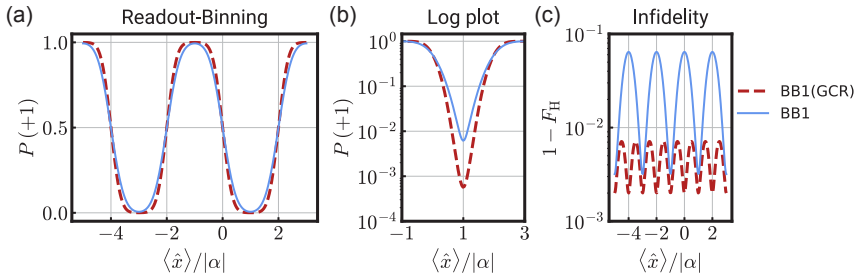
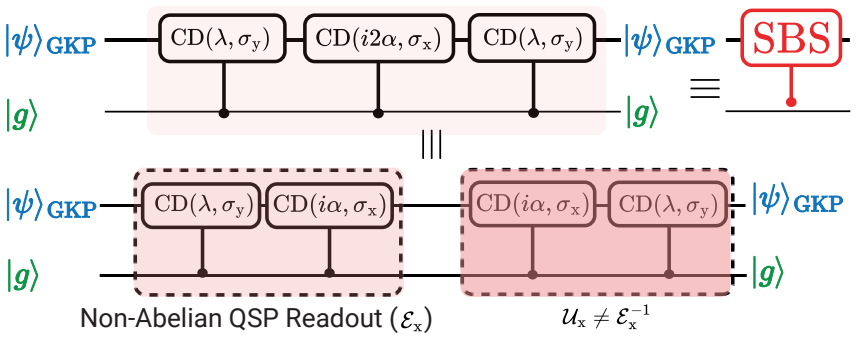
The core object is the Gaussian-Controlled-Rotation composite pulse, GCR($\theta$), built from two conditional displacements whose control parameters are the non-commuting oscillator operators $\hat{x}$ and $\hat{p}$. The mechanism is a pre-correction: the momentum-controlled rotation $R_{\pi/2}(-\theta\Delta^2\hat{p}/|\alpha|)$ acts like a rotation about $\hat{x}$ with angle proportional to $\hat{x}-\alpha$, exactly canceling the first-order error of the position-controlled rotation, provided the ancilla qubit starts in $|g\rangle$. The error parameter is $\chi = \theta\Delta/2|\alpha|$, and the whole argument maps the composite pulse onto a flat-top square-wave response in phase space, giving the error scalings $P_e \sim 0.1\chi^6$ and $1-F_H \sim \chi^4/8$.
What would settle it
Run GCR($\theta$) on a squeezed coherent state with the ancilla prepared in $|e\rangle$ rather than $|g\rangle$; if the failure probability and target-rotation fidelity remain at the claimed $\chi^6$ and $\chi^4$ levels, the stated $|g\rangle$ precondition is not load-bearing.
Extended reading notes
Core claim
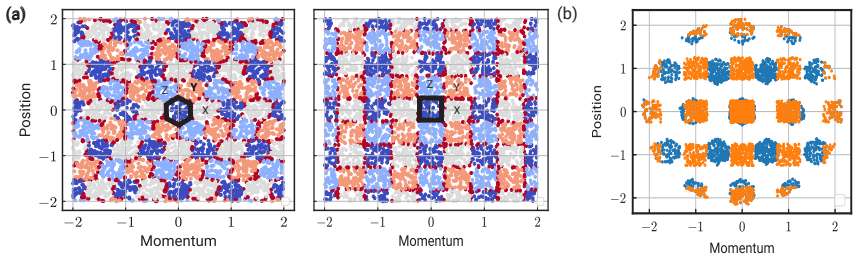
The central claim is that Gaussian-Controlled-Rotation, defined as GCR($\theta$) = $R_0(-\theta \hat{x}/|\alpha|)\, R_{\pi/2}(-\theta\Delta^2 \hat{p}/|\alpha|)$, acts as a non-abelian composite pulse: applied to $|g\rangle |\alpha_\Delta\rangle$ it produces the target rotation $R_0(-\theta\alpha/|\alpha|)$ with failure probability $P_e \sim 0.1\chi^6$ and hybrid infidelity $1-F_H \sim \chi^4/8$, where $\chi = \theta\Delta/2|\alpha|$. The proof rests on the identity $\sigma_y|g\rangle = i\sigma_x|g\rangle$, which turns a momentum-controlled pre-rotation into a first-order correction of position-uncertainty errors. The thesis further claims this sequence enables deterministic, numerically-optimizer-free preparation of squeezed states, two- and four-legged cat states, and GKP states with fidelity comparable to the best numerical methods, and that the same non-abelian framework yields an analytical account of photon-loss correction in finite-energy GKP codes through a newly defined 'probabilistic distance.'
Load-bearing premise
The error cancellation works only when the ancilla qubit starts in the $|g\rangle$ eigenstate of $\sigma_z$, because the pre-correction relies on $\sigma_y|g\rangle = i\sigma_x|g\rangle$; any initialization error, leakage, or pre-rotation of the ancilla breaks the cancellation.
Editorial extensions
If this is right
- Deterministic preparation of squeezed, cat, and GKP states becomes possible without numerical optimization, reducing classical processing and control hardware requirements.
- GCR-based readout and error-corrected gate teleportation can achieve high fidelity for GKP qubits even with residual oscillator errors, provided the ancilla bias assumptions hold.
- The probabilistic-distance analysis offers an analytical explanation of how recent beyond-break-even GKP experiments correct photon loss, and extends to square and hexagonal lattices and qudit encodings.
- The non-abelian QSP framework generalizes toward non-abelian quantum singular value transformation, potentially unifying hybrid CV-DV algorithms in the same way QSVT unifies qubit algorithms.
- Multi-mode extensions of GCR supply efficient entangling gates and error-corrected two-qubit rotations for GKP-based fault-tolerant architectures.
Reading between the lines
- The explicit dependence on the initial $|g\rangle$ ancilla state suggests a direct experimental test: preparing the ancilla in $|e\rangle$ or a superposition should break the error cancellation, and verifying this would confirm the claimed mechanism rather than a generic pulse-sequencing effect.
- The same pre-correction idea could be ported to other non-commuting pairs of control operators, such as number and phase, to design composite pulses for states that are not Gaussian superpositions.
- The probabilistic-distance metric could be applied to other bosonic codes, such as binomial or cat codes, to compare their photon-loss correction performance on a common footing.
- Because GCR preparation is deterministic yet allows a herald of ancilla errors, the protocols could be inserted into mid-circuit error-detection schedules without a numerical re-optimization of the whole circuit.
Editorial analysis
A structured set of objections, weighed in public.
Referee Report
Summary. This dissertation develops a framework for hybrid discrete-variable (DV) and continuous-variable (CV) quantum control, centered on 'non-abelian quantum signal processing' (NA-QSP). The central technical object is the Gaussian-Controlled-Rotation (GCR), a two-pulse non-abelian composite sequence that approximates a qubit rotation whose sign is set by the mean oscillator position, with failure probability Pe ~ 0.1 chi^6 and hybrid infidelity 1-FH ~ chi^4/8, and with a claimed circuit-duration advantage of at least 4.5x over the commuting-variable BB1(90) sequence (Secs. 3.2, 3.3, Eqs. 3.15, 3.29-3.33). The thesis applies GCR to deterministic preparation of squeezed, cat, and GKP states (Ch. 4), introduces a Gaussian hierarchy classification of CV operations (Sec. 2.3), develops a probabilistic error-correction framework for photon loss in finite-energy GKP codes (Ch. 5), and discusses error-corrected control of GKP qudits (Ch. 6).
Significance. If the central GCR analysis is correct, it is a genuinely useful analytical primitive: it gives explicit, checkable error scalings for a hybrid CV-DV gate, it is confirmed by QuTiP numerics in the present manuscript, and the analytical structure of the circuit is better suited to error tracking and generalization to qudits than purely numerical pulses. The proposed Gaussian hierarchy is a stimulating open-problem framework, even if much of it remains conjectural. The probabilistic-distance analysis of photon-loss correction also provides a concrete analytical lens on recent beyond-break-even GKP experiments. These strengths justify publication after revision, provided the load-bearing claim of 'preparation without numerical optimization' is made precise.
major comments (3)
- [Sec. 4.1 and App. C.1] The abstract and Ch. 4 claim deterministic preparation of squeezed, cat, and GKP states 'without numerical optimization,' but Sec. 4.1 explicitly states that the correction parameter alpha_k/Delta_k^2 for each squeezing round must be obtained by approximating the state as Gaussian, and later states that the corrections to the linear slope 4 alpha/Delta^2 are 'approximated numerically (see App. C.1).' The convergence, fidelity, and circuit-duration results in Fig. 4.1(c)-(e) depend on this numerically fitted schedule, and the GKP protocol of Sec. 4.3 starts from the squeezed state prepared in Sec. 4.1, so the numerical dependence propagates to the headline GKP preparation result. This contradicts the unqualified claim in the abstract. Please either provide an analytic schedule for alpha_k as a function of Delta_k, or clearly qualify the claim (for example, 'no numerical state-by-state optimizer, though the squeezing schedule uses a Gaussian-fit approximation') and state that qualification in the abstract and protocol statements.
- [Sec. 2.3, near Eqs. (2.90)-(2.96)] The text concludes that 'for GKP encoding, C_n subset of G_n for n >= 4,' but the argument given does not establish this containment. The example shows that a gate sqrt(H) in G4 lies outside the union of Clifford hierarchy levels, which proves G4 is not contained in C4 but does not prove that every Clifford-hierarchy-4 gate lies in G4. The recursive conjugacy-set argument also appears only to track a finite set of generated gates, not to characterize the full Clifford hierarchy. Since this section is explicitly framed as an open problem, the claim should be weakened to a conjecture unless a full proof is supplied.
- [Sec. 3.2.1, Eq. (3.23)] The error-cancellation mechanism of GCR relies on the identity sigma_y|g> = i sigma_x|g>, which holds only when the ancilla qubit begins in the sigma_z eigenstate |g>. The text states this condition explicitly, which is good, but the protocols in Ch. 4 that use GCR as a pre-correction inherit this sensitivity without an error analysis. A small initial admixture of |e> will generically produce a first-order error in the correction parameter lambda, potentially spoiling the chi^4/chi^6 scalings. This does not invalidate the derivation, but the practical claim of deterministic, high-fidelity preparation should include an explicit sensitivity estimate or a stated assumption that ancilla initialization errors are negligible.
minor comments (4)
- [Fig. 4.2 caption] The caption contains the typo 'cat ctates'; this should read 'cat states.'
- [Fig. 7.3 caption] The caption contains the typo 'succcess probability'; this should be corrected to 'success probability.'
- [Fig. 5.6 caption] The caption contains the typo 'V oronoi cells'; the spacing should be corrected to 'Voronoi cells.'
- [Sec. 4.1, Fig. 4.1(d)-(e)] The figure and text report a specific Fisher information (F=53.5) and infidelity (0.008) for the faster protocol, but it is not immediately clear from the figure whether these values correspond to post-selected or non-post-selected results; adding a note in the caption would improve reproducibility.
Circularity Check
No significant circularity; the GCR derivation is self-contained and benchmarked externally, but the 'without numerical optimization' wording is unsupported by the numerically approximated squeezing schedule.
full rationale
The central GCR result is derived rather than assumed. In Sec. 3.2.1, the pre-rotation is explicitly constructed with lambda = theta*Delta^2/|alpha| so that the momentum-controlled rotation converts to a first-order position correction on |g> (Eq. 3.24), and Sec. 3.2.2 computes P_e ~ 0.1 chi^6 and 1 - F_H ~ chi^4/8 from Hermite expansions (Eqs. 3.29-3.32), with numerical verification in Fig. 3.2. The target rotation R_0(-theta*alpha/|alpha|) is not inserted as an input; it is the ideal limit of the constructed gate. The circuit-depth comparison with BB1(90) (Eq. 3.33) is arithmetic on conditional-displacement amplitudes, not a fitted result. State preparation benchmarks are made against external numerical schemes (Refs. [5,116]) and against the classical BB1 pulse, so the central claims have independent content. Self-citations to Refs. [1,2,31] appear frequently, but the thesis itself contains the relevant derivations, so these citations are not load-bearing circularity. The |g>-initialization condition is a stated precondition, not a hidden circular input. The main caveat is that Sec. 4.1 states that the squeezing schedule alpha_k/Delta_k^2 'can be computed using various approximations/numerical methods' and later says 'we approximate corrections to the linear slope 4*alpha/Delta^2 numerically,' which conflicts with the abstract's claim of preparation 'without numerical optimization' and propagates to the GKP protocol that starts from that squeezed state. This is an overclaim about analyticity of the method, not a circular reduction: the Chapter 3 error-cancellation proof does not assume the squeezing results or the target fidelities. Score 2 reflects the minor, non-load-bearing self-citations and the unsupported optimizer-free wording, with no genuine circular step identified.
Assumptions & free parameters
free parameters (2)
- Squeezing schedule exponents a and c =
a in {0.06, 0.13, 0.27}, c in [-3, 0] or c = 2
- Finite-energy GKP envelope parameter Δ =
0.34 for the GKP preparation benchmarks
assumptions (5)
- domain assumption Ancilla qubit starts in |g>, an eigenstate of σ_z, for the GCR pre-correction to convert a σ_y rotation into a σ_x rotation.
- domain assumption Oscillator states are Gaussian wave functions with known position uncertainty Δ, so rotation errors from quantum fluctuations are linear in (x-α) to first order.
- domain assumption The phase-space instruction set (conditional displacements CD and qubit rotations R) is the available universal gate set.
- ad hoc to paper The Gaussian hierarchy definition G_n = {U | [H(D), H(U)] = H(U') ⇒ U' in G_{n-1}} is a valid classification analog of the Clifford hierarchy.
- domain assumption Photon loss can be analyzed through finite-energy GKP error spaces and a probabilistic distance.
Cite this review
Pith. "Pith review of Quantum Computing in Discrete- and Continuous-Variable Architectures." pith.science (2026). https://pith.science/paper/P7P4YJYQ
@misc{pith2026250701146,
  author       = {Pith},
  title        = {Pith review of: Quantum Computing in Discrete- and Continuous-Variable Architectures},
  year         = {2026},
  howpublished = {\url{https://pith.science/paper/P7P4YJYQ}},
  note         = {Machine review of arXiv:2507.01146}
}
read the original abstract
This thesis develops a theoretical framework for hybrid continuous-variable (CV) and discrete-variable (DV) quantum systems, with emphasis on quantum control, state preparation, and error correction. A central contribution is non-abelian quantum signal processing (NA-QSP), a generalization of quantum signal processing to settings where control parameters are non-commuting operators. Within this framework, we introduce the Gaussian-Controlled-Rotation (GCR) protocol, which enables high-fidelity control of CV states using DV ancillae. This approach allows for deterministic preparation of squeezed, cat, and Gottesman-Kitaev-Preskill (GKP) states without numerical optimization. Two previously unpublished contributions are included: (i) Chapter 2.3 introduces the Gaussian hierarchy, a classification of CV operations analogous to the Clifford hierarchy, offering a new lens for understanding CV gate sets; (ii) Chapter 5 presents an analytical framework for correcting photon loss in finite-energy GKP codes, introducing the notion of probabilistic error correction, providing insight into recent GKP experiments surpassing break-even thresholds. Overall, this work lays the groundwork for scalable, fault-tolerant quantum computation in hybrid CV-DV architectures, with applications to logical gate synthesis, readout, and hybrid algorithm design using ancilla oscillators.
Figures


Figures from the paper (26 more)









Reference graph
Works this paper leans on
- [1]
-
[2]
Singh, S
S. Singh, S. Girvin, B. Royer, Error correction of photon loss using GKP states, In preparation (2024). 2, 6
2024
-
[3]
V . V . Sivak, A. Eickbusch, B. Royer, S. Singh, I. Tsioutsios, S. Ganjam, A. Miano, B. L. Brock, A. Z. Ding, L. Frunzio, S. M. Girvin, R. J. Schoelkopf, M. H. Devoret, Real-time quantum error correction beyond break-even, Nature 616 (7955) (2023) 50–55, publisher: Nature Publishing Group. URL https://www.nature.com/articles/s41586-023-05782-6 2, 4, 6, 7,...
2023
-
[4]
B. L. Brock, S. Singh, A. Eickbusch, V . V . Sivak, A. Z. Ding, L. Frunzio, S. M. Girvin, M. H. Devoret, Quantum Error Correction of Qudits Beyond Break-even, arXiv:2409.15065 [quant-ph] (Oct. 2024). URL http://arxiv.org/abs/2409.15065 2, 3, 6, 7, 48, 114, 115, 116, 118, 121, 133, 138, 163, 185, 192, 195, 199
arXiv 2024
-
[5]
Eickbusch, V
A. Eickbusch, V . Sivak, A. Z. Ding, S. S. Elder, S. R. Jha, J. Venkatraman, B. Royer, S. M. Girvin, R. J. Schoelkopf, M. H. Devoret, Fast universal control of an oscillator with weak dispersive coupling to a qubit, Nature Physics 18 (12) (2022) 1464–1469, publisher: Nature Publishing Group. URL https://www.nature.com/articles/s41567-022-01776-9 xiv, 7, 1...
2022
-
[6]
A. Blais, R.-S. Huang, A. Wallraff, S. M. Girvin, R. J. Schoelkopf, Cavity quantum electrodynamics for superconducting electrical circuits: An architecture for quan- tum computation, Physical Review A 69 (6) (2004) 062320, publisher: American 255 Physical Society. URL https://link.aps.org/doi/10.1103/PhysRevA.69.062320 1
-
[7]
Blais, S
A. Blais, S. M. Girvin, W. D. Oliver, Quantum information processing and quantum optics with circuit quantum electrodynamics, Nature Physics 16 (3) (2020) 247– 256, publisher: Nature Publishing Group. URL https://www.nature.com/articles/s41567-020-0806-z 1
2020
-
[8]
A. Blais, A. L. Grimsmo, S. Girvin, A. Wallraff, Circuit quantum electrodynamics, Reviews of Modern Physics 93 (2) (2021) 025005, publisher: American Physical Society. URL https://link.aps.org/doi/10.1103/RevModPhys.93.025005 1, 2, 59
Show all 219 references
-
[9]
C. D. Bruzewicz, J. Chiaverini, R. McConnell, J. M. Sage, Trapped-ion quantum computing: Progress and challenges, Applied Physics Reviews 6 (2) (2019) 021314. URL https://doi.org/10.1063/1.5088164 1, 3, 57
2019 doi
-
[10]
Schlosser, G
N. Schlosser, G. Reymond, I. Protsenko, P. Grangier, Sub-poissonian loading of single atoms in a microscopic dipole trap, Nature 411 (6841) (2001) 1024–1027, publisher: Nature Publishing Group. URL https://www.nature.com/articles/35082512 1
2001
-
[11]
Y . R. P. Sortais, H. Marion, C. Tuchendler, A. M. Lance, M. Lamare, P. Fournet, C. Armellin, R. Mercier, G. Messin, A. Browaeys, P. Grangier, Diffraction-limited optics for single-atom manipulation, Physical Review A 75 (1) (2007) 013406, pub- lisher: American Physical Societ...
2007 doi
-
[12]
A. M. Kaufman, B. J. Lester, C. A. Regal, Cooling a Single Atom in an Optical Tweezer to Its Quantum Ground State, Physical Review X 2 (4) (2012) 041014, publisher: American Physical Society. URL https://link.aps.org/doi/10.1103/PhysRevX.2.041014 1
2012 doi
-
[13]
Pezzagna, J
S. Pezzagna, J. Meijer, Quantum computer based on color centers in diamond, Ap- plied Physics Reviews 8 (1) (2021) 011308. URL https://doi.org/10.1063/5.0007444 1
2021 doi
-
[14]
AbuGhanem, Photonic Quantum Computers, arXiv:2409.08229 [quant-ph] (Sep
M. AbuGhanem, Photonic Quantum Computers, arXiv:2409.08229 [quant-ph] (Sep. 2024). URL http://arxiv.org/abs/2409.08229 1
2024 arXiv
-
[15]
Slussarenko, G
S. Slussarenko, G. J. Pryde, Photonic quantum information processing: A concise review, Applied Physics Reviews 6 (4) (2019) 041303. URL https://doi.org/10.1063/1.5115814 1 256
2019 doi
-
[16]
L.-M. Duan, H. J. Kimble, Scalable Photonic Quantum Computation through Cavity-Assisted Interactions, Physical Review Letters 92 (12) (2004) 127902, pub- lisher: American Physical Society. URL https://link.aps.org/doi/10.1103/PhysRevLett.92.127902 1
2004 doi
-
[17]
J. L. O’Brien, A. Furusawa, J. Vu ˇckovi´c, Photonic quantum technologies, Nature Photonics 3 (12) (2009) 687–695, publisher: Nature Publishing Group. URL https://www.nature.com/articles/nphoton.2009.229 1
2009
-
[18]
C. H. W. Barnes, J. M. Shilton, A. M. Robinson, Quantum computation using elec- trons trapped by surface acoustic waves, Physical Review B 62 (12) (2000) 8410– 8419, publisher: American Physical Society. URL https://link.aps.org/doi/10.1103/PhysRevB.62.8410 1
2000 doi
-
[19]
K. J. Satzinger, Y . P. Zhong, H. S. Chang, G. A. Peairs, A. Bienfait, M. H. Chou, A. Y . Cleland, C. R. Conner, E. Dumur, J. Grebel, I. Gutierrez, B. H. November, R. G. Povey, S. J. Whiteley, D. D. Awschalom, D. I. Schuster, A. N. Cleland, Quan- tum control of surface acousti...
2018
-
[20]
C. T. Hann, C.-L. Zou, Y . Zhang, Y . Chu, R. J. Schoelkopf, S. M. Girvin, L. Jiang, Hardware-Efficient Quantum Random Access Memory with Hybrid Quan- tum Acoustic Systems, Physical Review Letters 123 (25) (2019) 250501, publisher: American Physical Society. URL https://link.a...
2019 doi
-
[21]
Y . Yang, I. Kladari´c, M. Drimmer, U. von L ¨upke, D. Lenterman, J. Bus, S. Marti, M. Fadel, Y . Chu, A mechanical qubit, Science 386 (6723) (2024) 783–788, pub- lisher: American Association for the Advancement of Science. URL https://www.science.org/doi/10.1126/science.adr2464 1
2024 doi
-
[22]
URL https://www.nature.com/articles/s41586-024-08449-y 2, 3, 115, 198
Google Quantum AI and Collaborators, Quantum error correction below the surface code threshold, Nature 638 (8052) (2025) 920–926, publisher: Nature Publishing Group. URL https://www.nature.com/articles/s41586-024-08449-y 2, 3, 115, 198
2025
-
[23]
Ryan-Anderson, J
C. Ryan-Anderson, J. G. Bohnet, K. Lee, D. Gresh, A. Hankin, J. P. Gaebler, D. Francois, A. Chernoguzov, D. Lucchetti, N. C. Brown, T. M. Gatterman, S. K. Halit, K. Gilmore, J. A. Gerber, B. Neyenhuis, D. Hayes, R. Stutz, Realization of Real-Time Fault-Tolerant Quantum Error C...
2021 doi
-
[24]
Bluvstein, H
D. Bluvstein, H. Levine, G. Semeghini, T. T. Wang, S. Ebadi, M. Kalinowski, A. Keesling, N. Maskara, H. Pichler, M. Greiner, V . Vuleti ´c, M. D. Lukin, A 257 quantum processor based on coherent transport of entangled atom arrays, Nature 604 (7906) (2022) 451–456, publisher: N...
2022
-
[25]
Aghaee Rad, T
H. Aghaee Rad, T. Ainsworth, R. N. Alexander, B. Altieri, M. F. Askarani, R. Baby, L. Banchi, B. Q. Baragiola, J. E. Bourassa, R. S. Chadwick, I. Charania, H. Chen, M. J. Collins, P. Contu, N. D’Arcy, G. Dauphinais, R. De Prins, D. Deschenes, I. Di Luch, S. Duque, P. Edke, S. ...
2025
-
[26]
Reagor, W
M. Reagor, W. Pfaff, C. Axline, R. W. Heeres, N. Ofek, K. Sliwa, E. Holland, C. Wang, J. Blumoff, K. Chou, M. J. Hatridge, L. Frunzio, M. H. Devoret, L. Jiang, R. J. Schoelkopf, Quantum memory with millisecond coherence in circuit QED, Physical Review B 94 (1) (2016) 014506, p...
2016 doi
-
[27]
Milul, B
O. Milul, B. Guttel, U. Goldblatt, S. Hazanov, L. M. Joshi, D. Chausovsky, N. Kahn, E. C ¸ ifty¨urek, F. Lafont, S. Rosenblum, Superconducting Cavity Qubit with Tens of Milliseconds Single-Photon Coherence Time, PRX Quantum 4 (3) (2023) 030336, publisher: American Physical Soc...
2023 doi
-
[28]
Ganjam, Y
S. Ganjam, Y . Wang, Y . Lu, A. Banerjee, C. U. Lei, L. Krayzman, K. Kisslinger, C. Zhou, R. Li, Y . Jia, M. Liu, L. Frunzio, R. J. Schoelkopf, Surpassing millisecond coherence in on chip superconducting quantum memories by optimizing materials and circuit design, Nature Commu...
2024
-
[29]
de Neeve, T.-L
B. de Neeve, T.-L. Nguyen, T. Behrle, J. P. Home, Error correction of a logical grid state qubit by dissipative pumping, Nature Physics 18 (3) (2022) 296–300, publisher: Nature Publishing Group. 258 URL https://www.nature.com/articles/s41567-021-01487-7 3, 57, 58, 100, 104, 142
2022
-
[30]
Fl ¨uhmann, T
C. Fl ¨uhmann, T. L. Nguyen, M. Marinelli, V . Negnevitsky, K. Mehta, J. P. Home, Encoding a qubit in a trapped-ion mechanical oscillator, Nature 566 (2019) 513– 517, publisher: Nature Publishing Group. URL https://www.nature.com/articles/s41586-019-0960-6 3, 7, 57, 58, 98
2019
-
[31]
Y . Liu, S. Singh, K. C. Smith, E. Crane, J. M. Martyn, A. Eickbusch, A. Schuck- ert, R. D. Li, J. Sinanan-Singh, M. B. Soley, T. Tsunoda, I. L. Chuang, N. Wiebe, S. M. Girvin, Hybrid Oscillator-Qubit Quantum Processors: Instruction Set Archi- tectures, Abstract Machine Models...
2024
-
[32]
M. O. Brown, S. R. Muleady, W. J. Dworschack, R. J. Lewis-Swan, A. M. Rey, O. Romero-Isart, C. A. Regal, Time-of-flight quantum tomography of an atom in an optical tweezer, Nature Physics 19 (4) (2023) 569–573, publisher: Nature Publish- ing Group. URL https://www.nature.com/a...
2023
-
[33]
A. L. Shaw, P. Scholl, R. Finkelstein, R. B.-S. Tsai, J. Choi, M. Endres, Erasure-cooling, control, and hyper-entanglement of motion in optical tweezers, arXiv:2311.15580 [quant-ph] (Aug. 2024). URL http://arxiv.org/abs/2311.15580 3, 57
2024 arXiv
-
[34]
X. Yu, B. Wilhelm, D. Holmes, A. Vaartjes, D. Schwienbacher, M. Nurizzo, A. Kringhøj, M. R. v. Blankenstein, A. M. Jakob, P. Gupta, F. E. Hudson, K. M. Itoh, R. J. Murray, R. Blume-Kohout, T. D. Ladd, N. Anand, A. S. Dzurak, B. C. Sanders, D. N. Jamieson, A. Morello, Schr ¨odi...
2025
-
[35]
Omanakuttan, V
S. Omanakuttan, V . Buchemmavari, J. A. Gross, I. H. Deutsch, M. Marvian, Fault- Tolerant Quantum Computation Using Large Spin-Cat Codes, PRX Quantum 5 (2) (2024) 020355, publisher: American Physical Society. URL https://link.aps.org/doi/10.1103/PRXQuantum.5.020355 3, 199
2024 doi
-
[36]
O. C. Wetherbee, S. Roy, B. Royer, V . Fatemi, A Mathematical Structure for Amplitude-Mixing Error-Transparent Gates for Binomial Codes, arXiv:2412.08870 [quant-ph] (Dec. 2024). URL http://arxiv.org/abs/2412.08870 3, 199 259
2024
-
[37]
K. Noh, S. Girvin, L. Jiang, Encoding an Oscillator into Many Oscillators, Physical Review Letters 125 (8) (2020) 080503, publisher: American Physical Society. URL https://link.aps.org/doi/10.1103/PhysRevLett.125.080503 3, 48, 139
2020 doi
-
[38]
H ¨anggli, R
L. H ¨anggli, R. K ¨onig, Oscillator-to-Oscillator Codes Do Not Have a Threshold, IEEE Transactions on Information Theory 68 (2) (2022) 1068–1084, conference Name: IEEE Transactions on Information Theory. URL https://ieeexplore.ieee.org/document/9610029 3, 48, 139, 140, 192
2022
-
[39]
V . V . Albert, K. Noh, K. Duivenvoorden, D. J. Young, R. T. Brierley, P. Reinhold, C. Vuillot, L. Li, C. Shen, S. M. Girvin, B. M. Terhal, L. Jiang, Performance and structure of single-mode bosonic codes, Physical Review A 97 (3) (2018) 032346, publisher: American Physical So...
2018 doi
-
[40]
D. E. Gottesman, Stabilizer Codes and Quantum Error Correction, phd, California Institute of Technology (1997). URL https://resolver.caltech.edu/CaltechETD:etd-07162004-113028 4, 22, 27
1997
-
[41]
Mirrahimi, Z
M. Mirrahimi, Z. Leghtas, V . V . Albert, S. Touzard, R. J. Schoelkopf, L. Jiang, M. H. Devoret, Dynamically protected cat-qubits: a new paradigm for universal quantum computation, New Journal of Physics 16 (4) (2014) 045014, publisher: IOP Publishing. URL https://dx.doi.org/1...
2014 doi
-
[42]
M. H. Michael, M. Silveri, R. T. Brierley, V . V . Albert, J. Salmilehto, L. Jiang, S. M. Girvin, New Class of Quantum Error-Correcting Codes for a Bosonic Mode, Physical Review X 6 (3) (2016) 031006, publisher: American Physical Society. URL https://link.aps.org/doi/10.1103/P...
2016 doi
-
[43]
J. M. Martyn, Z. M. Rossi, A. K. Tan, I. L. Chuang, Grand Unification of Quantum Algorithms, PRX Quantum 2 (4) (2021) 040203, publisher: American Physical Society. URL https://link.aps.org/doi/10.1103/PRXQuantum.2.040203 5, 64, 71, 74
2021 doi
-
[44]
G. H. Low, T. J. Yoder, I. L. Chuang, The methodology of resonant equian- gular composite quantum gates, Physical Review X 6 (4) (2016) 041067, arXiv:1603.03996 [quant-ph]. URL http://arxiv.org/abs/1603.03996 5, 70, 71, 73, 74
2016 arXiv
-
[45]
G. H. Low, I. L. Chuang, Optimal Hamiltonian Simulation by Quantum Signal Pro- cessing, Physical Review Letters 118 (1) (2017) 010501, publisher: American Phys- ical Society. URL https://link.aps.org/doi/10.1103/PhysRevLett.118.010501 5, 64, 74
2017 doi
-
[47]
Wimperis, Broadband, Narrowband, and Passband Composite Pulses for Use in Advanced NMR Experiments, Journal of Magnetic Resonance, Series A 109 (2) (1994) 221–231
S. Wimperis, Broadband, Narrowband, and Passband Composite Pulses for Use in Advanced NMR Experiments, Journal of Magnetic Resonance, Series A 109 (2) (1994) 221–231. URL https://www.sciencedirect.com/science/article/pii/S1064185884711594 5, 66, 70, 208
1994
-
[48]
Campagne-Ibarcq, A
P. Campagne-Ibarcq, A. Eickbusch, S. Touzard, E. Zalys-Geller, N. E. Frattini, V . V . Sivak, P. Reinhold, S. Puri, S. Shankar, R. J. Schoelkopf, L. Frunzio, M. Mirrahimi, M. H. Devoret, Quantum error correction of a qubit encoded in grid states of an oscillator, Nature 584 (7...
2020
-
[49]
Reinhold, S
P. Reinhold, S. Rosenblum, W.-L. Ma, L. Frunzio, L. Jiang, R. J. Schoelkopf, Error- corrected gates on an encoded qubit, Nature Physics 16 (8) (2020) 822–826, pub- lisher: Nature Publishing Group. URL https://www.nature.com/articles/s41567-020-0931-8 7, 12, 57, 72, 155, 164, 193, 199
2020
-
[50]
W.-L. Ma, M. Zhang, Y . Wong, K. Noh, S. Rosenblum, P. Reinhold, R. J. Schoelkopf, L. Jiang, Path-Independent Quantum Gates with Noisy Ancilla, Physi- cal Review Letters 125 (11) (2020) 110503, publisher: American Physical Society. URL https://link.aps.org/doi/10.1103/PhysRevL...
2020 doi
-
[51]
Ma, S.-S
W.-L. Ma, S.-S. Li, L. Jiang, Algebraic structure of path-independent quantum con- trol, Physical Review Research 4 (2) (2022) 023102, publisher: American Physical Society. URL https://link.aps.org/doi/10.1103/PhysRevResearch.4.023102 7, 72, 155, 164
2022 doi
-
[52]
Gottesman, A
D. Gottesman, A. Kitaev, J. Preskill, Encoding a qubit in an oscillator, Physical Review A 64 (1) (2001) 012310, publisher: American Physical Society. URL https://link.aps.org/doi/10.1103/PhysRevA.64.012310 7, 39, 46, 47, 55, 88, 98, 101, 114, 133, 134, 159, 246
2001 doi
-
[53]
Hastrup, M
J. Hastrup, M. V . Larsen, J. S. Neergaard-Nielsen, N. C. Menicucci, U. L. Ander- sen, Unsuitability of cubic phase gates for non-Clifford operations on Gottesman- Kitaev-Preskill states, Physical Review A 103 (3) (2021) 032409, publisher: Amer- ican Physical Society. URL http...
2021 doi
-
[54]
Rojkov, P
I. Rojkov, P. M. R ¨oggla, M. Wagener, M. Fontbot ´e-Schmidt, S. Welte, J. Home, F. Reiter, Two-Qubit Operations for Finite-Energy Gottesman-Kitaev-Preskill En- codings, Physical Review Letters 133 (10) (2024) 100601, publisher: American 261 Physical Society. URL https://link....
2024 doi
-
[55]
Hastrup, K
J. Hastrup, K. Park, J. B. Brask, R. Filip, U. L. Andersen, Measurement-free prepa- ration of grid states, npj Quantum Information 7 (1) (2021) 1–8, publisher: Nature Publishing Group. URL https://www.nature.com/articles/s41534-020-00353-3 7, 69, 100, 103, 144, 232
2021
-
[56]
Singh, A
S. Singh, A. S. Darmawan, B. J. Brown, S. Puri, High-fidelity magic-state prepa- ration with a biased-noise architecture, Physical Review A 105 (5) (2022) 052410, publisher: American Physical Society. URL https://link.aps.org/doi/10.1103/PhysRevA.105.052410 7, 165, 166
2022 doi
-
[57]
Brenner, L
L. Brenner, L. Caha, X. Coiteux-Roy, R. Koenig, Factoring an integer with three oscillators and a qubit, arXiv:2412.13164 [quant-ph] (Dec. 2024). URL http://arxiv.org/abs/2412.13164 12
2024
-
[58]
Jozsa, Fidelity for Mixed Quantum States, Journal of Modern Op- tics 41 (12) (1994) 2315–2323, publisher: Taylor & Francis eprint: https://doi.org/10.1080/09500349414552171
R. Jozsa, Fidelity for Mixed Quantum States, Journal of Modern Op- tics 41 (12) (1994) 2315–2323, publisher: Taylor & Francis eprint: https://doi.org/10.1080/09500349414552171. URL https://doi.org/10.1080/09500349414552171 14
1994 doi
-
[59]
Gottesman, The Heisenberg Representation of Quantum Computers, arXiv:quant-ph/9807006 (Jul
D. Gottesman, The Heisenberg Representation of Quantum Computers, arXiv:quant-ph/9807006 (Jul. 1998). URL http://arxiv.org/abs/quant-ph/9807006 21, 52
1998 arXiv
-
[60]
Aaronson, D
S. Aaronson, D. Gottesman, Improved simulation of stabilizer circuits, Physical Review A 70 (5) (2004) 052328, publisher: American Physical Society. URL https://link.aps.org/doi/10.1103/PhysRevA.70.052328 21, 22, 52
2004 doi
-
[61]
C. M. Dawson, M. A. Nielsen, The Solovay-Kitaev algorithm, Quantum Info. Com- put. 6 (1) (2006) 81–95. 23, 56, 191
2006
-
[62]
B. C. Hall, Quantum Theory for Mathematicians, Springer, 2013. 24
2013
-
[63]
Knill, R
E. Knill, R. Laflamme, L. Viola, Theory of Quantum Error Correction for General Noise, Physical Review Letters 84 (11) (2000) 2525–2528, publisher: American Physical Society. URL https://link.aps.org/doi/10.1103/PhysRevLett.84.2525 27, 28
2000 doi
-
[64]
Arzani, R
F. Arzani, R. I. Booth, U. Chabaud, Can effective descriptions of bosonic systems be considered complete?, arXiv:2501.13857 [quant-ph] (Jan. 2025). URL http://arxiv.org/abs/2501.13857 29, 42, 191 262
2025 arXiv
-
[65]
S. L. Braunstein, P. van Loock, Quantum information with continuous variables, Reviews of Modern Physics 77 (2) (2005) 513–577, publisher: American Physical Society. URL https://link.aps.org/doi/10.1103/RevModPhys.77.513 29
2005 doi
-
[66]
Z. M. Rossi, I. L. Chuang, Multivariable quantum signal processing (M-QSP): prophecies of the two-headed oracle, Quantum 6 (2022) 811, publisher: Verein zur F¨orderung des Open Access Publizierens in den Quantenwissenschaften. URL https://quantum-journal.org/papers/q-2022-09-2...
2022
-
[67]
S. D. Bartlett, B. C. Sanders, Efficient Classical Simulation of Optical Quantum Information Circuits, Physical Review Letters 89 (20) (2002) 207903, publisher: American Physical Society. URL https://link.aps.org/doi/10.1103/PhysRevLett.89.207903 39, 40, 51, 52
2002 doi
-
[68]
S. L. Braunstein, Squeezing as an irreducible resource, Physical Review A 71 (5) (2005) 055801, publisher: American Physical Society. URL https://link.aps.org/doi/10.1103/PhysRevA.71.055801 39
2005 doi
-
[69]
Weedbrook, S
C. Weedbrook, S. Pirandola, R. Garc´ıa-Patr´on, N. J. Cerf, T. C. Ralph, J. H. Shapiro, S. Lloyd, Gaussian quantum information, Reviews of Modern Physics 84 (2) (2012) 621–669, publisher: American Physical Society. URL https://link.aps.org/doi/10.1103/RevModPhys.84.621 39
2012 doi
-
[70]
Cariolaro, G
G. Cariolaro, G. Pierobon, Bloch-Messiah reduction of Gaussian unitaries by Tak- agi factorization, Physical Review A 94 (6) (2016) 062109, publisher: American Physical Society. URL https://link.aps.org/doi/10.1103/PhysRevA.94.062109 39
2016 doi
-
[71]
B. Q. Baragiola, G. Pantaleoni, R. N. Alexander, A. Karanjai, N. C. Menicucci, All-Gaussian Universality and Fault Tolerance with the Gottesman-Kitaev-Preskill Code, Physical Review Letters 123 (20) (2019) 200502, publisher: American Phys- ical Society. URL https://link.aps.or...
2019 doi
-
[72]
J. R. Johansson, P. D. Nation, F. Nori, QuTiP 2: A Python framework for the dynam- ics of open quantum systems, Computer Physics Communications 184 (4) (2013) 1234–1240. URL https://www.sciencedirect.com/science/article/pii/S0010465512003955 43, 80, 158, 216
2013
-
[73]
A. L. Grimsmo, J. Combes, B. Q. Baragiola, Quantum Computing with Rotation- Symmetric Bosonic Codes, Physical Review X 10 (1) (2020) 011058, publisher: American Physical Society. URL https://link.aps.org/doi/10.1103/PhysRevX.10.011058 46, 49 263
2020 doi
-
[74]
Royer, S
B. Royer, S. Singh, S. Girvin, Encoding Qubits in Multimode Grid States, PRX Quantum 3 (1) (2022) 010335, publisher: American Physical Society. URL https://link.aps.org/doi/10.1103/PRXQuantum.3.010335 46, 48, 53, 57
2022 doi
-
[75]
Conrad, A
J. Conrad, A. G. Burchards, S. T. Flammia, Lattices, Gates, and Curves: GKP codes as a Rosetta stone, arXiv:2407.03270 [quant-ph] (Jul. 2024). URL http://arxiv.org/abs/2407.03270 46, 48
2024 arXiv
-
[76]
S. P. Jain, J. T. Iosue, A. Barg, V . V . Albert, Quantum spherical codes, Nature Physics 20 (8) (2024) 1300–1305, publisher: Nature Publishing Group. URL https://www.nature.com/articles/s41567-024-02496-y 46
2024
-
[77]
S. P. Jordan, K. S. M. Lee, J. Preskill, Quantum Algorithms for Quantum Field Theories, Science 336 (6085) (2012) 1130–1133, publisher: American Association for the Advancement of Science. URL https://www.science.org/doi/10.1126/science.1217069 48, 139
2012 doi
-
[78]
Hastrup, U
J. Hastrup, U. L. Andersen, Analysis of loss correction with the Gottesman-Kitaev- Preskill code, Physical Review A 108 (5) (2023) 052413, publisher: American Physical Society. URL https://link.aps.org/doi/10.1103/PhysRevA.108.052413 48
2023 doi
-
[79]
Zheng, W
G. Zheng, W. He, G. Lee, K. Noh, L. Jiang, Performance and achievable rates of the Gottesman-Kitaev-Preskill code for pure-loss and amplification channels, arXiv:2412.06715 [quant-ph] (Dec. 2024). URL http://arxiv.org/abs/2412.06715 48, 115, 138
2024 arXiv
-
[80]
Harrington, J
J. Harrington, J. Preskill, Achievable rates for the Gaussian quantum channel, Phys- ical Review A 64 (6) (2001) 062301, publisher: American Physical Society. URL https://link.aps.org/doi/10.1103/PhysRevA.64.062301 48, 133, 134
2001 doi
-
[81]
Conrad, J
J. Conrad, J. Eisert, F. Arzani, Gottesman-Kitaev-Preskill codes: A lattice perspec- tive, Quantum 6 (2022) 648, publisher: Verein zur F ¨orderung des Open Access Publizierens in den Quantenwissenschaften. URL https://quantum-journal.org/papers/q-2022-02-10-648/ 48
2022
-
[82]
S. M. Barnett, D. T. Pegg, Phase in quantum optics, Journal of Physics A: Mathe- matical and General 19 (18) (1986) 3849. URL https://dx.doi.org/10.1088/0305-4470/19/18/030 49
1986 doi
-
[83]
Gottesman, I
D. Gottesman, I. L. Chuang, Demonstrating the viability of universal quantum com- putation using teleportation and single-qubit operations, Nature 402 (6760) (1999) 390–393, publisher: Nature Publishing Group. URL https://www.nature.com/articles/46503 49 264
1999
-
[84]
Bravyi, R
S. Bravyi, R. K ¨onig, Classification of Topologically Protected Gates for Local Sta- bilizer Codes, Physical Review Letters 110 (17) (2013) 170503, publisher: Ameri- can Physical Society. URL https://link.aps.org/doi/10.1103/PhysRevLett.110.170503 50, 56, 192
2013 doi
-
[85]
J. T. Iosue, K. Sharma, M. J. Gullans, V . V . Albert, Continuous-Variable Quantum State Designs: Theory and Applications, Physical Review X 14 (1) (2024) 011013, publisher: American Physical Society. URL https://link.aps.org/doi/10.1103/PhysRevX.14.011013 51
2024 doi
-
[86]
Howard, J
M. Howard, J. Wallman, V . Veitch, J. Emerson, Contextuality supplies the ‘magic’ for quantum computation, Nature 510 (7505) (2014) 351–355, publisher: Nature Publishing Group. URL https://www.nature.com/articles/nature13460 52
2014
-
[87]
Pashayan, J
H. Pashayan, J. J. Wallman, S. D. Bartlett, Estimating Outcome Probabilities of Quantum Circuits Using Quasiprobabilities, Physical Review Letters 115 (7) (2015) 070501, publisher: American Physical Society. URL https://link.aps.org/doi/10.1103/PhysRevLett.115.070501 52
2015 doi
-
[88]
J. R. Seddon, E. T. Campbell, Quantifying magic for multi-qubit operations, Pro- ceedings of the Royal Society A: Mathematical, Physical and Engineering Sciences 475 (2227) (2019) 20190251, publisher: Royal Society. URL https://royalsocietypublishing.org/doi/10.1098/rspa.2019.0251 52
2019
-
[89]
Bravyi, D
S. Bravyi, D. Browne, P. Calpin, E. Campbell, D. Gosset, M. Howard, Simulation of quantum circuits by low-rank stabilizer decompositions, Quantum 3 (2019) 181, publisher: Verein zur F¨orderung des Open Access Publizierens in den Quantenwis- senschaften. URL https://quantum-jou...
2019
-
[90]
T. Haug, M. Kim, Scalable Measures of Magic Resource for Quantum Computers, PRX Quantum 4 (1) (2023) 010301, publisher: American Physical Society. URL https://link.aps.org/doi/10.1103/PRXQuantum.4.010301 52
2023 doi
-
[91]
A. Mari, J. Eisert, Positive Wigner Functions Render Classical Simulation of Quan- tum Computation Efficient, Physical Review Letters 109 (23) (2012) 230503, pub- lisher: American Physical Society. URL https://link.aps.org/doi/10.1103/PhysRevLett.109.230503 53
2012 doi
-
[92]
Veitch, N
V . Veitch, N. Wiebe, C. Ferrie, J. Emerson, Efficient simulation scheme for a class of quantum optics experiments with non-negative Wigner representation, New Journal of Physics 15 (1) (2013) 013037, publisher: IOP Publishing. URL https://dx.doi.org/10.1088/1367-2630/15/1/013037 53
2013 doi
-
[93]
K. Bu, W. Gu, A. Jaffe, Quantum entropy and central limit theorem, Proceedings of the National Academy of Sciences 120 (25) (2023) e2304589120, publisher: 265 Proceedings of the National Academy of Sciences. URL https://www.pnas.org/doi/10.1073/pnas.2304589120 53
2023 doi
-
[94]
N. Ofek, A. Petrenko, R. Heeres, P. Reinhold, Z. Leghtas, B. Vlastakis, Y . Liu, L. Frunzio, S. M. Girvin, L. Jiang, M. Mirrahimi, M. H. Devoret, R. J. Schoelkopf, Extending the lifetime of a quantum bit with error correction in superconducting circuits, Nature 536 (7617) (201...
2016
-
[95]
Z. Ni, S. Li, X. Deng, Y . Cai, L. Zhang, W. Wang, Z.-B. Yang, H. Yu, F. Yan, S. Liu, C.-L. Zou, L. Sun, S.-B. Zheng, Y . Xu, D. Yu, Beating the break-even point with a discrete-variable-encoded logical qubit, Nature 616 (7955) (2023) 56–60, publisher: Nature Publishing Group....
2023
-
[96]
J. M. Gertler, B. Baker, J. Li, S. Shirol, J. Koch, C. Wang, Protecting a bosonic qubit with autonomous quantum error correction, Nature 590 (7845) (2021) 243– 248, publisher: Nature Publishing Group. URL https://www.nature.com/articles/s41586-021-03257-0 57
2021
-
[97]
Crane, K
E. Crane, K. C. Smith, T. Tomesh, A. Eickbusch, J. M. Martyn, S. K¨uhn, L. Funcke, M. A. DeMarco, I. L. Chuang, N. Wiebe, A. Schuckert, S. M. Girvin, Hybrid Oscillator-Qubit Quantum Processors: Simulating Fermions, Bosons, and Gauge Fields, arXiv:2409.03747 [quant-ph] (Sep. 20...
2024 arXiv
-
[98]
Quesada, Franck-Condon factors by counting perfect matchings of graphs with loops, The Journal of Chemical Physics 150 (16) (2019) 164113
N. Quesada, Franck-Condon factors by counting perfect matchings of graphs with loops, The Journal of Chemical Physics 150 (16) (2019) 164113. URL https://doi.org/10.1063/1.5086387 57
2019 doi
-
[99]
Hu, Y .-C
L. Hu, Y .-C. Ma, Y . Xu, W.-T. Wang, Y .-W. Ma, K. Liu, H.-Y . Wang, Y .-P. Song, M.-H. Yung, L.-Y . Sun, Simulation of molecular spectroscopy with circuit quantum electrodynamics, Science Bulletin 63 (5) (2018) 293–299. URL https://www.sciencedirect.com/science/article/pii/S...
2018
-
[100]
C. S. Wang, J. C. Curtis, B. J. Lester, Y . Zhang, Y . Y . Gao, J. Freeze, V . S. Batista, P. H. Vaccaro, I. L. Chuang, L. Frunzio, L. Jiang, S. Girvin, R. J. Schoelkopf, Ef- ficient Multiphoton Sampling of Molecular Vibronic Spectra on a Superconducting Bosonic Processor, Phy...
2020 doi
-
[101]
C. S. Wang, N. E. Frattini, B. J. Chapman, S. Puri, S. Girvin, M. H. Devoret, R. J. Schoelkopf, Observation of Wave-Packet Branching through an Engineered Con- ical Intersection, Physical Review X 13 (1) (2023) 011008, publisher: American Physical Society. URL https://link.aps...
2023 doi
-
[102]
Rosenblum, P
S. Rosenblum, P. Reinhold, M. Mirrahimi, L. Jiang, L. Frunzio, R. J. Schoelkopf, Fault-tolerant detection of a quantum error, Science 361 (6399) (2018) 266–270, publisher: American Association for the Advancement of Science. URL https://www.science.org/doi/10.1126/science.aat3996 57
2018 doi
-
[103]
Tsunoda, J
T. Tsunoda, J. D. Teoh, W. D. Kalfus, S. J. de Graaf, B. J. Chapman, J. C. Curtis, N. Thakur, S. M. Girvin, R. J. Schoelkopf, Error-Detectable Bosonic Entangling Gates with a Noisy Ancilla, PRX Quantum 4 (2) (2023) 020354, publisher: Ameri- can Physical Society. URL https://li...
2023 doi
-
[104]
J. D. Teoh, P. Winkel, H. K. Babla, B. J. Chapman, J. Claes, S. J. de Graaf, J. W. O. Garmon, W. D. Kalfus, Y . Lu, A. Maiti, K. Sahay, N. Thakur, T. Tsunoda, S. H. Xue, L. Frunzio, S. M. Girvin, S. Puri, R. J. Schoelkopf, Dual-rail encoding with su- perconducting cavities, Pr...
2023 doi
-
[105]
Khaneja, T
N. Khaneja, T. Reiss, C. Kehlet, T. Schulte-Herbr ¨uggen, S. J. Glaser, Optimal con- trol of coupled spin dynamics: design of NMR pulse sequences by gradient ascent algorithms, Journal of Magnetic Resonance 172 (2) (2005) 296–305. URL https://www.sciencedirect.com/science/arti...
2005
-
[106]
R. W. Heeres, B. Vlastakis, E. Holland, S. Krastanov, V . V . Albert, L. Frunzio, L. Jiang, R. J. Schoelkopf, Cavity State Manipulation Using Photon-Number Se- lective Phase Gates, Physical Review Letters 115 (13) (2015) 137002, publisher: American Physical Society. URL https:...
2015 doi
-
[107]
S. Haroche, Nobel Lecture: Controlling photons in a box and exploring the quan- tum to classical boundary, Reviews of Modern Physics 85 (3) (2013) 1083–1102, publisher: American Physical Society. URL https://link.aps.org/doi/10.1103/RevModPhys.85.1083 57, 96
2013 doi
-
[108]
Kumar, A
A. Kumar, A. Suleymanzade, M. Stone, L. Taneja, A. Anferov, D. I. Schuster, J. Si- mon, Quantum-enabled millimetre wave to optical transduction using neutral atoms, Nature 615 (7953) (2023) 614–619, publisher: Nature Publishing Group. URL https://www.nature.com/articles/s41586...
2023
-
[109]
S. D. Hogan, J. A. Agner, F. Merkt, T. Thiele, S. Filipp, A. Wallraff, Driving Rydberg-Rydberg Transitions from a Coplanar Microwave Waveguide, Physical Review Letters 108 (6) (2012) 063004, publisher: American Physical Society. URL https://link.aps.org/doi/10.1103/PhysRevLett...
2012 doi
-
[110]
Garcia, M
S. Garcia, M. Stammeier, J. Deiglmayr, F. Merkt, A. Wallraff, Single-Shot Nonde- structive Detection of Rydberg-Atom Ensembles by Transmission Measurement of 267 a Microwave Cavity, Physical Review Letters 123 (19) (2019) 193201, publisher: American Physical Society. URL https...
2019 doi
-
[111]
Y . Chu, S. Gr¨oblacher, A perspective on hybrid quantum opto- and electromechan- ical systems, Applied Physics Letters 117 (15) (2020) 150503. URL https://doi.org/10.1063/5.0021088 58
2020 doi
-
[112]
Leghtas, G
Z. Leghtas, G. Kirchmair, B. Vlastakis, R. J. Schoelkopf, M. H. Devoret, M. Mir- rahimi, Hardware-Efficient Autonomous Quantum Memory Protection, Physical Review Letters 111 (12) (2013) 120501, publisher: American Physical Society. URL https://link.aps.org/doi/10.1103/PhysRevL...
2013 doi
-
[113]
A. Z. Ding, B. L. Brock, A. Eickbusch, A. Koottandavida, N. E. Frattini, R. G. Cortinas, V . R. Joshi, S. J. d. Graaf, B. J. Chapman, S. Ganjam, L. Frunzio, R. J. Schoelkopf, M. H. Devoret, Quantum Control of an Oscillator with a Kerr-cat Qubit, arXiv:2407.10940 [quant-ph] (Ju...
2024 arXiv
-
[114]
Motlagh, N
D. Motlagh, N. Wiebe, Generalized Quantum Signal Processing, PRX Quantum 5 (2) (2024) 020368, publisher: American Physical Society. URL https://link.aps.org/doi/10.1103/PRXQuantum.5.020368 64
2024 doi
-
[115]
Sinanan-Singh, G
J. Sinanan-Singh, G. L. Mintzer, I. L. Chuang, Y . Liu, Single-shot Quantum Sig- nal Processing Interferometry, Quantum 8 (2024) 1427, publisher: Verein zur F¨orderung des Open Access Publizierens in den Quantenwissenschaften. URL https://quantum-journal.org/papers/q-2024-07-3...
2024
-
[116]
Hastrup, K
J. Hastrup, K. Park, R. Filip, U. L. Andersen, Unconditional Preparation of Squeezed Vacuum from Rabi Interactions, Physical Review Letters 126 (15) (2021) 153602, publisher: American Physical Society. URL https://link.aps.org/doi/10.1103/PhysRevLett.126.153602 69, 89, 92, 93,...
2021 doi
-
[117]
Hastrup, U
J. Hastrup, U. L. Andersen, Improved readout of qubit-coupled Gottes- man–Kitaev–Preskill states, Quantum Science and Technology 6 (3) (2021) 035016, publisher: IOP Publishing. URL https://dx.doi.org/10.1088/2058-9565/ac070d 69, 142, 145, 146, 151
2021 doi
-
[118]
H. K. Cummins, G. Llewellyn, J. A. Jones, Tackling systematic errors in quantum logic gates with composite rotations, Physical Review A 67 (4) (2003) 042308, publisher: American Physical Society. URL https://link.aps.org/doi/10.1103/PhysRevA.67.042308 70, 86
2003 doi
-
[119]
Tycko, H
R. Tycko, H. M. Cho, E. Schneider, A. Pines, Composite pulses without phase distortion, Journal of Magnetic Resonance (1969) 61 (1) (1985) 90–101. URL https://www.sciencedirect.com/science/article/pii/0022236485902707 70, 86 268
1969
-
[120]
G. H. Low, Quantum signal processing by single-qubit dynamics, Thesis, Mas- sachusetts Institute of Technology, accepted: 2018-04-27T18:10:33Z (2017). URL https://dspace.mit.edu/handle/1721.1/115025 70
2017
-
[121]
N ´emeth, B
B. N ´emeth, B. K ¨ov´er, B. Kulcs ´ar, R. B. Mikl ´osi, A. Gily ´en, On variants of mul- tivariate quantum signal processing and their characterizations, arXiv:2312.09072 [quant-ph] (Dec. 2023). URL http://arxiv.org/abs/2312.09072 71, 73, 74, 75, 78
2023 arXiv
-
[122]
B. d. Neeve, T.-L. Nguyen, A. Ferk, T. Behrle, F. Lancellotti, M. Simoni, S. Welte, J. Home, Modular variable laser cooling for efficient entropy extraction, arXiv:2408.16128 [quant-ph] (Aug. 2024). URL http://arxiv.org/abs/2408.16128 85
2024 arXiv
-
[123]
Paris, J
M. Paris, J. ˇReh´aˇcek (Eds.), Quantum State Estimation, V ol. 649 of Lecture Notes in Physics, Springer, Berlin, Heidelberg, 2004. URL http://link.springer.com/10.1007/b98673 92
2004 doi
-
[124]
L. Sun, A. Petrenko, Z. Leghtas, B. Vlastakis, G. Kirchmair, K. M. Sliwa, A. Narla, M. Hatridge, S. Shankar, J. Blumoff, L. Frunzio, M. Mirrahimi, M. H. Devoret, R. J. Schoelkopf, Tracking photon jumps with repeated quantum non-demolition parity measurements, Nature 511 (7510)...
2014
-
[125]
D. J. Wineland, Nobel Lecture: Superposition, entanglement, and raising Schr\”odinger’s cat, Reviews of Modern Physics 85 (3) (2013) 1103–1114, pub- lisher: American Physical Society. URL https://link.aps.org/doi/10.1103/RevModPhys.85.1103 96
2013 doi
-
[126]
Royer, S
B. Royer, S. Singh, S. Girvin, Stabilization of Finite-Energy Gottesman-Kitaev- Preskill States, Physical Review Letters 125 (26) (2020) 260509, publisher: Amer- ican Physical Society. URL https://link.aps.org/doi/10.1103/PhysRevLett.125.260509 99, 100, 103, 104, 114, 116, 118...
2020 doi
-
[127]
A. J. Brady, A. Eickbusch, S. Singh, J. Wu, Q. Zhuang, Advances in bosonic quan- tum error correction with Gottesman–Kitaev–Preskill Codes: Theory, engineering and applications, Progress in Quantum Electronics 93 (2024) 100496. URL https://www.sciencedirect.com/science/article...
2024
-
[128]
Matsuura, H
T. Matsuura, H. Yamasaki, M. Koashi, Equivalence of approximate Gottesman- Kitaev-Preskill codes, Physical Review A 102 (3) (2020) 032408, publisher: Amer- ican Physical Society. URL https://link.aps.org/doi/10.1103/PhysRevA.102.032408 100, 117 269
2020 doi
-
[129]
C. K. Law, J. H. Eberly, Arbitrary Control of a Quantum Electromagnetic Field, Physical Review Letters 76 (7) (1996) 1055–1058, publisher: American Physical Society. URL https://link.aps.org/doi/10.1103/PhysRevLett.76.1055 109, 234, 235
1996 doi
-
[130]
Hastrup, K
J. Hastrup, K. Park, J. B. Brask, R. Filip, U. L. Andersen, Universal Unitary Trans- fer of Continuous-Variable Quantum States into a Few Qubits, Physical Review Letters 128 (11) (2022) 110503, publisher: American Physical Society. URL https://link.aps.org/doi/10.1103/PhysRevL...
2022 doi
-
[131]
D. W. Leung, M. A. Nielsen, I. L. Chuang, Y . Yamamoto, Approximate quantum error correction can lead to better codes, Physical Review A 56 (4) (1997) 2567– 2573, publisher: American Physical Society. URL https://link.aps.org/doi/10.1103/PhysRevA.56.2567 114
1997 doi
-
[132]
B. M. Terhal, J. Conrad, C. Vuillot, Towards scalable bosonic quantum error cor- rection, Quantum Science and Technology 5 (4) (2020) 043001, publisher: IOP Publishing. URL https://dx.doi.org/10.1088/2058-9565/ab98a5 116, 240
2020 doi
-
[133]
M. H. Shaw, A. C. Doherty, A. L. Grimsmo, Stabilizer Subsystem Decompositions for Single- and Multimode Gottesman-Kitaev-Preskill Codes, publisher: American Physical Society (Feb. 2024). URL https://link.aps.org/doi/10.1103/PRXQuantum.5.010331 118, 237
2024 doi
-
[134]
B. M. Terhal, D. Weigand, Encoding a qubit into a cavity mode in circuit QED using phase estimation, Physical Review A 93 (1) (2016) 012315, publisher: American Physical Society. URL https://link.aps.org/doi/10.1103/PhysRevA.93.012315 121
2016 doi
-
[135]
S. Puri, S. Boutin, A. Blais, Engineering the quantum states of light in a Kerr- nonlinear resonator by two-photon driving, npj Quantum Information 3 (1) (2017) 1–7, publisher: Nature Publishing Group. URL https://www.nature.com/articles/s41534-017-0019-1 138, 165, 167
2017
-
[136]
Kitaev, Protected qubit based on a superconducting current mirror, arXiv:cond- mat/0609441 (Sep
A. Kitaev, Protected qubit based on a superconducting current mirror, arXiv:cond- mat/0609441 (Sep. 2006). URL http://arxiv.org/abs/cond-mat/0609441 138
2006
-
[137]
Grimm, N
A. Grimm, N. E. Frattini, S. Puri, S. O. Mundhada, S. Touzard, M. Mirrahimi, S. M. Girvin, S. Shankar, M. H. Devoret, Stabilization and operation of a Kerr-cat qubit, Nature 584 (7820) (2020) 205–209, publisher: Nature Publishing Group. URL https://www.nature.com/articles/s415...
2020
-
[138]
Gyenis, P
A. Gyenis, P. S. Mundada, A. Di Paolo, T. M. Hazard, X. You, D. I. Schuster, J. Koch, A. Blais, A. A. Houck, Experimental Realization of a Protected Supercon- ducting Circuit Derived from the $0$–$ \ensuremath{\pi}$ Qubit, PRX Quantum 2 (1) (2021) 010339, publisher: American P...
2021 doi
-
[139]
Sellem, Dissipative Protection of a GKP Qubit in a High-Impedance Super- conducting Circuit Driven by a Microwave Frequency Comb, Physical Review X 15 (1) (2025)
L.-A. Sellem, Dissipative Protection of a GKP Qubit in a High-Impedance Super- conducting Circuit Driven by a Microwave Frequency Comb, Physical Review X 15 (1) (2025). 139, 193, 237
2025
-
[140]
Nathan, L
F. Nathan, L. O’Brien, K. Noh, M. H. Matheny, A. L. Grimsmo, L. Jiang, G. Refael, Self-correcting GKP qubit and gates in a driven-dissipative circuit, arXiv:2405.05671 [cond-mat] (May 2024). URL http://arxiv.org/abs/2405.05671 139, 193
2024 arXiv
-
[141]
Geier, F
M. Geier, F. Nathan, Self-correcting GKP qubit in a superconducting circuit with an oscillating voltage bias, arXiv:2412.03650 [quant-ph] (Dec. 2024). URL http://arxiv.org/abs/2412.03650 139, 193
2024 arXiv
-
[142]
S. Puri, A. Grimm, P. Campagne-Ibarcq, A. Eickbusch, K. Noh, G. Roberts, L. Jiang, M. Mirrahimi, M. H. Devoret, S. Girvin, Stabilized Cat in a Driven Non- linear Cavity: A Fault-Tolerant Error Syndrome Detector, Physical Review X 9 (4) (2019) 041009, publisher: American Physic...
2019 doi
-
[143]
B. J. Chapman, S. J. de Graaf, S. H. Xue, Y . Zhang, J. Teoh, J. C. Curtis, T. Tsun- oda, A. Eickbusch, A. P. Read, A. Koottandavida, S. O. Mundhada, L. Frunzio, M. Devoret, S. Girvin, R. Schoelkopf, High-On-Off-Ratio Beam-Splitter Interac- tion for Gates on Bosonically Encode...
2023 doi
-
[144]
Q. Xu, P. Zeng, D. Xu, L. Jiang, Fault-Tolerant Operation of Bosonic Qubits with Discrete-Variable Ancillae, Physical Review X 14 (3) (2024) 031016, publisher: American Physical Society. URL https://link.aps.org/doi/10.1103/PhysRevX.14.031016 155
2024 doi
-
[145]
Y . Lu, A. Maiti, J. W. O. Garmon, S. Ganjam, Y . Zhang, J. Claes, L. Frunzio, S. M. Girvin, R. J. Schoelkopf, High-fidelity parametric beamsplitting with a parity- protected converter, Nature Communications 14 (1) (2023) 5767. URL https://www.nature.com/articles/s41467-023-41...
2023
-
[146]
S. Puri, L. St-Jean, J. A. Gross, A. Grimm, N. E. Frattini, P. S. Iyer, A. Krishna, S. Touzard, L. Jiang, A. Blais, S. T. Flammia, S. M. Girvin, Bias-preserving gates with stabilized cat qubits, Science Advances 6 (34) (2020) eaay5901, publisher: American Association for the A...
2020 doi
-
[147]
Aliferis, J
P. Aliferis, J. Preskill, Fault-tolerant quantum computation against biased noise, Physical Review A 78 (5) (2008) 052331, publisher: American Physical Society. URL https://link.aps.org/doi/10.1103/PhysRevA.78.052331 165, 167
2008 doi
-
[148]
Zhang, Y .-C
J. Zhang, Y .-C. Wu, G.-P. Guo, Concatenation of the Gottesman-Kitaev-Preskill code with the XZZX surface code, Physical Review A 107 (6) (2023) 062408, pub- lisher: American Physical Society. URL https://link.aps.org/doi/10.1103/PhysRevA.107.062408 165
2023 doi
-
[149]
Delfosse, Hierarchical decoding to reduce hardware requirements for quantum computing, arXiv:2001.11427 [quant-ph] (Jan
N. Delfosse, Hierarchical decoding to reduce hardware requirements for quantum computing, arXiv:2001.11427 [quant-ph] (Jan. 2020). URL http://arxiv.org/abs/2001.11427 165, 193
2001 arXiv
-
[150]
A. G. Fowler, M. Mariantoni, J. M. Martinis, A. N. Cleland, Surface codes: To- wards practical large-scale quantum computation, Physical Review A 86 (3) (2012) 032324, publisher: American Physical Society. URL https://link.aps.org/doi/10.1103/PhysRevA.86.032324 166, 167
2012 doi
-
[151]
Reiher, N
M. Reiher, N. Wiebe, K. M. Svore, D. Wecker, M. Troyer, Elucidating reaction mechanisms on quantum computers, Proceedings of the National Academy of Sci- ences 114 (29) (2017) 7555–7560, publisher: Proceedings of the National Academy of Sciences. URL https://www.pnas.org/doi/1...
2017 doi
-
[152]
O’Gorman, E
J. O’Gorman, E. T. Campbell, Quantum computation with realistic magic-state fac- tories, Physical Review A 95 (3) (2017) 032338, publisher: American Physical Society. URL https://link.aps.org/doi/10.1103/PhysRevA.95.032338 166
2017 doi
-
[153]
Campbell, A
E. Campbell, A. Khurana, A. Montanaro, Applying quantum algorithms to con- straint satisfaction problems, Quantum 3 (2019) 167, publisher: Verein zur F¨orderung des Open Access Publizierens in den Quantenwissenschaften. URL https://quantum-journal.org/papers/q-2019-07-18-167/ 166
2019
-
[154]
Y . R. Sanders, D. W. Berry, P. C. Costa, L. W. Tessler, N. Wiebe, C. Gidney, H. Neven, R. Babbush, Compilation of Fault-Tolerant Quantum Heuristics for Com- binatorial Optimization, PRX Quantum 1 (2) (2020) 020312, publisher: American Physical Society. URL https://link.aps.or...
2020 doi
-
[155]
Babbush, J
R. Babbush, J. R. McClean, M. Newman, C. Gidney, S. Boixo, H. Neven, Focus be- yond Quadratic Speedups for Error-Corrected Quantum Advantage, PRX Quantum 2 (1) (2021) 010103, publisher: American Physical Society. URL https://link.aps.org/doi/10.1103/PRXQuantum.2.010103 166
2021 doi
-
[156]
Gidney, M
C. Gidney, M. Eker ˚a, How to factor 2048 bit RSA integers in 8 hours using 20 million noisy qubits, Quantum 5 (2021) 433, publisher: Verein zur F ¨orderung des 272 Open Access Publizierens in den Quantenwissenschaften. URL https://quantum-journal.org/papers/q-2021-04-15-433/ 166
2021
-
[157]
D. K. Tuckett, S. D. Bartlett, S. T. Flammia, Ultrahigh Error Threshold for Surface Codes with Biased Noise, Physical Review Letters 120 (5) (2018) 050505, pub- lisher: American Physical Society. URL https://link.aps.org/doi/10.1103/PhysRevLett.120.050505 166
2018 doi
-
[158]
D. K. Tuckett, A. S. Darmawan, C. T. Chubb, S. Bravyi, S. D. Bartlett, S. T. Flam- mia, Tailoring Surface Codes for Highly Biased Noise, Physical Review X 9 (4) (2019) 041031, publisher: American Physical Society. URL https://link.aps.org/doi/10.1103/PhysRevX.9.041031 166
2019 doi
-
[159]
J. P. Bonilla Ataides, D. K. Tuckett, S. D. Bartlett, S. T. Flammia, B. J. Brown, The XZZX surface code, Nature Communications 12 (1) (2021) 2172, publisher: Nature Publishing Group. URL https://www.nature.com/articles/s41467-021-22274-1 166, 168, 170, 172
2021
-
[160]
A. S. Darmawan, B. J. Brown, A. L. Grimsmo, D. K. Tuckett, S. Puri, Practical Quantum Error Correction with the XZZX Code and Kerr-Cat Qubits, PRX Quan- tum 2 (3) (2021) 030345, publisher: American Physical Society. URL https://link.aps.org/doi/10.1103/PRXQuantum.2.030345 166,...
2021 doi
-
[161]
Chamberland, K
C. Chamberland, K. Noh, P. Arrangoiz-Arriola, E. T. Campbell, C. T. Hann, J. Iver- son, H. Putterman, T. C. Bohdanowicz, S. T. Flammia, A. Keller, G. Refael, J. Preskill, L. Jiang, A. H. Safavi-Naeini, O. Painter, F. G. Brand ˜ao, Building a Fault-Tolerant Quantum Computer Usi...
2022 doi
-
[162]
Higgott, N
O. Higgott, N. P. Breuckmann, Subsystem Codes with High Thresholds by Gauge Fixing and Reduced Qubit Overhead, Physical Review X 11 (3) (2021) 031039, publisher: American Physical Society. URL https://link.aps.org/doi/10.1103/PhysRevX.11.031039 166
2021 doi
-
[163]
Huang, K
S. Huang, K. R. Brown, Fault-tolerant compass codes, Physical Review A 101 (4) (2020) 042312, publisher: American Physical Society. URL https://link.aps.org/doi/10.1103/PhysRevA.101.042312 166
2020 doi
-
[164]
Guillaud, M
J. Guillaud, M. Mirrahimi, Error rates and resource overheads of repetition cat qubits, Physical Review A 103 (4) (2021) 042413, publisher: American Physical Society. URL https://link.aps.org/doi/10.1103/PhysRevA.103.042413 166, 169 273
2021 doi
-
[165]
Bravyi, A
S. Bravyi, A. Kitaev, Universal quantum computation with ideal Clifford gates and noisy ancillas, Physical Review A 71 (2) (2005) 022316, publisher: American Phys- ical Society. URL https://link.aps.org/doi/10.1103/PhysRevA.71.022316 166, 168, 178
2005 doi
-
[166]
B. W. Reichardt, Quantum Universality from Magic States Distillation Applied to CSS Codes, Quantum Information Processing 4 (3) (2005) 251–264. URL https://doi.org/10.1007/s11128-005-7654-8 166
2005 doi
-
[167]
Bravyi, J
S. Bravyi, J. Haah, Magic-state distillation with low overhead, Physical Review A 86 (5) (2012) 052329, publisher: American Physical Society. URL https://link.aps.org/doi/10.1103/PhysRevA.86.052329 166
2012 doi
-
[168]
A. G. Fowler, S. J. Devitt, C. Jones, Surface code implementation of block code state distillation, Scientific Reports 3 (1) (2013) 1939, publisher: Nature Publishing Group. URL https://www.nature.com/articles/srep01939 166, 167
2013
-
[169]
A. M. Meier, B. Eastin, E. Knill, Magic-state distillation with the four-qubit code, Quantum Info. Comput. 13 (3-4) (2013) 195–209. 166
2013
-
[170]
Jones, Multilevel distillation of magic states for quantum computing, Physical Review A 87 (4) (2013) 042305, publisher: American Physical Society
C. Jones, Multilevel distillation of magic states for quantum computing, Physical Review A 87 (4) (2013) 042305, publisher: American Physical Society. URL https://link.aps.org/doi/10.1103/PhysRevA.87.042305 166
2013 doi
-
[171]
Duclos-Cianci, K
G. Duclos-Cianci, K. M. Svore, Distillation of nonstabilizer states for universal quantum computation, Physical Review A 88 (4) (2013) 042325, publisher: Amer- ican Physical Society. URL https://link.aps.org/doi/10.1103/PhysRevA.88.042325 166
2013 doi
-
[172]
Duclos-Cianci, D
G. Duclos-Cianci, D. Poulin, Reducing the quantum-computing overhead with complex gate distillation, Physical Review A 91 (4) (2015) 042315, publisher: American Physical Society. URL https://link.aps.org/doi/10.1103/PhysRevA.91.042315 166
2015 doi
-
[173]
E. T. Campbell, M. Howard, Unified framework for magic state distillation and multiqubit gate synthesis with reduced resource cost, Physical Review A 95 (2) (2017) 022316, publisher: American Physical Society. URL https://link.aps.org/doi/10.1103/PhysRevA.95.022316 166
2017 doi
-
[174]
J. Haah, M. B. Hastings, Codes and Protocols for Distilling $T$, controlled-$S$, and Toffoli Gates, Quantum 2 (2018) 71, publisher: Verein zur F¨orderung des Open Access Publizierens in den Quantenwissenschaften. URL https://quantum-journal.org/papers/q-2018-06-07-71/ 166
2018
-
[175]
E. T. Campbell, M. Howard, Magic state parity-checker with pre-distilled compo- nents, Quantum 2 (2018) 56, publisher: Verein zur F ¨orderung des Open Access 274 Publizierens in den Quantenwissenschaften. URL https://quantum-journal.org/papers/q-2018-03-14-56/ 166
2018
-
[176]
Gidney, A
C. Gidney, A. G. Fowler, Efficient magic state factories with a catalyzed $|CCZ\rangle$ to $2|T\rangle$ transformation, Quantum 3 (2019) 135, publisher: Verein zur F¨orderung des Open Access Publizierens in den Quantenwissenschaften. URL https://quantum-journal.org/papers/q-20...
2019
-
[177]
Litinski, Magic State Distillation: Not as Costly as You Think, Quantum 3 (2019) 205, publisher: Verein zur F ¨orderung des Open Access Publizierens in den Quan- tenwissenschaften
D. Litinski, Magic State Distillation: Not as Costly as You Think, Quantum 3 (2019) 205, publisher: Verein zur F ¨orderung des Open Access Publizierens in den Quan- tenwissenschaften. URL https://quantum-journal.org/papers/q-2019-12-02-205/ 166
2019
-
[178]
A. Y . Kitaev, Fault-tolerant quantum computation by anyons, Annals of Physics 303 (1) (2003) 2–30. URL https://www.sciencedirect.com/science/article/pii/S0003491602000180 166
2003
-
[179]
Dennis, A
E. Dennis, A. Kitaev, A. Landahl, J. Preskill, Topological quantum memory, Journal of Mathematical Physics 43 (9) (2002) 4452–4505. URL https://doi.org/10.1063/1.1499754 166, 172
2002 doi
-
[180]
S. B. Bravyi, A. Y . Kitaev, Quantum codes on a lattice with boundary, arXiv:quant- ph/9811052 (Nov. 1998). URL http://arxiv.org/abs/quant-ph/9811052 166
1998
-
[181]
L. Z. Cohen, I. H. Kim, S. D. Bartlett, B. J. Brown, Low-overhead fault-tolerant quantum computing using long-range connectivity, Science Advances 8 (20) (2022) eabn1717, publisher: American Association for the Advancement of Science. URL https://www.science.org/doi/10.1126/sc...
2022 doi
-
[182]
Horsman, A
D. Horsman, A. G. Fowler, S. Devitt, R. V . Meter, Surface code quantum computing by lattice surgery, New Journal of Physics 14 (12) (2012) 123011, publisher: IOP Publishing. URL https://dx.doi.org/10.1088/1367-2630/14/12/123011 167
2012 doi
-
[183]
A. J. Landahl, C. Ryan-Anderson, Quantum computing by color-code lattice surgery, arXiv:1407.5103 [quant-ph] (Jul. 2014). URL http://arxiv.org/abs/1407.5103 167
2014 arXiv
-
[184]
Li, A magic state’s fidelity can be superior to the operations that created it, New Journal of Physics 17 (2) (2015) 023037, publisher: IOP Publishing
Y . Li, A magic state’s fidelity can be superior to the operations that created it, New Journal of Physics 17 (2) (2015) 023037, publisher: IOP Publishing. URL https://dx.doi.org/10.1088/1367-2630/17/2/023037 167, 170, 172
2015 doi
-
[185]
Luo, M.-C
Y .-H. Luo, M.-C. Chen, M. Erhard, H.-S. Zhong, D. Wu, H.-Y . Tang, Q. Zhao, X.-L. Wang, K. Fujii, L. Li, N.-L. Liu, K. Nemoto, W. J. Munro, C.-Y . Lu, A. Zeilinger, 275 J.-W. Pan, Quantum teleportation of physical qubits into logical code spaces, Pro- ceedings of the National...
2021 doi
-
[186]
Babbush, C
R. Babbush, C. Gidney, D. W. Berry, N. Wiebe, J. McClean, A. Paler, A. Fowler, H. Neven, Encoding Electronic Spectra in Quantum Circuits with Linear T Com- plexity, Physical Review X 8 (4) (2018) 041015, publisher: American Physical Society. URL https://link.aps.org/doi/10.110...
2018 doi
-
[187]
A. M. Childs, D. Maslov, Y . Nam, N. J. Ross, Y . Su, Toward the first quantum sim- ulation with quantum speedup, Proceedings of the National Academy of Sciences 115 (38) (2018) 9456–9461, publisher: Proceedings of the National Academy of Sciences. URL https://www.pnas.org/doi...
2018 doi
-
[188]
Y . Nam, D. Maslov, Low-cost quantum circuits for classically intractable instances of the Hamiltonian dynamics simulation problem, npj Quantum Information 5 (1) (2019) 1–8, publisher: Nature Publishing Group. URL https://www.nature.com/articles/s41534-019-0152-0 168
2019
-
[189]
Webster, S
P. Webster, S. D. Bartlett, D. Poulin, Reducing the overhead for quantum compu- tation when noise is biased, Physical Review A 92 (6) (2015) 062309, publisher: American Physical Society. URL https://link.aps.org/doi/10.1103/PhysRevA.92.062309 169
2015 doi
-
[190]
Edmonds, Paths, Trees, and Flowers, Canadian Journal of Mathematics 17 (1965) 449–467
J. Edmonds, Paths, Trees, and Flowers, Canadian Journal of Mathematics 17 (1965) 449–467. URL https://www.cambridge.org/core/journals/canadian-journal-of-mathematics/ article/paths-trees-and-flowers/08B492B72322C4130AE800C0610E0E21 172
1965
-
[191]
Kolmogorov, Blossom V: a new implementation of a minimum cost perfect matching algorithm, Mathematical Programming Computation 1 (1) (2009) 43–67
V . Kolmogorov, Blossom V: a new implementation of a minimum cost perfect matching algorithm, Mathematical Programming Computation 1 (1) (2009) 43–67. URL https://doi.org/10.1007/s12532-009-0002-8 172
2009 doi
-
[192]
Q. Xu, J. K. Iverson, F. G. S. L. Brand˜ao, L. Jiang, Engineering fast bias-preserving gates on stabilized cat qubits, Physical Review Research 4 (1) (2022) 013082, pub- lisher: American Physical Society. URL https://link.aps.org/doi/10.1103/PhysRevResearch.4.013082 175, 182
2022 doi
-
[193]
Leghtas, S
Z. Leghtas, S. Touzard, I. M. Pop, A. Kou, B. Vlastakis, A. Petrenko, K. M. Sliwa, A. Narla, S. Shankar, M. J. Hatridge, M. Reagor, L. Frunzio, R. J. Schoelkopf, M. Mirrahimi, M. H. Devoret, Confining the state of light to a quantum manifold by engineered two-photon loss, Scie...
2015 doi
-
[194]
Touzard, A
S. Touzard, A. Grimm, Z. Leghtas, S. Mundhada, P. Reinhold, C. Axline, M. Reagor, K. Chou, J. Blumoff, K. Sliwa, S. Shankar, L. Frunzio, R. Schoelkopf, M. Mirrahimi, M. Devoret, Coherent Oscillations inside a Quantum Manifold Stabi- lized by Dissipation, Physical Review X 8 (2...
2018 doi
-
[195]
Lescanne, M
R. Lescanne, M. Villiers, T. Peronnin, A. Sarlette, M. Delbecq, B. Huard, T. Kontos, M. Mirrahimi, Z. Leghtas, Exponential suppression of bit-flips in a qubit encoded in an oscillator, Nature Physics 16 (5) (2020) 509–513, publisher: Nature Publishing Group. URL https://www.na...
2020
-
[196]
J. M. Gambetta, J. M. Chow, M. Steffen, Building logical qubits in a supercon- ducting quantum computing system, npj Quantum Information 3 (1) (2017) 1–7, publisher: Nature Publishing Group. URL https://www.nature.com/articles/s41534-016-0004-0 182
2017
-
[197]
Chamberland, A
C. Chamberland, A. W. Cross, Fault-tolerant magic state preparation with flag qubits, Quantum 3 (2019) 143, publisher: Verein zur F ¨orderung des Open Access Publizierens in den Quantenwissenschaften. URL https://quantum-journal.org/papers/q-2019-05-20-143/ 183
2019
-
[198]
Chamberland, K
C. Chamberland, K. Noh, Very low overhead fault-tolerant magic state preparation using redundant ancilla encoding and flag qubits, npj Quantum Information 6 (1) (2020) 1–12, publisher: Nature Publishing Group. URL https://www.nature.com/articles/s41534-020-00319-5 183
2020
-
[199]
Y . Wu, L. Zhong, Fusion Blossom: Fast MWPM Decoders for QEC, in: 2023 IEEE International Conference on Quantum Computing and Engineering (QCE), IEEE Computer Society, 2023, pp. 928–938. URL https://www.computer.org/csdl/proceedings-article/qce/2023/432301a928/ 1SuQH0d1tFm 184
2023
-
[200]
Higgott, C
O. Higgott, C. Gidney, Sparse Blossom: correcting a million errors per core second with minimum-weight matching, Quantum 9 (2025) 1600, publisher: Verein zur F¨orderung des Open Access Publizierens in den Quantenwissenschaften. URL https://quantum-journal.org/papers/q-2025-01-...
2025
-
[201]
N. Liu, J. Thompson, C. Weedbrook, S. Lloyd, V . Vedral, M. Gu, K. Modi, Power of one qumode for quantum computation, Physical Review A 93 (5) (2016) 052304, publisher: American Physical Society. URL https://link.aps.org/doi/10.1103/PhysRevA.93.052304 186
2016 doi
-
[202]
Aharonov, L
Y . Aharonov, L. Davidovich, N. Zagury, Quantum random walks, Physical Review A 48 (2) (1993) 1687–1690, publisher: American Physical Society. URL https://link.aps.org/doi/10.1103/PhysRevA.48.1687 188, 192, 251, 252 277
1993 doi
-
[203]
Singh, G
S. Singh, G. Refael, A. Clerk, E. Rosenfeld, Impact of Josephson junction array modes on fluxonium readout, arXiv:2412.14788 [cond-mat] (Jan. 2025). URL http://arxiv.org/abs/2412.14788 195, 196
2025
-
[204]
L. B. Nguyen, G. Koolstra, Y . Kim, A. Morvan, T. Chistolini, S. Singh, K. N. Nes- terov, C. J¨unger, L. Chen, Z. Pedramrazi, B. K. Mitchell, J. M. Kreikebaum, S. Puri, D. I. Santiago, I. Siddiqi, Blueprint for a High-Performance Fluxonium Quantum Processor, PRX Quantum 3 (3) ...
2022 doi
-
[205]
J. Koch, T. M. Yu, J. Gambetta, A. A. Houck, D. I. Schuster, J. Majer, A. Blais, M. H. Devoret, S. M. Girvin, R. J. Schoelkopf, Charge-insensitive qubit design de- rived from the Cooper pair box, Physical Review A 76 (4) (2007) 042319, publisher: American Physical Society. URL...
2007 doi
-
[206]
V . E. Manucharyan, J. Koch, L. I. Glazman, M. H. Devoret, Fluxonium: Single Cooper-Pair Circuit Free of Charge Offsets, Science 326 (5949) (2009) 113–116, publisher: American Association for the Advancement of Science. URL https://www.science.org/doi/10.1126/science.1175552 195
2009 doi
-
[207]
L. Ding, M. Hays, Y . Sung, B. Kannan, J. An, A. Di Paolo, A. H. Karamlou, T. M. Hazard, K. Azar, D. K. Kim, B. M. Niedzielski, A. Melville, M. E. Schwartz, J. L. Yoder, T. P. Orlando, S. Gustavsson, J. A. Grover, K. Serniak, W. D. Oliver, High- Fidelity, Frequency-Flexible Tw...
2023 doi
-
[208]
Zhang, C
H. Zhang, C. Ding, D. Weiss, Z. Huang, Y . Ma, C. Guinn, S. Sussman, S. P. Chitta, D. Chen, A. A. Houck, J. Koch, D. I. Schuster, Tunable Inductive Coupler for High- Fidelity Gates Between Fluxonium Qubits, PRX Quantum 5 (2) (2024) 020326, publisher: American Physical Society....
2024 doi
-
[209]
Posen, M
S. Posen, M. Checchin, O. Melnychuk, T. Ring, I. Gonin, T. Khabiboulline, High- Quality-Factor Superconducting Cavities in Tesla-Scale Magnetic Fields for Dark- Matter Searches, Physical Review Applied 20 (3) (2023) 034004, publisher: Amer- ican Physical Society. URL https://l...
2023 doi
-
[210]
Putterman, K
H. Putterman, K. Noh, C. T. Hann, G. S. MacCabe, S. Aghaeimeibodi, R. N. Pa- tel, M. Lee, W. M. Jones, H. Moradinejad, R. Rodriguez, N. Mahuli, J. Rose, J. C. Owens, H. Levine, E. Rosenfeld, P. Reinhold, L. Moncelsi, J. A. Alcid, N. Ali- doust, P. Arrangoiz-Arriola, J. Barnett...
2025
-
[211]
G. A. Baker, P. Graves-Morris, Pad ´e Approximants, 2nd Edition, Encyclopedia of Mathematics and its Applications, Cambridge University Press, Cambridge, 1996. URL https://www.cambridge.org/core/books/pade-approximants/ A98B8DD2AFC0AF094EB6BF96C5C77A06 216
1996
-
[212]
Zak, Finite Translations in Solid-State Physics, Physical Review Letters 19 (24) (1967) 1385–1387, publisher: American Physical Society
J. Zak, Finite Translations in Solid-State Physics, Physical Review Letters 19 (24) (1967) 1385–1387, publisher: American Physical Society. URL https://link.aps.org/doi/10.1103/PhysRevLett.19.1385 237
1967 doi
-
[213]
Aharonov, H
Y . Aharonov, H. Pendleton, A. Petersen, Modular variables in quantum theory, In- ternational Journal of Theoretical Physics 2 (3) (1969) 213–230. URL https://doi.org/10.1007/BF00670008 237
1969 doi
-
[214]
Ketterer, A
A. Ketterer, A. Keller, S. P. Walborn, T. Coudreau, P. Milman, Quantum information processing in phase space: A modular variables approach, Physical Review A 94 (2) (2016) 022325, publisher: American Physical Society. URL https://link.aps.org/doi/10.1103/PhysRevA.94.022325 237
2016 doi
-
[215]
Pantaleoni, B
G. Pantaleoni, B. Q. Baragiola, N. C. Menicucci, Modular Bosonic Subsystem Codes, Physical Review Letters 125 (4) (2020) 040501, publisher: American Phys- ical Society. URL https://link.aps.org/doi/10.1103/PhysRevLett.125.040501 237
2020 doi
-
[216]
Pantaleoni, B
G. Pantaleoni, B. Q. Baragiola, N. C. Menicucci, Subsystem analysis of continuous- variable resource states, Physical Review A 104 (1) (2021) 012430, publisher: American Physical Society. URL https://link.aps.org/doi/10.1103/PhysRevA.104.012430 237 279
2021 doi
-
[217]
L. J. Mensen, B. Q. Baragiola, N. C. Menicucci, Phase-space methods for repre- senting, manipulating, and correcting Gottesman-Kitaev-Preskill qubits, Physical Review A 104 (2) (2021) 022408, publisher: American Physical Society. URL https://link.aps.org/doi/10.1103/PhysRevA.1...
2021 doi
-
[218]
Pantaleoni, B
G. Pantaleoni, B. Q. Baragiola, N. C. Menicucci, Zak transform as a framework for quantum computation with the Gottesman-Kitaev-Preskill code, Physical Review A 107 (6) (2023) 062611, publisher: American Physical Society. URL https://link.aps.org/doi/10.1103/PhysRevA.107.062611 237
2023 doi
-
[219]
Y . Shi, C. Chamberland, A. Cross, Fault-tolerant preparation of approximate GKP states, New Journal of Physics 21 (9) (2019) 093007, publisher: IOP Publishing. URL https://dx.doi.org/10.1088/1367-2630/ab3a62 240
2019 doi
-
[220]
Siegele, P
C. Siegele, P. Campagne-Ibarcq, Robust suppression of noise propagation in GKP error-correction, arXiv:2302.12088 [quant-ph] (Sep. 2023). URL http://arxiv.org/abs/2302.12088 240 280
2023 arXiv
Reviewed August 6, 2026 · model on record in the stance chip above.
Discussion (0). Sign in to comment.