REVIEW 3 major objections 5 minor 1 cited by
LotteryCodec: Searching the Implicit Representation in a Random Network for Low-Complexity Image Compression
T0 review · 3 major / 5 minor · reviewed 2026-08-06 · deepseek-v4-flash
Pith's one-line read Compress a single image by finding, inside a never-trained random network, the subset of connections that redraws it, then send only a binary mask and small modulations, beating the classical VTM codec.
desk verdict Genuinely new code format and the first overfitted codec to claim beating VTM, but the load-bearing rate inequality is never verified with component bit counts, and the abstract oversells to 'state-of-the-art.' read the letter →
The pith
A machine-rendered reading of the paper's core claim, the machinery that carries it, and where it could break.
The reading
What carries the argument
The load-bearing object is the winning ticket: a binary mask $\tau \in \{0,1\}^{|W_0|}$ that selects a subnetwork of a frozen, randomly initialized network $g_{W_0}$ which both encoder and decoder can regenerate from a seed. The mask is learned by gradient descent on a score matrix $P$, where each entry scores one weight, the top $r_a\%$ of scores become active, and a straight-through estimator carries gradients through the hard threshold, so the compression problem becomes 'find the right structure inside a shared random network' instead of 'quantize and transmit trained weights'. Two mechanisms carry the rate-distortion performance: a Fourier-style initialization of $W_0$ that preserves sign information and input-output variance, which the strong-lottery-ticket literature identifies as helpful for finding winning tickets; and the rewind modulation mechanism, in which a lightweight ModNet $f_\theta$ generates hierarchical modulation vectors from the quantized latent $\hat{z}$ and concatenates them into the subnetwork's activations in reverse layer order, simplifying the subnetwork search and improving the RD curve. An autoregressive entropy model codes $\hat{z}$, and the reported rate counts the mask, the latent, and the small ModNet and entropy-model parameters, never the network weights.
What would settle it
A decisive experiment sits at the over-parameterization boundary: run the paper's C3-Lottery protocol at depth $L_t = 4$ with widths below the $d = 64$ point where the reported match with trained C3 appears (for example $d = 24$ and $d = 32$), and compare total bitstream size, entropy-coded mask plus latent plus side parameters, against trained C3 at matched distortion; if no subnetwork of the smaller random networks matches C3's distortion at equal or lower total rate, the hypothesis fails precisely in the affordable regime and the rate advantage of a binary mask over trained weights disappears.
Extended reading notes
Core claim
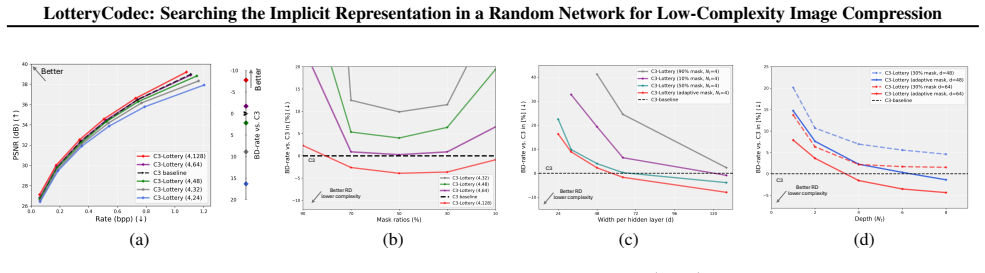
The paper establishes two claims. First, the lottery codec hypothesis holds in the tested regime: when the trained synthesis network of the C3 overfitted codec is replaced by a subnetwork of a frozen random network, selected by a learned binary mask $\tau \in \{0,1\}^{|W_0|}$, the replacement matches or exceeds C3's distortion at the same latent bitrate once the random network is wide enough (four hidden layers of width at least 64). The rate advantage is structural: a trained overfitted codec must transmit its real-valued weights, typically more than 13 bits per parameter, whereas a lottery codec transmits an entropy-coded binary mask at about 1 bit per entry, with the random network itself shared between encoder and decoder through a random seed. Second, the full LotteryCodec scheme, built from a SuperMask network with Fourier-style initialization, modulation vectors generated by a ModNet in a rewind fashion, and an autoregressive entropy model, is reported to reach BD-rate gains of -6.4% over C3 and -3.73% over its adaptive variant on Kodak, and up to -9.79% over VTM-19.1 on CLIC2020, which the authors state makes it the first overfitted image codec to surpass VTM's rate-distortion performance at low decoding complexity. Decoding cost scales linearly with the chosen mask ratio, so one codec covers a tunable complexity-quality range.
Load-bearing premise
The load-bearing premise is the lottery codec hypothesis itself: that for every image and every trained overfitted codec, a sufficiently large never-trained random network contains a subset of connections that reconstructs the image just as well at the same latent bitrate, a claim the paper justifies heuristically by analogy to strong lottery ticket theorems, without pinning down the required over-parameterization level, and one its own experiments show degrading as the random network shrinks toward practical sizes.
Editorial extensions
If this is right
- The unit of compression changes from numbers to structure: an image is encoded by which connections of a shared random network stay active, so per-image rate no longer includes the cost of transmitting trained weights.
- If the reported numbers hold, overfitted single-image compression enters a regime closed to it before: beating the classical VTM-19.1 codec by BD-rate margins of -3.73% on Kodak and up to -9.79% on CLIC2020.
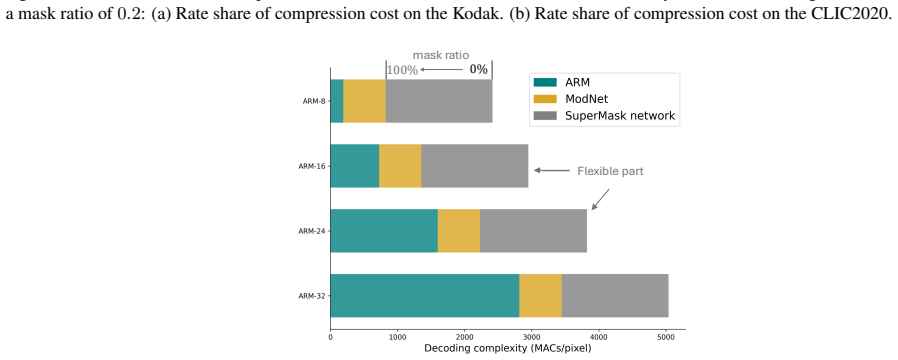
- Decoding complexity becomes a dial rather than a fixed property: the mask ratio sets the active fraction of the network, so one bitstream architecture serves both high-quality and low-power decoding, and even an 80% mask ratio still outperforms the C3 baseline.
- Decoding needs roughly two orders of magnitude fewer multiply-accumulate operations than autoencoder-based neural codecs such as MLIC+, which is what makes the reported RD performance usable on resource-constrained devices.
Reading between the lines
- A consequence the paper leaves implicit: if the lottery codec hypothesis holds at scale, the frozen random network functions as a universal codebook shared by all encoders and decoders, and the mask is the message, which would make the mask's entropy model a learnable, image-adaptive prior rather than a static distribution, a direction the paper does not pursue.
- The paper's own Fig. 6a shows the winning-ticket property is fragile at smaller widths, so an open question it does not resolve is where the crossover sits between mask cost and trained-weight cost: at low resolutions or low bitrates the network is a larger fraction of the bitstream, and the 1-bit-per-entry mask could lose its advantage.
- The shift of the optimal mask ratio from about 50% (without modulation) to about 20% (with rewind modulation) suggests the mask and the modulations are substitutable carriers of image content; a testable prediction is that at low mask ratios the modulation stream carries the detail, while at high ratios the structure does.
- The paper's visualization that low-bitrate reconstructions are dominated by low-resolution latents hints at a progressive-decoding scheme, decoding a coarse image from the low-resolution latents first and refining as higher-resolution latents arrive, which would give the same bitstream a graceful-degradation property the paper does not claim.
Editorial analysis
A structured set of objections, weighed in public.
Referee Report
Summary. The paper introduces the LotteryCodec, a single-image overfitted compression scheme that encodes an image as a binary mask over a frozen, randomly initialized network plus a small modulation model and latent modulations. The authors propose the 'lottery codec hypothesis,' claiming that for any overfitted codec there exists an untrained subnetwork of a sufficiently over-parameterized random network that matches its distortion at the same latent rate. They report experiments on Kodak and CLIC2020, state that LotteryCodec outperforms VTM-19.1 by BD-rate margins of roughly -3.7% to -9.8%, and show an adaptive rate-complexity trade-off via the mask ratio. They also provide ablations, a complexity analysis distinguishing theoretical lower bounds from practical structured-pruning timings, and a project page with datapoints.
Significance. If validated, the paper would make an important contribution: it would be the first overfitted image codec to beat a strong classical codec (VTM) in rate-distortion at low decoding complexity, and it introduces an interesting new paradigm of encoding image statistics into network structure. The empirical scope is reasonably broad (two datasets, multiple baselines, mask-ratio ablations, and separate complexity measurements), and the authors are transparent about the heuristic status of the hypothesis in Appendix C. However, the central claimed advantage rests on a rate comparison that is not actually measured in the paper: the reported RD curves and the hypothesis verification in Fig. 6a do not include the binary-mask rate on the rate axis. Since the mask is the mechanism claimed to replace the transmitted network weights, this missing measurement is load-bearing. The significance is therefore conditional on a total-rate verification that the manuscript does not yet provide.
major comments (3)
- [§3.1 and §4.1, Eqs. (4)-(5), Fig. 6a] The load-bearing rate claim — that the binary mask plus ModNet costs less than the quantized weights W of a conventional overfitted codec — is not supported by the reported measurements. Section 4.1 verifies the lottery codec hypothesis using Fig. 6a, but the horizontal axis is explicitly the rate contributed by ẑ alone, not the total bitstream. The RD curves in Fig. 7 also omit any decomposition of the final bitstream. The only per-component visualization, Fig. 15, gives relative shares inside LotteryCodec, not absolute bit counts for τ, θ, ψ, and ẑ, and it does not compare against the actual coded size of W. This matters because at the d=64 configuration of Fig. 6a the mask has about 17,000 entries; at a 50% mask ratio with entropy coding at roughly 0.7-1.0 bits per entry, the mask alone costs about 12-17 kbit, i.e. about 0.03-0.04 bpp on Kodak. In the low-rate regime (at or below 0.1 bpp) where the paper claims its main advantage, this overhead is comparable to the entire rate budget and to the reported BD-rate margins (-3.7% to -9.8%). The authors should report per-component bit counts for every operating point in Fig. 7 and re-plot at least one RD curve with total rate (ẑ + ψ + θ + τ) on the axis; without this, the central claim is not verifiable.
- [§1, §4.1, Appendix C] The heuristic justification of the lottery codec hypothesis relies on strong lottery ticket existence theorems (Pensia et al. 2020; da Cunha et al. 2022) that guarantee approximation only at asymptotic logarithmic over-parameterization, with no specification of the width or depth required at the tested sizes (Nt=4, d up to 128, with final operating dimensions d=32/48). The paper itself states in Section 1 that precise guidelines for the required over-parameterization remain unclear, and Appendix C concedes that a rigorous bound is not available. The empirical validation in Section 4.1, which replaces only the synthesis network in C3 and excludes the mask from the rate axis, does not directly test the total-rate inequality. If winning tickets do not exist at the tested sizes, the rate advantage of transmitting a binary mask instead of trained weights disappears. I am not asking for a proof, but the authors should present, at the actual operating sizes, a total-rate comparison against the original C3 bitstream (W, ẑ, ψ) to demonstrate that the hypothesis holds where it is being used.
- [§3.1, Eq. (4), and Appendix A.2] The training objective in Eq. (4) optimizes only the latent rate R(ẑ), while the rates of ψ, θ, and τ are described as minimal without supporting measurements. The later quantization-step search in Eq. (19) does use the full rate from Eq. (5), but the main RD-optimization during training does not. If the side rates are not negligible — and the mask-cost estimate above suggests they are not at low bpp — then the objective being optimized is not the RD trade-off being measured. The authors should quantify R(ψ), R(θ), and R(τ) per operating point and, if these are not negligible, include them in the training loss or justify their omission with measurements.
minor comments (5)
- [Abstract and §4.2] The abstract says LotteryCodec "sets a new state-of-the-art in single-image compression," while the body of Section 4.2 correctly qualifies this as the first overfitted codec to surpass VTM; since AE-based codecs such as MLIC+ still outperform it, the abstract's phrasing is too broad and should be qualified.
- [§1] In the introduction, "VCC (Bross et al., 2021a)" appears to be a typo for VVC; please fix.
- [Appendix F, Fig. 17] Fig. 17 contains untranslated Chinese text (e.g., "纬度 可视化浅层mod") and an incomplete English sentence ("For less mask, modulation need to be more complex, 他体现在符号/entropy的多变"); this should be cleaned up for publication.
- [Table 6 and Appendix D.5] The first row of Table 6 ("0 +12.45% +13.02%/ + 11.98%/ + 14.99%") is difficult to parse and should be reformatted; also "Gumble-softmax" should be "Gumbel-softmax."
- [§4.2 and Fig. 7] The abbreviations "C3-adapt" and "C3-adpt" are used inconsistently; please unify the notation.
Circularity Check
No load-bearing circularity; RD results are measured against external baselines, but the lottery codec hypothesis is verified on a rate axis that omits the mask cost its rate advantage depends on.
-
other
[Section 4.1, Fig. 6a; Section 3.1, Eqs. (2)-(5)]
"Fig. 6a presents PSNR versus the rate contributed by ẑ... the C3-Lottery scheme matches or even surpasses the performance of well-trained C3 baselines for width d ≥ 64. ... According to the Lottery Codec Hypothesis, our bit cost for ẑ and ψ̂ matches that of standard overfitted codecs. While each quantized parameter in Ŵ typically requires more than 13 bits, our binary mask τ uses up to 1 bits per entry... the combined rate of τ and θ̂ remains lower than that of Ŵ."
The LCH is the load-bearing premise for LotteryCodec's rate advantage, and its in-paper verification replaces C3's synthesis network with a masked random network — a stripped-down version of the proposed scheme — plotting PSNR against only the ẑ-contributed rate, explicitly excluding the mask and ModNet costs. Section 3.1 then invokes the LCH to conclude that the total rate {ẑ, ψ̂, τ, θ̂} undercuts {ẑ, ψ̂, Ŵ}. That conclusion does not follow from the ẑ-only verification: the decisive term (τ+θ̂ vs Ŵ) is exactly what the verification axis omits, and it is asserted only via a '1 bit vs 13 bits' heuristic, without absolute per-component bit counts at the Fig. 7 operating points (Fig. 15 gives only relative shares).
full rationale
The paper's central results are empirical: the RD curves in Fig. 7 (Kodak, CLIC2020) compare an end-to-end bitstream (ẑ, ψ̂, θ̂, τ per Eq. 5) against external baselines VTM-19.1, C3, COOL-CHICv2, and MLIC+, giving BD-rate reductions of -3.73% to -9.79% vs VTM. No fitted parameter is renamed as a prediction, and no equation reduces to its own input by construction. The lottery codec hypothesis is not self-justifying: its theoretical support cites external SLTH results (Pensia et al. 2020; da Cunha et al. 2022), and its empirical test (Section 4.1) is anchored to an external trained codec, C3 — a random subnetwork must match C3's distortion at equal ẑ-rate, which is a falsifiable comparison. There are no load-bearing self-citations; the author list does not overlap the cited SLTH/C3/COOL-CHIC literature, so kinds 3-5 do not apply. Appendix C honestly concedes that 'a rigorous bound supporting the LCH is not available.' The one mild self-referential element is that the hypothesis is searched with the paper's own mask-learning machinery and verified on a rate axis that excludes the mask cost, while Section 3.1's claim that τ+θ̂ undercuts Ŵ relies on a '1 bit vs 13 bits' heuristic never checked with absolute per-component bit counts at the Fig. 7 operating points. This is an evidential gap and a mild self-reference, not a circular reduction: the Fig. 7 end-to-end rates, which include all four bitstream components, stand as genuine measurements. Per the hard rules, the missing verification of the τ+θ̂ < Ŵ inequality, and the unspecified over-parameterization level needed at Lt=4, d≤64, belong to correctness risk rather than to a circularity score above 2.
Assumptions & free parameters
free parameters (5)
- Per-image mask ratio =
[0.1, 0.9]; CLIC2020 results use [0.15, 0.45]
- Rate-distortion weight lambda =
{2e-2, 1e-2, 5e-3, 1e-3, 5e-4, 2e-4, 1e-4}
- Quantization steps Delta_theta, Delta_psi =
Selected by greedy search per image (Eq. 19)
- ARM width c =
8, 16, 24, or 32
- ModNet hidden dimensions =
32 or 48
assumptions (4)
- domain assumption Strong Lottery Ticket Hypothesis existence results (Pensia et al. 2020; da Cunha et al. 2022): any target network can be approximated by a subnetwork of a sufficiently over-parameterized random network.
- domain assumption The entropy model (Laplace distribution with autoregressive context) accurately estimates the true distribution of the quantized latent z_hat.
- domain assumption A static or offline-trained entropy model compresses the binary mask tau losslessly at negligible cost.
- domain assumption BD-rate computed against VTM-19.1 from CompressAI is a fair and representative comparison for all codecs.
Cite this review
Pith. "Pith review of LotteryCodec: Searching the Implicit Representation in a Random Network for Low-Complexity Image Compression." pith.science (2026). https://pith.science/paper/BPCJOW4O
@misc{pith2026250701204,
  author       = {Pith},
  title        = {Pith review of: LotteryCodec: Searching the Implicit Representation in a Random Network for Low-Complexity Image Compression},
  year         = {2026},
  howpublished = {\url{https://pith.science/paper/BPCJOW4O}},
  note         = {Machine review of arXiv:2507.01204}
}
read the original abstract
We introduce and validate the lottery codec hypothesis, which states that untrained subnetworks within randomly initialized networks can serve as synthesis networks for overfitted image compression, achieving rate-distortion (RD) performance comparable to trained networks. This hypothesis leads to a new paradigm for image compression by encoding image statistics into the network substructure. Building on this hypothesis, we propose LotteryCodec, which overfits a binary mask to an individual image, leveraging an over-parameterized and randomly initialized network shared by the encoder and the decoder. To address over-parameterization challenges and streamline subnetwork search, we develop a rewind modulation mechanism that improves the RD performance. LotteryCodec outperforms VTM and sets a new state-of-the-art in single-image compression. LotteryCodec also enables adaptive decoding complexity through adjustable mask ratios, offering flexible compression solutions for diverse device constraints and application requirements.
Figures


Figures from the paper (15 more)






Forward citations
Cited by 1 Pith paper
-
Cool-chic 5.0: Faster Encoding and Inter-Feature Entropy Modeling for Overfitted Image Compression
Cool-chic 5.0 delivers 11% lower rate than H.266/VVC and matches modern autoencoders like MLIC++ with 250 times lower decoding complexity through an updated decoder architecture and faster optimization for overfitted codecs.
Reference graph
Works this paper leans on
-
[1]
Latent modulation Quantization
A.1. Latent modulation Quantization. Similar to (Kim et al., 2024), we adopt a two-stage quantization-aware optimization approach for optimizing z. During the training stage, z is learned in a continuous space for discrete optimization, with quantization approximated using Kumaraswamy noise. This soft-rounding technique ensures that the quantization proce...
work page 2024
-
[6]
Interestingly, experiments show that additive bias alone achieves competitive performance, although it falls short of the proposed concatenation-based method. This approach, however, provides the potential of reducing inference complexity and exploring alternative modulation strategies in future research. D.5. Alternative masking learning approach This se...
work page 2020
-
[7]
Orange indicates GPU computation; blue indicates CPU computation
Coding time for Kodak images on NVIDIA L40S (GPU) and Intel Xeon Platinum 8358 (CPU) with a masking ratio of 0.8 under structured pruning. Orange indicates GPU computation; blue indicates CPU computation. LotteryCodec vs. C3 LotteryCodec vs. C3 vs. MLIC+ Input resolution GPU Encoding CPU Decoding Peak Memory usuage during the training (sec/1k steps) (ms) ...
-
[9]
Overall, our method has a slightly higher encoding time than other overfitted codecs due to additional gradient-based mask learning, but it offers greater flexibility and faster decoding. Notably, the lottery codec hypothesis provides potential for parallel encoding by re-parameterizing distinct network optimizations into batch-wise mask learning, highlig...
work page 2024
-
[10]
Bross, B., Chen, J., Ohm, J.-R., Sullivan, G
23919/EUSIPCO63174.2024.10714961. Bross, B., Chen, J., Ohm, J.-R., Sullivan, G. J., and Wang, Y .-K. Developments in international video coding stan- dardization after avc, with an overview of versatile video coding (vvc). Proceedings of the IEEE , 109(9):1463– 1493, 2021a. Bross, B., Wang, Y .-K., Ye, Y ., Liu, S., Chen, J., Sullivan, G. J., and Ohm, J.-...
arXiv 2024
-
[11]
Cool-chic: Perceptually tuned low complexity overfitted image coder
Ladune, T., Philippe, P., Clare, G., Henry, F., and Leguay, T. Cool-chic: Perceptually tuned low complexity overfitted image coder. In 2024 Data Compression Conference (DCC), pp. 565–565. IEEE,
work page 2024
-
[12]
Low-complexity overfitted neural image codec
Leguay, T., Ladune, T., Philippe, P., Clare, G., Henry, F., and D´eforges, O. Low-complexity overfitted neural image codec. In 2023 IEEE 25th International Workshop on Multimedia Signal Processing (MMSP), pp. 1–6. IEEE,
work page 2023
-
[13]
Oh, J., Baik, S., and Lee, K. M. Find a winning sign: Sign is all we need to win the lottery. arXiv preprint arXiv:2504.05357,
Show all 26 references
-
[14]
Different alternative modulation methods of the LotteryCodec. (a). A FilM-based modulation approach. (b). Concatenation- based approach Note that LotteryCodec is a flexible framework that supports various modulation methods. We also implement a FiLM-based modulation (Perez et ...
2018
-
[16]
The resulting rate contributed by ˆ zis then given by: R(ˆ z) = − log2 pψ(ˆ z) = − X i,j log2 pψ(ˆzi,j|ci,j)
2, to compress ˆz. The resulting rate contributed by ˆ zis then given by: R(ˆ z) = − log2 pψ(ˆ z) = − X i,j log2 pψ(ˆzi,j|ci,j). (15) A.2. Model compression The parameters of ModNet and ARM are essential for decoding and are therefore compressed. Specifically, we first quantiz...
2012
-
[17]
We measure PSNR on RGB channels and quantify RD performance using the BD-rate metric (Gisle, 2001)
(an optimized version of COOL-CHIC version). We measure PSNR on RGB channels and quantify RD performance using the BD-rate metric (Gisle, 2001). The baseline results were obtained using their official implementations or directly using the reported results (C3, MLIC+) from thei...
2001
-
[18]
For a fair and more aligned comparison, we update VTM baseline into VTM-19.1 from CompressAI (B´egaint et al.,
We note that VTM configurations vary between implementations (Kim et al., 2024; Blard et al., 2024), and the BD-rate computation depends on both configurations and datapoints. For a fair and more aligned comparison, we update VTM baseline into VTM-19.1 from CompressAI (B´egain...
2024
-
[19]
We also open-resourced all above baselines and datapoints in our project page for future alignment
and recompute BD-rates for all codecs under similar λ settings. We also open-resourced all above baselines and datapoints in our project page for future alignment. Due to computational constraints, the optimal BD-rate is evaluated over ratio [0.15, 0.9] and λ ∈ {1e−2, 5e−3, 1e...
2018
-
[20]
+2.21% ⇒Score-based same layer masking algorithm (Ramanujan et al., 2020)+1.77% ⇒NeRF positional encoding module (Mildenhall et al.,
2020
-
[26]
davide-ragusa-716 in CLIC2020 with optimal result PSNR 37.18 at bpp 0.196
Encoding cost for a 2K image (size 1292 × 1945), “davide-ragusa-716 in CLIC2020 with optimal result PSNR 37.18 at bpp 0.196” (d = 24, ratio 0.2, peak memory 5.64 G), where 10-20k steps can yield a descent performance. E. Pseudocode for the algorithm This section provides detai...
1945
-
[1999]
Proving the strong lottery ticket hypothesis for convolutional neural networks
da Cunha, A., Natale, E., and Viennot, L. Proving the strong lottery ticket hypothesis for convolutional neural networks. In ICLR 2022-10th International Conference on Learning Representations,
2022
-
[2010]
Guo, Z., Flamich, G., He, J., Chen, Z., and Hern ´andez- Lobato, J. M. Compression with Bayesian implicit neu- ral representations. In Advances in Neural Information Processing Systems 36: Annual Conference on Neural In- formation Processing Systems 2023, NeurIPS 2023, New Orl...
2023
-
[2015]
Overfitted image coding at reduced complexity
Blard, T., Ladune, T., Philippe, P., Clare, G., Jiang, X., and D ´eforges, O. Overfitted image coding at reduced complexity. In 2024 32nd European Signal Processing Conference (EUSIPCO), pp. 927–931,
2024
-
[2016]
Not work well ⇒Gumble-softmax for mask ratio learning (Miles & Mikolajczyk, 2020; Dupont et al., 2022b)Not work well ⇒Bernoulli-based masking algorithm (Zhou et al.,
2020
-
[2018]
Good, cheap, and fast: Overfitted image com- pression with wasserstein distortion
Ball´e, J., Versari, L., Dupont, E., Kim, H., and Bauer, M. Good, cheap, and fast: Overfitted image com- pression with wasserstein distortion. arXiv preprint arXiv:2412.00505,
-
[2019]
12 LotteryCodec: Searching the Implicit Representation in a Random Network for Low-Complexity Image Compression Appendix A. Quantization and entropy coding methods For compression, the latent modulation z and network parameters θ, ψ are quantized into ˆ z, ˆθ and ˆψ, respectiv...
2024
-
[2020]
J., and Johnston, N
Ball´e, J., Minnen, D., Singh, S., Hwang, S. J., and Johnston, N. Variational image compression with a scale hyperprior. ICLR 2018-6th International Conference on Learning Representations,
2018
-
[2021]
Coin++: neural compression across modalities
Dupont, E., Loya, H., Alizadeh, M., Golinski, A., Teh, Y ., and Doucet, A. Coin++: neural compression across modalities. Transactions on Machine Learning Research, 2022(11), 2022a. Dupont, R., Amine Alaoui, M., Sahbi, H., and Lebois, A. Extracting effective subnetworks with gu...
2022
-
[2022]
W., and Doucet, A
Dupont, E., Goli ´nski, A., Alizadeh, M., Teh, Y . W., and Doucet, A. Coin: Compression with implicit neural rep- resentations. ICLR 2021-International Conference on Learning Representations Workshop Neural Compression 2021,
2021
-
[2023]
Han, S., Mao, H., and Dally, W. J. Deep compres- sion: Compressing deep neural networks with pruning, trained quantization and huffman coding. arXiv preprint arXiv:1510.00149, 2015a. Han, S., Pool, J., Tran, J., and Dally, W. Learning both weights and connections for efficient...
-
[2024]
B´egaint, J., Racap ´e, F., Feltman, S., and Pushparaja, A. Compressai: A PyTorch library and evaluation platform 9 LotteryCodec: Searching the Implicit Representation in a Random Network for Low-Complexity Image Compression for end-to-end compression research. arXiv preprint ...
2011 arXiv
Reviewed August 6, 2026 · model on record in the stance chip above.
Discussion (0). Continue with ORCID to comment.