Distance-Domain Degrees of Freedom in Near-Field Region
Pith reviewed 2026-05-19 06:00 UTC · model grok-4.3
The pith
Distance-domain degrees of freedom in near-field LoS links depend on the outer boundaries of the transmit and receive arrays rather than their internal details.
A machine-rendered reading of the paper's core claim, the machinery that carries it, and where it could break.
Core claim
For a continuous-aperture transmit array and a linear receive array whose elements lie at varying distances, the distance-domain DoF equals the number of significant eigenvalues of the associated integral operator; these eigenvalues are obtained in closed form from the Fourier transform of the kernel. The resulting DoF value depends only on the extreme radial and lateral boundaries of the two arrays. The same count holds when the receive array is displaced from broadside via an equivalent projected geometry, and modular transmit arrays increase the count relative to a single-piece array under fixed total physical length.
What carries the argument
Reformulation of the line-of-sight channel as an integral operator whose Hermitian convolution kernel admits a closed-form Fourier-transform solution for the distance-domain eigenvalues.
If this is right
- Users at the same angle but different distances can be spatially multiplexed using distance-domain resources alone.
- Array design can prioritize overall span over precise interior element arrangement to achieve the distance-domain DoF bound.
- Modular arrays deliver measurable DoF gains compared with a single contiguous aperture of identical total length.
- The continuous-aperture result supplies a concrete upper bound that finite-element arrays approach as element density rises.
Where Pith is reading between the lines
- Finite-element arrays with practical spacing should closely approach the derived DoF once element density is high enough to approximate the continuous limit.
- Beamforming or precoding algorithms could be simplified by depending primarily on the positions of the outermost elements rather than the full array geometry.
- The boundary-dominance finding may extend to three-dimensional user placements or multi-user scheduling that jointly exploits angle and distance.
Load-bearing premise
Both the transmit and receive arrays are modeled as continuous apertures containing infinitely many elements with infinitesimal spacing.
What would settle it
Build two transmit arrays that share identical outer boundaries but differ in internal element placement or density, then count how many independent distance-domain channels each supports to the same receive array at multiple distances.
Figures




read the original abstract
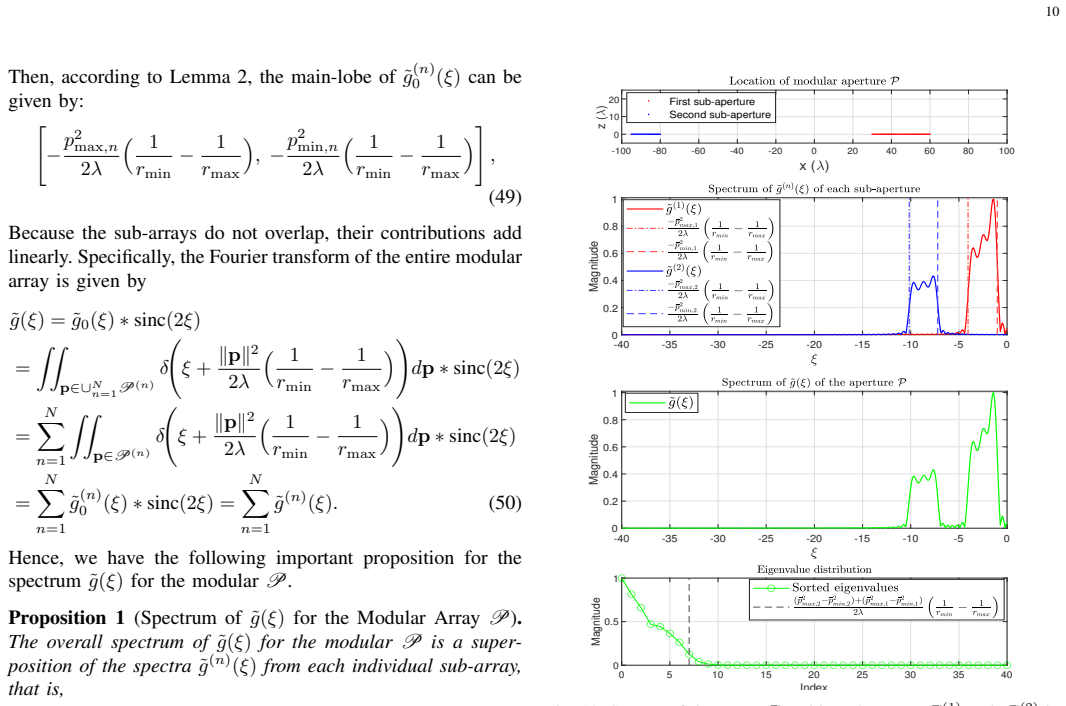
Extremely large aperture arrays operating in the near-field regime unlock additional spatial resources, which can be exploited to simultaneously serve multiple users even when they share the same angular direction. This work investigates the distance-domain degrees of freedom (DoF), defined as the DoF when a user varies only its distance to the base station and not the angle. To obtain the distance-domain DoF, we investigate a line-of-sight (LoS) channel between a base station (source) and observation region representing users. The base station is modeled as a large two-dimensional transmit (Tx) array with an arbitrary shape. The observation region is modeled as an arbitrarily long linear receive (Rx) array, where elements are collinearly aligned but located at varying distances from the Tx array. We assume that both the Tx and Rx arrays have continuous apertures with an infinite number of elements and infinitesimal spacing, which establishes an upper bound for the distance-domain DoF in the case of a finite number of elements. First, we analyze an ideal case where the Tx array is a single piece and the Rx array is on the broadside of the Tx array. By reformulating the channel as an integral operator with a Hermitian convolution kernel, we derive a closed-form expression for the distance-domain DoF via the Fourier transform. Our analysis shows that the distance-domain DoF is predominantly determined by the extreme boundaries of both the Tx and Rx arrays rather than their detailed interior structure. We further extend the framework to non-broadside configurations by employing a projection method that converts the problem to an equivalent broadside case. Finally, we extend the analytical framework to modular arrays and show the distance-domain DoF gain over a single-piece array under a fixed total physical length.
Editorial analysis
A structured set of objections, weighed in public.
Referee Report
Summary. The paper analyzes distance-domain degrees of freedom (DoF) for LoS near-field channels with extremely large aperture arrays. The BS is modeled as an arbitrary-shaped 2D continuous transmit aperture and users as a linear receive array at varying distances. For the ideal broadside case the channel is recast as an integral operator possessing a Hermitian convolution kernel; Fourier analysis then yields a closed-form expression showing that the effective spectral support (hence DoF) is fixed by the outermost radial extents of the two apertures rather than their interior geometry. The framework is extended to non-broadside geometries via a projection that reduces the problem to an equivalent broadside case and to modular arrays, where a DoF gain relative to a single-piece aperture of equal total length is reported. The continuous-aperture idealization is explicitly presented as an upper bound for finite-element realizations.
Significance. If the boundary-dominated result holds under the stated modeling assumptions, the work supplies a clean analytical handle on an additional spatial resource that can be exploited when users share the same angle but differ in range. The derivation is parameter-free once the aperture extents are fixed, the continuous-aperture limit is correctly labeled as an upper bound, and the modular-array extension offers a concrete, falsifiable prediction of DoF improvement. These features make the contribution potentially useful for both theoretical capacity studies and practical array partitioning in XL-MIMO systems.
major comments (1)
- [§3.2] §3.2, after Eq. (12): the projection step that maps a non-broadside geometry onto an equivalent broadside kernel is asserted to preserve the convolution structure required for the Fourier-transform argument, yet the transformed kernel is not explicitly recomputed; without this step the claim that the same closed-form DoF expression applies is not fully load-bearing.
minor comments (3)
- [Abstract] Abstract and §2.1: the phrase 'infinitesimal spacing' should be accompanied by a brief statement of the limiting process (e.g., element density → ∞ while total aperture length fixed) to avoid ambiguity for readers unfamiliar with continuous-aperture models.
- [Figure 3] Figure 3: the modular-array illustration would benefit from explicit annotation of the outermost radial coordinates that, according to the main result, determine the DoF.
- [§2] Notation: the symbol for the radial distance variable is reused in both the Tx and Rx domains; a subscript (e.g., r_T, r_R) would improve readability in the integral-operator definition.
Simulated Author's Rebuttal
We thank the referee for the constructive review and positive recommendation for minor revision. The single major comment concerns the clarity of the projection argument in §3.2, which we address below by committing to an explicit addition in the revised manuscript.
read point-by-point responses
-
Referee: [§3.2] §3.2, after Eq. (12): the projection step that maps a non-broadside geometry onto an equivalent broadside kernel is asserted to preserve the convolution structure required for the Fourier-transform argument, yet the transformed kernel is not explicitly recomputed; without this step the claim that the same closed-form DoF expression applies is not fully load-bearing.
Authors: We agree that an explicit recomputation of the transformed kernel would make the argument fully rigorous. The projection maps each Rx position to an equivalent broadside coordinate by replacing the slant-range distance with its projected component along the array axis; the resulting kernel then depends only on the difference of these projected coordinates and remains Hermitian. Consequently the integral operator stays convolutional in the new variable, so the same Fourier-support analysis and closed-form DoF expression apply directly. In the revised §3.2 we will insert the explicit expression for the projected kernel immediately after Eq. (12) and verify that it is a function of the difference variable only. revision: yes
Circularity Check
Derivation self-contained via standard Fourier analysis on first-principles operator
full rationale
The paper defines the LoS channel from first principles as an integral operator between continuous Tx and Rx apertures, reformulates it for the broadside case as a Hermitian convolution kernel, and applies the standard Fourier transform property to extract the spectral support (hence distance-domain DoF) directly from the kernel's frequency-domain representation. The conclusion that DoF is fixed by outermost radial boundaries follows immediately from the support of that transform without any fitted parameters, self-referential definitions, or load-bearing self-citations. The projection method for non-broadside geometries and the modular-array extension are presented as algebraic consequences of the same boundary-determined kernel. No step reduces by construction to its own inputs or to an unverified prior result by the same authors.
Axiom & Free-Parameter Ledger
axioms (2)
- domain assumption LoS channel between Tx array and linear Rx observation region
- domain assumption Continuous apertures with infinite elements and infinitesimal spacing
Lean theorems connected to this paper
-
IndisputableMonolith/Foundation/AbsoluteFloorClosure.leanreality_from_one_distinction unclear?
unclearRelation between the paper passage and the cited Recognition theorem.
By reformulating the channel as an integral operator with a Hermitian convolution kernel, we derive a closed-form expression for the distance-domain DoF via the Fourier transform. ... DoF ≈ (p_max² - p_min²)/(2λ) * (1/r_min - 1/r_max) + O(1)
What do these tags mean?
- matches
- The paper's claim is directly supported by a theorem in the formal canon.
- supports
- The theorem supports part of the paper's argument, but the paper may add assumptions or extra steps.
- extends
- The paper goes beyond the formal theorem; the theorem is a base layer rather than the whole result.
- uses
- The paper appears to rely on the theorem as machinery.
- contradicts
- The paper's claim conflicts with a theorem or certificate in the canon.
- unclear
- Pith found a possible connection, but the passage is too broad, indirect, or ambiguous to say the theorem truly supports the claim.
Reference graph
Works this paper leans on
-
[1]
Near- field communications: A comprehensive survey,
Y . Liu, C. Ouyang, Z. Wang, J. Xu, X. Mu, and A. L. Swindlehurst, “Near- field communications: A comprehensive survey,” IEEE Communications Surveys & Tutorials, vol. 27, no. 3, pp. 1687–1728, June 2025
work page 2025
-
[2]
Prospective multiple antenna technologies for beyond 5G,
J. Zhang, E. Bj ¨ornson, M. Matthaiou, D. W. K. Ng, H. Yang, and D. J. Love, “Prospective multiple antenna technologies for beyond 5G,” IEEE Journal on Selected Areas in Communications , vol. 38, no. 8, pp. 1637– 1660, Aug. 2020
work page 2020
-
[3]
Beam focusing for near-field multiuser MIMO communications,
H. Zhang, N. Shlezinger, F. Guidi, D. Dardari, M. F. Imani, and Y . C. Eldar, “Beam focusing for near-field multiuser MIMO communications,” IEEE Transactions on Wireless Communications, vol. 21, no. 9, pp. 7476– 7490, Sept. 2022
work page 2022
-
[4]
Near-field beamforming optimization for holographic XL-MIMO multiuser systems,
Y . Li, S. Gong, H. Liu, C. Xing, N. Zhao, and X. Wang, “Near-field beamforming optimization for holographic XL-MIMO multiuser systems,” IEEE Transactions on Communications , vol. 72, no. 4, pp. 2309–2323, April 2023
work page 2023
-
[5]
Multiple access for near-field communications: SDMA or LDMA?
Z. Wu and L. Dai, “Multiple access for near-field communications: SDMA or LDMA?” IEEE Journal on Selected Areas in Communications , vol. 41, no. 6, pp. 1918–1935, June 2023
work page 1918
-
[6]
Enabling more users to benefit from near- field communications: From linear to circular array,
Z. Wu, M. Cui, and L. Dai, “Enabling more users to benefit from near- field communications: From linear to circular array,” IEEE Transactions on Wireless Communications, vol. 23, no. 4, pp. 3735–3748, April 2023
work page 2023
-
[7]
Finite Beam Depth Analysis for Large Arrays,
A. Kosasih and E. Bj ¨ornson, “Finite Beam Depth Analysis for Large Arrays,” IEEE Transactions on Wireless Communications , vol. 23, no. 8, pp. 10 015–10 029, Aug. 2024
work page 2024
-
[8]
Achieving beamfocusing via two separated uniform linear arrays,
A. Kosasih, ¨O. T. Demir, and E. Bj ¨ornson, “Achieving beamfocusing via two separated uniform linear arrays,” in 2024 58th Asilomar Conference on Signals, Systems, and Computers , Pacific Grove, CA, USA, 2024, pp. 168–172
work page 2024
-
[9]
Multi-user modular XL-MIMO communications: Near-field beam focusing pattern and user grouping,
X. Li, Z. Dong, Y . Zeng, S. Jin, and R. Zhang, “Multi-user modular XL-MIMO communications: Near-field beam focusing pattern and user grouping,” IEEE Transactions on Wireless Communications , vol. 23, no. 10, pp. 13 766–13 781, October 2024
work page 2024
-
[10]
Near-field multiuser communications based on sparse arrays,
K. Chen, C. Qi, G. Y . Li, and O. A. Dobre, “Near-field multiuser communications based on sparse arrays,” IEEE Journal of Selected Topics in Signal Processing , vol. 18, no. 4, pp. 619–632, May 2024
work page 2024
-
[11]
Sparse Array Enabled Near-Field Communications: Beam Pattern Analysis and Hybrid Beamforming Design,
C. Zhou, C. You, H. Zhang, L. Chen, and S. Shi, “Sparse Array Enabled Near-Field Communications: Beam Pattern Analysis and Hybrid Beamforming Design,” arXiv preprint arXiv:2401.05690 , 2024
-
[12]
L. Ding, E. G. Str ¨om, and J. Zhang, “Degrees of freedom in 3D linear large-scale antenna array communications—A spatial bandwidth approach,” IEEE Journal on Selected Areas in Communications , vol. 40, no. 10, pp. 2805–2822, Oct. 2022
work page 2022
-
[13]
Performance analysis for near-field MIMO: Discrete and continuous aperture antennas,
Z. Xie, Y . Liu, J. Xu, X. Wu, and A. Nallanathan, “Performance analysis for near-field MIMO: Discrete and continuous aperture antennas,” IEEE Wireless Communications Letters , vol. 12, no. 12, pp. 2258–2262, Dec. 2023
work page 2023
-
[14]
X. Pu, S. Shao, K. Deng, and Y . Tang, “Effects of array orientations on degrees of freedom for 3D LoS channels in short-range communications,” IEEE Wireless Communications Letters , vol. 4, no. 1, pp. 106–109, Feb. 2015
work page 2015
-
[15]
Communication modes with large intelligent surfaces in the near field,
N. Decarli and D. Dardari, “Communication modes with large intelligent surfaces in the near field,” IEEE Access , vol. 9, pp. 165 648–165 666, 2021
work page 2021
-
[16]
Electromagnetic channel model for near field MIMO systems in the half space,
Y . Jiang and F. Gao, “Electromagnetic channel model for near field MIMO systems in the half space,” IEEE Communications Letters , vol. 27, no. 2, pp. 706–710, Feb. 2023
work page 2023
-
[17]
Communicating with large intelligent surfaces: Fundamental limits and models,
D. Dardari, “Communicating with large intelligent surfaces: Fundamental limits and models,” IEEE Journal on Selected Areas in Communications , vol. 38, no. 11, pp. 2526–2537, Nov. 2020
work page 2020
-
[18]
On Landau’s eigenvalue theorem for line-of- sight MIMO channels,
A. Pizzo and A. Lozano, “On Landau’s eigenvalue theorem for line-of- sight MIMO channels,” IEEE Wireless Communications Letters , vol. 11, no. 12, pp. 2565–2569, Dec. 2022
work page 2022
-
[19]
Degrees of Freedom of Holographic MIMO in Multi-user Near-field Channels,
H. Chen, S. Yue, M. Di Renzo, and H. Zhang, “Degrees of Freedom of Holographic MIMO in Multi-user Near-field Channels,” IEEE Communi- cations Letters, vol. 29, no. 6, pp. 1186–1190, June 2025
work page 2025
-
[20]
On the degrees of freedom and eigenfunctions of line-of-sight holographic MIMO communications,
J. C. Ruiz-Sicilia, M. Di Renzo, M. D. Migliore, M. Debbah, and H. V . Poor, “On the degrees of freedom and eigenfunctions of line-of-sight holographic MIMO communications,” arXiv preprint arXiv:2308.08009 , 2023
-
[21]
Parabolic wavefront model for line-of- sight MIMO channels,
H. Do, N. Lee, and A. Lozano, “Parabolic wavefront model for line-of- sight MIMO channels,” IEEE Transactions on Wireless Communications , vol. 22, no. 11, pp. 7620–7634, Nov. 2023
work page 2023
-
[22]
Degrees of freedom of OAM-based line-of-sight radio systems,
J. Xu, “Degrees of freedom of OAM-based line-of-sight radio systems,” IEEE Transactions on Antennas and Propagation, vol. 65, no. 4, pp. 1996– 2008, April 2017
work page 1996
-
[23]
Electromagnetic effective degree of freedom of an MIMO system in free space,
S. S. Yuan, Z. He, X. Chen, C. Huang, and W. E. Sha, “Electromagnetic effective degree of freedom of an MIMO system in free space,” IEEE Antennas and Wireless Propagation Letters , vol. 21, no. 3, pp. 446–450, Mar. 2022
work page 2022
-
[24]
Electromagnetic effective-degree-of-freedom prediction with parabolic equation method,
Y . Shen, Z. He, E. Wei, S. S. Yuan, and X. Chen, “Electromagnetic effective-degree-of-freedom prediction with parabolic equation method,” IEEE Transactions on Antennas and Propagation, vol. 71, no. 4, pp. 3752– 3757, 2023
work page 2023
-
[25]
Exploiting STAR-RISs in near-field communi- cations,
J. Xu, X. Mu, and Y . Liu, “Exploiting STAR-RISs in near-field communi- cations,” IEEE Transactions on Wireless Communications , vol. 23, no. 3, pp. 2181–2196, Mar. 2024
work page 2024
-
[26]
D. A. Miller, “Communicating with waves between volumes: evaluating orthogonal spatial channels and limits on coupling strengths,” Applied optics, vol. 39, no. 11, pp. 1681–1699, Apr. 2000
work page 2000
-
[27]
On Szeg ¨o’s eingenvalue distribution theorem and non- Hermitian kernels,
H. Landau, “On Szeg ¨o’s eingenvalue distribution theorem and non- Hermitian kernels,” Journal d’Analyse Math´ematique, vol. 28, no. 1, pp. 335–357, 1975
work page 1975
-
[28]
Analytical framework for effective degrees of freedom in near-field XL-MIMO,
Z. Wang, J. Zhang, W. Yi, H. Xiao, H. Du, D. Niyato, B. Ai, and D. W. K. Ng, “Analytical framework for effective degrees of freedom in near-field XL-MIMO,” IEEE Transactions on Wireless Communications , vol. 24, no. 4, pp. 3465–3482, April 2025
work page 2025
-
[29]
Near- field communications: A tutorial review,
Y . Liu, Z. Wang, J. Xu, C. Ouyang, X. Mu, and R. Schober, “Near- field communications: A tutorial review,” IEEE Open Journal of the Communications Society, vol. 4, pp. 1999–2049, 2023
work page 1999
discussion (0)
Sign in with ORCID, Apple, or X to comment. Anyone can read and Pith papers without signing in.