REVIEW 5 minor 1 cited by
A Multimessenger Strategy for Downselecting the Orientations of Galactic Close White Dwarf Binaries
T0 review · 0 major / 5 minor · reviewed 2026-08-06 · deepseek-v4-flash
Pith's one-line read Combining LISA strain data with electromagnetic timing can halve the fourfold orientation degeneracy for Galactic close white dwarf binaries.
desk verdict A correct, modest, genuinely new idea: EM phase information cuts the LISA orientation degeneracy from fourfold to twofold, and the claimed phase-accuracy threshold is actually conservative. read the letter →
The pith
A machine-rendered reading of the paper's core claim, the machinery that carries it, and where it could break.
The reading
What carries the argument
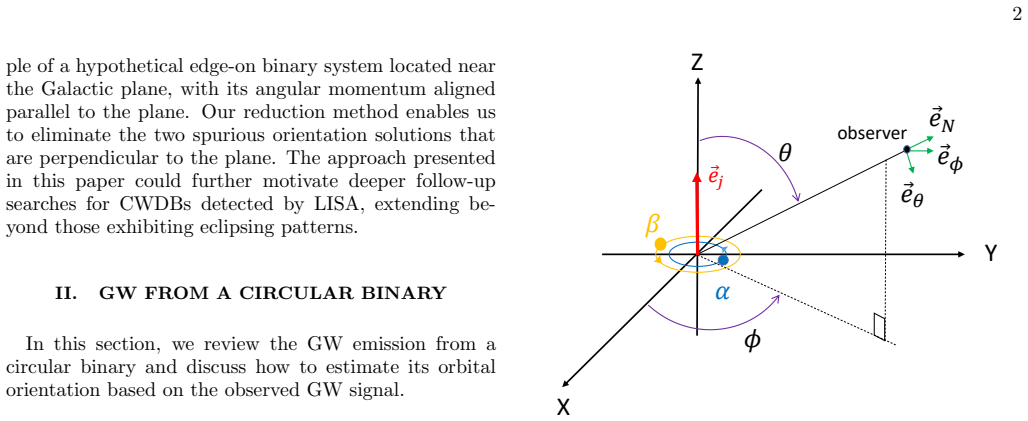
The machinery is the equality of orbital phase between the electromagnetic and gravitational-wave channels, together with the quadrupole waveform of Eqs. (8)–(11). The fourfold degeneracy arises because rotating the binary by $90^\circ$ about the line of sight changes the sign of the transverse-traceless strain tensor, an effect that can be absorbed into a phase shift of $\pi/2$; this makes $\pm\mathbf{e}_\theta$ and $\pm\mathbf{e}_\phi$ indistinguishable from GW data alone. The radial velocity $v_\alpha\propto\sin\Phi_o(t)$ and the eclipse condition $\sin\Phi_o(t)=0$ share the same phase $\Phi_o(t)$, so EM timing fixes which strain pattern corresponds to which orientation. Only coarse timing, $\Delta\Phi_o\sim 0.1$ rad, is needed because the choice is among four discrete candidates.
What would settle it
Measure both channels on a nearly edge-on eclipsing white dwarf binary and compare the GW strain tensor at the conjunction epoch predicted by the EM ephemeris; if the strain is not a pure compression along $\pm\mathbf{e}_\theta$ (that is, if $h_{\theta\phi}$ is nonzero at that epoch within the measurement uncertainty), the assumed phase identity is broken.
Extended reading notes
Core claim
The central claim is that the phase $\Phi_o(t)=2\pi f(t-r/c)+\varphi_s-\phi$ in the quadrupole gravitational-wave waveform is exactly the same orbital phase that appears in the binary's radial velocity curves and in the geometric condition for eclipses. Because the GW strain at $\sin\Phi_o=0$ satisfies $h_{\theta\theta}=-h_{\phi\phi}<0$ and $h_{\theta\phi}=0$, the deformation is a compression along the $\pm\mathbf{e}_\theta$ axes of the observer's transverse plane. Therefore, once electromagnetic data identify the conjunction epochs, comparing the radial velocity profile with the strain pattern selects the two candidate orientations $\pm\mathbf{e}_\theta$ and rules out the spurious $\pm\mathbf{e}_\phi$ solutions that arise from the spin-2 symmetry of the GW signal.
Load-bearing premise
The load-bearing premise is that the orbital phase inferred from electromagnetic timing is exactly the same phase that appears in the gravitational-wave strain, with no unknown offset between them; if an offset larger than about 0.1 rad separates them, the method fails.
Editorial extensions
If this is right
- For the roughly 100 eclipsing close white dwarf binaries expected to be seen simultaneously by LISA and optical surveys, eclipse timing alone selects the $\pm\mathbf{e}_\theta$ pair, so their projected orbital axes become measurable up to sign.
- The method turns follow-up radial-velocity spectroscopy, not just eclipses, into orientation science: any short-period binary with measurable velocity modulation can be used, expanding the sample.
- Statistical studies of whether white dwarf binary angular momenta are randomly oriented or aligned with the Galactic plane can be carried out at large distances using LISA, with the sign ambiguity treated as a mirror direction.
- Because only discrete alternatives are distinguished, precision phase measurement is not required; timing accuracy near $0.1$ rad in orbital phase is enough.
- For an edge-on binary near the Galactic plane, the method eliminates the two spurious solutions perpendicular to the plane, directly resolving the illustrative ambiguity discussed in the introduction.
Reading between the lines
- If the EM and GW phases ever differ by more than roughly 0.1 rad—from ephemeris errors, apsidal motion in slightly eccentric orbits, or light-travel and detector timing offsets—the strain at the EM-predicted conjunction will not cleanly select $\mathbf{e}_\theta$, so the method's reliability could be tested by comparing conjunction epochs inferred from radial velocity and from eclipse light curves
- The same phase-matching idea could be extended to higher GW harmonics or to binaries with small eccentricity, where the relation between the radial velocity curve and the strain pattern becomes richer and might resolve even the remaining sign ambiguity.
- In a future catalog of roughly 100 such binaries, the pattern of $\pm\mathbf{e}_\theta$ choices across the sky could be compared with Galactic models; any systematic preference for one sign, such as a preferred angular momentum direction, would show up as a non-random distribution of the selected axes.
Editorial analysis
A structured set of objections, weighed in public.
Referee Report
Summary. The paper proposes a multimessenger strategy to reduce the fourfold degeneracy in the transverse projection of the angular momentum vector of circular Galactic close white dwarf binaries (CWDBs) detected by LISA. Using the quadrupole waveform, the authors show that at the conjunction epochs of the binary, identified from electromagnetic timing (radial velocity zero crossings or eclipse minima), the gravitational-wave strain is a pure compression along one of the principal axes. This timing information selects two of the four discrete solutions, ±eθ, leaving only the twofold degeneracy associated with a 180-degree rotation around the line of sight. The derivation is algebraic and self-contained, with no fitted parameters.
Significance. If correct, the result provides a simple, essentially parameter-free way to improve the scientific yield of LISA for Galactic binaries, with direct relevance to studying the alignment of binary angular momenta with Galactic structure. The paper is honest in claiming only a reduction to twofold, and it correctly identifies the remaining ±eθ ambiguity as a physical 180-degree rotational symmetry that leaves all line-of-sight-projected EM observables unchanged. The core equations (8)-(13) are transparent and verifiable. The stated 0.1 rad phase-accuracy requirement is conservative; the discrete discrimination actually tolerates phase offsets up to about π/4, so the central claim is robust against the main synchronization concern.
minor comments (5)
- [III.A, Eqs. (12)-(13)] The derivation of the radial velocities from Eqs. (2)-(3) should state explicitly that the orbital phase is evaluated at the retarded time t−r/c for consistency with the GW phase Φ_o(t) in Eq. (10); as written, the text may leave the impression that the −r/c term is absent from the EM phase, whereas the equality of the EM and GW phases is the load-bearing premise of the method.
- [III.A, last paragraph] The statement that a phase accuracy of ΔΦ_o(t) ∼ 0.1 is sufficient is not justified; since the discrimination between the eθ and eϕ candidates requires only that the sign of h+ at the EM-determined epoch be preserved, the actual tolerance is |ΔΦ_o| < π/4. Adding this threshold (or an explanation of why 0.1 rad is a safe choice) would make the robustness of the method explicit.
- [II.C] The explanation of the fourfold degeneracy would be clearer if it explicitly displayed the transformation of h+ and h× under a 90-degree rotation of the binary (both change sign) and the compensating phase shift Φ → Φ+π/2; this would make the origin of the four discrete solutions and the role of the EM phase shift in breaking them more transparent.
- [III.B] The light-curve method is stated to apply to 'nearly edge-on' configurations, but this condition is not quantified; a sentence noting that detectable eclipses also require the stellar radii to be a non-negligible fraction of the orbital separation would better connect the method to the ∼100 eclipsing CWDBs estimated by Korol et al. [13].
- [II.B] There is a typo in the phrase 'principle axes'; it should read 'principal axes'.
Circularity Check
No significant circularity: the degeneracy-breaking method is derived from explicit quadrupole and kinematical formulas, with no fitted parameter or self-citation carrying the argument.
full rationale
The paper's central claim, that EM timing information reduces the fourfold GW degeneracy (±e_theta, ±e_phi) to the twofold degeneracy (±e_theta), is derived from the paper's own explicit quadrupole formulas (Eqs. 8-11) and the kinematic radial-velocity expressions (Eqs. 12-13), which share the same orbital phase Phi_o(t). At sin(Phi_o)=0, Eqs. (8)-(9) give h_+ = -A(cos^2 theta + 1) < 0 and h_x = 0, identifying compression along ±e_theta; the spurious ±e_phi solutions correspond to a 90-degree rotation absorbed in a pi/2 phase shift, so their conjunction epochs differ. This is a direct algebraic and geometric comparison, not a fit: no parameter is fitted to a subset of data and then renamed as a prediction, and no equation assumes the target result. The self-citations [7,8,15] are contextual (motivational statements and a rare-case caveat) and do not carry the derivation; the quadrupole formulas and the degeneracy argument are standard textbook material. The reader's concern about an EM/GW phase offset is a practical calibration issue, not a circularity: the selection is discrete and tolerates any constant offset with |delta| < pi/4, and known offsets can be fitted out in a joint analysis. There is no load-bearing self-citation chain and no construction equivalence; the derivation is self-contained against external benchmarks.
Assumptions & free parameters
assumptions (4)
- domain assumption The quadrupole formula describes the GW emission of a circular binary; post-Newtonian corrections are negligible at O(10^-3).
- domain assumption The orbital phase Φ_o(t) is common to the GW signal and the EM signals, with no unknown phase offset.
- domain assumption The observer's polarization basis (e_theta, e_phi) is fixed, making the four candidate projections ±e_theta and ±e_phi discrete.
- domain assumption The binary has a circular orbit and the two stars move on the same Keplerian orbit with phase Φ_s(t) = 2π f t + φ_s.
Cite this review
Pith. "Pith review of A Multimessenger Strategy for Downselecting the Orientations of Galactic Close White Dwarf Binaries." pith.science (2026). https://pith.science/paper/UVHKPTQO
@misc{pith2026250701250,
  author       = {Pith},
  title        = {Pith review of: A Multimessenger Strategy for Downselecting the Orientations of Galactic Close White Dwarf Binaries},
  year         = {2026},
  howpublished = {\url{https://pith.science/paper/UVHKPTQO}},
  note         = {Machine review of arXiv:2507.01250}
}
read the original abstract
The planned space-based gravitational wave detector, LISA, will provide a fundamentally new means of studying the orbital alignment of close white dwarf binaries. However, due to the inherent symmetry of their gravitational wave signals, a fourfold degeneracy arises in the transverse projections of their angular momentum vectors. In this paper, we demonstrate that by incorporating timing information from electromagnetic observations, such as radial velocity modulations and light curves, this degeneracy can be reduced to twofold.
Figures

Forward citations
Cited by 1 Pith paper
-
Probing the Orientation Distribution of Nearby Double White Dwarfs through Gravitational Waves with LISA
A spherical-harmonic method extracts low-multipole orientation coefficients of ~500 nearby double white dwarfs from LISA data with ~0.02 shot-noise uncertainty.
Reference graph
Works this paper leans on
-
[1]
Y. C. Chang, AJ 40, 11 (1929)
work page 1929
-
[2]
J. L. Agati, D. Bonneau, A. Jorissen, E. Souli´ e, S. Udry, P. Verhas, and J. Dommanget, A&A 574, A6 (2015), 1411.4919
work page Pith review arXiv 2015
-
[3]
S. Tan, Q. A. Parker, A. A. Zijlstra, A. Ritter, and B. Rees, ApJL 951, L44 (2023), 2307.07140
work page Pith review arXiv 2023
-
[4]
P. A. Seoane et al. (LISA), Living Rev. Rel. 26, 2 (2023), 2203.06016
arXiv 2023
-
[5]
W.-H. Ruan, Z.-K. Guo, R.-G. Cai, and Y.-Z. Zhang, Int. J. Mod. Phys. A 35, 2050075 (2020), 1807.09495
arXiv 2020
- [6]
-
[7]
Exploring the Orbital Alignments of Galactic Close White Dwarf Binaries with LISA
N. Seto, Phys. Rev. D 109, 103016 (2024), 2404.13313
work page Pith review arXiv 2024
-
[8]
Measuring the dipole component of possible Galaxy-binary alignment in the mHz band
N. Seto, Phys. Rev. D 110, 123003 (2024), 2411.12961
work page Pith review arXiv 2024
Show all 18 references
-
[9]
For instance, sup- pose LISA detects an edge-on CWDB located near the Galactic plane, with its angular momentum aligned par- allel to the plane
in the context of Galactic binaries). For instance, sup- pose LISA detects an edge-on CWDB located near the Galactic plane, with its angular momentum aligned par- allel to the plane. The fourfold degeneracy would prevent us from determining whether the binary’s orientation is ...
2025 arXiv
-
[10]
N. J. Cornish and S. L. Larson, Phys. Rev. D 67, 103001 (2003), astro-ph/0301548
2003 arXiv
- [11]
-
[12]
Takahashi and N
R. Takahashi and N. Seto, Astrophys. J. 575, 1030 (2002), astro-ph/0204487
2002 arXiv
-
[13]
K. B. Burdge et al., Nature 571, 528 (2019), 1907.11291
2019 arXiv
-
[14]
Korol, E
V. Korol, E. M. Rossi, P. J. Groot, G. Nelemans, S. Too- nen, and A. G. A. Brown, Mon. Not. Roy. Astron. Soc. 470, 1894 (2017), 1703.02555
2017 arXiv
-
[15]
T. B. Littenberg, S. L. Larson, G. Nelemans, and N. J. Cornish, Mon. Not. Roy. Astron. Soc. 429, 2361 (2013), 1207.4848
2013 arXiv
-
[16]
Seto (2025), submitted
N. Seto (2025), submitted
2025
-
[17]
K. S. Thorne and R. D. Blandford, Modern Classical Physics Optics, Fluids, Plasmas, Elasticity, Relativity, and Statistical Physics(2017)
2017
-
[18]
P. F. L. Maxted, A&A 591, A111 (2016), 1603.08484
2016 arXiv
Reviewed August 6, 2026 · model on record in the stance chip above.
Discussion (0). Sign in to comment.