REVIEW 5 major objections 6 minor 70 references
Robust Brain Tumor Segmentation with Incomplete MRI Modalities Using H\"older Divergence and Mutual Information-Enhanced Knowledge Transfer
T0 review · 5 major / 6 minor · reviewed 2026-08-06 · deepseek-v4-flash
Pith's one-line read A single model trained with Hölder divergence and mutual information losses keeps brain tumor segmentation accurate under any missing-modality combination.
desk verdict A legitimate engineering combination with a clean ablation, but the SOTA claim rests on cross-paper baselines and a test-set-tuned Hölder exponent, so the current evidence is not convincing. read the letter →
The pith
A machine-rendered reading of the paper's core claim, the machinery that carries it, and where it could break.
The reading
What carries the argument
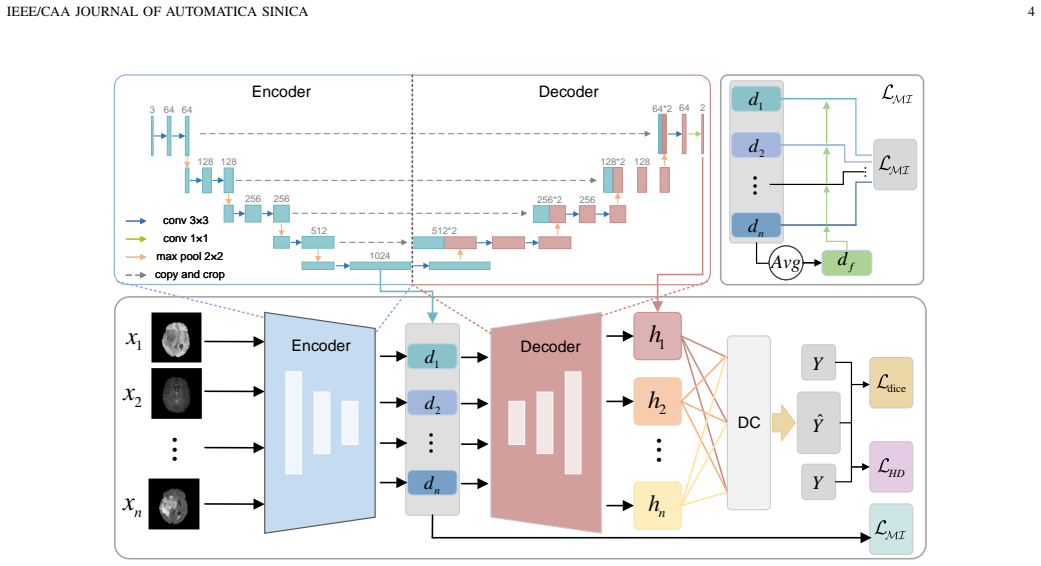
The load-bearing objects are the two loss terms added to Dice loss. Hölder divergence (or Hölder statistical pseudo-divergence) is a logarithmic ratio of an inner product to the product of L^α and L^β norms, with conjugate exponents; at α = 1.1 it sits close to KL divergence but is claimed to penalize asymmetric distributional differences more flexibly. The mutual-information term uses a variational approximation q(df | dm) to a Gaussian conditional, maximizing a lower bound on MI(df; dm) between deepest full-modality and missing-modality features, with layer weights γk increasing with depth. These two losses are what the ablation study credits for the gains: adding the parallel network alone raises average Dice from 59.8 to 70.7, mutual information adds another 8.7 points on average, and Hölder divergence adds 9.1 points, with the full combination reaching 80.1.
What would settle it
Retrain the proposed model and a top baseline such as GGMD on the identical BraTS 2018 training/validation split and preprocessing pipeline, and compare T1-only tumor-core Dice. If the +6.2% margin reported for T1-only TC shrinks to within run-to-run noise or reverses, the central claim of consistent superiority is not supported.
Extended reading notes
Core claim
The paper's central claim is that a single-modality parallel processing framework, built on a shared 3D U-Net, can match or beat state-of-the-art missing-modality segmentation methods without any modality-reconstruction or attention-heavy fusion. Each modality goes through its own channel encoder and a shared backbone, producing per-modality representations that are averaged at the deepest level to form a full-modality proxy; a Dynamic Combination module averages whatever representations are available at test time. The model is trained with the total loss LAll = LDice + λ1LMI + λ2LHD, where the mutual-information loss maximizes a variational lower bound between full and missing features and the Hölder-divergence loss measures prediction-label discrepancy with a tuneable exponent α = 1.1. On BraTS 2018 the method reports average Dice of 88.2/82.6/69.4 for WT/TC/ET, and 89.6/84.5/70.3 on BraTS 2020, with single-modality T1 gains up to +6.2% in tumor core on BraTS 2018. The paper also provides seven theorems supporting the design choices, including preservation of modality-specific features, reduction of conditional entropy via mutual information, and convergence of the total loss.
Load-bearing premise
The reported superiority over 16 of the 17 baselines rests on the assumption that the Dice scores quoted from those papers come from the same data split, preprocessing, and evaluation protocol as the authors' own runs, so the margins such as +6.2% in tumor core under T1-only are due to the method rather than to different experimental setups.
Editorial extensions
If this is right
- If the central claim holds, missing-modality segmentation can be handled by a single model with no modality-reconstruction module, and clinicians can drop any unavailable sequence without retraining.
- The performance gap under single-modality T1 input shrinks substantially, meaning the weakest clinical imaging setting is the one where the method gains most.
- The ablation indicates that divergence-based and mutual-information losses are each worth roughly 8–9 average Dice points on top of a parallel U-Net, so future missing-modality models can treat these losses as plug-in components.
- Training time is reported at 22.5 hours on two GPUs, about 25% less than the next-fastest strong baseline, which would make the approach practical for resource-limited deployment.
Reading between the lines
- An implicit consequence is that the specific choice of fusion (simple averaging of per-modality representations) matters less than the training losses; one could test this by replacing the average with a learned weighted sum and measuring whether the gains persist.
- Because the Hölder exponent is tuned on BraTS 2018 only, a natural extension is to test whether α = 1.1 transfers to other datasets or whether it must be re-tuned per site; the paper's own hyperparameter sensitivity table suggests the optimum is fairly flat.
- The method's avoidance of attention and reconstruction suggests it may combine with federated or privacy-preserving training, where modality availability varies across sites; this is not explored in the paper.
- One could also measure calibration or uncertainty under missing modalities, since the paper reports only Dice; the divergence loss may change the confidence of predictions in ways not captured by overlap metrics.
Editorial analysis
A structured set of objections, weighed in public.
Referee Report
Summary. The paper proposes a parallel 3D U-Net framework for brain tumor segmentation under missing MRI modalities. Each available modality is processed by a shared backbone, a mutual information loss aligns full-modality and missing-modality features, and a Hölder divergence loss is added to the Dice loss. The authors claim state-of-the-art average Dice scores on BraTS 2018 and BraTS 2020 across all missing-modality combinations, support the design with Theorems 1 through 7, and report ablations plus training-time comparisons. The code is made publicly available.
Significance. If the reported gains were confirmed under controlled conditions, the method would be a practically useful contribution: it is architecturally simple, handles all missing-modality combinations with one model, and the ablation study in Table V is internally consistent, showing monotone improvements from the parallel framework, the MI loss, and the Hölder loss. The provision of code is a strength. However, the headline claim of consistently outperforming existing methods rests on baseline numbers copied from other papers without evidence of matched evaluation protocols, and the theoretical support contains several invalid or circular steps. The paper is therefore not yet publishable in its current form, but the central idea remains worth evaluating after a major revision that supplies a controlled comparison and repairs the theory.
major comments (5)
- [§IV-B.1, Tables II–III] The claim of consistent superiority over state-of-the-art methods is supported for 16 of 17 baselines by numbers “sourced from their respective original research papers, all adhering to the same experimental configuration as RFNet,” yet no evidence is provided that those papers used the same BraTS split, preprocessing, augmentation, and evaluation protocol as the proposed method. BraTS 2018 and 2020 have multiple legitimate evaluation setups, and the reported margins are small (e.g., average DSC gains of 0.6–1.8 points on BraTS 2018, and the T1-only TC gain of +6.2% is against an RFNet number produced under unknown conditions). A shift of 1–2 DSC points from fold or preprocessing differences can change rankings, so the stated superiority is unsupported as presented. The authors need to rerun the baselines under their own protocol or otherwise demonstrate matched evaluation conditions.
- [§IV-C, Table VIII, Theorem 6] The Hölder exponent α = 1.1 is selected by scanning values on the same BraTS 2018 evaluation set used for the final results, and Theorem 6 then “proves” this choice by citing Table VIII. This is circular: the reported best-case numbers are partly an artifact of test-set fitting, not evidence of an independent property of α = 1.1. The exponent should be chosen on a validation split or via nested cross-validation, and Theorem 6 should not cite the same table as its proof.
- [Definition 1, Eq. (2), §IV-F] Definition 1 restricts HPD to 0 < α < 1 with β = α/(α−1) < 0, or α < 0 with 0 < β < 1. All experiments and Theorem 6 use α = 1.1, for which β = 11, a case excluded by the definition. Theorem 3 and Eq. (8) similarly assume α > 1. The authors must either extend the definition to cover α > 1 with the correct conjugate-exponent conditions, or align the experimental choice with the stated definition; the current text is internally inconsistent on a quantity that is central to the method.
- [§III-D, Theorem 2] The proof of Theorem 2 assumes “Y depends on df” and then asserts that reducing H(df | dm) reduces H(Y | dm). This does not follow from the data processing inequality, and no channel or Markov-chain argument establishing the implication is supplied. The theorem, as stated and proved, does not establish that maximizing MI(df ; dm) improves segmentation accuracy for arbitrary missing-modality features.
- [§III-D, Theorem 5] The convergence proof is a generic stochastic-gradient argument that assumes Lipschitz smoothness of all loss components and monotone decrease of the total loss at every iteration, neither of which is verified for the variational MI loss or the Hölder divergence loss defined earlier. Eq. (10) is stated as a guarantee, but SGD does not provide monotone decrease without additional conditions. This theorem should either be removed or replaced by a proof that actually covers the proposed loss combination.
minor comments (6)
- [Throughout] “H¨older” should be typeset as “Hölder” throughout the manuscript.
- [§IV-B.1] The text says the method is benchmarked against “five state-of-the-art” techniques, but 17 baselines are listed; the count should be corrected.
- [Tables II–III] The sentence describing “the symbol ∼ (·) denotes the amissing of a specific modality” contains a typo (“amissing”) and the column headers “∼ T1 ∼ T1c ∼ T2 ∼ Fl.” are hard to parse; please clarify the notation.
- [§III-D, Theorem 5] The total loss is written as LAll in Eq. (7) and in the theorem statement, but the proof uses Lall; the notation should be unified.
- [Tables VI–VII] Table VII reports 30.1 hours for one GPU and 22.5 hours for two GPUs, while Table VI lists 22.5 hours as the proposed method's training time and 30.1 hours for GGDM; the hardware configuration underlying Table VI should be stated explicitly so the reader can tell which setting produced the headline efficiency claim.
- [Table IV] The Total Variation row reports near-zero DSC values (1.9 for TC and 0.9 for ET), which is implausible for a trained segmentation loss; please verify the numbers or explain the experimental condition.
Circularity Check
Hölder exponent α=1.1 is selected by scanning the same BraTS 2018 dataset used for the headline comparisons, and Theorem 6 'proves' that choice by citing the scan; the reported Hölder advantage is partly a fitted result rather than an independent derivation.
-
fitted input called prediction
[Section IV-C / Table VIII and Section IV-F.1, Theorem 6]
"Theorem 6. Selecting α = 1.1 in Hölder divergence provides a balance between sensitivity to distribution differences and robustness to noise, improving segmentation accuracy compared to both α = 1 (KL divergence) and larger values of α. Proof. ... Empirically, α = 1.1 provides a moderate sensitivity increase that enhances segmentation accuracy by approximately 6.1% over KL divergence (see Table VIII)."
The value α=1.1 is not derived from a first-principles property of Hölder divergence. Section IV-C presents Table VIII, which scans candidate exponents (1.05, 1.08, 1.10, 1.15, 1.20) on BraTS 2018, and the same α=1.10 is used for the headline results in Tables II–III. Theorem 6 then 'proves' that α=1.1 is the right choice by citing the very empirical outcome of that scan. The proof's only empirical content is the result of the hyperparameter search it is supposed to justify, so the claimed theoretical guarantee reduces to a fitted parameter evaluated on the same dataset. The Hölder-over-KL advantage of 6.1% is therefore a measurement of a test-set-tuned choice, not an independent prediction.
full rationale
The substantive circularity is localized to the Hölder exponent. Table VIII is a hyperparameter scan on BraTS 2018: it compares KL divergence, no-knowledge-distillation, and Hölder exponents 1.05, 1.08, 1.10, 1.15, 1.20. The paper then adopts α=1.10 for the main comparisons in Tables II–III and, in Section IV-F.1, presents Theorem 6 asserting that 'selecting α=1.1' is optimal. The proof of that theorem does not derive 1.1 from Hölder divergence theory; its final step cites the empirical gain from Table VIII. That is circular in the specific sense that the theoretical result is justified by the same experiment that selected the parameter. The resulting Hölder advantage over KL (6.1%) and the contribution claims in the ablation study are thus not independent support for the choice. I do not count as circular the cross-paper comparison issue, where the paper asserts without evidence that 16 of 17 baselines 'adher[e] to the same experimental configuration as RFNet'; that is a serious comparability/correctness risk but not a derivation that reduces to its inputs. Likewise, the self-citations (e.g., the authors' conference paper [22] and other author references) are bibliographic and not load-bearing for the central derivation. Because the network architecture and mutual-information loss have independent content, the circularity is partial, not total: the central 'Hölder advantage' claim is partly the result of fitting α on the same evaluation data, warranting a score of 6 rather than 8 or 10.
Assumptions & free parameters
free parameters (4)
- Hölder exponent α =
1.1
- Mutual information loss weight λ1
- Hölder divergence loss weight λ2
- MI layer-weight base γ0
assumptions (5)
- ad hoc to paper Each composite T∘f_i is injective and different encoders yield different outputs for the same input.
- ad hoc to paper Maximizing MI(df;dm) reduces H(Y|dm) because 'Y depends on df'.
- ad hoc to paper The fusion operator M compensates for missing modalities.
- domain assumption The variational distribution q(df|dm) makes Eq. (4) a valid mutual information surrogate despite the dropped entropy term H(df).
- domain assumption LDice, LMI, and LHD are smooth with Lipschitz gradients and bounded below.
Cite this review
Pith. "Pith review of Robust Brain Tumor Segmentation with Incomplete MRI Modalities Using H\"older Divergence and Mutual Information-Enhanced Knowledge Transfer." pith.science (2026). https://pith.science/paper/FXVEIYDH
@misc{pith2026250701254,
  author       = {Pith},
  title        = {Pith review of: Robust Brain Tumor Segmentation with Incomplete MRI Modalities Using H\"older Divergence and Mutual Information-Enhanced Knowledge Transfer},
  year         = {2026},
  howpublished = {\url{https://pith.science/paper/FXVEIYDH}},
  note         = {Machine review of arXiv:2507.01254}
}
read the original abstract
Multimodal MRI provides critical complementary information for accurate brain tumor segmentation. However, conventional methods struggle when certain modalities are missing due to issues such as image quality, protocol inconsistencies, patient allergies, or financial constraints. To address this, we propose a robust single-modality parallel processing framework that achieves high segmentation accuracy even with incomplete modalities. Leveraging Holder divergence and mutual information, our model maintains modality-specific features while dynamically adjusting network parameters based on the available inputs. By using these divergence- and information-based loss functions, the framework effectively quantifies discrepancies between predictions and ground-truth labels, resulting in consistently accurate segmentation. Extensive evaluations on the BraTS 2018 and BraTS 2020 datasets demonstrate superior performance over existing methods in handling missing modalities.
Figures


Reference graph
Works this paper leans on
-
[1]
Glioma Segmentation- Mriented Multi-Modal MR Image Fusion with Adversarial Learning,
Y . Liu, Y . Shi, F. Mu, J. Cheng, and X. Chen, “Glioma Segmentation- Mriented Multi-Modal MR Image Fusion with Adversarial Learning,” IEEE/CAA Journal of Automatica Sinica , vol. 9, no. 8, pp. 1528–1531, 2022
work page 2022
-
[2]
Self- Supervised Entity Alignment Based on Multi-Modal Contrastive Learn- ing,
B. Liu, R. Song, Y . Xiang, J. Du, W. Ruan, and J. Hu, “Self- Supervised Entity Alignment Based on Multi-Modal Contrastive Learn- ing,” IEEE/CAA Journal of Automatica Sinica , vol. 9, no. 11, pp. 2031– 2033, 2022
work page 2022
-
[3]
S2-Net: Self-Supervision Guided Feature Representation Learning for Cross-Modality Images,
S. Mei, Y . Ma, X. Mei, J. Huang, and F. Fan, “S2-Net: Self-Supervision Guided Feature Representation Learning for Cross-Modality Images,” IEEE/CAA Journal of Automatica Sinica, vol. 9, no. 10, pp. 1883–1885, 2022
work page 2022
-
[4]
Y .-P. Huang, K. Bhalla, H.-C. Chu, Y .-C. Lin, H.-C. Kuo, W.-J. Chu, and J.-H. Lee, “Wavelet K-Means Clustering and Fuzzy-Based Method for Segmenting MRI Images Depicting Parkinson’s Disease,” International Journal of Fuzzy Systems , pp. 1–13, 2021
work page 2021
-
[5]
A Survey on Brain Tumor Segmentation with Missing MRI Modalities,
D. Shah, A. Barve, B. Vala, and J. Gandhi, “A Survey on Brain Tumor Segmentation with Missing MRI Modalities,” in International Conference on Information Technology . Springer, 2023, pp. 299–308
work page 2023
-
[6]
SMU-Net: Style Matching U-Net for Brain Tumor Segmentation with Missing Modalities,
R. Azad, N. Khosravi, and D. Merhof, “SMU-Net: Style Matching U-Net for Brain Tumor Segmentation with Missing Modalities,” in International Conference on Medical Imaging with Deep Learning, MIDL 2022, 6-8 July 2022, Zurich, Switzerland , ser. Proceedings of Machine Learning Research, vol. 172. PMLR, 2022, pp. 48–62
work page 2022
-
[7]
Prototype Knowledge Distillation for Medical Segmentation with Missing Modal- ity,
S. Wang, Z. Yan, D. Zhang, H. Wei, Z. Li, and R. Li, “Prototype Knowledge Distillation for Medical Segmentation with Missing Modal- ity,” in IEEE International Conference on Acoustics, Speech and Signal Processing ICASSP 2023, Rhodes Island, Greece, June 4-10, 2023 . IEEE, 2023, pp. 1–5
work page 2023
-
[8]
MMCFormer: Missing Modality Compensation Transformer for Brain Tumor Segmentation,
S. Karimijafarbigloo, R. Azad, A. Kazerouni, S. Ebadollahi, and D. Mer- hof, “MMCFormer: Missing Modality Compensation Transformer for Brain Tumor Segmentation,” in Medical Imaging with Deep Learning . PMLR, 2024, pp. 1144–1162
work page 2024
Show all 70 references
-
[9]
RFNet: Region-Aware Fusion Network for Incomplete Multi-Modal Brain Tumor Segmentation,
Y . Ding, X. Yu, and Y . Yang, “RFNet: Region-Aware Fusion Network for Incomplete Multi-Modal Brain Tumor Segmentation,” in Proceedings of the IEEE/CVF International Conference on Computer Vision , 2021, pp. 3975–3984
2021
-
[10]
Multimodal Transformer of Incomplete MRI Data for Brain Tumor Segmentation,
H. Ting and M. Liu, “Multimodal Transformer of Incomplete MRI Data for Brain Tumor Segmentation,”IEEE Journal of Biomedical and Health Informatics, vol. 28, no. 1, pp. 89–99, 2024
2024
-
[11]
Multi- Modal Learning with Missing Modality via Shared-Specific Feature Modelling,
H. Wang, Y . Chen, C. Ma, J. Avery, L. Hull, and G. Carneiro, “Multi- Modal Learning with Missing Modality via Shared-Specific Feature Modelling,” in Proceedings of the IEEE/CVF Conference on Computer Vision and Pattern Recognition , 2023, pp. 15 878–15 887
2023
-
[12]
Gradient-Guided Modality Decoupling for Missing-Modality Robustness,
H. Wang, S. Luo, G. Hu, and J. Zhang, “Gradient-Guided Modality Decoupling for Missing-Modality Robustness,” in Proceedings of the AAAI Conference on Artificial Intelligence , vol. 38, no. 14, 2024, pp. 15 483–15 491
2024
-
[13]
Modal-Aware Visual Prompting for Incomplete Multi-Modal Brain Tumor Segmentation,
Y . Qiu, Z. Zhao, H. Yao, D. Chen, and Z. Wang, “Modal-Aware Visual Prompting for Incomplete Multi-Modal Brain Tumor Segmentation,” in Proceedings of the 31st ACM International Conference on Multimedia, MM 2023, Ottawa, ON, Canada, 29 October 2023- 3 November 2023 . ACM, 2023,...
2023
-
[14]
Query Re-Training for Modality-Gnostic Incomplete Multi-modal Brain Tumor Segmentation,
D. Chen, Y . Qiu, and Z. Wang, “Query Re-Training for Modality-Gnostic Incomplete Multi-modal Brain Tumor Segmentation,” in International Conference on Medical Image Computing and Computer-Assisted Inter- vention. Springer, 2023, pp. 135–146
2023
-
[15]
Asynchronous Parallel Fuzzy Stochastic Gradient Descent for High-Dimensional Incomplete Data Representation,
W. Qin and X. Luo, “Asynchronous Parallel Fuzzy Stochastic Gradient Descent for High-Dimensional Incomplete Data Representation,” IEEE Transactions on Fuzzy Systems , vol. 32, no. 2, pp. 445–459, 2024
2024
-
[16]
Efficient and High-quality Recommendations via Momentum-incorporated Parallel Stochastic Gradient Descent-Based Learning,
X. Luo, W. Qin, A. Dong, K. Sedraoui, and M. Zhou, “Efficient and High-quality Recommendations via Momentum-incorporated Parallel Stochastic Gradient Descent-Based Learning,” IEEE/CAA Journal of Automatica Sinica, vol. 8, no. 2, pp. 402–411, 2021
2021
-
[17]
Adjusting Learning Depth in Nonnegative Latent Factorization of Tensors for Accurately Modeling Temporal Patterns in Dynamic QoS Data,
X. Luo, M. Chen, H. Wu, Z. Liu, H. Yuan, and M. Zhou, “Adjusting Learning Depth in Nonnegative Latent Factorization of Tensors for Accurately Modeling Temporal Patterns in Dynamic QoS Data,” IEEE Transactions on Automation Science and Engineering , vol. 18, no. 4, pp. 2142–2155, 2021
2021
-
[18]
Parallel Adaptive Stochastic Gradient Descent Algorithms for Latent Factor Analysis of High- Dimensional and Incomplete Industrial Data,
W. Qin, X. Luo, S. Li, and M. Zhou, “Parallel Adaptive Stochastic Gradient Descent Algorithms for Latent Factor Analysis of High- Dimensional and Incomplete Industrial Data,” IEEE Transactions on Automation Science and Engineering , vol. 21, no. 3, pp. 2716–2729, 2024
2024
-
[19]
Domain- Specific Batch Normalization for Unsupervised Domain Adaptation,
W.-G. Chang, T. You, S. Seo, S. Kwak, and B. Han, “Domain- Specific Batch Normalization for Unsupervised Domain Adaptation,” in Proceedings of the IEEE/CVF Conference on Computer Vision and Pattern Recognition, 2019, pp. 7354–7362
2019
-
[20]
Variational Information Distillation for Knowledge Transfer,
S. Ahn, S. X. Hu, A. Damianou, N. D. Lawrence, and Z. Dai, “Variational Information Distillation for Knowledge Transfer,” in Pro- ceedings of the IEEE/CVF Conference on Computer Vision and Pattern Recognition, 2019, pp. 9163–9171
2019
-
[21]
On H ¨older Projective Divergences,
F. Nielsen, K. Sun, and S. Marchand-Maillet, “On H ¨older Projective Divergences,” Entropy, vol. 19, no. 3, p. 122, 2017
2017
-
[22]
Robust divergence learning for missing-modality segmentation,
R. Cheng, Z. Sun, Y . Zhang, and C. Li, “Robust divergence learning for missing-modality segmentation,” in 2024 China Automation Congress (CAC), 2024, pp. 2077–2083
2024
-
[23]
Self-supervised geometric features discovery via interpretable attention for vehicle re-identification and beyond,
M. Li, X. Huang, and Z. Zhang, “Self-supervised geometric features discovery via interpretable attention for vehicle re-identification and beyond,” in ICCV, 2021
2021
-
[24]
Exploiting multi- view part-wise correlation via an efficient transformer for vehicle re- identification,
M. Li, J. Liu, C. Zheng, X. Huang, and Z. Zhang, “Exploiting multi- view part-wise correlation via an efficient transformer for vehicle re- identification,” TOM, 2021
2021
-
[25]
Synthetic-to-real self-supervised robust depth estimation via learning with motion and structure priors,
W. Yan, M. Li, H. Li, S. Shao, and R. T. Tan, “Synthetic-to-real self-supervised robust depth estimation via learning with motion and structure priors,” in Proceedings of the Computer Vision and Pattern Recognition Conference (CVPR) , June 2025, pp. 21 880–21 890
2025
-
[26]
Eventgpt: Event stream understanding with multimodal large language models,
S. Liu, J. Li, G. Zhao, Y . Zhang, X. Meng, F. R. Yu, X. Ji, and M. Li, “Eventgpt: Event stream understanding with multimodal large language models,” in Proceedings of the Computer Vision and Pattern Recognition Conference (CVPR), June 2025, pp. 29 139–29 149
2025
-
[27]
Favchat: Unlocking fine-grained facial video understanding with multimodal large language models,
F. Zhao, M. Li, L. Xu, W. Jiang, J. Gao, and D. Yan, “Favchat: Unlocking fine-grained facial video understanding with multimodal large language models,” arXiv preprint arXiv:2503.09158 , 2025
2025 arXiv
-
[28]
Unif2ace: Fine-grained face understanding and generation with unified multimodal models,
J. Li, X. Qiu, L. Xu, L. Guo, D. Qu, T. Long, C. Fan, and M. Li, “Unif2ace: Fine-grained face understanding and generation with unified multimodal models,” arXiv preprint arXiv:2503.08120 , 2025
2025
-
[29]
Dr-fer: Discriminative and robust representation learning for facial expression recognition,
M. Li, H. Fu, S. He, H. Fan, J. Liu, J. Keppo, and M. Z. Shou, “Dr-fer: Discriminative and robust representation learning for facial expression recognition,” IEEE Transactions on Multimedia, vol. 26, pp. 6297–6309, 2023
2023
-
[30]
Stprivacy: Spatio-temporal privacy-preserving action recognition,
M. Li, X. Xu, H. Fan, P. Zhou, J. Liu, J.-W. Liu, J. Li, J. Keppo, M. Z. Shou, and S. Yan, “Stprivacy: Spatio-temporal privacy-preserving action recognition,” in ICCV, 2023
2023
-
[31]
Instant3d: instant text-to-3d generation,
M. Li, P. Zhou, J.-W. Liu, J. Keppo, M. Lin, S. Yan, and X. Xu, “Instant3d: instant text-to-3d generation,” IJCV, 2024
2024
-
[32]
Realera: Semantic-level concept erasure via neighbor-concept mining,
Y . Liu, J. An, W. Zhang, M. Li, D. Wu, J. Gu, Z. Lin, and W. Wang, “Realera: Semantic-level concept erasure via neighbor-concept mining,” arXiv preprint arXiv:2410.09140 , 2024
2024 arXiv
-
[33]
Vistorybench: Comprehensive bench- mark suite for story visualization,
C. Zhuang, A. Huang, W. Cheng, J. Wu, Y . Hu, J. Liao, Z. Huang, H. Wang, X. Liao, W. Cai et al., “Vistorybench: Comprehensive bench- mark suite for story visualization,” arXiv preprint arXiv:2505.24862 , 2025
2025
-
[34]
NNU-Net: a Self-Configuring Method for Deep Learning-Based Biomedical Image Segmentation,
F. Isensee, P. F. Jaeger, S. A. Kohl, J. Petersen, and K. H. Maier- Hein, “NNU-Net: a Self-Configuring Method for Deep Learning-Based Biomedical Image Segmentation,” Nature Methods, vol. 18, no. 2, pp. 203–211, 2021
2021
-
[35]
Hemis: Hetero-Modal Image Segmentation,
M. Havaei, N. Guizard, N. Chapados, and Y . Bengio, “Hemis: Hetero-Modal Image Segmentation,” in Medical Image Computing and Computer-Assisted Intervention–MICCAI 2016: 19th International Con- ference, Athens, Greece, October 17-21, 2016, Proceedings, Part II 19 . Springer, 20...
2016
-
[36]
ACN: Adversarial Co-Training Network for Brain Tumor Segmentation with Missing Modalities,
Y . Wang, Y . Zhang, Y . Liu, Z. Lin, J. Tian, C. Zhong, Z. Shi, J. Fan, and Z. He, “ACN: Adversarial Co-Training Network for Brain Tumor Segmentation with Missing Modalities,” in Medical Image Computing and Computer Assisted Intervention–MICCAI 2021: 24th International Confer...
2021
-
[37]
MMformer: Multimodal Medical Transformer for Incomplete Multimodal Learning of Brain Tumor Segmentation,
Y . Zhang, N. He, J. Yang, Y . Li, D. Wei, Y . Huang, Y . Zhang, Z. He, and Y . Zheng, “MMformer: Multimodal Medical Transformer for Incomplete Multimodal Learning of Brain Tumor Segmentation,” in International Conference on Medical Image Computing and Computer- Assisted Inter...
2022
-
[38]
Swin Unetr: Swin Transformers for Semantic Segmentation of Brain Tumors in MRI Images,
A. Hatamizadeh, V . Nath, Y . Tang, D. Yang, H. R. Roth, and D. Xu, “Swin Unetr: Swin Transformers for Semantic Segmentation of Brain Tumors in MRI Images,” in International MICCAI brainlesion work- shop. Springer, 2021, pp. 272–284
2021
-
[39]
SFusion: Self-Attention based N-to- One Multimodal Fusion Block,
Z. Liu, J. Wei, R. Li, and J. Zhou, “SFusion: Self-Attention based N-to- One Multimodal Fusion Block,” in International Conference on Medical Image Computing and Computer-Assisted Intervention. Springer, 2023, pp. 159–169. IEEE/CAA JOURNAL OF AUTOMATICA SINICA 15
2023
-
[40]
MFTrans: Modality-Masked Fusion Transformer for Incomplete Multi-Modality Brain Tumor Segmentation,
J. Shi, L. Yu, Q. Cheng, X. Yang, K. Cheng, and Z. Yan, “MFTrans: Modality-Masked Fusion Transformer for Incomplete Multi-Modality Brain Tumor Segmentation,” IEEE Journal of Biomedical and Health Informatics, vol. 28, no. 1, pp. 379–390, 2024
2024
-
[41]
Enhancing Modality-Agnostic Representations via Meta-learning for Brain Tumor Segmentation,
A. Konwer, X. Hu, J. Bae, X. Xu, C. Chen, and P. Prasanna, “Enhancing Modality-Agnostic Representations via Meta-learning for Brain Tumor Segmentation,” in IEEE/CVF International Conference on Computer Vision, ICCV 2023, Paris, France, October 1-6, 2023 . IEEE, 2023, pp. 21 358–21 368
2023
-
[42]
Scratch Each Other’s Back: Incomplete Multi-Modal Brain Tumor Segmentation via Category Aware Group Self-Support Learning,
Y . Qiu, D. Chen, H. Yao, Y . Xu, and Z. Wang, “Scratch Each Other’s Back: Incomplete Multi-Modal Brain Tumor Segmentation via Category Aware Group Self-Support Learning,” in Proceedings of the IEEE/CVF International Conference on Computer Vision, 2023, pp. 21 317–21 326
2023
-
[43]
The Cauchy– Schwarz Divergence for Poisson Point Processes,
H. G. Hoang, B.-N. V o, B.-T. V o, and R. Mahler, “The Cauchy– Schwarz Divergence for Poisson Point Processes,” IEEE Transactions on Information Theory , vol. 61, no. 8, pp. 4475–4485, 2015
2015
-
[44]
K-Means Clustering with H ¨older Divergences,
F. Nielsen, K. Sun, and S. Marchand-Maillet, “K-Means Clustering with H ¨older Divergences,” in Geometric Science of Information: Third International Conference, GSI 2017, Paris, France, November 7-9, 2017, Proceedings 3. Springer, 2017, pp. 856–863
2017
-
[45]
Distilling the Knowledge in a Neural Network,
G. Hinton, O. Vinyals, and J. Dean, “Distilling the Knowledge in a Neural Network,” arXiv preprint arXiv:1503.02531 , 2015
2015 arXiv
-
[46]
Two-Stage Approach for Targeted Knowledge Transfer in Self-Knowledge Distillation,
Z. Yin, J. Pu, Y . Zhou, and X. Xue, “Two-Stage Approach for Targeted Knowledge Transfer in Self-Knowledge Distillation,”IEEE/CAA Journal of Automatica Sinica , vol. 11, no. 11, pp. 2270–2283, 2024
2024
-
[47]
Knowledge Transfer Learning via Dual Density Sampling for Resource-Limited Domain Adaptation,
Z. Zheng, L. Teng, W. Zhang, N. Wu, and S. Teng, “Knowledge Transfer Learning via Dual Density Sampling for Resource-Limited Domain Adaptation,” IEEE/CAA Journal of Automatica Sinica , vol. 10, no. 12, pp. 2269–2291, 2023
2023
-
[48]
M3AE: Multimodal Representation Learning for Brain Tumor Segmentation with Missing Modalities,
H. Liu, D. Wei, D. Lu, J. Sun, L. Wang, and Y . Zheng, “M3AE: Multimodal Representation Learning for Brain Tumor Segmentation with Missing Modalities,” in Proceedings of the AAAI Conference on Artificial Intelligence, vol. 37, no. 2, 2023, pp. 1657–1665
2023
-
[49]
The IM Algorithm: a Variational Approach to Information Maximization,
D. Barber and F. Agakov, “The IM Algorithm: a Variational Approach to Information Maximization,” Advances in Neural Information Processing Systems, vol. 16, no. 320, p. 201, 2004
2004
-
[50]
V-Net: Fully Convolutional Neural Networks for V olumetric Medical Image Segmentation,
F. Milletari, N. Navab, and S.-A. Ahmadi, “V-Net: Fully Convolutional Neural Networks for V olumetric Medical Image Segmentation,” in 2016 Fourth International Conference on 3D Vision (3DV). IEEE, 2016, pp. 565–571
2016
-
[51]
Deep Learning,
I. Goodfellow, “Deep Learning,” 2016
2016
-
[52]
T. M. Cover, Elements of Information Theory . John Wiley & Sons, 1999
1999
-
[53]
Densely Connected Convolutional Networks,
G. Huang, Z. Liu, L. Van Der Maaten, and K. Q. Weinberger, “Densely Connected Convolutional Networks,” in Proceedings of the IEEE Con- ference on Computer Vision and Pattern Recognition , 2017, pp. 4700– 4708
2017
-
[54]
MR Image Reconstruction Using Deep Density Priors,
K. C. Tezcan, C. F. Baumgartner, R. Luechinger, K. P. Pruessmann, and E. Konukoglu, “MR Image Reconstruction Using Deep Density Priors,” IEEE Transactions on Medical Imaging , vol. 38, no. 7, pp. 1633–1642, 2018
2018
-
[55]
Nesterov, Introductory Lectures on Convex Optimization: A Basic Course
Y . Nesterov, Introductory Lectures on Convex Optimization: A Basic Course. Springer Science & Business Media, 2013, vol. 87
2013
-
[56]
A Stochastic Approximation Method,
H. Robbins and S. Monro, “A Stochastic Approximation Method,” The Annals of Mathematical Statistics , pp. 400–407, 1951
1951
-
[57]
Learning Deep Representations by Mutual Information Estimation and Maximization,
R. D. Hjelm, A. Fedorov, S. Lavoie-Marchildon, K. Grewal, P. Bach- man, A. Trischler, and Y . Bengio, “Learning Deep Representations by Mutual Information Estimation and Maximization,” in 7th International Conference on Learning Representations, ICLR 2019, New Orleans, LA, USA...
2019
-
[58]
Hetero-Modal Variational Encoder-Decoder for Joint Modality Com- pletion and Segmentation,
R. Dorent, S. Joutard, M. Modat, S. Ourselin, and T. Vercauteren, “Hetero-Modal Variational Encoder-Decoder for Joint Modality Com- pletion and Segmentation,” in Medical Image Computing and Computer Assisted Intervention–MICCAI 2019: 22nd International Conference, Shenzhen, Ch...
2019
-
[59]
D2-Net: Dual Disentanglement Network for Brain Tumor Segmentation with Missing Modalities,
Q. Yang, X. Guo, Z. Chen, P. Y . Woo, and Y . Yuan, “D2-Net: Dual Disentanglement Network for Brain Tumor Segmentation with Missing Modalities,” IEEE Transactions on Medical Imaging , vol. 41, no. 10, pp. 2953–2964, 2022
2022
-
[60]
The Multimodal Brain Tumor Image Segmentation Benchmark (BRATS),
B. H. Menze, A. Jakab, S. Bauer, J. Kalpathy-Cramer, K. Farahani, J. Kirby, Y . Burren, N. Porz, J. Slotboom, R. Wiest et al. , “The Multimodal Brain Tumor Image Segmentation Benchmark (BRATS),” IEEE Transactions on Medical Imaging, vol. 34, no. 10, pp. 1993–2024, 2014
1993
-
[61]
Pytorch: An Imperative Style, High-Performance Deep Learning Library,
A. Paszke, S. Gross, F. Massa, A. Lerer, J. Bradbury, G. Chanan, T. Killeen, Z. Lin, N. Gimelshein, L. Antiga et al. , “Pytorch: An Imperative Style, High-Performance Deep Learning Library,” Advances in Neural Information Processing Systems , vol. 32, 2019
2019
-
[62]
Head and Neck Tumor Segmentation with 3D UNet and Survival Prediction with Multiple Instance Neural Network,
J. Chen and A. L. Martel, “Head and Neck Tumor Segmentation with 3D UNet and Survival Prediction with Multiple Instance Neural Network,” in 3D Head and Neck Tumor Segmentation in PET/CT Challenge . Springer, 2022, pp. 221–229
2022
-
[63]
Adam: A Method for Stochastic Optimiza- tion,
D. P. Kingma and J. Ba, “Adam: A Method for Stochastic Optimiza- tion,” in 3rd International Conference on Learning Representations, ICLR 2015, San Diego, CA, USA, May 7-9, 2015, Conference Track Proceedings, Y . Bengio and Y . LeCun, Eds., 2015
2015
-
[64]
Nonlinear total variation based noise removal algorithms,
L. I. Rudin, S. Osher, and E. Fatemi, “Nonlinear total variation based noise removal algorithms,” Physica D: Nonlinear Phenomena , vol. 60, no. 1-4, pp. 259–268, 1992
1992
-
[65]
Exact mean and variance of the squared Hellinger distance for random density matrices,
V . Kumar, K. Vasan, and S. Kumar, “Exact mean and variance of the squared Hellinger distance for random density matrices,” Physical Review E, vol. 111, no. 5, p. 054204, 2025
2025
-
[66]
On information and sufficiency,
S. Kullback and R. A. Leibler, “On information and sufficiency,” The Annals of Mathematical Statistics , vol. 22, no. 1, pp. 79–86, 1951
1951
-
[67]
On the F-Divergences between Densities of a Multivariate Location or Scale Family,
F. Nielsen and K. Okamura, “On the F-Divergences between Densities of a Multivariate Location or Scale Family,” Statistics and Computing , vol. 34, no. 1, p. 60, 2024
2024
-
[68]
On a generalization of the Jensen–Shannon divergence and the Jensen–Shannon centroid,
F. Nielsen, “On a generalization of the Jensen–Shannon divergence and the Jensen–Shannon centroid,” Entropy, vol. 22, no. 2, p. 221, 2020
2020
-
[69]
C. F. Gauss, Theoria motus corporum coelestium in sectionibus conicis solem ambientium. Perthes et Besser, 1809
-
[70]
A mathematical theory of communication,
C. E. Shannon, “A mathematical theory of communication,” The Bell System Technical Journal, vol. 27, no. 3, pp. 379–423, 1948
1948
Reviewed August 6, 2026 · model on record in the stance chip above.
Discussion (0). Continue with ORCID to comment.