REVIEW 4 major objections 4 minor 86 references
The electromagnetic form factors of $\Sigma$ and $\Sigma^0 \to \Lambda$ transition in the timelike region
T0 review · 4 major / 4 minor · reviewed 2026-08-06 · deepseek-v4-flash
Pith's one-line read The paper claims that the 2.5 GeV bump in electron-positron annihilation into Sigma hyperon pairs is the phi(3D) vector meson, and that a subthreshold rho(3D) state shapes the Lambda-Sigma0 transition.
desk verdict A solid VMD extension with real predictions and an appendix worth reading, but the 'phi(3D) is essential' claim is not supported by the fits as presented. read the letter →
The pith
A machine-rendered reading of the paper's core claim, the machinery that carries it, and where it could break.
The reading
What carries the argument
The machinery is the extended vector meson dominance model: the virtual photon couples to baryon pairs through Breit-Wigner propagators $B_R = M_R^2/(M_R^2 - q^2 - i M_R \Gamma_R)$ for each included vector meson $R$, multiplied by a dipole intrinsic form factor $g(q^2)=(1-\gamma q^2)^{-2}$ that gives the correct large-$Q^2$ falloff. The named central objects are the excited states $\rho(3D)$, $\omega(3D)$, $\phi(3D)$ (a $\phi$ meson in the $3D$ orbital excitation, mass about 2500 MeV), and $\rho(6D)$, whose poles and interferences generate the threshold enhancement, the oscillatory $|G_E/G_M|$, and the nontrivial relative phase $\Delta\Phi$. Because $\rho(3D)$ and $\omega(3D)$ share nearly the same mass, the authors split the analysis into two scenarios that swap the isospin-1 and isospin-0 contributions, and the observed cross-section ratio $\sigma(\Sigma^+):\sigma(\Sigma^0):\sigma(\Sigma^-)\approx 9.7:3.3:1$ is used to constrain the isospin decomposition.
What would settle it
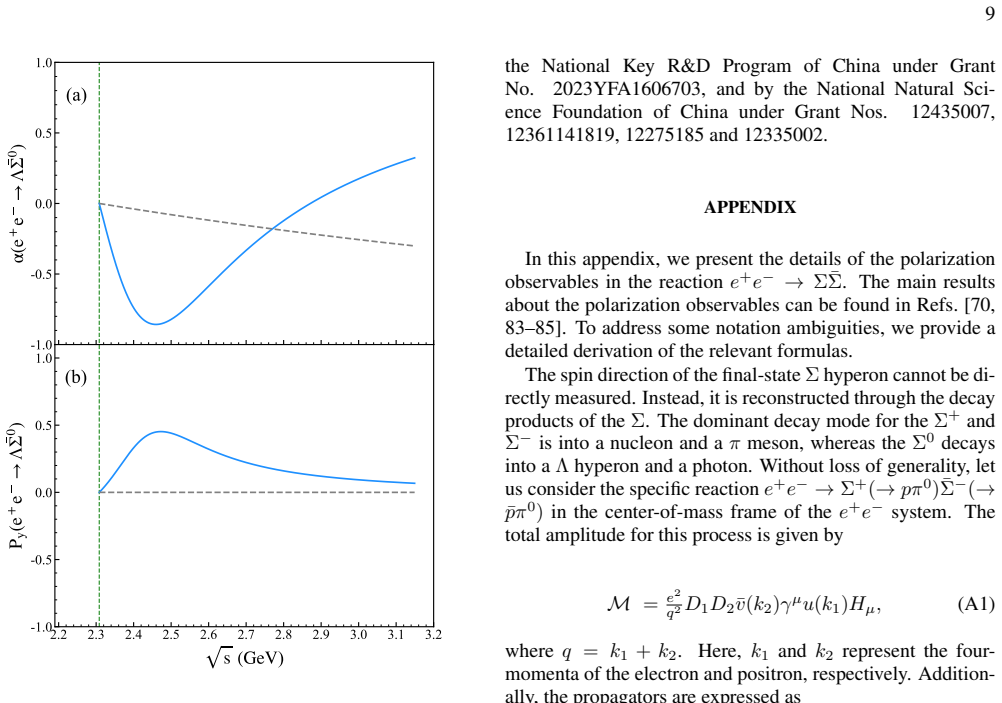
A fine energy scan of $e^+e^-\to\Sigma^+\bar{\Sigma}^-$ between 2.4 and 2.6 GeV: if the bump near 2.5 GeV does not show the line shape and phase motion of a 170-MeV-wide Breit-Wigner pole, or if high-statistics polarization data at $\sqrt{s}=2.5$ GeV show no peak in $P_y$ where the $\phi(3D)$ interference predicts one, the claim would be refuted. Similarly, measuring the angular distribution of $e^+e^-\to\Lambda\bar{\Sigma}^0$ near 2.46 GeV and checking whether the parameter $\alpha$ indeed approaches $-1$ would test the $\rho(3D)$ attribution.
Extended reading notes
Core claim
The central claim is that the timelike electromagnetic form factors of the $\Sigma$ and the $\Lambda\to\bar{\Sigma}^0$ transition are governed by a small set of vector-meson poles, including excited states that lie at or above the reaction thresholds. Within the extended vector meson dominance model, adding $\rho(3D)$, $\omega(3D)$, $\phi(3D)$, and $\rho(6D)$ with masses and widths taken from theory and the PDG yields a simultaneous description of 43 cross-section data points, 6 $|G_E/G_M|$ points, and 4 relative-phase points for $e^+e^-\to\Sigma\bar{\Sigma}$ with $\chi^2/\mathrm{d.o.f.}=0.9$ (Scenario I) or 1.1 (Scenario II). The specific physical conclusion is that the $2.5$ GeV enhancement in the BESIII data is caused by $\phi(3D)$, a vector meson predicted at 2500 MeV with a width of 170 MeV and a significant $\Sigma\bar{\Sigma}$ branching ratio; the $\rho(6D)$ is responsible for the nonzero phase at 2.9 GeV; and in $e^+e^- \to \Lambda\bar{\Sigma}^0$ the subthreshold $\rho(3D)$ pole produces the threshold enhancement and a non-monotonic $|G_E/G_M|$. The paper also corrects published formulas for the polarization moment $M(\cos\theta)$, stating that two earlier experimental extractions used a sign-inconsistent definition and should be revised.
Load-bearing premise
The whole explanation rests on the theoretical masses, widths, and especially the $\Sigma\bar{\Sigma}$ branching ratio of the excited vector mesons, above all the $\phi(3D)$ state at 2500 MeV with 170 MeV width taken from Refs. [59,65]; if that state does not exist with those properties, the enhancement would need another cause.
Editorial extensions
If this is right
- The near-threshold enhancement of $e^+e^-\to\Sigma\bar{\Sigma}$ at $\sqrt{s}\approx2.5$ GeV is identified with the $\phi(3D)$ resonance at 2500 MeV, turning a data bump into evidence for a specific predicted state.
- The oscillating $|G_E/G_M|$ ratio of $\Sigma^+$, similar to the $\Lambda_c^+$ pattern, is produced by the interference of near-threshold vector resonances, so the same mechanism may unify the two channels.
- The $\rho(6D)$ state, with an enlarged effective width, accounts for the nonzero relative phase at 2.9 GeV; without it the phase would vanish.
- In $e^+e^-\to\Lambda\bar{\Sigma}^0$, the subthreshold $\rho(3D)$ pole drives the threshold cross-section rise and creates a non-monotonic $|G_E/G_M|$ with $\alpha\to -1$ near 2.46 GeV.
- The predicted polarization $P_y$ peaks near the $\phi(3D)$ and $\rho(6D)$ energies in $\Sigma$ production and near 2.4-2.5 GeV in the $\Lambda\bar{\Sigma}^0$ channel, making the resonances testable by spin measurements.
Reading between the lines
- If the $\phi(3D)$ identification survives, it would be one of the first direct dynamical confirmations of a highly excited vector meson predicted by the modified Godfrey-Isgur quark model, validating that model's mass spectrum in the 2.4-3.0 GeV region.
- The appendix's correction to the polarization-moment formula implies that previously published relative phases $\Delta\Phi$ extracted from $\Lambda$ and $\Xi$ angular distributions may carry a sign error; reanalyzing existing BESIII data with the corrected formula is a cheap, direct test.
- Because the $\rho(6D)$ here is an effective single resonance with an artificially large width absorbing several predicted states, a finer energy scan near 2.9 GeV should resolve multiple poles; the model predicts the phase data will then split into several narrower interferences.
- The strong isospin sensitivity of $|G_E/G_M|$ for $\Sigma^0$ and $\Sigma^-$ suggests that measuring differential cross sections for those channels, not just total rates, would sharply distinguish which of the two scenarios is realized.
Editorial analysis
A structured set of objections, weighed in public.
Referee Report
Summary. The paper studies the electromagnetic form factors of the Σ isospin triplet and the Λ–Σ0 transition in the timelike region within an extended vector meson dominance (VMD) model. In addition to the ground-state ρ, ω, and φ mesons, the authors include excited states ρ(3D), ω(3D), φ(3D), and ρ(6D), splitting the analysis into two scenarios that differ in the isospin assignment of the 2.3 GeV excited state. Good fits to the e+e−→ΣΣbar total cross sections, |GE/GM|, and the relative phase ΔΦ are obtained (χ2/d.o.f. 0.9 and 1.1 for the two scenarios). The paper claims that φ(3D) is essential for the near-threshold enhancement in e+e−→Σ+Σ− at √s≈2.5 GeV, and that ρ(3D) is important for the e+e−→ΛΣ0bar threshold cross section. It also provides predictions for the Σ0 and Σ− form factor ratios, phases, angular asymmetries, and polarizations, and includes a lengthy appendix on polarization observables in the decay chain.
Significance. If the central claim is correct, the paper offers a natural VMD explanation for the BESIII data at √s≈2.5 GeV and produces concrete, falsifiable predictions for Σ0, Σ−, and Λ–Σ0 observables that can be tested by future experiments. The fits are good, the model is economical, and the out-of-sample predictions for the Σ0/Σ− ratios and phases and for the Λ–Σ0 transition are genuine and useful. The paper also openly acknowledges that the ρ(6D) width is phenomenological and compensates for several unconstrained states. However, the strongest claim in the abstract—that φ(3D) is essential—is not supported by a controlled test, and the paper's own text notes correlations that undermine the uniqueness of that attribution. This is the main gap between the evidence and the conclusion.
major comments (4)
- [Sec. III.A, Fig. 1; Abstract; Sec. IV] The claim that φ(3D) is essential to the near-threshold enhancement is not tested by a controlled exclusion. The gray dashed baseline in Fig. 1(a) is the ground-state-only model of Ref. [36], while both full scenarios (blue and orange) include φ(3D) together with ω(3D)/ρ(3D) and ρ(6D). This comparison cannot isolate the role of φ(3D). A fit with φ(3D) removed and all remaining parameters re-optimized is required, with a chi-squared comparison and a check of whether the 2.5 GeV structure persists. Without such a test, the abstract's statement that 'φ(3D) is essential' goes beyond what the reported calculations demonstrate.
- [Table II] The fitted φ(3D) couplings flip sign between Scenario I (β=−0.500, α=0.486) and Scenario II (β=0.375, α=−0.361), indicating strong parameter correlations with the other excited states. This is consistent with the near-threshold enhancement being produced by a combination of subthreshold resonances rather than by a unique, isolated φ(3D) contribution. A stability analysis, such as profiling the χ2 as a function of the φ(3D) couplings or excluding φ(3D) entirely, is needed to substantiate the claimed essentiality.
- [Table I and Sec. I] The mass and width of φ(3D) are fixed at the theoretical values 2500 MeV and 170 MeV from Refs. [59,65] and are not varied in the fits. The essentiality claim therefore depends on unvalidated resonance properties. A sensitivity study varying the φ(3D) mass and width over the ranges suggested by these references is needed to establish that the conclusion is robust to the model input.
- [Sec. III.B, Fig. 7] For the e+e−→ΛΣ0bar channel, the text states that the gray dashed line 'represents a fit without ρ(3D) (achieved by setting the βρ(3D) and αρ(3D) coupling constant to zero)'. It is unclear whether the remaining two parameters were re-optimized after setting those couplings to zero. If they were merely zeroed in the best-fit parameter set, the comparison is not a controlled test of ρ(3D)'s importance. The χ2 for the without-ρ(3D) case is not reported. Please clarify the procedure and, if necessary, re-fit the reduced model and report the resulting χ2.
minor comments (4)
- [Throughout] There are several typographical errors: 'obatined' in Sec. III.A, 'BarBar' instead of 'BaBar' in Sec. I and in the captions of Figs. 3 and 7, and 'expect' instead of 'except' in Sec. I.
- [Eqs. (18)-(21)] The signs in the constraints for fΣ±2 in Eq. (19) involve '∓ βρ(6D)/√2' while FΣ±1 in Eq. (13) has '± βρ(6D)/√2'. Please verify that this sign difference is intentional and not a typographical error.
- [Sec. II] Equation (22) is an empty numbered equation; it should be removed or given content.
- [Appendix] The appendix is very long relative to the main text and includes a critique of formulas in Refs. [18,27]. While the derivation is instructive, the connection to the main results could be stated more concisely, and the critique could be separated into a dedicated note.
Circularity Check
No significant circularity: the central claims are fit interpretations, and the paper's out-of-sample predictions are genuinely new observables.
full rationale
The paper is a standard phenomenological vector meson dominance fit. The excited-state couplings (β, α) are free parameters fitted to the e+e− → ΣΣ-bar cross-section, |GE/GM| and ΔΦ data, while the masses and widths are taken from external theoretical sources (Refs. [58,59,65,68]). The Abstract's statement that 'the ϕ(3D) resonance is essential to the near threshold enhancement' is an interpretive summary of the fitted model, but no equation in the paper makes that claim true by construction: the gray comparison line in Fig. 1(a) removes all excited states, not ϕ(3D) alone, and no re-fit without ϕ(3D) is reported. This is an evidentiary/model-selection gap, not a circular reduction. Similarly, ρ(6D) is explicitly introduced 'to account for experimental data at a center-of-mass energy of 2.9 GeV' and later used to interpret the phase at that energy; this is transparent parameterization, not a renamed prediction. The ΛΣ̄0 analysis contains a genuine removal test: 'the gray dashed line represents a fit without ρ(3D) (achieved by setting the βρ(3D) and αρ(3D) coupling constant to zero)'. The claimed predictions for |GE/GM|, ΔΦ, α and Py in channels where no data were fitted are genuine out-of-sample outputs of the fitted amplitude. The only self-citations (Refs. [34,36,78]) are used for baseline comparison or for the value γ = 0.43, which is externally supported by a ΛΛ̄ fit and by the authors' own Σ fit; none is load-bearing in a way that forces the central result. I therefore find no step in the derivation chain that reduces to its inputs by definition or by construction.
Assumptions & free parameters
free parameters (5)
- gamma (dipole form factor slope) =
0.4217 (Scenario I), 0.4662 (Scenario II); fixed to 0.43 for Lambda-Sigma0
- Vector meson couplings (Scenario I: beta_rho, beta_omega_phi, alpha_omega_phi, beta_omega_3D, alpha_omega_3D… =
0.9354, -0.3363, -2.8767, 0.6881, -0.7078, -0.4998, 0.4856, -0.0265, 0.0278
- Vector meson couplings (Scenario II: beta_rho, beta_omega_phi, alpha_omega_phi, beta_rho_3D, alpha_rho_3D… =
1.4189, -0.4264, 7.9466, 0.0645, -0.0968, 0.3754, -0.3608, 0.0537, -0.050
- Lambda-Sigma0 couplings (beta_rho_3D, alpha_rho_3D) =
0.3784, -0.4053
- rho(6D) mass and width =
2850 MeV, 150 MeV
assumptions (6)
- domain assumption Vector meson dominance: the virtual photon couples to baryons through intermediate vector meson resonances
- standard math Breit-Wigner propagator form B_R = M_R^2 / (M_R^2 - q^2 - i M_R Gamma_R)
- ad hoc to paper Dipole intrinsic form factor g(q^2) = (1 - gamma q^2)^-2
- domain assumption Existence and properties of rho(3D), omega(3D), phi(3D) excited states as listed in Table I
- domain assumption g_Sigma-Lambda-rho = 0, hence beta_rho = 0 for Lambda-Sigma0
- domain assumption Same intrinsic form factor slope gamma for Lambda-Sigma0 as for Sigma and Lambda
invented entities (3)
-
rho(6D) resonance
-
phi(3D) resonance
-
rho(3D) resonance (for Lambda-Sigma0)
Cite this review
Pith. "Pith review of The electromagnetic form factors of $\Sigma$ and $\Sigma^0 \to \Lambda$ transition in the timelike region." pith.science (2026). https://pith.science/paper/M4QOO6TC
@misc{pith2026250701277,
  author       = {Pith},
  title        = {Pith review of: The electromagnetic form factors of $\Sigma$ and $\Sigma^0 \to \Lambda$ transition in the timelike region},
  year         = {2026},
  howpublished = {\url{https://pith.science/paper/M4QOO6TC}},
  note         = {Machine review of arXiv:2507.01277}
}
abstract
We investigate the $e^+e^-\to \Sigma\bar{\Sigma}$ and $e^+e^-\to \Lambda\bar{\Sigma}^0$ reactions within the extended vector meson dominance model. In addition to the ground state mesons $\rho$ and $\omega$, we consider the contributions of the excited states $\rho(3D)$, $\omega(3D)$, $\phi(3D)$, and $\rho(6D)$. It is found that the current experimental data on the $\Sigma$ electromagnetic form factors in timelike region can be well reproduced. And the $\phi(3D)$ resonance is essential to the near threshold enhancement of the cross section for the $e^+e^-\to \Sigma\bar{\Sigma}$ reaction. Furthermore, in the $e^+e^-\to \Lambda\bar{\Sigma}^0$ reaction, the $\rho(3D)$ is important to get a good fit for the experimental results.
Figures


Figures from the paper (4 more)


Reference graph
Works this paper leans on
- [36]
-
[1]
(A37) After simplifying the expressions, the final result is H µν S Lµν = sD(s) p 1 − α2 sin θ cos θ sin ∆Φ × 1 sin θ (ˆp × ˆk) · ⃗l′ 1 . (A38) For the third component H µν ¯S , its explicit form is given by H µν ¯S = Tr h (/p1 + M )Γµ(/p2 − M )γ5 /l 2 − H2 ¯Γν i = −4i|GM |2(M ερσµν (p1ρ + p2ρ)l2σ − H2ερσµν p1ρp2σ) −GM F ∗ 2 2M 4iεαβγµ p1αp2βl2γ(pν 1 − pν...
-
[2]
A. Denig and G. Salme, Prog. Part. Nucl. Phys. 68, 113 (2013), arXiv:1210.4689 [hep-ex]
arXiv 2013
-
[3]
Pacetti, R
S. Pacetti, R. Baldini Ferroli, and E. Tomasi-Gustafsson, Phys. Rept. 550-551, 1 (2015)
2015
-
[4]
V . Punjabi, C. F. Perdrisat, M. K. Jones, E. J. Brash, and C. E. Carlson, Eur. Phys. J. A51, 79 (2015), arXiv:1503.01452 [nucl- ex]
arXiv 2015
-
[5]
The first exploration of the physical Riemann surfaces of the ratio $G_E^\Lambda/G_M^\Lambda$
A. Mangoni, S. Pacetti, and E. Tomasi-Gustafsson, Phys. Rev. D 104, 116016 (2021), arXiv:2109.03759 [hep-ph]
work page Pith review arXiv 2021
-
[6]
E. A. Kuraev, E. Tomasi-Gustafsson, and A. Dbeyssi, Phys. Lett. B 712, 240 (2012), arXiv:1106.1670 [hep-ph]
work page Pith review arXiv 2012
-
[7]
B. Aubert et al. (BaBar), Phys. Rev. D 76, 092006 (2007), arXiv:0709.1988 [hep-ex]
arXiv 2007
Show all 86 references
-
[8]
Ablikim et al
M. Ablikim et al. (BESIII), Phys. Rev. D 97, 032013 (2018), arXiv:1709.10236 [hep-ex]
2018
-
[9]
Ablikim et al
M. Ablikim et al. (BESIII), Phys. Rev. Lett. 124, 032002 (2020), arXiv:1910.04921 [hep-ex]
2020
-
[10]
Ablikim et al
M. Ablikim et al. (BESIII), Phys. Rev. Lett. 123, 122003 (2019), arXiv:1903.09421 [hep-ex]
2019
-
[11]
Ablikim et al
M. Ablikim et al. (BESIII), Phys. Lett. B 820, 136557 (2021), arXiv:2105.14657 [hep-ex]
2021
-
[12]
Ablikim et al
M. Ablikim et al. (BESIII), Phys. Lett. B 831, 137187 (2022), arXiv:2110.04510 [hep-ex]
2022
-
[13]
Ablikim et al
M. Ablikim et al. (BESIII), Phys. Rev. D104, L091104 (2021), arXiv:2108.02410 [hep-ex]
2021
-
[14]
Gong et al
G. Gong et al. (Belle), Phys. Rev. D 107, 072008 (2023), arXiv:2210.16761 [hep-ex]
2023 arXiv
-
[15]
Ablikim et al
M. Ablikim et al. (BESIII), JHEP 11, 228 (2023), arXiv:2309.04215 [hep-ex]
2023
-
[16]
Ablikim et al
M. Ablikim et al. (BESIII), Phys. Rev. D 109, 034029 (2024), arXiv:2312.12719 [hep-ex]
2024
-
[17]
Ablikim et al
M. Ablikim et al. (BESIII), Phys. Rev. D 109, 012002 (2024), arXiv:2308.03361 [hep-ex]
2024
-
[18]
Ablikim et al
M. Ablikim et al. (BESIII), JHEP 05, 022 (2024), arXiv:2401.09468 [hep-ex]
2024
-
[19]
Ablikim et al
M. Ablikim et al. (BESIII), Nature Phys. 15, 631 (2019), arXiv:1808.08917 [hep-ex]
2019 arXiv
-
[20]
Ablikim et al
M. Ablikim et al. (BESIII), Phys. Rev. D105, L011101 (2022), arXiv:2111.11742 [hep-ex]
2022
-
[21]
Ablikim et al
M. Ablikim et al. (BESIII), Phys. Rev. Lett. 129, 131801 (2022), arXiv:2204.11058 [hep-ex]
2022
-
[22]
Ablikim et al
M. Ablikim et al. (BESIII), JHEP 10, 081 (2023), [Erratum: JHEP 12, 080 (2023)], arXiv:2303.00271 [hep-ex]
2023
-
[23]
Ablikim et al
M. Ablikim et al. (BESIII), Phys. Rev. Lett. 125, 052004 (2020), arXiv:2004.07701 [hep-ex]
2020
-
[24]
Ablikim et al
M. Ablikim et al. (BESIII), Phys. Rev. Lett. 132, 081904 (2024), arXiv:2307.15894 [hep-ex]
2024
-
[25]
Ablikim et al
M. Ablikim et al. (BESIII), Phys. Rev. Lett. 133, 101902 (2024), arXiv:2406.06118 [hep-ex]
2024
-
[26]
Ablikim et al
M. Ablikim et al. (BESIII), (2024), 10.1007/JHEP12(2024)186, arXiv:2408.03205 [hep-ex]
2024
-
[27]
Ablikim et al
M. Ablikim et al. (BESIII), Phys. Rev. D106, L091101 (2022), arXiv:2206.10900 [hep-ex]
2022
-
[28]
Ablikim et al
M. Ablikim et al. (BESIII), Phys. Rev. D108, L031106 (2023), arXiv:2305.09218 [hep-ex]
2023
-
[29]
Ablikim et al
M. Ablikim et al. (BESIII), Phys. Rev. D108, L011101 (2023), arXiv:2302.09767 [hep-ex]
2023
-
[30]
H. Liu, J. Zhang, and X. Wang, Symmetry 15, 214 (2023)
2023
-
[31]
Cao, J.-P
X. Cao, J.-P. Dai, and Y .-P. Xie, Phys. Rev. D 98, 094006 (2018), arXiv:1808.06382 [hep-ph]
2018 arXiv
-
[32]
Yang, D.-Y
Y . Yang, D.-Y . Chen, and Z. Lu, Phys. Rev. D 100, 073007 (2019), arXiv:1902.01242 [hep-ph]
2019 arXiv
-
[33]
Haidenbauer, U.-G
J. Haidenbauer, U.-G. Meißner, and L.-Y . Dai, Phys. Rev. D 103, 014028 (2021), arXiv:2011.06857 [nucl-th]
2021 arXiv
-
[34]
Li and J.-J
Z.-Y . Li and J.-J. Xie, Commun. Theor. Phys. 73, 055201 (2021), arXiv:2012.02379 [hep-ph]
2021 arXiv
-
[35]
Li, A.-X
Z.-Y . Li, A.-X. Dai, and J.-J. Xie, Chin. Phys. Lett. 39, 011201 (2022), arXiv:2107.10499 [hep-ph]
2022 arXiv
-
[37]
B. Yan, C. Chen, and J.-J. Xie, Phys. Rev. D 107, 076008 (2023), arXiv:2301.00976 [hep-ph]
2023 arXiv
-
[38]
Lin, H.-W
Y .-H. Lin, H.-W. Hammer, and U.-G. Meißner, Eur. Phys. J. C 82, 1091 (2022), arXiv:2208.14802 [hep-ph]
2022 arXiv
-
[39]
J.-P. Dai, X. Cao, and H. Lenske, Phys. Lett. B 846, 138192 17 (2023), arXiv:2304.04913 [hep-ph]
2023 arXiv
-
[40]
Lin, F.-K
Y .-H. Lin, F.-K. Guo, and U.-G. Meißner, Phys. Lett. B 856, 138887 (2024), arXiv:2309.07850 [hep-ph]
2024 arXiv
-
[41]
Cao, Y .-T
X. Cao, Y .-T. Liang, and R.-G. Ping, Phys. Rev. D110, 014035 (2024), arXiv:2404.00298 [hep-ph]
2024 arXiv
-
[42]
Zhang, R.-G
Z. Zhang, R.-G. Ping, T. Liu, J. J. Song, W. Yang, and Y .- j. Zhou, Phys. Rev. D 110, 034034 (2024), arXiv:2404.04787 [hep-ph]
2024 arXiv
-
[43]
Zheng, A
W. Zheng, A. Kupsc, S. Pacetti, F. Rosini, N. Salone, X. Wang, and S.-s. Fang, Chin. Phys. Lett. 42, 041201 (2025), arXiv:2501.11205 [hep-ex]
2025 arXiv
-
[44]
L.-Y . Dai, J. Haidenbauer, and U.-G. Meißner, Chin. Phys. Lett. 42, 030202 (2025), arXiv:2412.07543 [hep-ph]
2025 arXiv
-
[45]
Ablikim et al
M. Ablikim et al. (BESIII), Phys. Lett. B 814, 136110 (2021), arXiv:2009.01404 [hep-ex]
2021
-
[46]
Mangoni, SciPost Phys
A. Mangoni, SciPost Phys. Proc. 10, 021 (2022), arXiv:2110.12475 [hep-ex]
2022 arXiv
-
[47]
Irshad, D
M. Irshad, D. Liu, X. Zhou, and G. Huang, Symmetry 14, 69 (2022)
2022
-
[48]
Ramalho, M
G. Ramalho, M. T. Pe ˜na, and K. Tsushima, Phys. Rev. D 101, 014014 (2020), arXiv:1908.04864 [hep-ph]
2020 arXiv
-
[49]
Anselmino, E
M. Anselmino, E. Predazzi, S. Ekelin, S. Fredriksson, and D. B. Lichtenberg, Rev. Mod. Phys. 65, 1199 (1993)
1993
-
[50]
Kubis and U
B. Kubis and U. G. Meissner, Eur. Phys. J. C 18, 747 (2001), arXiv:hep-ph/0010283
2001 arXiv
-
[51]
Iachello, A
F. Iachello, A. D. Jackson, and A. Lande, Phys. Lett. B 43, 191 (1973)
1973
-
[52]
Iachello and Q
F. Iachello and Q. Wan, Phys. Rev. C 69, 055204 (2004)
2004
-
[53]
Bijker and F
R. Bijker and F. Iachello, Phys. Rev. C 69, 068201 (2004), arXiv:nucl-th/0405028
2004 arXiv
-
[54]
B. Yan, C. Chen, X. Li, and J.-J. Xie, Phys. Rev. D109, 036033 (2024), arXiv:2312.04866 [nucl-th]
2024 arXiv
-
[55]
Bisello et al
D. Bisello et al. (DM2), Z. Phys. C 48, 23 (1990)
1990
-
[56]
Haidenbauer, K
J. Haidenbauer, K. Holinde, and J. Speth, Nucl. Phys. A 562, 317 (1993)
1993
-
[57]
Navas et al
S. Navas et al. (Particle Data Group), Phys. Rev. D110, 030001 (2024)
2024
-
[58]
Pang, Y .-R
C.-Q. Pang, Y .-R. Wang, J.-F. Hu, T.-J. Zhang, and X. Liu, Phys. Rev. D 101, 074022 (2020), arXiv:1910.12408 [hep-ph]
2020 arXiv
-
[59]
Wang, L.-M
J.-Z. Wang, L.-M. Wang, X. Liu, and T. Matsuki, Phys. Rev. D 104, 054045 (2021), arXiv:2106.14582 [hep-ph]
2021 arXiv
-
[60]
Wang, S.-Q
L.-M. Wang, S.-Q. Luo, and X. Liu, Phys. Rev. D 105, 034011 (2022), arXiv:2109.06617 [hep-ph]
2022 arXiv
-
[61]
Feng, X.-W
J.-C. Feng, X.-W. Kang, Q.-F. L ¨u, and F.-S. Zhang, Phys. Rev. D 104, 054027 (2021), arXiv:2104.01339 [hep-ph]
2021 arXiv
-
[62]
Zhou, J.-Z
Q.-S. Zhou, J.-Z. Wang, and X. Liu, Phys. Rev. D 106, 034010 (2022), arXiv:2207.00276 [hep-ph]
2022 arXiv
-
[63]
Zhou, J.-Z
Q.-S. Zhou, J.-Z. Wang, X. Liu, and T. Matsuki, Phys. Rev. D 105, 074035 (2022), arXiv:2201.06393 [hep-ph]
2022 arXiv
-
[64]
Wang, T.-Y
Y .-R. Wang, T.-Y . Li, Z.-Y . Fang, H. Chen, and C.-Q. Pang, Phys. Rev. D 106, 114024 (2022), arXiv:2208.10329 [hep-ph]
2022 arXiv
-
[65]
Y .-r. Wang, Y . Ma, and C.-q. Pang, Int. J. Mod. Phys. A 38, 2350118 (2023), arXiv:2211.09023 [hep-ph]
2023 arXiv
-
[66]
Bai, Q.-S
Z.-Y . Bai, Q.-S. Zhou, and X. Liu, Phys. Rev. D 108, 094036 (2023), arXiv:2307.16255 [hep-ph]
2023 arXiv
-
[67]
Lodha and A
C. Lodha and A. K. Rai, Eur. Phys. J. Plus 139, 663 (2024)
2024
-
[68]
Lodha and A
C. Lodha and A. K. Rai, Few Body Syst. 65, 99 (2024), arXiv:2410.14246 [hep-ph]
2024 arXiv
-
[69]
Feng, Z.-Y
X.-C. Feng, Z.-Y . Li, D.-M. Li, Q.-T. Song, E. Wang, and W.- C. Yan, Phys. Rev. D 106, 076012 (2022), arXiv:2206.10132 [hep-ph]
2022 arXiv
-
[70]
A. D. Sakharov, Zh. Eksp. Teor. Fiz. 18, 631 (1948)
1948
-
[71]
F ¨aldt and A
G. F ¨aldt and A. Kupsc, Phys. Lett. B 772, 16 (2017), arXiv:1702.07288 [hep-ph]
2017 arXiv
-
[72]
Granados, S
C. Granados, S. Leupold, and E. Perotti, Eur. Phys. J. A 53, 117 (2017), arXiv:1701.09130 [hep-ph]
2017 arXiv
-
[73]
G. P. Lepage and S. J. Brodsky, Phys. Rev. Lett.43, 545 (1979), [Erratum: Phys.Rev.Lett. 43, 1625–1626 (1979)]
1979
-
[74]
G. P. Lepage and S. J. Brodsky, Phys. Rev. D 22, 2157 (1980)
1980
-
[75]
A. V . Belitsky, X.-d. Ji, and F. Yuan, Phys. Rev. Lett. 91, 092003 (2003), arXiv:hep-ph/0212351
2003 arXiv
-
[76]
D. B. Leinweber, R. M. Woloshyn, and T. Draper, Phys. Rev. D 43, 1659 (1991)
1991
-
[77]
T. M. Aliev, A. Ozpineci, and M. Savci, Phys. Lett. B 516, 299 (2001), arXiv:hep-ph/0104204
2001 arXiv
-
[78]
Ablikim et al
M. Ablikim et al. (BESIII), Phys. Rev. Lett. 131, 191901 (2023), arXiv:2307.07316 [hep-ex]
2023
-
[79]
C. Chen, B. Yan, and J.-J. Xie, Chin. Phys. Lett. 41, 021302 (2024), arXiv:2312.16753 [hep-ph]
2024 arXiv
-
[80]
Bijker, F
R. Bijker, F. Iachello, and A. Leviatan, Phys. Rev. C 54, 1935 (1996), arXiv:nucl-th/9510001
1996 arXiv
-
[81]
C. S. Lai, Phys. Rev. 155, 1562 (1967)
1967
-
[82]
Erkol, R
G. Erkol, R. G. E. Timmermans, and T. A. Rijken, Phys. Rev. C 74, 045201 (2006)
2006
-
[83]
Xiao, X.-Z
L.-Y . Xiao, X.-Z. Weng, X.-H. Zhong, and S.-L. Zhu, Chin. Phys. C 43, 113105 (2019), arXiv:1904.06616 [hep-ph]
2019 arXiv
-
[84]
H. Czyz, A. Grzelinska, and J. H. Kuhn, Phys. Rev. D 75, 074026 (2007), arXiv:hep-ph/0702122
2007 arXiv
- [85]
- [86]
Reviewed August 6, 2026 · model on record in the stance chip above.
Discussion (0). Sign in to comment.