REVIEW 4 major objections 6 minor 52 references
Facial Emotion Learning with Text-Guided Multiview Fusion via Vision-Language Model for 3D/4D Facial Expression Recognition
T0 review · 4 major / 6 minor · reviewed 2026-08-06 · deepseek-v4-flash
Pith's one-line read FACET-VLM, a vision-language model that fuses frontal, left, and right face views with language prompts, reports top accuracies on BU-3DFE, Bosphorus, BU-4DFE, and BP4D-Spontaneous.
desk verdict Plausible multiview fusion architecture with strong reported numbers, but the paper never isolates the language contribution, so its central claim about text guidance is unverified. read the letter →
The pith
A machine-rendered reading of the paper's core claim, the machinery that carries it, and where it could break.
The reading
What carries the argument
The load-bearing machinery is the combination of three modules inside a CLIP-style contrastive space: a cross-view self-attention mechanism (CVSA), a text-guided fusion layer (MTGF), and a consistency regularizer. CVSA concatenates patch tokens from the three views, adds view-specific positional encodings, and runs scaled dot-product self-attention over the joint token sequence, so spatial regions that correspond across poses can communicate directly. MTGF projects the text embedding into a single query that attends to the multiview tokens, then blends the text-attended result with the CVSA output through a learned scalar gate. The consistency loss is the pairwise Euclidean distance between the three views' final embeddings, added to the contrastive loss with weight $\lambda_{\mathrm{FACET}} = 0.1$. The shared CLIP encoders provide the common image-text embedding space in which the fused visual embedding and the prompt embedding are compared.
What would settle it
Train the exact same multiview architecture, CVSA plus consistency loss, but replace the CLIP text encoder and prompts with a fixed one-hot class embedding of the same dimension; if accuracy on BU-3DFE Subset I or BP4D stays equal or improves, the claimed language-guidance effect is not due to text semantics. A finer check would keep the text encoder but shuffle the prompt-to-label mapping during training; chance-level performance would indicate the model is not using language meaning.
Extended reading notes
Core claim
The central claim is that text-guided multiview fusion is a better route to 3D/4D facial expression recognition than either geometry-only multiview learning or single-view vision-language classification. Concretely, the paper argues that the CVSA module creates view-consistent token-level correspondences, the MTGF layer injects emotion semantics directly into the fusion stage, and the consistency loss makes the learned embeddings viewpoint-invariant. Under a 10-fold subject-independent protocol, FACET-VLM reports the best numbers on all four benchmarks, with the largest gap on BU-4DFE (99.41% versus the previous 96.50%), and the ablation experiments attribute a positive contribution to every component, with CVSA removal causing the largest drops. The extension to 4DME shows the same recipe transfers to micro-expressions.
Load-bearing premise
The assumption that carries the method is that the text prompts contribute semantic supervision beyond the categorical label; the paper never trains a vision-only model with the same components, so the reported gains could in principle come from the extra parameters or the contrastive objective rather than from language meaning.
Editorial extensions
If this is right
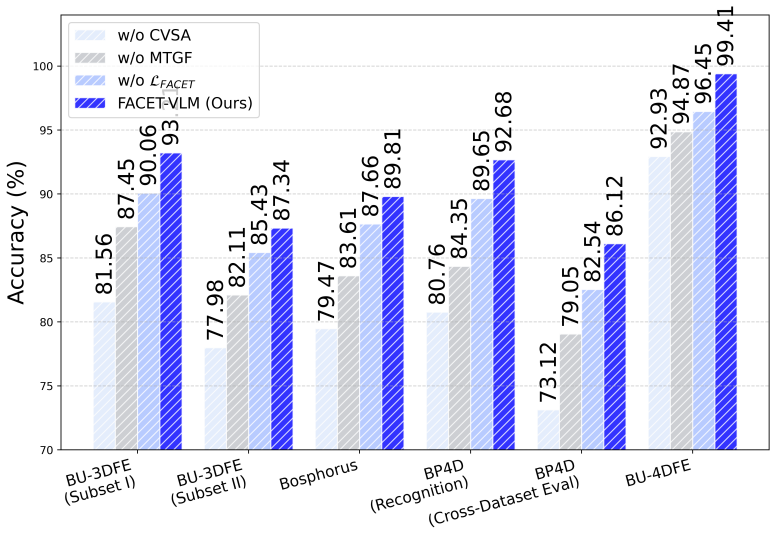
- On the 3D benchmarks, the paper reports accuracy gains of 3.90 points over the previous best on BU-3DFE Subset I and 9.81 points on Bosphorus, with Subset II rising to 87.34%.
- On BU-4DFE, the reported 99.41% exceeds the previous best 96.50%, and on BP4D-Spontaneous the within-dataset result is 92.68% while cross-dataset happy/disgust reaches 86.12%.
- Ablations show the system degrades most when CVSA is removed, for example from 93.21% to 81.56% on BU-3DFE Subset I, indicating that cross-view attention is the primary source of the gain.
- The same framework, fine-tuned with micro-expression prompts, reports an average F1 of 0.8109 and accuracy of 86.83% on 4DME multi-view micro-expression recognition.
Reading between the lines
- The paper does not train a vision-only counterpart with the same multiview modules, so a natural next experiment would swap the text prompts for a fixed categorical embedding to isolate whether the reported gains come from language semantics or from added parameters.
- Because the multiview projection recipe is agnostic to the object class, the CVSA plus MTGF plus consistency-loss stack could transfer to other 3D/4D geometric recognition tasks where viewpoint invariance matters, such as hand-pose or whole-body gesture recognition.
- The consistency loss pulls all three views together and could in principle suppress genuinely view-specific cues; testing on asymmetric or occluded expressions would reveal whether the regularization ever hurts.
- The cross-dataset experiment is limited to happy and disgust tasks, so extending the protocol to all emotion categories would give a fuller picture of generalization.
Editorial analysis
A structured set of objections, weighed in public.
Referee Report
Summary. The manuscript introduces FACET-VLM, a vision-language framework for 3D/4D facial expression recognition. It decomposes each 3D/4D face into three rendered views, encodes these with a shared CLIP-based ViT, fuses the view tokens with a Cross-View Self-Attention module (CVSA), modulates the fusion with text prompts through a Multiview Text-Guided Fusion layer (MTGF), and trains with a CLIP-style contrastive loss plus a multiview consistency loss. The paper reports state-of-the-art or strong accuracies on BU-3DFE, Bosphorus, BU-4DFE, BP4D-Spontaneous, and the 4DME micro-expression dataset, and includes ablations claiming each module contributes. No code, data, or trained models are released.
Significance. If the reported results are reproducible, the architecture is a credible contribution to 3D/4D FER: the idea of injecting language prompts at the token-fusion stage is interesting, and the evaluation covers four standard benchmarks plus a micro-expression extension with explicit architectural details and training schedules. However, the central causal claim that language semantics drive the improvements is not tested, the numbers are reported without error bars or significance tests, and some comparisons mix evaluation protocols. The contribution is therefore plausible but not yet established at the level claimed in the abstract.
major comments (4)
- [§4.4, Figs. 3 and 4] The paper never isolates the effect of text semantics. Every configuration in the ablation retains the CLIP-style contrastive loss with text prompts; removing CVSA, MTGF, or the consistency loss changes the architecture or regularization but always leaves language supervision in place. Thus the abstract's claim that 'semantic guidance from natural language prompts' improves accuracy is untested. A vision-only or label-only control with the same multiview architecture and comparable parameter count is needed—for example, a softmax classifier on the fused visual embedding trained with one-hot labels, or a variant in which the text embeddings are replaced by learned per-class embeddings. Without this control, the observed gains could come from the extra parameters of MTGF/CVSA or from the contrastive objective acting as a standard label-supervised regularizer rather than from language semantics.
- [§2.5.1, Eqs. (21)–(23)] The claimed equivalence between the pairwise consistency loss and the variance form is incorrect. For three view embeddings, Eq. (22) equals (1/9) Σ_{i<j} ||v^{(i)}−v^{(j)}||^2, while Eq. (21) equals (2/3) Σ_{i<j} ||v^{(i)}−v^{(j)}||^2. The expression (1/6) Σ_{i≠j} in Eq. (23) equals (1/3) Σ_{i<j} ||v^{(i)}−v^{(j)}||^2, so the three forms in Eqs. (21)–(23) are pairwise inconsistent. The error is partly absorbable into the tuned λ_FACET, but the loss is not pinned down as tightly as the text claims and the equation should be corrected.
- [§4.2, Table 3] The table mixes evaluation protocols: Sandbach et al. use 6-CV with a sliding window, Yao et al. use key-frame selection, and other baselines use 10-CV full sequences. The text states that comparisons are made 'under consistent experimental settings,' which is contradicted by the table's own 'Experimental Settings' column. A state-of-the-art claim cannot be supported by accuracy differences across differing CV splits and temporal sampling protocols. Please re-run the baselines under the same 10-CV full-sequence protocol, or clearly report and qualify the protocol mismatch.
- [§4.3, Table 4(b)] The cross-dataset evaluation on BP4D-Spontaneous covers only Tasks 1 and 8, corresponding to happy and disgust expressions. This is a two-class subset of the six prototypical expressions, so the general claim that FACET-VLM generalizes to spontaneous expressions is overstated. Either evaluate all prototypical expression tasks used in the within-dataset setting or explicitly limit the cross-dataset claim to the two tested tasks.
minor comments (6)
- [§1 and §4.4.2] There are several typos, including 'complicted' in §1, 'ability pf' in §1, and 'perfromance' in §4.4.2; the model name is also typeset inconsistently as 'F ACET-VLM'.
- [§4.4, Figs. 3 and 4] The figure captions do not state whether the reported values are mean accuracies across folds or single runs, and no error bars or standard deviations are shown; this should be clarified for the ablation claims as well as for the main tables.
- [§2.5 and §3.4] The notation for the loss is inconsistent: it is denoted L_FACET-VLM in Eq. (11), L_FACET in Eqs. (22)–(25), and L_CLIP in Eq. (25). Please unify the notation and separate the model name from the loss symbol.
- [§4.5, Table 5] The micro-expression experiment compares FACET-VLM only in its multiview configuration against the single-view baselines of [53]; no FACET-VLM single-view variant is reported, so the statement that multiview fusion substantially improves performance is not supported by the authors' own ablation.
- [Reproducibility] No code, data, or trained models are released; please add a data/code availability statement or explain why the exact settings cannot be shared.
- [References] Refs. [39]–[41] are closely related arXiv preprints by the same author on vision-language contrastive learning for 3D/4D FER, but the body does not explain how FACET-VLM differs from them; an explicit comparison would help the reader judge novelty.
Circularity Check
No circularity: the empirical benchmark claims are self-contained; the text-guidance attribution is underdetermined but not a circular reduction.
full rationale
This is an empirical benchmark paper whose claims are supported by held-out accuracy and ablations, not by a derivation from definitions. The language prompts in Table 1 are templated from class labels ('happy' to 'a happy face'), so the text branch is informationally equivalent to the label; however, the paper never derives the reported accuracies from that mapping, and the absence of a vision-only or label-only control is an attribution confound rather than a circular reduction. The claimed equivalence in Eq. (23) between the pairwise consistency loss and the variance form is off by a constant factor for three views, but this affects the stated loss identity, not the circularity of the method. Self-citations appear as baselines (MiFaR [45], Behzad et al. [46]) and as protocol references, but the benchmark numbers are generated by the paper's own experiments and do not depend on those citations for their validity. Consequently there is no step in which a prediction is equivalent to an input by construction, no fitted parameter renamed as a prediction, and no load-bearing self-citation chain.
Assumptions & free parameters
free parameters (3)
- view angles =
0 degrees, -30 degrees, +30 degrees
- lambda_FACET =
0.1
- InfoNCE temperature tau =
not reported
assumptions (4)
- domain assumption CLIP's pretrained vision-language embedding space provides useful semantic alignment for facial expression concepts.
- domain assumption Rendering 3D/4D facial scans into three 2D projections preserves emotion-discriminative information.
- domain assumption Rank pooling over sampled frames summarizes 4D expression dynamics sufficiently.
- standard math Standard neural network optimization assumptions hold, including differentiability and convergence of the AdamW training procedure.
Cite this review
Pith. "Pith review of Facial Emotion Learning with Text-Guided Multiview Fusion via Vision-Language Model for 3D/4D Facial Expression Recognition." pith.science (2026). https://pith.science/paper/HE26DG6B
@misc{pith2026250701673,
  author       = {Pith},
  title        = {Pith review of: Facial Emotion Learning with Text-Guided Multiview Fusion via Vision-Language Model for 3D/4D Facial Expression Recognition},
  year         = {2026},
  howpublished = {\url{https://pith.science/paper/HE26DG6B}},
  note         = {Machine review of arXiv:2507.01673}
}
read the original abstract
Facial expression recognition (FER) in 3D and 4D domains presents a significant challenge in affective computing due to the complexity of spatial and temporal facial dynamics. Its success is crucial for advancing applications in human behavior understanding, healthcare monitoring, and human-computer interaction. In this work, we propose FACET-VLM, a vision-language framework for 3D/4D FER that integrates multiview facial representation learning with semantic guidance from natural language prompts. FACET-VLM introduces three key components: Cross-View Semantic Aggregation (CVSA) for view-consistent fusion, Multiview Text-Guided Fusion (MTGF) for semantically aligned facial emotions, and a multiview consistency loss to enforce structural coherence across views. Our model achieves state-of-the-art accuracy across multiple benchmarks, including BU-3DFE, Bosphorus, BU-4DFE, and BP4D-Spontaneous. We further extend FACET-VLM to 4D micro-expression recognition (MER) on the 4DME dataset, demonstrating strong performance in capturing subtle, short-lived emotional cues. The extensive experimental results confirm the effectiveness and substantial contributions of each individual component within the framework. Overall, FACET-VLM offers a robust, extensible, and high-performing solution for multimodal FER in both posed and spontaneous settings.
Figures


Figures from the paper (1 more)

Reference graph
Works this paper leans on
-
[1]
An introduction to vision-language mod- eling,
F. Bordes, R. Y. Pang, A. Ajay, A. C. Li, A. Bardes, S. Petryk, O. Ma˜ nas, Z. Lin, A. Mahmoud, B. Jayaraman, M. Ibrahim, M. Hall, Y. Xiong, J. Lebensold, C. Ross, S. Jayakumar, C. Guo, D. Bouchacourt, H. Al-Tahan, K. Padthe, V. Sharma, H. Xu, X. E. Tan, M. Richards, S. Lavoie, P. Astolfi, R. A. Hemmat, J. Chen, K. Tirumala, R. Assouel, M. Moayeri, A. Tal...
work page 2024
-
[2]
Large language models: A survey,
S. Minaee, T. Mikolov, N. Nikzad, M. Chenaghlu, R. Socher, X. Amatriain, and J. Gao, “Large language models: A survey,” 2024
work page 2024
-
[3]
Learning transferable visual models from natural language supervision,
A. Radford, J. W. Kim, C. Hallacy, A. Ramesh, G. Goh, S. Agarwal, G. Sastry, A. Askell, P. Mishkin, J. Clark, G. Krueger, and I. Sutskever, “Learning transferable visual models from natural language supervision,” 2021
2021
-
[4]
Fine-tuning large vision-language models as decision- making agents via reinforcement learning,
Y. Zhai, H. Bai, Z. Lin, J. Pan, S. Tong, Y. Zhou, A. Suhr, S. Xie, Y. LeCun, Y. Ma, and S. Levine, “Fine-tuning large vision-language models as decision- making agents via reinforcement learning,” 2024
work page 2024
-
[5]
Affective computing in education: A systematic review and future research,
E. Yadegaridehkordi, N. F. B. M. Noor, M. N. B. Ayub, H. B. Affal, and N. B. Hussin, “Affective computing in education: A systematic review and future research,” Computers & Education , vol. 142, 2019
work page 2019
-
[6]
Learning from label relationships in human affect,
N. M. Foteinopoulou and I. Patras, “Learning from label relationships in human affect,” in Proceedings of the 30th ACM International Conference on Multimedia, vol. 33 of MM ’22 , ACM, 2022. 26
work page 2022
-
[7]
C. A. Corneanu, M. O. Sim´ on, J. F. Cohn, and S. E. Guerrero, “Survey on rgb, 3d, thermal, and multimodal approaches for facial expression recognition: History, trends, and affect-related applications,” IEEE TPAMI, vol. 38, no. 8, pp. 1548–1568, 2016
work page 2016
-
[8]
4d facial analysis: A survey of datasets, algorithms and applications,
Y.-J. Liu, B. Wang, L. Gao, J. Zhao, R. Yi, M. Yu, Z. Pan, and X. Gu, “4d facial analysis: A survey of datasets, algorithms and applications,” Computers & Graphics, vol. 115, pp. 423–445, 2023
work page 2023
Show all 52 references
-
[9]
Constants across cultures in the face and emotion.,
P. Ekman and W. V. Friesen, “Constants across cultures in the face and emotion.,” Journal of personality and social psychology , vol. 17, no. 2, p. 124, 1971
1971
-
[10]
3d facial expression recognition via multiple kernel learning of multi-scale local normal patterns,
H. Li et al., “3d facial expression recognition via multiple kernel learning of multi-scale local normal patterns,” in ICPR, 2012
2012
-
[11]
Expression-insensitive 3d face recognition using sparse representation,
X. Li, Tao Jia, and H. Zhang, “Expression-insensitive 3d face recognition using sparse representation,” in CVPR, pp. 2575–2582, 2009
2009
-
[12]
An efficient multimodal 2d+ 3d feature-based approach to automatic facial expression recognition,
H. Li, H. Ding, D. Huang, Y. Wang, X. Zhao, J.-M. Morvan, and L. Chen, “An efficient multimodal 2d+ 3d feature-based approach to automatic facial expression recognition,” CVIU, pp. 83–92, 2015
2015
-
[13]
Bilinear models for 3-d face and facial expression recognition,
I. Mpiperis, S. Malassiotis, and M. G. Strintzis, “Bilinear models for 3-d face and facial expression recognition,” IEEE Transactions on Information Forensics and Security, vol. 3, no. 3, pp. 498–511, 2008
2008
-
[14]
Automatic 3d facial expres- sion recognition based on a bayesian belief net and a statistical facial feature model,
X. Zhao, D. Huang, E. Dellandr´ ea, and L. Chen, “Automatic 3d facial expres- sion recognition based on a bayesian belief net and a statistical facial feature model,” in ICPR, pp. 3724–3727, 2010
2010
-
[15]
An intrinsic framework for analysis of facial surfaces,
C. Samir et al., “An intrinsic framework for analysis of facial surfaces,” IJCV, 2009
2009
-
[16]
Shape analysis of local facial patches for 3d facial expression recognition,
A. Maalej, B. B. Amor, M. Daoudi, A. Srivastava, and S. Berretti, “Shape analysis of local facial patches for 3d facial expression recognition,” Pattern Recognition, vol. 44, no. 8, pp. 1581–1589, 2011
2011
-
[17]
Multimodal 2d+3d facial expression recog- nition with deep fusion convolutional neural network,
H. Li, J. Sun, Z. Xu, and L. Chen, “Multimodal 2d+3d facial expression recog- nition with deep fusion convolutional neural network,” IEEE Transactions on Multimedia, vol. 19, 2017. 27
2017
-
[18]
Facial expression recognition via joint deep learning of rgb-depth map latent representations,
O. K. Oyedotun, G. Demisse, A. E. R. Shabayek, D. Aouada, and B. Otter- sten, “Facial expression recognition via joint deep learning of rgb-depth map latent representations,” in ICCVW, 2017
2017
-
[19]
A high-resolution spontaneous 3d dynamic facial expression database,
X. Zhang, L. Yin, J. F. Cohn, S. Canavan, M. Reale, A. Horowitz, and P. Liu, “A high-resolution spontaneous 3d dynamic facial expression database,” in FG, 2013
2013
-
[20]
Tracking vertex flow and model adaptation for three-dimensional spatiotemporal face analysis,
Y. Sun, X. Chen, M. Rosato, and L. Yin, “Tracking vertex flow and model adaptation for three-dimensional spatiotemporal face analysis,” IEEE Trans- actions on Systems, Man, and Cybernetics-Part A: Systems and Humans , vol. 40, no. 3, pp. 461–474, 2010
2010
-
[21]
Recognition of 3d facial expression dynamics,
G. Sandbach, S. Zafeiriou, M. Pantic, and D. Rueckert, “Recognition of 3d facial expression dynamics,” Image and Vision Computing , 2012
2012
-
[22]
4-d facial expression recognition by learning geometric deformations,
B. B. Amor, H. Drira, S. Berretti, M. Daoudi, and A. Srivastava, “4-d facial expression recognition by learning geometric deformations,” IEEE transac- tions on cybernetics , vol. 44, 2014
2014
-
[23]
3d/4d facial expression analysis: An advanced annotated face model approach,
T. Fang, X. Zhao, O. Ocegueda, S. K. Shah, and I. A. Kakadiaris, “3d/4d facial expression analysis: An advanced annotated face model approach,” Image and vision Computing , vol. 30, no. 10, 2012
2012
-
[24]
4d facial expression recognition,
T. Fang, X. Zhao, S. K. Shah, and I. A. Kakadiaris, “4d facial expression recognition,” in ICCVW, 2011
2011
-
[25]
Nebula feature: A space-time feature for posed and spontaneous 4d facial behavior analysis,
M. Reale, X. Zhang, and L. Yin, “Nebula feature: A space-time feature for posed and spontaneous 4d facial behavior analysis,” in FG, 2013
2013
-
[26]
Automatic 4d facial expression recog- nition using dynamic geometrical image network,
W. Li, D. Huang, H. Li, and Y. Wang, “Automatic 4d facial expression recog- nition using dynamic geometrical image network,” in FG, 2018
2018
-
[27]
Margin loss: Making faces more separable,
R. Gao, F. Yang, W. Yang, and Q. Liao, “Margin loss: Making faces more separable,” IEEE Signal Processing Letters, vol. 25, no. 2, pp. 308–312, 2018
2018
-
[28]
Secondary information aware fa- cial expression recognition,
Y. Tian, J. Cheng, Y. Li, and S. Wang, “Secondary information aware fa- cial expression recognition,” IEEE Signal Processing Letters , vol. 26, no. 12, pp. 1753–1757, 2019
2019
-
[29]
Fast and efficient facial expression recognition using a gabor convolutional network,
P. Jiang, B. Wan, Q. Wang, and J. Wu, “Fast and efficient facial expression recognition using a gabor convolutional network,” IEEE Signal Processing Letters, vol. 27, pp. 1954–1958, 2020. 28
1954
-
[30]
A two-stage spatiotemporal attention convolution network for continuous dimensional emotion recognition from facial video,
M. Hu, Q. Chu, X. Wang, L. He, and F. Ren, “A two-stage spatiotemporal attention convolution network for continuous dimensional emotion recognition from facial video,” IEEE Signal Processing Letters, vol. 28, pp. 698–702, 2021
2021
-
[31]
Representation learning with con- trastive predictive coding,
A. van den Oord, Y. Li, and O. Vinyals, “Representation learning with con- trastive predictive coding,” 2019
2019
-
[32]
Bosphorus database for 3d face analysis,
A. Savran, N. Aly¨ uz, H. Dibeklio˘ glu, O. C ¸ eliktutan, B. G¨ okberk, B. Sankur, and L. Akarun, “Bosphorus database for 3d face analysis,” in European work- shop on biometrics and identity management , 2008
2008
-
[33]
A 3d facial expression database for facial behavior research,
L. Yin, X. Wei, Y. Sun, J. Wang, and M. J. Rosato, “A 3d facial expression database for facial behavior research,” in FG, 2006
2006
-
[34]
Bp4d-spontaneous: a high-resolution spontaneous 3d dynamic facial expression database,
X. Zhang, L. Yin, J. F. Cohn, S. Canavan, M. Reale, A. Horowitz, P. Liu, and J. M. Girard, “Bp4d-spontaneous: a high-resolution spontaneous 3d dynamic facial expression database,” Image and Vision Computing , vol. 32, no. 10, pp. 692 – 706, 2014
2014
-
[35]
Mag- nifying subtle facial motions for effective 4d expression recognition,
Q. Zhen, D. Huang, H. Drira, B. B. Amor, Y. Wang, and M. Daoudi, “Mag- nifying subtle facial motions for effective 4d expression recognition,” IEEE Transactions on Affective Computing , 2017
2017
-
[36]
Landmarks-assisted collaborative deep framework for automatic 4d facial expression recognition,
M. Behzad, N. Vo, X. Li, and G. Zhao, “Landmarks-assisted collaborative deep framework for automatic 4d facial expression recognition,” in FG, 2020
2020
-
[37]
Towards reading beyond faces for sparsity-aware 3d/4d affect recognition,
M. Behzad, N. Vo, X. Li, and G. Zhao, “Towards reading beyond faces for sparsity-aware 3d/4d affect recognition,” Neurocomputing, 2021
2021
-
[38]
Disentangling 3d/4d facial affect recognition with faster multi-view transformer,
M. Behzad, X. Li, and G. Zhao, “Disentangling 3d/4d facial affect recognition with faster multi-view transformer,” IEEE Signal Processing Letters, vol. 28, pp. 1913–1917, 2021
1913
-
[39]
Self-supervised multi-view representation learning using vision- language model for 3d/4d facial expression recognition,
M. Behzad, “Self-supervised multi-view representation learning using vision- language model for 3d/4d facial expression recognition,” arXiv preprint arXiv:2506.01203, 2025
2025 arXiv
-
[40]
Unsupervised multiview contrastive language-image joint learn- ing with pseudo-labeled prompts via vision-language model for 3d/4d facial expression recognition,
M. Behzad, “Unsupervised multiview contrastive language-image joint learn- ing with pseudo-labeled prompts via vision-language model for 3d/4d facial expression recognition,” arXiv preprint arXiv:2505.09336 , 2025
2025 arXiv
-
[41]
Contrastive language-image learning with aug- mented textual prompts for 3d/4d fer using vision-language model,
M. Behzad and G. Zhao, “Contrastive language-image learning with aug- mented textual prompts for 3d/4d fer using vision-language model,” arXiv preprint arXiv:2504.19739, 2025. 29
2025 arXiv
-
[42]
Action recognition with dynamic image networks,
H. Bilen, B. Fernando, E. Gavves, and A. Vedaldi, “Action recognition with dynamic image networks,” IEEE TPAMI, 2017
2017
-
[44]
Automatic 3d facial expression recognition using geometric scattering representation,
X. Yang, D. Huang, Y. Wang, and L. Chen, “Automatic 3d facial expression recognition using geometric scattering representation,” in IEEE FG, 2015
2015
-
[45]
Self-supervised learning via multi-view facial ren- dezvous for 3d/4d affect recognition,
M. Behzad and G. Zhao, “Self-supervised learning via multi-view facial ren- dezvous for 3d/4d affect recognition,” in 2021 16th IEEE International Con- ference on Automatic Face and Gesture Recognition (FG 2021) , pp. 1–5, IEEE, 2021
2021
-
[46]
Automatic 4d facial expression recog- nition via collaborative cross-domain dynamic image network,
M. Behzad, N. Vo, X. Li, and G. Zhao, “Automatic 4d facial expression recog- nition via collaborative cross-domain dynamic image network,” in BMVC, British Machine Vision Association Press, 2019
2019
-
[47]
Texture and geom- etry scattering representation-based facial expression recognition in 2d+3d videos,
Y. Yao, D. Huang, X. Yang, Y. Wang, and L. Chen, “Texture and geom- etry scattering representation-based facial expression recognition in 2d+3d videos,” ACM Trans. Mult. Comput. Commun. Appl. , 2018
2018
-
[48]
Automatic 4d facial expression recognition using dct features,
M. Xue et al., “Automatic 4d facial expression recognition using dct features,” in WACV, 2015
2015
-
[49]
Muscular movement model- based automatic 3d/4d facial expression recognition,
Q. Zhen, D. Huang, Y. Wang, and L. Chen, “Muscular movement model- based automatic 3d/4d facial expression recognition,” IEEE Transactions on Multimedia, vol. 18, no. 7, pp. 1438–1450, 2016
2016
-
[50]
Sparse coding-based represen- tation of lbp difference for 3d/4d facial expression recognition,
H. Bejaoui, H. Ghazouani, and W. Barhoumi, “Sparse coding-based represen- tation of lbp difference for 3d/4d facial expression recognition,” Multimedia Tools and Applications, 2019
2019
-
[51]
An effective methodology for dynamic 3d facial expression retrieval,
A. Danelakis, T. Theoharis, I. Pratikakis, and P. Perakis, “An effective methodology for dynamic 3d facial expression retrieval,” Pattern Recognition, vol. 52, 2016
2016
-
[52]
Mag- nifying subtle facial motions for effective 4d expression recognition,
Q. Zhen, D. Huang, H. Drira, B. B. Amor, Y. Wang, and M. Daoudi, “Mag- nifying subtle facial motions for effective 4d expression recognition,” IEEE Transactions on Affective Computing , 2017. 30
2017
-
[53]
4dme: A spontaneous 4d micro-expression dataset with mul- timodalities,
X. Li, S. Cheng, Y. Li, M. Behzad, J. Shen, S. Zafeiriou, M. Pantic, and G. Zhao, “4dme: A spontaneous 4d micro-expression dataset with mul- timodalities,” IEEE Transactions on Affective Computing , vol. 14, no. 4, pp. 3031–3047, 2022. 31
2022
Reviewed August 6, 2026 · model on record in the stance chip above.
Discussion (0). Sign in to comment.