REVIEW 3 major objections 4 minor 13 references
Deep Recommender Models Inference: Automatic Asymmetric Data Flow Optimization
T0 review · 3 major / 4 minor · reviewed 2026-08-06 · deepseek-v4-flash
Pith's one-line read Asymmetric core assignment cuts embedding-lookup latency by 1.5x-6.5x.
desk verdict Real measured speedups on Ascend 910 and a genuinely new asymmetric table-to-core partitioning idea, but the auto-mapper's unvalidated cost model and the unexplained Criteo fixed-distribution regression are load-bearing soft spots. read the letter →
The pith
A machine-rendered reading of the paper's core claim, the machinery that carries it, and where it could break.
The reading
What carries the argument
The load-bearing object is the per-table data-flow strategy set, named GM, GM-UB, L1, and L1-UB. GM reads one embedding row at a time from off-chip global memory with double buffering; GM-UB first moves the table in chunks into the shared unified buffer and performs vectorized lookups; L1 does the single-row read from a persistent L1 buffer; L1-UB combines persistent L1 storage with vectorized chunked lookups. The second object is the greedy asymmetric sharding heuristic, which splits oversized tables into chunks, sorts tables by descending sequence length and ascending size, and allocates each chunk to the core with the lowest predicted P99 under the linear model $J_i = \beta_0 + \beta_1 \, (B\, s_i / K) + \beta_2 \, m_i$ for the strategies that use the unified buffer, with $\beta$ coefficients fitted by ordinary least squares from hardware measurements. These pieces work together to turn an irregular random-access pattern into conflict-free on-chip accesses.
What would settle it
Run the automatic mapping on the six workloads and the three query distributions from the paper, then measure the actual P99 of the chosen strategies on a held-out subset of queries. If the mapping chosen by the linear model is not the best of the four strategies for a workload, or if a measured held-out latency disagrees with the model's prediction by more than the gap between strategies, the independence and linearity assumptions fail. The Criteo-1TB fixed-distribution row in Table I is a concrete place to look: there the automatic strategies measure 2632 microseconds and 2148 microseconds against a 538 microsecond baseline, which is the kind of divergence a validation step would need to catch.
Extended reading notes
Core claim
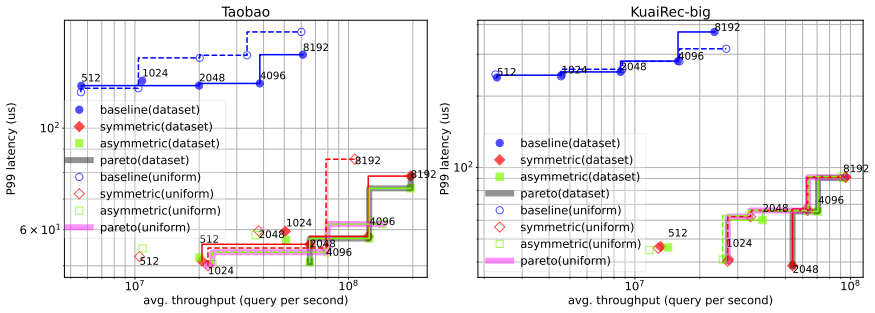
On the paper's own terms, the discovery is that DLRM embedding lookup can be split into four data flows — reading one row at a time from global memory or from a persistent on-chip buffer, or vectorized lookups that bring table chunks into the unified buffer before reading — and that these strategies can be combined with an automatic asymmetric table-to-core assignment. The asymmetric step splits each embedding table into chunks, optionally replicated, and places different chunks in the L1 buffers of different cores, effectively multiplying the usable on-chip table capacity by the number of cores. A greedy algorithm driven by the linear cost model in Eq. (2) chooses the strategy for every table, and the paper reports that the resulting schedules outperform the default Ascend compiler on all workloads for real query distributions, with the largest gains when the baseline suffers from L2 cache conflicts. The paper also presents a high-level bandwidth-based estimate suggesting the same approach would be competitive on an Nvidia A100.
Load-bearing premise
The automated mapping stands on the assumption that each embedding layer executes independently of the others and that a single linear formula with fitted coefficients predicts each table's P99 latency well enough that the greedy assignment picks a strategy that is at least as good as the baseline.
Editorial extensions
If this is right
- With P99 as the SLA metric, an operator can run the same batch size at the same P99 budget while lowering per-query cost, because asymmetric mapping reduces the tail latency caused by slow tables.
- Because the mapping is automatic and parameter-light, a new model version or new query skew does not require hand-tuning the data flow.
- The method's insensitivity to query distribution means a single compiled schedule can serve both uniform and skewed traffic without recompilation.
- If the high-level A100 estimate holds, the same four-strategy design could be offered as a compiler pass for GPU inference stacks.
Reading between the lines
- The fixed-distribution Criteo row in Table I suggests that the linear model can be wrong under worst-case bank conflicts; a natural extension is to add a fallback validation step that keeps the baseline schedule whenever a mapping's predicted P99 exceeds the measured baseline by a safety margin.
- If distribution independence holds across more workloads, recommendation platforms could replace per-query-distribution tuning with a single offline mapping computed once per model version, reducing operational overhead.
- The same asymmetric chunking idea should extend to embedding tables larger than the global memory by splitting them across multiple devices or by sending only the requested rows from the host, which the paper mentions as future work in passing.
Editorial analysis
A structured set of objections, weighed in public.
Referee Report
Summary. The paper addresses DLRM inference bottlenecked by embedding lookups on multi-core AI accelerators. It proposes four single-core data-flow strategies (GM, L1, GM-UB, L1-UB) and an automatic asymmetric table-to-core mapping algorithm guided by a linear performance model, with experiments on Ascend 910 hardware. Compared with the vendor's default compiler, the reported head-to-head measurements show 1.5x-6.5x P99 latency improvements on real workload distributions and up to about 20x on a fixed-distribution TenRec case, plus a high-level theoretical comparison with the A100.
Significance. If the results hold, the paper makes a practical contribution: a drop-in data-flow optimization for embedding lookups that improves inference latency and throughput on Ascend-class hardware, with plausible extension to GPUs. The strengths are the use of real hardware profiling, multiple public workloads, three query distributions, and a direct comparison against the vendor compiler. The central weakness is that the automatic mapper relies on a linear performance model (Eq. 2) that is never validated, and Table I contains an unexplained 4x-5x P99 regression for Criteo-1TB under the fixed distribution that directly contradicts the abstract's distribution-independence claim. These issues must be resolved before the automatic mapping and the distribution-independence claim can be accepted.
major comments (3)
- [Section IV, Table I (Criteo-1TB fixed-distribution row)] The proposed methods severely regress on Criteo-1TB with the fixed distribution: baseline P99 is 538 us, while symmetric and asymmetric measure 2632 us and 2148 us, respectively. This is a 4x-5x regression, and it contradicts the abstract's claim that the method is 'much more independent of the query distribution than the baseline': the baseline actually improves from 817 us (uniform) to 538 us (fixed), whereas the proposed symmetric method degrades from 530 us to 2632 us. The paper does not explain this failure. Because the auto-mapper selected the strategies that produced these measurements, this row is evidence that the automatic assignment can choose harmful strategies. The authors must explain the cause (e.g., bank conflicts, L1 thrashing, atomic accumulation overhead) and discuss how it affects the distribution-independence claim.
- [Section III-A, Eq. (2)] The linear additive latency model is never validated against held-out measurements. The model assumes that 'the execution of each embedding layer is independent of the other' and that P99 latency scales linearly with B*si/K and mi, with configuration-specific betas fit by OLS. No predicted-versus-measured comparison is provided, neither per table nor per workload. The Criteo-1TB fixed-distribution regression suggests that the model, or its independence assumption, can be badly wrong under contention. The authors should add a validation of Eq. (2), e.g., reporting the model's prediction error on held-out workloads and distributions, or at least per-table predicted and measured latencies for the configurations actually used. Without such validation, the automatic mapper is not established as safe for unseen workloads.
- [Section III-B (greedy asymmetric allocation)] The greedy algorithm's strategy choices are entirely driven by the fitted betas of Eq. (2), so any model error can flip the selected strategy and produce the kind of regression seen in Table I. The paper should include a robustness or sensitivity analysis: for instance, compare the current model-guided allocation against a simple heuristic (e.g., always L1 for tables that fit, GM otherwise), or perturb the fitted betas and measure how often the selected policies change and by how much the final P99 varies. Additionally, the 'Load Imbalance Factor (LIF) threshold' and the maximum chunk size are heuristic parameters that are mentioned but never quantified; their values and a sensitivity analysis should be reported to make the automatic mapping reproducible and to show that the results are not tuned to the specific workloads.
minor comments (4)
- [Table I header] The header reads 'P99 LATENCY [S/BATCH]' but the values are in microseconds (e.g., 22872µ, 817µ). Use 'µs/batch' consistently.
- [Section I (Introduction)] There is a typo: 'We propose innovativedata flow strategies' should read 'We propose innovative data flow strategies'.
- [References] Several references are malformed or incomplete, e.g., [9] lists 'j. Jean-Baptiste Tien' and [5] has a truncated subtitle. Please fix the reference formatting and complete all entries.
- [Section IV-B] The high-level A100 comparison in Figure 3 relies on unspecified hardware assumptions (e.g., peak bandwidth, conflict-free access). Briefly state the assumed parameters so the estimation is reproducible.
Circularity Check
No significant circularity: the reported speed-ups are measured hardware results, not outputs of the fitted performance model.
full rationale
The derivation chain is: (i) propose four lookup data flows; (ii) fit per-configuration linear coefficients in Eq. (2) to measured latencies to guide a greedy table-to-core assignment; (iii) apply the chosen policy and report the measured P99/throughput in Table I. The headline 1.5x-6.5x and 20x speedups are real hardware measurements under the selected policies, not model outputs; Eq. (2) is not used to synthesize the reported latencies. The fit is in-sample and unvalidated, and the Criteo-1TB fixed-distribution row (538 us baseline vs 2632/2148 us for the proposed strategies) indicates a possible model misspecification, but that is a robustness/correctness issue, not circularity. No load-bearing self-citations, imported uniqueness theorems, or ansatz-by-citation steps appear; the A100 analysis is explicitly called a high-level estimation based on declared specs. I therefore find no circular step by the stated standard.
Assumptions & free parameters
free parameters (4)
- beta coefficients of the linear latency model (beta0, beta1, beta2) =
not reported in the paper
- Load Imbalance Factor (LIF) threshold =
not reported
- Maximum chunk size and replication factor for table splitting =
replication factor fixed to 1; max chunk size unspecified
- Sorting and selection criteria for greedy allocation =
descending sequence length, ascending size
assumptions (4)
- domain assumption Embedding-layer execution times are independent of each other
- domain assumption P99 latency of the total workload is additive in per-table estimates Ji
- domain assumption The Ascend software stack supports persistent L1 buffer preloading
- domain assumption Estimating Nvidia A100 performance from declared specs with conflict-free, symmetric assumptions is representative
Cite this review
Pith. "Pith review of Deep Recommender Models Inference: Automatic Asymmetric Data Flow Optimization." pith.science (2026). https://pith.science/paper/TS4ZVW3T
@misc{pith2026250701676,
  author       = {Pith},
  title        = {Pith review of: Deep Recommender Models Inference: Automatic Asymmetric Data Flow Optimization},
  year         = {2026},
  howpublished = {\url{https://pith.science/paper/TS4ZVW3T}},
  note         = {Machine review of arXiv:2507.01676}
}
read the original abstract
Deep Recommender Models (DLRMs) inference is a fundamental AI workload accounting for more than 79% of the total AI workload in Meta's data centers. DLRMs' performance bottleneck is found in the embedding layers, which perform many random memory accesses to retrieve small embedding vectors from tables of various sizes. We propose the design of tailored data flows to speedup embedding look-ups. Namely, we propose four strategies to look up an embedding table effectively on one core, and a framework to automatically map the tables asymmetrically to the multiple cores of a SoC. We assess the effectiveness of our method using the Huawei Ascend AI accelerators, comparing it with the default Ascend compiler, and we perform high-level comparisons with Nvidia A100. Results show a speed-up varying from 1.5x up to 6.5x for real workload distributions, and more than 20x for extremely unbalanced distributions. Furthermore, the method proves to be much more independent of the query distribution than the baseline.
Figures


Figures from the paper (1 more)

Reference graph
Works this paper leans on
-
[1]
Notes from the ai frontier: Insights from hundreds of use cases,
M. Chui et al., “Notes from the ai frontier: Insights from hundreds of use cases,” McKinsey Global Institute , vol. 2, 2018
work page 2018
-
[2]
The Architectural Implications of Facebook’s DNN- Based Personalized Recommendation,
U. Gupta et al., “The Architectural Implications of Facebook’s DNN- Based Personalized Recommendation,” in Proc. IEEE HPCA , 2020
work page 2020
-
[3]
FleetRec: Large-Scale Recommendation Inference on Hybrid GPU-FPGA Clusters,
W. Jiang et al., “FleetRec: Large-Scale Recommendation Inference on Hybrid GPU-FPGA Clusters,” in Proc. ACM SIGKDD , 2021
work page 2021
-
[4]
MicroRec: Efficient Recommendation Inference by Hardware and Data Structure Solutions
W. Jiang, et al., “MicroRec: Efficient Recommendation Inference by Hardware and Data Structure Solutions.” ETH Zurich, Apr. 2021
work page 2021
-
[5]
EVStore: Storage and Caching Capabilities
D. H. Kurniawan et al., “EVStore: Storage and Caching Capabilities..” in Proc. ACM ASPLOS , 2023
work page 2023
-
[6]
AutoShard: Automated Embedding Table Sharding for Recommender Systems,
D. Zha et al., “AutoShard: Automated Embedding Table Sharding for Recommender Systems,” in Proc. ACM SIGKDD , 2022
work page 2022
-
[7]
3.2 The A100 Datacenter GPU and Ampere Architecture,
J. Choquette et al., “3.2 The A100 Datacenter GPU and Ampere Architecture,” in ISSCC, 2021
work page 2021
-
[8]
Ascend: a scalable and unified architecture for ubiqui- tous
H. Liao et al., “Ascend: a scalable and unified architecture for ubiqui- tous..” in Proc. IEEE HPCA , 2021
work page 2021
Show all 13 references
-
[9]
Display advertising challenge,
j. Jean-Baptiste Tien, “Display advertising challenge,” 2014
2014
-
[10]
Click-through rate prediction,
W. C. Steve Wang, “Click-through rate prediction,” 2014
2014
-
[11]
How serendipity improves user satisfaction with recom- mendations?
L. Chen et al., “How serendipity improves user satisfaction with recom- mendations?..” in The world wide web conference , 2019
2019
-
[12]
Tenrec: A Large-scale Multipurpose Benchmark Dataset for Recommender Systems,
G. Yuan et al., “Tenrec: A Large-scale Multipurpose Benchmark Dataset for Recommender Systems,” in Adv. NeurIPS, 2022
2022
-
[13]
KuaiRec: A Fully-observed Dataset and Insights for Evaluating Recommender Systems,
C. Gao et al., “KuaiRec: A Fully-observed Dataset and Insights for Evaluating Recommender Systems,” in Proc. ACM CIKM , 2022
2022
Reviewed August 6, 2026 · model on record in the stance chip above.
Discussion (0). Sign in to comment.