REVIEW 2 major objections 4 minor 48 references
Soft Self-labeling and Potts Relaxations for Weakly-Supervised Segmentation
T0 review · 2 major / 4 minor · reviewed 2026-08-06 · deepseek-v4-flash
Pith's one-line read Soft self-labeling with scribble annotations can beat full pixel-mask supervision.
desk verdict Solid soft self-labeling framework with clean derivations; empirical claims rest on a pseudo-label solver validated only for the convex relaxation, with thin margins. read the letter →
The pith
A machine-rendered reading of the paper's core claim, the machinery that carries it, and where it could break.
The reading
What carries the argument
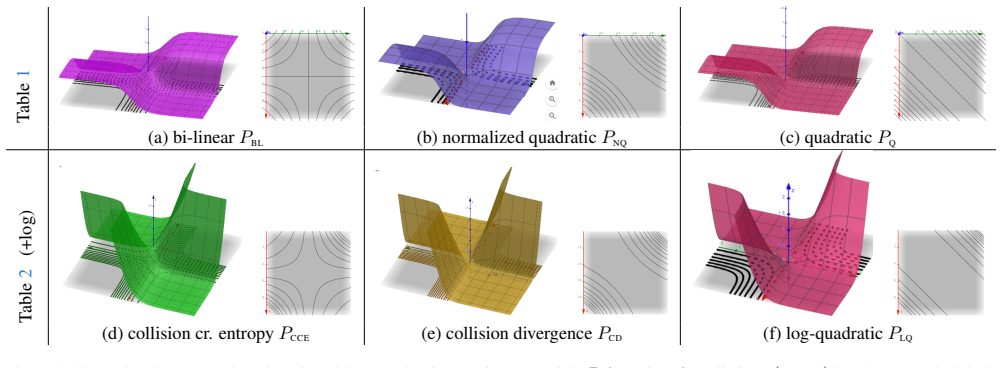
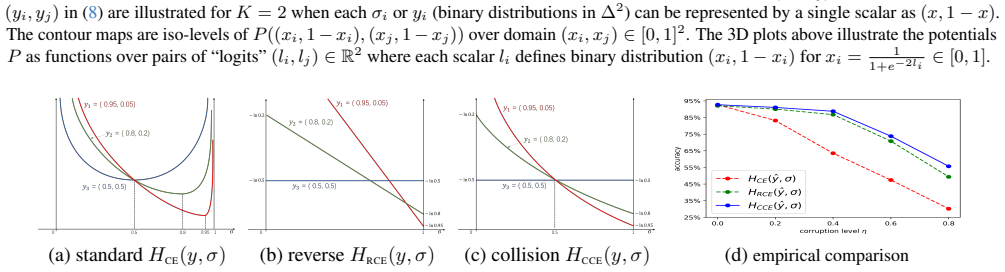
The load-bearing object is the joint self-labeling loss (8), which couples network predictions $\sigma_i$ with auxiliary soft pseudo-labels $y_i$ on the probability simplex: scribble pixels are fixed to ground truth, unlabeled pixels are free distributions. Alternating sub-problems—stochastic gradient descent on the network and a GPU gradient-descent solver on a softmax parameterization of the pseudo-labels—make the iteration convergent. The named innovations are collision cross-entropy $H_{\mathrm{CCE}}(y,\sigma) = -\ln(\sigma^\top y)$, which maximizes the probability that predicted and pseudo-labeled classes agree without forcing the network to copy uncertainty, and collision divergence $P_{\mathrm{CD}}$, the logarithm of a normalized quadratic Potts relaxation, which removes the flat-gradient and local-minimum problems of bilinear and plain quadratic forms.
What would settle it
Run the recommended PCD/PCCE pseudo-label sub-problem on a small set of images with a global optimizer (an exhaustive multi-start search over the small neighborhood graph) and compare both the similarity of the pseudo-labels to the true optimum and the final network mIoU against the paper's 200-step gradient descent; if the global pseudo-labels do not reproduce the reported advantage over full supervision, the central claim depends on the solver rather than the loss.
Extended reading notes
Core claim
The central claim is that the bottleneck in scribble-supervised segmentation is the optimization of the unsupervised Potts loss, not the network architecture: replacing hard pseudo-labels with soft ones, and the standard cross-entropy target with a symmetric probability-of-collision term, produces a convergent self-labeling procedure that outperforms much more complex systems. The paper reports that on PASCAL VOC 2012, DeepLabV3+ trained with its loss and only scribbles reaches 77.7 mean intersection-over-union (mIoU) at batch size 12, versus 76.6 for the same architecture trained on full pixel masks; with a ViT-linear backbone it reaches 80.94 mIoU, above the best specialized system on the same backbone at 78.7 mIoU.
Load-bearing premise
The load-bearing assumption is that the 200-step gradient-descent routine that estimates soft pseudo-labels lands close to the true optimum of a difficult, many-valley objective; if it gets stuck in a poor local valley, the reported gains would not transfer to a different solver or dataset.
Editorial extensions
If this is right
- Scribble-supervised training with loss (8) becomes a drop-in replacement for full supervision on standard segmentation architectures, removing the need for specialized modules or multi-stage training.
- The recommended combination of collision cross-entropy and collision divergence over a nearest-neighbor grid is the configuration to use; dense neighborhoods and non-normalized relaxations are systematically worse.
- Because the pseudo-label solver can be run for 100 instead of 200 gradient steps at a cost of only 0.72 mIoU, the method offers a practical speed-accuracy trade-off.
- Hard-pseudo-label self-labeling methods are limited by their inability to represent class uncertainty; any such system can in principle be upgraded to soft labels under the same joint-loss derivation.
Reading between the lines
- Editorial inference: the reported advantage over full supervision at batch size 12 may depend on how the full-supervision baselines were trained; a comparison with larger batches or stronger augmentation would test whether the gap is intrinsic.
- Editorial inference: the paper checks its pseudo-label solver against global optima only for the convex quadratic relaxation, so the non-convex PCD/PCCE results leave open how much of the gain is solver-dependent.
- Editorial inference: because the method makes no architectural assumptions, it should transfer to backbones beyond ResNet/MobileNet/ViT; testing on a newer convnet or transformer with stronger pretraining would extend the evidence.
- Editorial inference: the robustness of collision cross-entropy to label uncertainty, shown in a corrupted-label classification experiment, suggests uses in noisy-label learning and knowledge distillation, though the paper does not claim those.
Editorial analysis
A structured set of objections, weighed in public.
Referee Report
Summary. The paper proposes a soft self-labeling framework for weakly supervised semantic segmentation with scribble annotations. It derives an auxiliary loss (Eq. 8) by ADM splitting of a regularized loss (Eq. 4), introducing soft pseudo-labels y for unlabeled pixels and iterating between optimizing the network and the pseudo-labels. The authors systematically study several Potts relaxations (bilinear, quadratic, normalized quadratic, and log-based variants) and several cross-entropy-like terms (standard, reverse, and collision cross-entropy). A continuous gradient-descent solver for the pseudo-label subproblem is described in Appendix A. Experiments on Pascal VOC 2012, Cityscapes, and ADE20k report consistent gains over scribble-based baselines, state-of-the-art results among methods using standard architectures, and one configuration (DeepLabV3+, batch 12) where scribble supervision with the proposed loss (77.7 mIoU) outperforms training with full pixel masks (76.6 mIoU).
Significance. If the results hold, the paper offers a simple and reproducible recipe for scribble-supervised segmentation: standard architectures trained with loss (8) using collision cross-entropy and collision divergence outperform substantially more complex specialized WSSS systems and can approach or exceed full supervision. The algebraic identity H(sigma)+KL(sigma,y)=H(sigma,y) underlying Eq. (8) is clean, the evaluation is systematic across relaxations, cross-entropy terms, neighborhood systems, scribble lengths, backbones, and datasets, and the benchmark numbers are external and not fitted. The main uncertainty is the pseudo-label solver: its near-global optimality is verified only for the convex quadratic relaxation, while the recommended non-convex terms carry the headline claims. This is an empirical gap rather than a mathematical error, but it is load-bearing for the SOTA and full-supervision comparisons.
major comments (2)
- [Appendix A, Table 3, Table 5] The pseudo-label solver is validated against global optima only for the convex quadratic relaxation PQ (99.2% soft Jaccard over 100 images), but the appendix itself notes that the softmax reparameterization makes the problem non-convex, and the recommended terms PCD, PCCE, and PLQ are non-convex in y. The main comparative claims rely on PCD (Table 5) and on the ranking in Table 3, where the margin between PCD and PQ is only 0.17 mIoU (71.22 vs 71.05); the full-supervision overperformance in Table 5 is 1.1 mIoU (77.7 vs 76.6). A solver that finds moderately worse local minima for PCD could erase or invert these margins. Please provide solver validation for the non-convex recommended terms (e.g., comparison with a stronger discrete or continuous solver on small problems, or a demonstration that the joint loss decreases monotonically in the alternating scheme), or explicitly qualify the SOTA and full-supervision claims.
- [Section 2.2 and Eq. (8)] The notation in Eq. (8) is internally inconsistent. The derivation from Eq. (4) uses the identity H(sigma_i)+KL(sigma_i,y_i)=H(sigma_i,y_i), so the H in Eq. (8) is the Shannon cross-entropy H(sigma,y), which is exactly the reverse cross-entropy HRCE of Eq. (10). Section 3.1 then selects HCCE (Eq. 11) as 'the cross-entropy term in (8)', but HCCE is not the Shannon cross-entropy and is not justified by the ADM derivation. The paper should either define H in Eq. (8) as a placeholder for a family of cross-entropy-style terms and state which convergence or monotonicity guarantees hold for each member, or clearly separate the derived loss from the heuristic HCCE variant.
minor comments (4)
- [Eq. (8)] The symbol H(σ_i,y_i) is used both for the Shannon cross-entropy in the derivation and as a placeholder for HCE, HRCE, and HCCE later in the paper; please disambiguate the notation at first use.
- [Table 3] The differences among PNQ, PQ, PCD, and PLQ at full scribbles are within 0.2 mIoU (71.05–71.22), so a single training run per configuration makes the reported ranking fragile; please report multiple seeds or state explicitly that the differences are not statistically significant.
- [Appendix A] The sentence 'To solve y at given σ, it is a large-scale constrained convex problem' is accurate only for some terms (e.g., PQ with a convex unary); for the recommended non-convex terms it should be rephrased to avoid implying convexity.
- [Section 1.3 and Section 4] The phrase 'guaranteed convergence' should be qualified to the specific loss and solver; the current wording may overstate the guarantee for the non-convex HCCE/PCD combination used in the headline experiments.
Circularity Check
No significant circularity: the central claims are external-benchmark measurements built from parameter-free loss definitions, the self-cited baselines are reproduced with public code, and the Appendix A solver-optimality gap is an empirical limitation rather than a construction-level circular step.
full rationale
The derivation chain is transparent and self-contained. The paper starts from the standard weakly-supervised loss (4), applies ADM splitting, and obtains the joint self-labeling loss (8) via an explicitly stated approximation: "For simplicity, we use weight eta for KL(sigma_i, y_i) to combine it with H(sigma_i) into a single cross-entropy term." Every quantity in (8) is a parameter-free function definition (the Potts relaxations in Tables 1-2 and the cross-entropy variants in eqs. 9-11); none is defined in terms of the benchmark metrics it later reports, and no fitted constant is renamed as a prediction. The headline results (Tables 3, 5, 6 and Figure 5) are direct evaluations on the held-out Pascal VOC, Cityscapes, and ADE20k validation sets. Self-citation to the group's prior Potts self-labeling work [28, 29, 30, 37, 38, 40] is present and is used for methodological lineage (ADM splitting is standard, [5]) and for baseline comparisons, but Table 4 caption states "Reproduced results using public code are marked by *," so the cited baseline numbers are independently verified rather than taken on authority. No uniqueness theorem is imported from the authors and no ansatz is smuggled via self-citation: the softmax reparameterization in Appendix A is attributed to the external reference [47]. The flagged limitation to weigh in the verdict: Appendix A admits that "the original convex problem now becomes non-convex due to the Softmax operation" and validates the pseudo-label solver only against the global optimum of the convex quadratic relaxation (99.2% soft Jaccard on 100 images), not for the recommended non-convex PCD/PCCE terms; the Table 3 margin of PCD over PQ is only 0.17 mIoU (71.22 vs 71.05). This is an empirical robustness gap that could undermine the ablations if the solver lands in poor local minima for the non-convex relaxations, but it is not construction-level circularity: loss (8), the relaxations, and the solver are all defined independently of the reported outcomes, and the central SOTA and full-supervision comparisons are measurements on external validation data. Score 1 reflects the presence of minor self-citation and the unverified solver-optimality assumption, both non-circular in nature.
Assumptions & free parameters
free parameters (4)
- eta (unlabeled cross-entropy weight) =
0.3
- lambda (Potts weight) =
6
- color bandwidth (edge affinity sigma) =
9 for Pascal VOC, 3 for Cityscapes/ADE20k, 100 for dense-neighborhood experiments
- pseudo-label solver steps and learning rate =
200 steps, learning rate 0.075
assumptions (6)
- domain assumption The Potts model with intensity-edge-based affinities is an effective regularizer for segmentation.
- domain assumption Scribble labels on S are correct hard ground truth.
- ad hoc to paper Replacing the constraint sigma_i = y_i by a cross-entropy penalty yields a faithful approximation of loss (4).
- ad hoc to paper Softmax reparameterization with gradient descent finds near-global pseudo-label solutions.
- ad hoc to paper Maximizing the collision probability -ln(sigma^T y) is a sound training objective for soft targets.
- standard math Standard convex analysis and information-theoretic identities used in the derivation (H + KL = cross-entropy, KL convex in the second argument, softmax differentiability).
Cite this review
Pith. "Pith review of Soft Self-labeling and Potts Relaxations for Weakly-Supervised Segmentation." pith.science (2026). https://pith.science/paper/AHDF4BYX
@misc{pith2026250701721,
  author       = {Pith},
  title        = {Pith review of: Soft Self-labeling and Potts Relaxations for Weakly-Supervised Segmentation},
  year         = {2026},
  howpublished = {\url{https://pith.science/paper/AHDF4BYX}},
  note         = {Machine review of arXiv:2507.01721}
}
read the original abstract
We consider weakly supervised segmentation where only a fraction of pixels have ground truth labels (scribbles) and focus on a self-labeling approach optimizing relaxations of the standard unsupervised CRF/Potts loss on unlabeled pixels. While WSSS methods can directly optimize such losses via gradient descent, prior work suggests that higher-order optimization can improve network training by introducing hidden pseudo-labels and powerful CRF sub-problem solvers, e.g. graph cut. However, previously used hard pseudo-labels can not represent class uncertainty or errors, which motivates soft self-labeling. We derive a principled auxiliary loss and systematically evaluate standard and new CRF relaxations (convex and non-convex), neighborhood systems, and terms connecting network predictions with soft pseudo-labels. We also propose a general continuous sub-problem solver. Using only standard architectures, soft self-labeling consistently improves scribble-based training and outperforms significantly more complex specialized WSSS systems. It can outperform full pixel-precise supervision. Our general ideas apply to other weakly-supervised problems/systems.
Figures

Figures from the paper (3 more)


Reference graph
Works this paper leans on
-
[1]
Multilabel random walker image segmentation using prior models. In 2005 IEEE computer society conference on com- puter vision and pattern recognition (CVPR’05), pages 763–
work page 2005
-
[2]
Jiwoon Ahn and Suha Kwak. Learning pixel-level semantic affinity with image-level supervision for weakly supervised semantic segmentation. In Proceedings of the IEEE con- ference on computer vision and pattern recognition , pages 4981–4990, 2018. 2
work page 2018
-
[3]
Weakly su- pervised learning of instance segmentation with inter-pixel relations
Jiwoon Ahn, Sunghyun Cho, and Suha Kwak. Weakly su- pervised learning of instance segmentation with inter-pixel relations. In Proceedings of the IEEE/CVF conference on computer vision and pattern recognition, pages 2209–2218,
-
[4]
Single-stage seman- tic segmentation from image labels
Nikita Araslanov and Stefan Roth. Single-stage seman- tic segmentation from image labels. In Proceedings of the IEEE/CVF Conference on Computer Vision and Pattern Recognition, pages 4253–4262, 2020. 1
work page 2020
-
[5]
Stephen Boyd and Lieven Vandenberghe. Convex optimiza- tion. Cambridge university press, 2004. 3
work page 2004
-
[6]
Computing geodesics and minimal surfaces via graph cuts
Yuri Boykov and Vladimir Kolmogorov. Computing geodesics and minimal surfaces via graph cuts. In Inter- national conference on computer vision (ICCV) , 2003. 3, 8
work page 2003
-
[7]
Interactive graph cuts for opti- mal boundary & region segmentation of objects in nd images
Yuri Y Boykov and M-P Jolly. Interactive graph cuts for opti- mal boundary & region segmentation of objects in nd images. In international conference on computer vision (ICCV), pages 105–112, 2001. 2, 3
work page 2001
-
[8]
Unsu- pervised classifiers, mutual information and’phantom targets
John Bridle, Anthony Heading, and David MacKay. Unsu- pervised classifiers, mutual information and’phantom targets. Advances in neural information processing systems, 4, 1991. 2
work page 1991
Show all 48 references
-
[9]
A first-order primal- dual algorithm for convex problems with applications to imag- ing
Antonin Chambolle and Thomas Pock. A first-order primal- dual algorithm for convex problems with applications to imag- ing. Journal of mathematical imaging and vision, 40:120–145,
-
[10]
Seminar learning for click-level weakly supervised semantic segmentation
Hongjun Chen, Jinbao Wang, Hong Cai Chen, Xiantong Zhen, Feng Zheng, Rongrong Ji, and Ling Shao. Seminar learning for click-level weakly supervised semantic segmentation. In Proceedings of the IEEE/CVF International Conference on Computer Vision, pages 6920–6929, 2021. 2, 8
2021
-
[11]
Semantic image segmen- tation with deep convolutional nets and fully connected crfs
Liang-Chieh Chen, George Papandreou, Iasonas Kokkinos, Kevin Murphy, and Alan L Yuille. Semantic image segmen- tation with deep convolutional nets and fully connected crfs. arXiv preprint arXiv:1412.7062, 2014. 6, 11
2014 arXiv
-
[12]
Deeplab: Semantic image segmentation with deep convolutional nets, atrous convolu- tion, and fully connected crfs
Liang-Chieh Chen, George Papandreou, Iasonas Kokkinos, Kevin Murphy, and Alan L Yuille. Deeplab: Semantic image segmentation with deep convolutional nets, atrous convolu- tion, and fully connected crfs. IEEE transactions on pattern analysis and machine intelligence, 40(4):834–...
2017
-
[13]
Encoder-decoder with atrous separable convolution for semantic image segmentation
Liang-Chieh Chen, Yukun Zhu, George Papandreou, Florian Schroff, and Hartwig Adam. Encoder-decoder with atrous separable convolution for semantic image segmentation. In Proceedings of the European conference on computer vision (ECCV), pages 801–818, 2018. 6, 8, 11
2018
-
[14]
The cityscapes dataset for se- mantic urban scene understanding
Marius Cordts, Mohamed Omran, Sebastian Ramos, Timo Rehfeld, Markus Enzweiler, Rodrigo Benenson, Uwe Franke, Stefan Roth, and Bernt Schiele. The cityscapes dataset for se- mantic urban scene understanding. In Proc. of the IEEE Con- ference on Computer Vision and Pattern Recogn...
-
[15]
Power watershed: A unifying graph-based optimiza- tion framework
Camille Couprie, Leo Grady, Laurent Najman, and Hugues Talbot. Power watershed: A unifying graph-based optimiza- tion framework. IEEE transactions on pattern analysis and machine intelligence, 33(7):1384–1399, 2010. 2
2010
-
[16]
Imagenet: A large-scale hierarchical image database
Jia Deng, Wei Dong, Richard Socher, Li-Jia Li, Kai Li, and Li Fei-Fei. Imagenet: A large-scale hierarchical image database. In 2009 IEEE conference on computer vision and pattern recognition, pages 248–255. Ieee, 2009. 6
2009
-
[17]
An image is worth 16x16 words: Trans- formers for image recognition at scale
Alexey Dosovitskiy. An image is worth 16x16 words: Trans- formers for image recognition at scale. arXiv preprint arXiv:2010.11929, 2020. 6, 8
2010 arXiv
-
[18]
The pascal visual object classes (voc) challenge
Mark Everingham, Luc Van Gool, Christopher KI Williams, John Winn, and Andrew Zisserman. The pascal visual object classes (voc) challenge. International journal of computer vision, 88:303–308, 2009. 6, 11
2009
-
[19]
Random walks for image segmentation
Leo Grady. Random walks for image segmentation. IEEE transactions on pattern analysis and machine intelligence, 28 (11):1768–1783, 2006. 2, 3, 7, 8, 11
2006
-
[20]
Semi-supervised learn- ing by entropy minimization
Yves Grandvalet and Yoshua Bengio. Semi-supervised learn- ing by entropy minimization. Advances in neural information processing systems, 17, 2004. 2
2004
-
[21]
Deep residual learning for image recognition
Kaiming He, Xiangyu Zhang, Shaoqing Ren, and Jian Sun. Deep residual learning for image recognition. In Proceed- ings of the IEEE conference on computer vision and pattern recognition, pages 770–778, 2016. 6
2016
-
[22]
Universal weakly supervised segmentation by pixel-to-segment con- trastive learning
Tsung-Wei Ke, Jyh-Jing Hwang, and Stella X Yu. Universal weakly supervised segmentation by pixel-to-segment con- trastive learning. arXiv preprint arXiv:2105.00957, 2021. 2, 8
2021 arXiv
-
[23]
Seed, ex- pand and constrain: Three principles for weakly-supervised image segmentation
Alexander Kolesnikov and Christoph H Lampert. Seed, ex- pand and constrain: Three principles for weakly-supervised image segmentation. In Computer Vision–ECCV 2016: 14th European Conference, Amsterdam, The Netherlands, Octo- ber 11–14, 2016, Proceedings, Part IV 14 , pages 695...
2016
-
[24]
Efficient inference in fully connected CRFs with Gaussian edge potentials
Philipp Krähenbühl and Vladlen Koltun. Efficient inference in fully connected CRFs with Gaussian edge potentials. Ad- vances in neural information processing systems, 24, 2011. 2
2011
-
[25]
Kulharia, S
V . Kulharia, S. Chandra, A. Agrawal, P. Torr, and A. Tyagi. Box2seg: Attention weighted loss and discriminative feature learning for weakly supervised segmentation. In ECCV’20. 1
-
[26]
Ficklenet: Weakly and semi-supervised se- mantic image segmentation using stochastic inference
Jungbeom Lee, Eunji Kim, Sungmin Lee, Jangho Lee, and Sungroh Yoon. Ficklenet: Weakly and semi-supervised se- mantic image segmentation using stochastic inference. In Proceedings of the IEEE/CVF Conference on Computer Vi- sion and Pattern Recognition, pages 5267–5276, 2019. 2
2019
-
[27]
Tree energy loss: Towards sparsely annotated semantic segmentation
Zhiyuan Liang, Tiancai Wang, Xiangyu Zhang, Jian Sun, and Jianbing Shen. Tree energy loss: Towards sparsely annotated semantic segmentation. In Proceedings of the IEEE/CVF Conference on Computer Vision and Pattern Recognition , pages 16907–16916, 2022. 2, 3, 6, 8, 11 9
2022
-
[28]
Scribblesup: Scribble-supervised convolutional networks for semantic segmentation
Di Lin, Jifeng Dai, Jiaya Jia, Kaiming He, and Jian Sun. Scribblesup: Scribble-supervised convolutional networks for semantic segmentation. In Proceedings of the IEEE con- ference on computer vision and pattern recognition , pages 3159–3167, 2016. 1, 2, 6, 7, 8, 11
2016
-
[29]
Robust trust region for weakly supervised segmentation
Dmitrii Marin and Yuri Boykov. Robust trust region for weakly supervised segmentation. In Proceedings of the IEEE/CVF International Conference on Computer Vision , pages 6608–6618, 2021. 2, 7, 8, 11
2021
-
[30]
Beyond gradient descent for regularized segmen- tation losses
Dmitrii Marin, Meng Tang, Ismail Ben Ayed, and Yuri Boykov. Beyond gradient descent for regularized segmen- tation losses. In Proceedings of the IEEE/CVF Conference on Computer Vision and Pattern Recognition, pages 10187– 10196, 2019. 2, 3, 7
2019
-
[31]
When does label smoothing help? Advances in neural infor- mation processing systems, 32, 2019
Rafael Müller, Simon Kornblith, and Geoffrey E Hinton. When does label smoothing help? Advances in neural infor- mation processing systems, 32, 2019. 5
2019
-
[32]
Natural Scenes Dataset [NSD]
NSD. Natural Scenes Dataset [NSD]. https : / / www.kaggle.com/datasets/nitishabharathi/ scene-classification, 2020. 5
2020
-
[33]
Scribble-supervised semantic segmentation by uncertainty reduction on neural representation and self- supervision on neural eigenspace
Zhiyi Pan, Peng Jiang, Yunhai Wang, Changhe Tu, and An- thony G Cohn. Scribble-supervised semantic segmentation by uncertainty reduction on neural representation and self- supervision on neural eigenspace. In Proceedings of the IEEE/CVF International Conference on Computer Vis...
2021
-
[34]
A convex relaxation approach for comput- ing minimal partitions
Thomas Pock, Antonin Chambolle, Daniel Cremers, and Horst Bischof. A convex relaxation approach for comput- ing minimal partitions. In IEEE Conference on Computer Vision and Pattern Recognition, pages 810–817, 2009. 2
2009
-
[35]
Quadratic program- ming relaxations for metric labeling and Markov Random Field MAP estimation
Pradeep Ravikumar and John Lafferty. Quadratic program- ming relaxations for metric labeling and Markov Random Field MAP estimation. In The 23rd International Conference on Machine Learning, page 737–744, 2006. 2, 3
2006
-
[36]
Mobilenetv2: Inverted residuals and linear bottlenecks
Mark Sandler, Andrew Howard, Menglong Zhu, Andrey Zh- moginov, and Liang-Chieh Chen. Mobilenetv2: Inverted residuals and linear bottlenecks. In Proceedings of the IEEE conference on computer vision and pattern recognition, pages 4510–4520, 2018. 6
2018
-
[37]
Normalized cut loss for weakly-supervised cnn segmentation
Meng Tang, Abdelaziz Djelouah, Federico Perazzi, Yuri Boykov, and Christopher Schroers. Normalized cut loss for weakly-supervised cnn segmentation. In Proceedings of the IEEE conference on computer vision and pattern recognition, pages 1818–1827, 2018. 1, 6, 7, 11
2018
-
[38]
On reg- ularized losses for weakly-supervised cnn segmentation
Meng Tang, Federico Perazzi, Abdelaziz Djelouah, Ismail Ben Ayed, Christopher Schroers, and Yuri Boykov. On reg- ularized losses for weakly-supervised cnn segmentation. In Proceedings of the European Conference on Computer Vision (ECCV), pages 507–522, 2018. 1, 2, 6, 7, 8, 11
2018
-
[39]
Efficient graph cut optimization for full crfs with quantized edges
Olga Veksler. Efficient graph cut optimization for full crfs with quantized edges. IEEE transactions on pattern analysis and machine intelligence, 42(4):1005–1012, 2019. 7, 8
2019
-
[40]
Sparse non-local crf
Olga Veksler and Yuri Boykov. Sparse non-local crf. In Pro- ceedings of the IEEE/CVF Conference on Computer Vision and Pattern Recognition, pages 4493–4503, 2022. 2, 8
2022
-
[41]
Boundary perception guidance: A scribble-supervised semantic segmentation ap- proach
Bin Wang, Guojun Qi, Sheng Tang, Tianzhu Zhang, Yunchao Wei, Linghui Li, and Yongdong Zhang. Boundary perception guidance: A scribble-supervised semantic segmentation ap- proach. In IJCAI International joint conference on artificial intelligence, 2019. 2, 8
2019
-
[42]
Treating pseudo-labels generation as image matting for weakly supervised semantic segmentation
Changwei Wang, Rongtao Xu, Shibiao Xu, Weiliang Meng, and Xiaopeng Zhang. Treating pseudo-labels generation as image matting for weakly supervised semantic segmentation. In Proceedings of the IEEE/CVF International Conference on Computer Vision, pages 755–765, 2023. 2
2023
-
[43]
Modeling the label distributions for weakly-supervised semantic segmentation
Linshan Wu, Zhun Zhong, Jiayi Ma, Yunchao Wei, Hao Chen, Leyuan Fang, and Shutao Li. Modeling the label distributions for weakly-supervised semantic segmentation. arXiv preprint arXiv:2403.13225, 2024. 8
2024 arXiv
-
[44]
Scribble- supervised semantic segmentation inference
Jingshan Xu, Chuanwei Zhou, Zhen Cui, Chunyan Xu, Yuge Huang, Pengcheng Shen, Shaoxin Li, and Jian Yang. Scribble- supervised semantic segmentation inference. In Proceedings of the IEEE/CVF International Conference on Computer Vi- sion, pages 15354–15363, 2021. 2, 3, 8
2021
-
[45]
What is optimized in tight convex relaxations for multi-label prob- lems? In IEEE Conference on Computer Vision and Pattern Recognition, pages 1664–1671, 2012
Christopher Zach, Christian Häne, and Marc Pollefeys. What is optimized in tight convex relaxations for multi-label prob- lems? In IEEE Conference on Computer Vision and Pattern Recognition, pages 1664–1671, 2012. 2
2012
-
[46]
Scene parsing through ade20k dataset
Bolei Zhou, Hang Zhao, Xavier Puig, Sanja Fidler, Adela Bar- riuso, and Antonio Torralba. Scene parsing through ade20k dataset. In Proceedings of the IEEE conference on computer vision and pattern recognition, pages 633–641, 2017. 6, 11
2017
-
[47]
Learning from labeled and unlabeled data with label propagation
Xiaojin Zhu and Zoubin Ghahramani. Learning from labeled and unlabeled data with label propagation. ProQuest Number: INFORMATION TO ALL USERS, 2002. 11 10 A. Optimization Algorithm In this section, we will focus on the optimization of our loss where we iterate the optimization...
2002
-
[48]
The backbone is ResNet101
and use 50% of full annotations for supervision following [27]. The backbone is ResNet101. “∗”: reproduced results. All methods are trained in a single-stage fashion. 11
Reviewed August 6, 2026 · model on record in the stance chip above.
Discussion (0). Continue with ORCID to comment.