REVIEW 3 major objections 5 minor 1 cited by
Tailoring hard magnetic properties of Fe2MnSn Heusler alloy via interstitial modification: A first-principles approach
T0 review · 3 major / 5 minor · reviewed 2026-08-06 · deepseek-v4-flash
Pith's one-line read Interstitial doping with light elements such as nitrogen can flip Fe2MnSn's magnetic easy axis from in-plane to out-of-plane, making the alloy a candidate rare-earth-free permanent magnet.
desk verdict A clean DFT screening paper predicting that 12.5 at% N turns hexagonal Fe2MnSn uniaxial, but the realisability of the doped phase is under-supported. read the letter →
The pith
A machine-rendered reading of the paper's core claim, the machinery that carries it, and where it could break.
The reading
What carries the argument
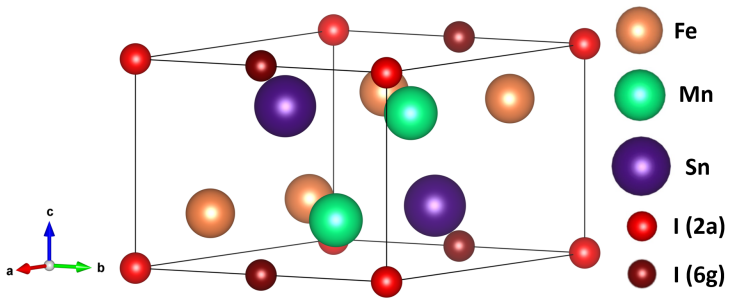
The central object is the octahedral interstitial $2a$ site $(0,0,0)$ of the hexagonal D019 cell, which all dopants except fluorine prefer, with fluorine taking the $6g$ site. The argument is carried by first-principles total-energy and spin-orbit calculations: the magnetocrystalline anisotropy energy is obtained through the magnetic force theorem as $\mathrm{MAE} = E[100]-E[001]$, and it is decomposed by second-order perturbation theory into $d$-orbital spin-orbit matrix elements for the inequivalent Fe1, Fe2, and Mn atoms. The mechanism that produces the anisotropy switch is the occupation of the $d_{x^2-y^2}$ state together with the emptiness of the $d_{xy}$ state near the Fermi level, which makes the $\langle x^2-y^2\uparrow|L_z|xy\uparrow\rangle$ matrix element favor out-of-plane magnetization; Curie temperatures are obtained from Heisenberg exchange parameters $J_{ij}$ derived from a Green's-function method and evaluated in a mean-field approximation.
What would settle it
A synthesis attempt at 12.5 at% N, or a phonon or competing-phase calculation, that finds a second phase, decomposition into Fe2MnSn plus a nitride, or an easy axis that stays in-plane would falsify the central claim. Concretely, measuring the anisotropy constant of N-doped Fe2MnSn and finding $K$ near zero or negative, or a Curie temperature far from 744 K, would show the predicted out-of-plane uniaxial state does not form.
Extended reading notes
Core claim
The central claim is that the hexagonal D019 phase of Fe2MnSn, whose easy axis is in-plane, can be transformed into an out-of-plane uniaxial magnet by 12.5 at% interstitial doping. Among the six dopants tested, nitrogen performs best: N-Fe2MnSn reaches a magnetic anisotropy constant $K = 0.61$ MJ/m$^3$ (MAE $0.45$ meV per formula unit), a saturation magnetization of 1.34 T, a hardness parameter $\kappa = 0.65$, and a maximum energy product of 0.36 MJ/m$^3$, while retaining a Curie temperature of 744 K. The authors attribute the anisotropy switch to doping-induced lattice distortion and $p$-$d$ hybridization that alter the crystal field and shift the spin-orbit-coupling contributions of Fe and Mn $d$ orbitals, with the dominant term being the spin-conserved coupling $\langle x^2-y^2\uparrow|L_z|xy\uparrow\rangle$ at the Fe sites. They also report that most dopants raise the Curie temperature, up to 1058 K for oxygen, and that the magnetization of the doped compounds exceeds that of ferrites and the gap magnets MnAl and MnBi.
Load-bearing premise
The result stands on the assumption that the doped compound remains single-phase hexagonal Fe2MnSn with the interstitial atom at the predicted octahedral site, with 0 K formation energies taken as proof of stability and no phonon, finite-temperature, or competing-phase analysis performed.
Editorial extensions
If this is right
- If the calculations are right, N-doped Fe2MnSn is a viable gap magnet: uniaxial anisotropy of 0.61 MJ/m^3, magnetization of 1.34 T, Curie temperature of 744 K, and hardness parameter 0.65.
- B-doped Fe2MnSn offers a close second with 0.44 MJ/m^3 and hardness 0.59, while oxygen and carbon doping push the Curie temperature to 1058 K and 1000 K, respectively.
- The anisotropy switch appears only at 12.5 at% doping, so interstitial concentration acts as a control knob for the easy-axis orientation in this alloy.
- Because the enhancement uses only abundant Fe, Mn, Sn, and light p-block elements, it avoids the supply and cost constraints of rare-earth and 5d elements.
- The predicted magnetization of the doped compounds, 1.26-1.49 T, clears the benchmark set by ferrites and by the established gap magnets MnAl and MnBi, suggesting a practical performance window.
Reading between the lines
- The stability check rests on 0 K formation energies only, so whether the 12.5 at% doped structures survive finite temperature, phonon instabilities, or competition from phases such as metal nitrides and carbides remains untested; that single-phase assumption is the main risk to the proposal.
- The same octahedral-site interstitial strategy could be screened across other hexagonal D019 and low-symmetry Heusler alloys, with the concentration threshold and $d$-orbital occupation rules providing a transferable design guide.
- A direct experimental test is feasible: synthesizing N-doped Fe2MnSn and measuring its magnetometry would show whether the easy axis truly points along $c$ and whether the anisotropy constant is close to 0.61 MJ/m^3; the predicted hardness parameter of 0.65 is modest relative to Nd-Fe-B, so practical utility would also depend on microstructure and coercivity.
- The comparison with Bruno's orbital-moment relation suggests that in multi-component Heusler hosts, spin-flip and off-site spin-orbit terms must be included when predicting anisotropy, which is a useful caution for future high-throughput searches over interstitial-doped magnets.
Editorial analysis
A structured set of objections, weighed in public.
Referee Report
Summary. The paper reports first-principles DFT calculations of the hexagonal D019 Heusler alloy Fe2MnSn with B, C, H, N, O, or F placed at octahedral interstitial sites at concentrations from 1.56 to 12.5 at%. The central claim is that at 12.5 at% doping, B, C, N, and O induce a transition from in-plane to out-of-plane magnetocrystalline anisotropy, with N-doped Fe2MnSn showing the largest uniaxial anisotropy (K = 0.61 MJ/m^3), a saturation magnetization of 1.34 T, and a Curie temperature of 744 K. The paper also reports formation energies, spin polarization, magnetic hardness parameters, theoretical energy products, exchange interactions, and a perturbation-theory decomposition of the MAE contributions. Stability of the doped phases is assessed only through 0 K formation energies relative to pristine Fe2MnSn and elemental or molecular reference states.
Significance. The calculations use standard, well-documented methodologies (GGA-PAW with VASP, force-theorem MAE, SPRKKR exchange parameters, LOBSTER COHP analysis) and introduce no fitted parameters. The pristine Fe2MnSn reference is taken from the authors' earlier independent study, which provides prior support. If the 12.5 at% interstitial phases can be shown to be thermodynamically and dynamically realizable, the predicted out-of-plane anisotropy of N-FMS (0.61 MJ/m^3) with 1.34 T magnetization and 744 K Curie temperature would be a useful addition to the rare-earth-free gap-magnet landscape and would justify experimental attention. The systematic concentration series and the orbital-resolved MAE decomposition are genuine strengths. However, the stability evidence is currently incomplete, and one of the four claimed switching dopants (C) rests on a numerically marginal value; both points need to be addressed before the central materials-design claim is fully supported.
major comments (3)
- [§3.1, Eq. (1), Fig. 2] The only thermodynamic stability evidence for the 12.5 at% doped phases is the formation energy of I-FMS relative to pristine Fe2MnSn plus elemental or molecular references. Because the central claim is that N-FMS (and the other 12.5 at% phases) is a realizable single-phase gap magnet, the calculations should also test decomposition into competing phases such as Fe4N, Mn4N, Fe2N, Fe3C, Fe2B, FeO/Fe2O3, SnO2, or phase-separated mixtures of FMS with dopant-rich compounds. No phonon, finite-temperature, or configurational-ordering analysis is reported, so the 2a/6g interstitial structures could be dynamically unstable or metastable with respect to phase separation. Without this broader energy landscape, the predicted 0.61 MJ/m^3 uniaxial anisotropy of N-FMS may have no physical referent.
- [Table 1, C-FMS row] The reported C-FMS MAE of 0.02 meV (K = 0.037 MJ/m^3) is within the numerical uncertainty typical of force-theorem MAE calculations at the GGA level; the sign itself is not established without detailed convergence tests for k-mesh, smearing, and the spin-orbit coupling implementation. This entry is used to support the statement that B, C, N, and O all switch from in-plane to out-of-plane anisotropy at 12.5 at%. The claim should either be backed by convergence data or restricted to B, N, and O.
- [§3.3, BHmax discussion] The BHmax values in Table 1 are theoretical upper bounds μ0Ms^2/4 for an ideal rectangular M-H loop, and comparing them directly with commercial Nd-Fe-B energy products (0.36-0.4 MJ/m^3) is misleading because the latter are realized values that include microstructural and coercivity constraints. For low-anisotropy compositions such as C-FMS, the achievable energy product is limited by K, not by Ms; presenting the intrinsic upper bound as 'comparable to rare earth neo-magnets' overstates the practical potential of the doped compounds.
minor comments (5)
- [Table 1 caption] The header lists 'μFe1, μFe1, μFe2'; the second entry should presumably be a distinct site label or a typo for μFe2.
- [Eq. (1)] The sign convention for μI in the formation-energy expression should be stated explicitly, since μI is called a chemical potential and could otherwise be mistaken for a positive quantity.
- [Section 2, MAE calculations] The k-point mesh, smearing parameters, and spin-orbit coupling settings used for the MAE calculations are not reported; this information is especially relevant for judging the small C-FMS value.
- [Section 3.3, Table 1] H-FMS and F-FMS have '–' entries for BHmax and κ; since the text defines these quantities for all compounds, a brief note explaining why they are omitted for in-plane compositions would help.
- [Throughout] There are encoding artifacts ('s˘p', 's˘p˘d') and typos such as 'enhacement'; these should be cleaned before publication.
Circularity Check
No significant circularity found: all reported quantities are direct DFT outputs or standard derived figures of merit, and the only self-citation is an independent prior host-phase calculation.
full rationale
The paper's central quantities are computed, not fitted, from density-functional theory: MAE via the magnetic force theorem (Eq. 2), anisotropy constant as MAE per volume (Eq. 3), magnetization from spin moments, Curie temperature from Liechtenstein exchange parameters mapped to a Heisenberg model and mean-field approximation, and stability from 0 K formation energies (Eq. 1). None of these is adjusted to reproduce the claimed anisotropy switch or target TC/MAE values. The only self-citation, [32], supplies the pristine hexagonal D019 host structure, its magnetization (6.45 uB/f.u.), TC (729 K), and in-plane MAE (-1.24 MJ/m3). That prior result is an independent, parameter-free DFT calculation whose assumptions do not include the present interstitial-doping results, and the host phase is also supported by external references [26,29-31]. No uniqueness theorem, ansatz, or fitted parameter is imported from the same authors to force the conclusion. A robustness limitation exists: the 12.5 at% doped phases are assessed only through 0 K formation energies relative to pristine FMS plus elemental/molecular references, without convex-hull competition against dopant-rich phases, phonon calculations, or finite-temperature free energies; the C-FMS anisotropy switch also rests on a 0.02 meV MAE near numerical precision. These concerns bear on realizability and numerical certainty, not on circularity, because the predicted properties are not constructed from the conclusion. Therefore no circular step is exhibited and the score is 0.
Assumptions & free parameters
assumptions (6)
- domain assumption GGA-PBE DFT accurately describes the electronic structure and magnetic properties of Fe2MnSn and its interstitial compounds.
- domain assumption The hexagonal D019 phase is the stable ground state of pristine Fe2MnSn.
- domain assumption The magnetic force theorem gives quantitatively reliable MAE for these bulk alloys.
- domain assumption Mean-field approximation for Tc from Heisenberg Jij is adequate for ranking dopants.
- domain assumption Interstitial chemical potentials referenced to H2, N2, O2, F2, diamond C, and trigonal B give meaningful formation energies.
- domain assumption One interstitial per supercell represents the dilute/interstitial alloy without ordering or clustering effects.
Cite this review
Pith. "Pith review of Tailoring hard magnetic properties of Fe2MnSn Heusler alloy via interstitial modification: A first-principles approach." pith.science (2026). https://pith.science/paper/CIJ7F3YQ
@misc{pith2026250701832,
  author       = {Pith},
  title        = {Pith review of: Tailoring hard magnetic properties of Fe2MnSn Heusler alloy via interstitial modification: A first-principles approach},
  year         = {2026},
  howpublished = {\url{https://pith.science/paper/CIJ7F3YQ}},
  note         = {Machine review of arXiv:2507.01832}
}
read the original abstract
We employ first-principles calculations to explore interstitial engineering as a strategy to tailor the hard magnetic properties of Fe2MnSn Heusler alloy, establishing its potential as a rare-earth-free permanent magnet. By introducing light interstitial elements -- B, C, H, N, O, and F -- at varying concentrations (1.56-12.5 at%), we uncover significant enhancements in structural stability, magnetization, Curie temperature, and magnetocrystalline anisotropy. These dopants preferentially occupy octahedral interstitial sites in the hexagonal phase of Fe2MnSn, leading to localized lattice distortions that enhance its magnetic characteristics. Notably, at 12.5 at% doping, B, C, N, and O induce a critical transition from in-plane to out-of-plane magnetic anisotropy -- achieved without 5d or rare-earth elements -- highlighting a sustainable pathway to high-performance magnets. Among these, N-doped Fe2MnSn exhibits the highest uniaxial anisotropy (0.61 MJ/m^3), followed by the B-doped (0.44 MJ/m^3) alloy. The magnetization of the doped compounds surpasses that of conventional ferrites and gap magnets like MnAl and MnBi. The Curie temperature sees a substantial boost, reaching 1058 K for O-doped Fe2MnSn and 1000 K for the C-doped alloy. Although N-doping results in a modest increase in Tc (744 K vs. 729 K for the pristine alloy), it delivers superior hard magnetic properties, with the highest magnetic hardness (0.65) and an enhanced maximum energy product (0.36 MJ/m^3), making it a strong candidate for gap magnet applications. These findings highlight interstitial doping as a viable route to engineer rare-earth-free permanent magnets with optimized magnetic performance.
Figures


Figures from the paper (5 more)


Forward citations
Cited by 1 Pith paper
-
Effect of annealing temperature on the structure and properties of co-sputtered Fe-Mn-Sn films near 2:1:1 ratio
Phase-pure Fe2MnSn thin films form only in a narrow ~580 °C annealing window; binary Fe-Sn phases appear below and elemental Mn above, with properties tracking phase purity and poor scaling below 100 nm.
Reference graph
Works this paper leans on
-
[1]
V. Rizos, E. Righetti, A. Kassab, Understanding the barriers to recycling critical raw materials for the energy transition: The case of rare earth permanent magnets, Energy Reports 12 (2024) 1673–1682. doi:https: //doi.org/10.1016/j.egyr.2024.07.022. URL https://www.sciencedirect.com/science/article/pii/ S2352484724004463 19
-
[2]
R. A. Barreto, Fossil fuels, alternative energy and economic growth, Economic Mod- elling 75 (2018) 196–220.doi:https://doi.org/10.1016/j.econmod.2018.06.019. URL https://www.sciencedirect.com/science/article/pii/ S0264999318301780
-
[3]
J. Mohapatra, J. P. Liu, Chapter 1 - rare-earth-free permanent magnets: The past and future, Vol. 27 of Handbook of Magnetic Materials, Elsevier, 2018, pp. 1–57. doi:https://doi.org/10.1016/bs.hmm.2018.08.001. URL https://www.sciencedirect.com/science/article/pii/ S1567271918300015
-
[4]
A. Trench, J. P. Sykes, Rare earth permanent magnets and their place in the future economy, Engineering 6 (2) (2020) 115–118. doi:https: //doi.org/10.1016/j.eng.2019.12.007. URL https://www.sciencedirect.com/science/article/pii/ S2095809919309026
-
[5]
J. Cui, M. Kramer, L. Zhou, F. Liu, A. Gabay, G. Hadjipanayis, B. Bal- asubramanian, D. Sellmyer, Current progress and future challenges in rare-earth-free permanent magnets, Acta Materialia 158 (2018) 118–137. doi:https://doi.org/10.1016/j.actamat.2018.07.049. URL https://www.sciencedirect.com/science/article/pii/ S1359645418305858
-
[6]
J. D. Widmer, R. Martin, M. Kimiabeigi, Electric vehicle traction motors with- out rare earth magnets, Sustainable Materials and Technologies 3 (2015) 7–13. doi:https://doi.org/10.1016/j.susmat.2015.02.001. URL https://www.sciencedirect.com/science/article/pii/ S2214993715000032
-
[7]
C. C. Pavel, R. Lacal-Arántegui, A. Marmier, D. Schüler, E. Tzimas, M. Buchert, W. Jenseit, D. Blagoeva, Substitution strategies for reducing the use of rare earths in wind turbines, Resources Policy 52 (2017) 349–357. doi:https://doi.org/10.1016/j.resourpol.2017.04.010. URL https://www.sciencedirect.com/science/article/pii/ S0301420717300077
-
[8]
McCallum, L
R. McCallum, L. H. Lewis, R. Skomski, M. Kramer, I. Anderson, Practical aspects of modern and future permanent magnets, Annual Review of Materials Research 44 (2014) 451–477
2014
Show all 103 references
-
[9]
Amato, A
A. Amato, A. Becci, A. Bollero, M. d. M. Cerrillo-Gonzalez, S. Cuesta-Lopez, S. Ener, I. Dirba, O. Gutfleisch, V. Innocenzi, M. Montes, K. Sakkas, I. Sokolova, F. Vegliò, M. Villen-Guzman, E. Vicente-Barragan, I. Yakoumis, F. Beolchini, Life cycle as- sessment of rare earth el...
2023 doi
-
[10]
Z. S. Du, T. A. Lipo, Interior permanent magnet machines with rare earth and fer- rite permanent magnets, in: 2017 IEEE International Electric Machines and Drives Conference (IEMDC), 2017, pp. 1–8.doi:10.1109/IEMDC.2017.8002189
2017
-
[11]
K. S. Stegen, Heavy rare earths, permanent magnets, and renewable energies: An imminent crisis, Energy Policy 79 (2015) 1–8
2015
-
[12]
Coey, Perspective and prospects for rare earth permanent magnets, Engineering 6 (2) (2020) 119–131
J. Coey, Perspective and prospects for rare earth permanent magnets, Engineering 6 (2) (2020) 119–131
2020
-
[13]
Skomski, P
R. Skomski, P. Manchanda, P. Kumar, B. Balamurugan, A. Kashyap, D. J. Sellmyer, Predicting the future of permanent-magnet materials, IEEE Transactions on Magnet- ics 49 (7) (2013) 3215–3220
2013
-
[14]
J. Lee, E. J. Lee, T.-Y. Hwang, J. Kim, Y.-H. Choa, Anisotropic characteristics and improved magnetic performance of ca–la–co-substituted strontium hexaferrite nano- magnets, Scientific reports 10 (1) (2020) 15929
2020
-
[15]
S. Mal, P. Sen, Leveraging available data for efficient exploration of materials space using machine learning: A case study for identifying rare earth-free perma- nent magnets, Journal of Magnetism and Magnetic Materials 589 (2024) 171590. doi:https://doi.org/10.1016/j.jmmm.20...
2024
-
[16]
Vishina, O
A. Vishina, O. Y. Vekilova, T. Björkman, A. Bergman, H. C. Herper, O. Eriksson, High-throughput and data-mining approach to predict new rare-earth free permanent magnets, Physical Review B 101 (9) (2020) 094407
2020
-
[17]
Vishina, D
A. Vishina, D. Hedlund, V. Shtender, E. K. Delczeg-Czirjak, S. R. Larsen, O. Y. Vekilova, S. Huang, L. Vitos, P. Svedlindh, M. Sahlberg, et al., Data-driven design of a new class of rare-earth free permanent magnets, Acta Materialia 212 (2021) 116913
2021
-
[18]
D. Kan, R. Aso, R. Sato, M. Haruta, H. Kurata, Y. Shimakawa, Tuning magnetic anisotropy by interfacially engineering the oxygen coordination environment in a tran- sition metal oxide, Nature materials 15 (4) (2016) 432–437
2016
-
[19]
H. C. Herper, Ni-based heusler compounds: How to tune the magnetocrystalline anisotropy, Phys. Rev. B 98 (2018) 014411.doi:10.1103/PhysRevB.98.014411. URL https://link.aps.org/doi/10.1103/PhysRevB.98.014411
2018 doi
-
[20]
Skokov, O
K. Skokov, O. Gutfleisch, Heavy rare earth free, free rare earth and rare earth free magnets - vision and reality, Scripta Materialia 154 (2018) 289–294. 21 doi:https://doi.org/10.1016/j.scriptamat.2018.01.032. URL https://www.sciencedirect.com/science/article/pii/ S1359646218300599
2018 doi
-
[21]
Q. Gao, I. Opahle, O. Gutfleisch, H. Zhang, Designing rare-earth free permanent magnets in heusler alloys via interstitial doping, Acta Materialia 186 (2020) 355–362. doi:https://doi.org/10.1016/j.actamat.2019.12.049. URL https://www.sciencedirect.com/science/article/pii/ S135...
2020 doi
-
[22]
Tavares, K
S. Tavares, K. Yang, M. A. Meyers, Heusler alloys: Past, properties, new alloys, and prospects, Progress in Materials Science 132 (2023) 101017. doi:https://doi.org/10.1016/j.pmatsci.2022.101017. URL https://www.sciencedirect.com/science/article/pii/ S0079642522000986
2023
-
[23]
Wederni, J
A. Wederni, J. Daza, W. Ben Mbarek, J. Saurina, L. Escoda, J.-J. Suñol, Crystal structure and properties of heusler alloys: A comprehensive review, Metals 14 (6) (2024) 688
2024
-
[24]
T. Graf, C. Felser, S. S. Parkin, Simple rules for the understanding of heusler com- pounds, Progress in solid state chemistry 39 (1) (2011) 1–50
2011
-
[25]
D. Li, Y. Li, D. Pan, Z. Zhang, C.-J. Choi, Prospect and status of iron-based rare- earth-free permanent magnetic materials, Journal of Magnetism and Magnetic Mate- rials 469 (2019) 535–544.doi:https://doi.org/10.1016/j.jmmm.2018.09.032. URL https://www.sciencedirect.com/scien...
2019 doi
-
[26]
S. V. Faleev, Y. Ferrante, J. Jeong, M. G. Samant, B. Jones, S. S. Parkin, Heusler compounds with perpendicular magnetic anisotropy and large tunneling magnetore- sistance, Physical Review Materials 1 (2) (2017) 024402
2017
-
[27]
F. Meng, X. Liu, Q. Li, H. Luo, Phase stability and magnetic properties of hexagonal and cubic fe2mnge, Journal of Magnetism and Magnetic Materials 482 (2019) 224–228. doi:https://doi.org/10.1016/j.jmmm.2019.03.063. URL https://www.sciencedirect.com/science/article/pii/ S03048...
2019 doi
-
[28]
T. Gasi, V. Ksenofontov, J. Kiss, S. Chadov, A. K. Nayak, M. Nicklas, J. Winterlik, M. Schwall, P. Klaer, P. Adler, C. Felser, Iron-based heusler compounds fe2yz: Com- parison with theoretical predictions of the crystal structure and magnetic properties, Phys. Rev. B 87 (2013)...
2013 doi
-
[29]
S. V. Faleev, Y. Ferrante, J. Jeong, M. G. Samant, B. Jones, S. S. Parkin, Origin of the tetragonal ground state of heusler compounds, Physical Review Applied 7 (3) (2017) 034022
2017
-
[30]
Dahal, A
B. Dahal, A. Al Maruf, S. Prophet, Y. Huh, P. V. Lukashev, P. Kharel, Electronic, magnetic, and structural properties of fe2mnsn heusler alloy, AIP Advances 10 (1) (2020) 015118
2020
-
[31]
Kratochvílová, D
M. Kratochvílová, D. Král, M. Dušek, J. Valenta, R. Colman, O. Heczko, M. Veis, Fe2mnsn – experimental quest for predicted heusler alloy, Jour- nal of Magnetism and Magnetic Materials 501 (2020) 166426. doi:https: //doi.org/10.1016/j.jmmm.2020.166426. URL https://www.sciencedi...
2020
-
[32]
J.Jami, R.Pathak, N.Venkataramani, K.G.Suresh, A.Bhattacharya, First-principles investigation of the structure, stability, and magnetic properties of the heusler alloy fe2MnSn, Phys. Rev. B 108 (2023) 054431.doi:10.1103/PhysRevB.108.054431. URL https://link.aps.org/doi/10.1103...
2023 doi
-
[33]
Hirosawa, M
S. Hirosawa, M. Nishino, S. Miyashita, Perspectives for high-performance permanent magnets: applications, coercivity, and new materials*, Advances in Natural Sciences: Nanoscience and Nanotechnology 8 (1) (2017) 013002. doi:10.1088/2043-6254/ aa597c. URL https://dx.doi.org/10....
2017 doi
-
[34]
J.-X. Zhu, M. Janoschek, R. Rosenberg, F. Ronning, J. D. Thompson, M. A. Torrez, E. D. Bauer, C. D. Batista,LDA+DMFT approach to magnetocrystalline anisotropy of strong magnets, Phys. Rev. X 4 (2014) 021027.doi:10.1103/PhysRevX.4.021027. URL https://link.aps.org/doi/10.1103/Ph...
2014 doi
-
[35]
L.Xu, Z.Yin, Y.Xiao, L.-D.Zhao, Interstitialsinthermoelectrics, AdvancedMaterials (2024) 2406009
2024
-
[36]
I. Khan, J. Hong, Tuning magnetocrystalline anisotropy of a"-fe16n2 by interstitial impurity doping: A first principles study, Journal of Magnetism and Magnetic Materials 433 (2017) 17–23.doi:https://doi.org/10.1016/j.jmmm.2017.02.041. URL https://www.sciencedirect.com/science...
2017 doi
-
[37]
Odkhuu, S
D. Odkhuu, S. C. Hong, First-principles prediction of possible rare-earth free per- manent magnet of tetragonal FeCo with enhanced magnetic anisotropy and energy product through interstitial nitrogen, Phys. Rev. Appl. 11 (2019) 054085. doi: 10.1103/PhysRevApplied.11.054085. UR...
2019 doi
-
[38]
Kitagawa, K
J. Kitagawa, K. Sakaguchi, T. Hara, F. Hirano, N. Shirakawa, M. Tsubota, Interstitial atom engineering in magnetic materials, Metals 10 (12) (2020) 1644
2020
-
[39]
Islam, J
R. Islam, J. Borah, Large magnetic anisotropy in co–fe–ni–n ordered structures: a first-principles study, Journal of Physics: Condensed Matter 34 (9) (2021) 095503
2021
-
[40]
T. Chen, C. Foo, S. C. E. Tsang, Interstitial and substitutional light elements in transition metals for heterogeneous catalysis, Chemical science 12 (2) (2021) 517–532
2021
-
[41]
Opahle, H
I. Opahle, H. K. Singh, J. Zemen, O. Gutfleisch, H. Zhang, Effect of n, c, and b interstitials on the structural and magnetic properties of alloys withcu3Au structure, Phys. Rev. Res. 2 (2020) 023134.doi:10.1103/PhysRevResearch.2.023134. URL https://link.aps.org/doi/10.1103/Ph...
2020 doi
-
[42]
Zhang, I
H. Zhang, I. Dirba, T. Helbig, L. Alff, O. Gutfleisch, Engineering perpendicular mag- netic anisotropy in fe via interstitial nitrogenation: N choose k, APL Materials 4 (11) (2016)
2016
-
[43]
Gajdzik, C
M. Gajdzik, C. Sürgers, M. Kelemen, H. v. Löhneysen, Ferromagnetism in carbon- doped mn5si3 films, Journal of applied physics 87 (9) (2000) 6013–6015
2000
-
[44]
Trung, L
N. Trung, L. Zhang, L. Caron, K. Buschow, E. Brück, Giant magnetocaloric effects by tailoring the phase transitions, Applied Physics Letters 96 (17) (2010)
2010
-
[45]
Xiong, J
C. Xiong, J. Bai, Y. Li, J. Gu, X. Liang, Z. Guan, Y. Zhang, C. Esling, X. Zhao, L.Zuo, First-principlesinvestigationonphasestability, elasticandmagneticproperties of boron doping in ni-mn-ti alloy, Acta Metallurgica Sinica (English Letters) (2022) 1–9
2022
-
[46]
Zhang, I
F. Zhang, I. Batashev, N. van Dijk, E. Brück, Reduced hysteresis and enhanced giant magnetocaloric effect in b-doped all-d-metal Ni-Co-Mn-Ti-based heusler materials, Phys. Rev. Appl. 17 (2022) 054032.doi:10.1103/PhysRevApplied.17.054032. URL https://link.aps.org/doi/10.1103/Ph...
2022 doi
-
[47]
Aledealat, B
K. Aledealat, B. Aladerah, A. Obeidat, A.-M. M. Rawashdeh, Enhancing the perfor- mance of rare-earth free permanent magnets: A computational study of nitrogen and oxygen defects in copt, cofept2, and conipt2 alloys, Journal of Physics and Chemistry of Solids 183 (2023) 111649....
2023
-
[48]
H. Luo, S. Liu, K. Sun, R. Gao, X. Shi, E. Liu, Enhancement of fer- romagnetism in carbon doped fe2mnga, Intermetallics 127 (2020) 106971. doi:https://doi.org/10.1016/j.intermet.2020.106971. URL https://www.sciencedirect.com/science/article/pii/ S096697952030875X 24
2020
-
[49]
Zhang, J
Y. Zhang, J. Liu, Q. Zheng, J. Zhang, W. Xia, J. Du, A. Yan, Large magnetic entropy change and enhanced mechanical properties of ni–mn–sn–c alloys, Scripta Materialia 75 (2014) 26–29. doi:https://doi.org/10.1016/j.scriptamat.2013.11.009. URL https://www.sciencedirect.com/scien...
2014 doi
-
[50]
F. Meng, S. Liu, K. Sun, R. Gao, X. Shi, H. Luo, Magnetization enhancement in b-doped heusler alloys fe2mnsi1-xbx (x = 0–0.4), Journal of Magnetism and Magnetic Materials 514 (2020) 167161.doi:https://doi.org/10.1016/j.jmmm.2020.167161. URL https://www.sciencedirect.com/scienc...
2020
-
[51]
Hohenberg, W
P. Hohenberg, W. Kohn, Inhomogeneous electron gas, Phys. Rev. 136 (1964) B864– B871. doi:10.1103/PhysRev.136.B864. URL https://link.aps.org/doi/10.1103/PhysRev.136.B864
1964 doi
-
[52]
W. Kohn, L. J. Sham, Self-consistent equations including exchange and correlation effects, Phys. Rev. 140 (1965) A1133–A1138.doi:10.1103/PhysRev.140.A1133. URL https://link.aps.org/doi/10.1103/PhysRev.140.A1133
1965 doi
-
[53]
Kresse, J
G. Kresse, J. Furthmüller, Efficient iterative schemes for ab initio total-energy cal- culations using a plane-wave basis set, Phys. Rev. B 54 (1996) 11169–11186.doi: 10.1103/PhysRevB.54.11169. URL https://link.aps.org/doi/10.1103/PhysRevB.54.11169
1996 doi
-
[54]
P. E. Blöchl, Projector augmented-wave method, Phys. Rev. B 50 (1994) 17953–17979. doi:10.1103/PhysRevB.50.17953. URL https://link.aps.org/doi/10.1103/PhysRevB.50.17953
1994 doi
-
[55]
Kresse, D
G. Kresse, D. Joubert, From ultrasoft pseudopotentials to the projector augmented- wave method, Phys. Rev. B 59 (1999) 1758–1775.doi:10.1103/PhysRevB.59.1758. URL https://link.aps.org/doi/10.1103/PhysRevB.59.1758
1999 doi
-
[56]
J. P. Perdew, K. Burke, M. Ernzerhof, Generalized gradient approximation made simple, Phys. Rev. Lett. 77 (1996) 3865–3868.doi:10.1103/PhysRevLett.77.3865. URL https://link.aps.org/doi/10.1103/PhysRevLett.77.3865
1996 doi
-
[57]
H. J. Monkhorst, J. D. Pack, Special points for brillouin-zone integrations, Physical review B 13 (12) (1976) 5188
1976
-
[58]
Momma, F
K. Momma, F. Izumi, Vesta 3 for three-dimensional visualization of crystal, volumetric and morphology data, Journal of applied crystallography 44 (6) (2011) 1272–1276
2011
-
[59]
J. H. van Vleck, On the anisotropy of cubic ferromagnetic crystals, Phys. Rev. 52 (1937) 1178–1198. doi:10.1103/PhysRev.52.1178. URL https://link.aps.org/doi/10.1103/PhysRev.52.1178 25
1937 doi
-
[60]
Wang, D.-s
X. Wang, D.-s. Wang, R. Wu, A. Freeman, Validity of the force theorem for magne- tocrystalline anisotropy, Journal of magnetism and magnetic materials 159 (3) (1996) 337–341
1996
-
[61]
Soulen, J
R. Soulen, J. Byers, M. Osofsky, B. Nadgorny, T. Ambrose, S. Cheng, P. R. Broussard, C. Tanaka, J. Nowak, J. Moodera, et al., Measuring the spin polarization of a metal with a superconducting point contact, science 282 (5386) (1998) 85–88
1998
-
[62]
A. I. Liechtenstein, M. Katsnelson, V. Antropov, V. Gubanov, Local spin density functional approach to the theory of exchange interactions in ferromagnetic metals and alloys, Journal of Magnetism and Magnetic Materials 67 (1) (1987) 65–74
1987
-
[63]
Ebert, D
H. Ebert, D. Koedderitzsch, J. Minar, Calculating condensed matter properties using the kkr-green’s function method—recent developments and applications, Reports on Progress in Physics 74 (9) (2011) 096501
2011
-
[64]
Lloyd, P
P. Lloyd, P. Smith, Multiple scattering theory in condensed materials, Ad- vances in Physics 21 (89) (1972) 69–142. arXiv:https://doi.org/10.1080/ 00018737200101268, doi:10.1080/00018737200101268. URL https://doi.org/10.1080/00018737200101268
1972 doi
-
[65]
doi:10.1088/0953-8984/20/03/035220
R.Zeller, Improvingthechargedensitynormalizationinkorringa–kohn–rostokergreen- function calculations, Journal of Physics: Condensed Matter 20 (3) (2007) 035220. doi:10.1088/0953-8984/20/03/035220. URL https://dx.doi.org/10.1088/0953-8984/20/03/035220
2007 doi
-
[66]
Dronskowski, P
R. Dronskowski, P. E. Blöchl, Crystal orbital hamilton populations (cohp): energy- resolved visualization of chemical bonding in solids based on density-functional calcu- lations, The Journal of Physical Chemistry 97 (33) (1993) 8617–8624
1993
-
[67]
Nelson, C
R. Nelson, C. Ertural, J. George, V. L. Deringer, G. Hautier, R. Dronskowski, Lob- ster: Local orbital projections, atomic charges, and chemical-bonding analysis from projector-augmented-wave-based density-functional theory, Journal of computational chemistry 41 (21) (2020) 1931–1940
2020
-
[68]
Steinberg, R
S. Steinberg, R. Dronskowski, The crystal orbital hamilton population (cohp) method as a tool to visualize and analyze chemical bonding in intermetallic compounds, Crys- tals 8 (5) (2018) 225
2018
-
[69]
M. I. Aroyo, J. M. Perez-Mato, C. Capillas, E. Kroumova, S. Ivantchev, G. Madariaga, A. Kirov, H. Wondratschek, Bilbao crystallographic server: I. databases and crystal- lographic computing programs, Zeitschrift für Kristallographie-Crystalline Materials 221 (1) (2006) 15–27
2006
-
[70]
D. Connétable, Theoretical study of the insertion and diffusivity of hy- drogen in the ti3al-d019 system: Comparison with ti-hcp and tial-l10 sys- tems, International Journal of Hydrogen Energy 44 (60) (2019) 32307–32322. 26 doi:https://doi.org/10.1016/j.ijhydene.2019.10.095. ...
2019 doi
-
[71]
Bakulin, A
A. Bakulin, A. Latyshev, S. Kulkova, Absorption and diffusion of oxygen in the ti 3 al alloy, Journal of Experimental and Theoretical Physics 125 (2017) 138–147
2017
-
[72]
Y. Wei, Y. Zhang, G.-H. Lu, H. Xu, Site preference and elastic properties of a 2-ti 3 al with oxygen impurity: A first-principles study, International Journal of Modern Physics B 24 (15n16) (2010) 2749–2755
2010
-
[73]
H. H. Wu, D. R. Trinkle, Direct diffusion through interpenetrating networks: Oxygen in titanium, Phys. Rev. Lett. 107 (2011) 045504. doi:10.1103/PhysRevLett.107. 045504. URL https://link.aps.org/doi/10.1103/PhysRevLett.107.045504
2011 doi
-
[74]
Scotti, A
L. Scotti, A. Mottura, Interstitial diffusion of o, n, and c inα-ti from first-principles: Analytical model and kinetic monte carlo simulations, The Journal of chemical physics 144 (8) (2016)
2016
-
[75]
David, D
M. David, D. Connétable, Diffusion of interstitials in metallic systems, illustration of a complex study case: aluminum, Journal of Physics: Condensed Matter 29 (45) (2017) 455703
2017
-
[76]
Sakurai, J
M. Sakurai, J. R. Chelikowsky, Metastable b-doped feni compounds for permanent magnets without rare earths, Physical Review Materials 4 (8) (2020) 084402
2020
-
[77]
Reichel, L
L. Reichel, L. Schultz, D. Pohl, S. Oswald, S. Fähler, M. Werwiński, A. Edström, E. K. Delczeg-Czirjak, J. Rusz, From soft to hard magnetic fe–co–b by spontaneous strain: a combined first principles and thin film study, Journal of Physics: Condensed Matter 27 (47) (2015) 476002
2015
-
[78]
Gutfleisch, M
O. Gutfleisch, M. A. Willard, E. Brück, C. H. Chen, S. Sankar, J. P. Liu, Magnetic materials and devices for the 21st century: stronger, lighter, and more energy efficient, Advanced materials 23 (7) (2011) 821–842
2011
-
[79]
Takayama, K.-P
H. Takayama, K.-P. Bohnen, P. Fulde, Magnetic surface anisotropy of transition met- als, Phys. Rev. B 14 (1976) 2287–2295.doi:10.1103/PhysRevB.14.2287. URL https://link.aps.org/doi/10.1103/PhysRevB.14.2287
1976 doi
-
[80]
Bruno, Tight-binding approach to the orbital magnetic moment and magnetocrys- talline anisotropy of transition-metal monolayers, Phys
P. Bruno, Tight-binding approach to the orbital magnetic moment and magnetocrys- talline anisotropy of transition-metal monolayers, Phys. Rev. B 39 (1989) 865–868. doi:10.1103/PhysRevB.39.865. URL https://link.aps.org/doi/10.1103/PhysRevB.39.865
1989 doi
-
[81]
Antropov, L
V. Antropov, L. Ke, D. Åberg, Constituents of magnetic anisotropy and a screening of spin–orbit coupling in solids, Solid State Communications 194 (2014) 35–38. 27
2014
-
[82]
Zhang, P
J. Zhang, P. V. Lukashev, S. S. Jaswal, E. Y. Tsymbal, Model of orbital populations for voltage-controlled magnetic anisotropy in transition-metal thin films, Phys. Rev. B 96 (2017) 014435.doi:10.1103/PhysRevB.96.014435. URL https://link.aps.org/doi/10.1103/PhysRevB.96.014435
2017 doi
-
[83]
Skomski, A
R. Skomski, A. Kashyap, A. Enders, Is the magnetic anisotropy proportional to the orbital moment?, Journal of Applied Physics 109 (7) (2011) 07E143
2011
-
[84]
Skomski, J
R. Skomski, J. Coey, Magnetic anisotropy — how much is enough for a permanent magnet?, Scripta Materialia 112 (2016) 3–8. doi:https: //doi.org/10.1016/j.scriptamat.2015.09.021. URL https://www.sciencedirect.com/science/article/pii/ S135964621500411X
2016 doi
-
[85]
Pareti, F
L. Pareti, F. Bolzoni, F. Leccabue, A. Ermakov, Magnetic anisotropy of mnal and mnalc permanent magnet materials, Journal of applied physics 59 (11) (1986) 3824– 3828
1986
-
[86]
J. Wei, Z. Song, Y. Yang, S. Liu, H. Du, J. Han, D. Zhou, C. Wang, Y. Yang, A. Franz, et al.,τ-mnal with high coercivity and saturation magnetization, AIP Advances 4 (12) (2014)
2014
-
[87]
Kharel, P
P. Kharel, P. Thapa, P. Lukashev, R. F. Sabirianov, E. Y. Tsymbal, D. J. Sellmyer, B. Nadgorny, Transport spin polarization of high curie temperature mnbi films, Phys. Rev. B 83 (2011) 024415.doi:10.1103/PhysRevB.83.024415. URL https://link.aps.org/doi/10.1103/PhysRevB.83.024415
2011 doi
-
[88]
Y. Yang, J. T. Lim, H.-D. Qian, J. Park, J.-W. Kim, O. L. Li, C.-J. Choi, Effect of fe doping on the magnetic properties of mnbi alloy, Journal of Alloys and Compounds 855 (2021) 157312. doi:https://doi.org/10.1016/j.jallcom.2020.157312. URL https://www.sciencedirect.com/scien...
2021
-
[89]
X. Guo, X. Chen, Z. Altounian, J. Ström-Olsen, Magnetic properties of mnbi prepared by rapid solidification, Physical Review B 46 (22) (1992) 14578
1992
-
[90]
Tuvshin, T
D. Tuvshin, T. Ochirkhuyag, S. Hong, D. Odkhuu, First-principles prediction of rare- earth free permanent magnet: Feni with enhanced magnetic anisotropy and stability through interstitial boron, AIP Advances 11 (1) (2021)
2021
-
[91]
G. A. Jacob, R. J. Joseyphus, Enhanced curie temperature and critical exponents of fe-substituted nicu alloy, physica status solidi (a) 218 (12) (2021) 2100050
2021
-
[92]
J. Liu, Y. Long, D. Bai, H. Sun, H. Zhang, K. Long, T. Yan, Magnetic properties of feni alloys for high-temperature thermomagnetic power generation, AIP Advances 9 (4) (2019). 28
2019
-
[93]
Tuvshin, T
D. Tuvshin, T. Tsevelmaa, S. Hong, D. Odkhuu, Fe-ni-n based alloys as rare-earth free high-performance permanent magnet across a" to l10 phase transition: A theoretical insight, Acta Materialia 210 (2021) 116807. doi:https://doi.org/10.1016/j.actamat.2021.116807. URL https://w...
2021
-
[94]
Honshima, K
M. Honshima, K. Ohashi, High-energy ndfeb magnets and their applications, Journal of materials engineering and performance 3 (1994) 218–222
1994
-
[95]
Scott, B
D. Scott, B. Ma, Y. Liang, C. Bounds, Microstructural control of ndfeb cast ingots for achieving 50 mgoe sintered magnets, Journal of applied physics 79 (8) (1996) 4830– 4832
1996
-
[96]
Skomski, J
R. Skomski, J. M. D. Coey, Permanent magnetism, Studies in condensed matter physics, Institute of Physics Publishing, 1999. URL https://cir.nii.ac.jp/crid/1130282271085861760
1999
-
[97]
J. M. D. Coey, Hard magnetic materials: A perspective, IEEE Transactions on Mag- netics 47 (12) (2011) 4671–4681.doi:10.1109/TMAG.2011.2166975
2011
-
[98]
Ochirkhuyag, D
T. Ochirkhuyag, D. Tuvshin, T. Tsevelmaa, S. Hong, K. Odbadrakh, D. Odkhuu, Fe-ni based alloys as rare-earth free gap permanent magnets, Acta Materialia 268 (2024) 119755. doi:https://doi.org/10.1016/j.actamat.2024.119755. URL https://www.sciencedirect.com/science/article/pii/...
2024
-
[99]
M. A. Brännvall, G. Persson, L. Casillas-Trujillo, R. Armiento, B. Alling, Predict- ing the curie temperature of magnetic materials with automated calculations across chemistries and structures, arXiv preprint arXiv:2406.02084 (2024)
2024 arXiv
-
[100]
Pajda, J
M. Pajda, J. Kudrnovský, I. Turek, V. Drchal, P. Bruno, Ab initio calculations of exchange interactions, spin-wave stiffness constants, and curie temperatures of fe, co, and ni, Phys. Rev. B 64 (2001) 174402.doi:10.1103/PhysRevB.64.174402. URL https://link.aps.org/doi/10.1103/...
2001 doi
-
[101]
Coey, Permanent magnets: Plugging the gap, Scripta Materialia 67 (6) (2012) 524–529, viewpoint Set No
J. Coey, Permanent magnets: Plugging the gap, Scripta Materialia 67 (6) (2012) 524–529, viewpoint Set No. 51: Magnetic Materials for Energy. doi:https://doi.org/10.1016/j.scriptamat.2012.04.036. URL https://www.sciencedirect.com/science/article/pii/ S1359646212002990
2012 doi
-
[102]
Cardias, A
R. Cardias, A. Szilva, A. Bergman, I. Di Marco, M. Katsnelson, A. Lichtenstein, L. Nordström, A. Klautau, O. Eriksson, Y. O. Kvashnin, The bethe-slater curve re- visited; new insights from electronic structure theory, Scientific reports 7 (1) (2017) 1–11. 29
2017
-
[103]
Kordt, Single-site Green function of the Dirac equation for full-potential electron scattering, Vol
P. Kordt, Single-site Green function of the Dirac equation for full-potential electron scattering, Vol. 34, Forschungszentrum Jülich, 2012. 30
2012
Reviewed August 6, 2026 · model on record in the stance chip above.
Discussion (0). Sign in to comment.