REVIEW 5 major objections 7 minor 101 references
MobileIE: An Extremely Lightweight and Effective ConvNet for Real-Time Image Enhancement on Mobile Devices
T0 review · 5 major / 7 minor · reviewed 2026-08-06 · deepseek-v4-flash
Pith's one-line read A 4K-parameter convolutional network performs real-time image enhancement at up to 1,100 FPS while matching the quality of models tens to hundreds of times larger.
desk verdict Plausible incremental beat over SYELLE, but the missing artifacts and a sloppy loss definition make the headline numbers unverifiable until the authors release code and split details. read the letter →
The pith
A machine-rendered reading of the paper's core claim, the machinery that carries it, and where it could break.
The reading
What carries the argument
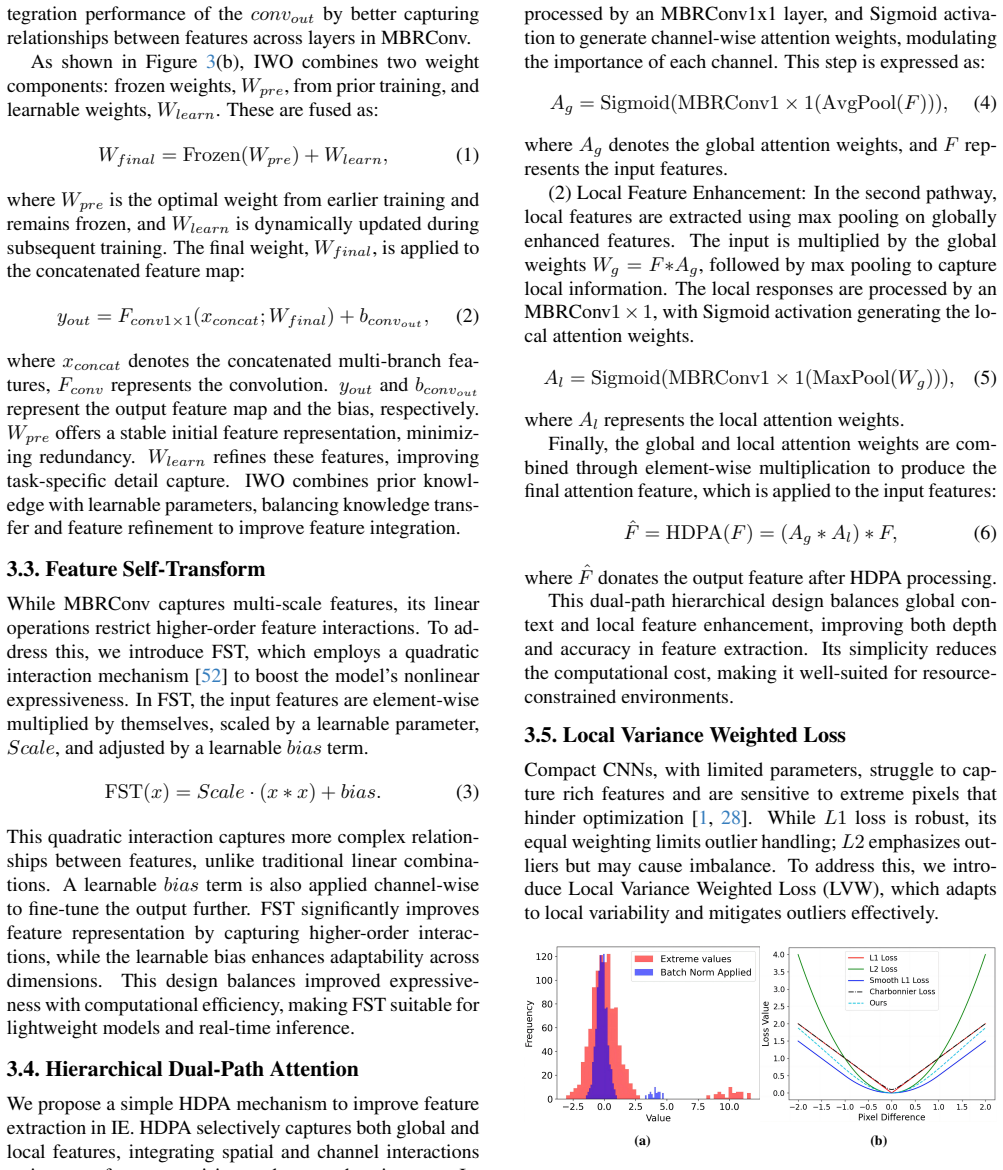
The pipeline is built on five components that work together. MBRConv is a multi-branch reparameterized convolution (branches of 3x3, 5x5, and 1x1 with parallel BatchNorm layers) that folds into a single standard convolution at inference, cutting parameters to about 4K with no added inference cost. Incremental Weight Optimization freezes a previously trained weight matrix and adds a learnable residual delta to it, letting the network keep improving late in training. Feature Self-Transform squares features channel-wise and applies a learnable scale and bias, adding nonlinear expressiveness beyond linear convolutions. Hierarchical Dual-Path Attention combines average-pooled global channel weights with max-pooled local weights and multiplies them onto the feature map. Local Variance-Weighted Loss reweights each pixel's L1 error by the hyperbolic tangent of its deviation from the local error mean divided by the local variance, reducing the influence of outlier pixels. These mechanisms carry the paper's claim that extreme compactness does not force a quality penalty.
What would settle it
Once code and checkpoints are made available, run the released MobileIE checkpoint on the standard LOLv1 test split and measure PSNR plus end-to-end latency on the same RTX 4090 and Snapdragon 8 Gen 3 devices used for the comparison methods; if the PSNR falls materially below the reported 23.62 dB or the 0.895 ms GPU latency cannot be reproduced, the central speed–quality trade-off claim fails.
Extended reading notes
Core claim
On the paper's terms, the central discovery is that a reparameterized CNN with 4,047–4,104 parameters achieves the best speed–quality trade-off reported so far across three image enhancement tasks. On the LOLv1 and LOLv2-Real low-light benchmarks it reaches 23.62 dB and 25.08 dB PSNR, respectively, with 0.895 ms GPU latency and 1,120 FPS; on UIEB it reaches 22.81 dB PSNR at 0.910 ms, and on ZRR it reaches 21.43 dB PSNR at 1.020 ms, all while running at roughly 6.7–14.4 ms on a Snapdragon 8 Gen 3 phone. The authors attribute this to MBRConv folding multi-branch training structure into a single inference convolution, the Incremental Weight Optimization strategy that keeps a frozen prior weight and learns a residual delta, the Feature Self-Transform's quadratic interaction, the Hierarchical Dual-Path Attention fusing global and local statistics, and the Local Variance-Weighted loss that down-weights outliers. They claim this is the first demonstration of real-time image enhancement inference at up to 1,100 FPS with competitive quality.
Load-bearing premise
The reported speed and quality numbers depend on the evaluation being run under fair, identical conditions on standard train/test splits; the paper does not yet provide code, checkpoints, or measurement details, so a failure of those conditions would change the headline PSNR and FPS figures.
Editorial extensions
If this is right
- A single 4K-parameter model can run low-light enhancement, underwater restoration, and raw-to-sRGB ISP in about 0.9 ms on a GPU and 6.7–14.4 ms on a Snapdragon 8 Gen 3 phone, making real-time on-device enhancement practical.
- MobileIE matches or exceeds the PSNR and SSIM of prior lightweight models such as IAT, FiveA+, and SYELLE/SYEISP while using a fraction of their parameters and latency.
- The reparameterization and cost-free training strategies (IWO, LVW) mean the training-time machinery adds no inference overhead, so the deployed model is a plain small CNN.
- The same architecture, without task-specific changes, handles three different degradation types, supporting the idea of a universal lightweight enhancer.
- The reported speeds open the door to real-time enhancement of UHD (2K–8K) images on mobile platforms, which the paper identifies as a target.
Reading between the lines
- If the central claim holds, the practical bottleneck for mobile image enhancement shifts from model size to data and training protocol: at 4K parameters the architecture is near the floor, so further gains would have to come from better losses, augmentation, or task-specific priors.
- The Feature Self-Transform's squaring operation is a parameter-free nonlinearity that could transfer to other lightweight low-level vision tasks, such as super-resolution or deblurring, where fine detail preservation matters.
- The Incremental Weight Optimization recipe—freeze a warm-started weight and learn a residual delta—could be a general cure for late-training stagnation in other compact networks, though the paper only demonstrates it inside MBRConv.
- Because the headline SCORE advantage is dominated by parameter count and latency, a benchmark that weights quality more heavily could reorder the ranking; that is a consequence of the metric, not necessarily a weakness of the model.
Editorial analysis
A structured set of objections, weighed in public.
Referee Report
Summary. The paper proposes MobileIE, a CNN with roughly 4K parameters for image enhancement, designed for real-time use on mobile devices. The architecture combines multi-branch reparameterized convolutions (MBRConv), an Incremental Weight Optimization (IWO) training schedule, a Feature Self-Transform (FST) block, a Hierarchical Dual-Path Attention (HDPA) module, and a Local Variance-Weighted (LVW) loss. Experiments are reported on low-light enhancement (LOLv1, LOLv2-Real), underwater enhancement (UIEB), and raw-to-RGB ISP (ZRR), with the claim that MobileIE achieves up to about 1,100 FPS on a GPU, around 6.7 ms on a Snapdragon 8 Gen 3 SoC, and competitive or better PSNR/SSIM/LPIPS than existing lightweight methods.
Significance. If the results are reproducible, the contribution is practically useful: a roughly 4K-parameter model that runs in under a millisecond on a GPU and in real time on a mobile SoC while matching or exceeding the quality of much larger lightweight enhancement networks would be a meaningful engineering advance. The paper also includes per-module ablations and visualizations, and the proposed modules are simple and hardware-friendly. However, the central speed/quality claim is currently conditional on dataset split details, benchmarking methodology, and code/checkpoint availability, none of which are provided in sufficient detail. The significance is therefore contingent on closing these reproducibility gaps.
major comments (5)
- [4.1] The dataset protocol is not specified. The text says "LOLv1 [76] and LOLv2 [82] datasets are used for both training and testing," but it does not state the train/test partition (e.g., 485/15 for LOLv1, 619/70 for LOLv2-Real), whether LOLv2 includes the Synthetic subset, or the image resolution and preprocessing for each dataset. The same omission applies to UIEB and ZRR. Without this information, the reported PSNR/SSIM values (e.g., 23.62 dB on LOLv1 and 25.08 on LOLv2-Real in Table 1) cannot be reproduced, and a split that leaks test images into training would invalidate the headline trade-off claim. Please specify exact splits, random seeds, and preprocessing steps.
- [3.5] Equation (8) does not match the "local" description in the text. The formulas for µ_{m,n} and σ²_{m,n} sum over all H×W spatial positions, so µ and σ are single global scalars per image/channel, not per-pixel local statistics. The subscripts are misleading, and the claim that the loss "adapts to local variability" is not supported by the equation. If the implementation follows the equation, the loss is global-mean/variance weighted; if a local window is used, Eq. (8) must be rewritten. Since Table 4 attributes a performance gain to LVW loss, the correct form of the loss is load-bearing and must be clarified. In addition, the second line of Eq. (8) has a missing parenthesis: the sum of (Δ_{m,n} − µ_{m,n}) should be squared as a whole.
- [3.1] The manuscript refers to an Appendix for "detailed architecture settings," but no appendix is present in the submitted version. Furthermore, the GPU (RTX 4090) and SoC (Snapdragon 8 Gen 3) latency numbers in Tables 1–3 are reported without describing the measurement methodology: batch size, warm-up iterations, inference framework, precision, number of runs, and whether the mobile measurements used the SoC's NPU, GPU, or CPU. No code or checkpoints are provided, and no standard deviations over repeated runs are reported. These omissions make the central claim of up to 1,100 FPS with ~4K parameters unfalsifiable. Please release the code and checkpoints, provide the appendix with exact channel configurations and layer-wise parameter/FLOP counts, and describe the benchmarking protocol in enough detail to be reproduced.
- [4.1] The IWO training schedule is underspecified. Section 4.1 lists optimizer, learning rate, warm-up, and total epochs, but does not state when IWO is activated, how W_pre is chosen and frozen in Eq. (1), or how W_learn is initialized. Section 4.3 later says W_pre is "the well-performing weight obtained after the first 1000 epochs," which suggests a phase split that should have been in Section 4.1. The IWO phase epoch is a key hyperparameter of the proposed method, and the ablation results in Table 4 (MBRConv No IWO vs. Ours) depend on it. Please state the exact IWO protocol in the experimental settings.
- [4.3 (Table 7)] Table 7 is headed "RTX 3090," while Section 4.2 and Tables 1–3 state that latency tests were run on a single NVIDIA 4090. If the table and the earlier tables use different hardware, the numbers are not directly comparable; if it is a typo, it should be corrected. In addition, the text in Section 4.3(3) says HDPA "achieved a PSNR gain of +3.08 dB," but Table 6 contains no baseline row without an attention module, so the gain cannot be read from the table. Please add the missing baseline and ensure hardware labels are consistent across all tables.
minor comments (7)
- [Abstract, Section 1] The claim of being "the first" to achieve real-time IE at up to 1,100 FPS should be qualified, because Table 1 lists SYELLE at 1,059.7 FPS, which is very close; the novelty should be framed around the combined speed-quality-parameter trade-off rather than a raw FPS record.
- [4.2] Section 4.2 refers to "the ZRR [44] dataset" for ISP experiments, but Table 3 and reference [36] identify ZRR as the dataset from PyNet; please correct the citation.
- [Table 4] The first row of Table 4, labeled "Only inference network," is not defined in the text; please state what training setup this row corresponds to (e.g., no loss term or random initialization).
- [Figure 6] The figure label "FivaA+" contains a typo and should read "FiveA+".
- [3.4] In Eq. (5), W_g = F * A_g is a weighted feature map, not a set of attention weights; naming it "W" is confusing because A_l is later multiplied with A_g and F in Eq. (6). Please rename W_g to something like F_g to avoid suggesting it is a weight tensor.
- [Tables 1–3, 6] The SCORE metric [38] is used throughout but never defined in the paper; given the large SCORE differences reported (e.g., 92.855 vs. 9.604 in Table 1), please include the formula or a brief explanation so readers can interpret these values.
- [3.5] In Eq. (9), the constant ε is described only as "a small constant"; please give its value, and clarify whether the tanh normalization is applied per channel or across the whole image.
Circularity Check
No circularity found: the reported speed/quality results are empirical benchmark outcomes, and no predicted quantity reduces to a fitted input or to a self-citation chain.
full rationale
The paper's derivation chain is empirical rather than definitional. MobileIE's trainable modules (MBRConv, FST, HDPA, IWO, LVW loss) are defined independently of the benchmark numbers they produce, and the reported PSNR/SSIM/LPIPS values and latencies are measured outcomes, not quantities that the definitions force by construction. The IWO strategy reuses the model's own earlier weights inside a training schedule, but this is a heuristic training procedure, not a case where a 'prediction' is identical to a fitted parameter. The LVW loss equation (Eq. 8) computes global mean and variance over the whole spatial map despite the 'local' name, which is an internal consistency or implementation-detail concern, but it does not make the claimed enhancement results equivalent to the loss definition. Citations to the authors' own prior work (e.g., [43], [49]) appear only as background examples of Transformer-based methods and challenge participation; they are not load-bearing for the central trade-off claim. The paper's strongest claim, achieving the best speed/quality trade-off at up to 1,100 FPS, rests on reproducibility conditions such as standard dataset splits and fair latency measurement, which are correctness and verification risks rather than circular reasoning. No step in the manuscript reduces, by its own equations or by self-citation, to its own inputs, so the appropriate circularity score is 0.
Assumptions & free parameters
free parameters (5)
- IWO phase split epoch =
1,000
- LVW epsilon =
unspecified small constant
- LVW Tanh normalization =
n/a
- Learning-rate schedule parameters =
1e-3 start, 1e-6 warm-up, 50-epoch reset
- Training epochs =
2,000
assumptions (5)
- standard math Multi-branch convolutions with batch norm can be reparameterized into an equivalent single convolution at inference.
- domain assumption The paired benchmarks LOLv1, LOLv2-Real, UIEB, and ZRR are used with valid train/test splits and no test-set contamination.
- domain assumption PSNR, SSIM, LPIPS, and SCORE measure the intended enhancement quality and efficiency.
- domain assumption The reported GPU and SoC latencies are measured under fair, comparable conditions for all methods.
- ad hoc to paper The loss actually implemented is the one in Eq. (10) with Eq. (8) as written.
Cite this review
Pith. "Pith review of MobileIE: An Extremely Lightweight and Effective ConvNet for Real-Time Image Enhancement on Mobile Devices." pith.science (2026). https://pith.science/paper/RPDYVOJP
@misc{pith2026250701838,
  author       = {Pith},
  title        = {Pith review of: MobileIE: An Extremely Lightweight and Effective ConvNet for Real-Time Image Enhancement on Mobile Devices},
  year         = {2026},
  howpublished = {\url{https://pith.science/paper/RPDYVOJP}},
  note         = {Machine review of arXiv:2507.01838}
}
read the original abstract
Recent advancements in deep neural networks have driven significant progress in image enhancement (IE). However, deploying deep learning models on resource-constrained platforms, such as mobile devices, remains challenging due to high computation and memory demands. To address these challenges and facilitate real-time IE on mobile, we introduce an extremely lightweight Convolutional Neural Network (CNN) framework with around 4K parameters. Our approach integrates reparameterization with an Incremental Weight Optimization strategy to ensure efficiency. Additionally, we enhance performance with a Feature Self-Transform module and a Hierarchical Dual-Path Attention mechanism, optimized with a Local Variance-Weighted loss. With this efficient framework, we are the first to achieve real-time IE inference at up to 1,100 frames per second (FPS) while delivering competitive image quality, achieving the best trade-off between speed and performance across multiple IE tasks. The code will be available at https://github.com/AVC2-UESTC/MobileIE.git.
Figures


Figures from the paper (9 more)


Reference graph
Works this paper leans on
-
[76]
Deep retinex decomposition for low-light enhancement
Chen Wei, Wenjing Wang, Wenhan Yang, and Jiaying Liu. Deep retinex decomposition for low-light enhancement. In BMVC, 2018. 5, 6, 7, 8
work page 2018
-
[82]
From fidelity to perceptual quality: A semi- supervised approach for low-light image enhancement
Wenhan Yang, Shiqi Wang, Yuming Fang, Yue Wang, and Jiaying Liu. From fidelity to perceptual quality: A semi- supervised approach for low-light image enhancement. In CVPR, pages 3063–3072, 2020. 5, 7
work page 2020
-
[1]
Bias loss for mobile neural networks
Lusine Abrahamyan, Valentin Ziatchin, Yiming Chen, and Nikos Deligiannis. Bias loss for mobile neural networks. In ICCV, pages 6556–6566, 2021. 1, 4
2021
-
[2]
Uw- mamba: Underwater image enhancement with state space model
Guanhua An, Ao He, Yudong Wang, and Jichang Guo. Uw- mamba: Underwater image enhancement with state space model. IEEE Signal Processing Letters, 2024. 2
2024
-
[3]
Beyond self-attention: Deformable large kernel attention for medi- cal image segmentation
Reza Azad, Leon Niggemeier, Michael H ¨uttemann, Amirhossein Kazerouni, Ehsan Khodapanah Aghdam, Yury Velichko, Ulas Bagci, and Dorit Merhof. Beyond self-attention: Deformable large kernel attention for medi- cal image segmentation. InWACV, pages 1287–1297, 2024. 8
2024
-
[4]
Retinexmamba: Retinex-based mamba for low-light image enhancement
Jiesong Bai, Yuhao Yin, and Qiyuan He. Retinexmamba: Retinex-based mamba for low-light image enhancement. arXiv preprint arXiv:2405.03349, 2024. 2
arXiv 2024
-
[5]
A general and adaptive robust loss func- tion
Jonathan T Barron. A general and adaptive robust loss func- tion. In CVPR, pages 4331–4339, 2019. 7
2019
-
[6]
Retinexformer: One-stage retinex-based transformer for low-light image enhance- ment
Yuanhao Cai, Hao Bian, Jing Lin, Haoqian Wang, Radu Timofte, and Yulun Zhang. Retinexformer: One-stage retinex-based transformer for low-light image enhance- ment. In ICCV, pages 12504–12513, 2023. 2
2023
Show all 101 references
-
[7]
Ref- conv: Re-parameterized refocusing convolution for power- ful convnets
Zhicheng Cai, Xiaohan Ding, Qiu Shen, and Xun Cao. Ref- conv: Re-parameterized refocusing convolution for power- ful convnets. arXiv preprint arXiv:2310.10563, 2023. 7
2023 arXiv
-
[8]
Vanillanet: the power of minimalism in deep learning
Hanting Chen, Yunhe Wang, Jianyuan Guo, and Dacheng Tao. Vanillanet: the power of minimalism in deep learning. NeurIPS, 36, 2024. 2
2024
-
[9]
Run, don’t walk: chasing higher flops for faster neural networks
Jierun Chen, Shiu-hong Kao, Hao He, Weipeng Zhuo, Song Wen, Chul-Ho Lee, and S-H Gary Chan. Run, don’t walk: chasing higher flops for faster neural networks. In CVPR, pages 12021–12031, 2023. 2
2023
-
[10]
Simple baselines for image restoration
Liangyu Chen, Xiaojie Chu, Xiangyu Zhang, and Jian Sun. Simple baselines for image restoration. In ECCV, pages 17–33. Springer, 2022. 1, 6, 8
2022
-
[11]
Mofa: A model simplification roadmap for image restoration on mobile devices
Xiangyu Chen, Ruiwen Zhen, Shuai Li, Xiaotian Li, and Guanghui Wang. Mofa: A model simplification roadmap for image restoration on mobile devices. In ICCV, pages 1322–1332, 2023. 1
2023
-
[12]
Gcam: lightweight image inpainting via group convolution and attention mechanism
Yuantao Chen, Runlong Xia, Kai Yang, and Ke Zou. Gcam: lightweight image inpainting via group convolution and attention mechanism. International Journal of Machine Learning and Cybernetics, 15(5):1815–1825, 2024. 1
2024
-
[13]
Mambauie&sr: Unravel- ing the ocean’s secrets with only 2.8 flops
Zhihao Chen and Yiyuan Ge. Mambauie&sr: Unravel- ing the ocean’s secrets with only 2.8 flops. arXiv preprint arXiv:2404.13884, 2024. 2
2024 arXiv
-
[14]
Dea-net: Single image dehazing based on detail-enhanced convolution and content-guided attention
Zixuan Chen, Zewei He, and Zhe-Ming Lu. Dea-net: Single image dehazing based on detail-enhanced convolution and content-guided attention. IEEE TIP, 2024. 8
2024
-
[15]
Reciprocal attention mixing transformer for lightweight image restoration
Haram Choi, Cheolwoong Na, Jihyeon Oh, Seungjae Lee, Jinseop Kim, Subeen Choe, Jeongmin Lee, Taehoon Kim, and Jihoon Yang. Reciprocal attention mixing transformer for lightweight image restoration. In CVPR, pages 5992– 6002, 2024. 1
2024
-
[16]
Efficient deep models for real-time 4k image super-resolution
Marcos V Conde, Eduard Zamfir, Radu Timofte, Daniel Motilla, Cen Liu, Zexin Zhang, Yunbo Peng, Yue Lin, Ji- aming Guo, Xueyi Zou, et al. Efficient deep models for real-time 4k image super-resolution. ntire 2023 benchmark and report. In CVPR, pages 1495–1521, 2023. 2
2023
-
[17]
Focal network for image restoration
Yuning Cui, Wenqi Ren, Xiaochun Cao, and Alois Knoll. Focal network for image restoration. In ICCV, pages 13001–13011, 2023. 1
2023
-
[18]
Image restoration via frequency selection
Yuning Cui, Wenqi Ren, Xiaochun Cao, and Alois Knoll. Image restoration via frequency selection. IEEE TPAMI, 2023
2023
-
[19]
Revitalizing convolutional network for image restoration
Yuning Cui, Wenqi Ren, Xiaochun Cao, and Alois Knoll. Revitalizing convolutional network for image restoration. IEEE TPAMI, 2024. 1
2024
-
[20]
You only need 90k parameters to adapt light: a light weight trans- former for image enhancement and exposure correction
Ziteng Cui, Kunchang Li, Lin Gu, Shenghan Su, Peng Gao, Zhengkai Jiang, Yu Qiao, and Tatsuya Harada. You only need 90k parameters to adapt light: a light weight trans- former for image enhancement and exposure correction. In BMVC, 2022. 5, 6
2022
-
[21]
Awnet: Attentive wavelet network for image isp
Linhui Dai, Xiaohong Liu, Chengqi Li, and Jun Chen. Awnet: Attentive wavelet network for image isp. In EC- CVW, pages 185–201. Springer, 2020. 2, 6
2020
-
[22]
Acnet: Strengthening the kernel skeletons for power- ful cnn via asymmetric convolution blocks
Xiaohan Ding, Yuchen Guo, Guiguang Ding, and Jungong Han. Acnet: Strengthening the kernel skeletons for power- ful cnn via asymmetric convolution blocks. In ICCV, pages 1911–1920, 2019. 2, 3, 7
1911
-
[23]
Diverse branch block: Building a con- volution as an inception-like unit
Xiaohan Ding, Xiangyu Zhang, Jungong Han, and Guiguang Ding. Diverse branch block: Building a con- volution as an inception-like unit. In CVPR, pages 10886– 10895, 2021. 2
2021
-
[24]
Repvgg: Making vgg- style convnets great again
Xiaohan Ding, Xiangyu Zhang, Ningning Ma, Jungong Han, Guiguang Ding, and Jian Sun. Repvgg: Making vgg- style convnets great again. In CVPR, pages 13733–13742,
-
[25]
Un- derwater depth estimation and image restoration based on single images
Paulo LJ Drews, Erickson R Nascimento, Silvia SC Botelho, and Mario Fernando Montenegro Campos. Un- derwater depth estimation and image restoration based on single images. IEEE computer graphics and applications , 36(2):24–35, 2016. 2
2016
-
[26]
Uncertainty inspired underwater image en- hancement
Zhenqi Fu, Wu Wang, Yue Huang, Xinghao Ding, and Kai- Kuang Ma. Uncertainty inspired underwater image en- hancement. In ECCV, pages 465–482. Springer, 2022. 6
2022
-
[27]
Learning a simple low-light im- age enhancer from paired low-light instances
Zhenqi Fu, Yan Yang, Xiaotong Tu, Yue Huang, Xinghao Ding, and Kai-Kuang Ma. Learning a simple low-light im- age enhancer from paired low-light instances. In CVPR, pages 22252–22261, 2023. 2, 5, 6
2023
-
[28]
Syenet: A simple yet effective net- work for multiple low-level vision tasks with real-time per- formance on mobile device
Weiran Gou, Ziyao Yi, Yan Xiang, Shaoqing Li, Zibin Liu, Dehui Kong, and Ke Xu. Syenet: A simple yet effective net- work for multiple low-level vision tasks with real-time per- formance on mobile device. In ICCV, pages 12182–12195,
-
[29]
Zero- reference deep curve estimation for low-light image en- hancement
Chunle Guo, Chongyi Li, Jichang Guo, Chen Change Loy, Junhui Hou, Sam Kwong, and Runmin Cong. Zero- reference deep curve estimation for low-light image en- hancement. In CVPR, pages 1780–1789, 2020. 2, 5, 6
2020
-
[30]
Ghostnet: More features from cheap operations
Kai Han, Yunhe Wang, Qi Tian, Jianyuan Guo, Chunjing Xu, and Chang Xu. Ghostnet: More features from cheap operations. In CVPR, pages 1580–1589, 2020. 2
2020
-
[31]
Masked autoencoders are scal- able vision learners
Kaiming He, Xinlei Chen, Saining Xie, Yanghao Li, Piotr Doll´ar, and Ross Girshick. Masked autoencoders are scal- able vision learners. In CVPR, pages 16000–16009, 2022. 5
2022
-
[32]
Enhancing raw-to-srgb with decoupled style structure in fourier domain
Xuanhua He, Tao Hu, Guoli Wang, Zejin Wang, Run Wang, Qian Zhang, Keyu Yan, Ziyi Chen, Rui Li, Chengjun Xie, et al. Enhancing raw-to-srgb with decoupled style structure in fourier domain. In AAAI, pages 2130–2138, 2024. 6
2024
-
[33]
Searching for mo- bilenetv3
Andrew Howard, Mark Sandler, Grace Chu, Liang-Chieh Chen, Bo Chen, Mingxing Tan, Weijun Wang, Yukun Zhu, Ruoming Pang, Vijay Vasudevan, et al. Searching for mo- bilenetv3. In ICCV, pages 1314–1324, 2019. 2
2019
-
[34]
Squeeze-and-excitation networks
Jie Hu, Li Shen, and Gang Sun. Squeeze-and-excitation networks. In CVPR, pages 7132–7141, 2018. 8
2018
-
[35]
Aim 2020 challenge on learned image signal processing pipeline
Andrey Ignatov, Radu Timofte, Zhilu Zhang, Ming Liu, Haolin Wang, Wangmeng Zuo, Jiawei Zhang, Ruimao Zhang, Zhanglin Peng, Sijie Ren, et al. Aim 2020 challenge on learned image signal processing pipeline. In ECCVW, pages 152–170. Springer, 2020. 2, 6
2020
-
[36]
Replac- ing mobile camera isp with a single deep learning model
Andrey Ignatov, Luc Van Gool, and Radu Timofte. Replac- ing mobile camera isp with a single deep learning model. In CVPRW, pages 536–537, 2020. 2, 5, 6, 8
2020
-
[37]
Learned smartphone isp on mobile npus with deep learning, mobile ai 2021 chal- lenge: Report
Andrey Ignatov, Cheng-Ming Chiang, Hsien-Kai Kuo, Anastasia Sycheva, and Radu Timofte. Learned smartphone isp on mobile npus with deep learning, mobile ai 2021 chal- lenge: Report. In CVPR, pages 2503–2514, 2021. 2
2021
-
[38]
Learned smartphone isp on mobile gpus with deep learning, mobile ai & aim 2022 challenge: report
Andrey Ignatov, Radu Timofte, Shuai Liu, Chaoyu Feng, Furui Bai, Xiaotao Wang, Lei Lei, Ziyao Yi, Yan Xiang, Zibin Liu, et al. Learned smartphone isp on mobile gpus with deep learning, mobile ai & aim 2022 challenge: report. In ECCVW, pages 44–70. Springer, 2022. 2, 5, 6, 8
2022
-
[39]
Fast un- derwater image enhancement for improved visual percep- tion
Md Jahidul Islam, Youya Xia, and Junaed Sattar. Fast un- derwater image enhancement for improved visual percep- tion. IEEE Robotics and Automation Letters , 5(2):3227– 3234, 2020. 2, 6
2020
-
[40]
Low-light image enhancement with wavelet-based diffusion models
Hai Jiang, Ao Luo, Haoqiang Fan, Songchen Han, and Shuaicheng Liu. Low-light image enhancement with wavelet-based diffusion models. TOG, 42(6):1–14, 2023. 2
2023
-
[41]
Five a+ net- work: You only need 9k parameters for underwater image enhancement
Jingxia Jiang, Tian Ye, Jinbin Bai, Sixiang Chen, Wenhao Chai, Shi Jun, Yun Liu, and Erkang Chen. Five a+ net- work: You only need 9k parameters for underwater image enhancement. In BMVC, 2023. 2, 6
2023
-
[42]
Spectroformer: Multi-domain query cascaded transformer network for underwater image enhancement
Raqib Khan, Priyanka Mishra, Nancy Mehta, Shruti S Phutke, Santosh Kumar Vipparthi, Sukumar Nandi, and Subrahmanyam Murala. Spectroformer: Multi-domain query cascaded transformer network for underwater image enhancement. In WACV, pages 1454–1463, 2024. 2
2024
-
[43]
Feature modulation transformer: Cross-refinement of global representation via high-frequency prior for image super-resolution
Ao Li, Le Zhang, Yun Liu, and Ce Zhu. Feature modulation transformer: Cross-refinement of global representation via high-frequency prior for image super-resolution. In ICCV, pages 12514–12524, 2023. 1
2023
-
[44]
An underwater image enhancement benchmark dataset and beyond
Chongyi Li, Chunle Guo, Wenqi Ren, Runmin Cong, Jun- hui Hou, Sam Kwong, and Dacheng Tao. An underwater image enhancement benchmark dataset and beyond. IEEE TIP, 29:4376–4389, 2019. 5, 6, 7
2019
-
[45]
Learning to enhance low-light image via zero-reference deep curve estimation
Chongyi Li, Chunle Guo, and Chen Change Loy. Learning to enhance low-light image via zero-reference deep curve estimation. IEEE TPAMI, 44(8):4225–4238, 2021. 5
2021
-
[46]
Ntire 2023 challenge on efficient super- resolution: Methods and results
Yawei Li, Yulun Zhang, Radu Timofte, Luc Van Gool, Lei Yu, Youwei Li, Xinpeng Li, Ting Jiang, Qi Wu, Mingyan Han, et al. Ntire 2023 challenge on efficient super- resolution: Methods and results. In CVPR, pages 1922– 1960, 2023. 2
2023
-
[47]
Retinex-inspired unrolling with cooperative prior architecture search for low-light image enhancement
Risheng Liu, Long Ma, Jiaao Zhang, Xin Fan, and Zhongx- uan Luo. Retinex-inspired unrolling with cooperative prior architecture search for low-light image enhancement. In CVPR, pages 10561–10570, 2021. 2, 5, 6
2021
-
[48]
Boths: Super lightweight network-enabled under- water image enhancement
Xu Liu, Sen Lin, Kaichen Chi, Zhiyong Tao, and Yang Zhao. Boths: Super lightweight network-enabled under- water image enhancement. IEEE Geoscience and Remote Sensing Letters, 20:1–5, 2023. 6
2023
-
[49]
Ntire 2024 challenge on low light image enhancement: Methods and results
Xiaoning Liu, Zongwei Wu, Ao Li, Florin-Alexandru Vasluianu, Yulun Zhang, Shuhang Gu, Le Zhang, Ce Zhu, Radu Timofte, Zhi Jin, et al. Ntire 2024 challenge on low light image enhancement: Methods and results. arXiv preprint arXiv:2404.14248, 2024. 1
2024 arXiv
-
[50]
Nam: Normalization-based attention module
Yichao Liu, Zongru Shao, Yueyang Teng, and Nico Hoff- mann. Nam: Normalization-based attention module. arXiv preprint arXiv:2111.12419, 2021. 8
2021 arXiv
-
[51]
Toward fast, flexible, and robust low-light image enhancement
Long Ma, Tengyu Ma, Risheng Liu, Xin Fan, and Zhongx- uan Luo. Toward fast, flexible, and robust low-light image enhancement. In CVPR, pages 5637–5646, 2022. 5
2022
-
[52]
Rewrite the stars
Xu Ma, Xiyang Dai, Yue Bai, Yizhou Wang, and Yun Fu. Rewrite the stars. In CVPR, pages 5694–5703, 2024. 2, 4
2024
-
[53]
A wavelet-based dual-stream network for underwater image enhancement
Ziyin Ma and Changjae Oh. A wavelet-based dual-stream network for underwater image enhancement. In ICASSP, pages 2769–2773, 2022. 2, 6
2022
-
[54]
Shallow-uwnet: Compressed model for underwater image enhancement (student abstract)
Ankita Naik, Apurva Swarnakar, and Kartik Mittal. Shallow-uwnet: Compressed model for underwater image enhancement (student abstract). In AAAI, pages 15853– 15854, 2021. 2, 6
2021
-
[55]
Efficient multi-scale attention module with cross-spatial learning
Daliang Ouyang, Su He, Guozhong Zhang, Mingzhu Luo, Huaiyong Guo, Jian Zhan, and Zhijie Huang. Efficient multi-scale attention module with cross-spatial learning. In ICASSP, pages 1–5, 2023. 8
2023
-
[56]
U-shape trans- former for underwater image enhancement
Lintao Peng, Chunli Zhu, and Liheng Bian. U-shape trans- former for underwater image enhancement. IEEE TIP, 32: 3066–3079, 2023. 1, 2, 6
2023
-
[57]
Rawformer: Unpaired raw-to-raw translation for learnable camera isps
Georgy Perevozchikov, Nancy Mehta, Mahmoud Afifi, and Radu Timofte. Rawformer: Unpaired raw-to-raw translation for learnable camera isps. arXiv preprint arXiv:2404.10700, 2024. 2
2024 arXiv
-
[58]
Semi- supervised feature distillation and unsupervised domain ad- versarial distillation for underwater image enhancement
Nianzu Qiao, Changyin Sun, and Lu Dong. Semi- supervised feature distillation and unsupervised domain ad- versarial distillation for underwater image enhancement. IEEE TCSVT, 2024. 1
2024
-
[59]
Double domain guided real- time low-light image enhancement for ultra-high-definition transportation surveillance
Jingxiang Qu, Ryan Wen Liu, Yuan Gao, Yu Guo, Fenghua Zhu, and Fei-Yue Wang. Double domain guided real- time low-light image enhancement for ultra-high-definition transportation surveillance. IEEE Transactions on Intelli- gent Transportation Systems, 2024. 5
2024
-
[60]
Quantized proximal averaging networks for com- pressed image recovery
Nareddy Kartheek Kumar Reddy, Mani Madhoolika Bu- lusu, Praveen Kumar Pokala, and Chandra Sekhar Seela- mantula. Quantized proximal averaging networks for com- pressed image recovery. In CVPR, pages 4633–4643, 2023. 1
2023
-
[61]
The ninth ntire 2024 efficient super- resolution challenge report
Bin Ren, Yawei Li, Nancy Mehta, Radu Timofte, Hongyuan Yu, Cheng Wan, Yuxin Hong, Bingnan Han, Zhuoyuan Wu, Yajun Zou, et al. The ninth ntire 2024 efficient super- resolution challenge report. In CVPR, pages 6595–6631,
2024
-
[62]
Wavelength- based attributed deep neural network for underwater image restoration
Prasen Sharma, Ira Bisht, and Arijit Sur. Wavelength- based attributed deep neural network for underwater image restoration. ACM Transactions on Multimedia Computing, Communications and Applications, 19(1):1–23, 2023. 2
2023
-
[63]
Efficient attention: Attention with lin- ear complexities
Zhuoran Shen, Mingyuan Zhang, Haiyu Zhao, Shuai Yi, and Hongsheng Li. Efficient attention: Attention with lin- ear complexities. In WACV, pages 3531–3539, 2021. 8
2021
-
[64]
Memory-oriented structural pruning for efficient im- age restoration
Xiangsheng Shi, Xuefei Ning, Lidong Guo, Tianchen Zhao, Enshu Liu, Yi Cai, Yuhan Dong, Huazhong Yang, and Yu Wang. Memory-oriented structural pruning for efficient im- age restoration. In AAAI, pages 2245–2253, 2023. 1
2023
-
[65]
Ghostnetv2: Enhance cheap operation with long-range attention
Yehui Tang, Kai Han, Jianyuan Guo, Chang Xu, Chao Xu, and Yunhe Wang. Ghostnetv2: Enhance cheap operation with long-range attention. NeurIPS, 35:9969–9982, 2022. 8
2022
-
[66]
Un- derwater image enhancement by transformer-based diffu- sion model with non-uniform sampling for skip strategy
Yi Tang, Hiroshi Kawasaki, and Takafumi Iwaguchi. Un- derwater image enhancement by transformer-based diffu- sion model with non-uniform sampling for skip strategy. In ACM MM, pages 5419–5427, 2023. 2
2023
-
[67]
Mobileone: An improved one millisecond mobile backbone
Pavan Kumar Anasosalu Vasu, James Gabriel, Jeff Zhu, Oncel Tuzel, and Anurag Ranjan. Mobileone: An improved one millisecond mobile backbone. In CVPR, pages 7907– 7917, 2023. 1, 2
2023
-
[68]
Swift parameter-free attention network for efficient super- resolution
Cheng Wan, Hongyuan Yu, Zhiqi Li, Yihang Chen, Ya- jun Zou, Yuqing Liu, Xuanwu Yin, and Kunlong Zuo. Swift parameter-free attention network for efficient super- resolution. In CVPR, pages 6246–6256, 2024. 8
2024
-
[69]
Repvit: Revisiting mobile cnn from vit perspective
Ao Wang, Hui Chen, Zijia Lin, Jungong Han, and Guiguang Ding. Repvit: Revisiting mobile cnn from vit perspective. In CVPR, pages 15909–15920, 2024. 2
2024
-
[70]
Cor- relation matching transformation transformers for uhd im- age restoration
Cong Wang, Jinshan Pan, Wei Wang, Gang Fu, Siyuan Liang, Mengzhu Wang, Xiao-Ming Wu, and Jun Liu. Cor- relation matching transformation transformers for uhd im- age restoration. In AAAI, pages 5336–5344, 2024. 1
2024
-
[71]
Eca-net: Efficient channel attention for deep convolutional neural networks
Qilong Wang, Banggu Wu, Pengfei Zhu, Peihua Li, Wang- meng Zuo, and Qinghua Hu. Eca-net: Efficient channel attention for deep convolutional neural networks. InCVPR, pages 11534–11542, 2020. 8
2020
-
[72]
Ultra-high-definition low-light image enhancement: A benchmark and transformer-based method
Tao Wang, Kaihao Zhang, Tianrun Shen, Wenhan Luo, Bjorn Stenger, and Tong Lu. Ultra-high-definition low-light image enhancement: A benchmark and transformer-based method. In AAAI, pages 2654–2662, 2023. 2
2023
-
[73]
Adversar- ially regularized low-light image enhancement
William Y Wang, Lisa Liu, and Pingping Cai. Adversar- ially regularized low-light image enhancement. In Inter- national Conference on Multimedia Modeling, pages 230–
-
[74]
Tied block convolution: Leaner and better cnns with shared thinner filters
Xudong Wang and X Yu Stella. Tied block convolution: Leaner and better cnns with shared thinner filters. In AAAI, pages 10227–10235, 2021. 7
2021
-
[75]
Repsr: Training efficient vgg-style super-resolution networks with structural re-parameterization and batch normalization
Xintao Wang, Chao Dong, and Ying Shan. Repsr: Training efficient vgg-style super-resolution networks with structural re-parameterization and batch normalization. In ACM MM, pages 2556–2564, 2022. 3
2022
-
[77]
An illumination-guided dual attention vision transformer for low-light image enhancement
Yanjie Wen, Ping Xu, Zhihong Li, and Wangtu Xu ATO. An illumination-guided dual attention vision transformer for low-light image enhancement. PR, page 111033, 2024. 2
2024
-
[78]
Cbam: Convolutional block attention module
Sanghyun Woo, Jongchan Park, Joon-Young Lee, and In So Kweon. Cbam: Convolutional block attention module. In ECCV, pages 3–19, 2018. 8
2018
-
[79]
Uretinex-net: Retinex-based deep unfolding network for low-light image enhancement
Wenhui Wu, Jian Weng, Pingping Zhang, Xu Wang, Wen- han Yang, and Jianmin Jiang. Uretinex-net: Retinex-based deep unfolding network for low-light image enhancement. In CVPR, pages 5901–5910, 2022. 2
2022
-
[80]
Diffir: Efficient diffusion model for image restoration
Bin Xia, Yulun Zhang, Shiyin Wang, Yitong Wang, Xing- long Wu, Yapeng Tian, Wenming Yang, and Luc Van Gool. Diffir: Efficient diffusion model for image restoration. In ICCV, pages 13095–13105, 2023. 1
2023
-
[81]
Boosting image restoration via priors from pre-trained models
Xiaogang Xu, Shu Kong, Tao Hu, Zhe Liu, and Hujun Bao. Boosting image restoration via priors from pre-trained models. In CVPR, pages 2900–2909, 2024. 1
2024
-
[83]
Accelir: Task-aware image compression for accelerating neural restoration
Juncheol Ye, Hyunho Yeo, Jinwoo Park, and Dongsu Han. Accelir: Task-aware image compression for accelerating neural restoration. In CVPR, pages 18216–18226, 2023. 1
2023
-
[84]
Diffraw: Leveraging diffusion model to generate dslr- comparable perceptual quality srgb from smartphone raw images
Mingxin Yi, Kai Zhang, Pei Liu, Tanli Zuo, and Jingduo Tian. Diffraw: Leveraging diffusion model to generate dslr- comparable perceptual quality srgb from smartphone raw images. In AAAI, pages 6711–6719, 2024. 1, 2
2024
-
[85]
Diff-retinex: Rethinking low-light image enhancement with a generative diffusion model
Xunpeng Yi, Han Xu, Hao Zhang, Linfeng Tang, and Jiayi Ma. Diff-retinex: Rethinking low-light image enhancement with a generative diffusion model. In ICCV, pages 12302– 12311, 2023. 2
2023
-
[86]
Learning enriched features for real image restora- tion and enhancement
Syed Waqas Zamir, Aditya Arora, Salman Khan, Munawar Hayat, Fahad Shahbaz Khan, Ming-Hsuan Yang, and Ling Shao. Learning enriched features for real image restora- tion and enhancement. In ECCV, pages 492–511. Springer,
-
[87]
Learning image-adaptive 3d lookup tables for high performance photo enhancement in real-time
Hui Zeng, Jianrui Cai, Lida Li, Zisheng Cao, and Lei Zhang. Learning image-adaptive 3d lookup tables for high performance photo enhancement in real-time. IEEE TPAMI, 44(4):2058–2073, 2020. 5
2020
-
[88]
Rethinking mobile block for efficient attention-based models
Jiangning Zhang, Xiangtai Li, Jian Li, Liang Liu, Zhu- cun Xue, Boshen Zhang, Zhengkai Jiang, Tianxin Huang, Yabiao Wang, and Chengjie Wang. Rethinking mobile block for efficient attention-based models. In ICCV, pages 1389–1400, 2023. 1, 2
2023
-
[89]
Repnas: Searching for efficient re-parameterizing blocks
Mingyang Zhang, Xinyi Yu, Jingtao Rong, and Linlin Ou. Repnas: Searching for efficient re-parameterizing blocks. In ICME, pages 270–275, 2023. 6, 7
2023
-
[90]
Liteenhancenet: A lightweight network for real-time single underwater image enhancement.Expert Systems with Applications, 240:122546, 2024
Song Zhang, Shili Zhao, Dong An, Daoliang Li, and Ran Zhao. Liteenhancenet: A lightweight network for real-time single underwater image enhancement.Expert Systems with Applications, 240:122546, 2024. 6
2024
-
[91]
Shufflenet: An extremely efficient convolutional neural net- work for mobile devices
Xiangyu Zhang, Xinyu Zhou, Mengxiao Lin, and Jian Sun. Shufflenet: An extremely efficient convolutional neural net- work for mobile devices. In CVPR, pages 6848–6856,
-
[92]
Edge-oriented convolution block for real-time super resolution on mobile devices
Xindong Zhang, Hui Zeng, and Lei Zhang. Edge-oriented convolution block for real-time super resolution on mobile devices. In ACM MM, pages 4034–4043, 2021. 3, 6, 7
2021
-
[93]
Llemamba: Low-light enhance- ment via relighting-guided mamba with deep unfolding net- work
Xuanqi Zhang, Haijin Zeng, Jinwang Pan, Qiangqiang Shen, and Yongyong Chen. Llemamba: Low-light enhance- ment via relighting-guided mamba with deep unfolding net- work. arXiv preprint arXiv:2406.01028, 2024. 2
2024 arXiv
-
[94]
Beyond brightening low-light images
Yonghua Zhang, Xiaojie Guo, Jiayi Ma, Wei Liu, and Ji- awan Zhang. Beyond brightening low-light images. IJCV, 129:1013–1037, 2021. 5
2021
-
[95]
Learning raw-to-srgb mappings with inaccurately aligned supervision
Zhilu Zhang, Haolin Wang, Ming Liu, Ruohao Wang, Ji- awei Zhang, and Wangmeng Zuo. Learning raw-to-srgb mappings with inaccurately aligned supervision. In ICCV, pages 4348–4358, 2021. 2, 6
2021
-
[96]
Wavelet-based fourier information interaction with fre- quency diffusion adjustment for underwater image restora- tion
Chen Zhao, Weiling Cai, Chenyu Dong, and Chengwei Hu. Wavelet-based fourier information interaction with fre- quency diffusion adjustment for underwater image restora- tion. In CVPR, pages 8281–8291, 2024. 1, 2
2024
-
[97]
To- ward sufficient spatial-frequency interaction for gradient- aware underwater image enhancement
Chen Zhao, Weiling Cai, Chenyu Dong, and Ziqi Zeng. To- ward sufficient spatial-frequency interaction for gradient- aware underwater image enhancement. In ICASSP, pages 3220–3224, 2024. 6
2024
-
[98]
Semantic-guided zero-shot learning for low-light image/video enhancement
Shen Zheng and Gaurav Gupta. Semantic-guided zero-shot learning for low-light image/video enhancement. InWACV, pages 581–590, 2022. 5
2022
-
[99]
A 7k parameter model for underwater image enhancement based on transmission map prior.arXiv preprint arXiv:2405.16197, 2024
Fuheng Zhou, Dikai Wei, Ye Fan, Yulong Huang, and Yonggang Zhang. A 7k parameter model for underwater image enhancement based on transmission map prior.arXiv preprint arXiv:2405.16197, 2024. 6
2024 arXiv
-
[100]
Ac- celerate cnn via recursive bayesian pruning
Yuefu Zhou, Ya Zhang, Yanfeng Wang, and Qi Tian. Ac- celerate cnn via recursive bayesian pruning. InICCV, pages 3306–3315, 2019. 7
2019
-
[101]
Underwater image enhancement with hyper-laplacian reflectance priors
Peixian Zhuang, Jiamin Wu, Fatih Porikli, and Chongyi Li. Underwater image enhancement with hyper-laplacian reflectance priors. IEEE TIP, 31:5442–5455, 2022. 2
2022
Reviewed August 6, 2026 · model on record in the stance chip above.
Discussion (0). Sign in to comment.