REVIEW 4 major objections 4 minor 78 references
Self-Reinforcing Prototype Evolution with Dual-Knowledge Cooperation for Semi-Supervised Lifelong Person Re-Identification
T0 review · 4 major / 4 minor · reviewed 2026-08-06 · deepseek-v4-flash
Pith's one-line read A self-reinforcing cycle between prototype-generated pseudo-labels and new-old knowledge agreement allows person re-identification models to keep learning from mostly unlabeled lifelong data streams, beating prior methods at 10% label…
desk verdict A practical new Semi-LReID setting with a strong method and large low-label gains, but the self-reinforcing loop's stability and benchmark-tuned hyperparameters need more evidence before the exact numbers are bankable. read the letter →
The pith
A machine-rendered reading of the paper's core claim, the machinery that carries it, and where it could break.
The reading
What carries the argument
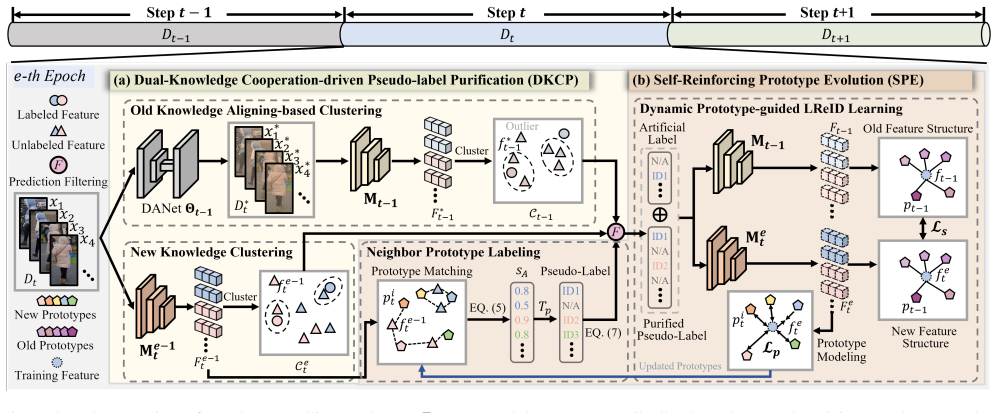
The load-bearing components are a set of learnable identity prototypes $P_t$, one per identity, trained with a prototype-orient identity loss plus triplet loss; the Neighbor Prototype Labeling rule, which converts the top-2 prototype similarities into a two-class softmax score $s_A$ and thresholds it; the set-based confidence $LC_s(x,S,C)$, the overlap ratio between a pseudo-label group and a cluster; two complementary clustering views, new-knowledge clustering by the current model and old-knowledge clustering by the previous model on style-aligned data; the union rule $Y^{pse}_t = Y^{pse}_{t-1}\cup Y^{pse}_{e-1}$ that fuses the purified sets; and a prototype-structure KL divergence that keeps the new model's affinity profile over old prototypes close to the old model's.
What would settle it
Evaluate SPRED at the 10% label rate and, each epoch, compute the precision of the purified pseudo-label set against a held-out subset of the unlabeled data whose identities are known. If precision does not increase monotonically, or if the union of the new- and old-model purified sets ever has lower precision than their intersection on the same epoch, the self-reinforcing and complementarity claims are contradicted.
Extended reading notes
Core claim
The central claim is that a self-reinforcing loop between prototype-generated pseudo-labels and new-old knowledge agreement can tame the noisy-label problem that blocks semi-supervised lifelong person re-identification. The paper shows that neighbor prototype labeling, which scores each unlabeled image by the softmax ratio of its top-2 nearest prototypes, produces better candidate labels than standard score-thresholding. Those candidates are then purified by a set-based label confidence, $LC_s(x,S,C)=|S\cap C|/|S\cup C|$, computed under two independent clusterings: one from the current model and one from the previous model applied after a style-alignment network. The union of the two purified sets outperforms either alone or their intersection, which the paper reads as evidence that new and old knowledge carry complementary errors. A prototype-structure KL loss against the old model preserves prior-domain structure while the loop trains the new domain.
Load-bearing premise
The loop's stability is the load-bearing premise: each round of filtering must remove more pseudo-label noise than it lets through, so that errors do not accumulate across epochs or across datasets.
Editorial extensions
If this is right
- At a 10% label rate, SPRED reports 43.2% Seen-Avg mAP and 54.4% R@1, improvements of 15.5 and 17.3 points over the strongest LReID baseline; at 50% the margins are 5.7 and 4.2 points.
- Pseudo-label prediction accuracy continues to rise with training epochs in SPRED while baseline methods plateau, so the paper's mechanism implies that unlabeled-data knowledge acquisition can be sustained over long streams rather than saturating.
- Because the method is exemplar-free, it offers a route to lifelong ReID in privacy-sensitive deployments where storing historical identity images for replay is not acceptable.
- The union-of-purified-sets result implies that, when two models disagree about which unlabeled samples belong together, treating their agreements as complementary rather than requiring consensus yields more usable training signal.
Reading between the lines
- The agreement principle is not tied to person images: the same prototype-plus-dual-clustering purification could be applied to streaming face, vehicle, or product identification with partial labels, at the cost of re-learning the domain-alignment network.
- The paper's union-versus-intersection finding suggests a general design rule for noisy pseudo-labels: heterogeneous feature spaces (fresh fine-tuned features versus older, more general features) should be combined by collecting their separately purified endorsements rather than by intersecting them.
- A natural next step would be to convert the empirical self-reinforcing loop into a convergence statement, e.g., bounding pseudo-label precision as a function of prototype purity and label rate; without such an analysis, the loop's stability rests on the observed accuracy curves.
- One could stress-test the loop by measuring per-epoch precision on a held-out labeled sample of the unlabeled set; if precision ever falls below the previous epoch, the current filter is admitting noise faster than it removes it.
Editorial analysis
A structured set of objections, weighed in public.
Referee Report
Summary. The paper introduces Semi-LReID, a setting in which a lifelong person re-identification model must adapt to a stream of new domains where only a fraction of the data is labeled. It proposes SPRED, which combines learnable identity prototypes for training and pseudo-label generation (DPL and NPL) with a dual-knowledge purification step (DKCP) that clusters the unlabeled data using both the new model and the old model and keeps pseudo-labels accepted by either cluster agreement score (Eqs. 8 and 9). A prototype-structure KL distillation loss is added to mitigate forgetting. Experiments on a 5-domain training / 7-domain testing benchmark at 10%, 20%, and 50% label rates compare SPRED with LReID and SSL+LReID baselines; the supplement adds a second training order, a 100% label-rate comparison, and additional ablations.
Significance. If the reported gains are reproducible, this is a useful contribution: it identifies a realistic and under-studied setting, provides a benchmark and promises code, and shows consistent gains over two training orders, with the component ablation moving monotonically in the intended direction. The authors also honestly report the 0.4% Seen-Avg R@1 deficit against HDC at 50% label rate. The main risk is that the load-bearing mechanism, a self-reinforcing loop between pseudo-label generation and purification, is supported by single-draw accuracy curves and thresholds chosen on the evaluation benchmark, without an analysis of error accumulation or a multi-seed evaluation. This is a correctness-risk concern that can be addressed within the manuscript's scope rather than a reason to reject.
major comments (4)
- [Sections 3.3, 3.4 and Eq. (8); Figs. 6 and 8] The central claim that the self-reinforcing loop improves pseudo-labels monotonically and prevents error accumulation is supported only by the label-prediction accuracy curves in Fig. 8 and supplement Fig. 10, which appear to come from a single random label draw. Early epochs are exactly the regime the paper itself criticizes in Section 2.2, where prototypes can overfit scarce labeled data; a biased prototype set can then bias the clusters used to purify pseudo-labels in Eq. (8). Since the thresholds Tp, Tc, To and the weight alpha are ablated on the evaluation benchmark (Fig. 6, Section 4.2), the reported margins could partly reflect favorable threshold choices rather than intrinsic loop stability. Please add multi-seed experiments with mean and standard deviation for the main tables, and per-epoch pseudo-label precision and recall against the ground-truth labels of the unlabeled subset (which are available in these datasets), reporting the worst seed separately at the 10% label rate.
- [Eq. (9) and Section 3.4] The final pseudo-label set is defined as the union of the new-knowledge and old-knowledge purified sets, so an instance is accepted if either filter passes. This rule is the basis of the claimed complementarity, but the paper does not report the per-source error rates. A noisy pseudo-label that passes only the old model or only the new model is retained, and if such labels persist across datasets the union could accumulate errors even though each individual filter looks reasonable. Please report, per epoch and per dataset, the precision of the new-only, old-only, and intersection subsets, and confirm that the union's advantage over intersection is not driven by a single domain or by early epochs when both models are nearly identical.
- [Algorithm 1 and Section 3.4] Algorithm 1 initializes the new model at each training step as M_t^0 = M_{t-1}. Consequently, in the first epoch the features used for new-knowledge clustering and old-knowledge clustering are extracted by the same model, differing only in the input style alignment via DANet; the two knowledge sources are therefore not independent at the first epoch. The paper does not discuss how the complementarity asserted in Eq. (9) emerges in this first epoch or whether the union is meaningful before the new model has diverged from the old one. Please clarify the initial-state behavior and report the NKC and OKAC pseudo-label precision separately for the first few epochs.
- [Supplement Table 5 and Table 2] The ablations show that OKAC and NKC each add only about 1 to 3 mAP over the DPL+NPL baseline, while the full DKCP adds about 5 mAP, so the bulk of the double-knowledge gain comes from the combination. Given the union rule of Eq. (9), this combination effect is the key evidence for the dual-knowledge claim, but the main paper only reports the full ablation (Table 2). Please move the per-component DKCP decomposition into the main paper and state the threshold choices and clustering parameters used for the matched comparison.
minor comments (4)
- [Section 4.4] The sentence reporting the 50% comparison with HDC should read "a 2.6% increase in Seen-Avg mAP but a 0.4% decrease in Seen-Avg R@1" for consistency with the metric names.
- [Eq. (6) and Section 3.3] The pseudo-label value N/A is used for samples that do not pass the neighbor-prototype threshold, but the paper does not explicitly state how these samples are excluded from Lp and Ltri in Eq. (2); please clarify the treatment of discarded samples in the training loss.
- [Figures 4, 5, and 6] In the version of the manuscript provided for review, the axis labels of Figures 4, 5, and 6 are not legible; if this is not an artifact of the review copy, the figures should be regenerated with readable labels.
- [Supplement Section 11] The 100% label-rate comparison in supplement Table 7 shows that SPRED without the SSL augmentation strategy is not consistently better than DKP, and the paper's explanation is qualitative; please add a short quantitative discussion of the label-rate dependence of the prototype distribution modeling.
Circularity Check
No significant circularity: target metrics are not inputs; self-citations are concentrated but not load-bearing.
full rationale
SPRED's reported quantities (Seen-Avg and UnSeen-Avg mAP/R@1) are never used as training inputs or as fitting targets: the pipeline in Eqs. (1)-(10) takes only labeled and unlabeled images, prototype-derived pseudo-labels, and cluster memberships, and the comparisons are against external and prior methods. The self-reinforcing loop (Eqs. 6-10) is an iterative bootstrap, not a derivation in which the conclusion is an input by construction; its stability is asserted empirically via Fig. 8 and the ablations, and the absence of multi-seed analysis is a robustness concern rather than circularity. Hyperparameters (alpha, Tc, To, Tp) are tuned on the benchmark in Fig. 6, but they are not fitted to the exact predicted mAP/R@1 values and sensitivity is reported, which is a standard model-selection caveat rather than a definitional reduction. Refs [53]-[55] are self-citations and supply the base model and problem framing, but the novel DKCP/SPE equations are specified in the paper and the method is evaluated against those same works as baselines; no load-bearing claim is justified solely by a self-citation and no uniqueness theorem or prior ansatz is imported to force the design. Therefore no circular step is identifiable.
Assumptions & free parameters
free parameters (5)
- Alpha (weight of structure-preserving loss Ls) =
4.0
- Tc (new-knowledge cluster agreement threshold) =
0.1
- To (old-knowledge cluster agreement threshold) =
0.6
- Tp (neighbor prototype labeling threshold) =
0.7
- DBSCAN parameters (eps, min_samples) =
not reported in main text
assumptions (5)
- domain assumption Identity label sets are disjoint across training datasets (Y_l^t ∩ Y_l^s = ∅)
- domain assumption Color-style alignment makes old-model features usable on new domains
- domain assumption DBSCAN cluster membership is a valid proxy for identity agreement
- ad hoc to paper Union of new and old purified label sets beats either alone or their intersection
- domain assumption The top-2 prototype softmax score is a calibrated confidence estimate
Cite this review
Pith. "Pith review of Self-Reinforcing Prototype Evolution with Dual-Knowledge Cooperation for Semi-Supervised Lifelong Person Re-Identification." pith.science (2026). https://pith.science/paper/O4RIWBAC
@misc{pith2026250701884,
  author       = {Pith},
  title        = {Pith review of: Self-Reinforcing Prototype Evolution with Dual-Knowledge Cooperation for Semi-Supervised Lifelong Person Re-Identification},
  year         = {2026},
  howpublished = {\url{https://pith.science/paper/O4RIWBAC}},
  note         = {Machine review of arXiv:2507.01884}
}
read the original abstract
Current lifelong person re-identification (LReID) methods predominantly rely on fully labeled data streams. However, in real-world scenarios where annotation resources are limited, a vast amount of unlabeled data coexists with scarce labeled samples, leading to the Semi-Supervised LReID (Semi-LReID) problem where LReID methods suffer severe performance degradation. Existing LReID methods, even when combined with semi-supervised strategies, suffer from limited long-term adaptation performance due to struggling with the noisy knowledge occurring during unlabeled data utilization. In this paper, we pioneer the investigation of Semi-LReID, introducing a novel Self-Reinforcing Prototype Evolution with Dual-Knowledge Cooperation framework (SPRED). Our key innovation lies in establishing a self-reinforcing cycle between dynamic prototype-guided pseudo-label generation and new-old knowledge collaborative purification to enhance the utilization of unlabeled data. Specifically, learnable identity prototypes are introduced to dynamically capture the identity distributions and generate high-quality pseudo-labels. Then, the dual-knowledge cooperation scheme integrates current model specialization and historical model generalization, refining noisy pseudo-labels. Through this cyclic design, reliable pseudo-labels are progressively mined to improve current-stage learning and ensure positive knowledge propagation over long-term learning. Experiments on the established Semi-LReID benchmarks show that our SPRED achieves state-of-the-art performance. Our source code is available at https://github.com/zhoujiahuan1991/ICCV2025-SPRED
Figures


Figures from the paper (7 more)


Reference graph
Works this paper leans on
-
[1]
Mixmatch: A holistic approach to semi-supervised learning
David Berthelot, Nicholas Carlini, Ian Goodfellow, Nicolas Papernot, Avital Oliver, and Colin A Raffel. Mixmatch: A holistic approach to semi-supervised learning. NeurIPS, 32,
-
[2]
Hy- pernetworks for continual semi-supervised learning
Dhanajit Brahma, Vinay Kumar Verma, and Piyush Rai. Hy- pernetworks for continual semi-supervised learning. arXiv preprint arXiv:2110.01856, 2021. 3
arXiv 2021
-
[3]
Imagery li- brary for intelligent detection systems (i-lids)
Home Office Scientific Development Branch. Imagery li- brary for intelligent detection systems (i-lids). In 2006 IET conference on crime and security, pages 445–448. IET, 2006. 5, 13, 14
work page 2006
-
[4]
Exponential moving average normalization for self-supervised and semi- supervised learning
Zhaowei Cai, Avinash Ravichandran, Subhransu Maji, Char- less Fowlkes, Zhuowen Tu, and Stefano Soatto. Exponential moving average normalization for self-supervised and semi- supervised learning. In CVPR, pages 194–203. IEEE, 2021. 5
work page 2021
-
[5]
Yongrui Chen, Xinnan Guo, Tongtong Wu, Guilin Qi, Yang Li, and Yang Dong. Learn from yesterday: A semi-supervised continual learning method for supervision- limited text-to-sql task streams. In AAAI, pages 12682– 12690, 2023. 4
work page 2023
-
[6]
Boosting semi- supervised learning by exploiting all unlabeled data
Yuhao Chen, Xin Tan, Borui Zhao, Zhaowei Chen, Ren- jie Song, Jiajun Liang, and Xuequan Lu. Boosting semi- supervised learning by exploiting all unlabeled data. In CVPR, pages 7548–7557, 2023. 3
work page 2023
-
[7]
Dma: Dual modality-aware alignment for visible-infrared person re- identification
Zhenyu Cui, Jiahuan Zhou, and Yuxin Peng. Dma: Dual modality-aware alignment for visible-infrared person re- identification. T-IFS, 19:2696–2708, 2024. 1
work page 2024
-
[8]
Learning continual compatible representation for re-indexing free lifelong person re-identification
Zhenyu Cui, Jiahuan Zhou, Xun Wang, Manyu Zhu, and Yuxin Peng. Learning continual compatible representation for re-indexing free lifelong person re-identification. In CVPR, pages 16614–16623, 2024. 1
work page 2024
Show all 78 references
-
[9]
Dkc: Differ- entiated knowledge consolidation for cloth-hybrid lifelong person re-identification
Zhenyu Cui, Jiahuan Zhou, and Yuxin Peng. Dkc: Differ- entiated knowledge consolidation for cloth-hybrid lifelong person re-identification. In CVPR, pages 3573–3582, 2025. 1
2025
-
[10]
Dynamic sub-graph distillation for robust semi-supervised continual learning
Yan Fan, Yu Wang, Pengfei Zhu, and Qinghua Hu. Dynamic sub-graph distillation for robust semi-supervised continual learning. In AAAI, pages 11927–11935, 2024. 2, 3
2024
-
[11]
Semi-supervised learning made simple with self-supervised clustering
Enrico Fini, Pietro Astolfi, Karteek Alahari, Xavier Alameda-Pineda, Julien Mairal, Moin Nabi, and Elisa Ricci. Semi-supervised learning made simple with self-supervised clustering. In CVPR, pages 3187–3197, 2023. 3, 4
2023
-
[12]
Domain adaptive learning with multi-granularity features for unsupervised person re- identification
Lihua Fu, Yubin Du, Yu Ding, Dan Wang, Hanxu Jiang, and Haitao Zhang. Domain adaptive learning with multi-granularity features for unsupervised person re- identification. Chinese Journal of Electronics , 31(1):116– 128, 2022. 1
2022
-
[13]
Lifelong person re-identification by pseudo task knowledge preservation
Wenhang Ge, Junlong Du, Ancong Wu, Yuqiao Xian, Ke Yan, Feiyue Huang, and Wei-Shi Zheng. Lifelong person re-identification by pseudo task knowledge preservation. In AAAI, pages 688–696, 2022. 1
2022
-
[14]
Exemplar-free continual representation learning via learn- able drift compensation
Alex Gomez-Villa, Dipam Goswami, Kai Wang, Andrew D Bagdanov, Bartlomiej Twardowski, and Joost van de Weijer. Exemplar-free continual representation learning via learn- able drift compensation. In ECCV, pages 473–490. Springer,
-
[15]
Cross-modality perturbation synergy attack for person re-identification
Yunpeng Gong, Zhun Zhong, Yansong Qu, Zhiming Luo, Rongrong Ji, and Min Jiang. Cross-modality perturbation synergy attack for person re-identification. 1
-
[16]
Person re- identification method based on color attack and joint de- fence
Yunpeng Gong, Liqing Huang, and Lifei Chen. Person re- identification method based on color attack and joint de- fence. In CVPR, pages 4313–4322, 2022. 1
2022
-
[17]
Viewpoint invariant pedestrian recognition with an ensemble of localized features
Douglas Gray and Hai Tao. Viewpoint invariant pedestrian recognition with an ensemble of localized features. InECCV, pages 262–275. Springer, 2008. 5, 13, 14
2008
-
[18]
Color prompting for data-free continual un- supervised domain adaptive person re-identification
Jianyang Gu, Hao Luo, Kai Wang, Wei Jiang, Yang You, and Jian Zhao. Color prompting for data-free continual un- supervised domain adaptive person re-identification. arXiv preprint arXiv:2308.10716, 2023. 5, 12
2023 arXiv
-
[19]
Transreid: Transformer-based object re- identification
Shuting He, Hao Luo, Pichao Wang, Fan Wang, Hao Li, and Wei Jiang. Transreid: Transformer-based object re- identification. In ICCV, pages 14993–15002. IEEE, 2021. 1
2021
-
[20]
Approximating the kull- back leibler divergence between gaussian mixture models
John R Hershey and Peder A Olsen. Approximating the kull- back leibler divergence between gaussian mixture models. In ICASSP, pages IV–317. IEEE, 2007. 4
2007
-
[21]
Person re-identification by descriptive and dis- criminative classification
Martin Hirzer, Csaba Beleznai, Peter M Roth, and Horst Bischof. Person re-identification by descriptive and dis- criminative classification. In Image Analysis, pages 91–102. Springer, 2011. 5, 13, 14
2011
-
[22]
Searching for mo- bilenetv3
Andrew Howard, Mark Sandler, Grace Chu, Liang-Chieh Chen, Bo Chen, Mingxing Tan, Weijun Wang, Yukun Zhu, Ruoming Pang, Vijay Vasudevan, et al. Searching for mo- bilenetv3. In ICCV, pages 1314–1324. IEEE, 2019. 12
2019
-
[23]
A soft nearest-neighbor framework for contin- ual semi-supervised learning
Zhiqi Kang, Enrico Fini, Moin Nabi, Elisa Ricci, and Kar- teek Alahari. A soft nearest-neighbor framework for contin- ual semi-supervised learning. In ICCV, pages 11868–11877,
-
[24]
Cdmad: Class- distribution-mismatch-aware debiasing for class-imbalanced semi-supervised learning
Hyuck Lee and Heeyoung Kim. Cdmad: Class- distribution-mismatch-aware debiasing for class-imbalanced semi-supervised learning. In CVPR, pages 23891–23900. IEEE, 2024. 6, 15
2024
-
[25]
Comatch: Semi-supervised learning with contrastive graph regulariza- tion
Junnan Li, Caiming Xiong, and Steven CH Hoi. Comatch: Semi-supervised learning with contrastive graph regulariza- tion. In ICCV, pages 9475–9484, 2021. 3
2021
-
[26]
Exemplar-free lifelong person re-identification via prompt- guided adaptive knowledge consolidation.IJCV, pages 1–16,
Qiwei Li, Kunlun Xu, Yuxin Peng, and Jiahuan Zhou. Exemplar-free lifelong person re-identification via prompt- guided adaptive knowledge consolidation.IJCV, pages 1–16,
-
[27]
Locally aligned feature trans- forms across views
Wei Li and Xiaogang Wang. Locally aligned feature trans- forms across views. In CVPR, pages 3594–3601. IEEE,
-
[28]
Human reidentifica- tion with transferred metric learning
Wei Li, Rui Zhao, and Xiaogang Wang. Human reidentifica- tion with transferred metric learning. InACCV, pages 31–44. Springer, 2012. 5, 13, 14
2012
-
[29]
Deep- reid: Deep filter pairing neural network for person re- identification
Wei Li, Rui Zhao, Tong Xiao, and Xiaogang Wang. Deep- reid: Deep filter pairing neural network for person re- identification. In CVPR, pages 152–159. IEEE, 2014. 5, 13, 14
2014
-
[30]
A bottom-up clustering approach to unsupervised per- 9 son re-identification
Yutian Lin, Xuanyi Dong, Liang Zheng, Yan Yan, and Yi Yang. A bottom-up clustering approach to unsupervised per- 9 son re-identification. In AAAI, pages 8738–8745, 2019. 2, 3
2019
-
[31]
Certainty driven consistency loss on multi-teacher networks for semi-supervised learning.Pat- tern Recognition, 120:108140, 2021
Lu Liu and Robby T Tan. Certainty driven consistency loss on multi-teacher networks for semi-supervised learning.Pat- tern Recognition, 120:108140, 2021. 3
2021
-
[32]
Time- delayed correlation analysis for multi-camera activity under- standing
Chen Change Loy, Tao Xiang, and Shaogang Gong. Time- delayed correlation analysis for multi-camera activity under- standing. IJCV, 90(1):106–129, 2010. 5, 13, 14
2010
-
[33]
Learning to predict gradients for semi-supervised con- tinual learning
Yan Luo, Yongkang Wong, Mohan Kankanhalli, and Qi Zhao. Learning to predict gradients for semi-supervised con- tinual learning. TNNLS, 2024. 3
2024
-
[34]
Lifelong person re-identification via adaptive knowl- edge accumulation
Nan Pu, Wei Chen, Yu Liu, Erwin M Bakker, and Michael S Lew. Lifelong person re-identification via adaptive knowl- edge accumulation. In CVPR, pages 7897–7906. IEEE,
-
[35]
Meta reconciliation normalization for lifelong person re-identification
Nan Pu, Yu Liu, Wei Chen, Erwin M Bakker, and Michael S Lew. Meta reconciliation normalization for lifelong person re-identification. In ACM MM, pages 541–549, 2022. 3
2022
-
[36]
A memorizing and generalizing framework for lifelong person re-identification
Nan Pu, Zhun Zhong, Nicu Sebe, and Michael S Lew. A memorizing and generalizing framework for lifelong person re-identification. IEEE TPAMI, 45(11):13567–13585, 2023. 3, 13
2023
-
[37]
Regularization with stochastic transformations and perturba- tions for deep semi-supervised learning
Mehdi Sajjadi, Mehran Javanmardi, and Tolga Tasdizen. Regularization with stochastic transformations and perturba- tions for deep semi-supervised learning. NeurIPS, 29, 2016. 3
2016
-
[38]
Dual pseudo-labels interactive self-training for semi- supervised visible-infrared person re-identification
Jiangming Shi, Yachao Zhang, Xiangbo Yin, Yuan Xie, Zhizhong Zhang, Jianping Fan, Zhongchao Shi, and Yanyun Qu. Dual pseudo-labels interactive self-training for semi- supervised visible-infrared person re-identification. InICCV, pages 11218–11228. IEEE, 2023. 2, 3, 5, 6, 15
2023
-
[39]
Learning commonality, divergence and variety for unsupervised visible-infrared person re- identification
Jiangming Shi, Xiangbo Yin, Yachao Zhang, Yuan Xie, Yanyun Qu, et al. Learning commonality, divergence and variety for unsupervised visible-infrared person re- identification. NeurIPS, 37:99715–99734, 2024. 1
2024
-
[40]
Multi- memory matching for unsupervised visible-infrared person re-identification
Jiangming Shi, Xiangbo Yin, Yeyun Chen, Yachao Zhang, Zhizhong Zhang, Yuan Xie, and Yanyun Qu. Multi- memory matching for unsupervised visible-infrared person re-identification. In ECCV, pages 456–474. Springer, 2025. 2
2025
-
[41]
Memory-efficient semi-supervised continual learning: The world is its own replay buffer
James Smith, Jonathan Balloch, Yen-Chang Hsu, and Zsolt Kira. Memory-efficient semi-supervised continual learning: The world is its own replay buffer. In IJCNN, pages 1–8. IEEE, 2021. 3
2021
-
[42]
Fixmatch: Simplifying semi-supervised learning with consistency and confidence
Kihyuk Sohn, David Berthelot, Nicholas Carlini, Zizhao Zhang, Han Zhang, Colin A Raffel, Ekin Dogus Cubuk, Alexey Kurakin, and Chun-Liang Li. Fixmatch: Simplifying semi-supervised learning with consistency and confidence. NeurIPS, 33:596–608, 2020. 2, 3
2020
-
[43]
Region-based quality estimation network for large-scale person re-identification
Guanglu Song, Biao Leng, Yu Liu, Congrui Hetang, and Shaofan Cai. Region-based quality estimation network for large-scale person re-identification. In AAAI, 2018. 5, 13, 14
2018
-
[44]
Marginmatch: Im- proving semi-supervised learning with pseudo-margins
Tiberiu Sosea and Cornelia Caragea. Marginmatch: Im- proving semi-supervised learning with pseudo-margins. In CVPR, pages 15773–15782, 2023. 3
2023
-
[45]
Patch-based knowledge dis- tillation for lifelong person re-identification
Zhicheng Sun and Yadong Mu. Patch-based knowledge dis- tillation for lifelong person re-identification. In ACM MM, pages 696–707, 2022. 5, 6, 15
2022
-
[46]
Ordisco: Effective and efficient usage of incremental unlabeled data for semi-supervised continual learning
Liyuan Wang, Kuo Yang, Chongxuan Li, Lanqing Hong, Zhenguo Li, and Jun Zhu. Ordisco: Effective and efficient usage of incremental unlabeled data for semi-supervised continual learning. In CVPR, pages 5383–5392, 2021. 3
2021
-
[47]
Persistence homology distillation for semi-supervised con- tinual learning
Yu Wang, Pengfei Zhu, Dongyue Chen, and Qinghua Hu. Persistence homology distillation for semi-supervised con- tinual learning. NeurIPS, 37:76332–76355, 2024. 2
2024
-
[48]
Person transfer gan to bridge domain gap for person re- identification
Longhui Wei, Shiliang Zhang, Wen Gao, and Qi Tian. Person transfer gan to bridge domain gap for person re- identification. In CVPR, pages 79–88. IEEE, 2018. 5, 13, 14
2018
-
[49]
Semi- supervised learning with heterogeneous distribution consis- tency for visible infrared person re-identification
Ziyu Wei, Xi Yang, Nannan Wang, and Xinbo Gao. Semi- supervised learning with heterogeneous distribution consis- tency for visible infrared person re-identification. IEEE TIP,
-
[50]
Rewarded semi-supervised re-identification on identities rarely cross- ing camera views
Ancong Wu, Wenhang Ge, and Wei-Shi Zheng. Rewarded semi-supervised re-identification on identities rarely cross- ing camera views. IEEE TPAMI, 2023. 2, 3
2023
-
[51]
Generalising without for- getting for lifelong person re-identification
Guile Wu and Shaogang Gong. Generalising without for- getting for lifelong person re-identification. In AAAI, pages 2889–2897, 2021. 1, 2
2021
-
[52]
End-to-end deep learning for person search
Tong Xiao, Shuang Li, Bochao Wang, Liang Lin, and Xi- aogang Wang. End-to-end deep learning for person search. arXiv preprint arXiv:1604.01850, 2(2):4, 2016. 5, 13, 14
2016 arXiv
-
[53]
Mitigate catastrophic remembering via con- tinual knowledge purification for noisy lifelong person re- identification
Kunlun Xu, Haozhuo Zhang, Yu Li, Yuxin Peng, and Ji- ahuan Zhou. Mitigate catastrophic remembering via con- tinual knowledge purification for noisy lifelong person re- identification. In ACM MM, pages 1–9, 2024. 1, 2, 3, 5, 16
2024
-
[54]
Distribution-aware knowledge prototyping for non-exemplar lifelong person re-identification
Kunlun Xu, Xu Zou, Yuxin Peng, and Jiahuan Zhou. Distribution-aware knowledge prototyping for non-exemplar lifelong person re-identification. In CVPR, pages 16604– 16613. IEEE, 2024. 1, 2, 3, 5, 6, 14, 15
2024
-
[55]
Lstkc: Long short-term knowledge consolidation for lifelong person re- identification
Kunlun Xu, Xu Zou, and Jiahuan Zhou. Lstkc: Long short-term knowledge consolidation for lifelong person re- identification. In AAAI, pages 16202–16210, 2024. 1, 3, 4, 5, 6, 13, 15
2024
-
[56]
Dask: Distribution rehearsing via adaptive style kernel learning for exemplar-free lifelong person re- identification
Kunlun Xu, Chenghao Jiang, Peixi Xiong, Yuxin Peng, and Jiahuan Zhou. Dask: Distribution rehearsing via adaptive style kernel learning for exemplar-free lifelong person re- identification. In AAAI, pages 8915–8923, 2025. 2
2025
-
[57]
Long short-term knowledge decomposition and con- solidation for lifelong person re-identification.IEEE TPAMI,
Kunlun Xu, Zichen Liu, Xu Zou, Yuxin Peng, and Jiahuan Zhou. Long short-term knowledge decomposition and con- solidation for lifelong person re-identification.IEEE TPAMI,
-
[58]
Compo- nential prompt-knowledge alignment for domain incremen- tal learning
Kunlun Xu, Xu Zou, Gang Hua, and Jiahuan Zhou. Compo- nential prompt-knowledge alignment for domain incremen- tal learning. In ICML, 2025. 1
2025
-
[59]
Shrinking class space for enhanced cer- tainty in semi-supervised learning
Lihe Yang, Zhen Zhao, Lei Qi, Yu Qiao, Yinghuan Shi, and Hengshuang Zhao. Shrinking class space for enhanced cer- tainty in semi-supervised learning. In ICCV, pages 16187– 16196, 2023. 6, 7, 15
2023
-
[60]
Handling label uncertainty for camera incremen- tal person re-identification
Zexian Yang, Dayan Wu, Wanqian Zhang, Bo Li, and Weip- inng Wang. Handling label uncertainty for camera incremen- tal person re-identification. In ACM MM, page 6253–6263,
-
[61]
Unsupervised cross-media hashing learning via knowledge graph
Zhaoda Ye, Xiangteng He, and Yuxin Peng. Unsupervised cross-media hashing learning via knowledge graph. Chinese Journal of Electronics, 31(6):1081–1091, 2022. 1
2022
-
[62]
Robust pseudo-label learning with neighbor relation for unsuper- vised visible-infrared person re-identification
Xiangbo Yin, Jiangming Shi, Yachao Zhang, Yang Lu, Zhizhong Zhang, Yuan Xie, and Yanyun Qu. Robust pseudo-label learning with neighbor relation for unsuper- vised visible-infrared person re-identification. In ACM MM, pages 2242–2251, 2024. 1
2024
-
[63]
Lifelong person re-identification via knowledge re- freshing and consolidation
Chunlin Yu, Ye Shi, Zimo Liu, Shenghua Gao, and Jingya Wang. Lifelong person re-identification via knowledge re- freshing and consolidation. In AAAI, pages 3295–3303,
-
[64]
S4l: Self-supervised semi-supervised learning
Xiaohua Zhai, Avital Oliver, Alexander Kolesnikov, and Lu- cas Beyer. S4l: Self-supervised semi-supervised learning. In ICCV, pages 1476–1485, 2019. 3
2019
-
[65]
Scap: Transductive test-time adaptation via supportive clique-based attribute prompting
Chenyu Zhang, Kunlun Xu, Zichen Liu, Yuxin Peng, and Jiahuan Zhou. Scap: Transductive test-time adaptation via supportive clique-based attribute prompting. InCVPR, pages 30032–30041, 2025. 1
2025
-
[66]
Spindle net: Person re-identification with human body region guided feature decomposition and fusion
Haiyu Zhao, Maoqing Tian, Shuyang Sun, Jing Shao, Junjie Yan, Shuai Yi, Xiaogang Wang, and Xiaoou Tang. Spindle net: Person re-identification with human body region guided feature decomposition and fusion. In CVPR, pages 907–915. IEEE, 2017. 5, 13, 14
2017
-
[67]
Scalable person re-identification: A benchmark
Liang Zheng, Liyue Shen, Lu Tian, Shengjin Wang, Jing- dong Wang, and Qi Tian. Scalable person re-identification: A benchmark. In ICCV, pages 1116–1124. IEEE, 2015. 5, 13, 14
2015
-
[68]
Simmatch: Semi-supervised learn- ing with similarity matching
Mingkai Zheng, Shan You, Lang Huang, Fei Wang, Chen Qian, and Chang Xu. Simmatch: Semi-supervised learn- ing with similarity matching. In CVPR, pages 14471–14481,
-
[69]
Simmatchv2: Semi- supervised learning with graph consistency
Mingkai Zheng, Shan You, Lang Huang, Chen Luo, Fei Wang, Chen Qian, and Chang Xu. Simmatchv2: Semi- supervised learning with graph consistency. In CVPR, pages 16432–16442. IEEE, 2023. 6, 15
2023
-
[70]
Camera style adaptation for person re- identification
Zhun Zhong, Liang Zheng, Zhedong Zheng, Shaozi Li, and Yi Yang. Camera style adaptation for person re- identification. In CVPR, pages 5157–5166. IEEE, 2018. 1 11 Self-Reinforcing Prototype Evolution with Dual-Knowledge Cooperation for Semi-Supervised Lifelong Person Re-Identif...
2018
-
[71]
As illustrated in Fig
Implementation of Distribution Alignment Network Inspired by [18], which revealed that the primary distribu- tion difference across ReID datasets lies in color styles, we propose a distribution alignment network (DANet) based on the architecture of [18]. As illustrated in Fig....
-
[72]
Ablation Studies on DKCP Our Dual-Knowledge Cooperation-driven Pseudo-label Pu- rification (DKCP) module is designed to filter noisy pseudo- labels by leveraging both old and new model knowledge. To achieve this, two complementary strategies are introduced: Old Knowledge Align...
-
[73]
Algorithm The pseudo-code of our SPRED method is shown in Alg 1
-
[74]
The de- tailed dataset statistics are presented in Tab
Datasets Details of Semi-LReID Benchmark We establish the Semi-LReID benchmark based on the ex- isting LReID configuration[34], incorporating 12 widely- used ReID datasets: Market1501 [67], LPW [43], CUHK-SYSU [52], MSMT17-V2 [48], CUHK03 [29], CUHK01 [28], CUHK02 [27], VIPeR ...
-
[75]
Experimental Results on Different Dataset Orders In our main paper, the default training dataset order follows Market-1501 →CUHK-SYSU→LPW→MSMT17 →CUHK03, denoted as Training Training Order-1 1. In this section, we extend the evaluation by compar- ing our method with existing a...
-
[76]
As shown in Tab
Experimental Results Under Label Rate r=100% We also evaluate our method under the fully-labeled sce- nario, where the label rater=100%. As shown in Tab. 7, our SPRED achieves competitive results with the latest LReID methods across both training orders. Additionally, the en- ...
-
[77]
Besides, the exemplar-free SSLL method LDC [14] is also compared (with sequential fine-tune as the baseline)
Quantitative comparisons with state-of- the-art NoisyLReID and SSLL methods We also compare our proposed method with the latest Noisy Lifelong Person Re-Identification (NoisyLReID) method CKP [53] by assigning all the unlabeled data with the same label, serving as noisy data. ...
-
[78]
Be- yond the prediction accuracy curves presented in the main paper, we provide additional visualizations for CUHK- SYSU, LPW, and CUHK03 datasets in Fig
Additional Visualization on Prediction and Features More Identity Prediction Capacity Visualization . Be- yond the prediction accuracy curves presented in the main paper, we provide additional visualizations for CUHK- SYSU, LPW, and CUHK03 datasets in Fig. 10. The re- sults sh...
Reviewed August 6, 2026 · model on record in the stance chip above.
Discussion (0). Sign in to comment.