REVIEW 5 major objections 6 minor 1 cited by
FreeMorph: Tuning-Free Generalized Image Morphing with Diffusion Model
T0 review · 5 major / 6 minor · reviewed 2026-08-06 · deepseek-v4-flash
Pith's one-line read FreeMorph makes image morphing tuning-free, handling different semantics and layouts, with transitions in under 30 seconds.
desk verdict A promising tuning-free morphing pipeline with a genuine new combination of attention blending tricks, but Eq. 8 is underspecified to the point of non-reproducibility, and the missing code/data keep the SOTA claim from being fully credible. read the letter →
The pith
A machine-rendered reading of the paper's core claim, the machinery that carries it, and where it could break.
The reading
What carries the argument
The load-bearing object is the self-attention module of the pre-trained U-Net. At each denoising step FreeMorph computes the key and value features of the two input-image latents and then replaces the generative attention with one of three blends: an equal average of the two inputs' attention outputs (Eq. 5), an average over all interpolated latents (Eq. 6), or a linearly weighted blend with weight $\alpha_j = j/(J+1)$ (Eq. 7). Four thresholds $\lambda_1, \lambda_2, \lambda_3, \lambda_4$ schedule which replacement is active across the 50 forward-diffusion and reverse-denoising steps. Identity preservation, directional drift, and smoothness each come from which attention replacement is active at which stage.
What would settle it
A concrete test: fix the hyperparameters $\lambda_1$ through $\lambda_4$ and run FreeMorph on pairs ranging from near-identical to semantically unrelated. If the optimal schedule drifts with pair type, or if re-running with different random high-frequency masks $m$ changes LPIPS or PPL by more than the reported gap to DiffMorpher, the tuning-free generalization claim is weaker than stated.
Extended reading notes
Core claim
The paper's discovery is a tuning-free recipe built on Stable Diffusion and DDIM: caption both inputs with a vision-language model, invert both images to latents, spherically interpolate the latents, and then overwrite the self-attention of the denoiser so that its keys and values are derived from the two inputs rather than from the current noisy latent. During forward diffusion, a prior-driven attention averages over all interpolated latents to keep the noise from collapsing into near-identical copies; during reverse denoising, a step-oriented variation trend with weight $\alpha_j = j/(J+1)$ shifts the attention blend from the source to the target so the sequence moves smoothly from one identity to the other. A high-frequency Gaussian noise injection adds flexibility. The authors claim this outperforms trained baselines on LPIPS, FID, and PPL on both MorphBench and their new Morph4Data, and completes a morph in under 30 seconds.
Load-bearing premise
The load-bearing premise is that mixing the self-attention key and value features of the two inputs at particular hand-chosen points in the denoising schedule produces genuine intermediates that preserve both identities, an empirical assumption demonstrated only on the authors' evaluation pairs.
Editorial extensions
If this is right
- Image morphing no longer needs per-pair fine-tuning; a morph sequence is produced in under 30 seconds on a single A100 GPU.
- Inputs with different semantics or layouts become tractable, not just near-identical pairs, because the guidance comes from attention features rather than from per-pair LoRA weights.
- The method establishes new state-of-the-art numbers on MorphBench and on the newly introduced Morph4Data on LPIPS, FID, and PPL.
- Text-guided image editing follows as a special case in which the same image is used as both endpoints and different text prompts drive the transition.
- Because the pre-trained diffusion model is used as-is, its generalization is preserved instead of being narrowed by fine-tuning.
Reading between the lines
- If attention-feature blending is the operative mechanism, the same schedule could be carried over to video diffusion or multi-image interpolation, where the same 'variation trend' problem appears.
- The reported failure at human limbs suggests the ceiling is set by Stable Diffusion's prior, so swapping the backbone for a differently trained diffusion model may relocate the failure modes without changing FreeMorph's structure.
- The binary high-pass mask $m$ in Eq. (8) is left unspecified, so the exact noise injection is not reproducible from the text alone; a sensitivity study over $m$ would clarify how much of the smoothness comes from that step.
- Since text-guided editing is demonstrated as a special case, FreeMorph could serve as a zero-shot editing baseline that does not require inversion-specific machinery.
Editorial analysis
A structured set of objections, weighed in public.
Referee Report
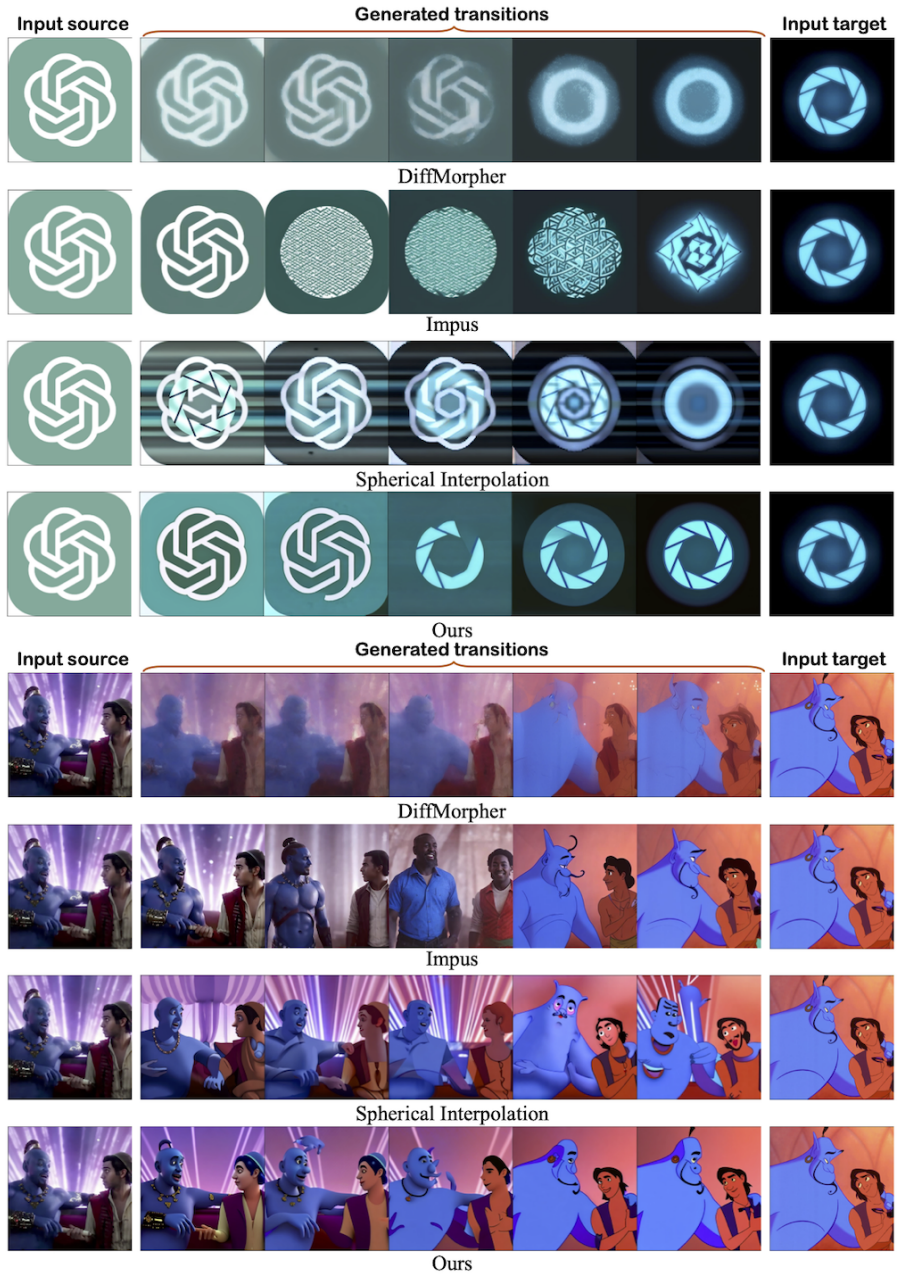
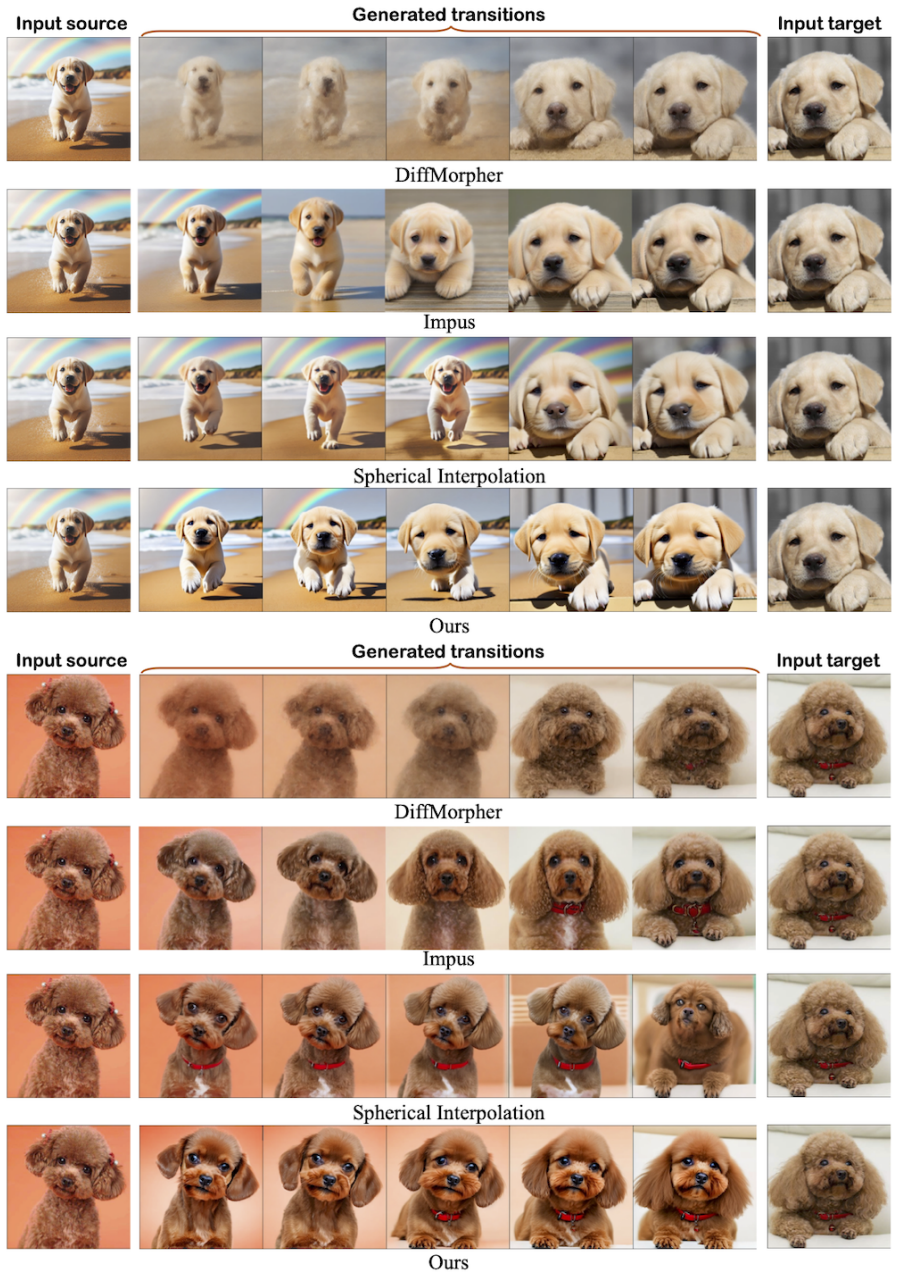
Summary. The paper proposes FreeMorph, a tuning-free image morphing method built on Stable Diffusion. The method combines spherical interpolation in latent space, guidance-aware modifications to self-attention key/value features, a step-oriented variation trend, and a high-frequency noise injection step, with a staged forward/reverse denoising schedule controlled by hyperparameters lambda_1 to lambda_4. The authors evaluate on the existing MorphBench dataset and on a newly introduced Morph4Data dataset, reporting lower LPIPS, FID, and PPL than IMPUS, DiffMorpher, and a spherical-interpolation baseline, together with a user study and qualitative comparisons. The central claims are that FreeMorph is the first tuning-free method to handle inputs with different semantics or layouts, produces high-fidelity transitions in under 30 seconds, and outperforms trained baselines.
Significance. If the central claims hold, the contribution is practically significant: a tuning-free diffusion-based image morphing method that works across semantic and layout gaps would be a useful advance, and the reported speed-up over trained baselines is substantial. The paper has concrete strengths: the component-level ablations in Table 3 are informative, the qualitative figures show visible differences from the baselines, and the newly collected Morph4Data attempts to cover a regime that existing benchmarks under-represent. However, several load-bearing details are either incorrect or underspecified as written, and the evaluation has reproducibility limitations, so I cannot recommend acceptance in the current form.
major comments (5)
- [Sec. 3.4, Eq. (8)] The high-frequency Gaussian noise injection step is mathematically ill-posed as written. For m=1, z := IFFT(FFT(z)) is exactly the identity transform; for m=0, z := IFFT(FFT(g)) equals g if g is a latent-space noise vector. Since m is described as a binary high-pass mask of the same size as z, the equation never multiplies the spectrum by m and has no frequency-selective effect. The ablation in Table 3 shows that removing noise injection changes overall LPIPS from 162.99 to 188.61, so this component materially affects the reported numbers. Please replace Eq. (8) with a correct masking operation such as z = IFFT(m * FFT(z) + (1-m) * FFT(g)), specify how m is constructed and how g is scaled, and state whether the implementation follows the corrected formula.
- [Sec. 3.2, Eq. (4)] The spherical interpolation formula for z_{0-j} is inconsistent with the stated range j in [1,J]. With j=1, the coefficient sin((1-j)*phi)/sin(phi) equals zero, so the first intermediate latent would not be close to the left input; with j=J, sin((1-J)*phi) is generally not sin(phi). The likely intended schedule involves a normalized interpolation parameter such as j/(J+1) inside the spherical-interpolation angle. Please correct Eq. (4) or clearly define the interpolation parameter, because this formula defines the initialization on which the entire pipeline depends.
- [Tables 1-3] All quantitative results are reported as point estimates without standard deviations, confidence intervals, or significance tests. FreeMorph has stochastic components, and the hyperparameters lambda_1 to lambda_4 are hand-picked, so the observed margins over baselines could be within run-to-run variability. Please report multiple runs or seeds with error bars, add statistical significance tests for the main comparisons, and include a sensitivity analysis for lambda_1, lambda_2, lambda_3, and lambda_4.
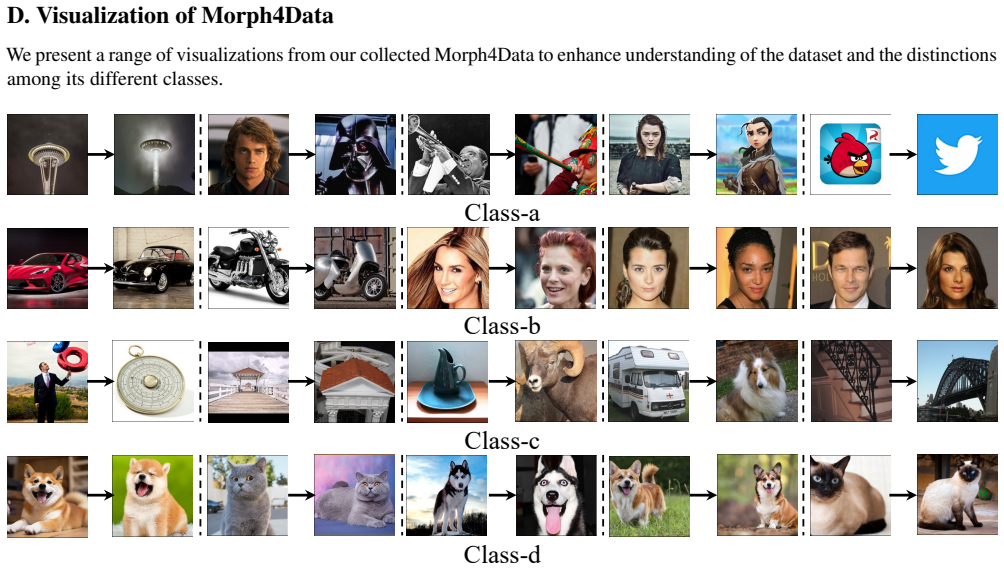
- [Sec. 4, Morph4Data] Morph4Data is a newly curated evaluation dataset, but it is not released and the paper does not provide detailed curation criteria or source breakdowns beyond the four class descriptions. Without access to the dataset or a precise construction protocol, the Morph4Data numbers in Tables 1 and 3 cannot be reproduced or extended by other researchers. Please release the dataset or provide a detailed protocol and a public download link.
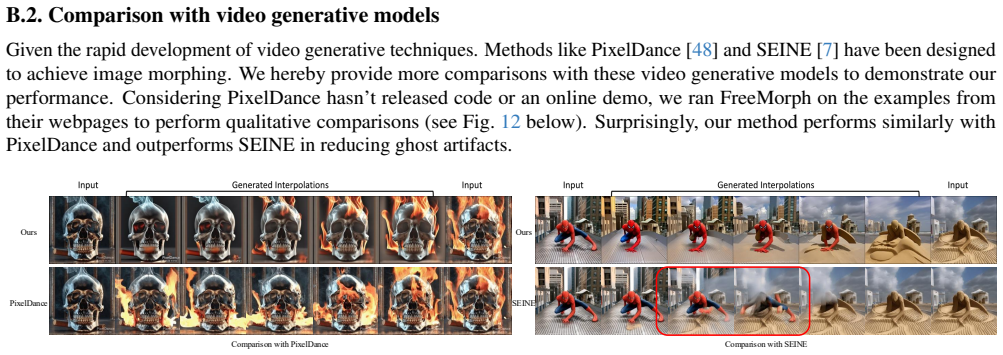
- [Sec. 4.1 and Appendix B.1] The main quantitative comparison omits AID and Smooth Diffusion, which are discussed only qualitatively in the appendix. If these methods are considered baselines for the morphing task, the state-of-the-art claim is incomplete. Please include their quantitative results in Table 1 or clearly justify why they are excluded from the metric-based comparison.
minor comments (6)
- [Sec. 3.2] The sentence 'Note that z_{t-j}, z_{t-left} and z_{t-right} are derived based on Eq. 3' is unclear because Eq. 3 is the attention formula, not the DDIM inversion or interpolation formula; please correct the cross-reference.
- [Sec. 3.4, Eq. (8)] The notation IFFT(FFT(g)) implicitly assumes g is defined in the same spatial or latent domain and has the same size as z; please state the domain, size, and normalization of g explicitly.
- [Algorithm 1, step 7] The instruction 'Add text-conditioned features' is vague; the mechanism by which text embeddings from LLaVA captions are injected into the denoising process, such as classifier-free guidance with averaged or interpolated text embeddings, should be specified.
- [Sec. 4, User studies] The user study reports only preference percentages; please provide the number of pairwise comparisons per participant, the randomization protocol, and inter-subject agreement or a related measure of reliability.
- [Appendix B.3] The section on GAN-based morphing ends with 'Additional evaluations and discussions will be included in the revised version,' which indicates that the comparison with Neural Crossbreed is incomplete as submitted; please either complete this section or remove the claim that it supports.
- [Sec. 4, Implementation Details] The paper claims a 10x to 50x speed-up but reports only 'under 30 seconds' on an A100 GPU; please include the exact runtime of each baseline and the timing protocol so that the speed comparison is verifiable.
Circularity Check
No circularity: FreeMorph's equations are explicit constructions rather than predictions, and its self-citations are not load-bearing; the main issue is an underspecified Eq. 8, which is a reproducibility flaw, not a tautology.
full rationale
No circular step can be exhibited. Eq. 4 is spherical interpolation of the input latents and is explicitly an initialization; Eq. 5, Eq. 6, and Eq. 7 are algorithmic replacements of self-attention keys/values with convex combinations or averages of input-derived features, so any smooth-transition property they produce is an empirical outcome, not an identity. The hyperparameters (lambda_1 through lambda_4, J=5, CFG=7.5) are global constants, and while component choices were validated by ablations on MorphBench/Morph4Data, this is test-set model selection, a correctness/overfitting concern, not a reduction of the reported LPIPS/FID/PPL numbers to the fitted values by construction. Self-citations to AID [29] and SEINE [7] appear only in appendix comparisons and are not load-bearing for the central claim. The paper's most serious weakness is Eq. 8: as written, z := IFFT(FFT(z)) if m=1 is the identity and z := IFFT(FFT(g)) if m=0 replaces the latent with Gaussian noise, so the described high-frequency Gaussian noise injection never applies a mask to the spectrum and is not reproducible as stated; Appendix F also concedes failure cases. These are specification and generalization limitations, not circular derivations.
Assumptions & free parameters
free parameters (5)
- lambda_1 =
0.3
- lambda_2 =
0.6
- lambda_3 =
0.2
- lambda_4 =
0.6
- high_frequency_mask_m =
unspecified
assumptions (4)
- domain assumption Pretrained Stable Diffusion 2.1 provides a valid generative prior for image morphing.
- domain assumption DDIM inversion (Eq. 2) gives a faithful latent representation of input images.
- ad hoc to paper Blending K/V self-attention features from two images produces semantically meaningful intermediate features.
- ad hoc to paper Hand-picked step schedule (lambda1-4) yields optimal transitions.
Cite this review
Pith. "Pith review of FreeMorph: Tuning-Free Generalized Image Morphing with Diffusion Model." pith.science (2026). https://pith.science/paper/BHQLQMXS
@misc{pith2026250701953,
  author       = {Pith},
  title        = {Pith review of: FreeMorph: Tuning-Free Generalized Image Morphing with Diffusion Model},
  year         = {2026},
  howpublished = {\url{https://pith.science/paper/BHQLQMXS}},
  note         = {Machine review of arXiv:2507.01953}
}
read the original abstract
We present FreeMorph, the first tuning-free method for image morphing that accommodates inputs with different semantics or layouts. Unlike existing methods that rely on finetuning pre-trained diffusion models and are limited by time constraints and semantic/layout discrepancies, FreeMorph delivers high-fidelity image morphing without requiring per-instance training. Despite their efficiency and potential, tuning-free methods face challenges in maintaining high-quality results due to the non-linear nature of the multi-step denoising process and biases inherited from the pre-trained diffusion model. In this paper, we introduce FreeMorph to address these challenges by integrating two key innovations. 1) We first propose a guidance-aware spherical interpolation design that incorporates explicit guidance from the input images by modifying the self-attention modules, thereby addressing identity loss and ensuring directional transitions throughout the generated sequence. 2) We further introduce a step-oriented variation trend that blends self-attention modules derived from each input image to achieve controlled and consistent transitions that respect both inputs. Our extensive evaluations demonstrate that FreeMorph outperforms existing methods, being 10x ~ 50x faster and establishing a new state-of-the-art for image morphing.
Figures


Figures from the paper (26 more)










Forward citations
Cited by 1 Pith paper
-
Kontinuous Kontext: Continuous Strength Control for Instruction-based Image Editing
Kontinuous Kontext adds continuous edit-strength control to instruction-based image editing by projecting a scalar strength and text embedding into the modulation space of a Flux Kontext diffusion editor.
Reference graph
Works this paper leans on
-
[1]
Image morphing techniques: A review
Alyaa Qusay Aloraibi. Image morphing techniques: A review. Technium, 9, 2023. 2
work page 2023
-
[2]
Feature-based image meta- morphosis
Thaddeus Beier and Shawn Neely. Feature-based image meta- morphosis. In SIGGRAPH, pages 35–42. ACM, 1992. 2, 3
work page 1992
-
[3]
Forest Black. Flux.1. https://blackforestlabs.ai/announcing- black-forest-labs/, 2024. 2
work page 2024
-
[4]
Large scale gan training for high fidelity natural image synthesis
Andrew Brock, Jeff Donahue, and Karen Simonyan. Large scale gan training for high fidelity natural image synthesis. In ICLR, 2019. 2
work page 2019
-
[5]
Masactrl: Tuning-free mu- tual self-attention control for consistent image synthesis and editing
Mingdeng Cao, Xintao Wang, Zhongang Qi, Ying Shan, Xi- aohu Qie, and Yinqiang Zheng. Masactrl: Tuning-free mu- tual self-attention control for consistent image synthesis and editing. In Proceedings of the IEEE/CVF International Con- ference on Computer Vision, pages 22560–22570, 2023. 3, 4
work page 2023
-
[6]
Pixart- α: Fast training of diffusion transformer for photorealistic text-to-image synthesis
Junsong Chen, Jincheng Yu, Chongjian Ge, Lewei Yao, Enze Xie, Yue Wu, Zhongdao Wang, James Kwok, Ping Luo, Huchuan Lu, et al. Pixart- α: Fast training of diffusion transformer for photorealistic text-to-image synthesis. arXiv preprint arXiv:2310.00426, 2023. 2
-
[7]
Seine: Short-to-long video diffusion model for generative transition and prediction
Xinyuan Chen, Yaohui Wang, Lingjun Zhang, Shaobin Zhuang, Xin Ma, Jiashuo Yu, Yali Wang, Dahua Lin, Yu Qiao, and Ziwei Liu. Seine: Short-to-long video diffusion model for generative transition and prediction. In The Twelfth International Conference on Learning Representations, 2023. 13
work page 2023
-
[8]
Imagenet: A large-scale hierarchical image database
Jia Deng, Wei Dong, Richard Socher, Li-Jia Li, Kai Li, and Li Fei-Fei. Imagenet: A large-scale hierarchical image database. In 2009 IEEE conference on computer vision and pattern recognition, pages 248–255. Ieee, 2009. 6
2009
Show all 51 references
-
[9]
A nonaliasing, real-time spatial transform tech- nique
Karl M Fant. A nonaliasing, real-time spatial transform tech- nique. IEEE Computer Graphics and Applications , 6(1): 71–80, 1986. 2, 3
1986
-
[10]
Image morphing with per- ceptual constraints and stn alignment
Noa Fish, Richard Zhang, Lilach Perry, Daniel Cohen-Or, Eli Shechtman, and Connelly Barnes. Image morphing with per- ceptual constraints and stn alignment. In Computer Graphics Forum, pages 303–313. Wiley Online Library, 2020. 3
2020
-
[11]
Generative adversarial nets
Ian Goodfellow, Jean Pouget-Abadie, Mehdi Mirza, Bing Xu, David Warde-Farley, Sherjil Ozair, Aaron Courville, and Yoshua Bengio. Generative adversarial nets. In NeurIPS,
-
[12]
Smooth diffusion: Crafting smooth latent spaces in diffusion models
Jiayi Guo, Xingqian Xu, Yifan Pu, Zanlin Ni, Chaofei Wang, Manushree Vasu, Shiji Song, Gao Huang, and Humphrey Shi. Smooth diffusion: Crafting smooth latent spaces in diffusion models. In Proceedings of the IEEE/CVF Conference on Computer Vision and Pattern Recognition, pages ...
-
[13]
Prompt-to-prompt image editing with cross-attention control
Amir Hertz, Ron Mokady, Jay Tenenbaum, Kfir Aberman, Yael Pritch, and Daniel Cohen-or. Prompt-to-prompt image editing with cross-attention control. In ICLR, 2023. 3, 4
2023
-
[14]
Gans trained by a two time-scale update rule converge to a local nash equilibrium
Martin Heusel, Hubert Ramsauer, Thomas Unterthiner, Bern- hard Nessler, and Sepp Hochreiter. Gans trained by a two time-scale update rule converge to a local nash equilibrium. In NeurIPS, 2017. 6
2017
-
[15]
Denoising diffu- sion probabilistic models
Jonathan Ho, Ajay Jain, and Pieter Abbeel. Denoising diffu- sion probabilistic models. In NeurIPS, 2020. 2
2020
-
[16]
Progressive growing of GANs for improved quality, stability, and variation
Tero Karras, Timo Aila, Samuli Laine, and Jaakko Lehtinen. Progressive growing of GANs for improved quality, stability, and variation. In ICLR. OpenReview.net, 2018. 6
2018
-
[17]
A style-based generator architecture for generative adversarial networks
Tero Karras, Samuli Laine, and Timo Aila. A style-based generator architecture for generative adversarial networks. In CVPR, pages 4401–4410. Computer Vision Foundation / IEEE, 2019. 2
2019
-
[18]
Analyzing and improving the image quality of stylegan
Tero Karras, Samuli Laine, Miika Aittala, Janne Hellsten, Jaakko Lehtinen, and Timo Aila. Analyzing and improving the image quality of stylegan. pages 8110–8119, 2020. 6
2020
-
[19]
Ryzhakov, Andrei Chertkov, and Ivan V
Valentin Khrulkov, Gleb V . Ryzhakov, Andrei Chertkov, and Ivan V . Oseledets. Understanding DDPM latent codes through optimal transport. In ICLR. OpenReview.net, 2023. 3
2023
-
[20]
Auto-encoding vari- ational bayes
Diederik P Kingma and Max Welling. Auto-encoding vari- ational bayes. arXiv preprint arXiv:1312.6114 , 2013. 2, 3
2013 arXiv
-
[21]
Fast feature-based metamorphosis and operator design
Tong-Yee Lee, Young-Ching Lin, YN Sun, and Leeween Lin. Fast feature-based metamorphosis and operator design. In Computer Graphics Forum, pages 15–22. Wiley Online Library, 1998. 2, 3
1998
-
[22]
Llava-next: Improved reason- ing, ocr, and world knowledge, 2024
Haotian Liu, Chunyuan Li, Yuheng Li, Bo Li, Yuanhan Zhang, Sheng Shen, and Yong Jae Lee. Llava-next: Improved reason- ing, ocr, and world knowledge, 2024. 4
2024
-
[23]
Fixed-point inversion for text-to- image diffusion models
Barak Meiri, Dvir Samuel, Nir Darshan, Gal Chechik, Shai Avidan, and Rami Ben-Ari. Fixed-point inversion for text-to- image diffusion models. arXiv preprint arXiv:2312.12540,
-
[24]
Sdedit: Guided image synthesis and editing with stochastic differential equations
Chenlin Meng, Yutong He, Yang Song, Jiaming Song, Jiajun Wu, Jun-Yan Zhu, and Stefano Ermon. Sdedit: Guided image synthesis and editing with stochastic differential equations. In ICLR. OpenReview.net, 2022. 3
2022
-
[25]
Differentiable morphing
Chigozie Nri. Differentiable morphing. https://github.com/volotat/DiffMorph, 2022. 2, 4
2022
-
[26]
Neu- ral crossbreed: neural based image metamorphosis
Sanghun Park, Kwanggyoon Seo, and Junyong Noh. Neu- ral crossbreed: neural based image metamorphosis. ACM Transactions on Graphics (TOG), 39(6):1–15, 2020. 3
2020
-
[27]
Zero-shot image-to-image translation
Gaurav Parmar, Krishna Kumar Singh, Richard Zhang, Yijun Li, Jingwan Lu, and Jun-Yan Zhu. Zero-shot image-to-image translation. In SIGGRAPH (Conference Paper Track), pages 11:1–11:11. ACM, 2023. 4
2023
-
[28]
Sdxl: Improving latent diffusion models for high-resolution image synthesis
Dustin Podell, Zion English, Kyle Lacey, Andreas Blattmann, Tim Dockhorn, Jonas Müller, Joe Penna, and Robin Rombach. Sdxl: Improving latent diffusion models for high-resolution image synthesis. arXiv preprint arXiv:2307.01952, 2023. 2
2023 arXiv
-
[29]
Aid: Attention interpolation of text-to-image diffusion
He Qiyuan, Jinghao Wang, Ziwei Liu, and Angela Yao. Aid: Attention interpolation of text-to-image diffusion. Advances in Neural Information Processing Systems, 2024. 3, 12
2024
-
[30]
Hierarchical text-conditional image genera- tion with clip latents
Aditya Ramesh, Prafulla Dhariwal, Alex Nichol, Casey Chu, and Mark Chen. Hierarchical text-conditional image genera- tion with clip latents. arXiv preprint arXiv:2204.06125, 2022. 2
2022 arXiv
-
[31]
High-resolution image synthesis with latent diffusion models
Robin Rombach, Andreas Blattmann, Dominik Lorenz, Patrick Esser, and Björn Ommer. High-resolution image synthesis with latent diffusion models. InCVPR, pages 10674– 10685. IEEE, 2022. 2, 3
2022
-
[32]
Pho- torealistic text-to-image diffusion models with deep language understanding
Chitwan Saharia, William Chan, Saurabh Saxena, Lala Li, Jay Whang, Emily L Denton, Kamyar Ghasemipour, Raphael Gontijo Lopes, Burcu Karagol Ayan, Tim Salimans, et al. Pho- torealistic text-to-image diffusion models with deep language understanding. Advances in Neural Informati...
2022
-
[33]
Norm-guided latent space exploration for text-to-image generation
Dvir Samuel, Rami Ben-Ari, Nir Darshan, Haggai Maron, and Gal Chechik. Norm-guided latent space exploration for text-to-image generation. Advances in Neural Information Processing Systems, 36, 2024. 3
2024
-
[34]
Stylegan-t: Unlocking the power of gans for fast large-scale text-to-image synthesis
Axel Sauer, Tero Karras, Samuli Laine, Andreas Geiger, and Timo Aila. Stylegan-t: Unlocking the power of gans for fast large-scale text-to-image synthesis. In International confer- ence on machine learning, pages 30105–30118. PMLR, 2023. 2
2023
-
[35]
Laion-5b: An open large-scale dataset for training next gen- eration image-text models
Christoph Schuhmann, Romain Beaumont, Richard Vencu, Cade Gordon, Ross Wightman, Mehdi Cherti, Theo Coombes, Aarush Katta, Clayton Mullis, Mitchell Wortsman, et al. Laion-5b: An open large-scale dataset for training next gen- eration image-text models. Advances in Neural Infor...
2022
-
[36]
Dragdiffusion: Harnessing dif- fusion models for interactive point-based image editing
Yujun Shi, Chuhui Xue, Jiachun Pan, Wenqing Zhang, Vin- cent YF Tan, and Song Bai. Dragdiffusion: Harnessing dif- fusion models for interactive point-based image editing. In CVPR, 2024. 4
2024
-
[37]
A two-pass mesh warping algorithm for object transformation and image interpolation
Douglas B Smythe. A two-pass mesh warping algorithm for object transformation and image interpolation. Rapport technique, 1030:31, 1990. 2, 3
1990
-
[38]
Denoising diffusion implicit models
Jiaming Song, Chenlin Meng, and Stefano Ermon. Denoising diffusion implicit models. In ICLR, 2021. 2, 3
2021
-
[39]
Stable diffusion
Stability.AI. Stable diffusion. https://stability. ai/blog/stable- diffusion- public- release,
-
[40]
Chameleon: Mixed-modal early-fusion foundation models
Chameleon Team. Chameleon: Mixed-modal early-fusion foundation models. arXiv preprint arXiv:2405.09818, 2024. 2
2024 arXiv
-
[41]
Plug-and-play diffusion features for text-driven image-to- image translation
Narek Tumanyan, Michal Geyer, Shai Bagon, and Tali Dekel. Plug-and-play diffusion features for text-driven image-to- image translation. In CVPR, pages 1921–1930. IEEE, 2023. 3, 4
1921
-
[42]
Edict: Exact diffusion inversion via coupled transformations
Bram Wallace, Akash Gokul, and Nikhil Naik. Edict: Exact diffusion inversion via coupled transformations. In CVPR, pages 22532–22541, 2023. 3
2023
-
[43]
Interpolating between im- ages with diffusion models
Clinton J Wang and Polina Golland. Interpolating between im- ages with diffusion models. arXiv preprint arXiv:2307.12560,
-
[44]
Digital image warping
George Wolberg. Digital image warping. IEEE computer society press Los Alamitos, CA, 1990. 2, 3
1990
-
[45]
Recent advances in image morphing
George Wolberg. Recent advances in image morphing. Pro- ceedings of CG International’96, pages 64–71, 1996. 2
1996
-
[46]
Image morphing: a survey
George Wolberg. Image morphing: a survey. The visual computer, 14(8-9):360–372, 1998. 2
1998
-
[47]
Impus: Image morphing with perceptually-uniform sampling using diffusion models
Zhaoyuan Yang, Zhengyang Yu, Zhiwei Xu, Jaskirat Singh, Jing Zhang, Dylan Campbell, Peter Tu, and Richard Hartley. Impus: Image morphing with perceptually-uniform sampling using diffusion models. In The Twelfth International Confer- ence on Learning Representations, 2023. 2, 3...
2023
-
[48]
Make pixels dance: High- dynamic video generation
Yan Zeng, Guoqiang Wei, Jiani Zheng, Jiaxin Zou, Yang Wei, Yuchen Zhang, and Hang Li. Make pixels dance: High- dynamic video generation. In Proceedings of the IEEE/CVF Conference on Computer Vision and Pattern Recognition , pages 8850–8860, 2024. 13
2024
-
[49]
Diffmorpher: Unleashing the capability of diffusion models for image morphing
Kaiwen Zhang, Yifan Zhou, Xudong Xu, Bo Dai, and Xin- gang Pan. Diffmorpher: Unleashing the capability of diffusion models for image morphing. In Proceedings of the IEEE/CVF Conference on Computer Vision and Pattern Recognition ,
-
[50]
The unreasonable effectiveness of deep features as a perceptual metric
Richard Zhang, Phillip Isola, Alexei A Efros, Eli Shechtman, and Oliver Wang. The unreasonable effectiveness of deep features as a perceptual metric. In CVPR, 2018. 6
2018
-
[51]
input source
Bhushan Zope and Soniya B Zope. A survey of morphing techniques. International Journal of Advanced Engineering, Management and Science, 3(2):239773, 2017. 2 A. Further Analysis A.1. Usage of the Fast Fourier Transform (FFT) In our approach, we employ the fast Fourier transform...
2017
Reviewed August 6, 2026 · model on record in the stance chip above.
Discussion (0). Sign in to comment.