REVIEW 4 major objections 4 minor 23 references
Thermodynamics: A Clear Conceptual Framework
T0 review · 4 major / 4 minor · reviewed 2026-08-06 · deepseek-v4-flash
Pith's one-line read This paper argues that heat and work are not fundamental thermodynamic constructs: the physics is carried by the fundamental equation plus an entropy balance, and the split of entropy generation between system and surroundings is a free…
desk verdict A clean pedagogical reformulation of standard thermodynamics that overstates the arbitrariness of heat/work, with a free-expansion example that demonstrates the overreach. read the letter →
The pith
A machine-rendered reading of the paper's core claim, the machinery that carries it, and where it could break.
The reading
What carries the argument
The load-bearing object is the process invariant: equations that remain unchanged when system and surroundings labels are swapped, here conservation of energy, the process fundamental equation, the entropy balance, and the expression for entropy generation. The formalism splits the system's entropy change into an entropy flow plus a fraction $\beta dS_G$ of the generated entropy, with the surroundings receiving the remaining fraction $\beta_e dS_G = (1-\beta)dS_G$. The free parameter $\beta$ is the mechanism that generates the two heat/work conventions: $\beta=1$ assigns all irreversibility to the system and leads to the Clausius-consistent definitions, while $\beta=0$ assigns it to the surroundings and leads to the exergy definitions. The quasistatic proxy for free expansion, constructed as a sequence of infinitesimal barrier removals, is the machinery that lets the framework be tested on an abrupt non-quasistatic process.
What would settle it
Use a calorimetric free-expansion apparatus with separately instrumented gas and surrounding reservoir: measure the entropy change of each during the expansion. The framework predicts the total entropy generation is fixed and the split is unobservable, so any measured dependence of the partition on the assumed boundary location, or any nonzero reservoir entropy change in a true free expansion, would falsify the convention claim.
Extended reading notes
Core claim
The paper argues that the whole of macroscopic thermodynamics follows from the fundamental equation applied to both system and surroundings, together with conservation of energy and the entropy balance $dS + dS_e = dS_G \ge 0$. Heat and work enter only through the first law $dU = \delta Q + \delta W$, carrying no additional information; the split of entropy generation between system and surroundings, parameterized by $\beta$ and $\beta_e = 1 - \beta$, is a free convention. Choosing $\beta=1$ (irreversibility in the system) yields the reservoir textbook definitions of work and heat plus the Clausius relation; choosing $\beta=0$ (irreversibility in the surroundings) yields the engineering definitions whose lost work is exergy. The two descriptions represent the same process, with the same final state and entropy generation, so no observable can distinguish them.
Load-bearing premise
The load-bearing premise is that the split of entropy generation between system and surroundings is entirely conventional, with $\beta$ freely chosen in $[0,1]$ and $\beta_e = 1 - \beta$, so that no experiment can detect where entropy is generated.
Editorial extensions
If this is right
- The first law $dU = \delta Q + \delta W$ adds no information beyond $dU = T dS - P dV$, so any heat/work accounting is an interpretive overlay rather than new physics.
- The Clausius inequality holds only with the convention that places irreversibility in the system; the engineering convention produces a different inequality, so textbook statements of the second law are convention-laden.
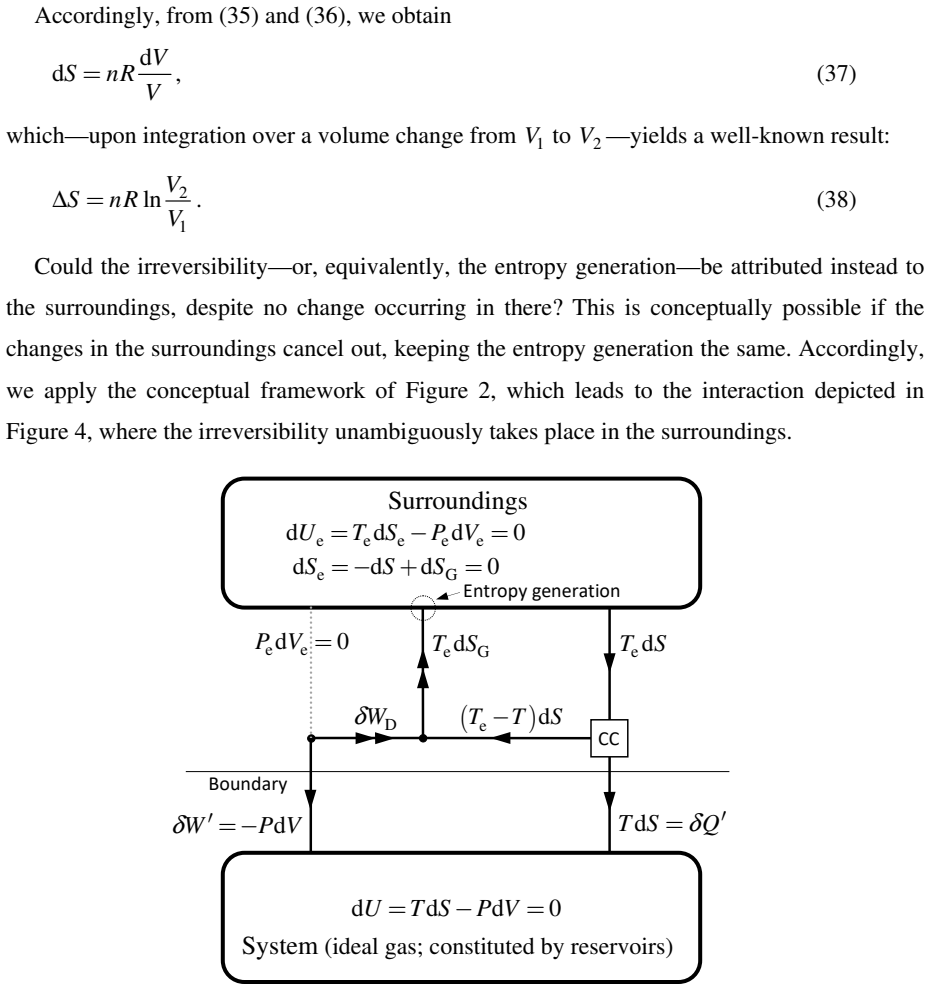
- Figures 1 and 2 describe the same process with different heat, work, lost work, and entropy flow values, and no observable criterion can tell which description was used.
- Free expansion can be modeled as a quasistatic sequence of infinitesimal free expansions, giving well-defined variables without changing the final state or the total entropy generation.
- Lost work and exergy are the same invariant seen from the two different choices of where entropy generation is assumed to occur.
Reading between the lines
- The $\beta$-split opens a whole continuum of equivalent heat/work conventions, not just the two endpoints: any choice in $[0,1]$ gives a self-consistent accounting, though only the endpoints match familiar textbook or engineering vocabularies.
- If the same logic were applied to open or multicomponent systems, matter-flow terms would presumably introduce an analogous convention for assigning chemical entropy generation, which could clarify why different chemical exergy definitions coexist in the engineering literature.
- In mesoscopic systems, fluctuation theorems make entropy production statistically observable per trajectory, so the location of entropy generation may cease to be a free convention there, marking the boundary of the macroscopic framework's indifference.
- A curriculum that introduces entropy before heat and work could sidestep the classic free-expansion paradox, since students would see heat and work as post-facto labels rather than definitions of energy transfer.
Editorial analysis
A structured set of objections, weighed in public.
Referee Report
Summary. The paper proposes a conceptual reconstruction of thermodynamics starting from the fundamental equation dU = T dS - P dV for the system and its surroundings, combined with energy conservation and the entropy balance. It introduces an entropy flow dS_phi and an entropy-generation split beta, beta_e = 1 - beta between system and surroundings (Eqs. 11-13), and argues that because beta is freely selectable, heat and work are convention-dependent labels rather than fundamental constructs. On this basis it derives the Clausius inequality, lost work, and exergy, and tests the framework on the free expansion of an ideal gas by replacing the abrupt process with a quasistatic sequence of infinitesimal free expansions. The paper concludes that the location of entropy generation has no inherent physical meaning and that two different heat/work descriptions are observationally indistinguishable after the process.
Significance. If the central claim were correct, the paper would provide a unified pedagogical framework that resolves long-standing controversies over heat and work and connects the Clausius relation, lost work, and exergy in an elegant way. The algebraic development from the fundamental equation to the entropy balance is standard, and the derivations of lost work and exergy are internally consistent. The paper also correctly reproduces the well-known result Delta S = nR ln(V2/V1) for free expansion. However, the main novelty depends on two load-bearing assumptions: the arbitrary partition of entropy generation between system and surroundings, and the equivalence between a non-quasistatic process and a quasistatic replacement. Both are asserted rather than demonstrated, and the free-expansion example reveals that the claimed equivalence of the two heat/work descriptions conflicts with the actual boundary conditions. The paper's pedagogical value is real, but its advertised conceptual innovation is not supported as stated.
major comments (4)
- [Section 3, Eqs. (11)-(13)] The central claim that beta and beta_e = 1 - beta can be freely selected is asserted without derivation or physical justification. In any real process, the entropy flux across the system boundary is fixed by the heat flux and boundary temperature, and the local entropy production is fixed by the dissipative fields. The partition of dS_G between system and surroundings is therefore not a free convention but is determined by the process. The statement that the location of entropy generation 'has no inherent physical meaning but is established by convention' is unsupported and is load-bearing, because the non-uniqueness of heat and work in Eqs. (17)-(18) versus (27)-(28) rests entirely on this freedom.
- [Section 5, Figure 4] For free expansion in a rigid adiabatic container, no energy crosses the boundary at any instant. Yet Figure 4 assigns nonzero heat dQ' = T dS and nonzero work dW' = -P dV through that same boundary, which cancel only in total energy. These are not two descriptions of one process; they describe two different processes that share only the initial and final states and the total entropy generation. The paper's claim that 'no observable criterion allows us to determine which description was used' is true only after the process is complete, not during it, when a boundary energy-flux measurement distinguishes the two descriptions. Thus the asserted equivalence of Figures 3 and 4 collapses.
- [Section 5, quasistatic replacement] The replacement of the non-quasistatic free expansion by a sequence of infinitesimal free expansions is presented as preserving all thermodynamic properties, including the entropy generation, with reference to the author's earlier work [24]. This is a nontrivial claim: the dynamics of dissipation in an abrupt expansion differ from those in a sequence of slow barrier removals, and it is not obvious that the entropy generation is identical. Since this replacement is necessary to apply the differential fundamental equation to the process, the argument is load-bearing and needs either a proof or a clear statement of the conditions under which such a replacement is valid.
- [Section 3, after Eq. (23)] The paper states that definitions (17) and (18) are 'definitely the only ones consistent with the Clausius relation' without proof. This uniqueness claim is not obvious, because the Clausius relation is an integral condition on cyclic processes and alternative definitions of heat and work might satisfy it under appropriate constraints. Since the paper uses this claim to privilege one set of definitions, a proof or a more precise statement of the domain of applicability is required.
minor comments (4)
- [References] References [15] and [17] are the same article; one should be removed or the citation numbering corrected.
- [Section 5, Figures 3 and 4] The captions and labels in Figures 3 and 4 are difficult to parse; for example, the boundary expressions differ in notation between the figures, and the meaning of the double-arrowed lines is not explained for these specific cases. Clarifying the labeling would improve readability.
- [Section 5, 'identical processes'] The term 'identical processes' is used with reference to the author's earlier work [22], but the operative definition (same initial and final states and same entropy generation) should be stated explicitly in this paper, since the validity of the argument depends on it.
- [Section 3, Eq. (10)] The discussion around Eq. (10) states that the validity of the equation holds regardless of how heat and work are defined, but Eq. (10) is obtained by inserting the first law, which is itself a statement about a particular definition of heat and work. This point should be stated more carefully to avoid appearing circular.
Circularity Check
Clausius relation is built into the heat definition and the free-expansion equivalence is imported from the author's prior work; the core bookkeeping is nevertheless self-contained.
-
self definitional
[Section 3, Eqs. (17)-(18) and (23)]
"Subsequently, a natural definition of δQ is to make it proportional to dSφ, which—according to (16)—implies that work and heat should be defined as δW = P_e dV_e, δQ = T_e dSφ = −T_e dS_e. ... The definitions (17) and (18) for δW and δQ are not the only possible ones but they are definitely the only ones consistent with the Clausius relation [10, 18]. This relation can be derived by integrating (5) over a cyclical process."
The Clausius relation (23) is not derived from the fundamental equation alone; it follows by substituting definition (18), in which heat has been defined as proportional to the entropy flow. The paper states that (17)-(18) are the only ones consistent with the Clausius relation, so the relation is a design criterion for the definitions, and deriving (23) from them is a restatement of that choice. The paper itself concedes that with other definitions (23) does not hold, confirming that the result is put in by construction.
-
self citation load bearing
[Section 5, free-expansion example, refs [22] and [24]]
"To address this difficulty, the approach detailed in [24] is used, whereby the standard free expansion is replaced by a sequence of infinitesimal free expansions, carried out at a sufficiently slow rate to yield a quasistatic process while preserving all thermodynamic properties of the original process, namely, the same initial and final states and entropy generation. ... the standard free expansion (violent in nature) and the sequence of infinitesimal free expansions (quasistatic) are indistinguishable processes [22]."
The decisive move of the illustrative test is that the violent free expansion can be replaced by an infinitesimal quasistatic sequence with the same entropy generation. That premise is justified only by citations to the author's own prior work, [24] and [22], and no independent derivation appears in the present paper. The framework is then said to be tested by reproducing the very entropy-balance equivalence that was imported, so the example's status as an external check rests on a self-citation chain rather than on a result established here.
full rationale
The core algebra is genuinely self-contained: Eqs. (1)-(8) derive the process invariants from the fundamental equation, energy conservation and the entropy balance, and the free-expansion entropy ΔS = nR ln(V2/V1) is a standard, externally known result. The score is raised by two transparent but real reductions. First, the Clausius relation is made to hold by choosing heat definition (18) to be proportional to the entropy flow; the claimed derivation of (23) is therefore a consequence of the definition, not of the fundamental equation alone. Second, the quasistatic replacement used to treat free expansion is justified only by the author's prior refs [22,24], so the example's equivalence premise is a self-citation. I do not count the β-freedom assertion of Eqs. (11)-(13) as circular: if β really is free, the conclusion that entropy-generation location is conventional follows; the missing support is an assumption about physics (boundary fluxes may fix the split), which is a correctness risk rather than a circular reduction. The central heat/work bookkeeping retains independent content, so partial circularity, score 4.
Assumptions & free parameters
free parameters (1)
- Entropy generation fraction beta (and beta_e = 1 - beta) =
Not fitted; paper selects beta=1 or beta=0 for the two descriptions
assumptions (5)
- domain assumption The fundamental equation dU = T dS - P dV applies to the surroundings as well as the system, with its own state variables.
- standard math Energy is conserved: dU + dU_e = 0.
- domain assumption Total entropy generation is nonnegative: dS + dS_e = dS_G >= 0.
- ad hoc to paper Entropy generation can be arbitrarily divided between system and surroundings via beta and beta_e = 1 - beta.
- ad hoc to paper A non-quasistatic process can be replaced by a quasistatic sequence of infinitesimal steps preserving all thermodynamic properties and entropy generation.
Cite this review
Pith. "Pith review of Thermodynamics: A Clear Conceptual Framework." pith.science (2026). https://pith.science/paper/FSHPTY53
@misc{pith2026250702023,
  author       = {Pith},
  title        = {Pith review of: Thermodynamics: A Clear Conceptual Framework},
  year         = {2026},
  howpublished = {\url{https://pith.science/paper/FSHPTY53}},
  note         = {Machine review of arXiv:2507.02023}
}
read the original abstract
Building on the fundamental equation, this study revisits key thermodynamic concepts in a cohesive and innovative manner. It demonstrates the consistency of thermodynamic theory while addressing and clarifying common misconceptions and errors found in the literature, particularly regarding discussions on heat and work. Although the latter two concepts could potentially be set aside, they can be retained if their various and different definitions are clearly articulated and properly understood. The proposed theoretical framework was tested using the free expansion of an ideal gas, a particularly demanding example due to its abrupt nature. From an educational standpoint, this article is invaluable as it consolidates fundamental yet often subtle concepts in an assertive and comprehensible way. Furthermore, it promotes a clearer and more accessible understanding of thermodynamics, challenging the widespread notion that is inherently difficult to grasp.
Figures


Figures from the paper (1 more)
Reference graph
Works this paper leans on
-
[22]
Anacleto J 2005 Identical thermodynamical processes and entropy Can. J. Phys. 83 629–36
work page 2005
-
[24]
Anacleto J 2015 On the representation of thermodynamic processes Eur. J. Phys. 36 035006
work page 2015
-
[1]
Tripp T B 1976 The definition of heat J. Chem. Educ. 53 782–4
work page 1976
-
[2]
Hornack F M 1984 Further reflections on heat J. Chem. Educ. 61 869–74
work page 1984
-
[3]
Kemp H R 1984 The concept of energy without hea t or work Phys. Educ. 19 234–40
work page 1984
-
[4]
Gislason E A and Craig N C 1987 General definit ions of work and heat in thermodynamic processes J. Chem. Educ. 64 660–8
work page 1987
-
[5]
Barrow G M 1988 Thermodynamics should be built on energy – not on heat and work J. Chem. Educ. 65 122–5
work page 1988
-
[6]
Mungan C E 2005 Why distinguish work from heat? APS Forum on Education Fall 2005 Newsletter pp 3–4
work page 2005
Show all 23 references
-
[7]
Gislason E A and Craig N C 2005 The proper defi nition of pressure–volume work: a continuing challenge APS Forum on Education Spring 2005 Newsletter pp 9–11
2005
-
[8]
Mungan C E 2007 Thermodynamics of a block slidi ng across a frictional surface Phys. Teach. 45 288–91
2007
-
[9]
Anacleto J 2022 How to distinguish heat from wo rk in irreversible processes? Eur. J. Phys. 43 045103
2022
-
[10]
Zemansky M W and Dittman R H 1997 Heat and Thermodynamics 7th edn (New York: McGraw- Hill)
1997
-
[11]
Callen H B 1985 Thermodynamics and an Introduction to Thermostatist ics 2nd edn (New York: Wiley)
1985
-
[12]
Güemez J, Fiolhais C and Fiolhais M 2000 Equiv alence of thermodynamical fundamental equations Eur. J. Phys. 21 395–404
2000
-
[13]
Volume I
Gibbs J W 1928 The Collected Works of J Willard Gibbs. Volume I. T hermodynamics (New York: Longmans)
1928
-
[14]
Greiner W, Neise L and Stöcker H 1995 Thermodynamics and Statistical Mechanics (New York: Springer)
1995
-
[16]
Anacleto J 2024 Lost work and exergy: two views of the same concept Eur. J. Phys. 45 025101
2024
-
[17]
Anacleto J 2021 The reservoir concept: entropy generation and lost work Eur. J. Phys. 42 035102
2021
-
[18]
Anacleto J 2011 On the Clausius equality and inequality Eur. J. Phys. 32 279–86
2011
-
[19]
Moran M J, Shapiro H N, Boettner D D and Baile y M D 2011 Fundamentals of engineering thermodynamics 7th edn (New Jersey: John Wiley)
2011
-
[20]
Borgnakke C and Sonntag R E 2013 Fundamentals of Thermodynamics 8th edn (New Jersey: John Wiley)
2013
-
[21]
Çengel Y A and Boles M A 2015 Thermodynamics: An Engineering Approach 8th edn (New York: McGraw-Hill)
2015
-
[23]
Reed B C 2022 A deeper look at entropy change in the free expansion of an ideal gas Phys. Educ. 57 053001
2022
Reviewed August 6, 2026 · model on record in the stance chip above.
Discussion (0). Sign in to comment.