REVIEW 3 major objections 5 minor 1 cited by
Quark-Gluon Plasma as a Quantum Channel: Entanglement, Decoherence, and Hadronization
T0 review · 3 major / 5 minor · reviewed 2026-08-06 · deepseek-v4-flash
Pith's one-line read This paper proposes that the quark-gluon plasma acts as a noisy quantum channel that progressively erases color entanglement, and that entanglement entropy serves as a natural order parameter for the QGP-to-hadron transition.
desk verdict A toy model that borrows standard quantum channels for QGP, but the load-bearing hadronization channel is not a valid CPTP map and the central numerical claim is just textbook amplitude damping. read the letter →
The pith
A machine-rendered reading of the paper's core claim, the machinery that carries it, and where it could break.
The reading
What carries the argument
The carrying object is the composite quantum channel $\mathcal{E}=\mathcal{E}_{\rm had}\circ\mathcal{E}_{\rm dep}\circ\mathcal{E}_{\rm AD}$, each factor given by Kraus operators. Amplitude damping uses $K_0=\mathrm{diag}(1,\sqrt{1-\gamma_{\rm AD}})$ and $K_1=\sqrt{\gamma_{\rm AD}}|0\rangle\langle1|$ (with a qutrit generalization to color states); dephasing is an SU(3) depolarizing channel built from the traceless generators of the gauge group; hadronization uses $K_i=\sqrt{p_i}P_i$ with $p_i=e^{-E_i/T}/\sum_j e^{-E_j/T}$ and $P_i$ a projector onto a color-singlet hadron state such as a pion or kaon. All observables—$S(\rho_A)$, purity, and hadron yields—are computed by applying this sequence to the initial color-singlet state and tracing out one subsystem.
What would settle it
Take the hadronization Kraus operators in Eq. (15), write out $P_\pi = |\pi\rangle\langle rr, gg, bb|$ and any other hadron projectors, and compute $\sum_i K_i^\dagger K_i$ on the full three-color space: if the sum is not the identity, the channel is not a valid quantum operation and the entropy and purity curves in Figures 3–5 and 7 are not consequences of the model as stated.
Extended reading notes
Core claim
On the paper's own terms, the central discovery is that a generalized color-singlet state evolved through the composite channel $\mathcal{E} = \mathcal{E}_{\rm had} \circ \mathcal{E}_{\rm dep} \circ \mathcal{E}_{\rm AD}$ loses entanglement monotonically: the entanglement entropy $S(\rho_A)=-\operatorname{Tr}(\rho_A\log_2\rho_A)$ of a quark subsystem decreases with amplitude-damping strength, with time under the composite channel, and with freeze-out temperature, while the purity $\operatorname{Tr}(\rho_A^2)$ decreases as thermal mixing sets in. The author reads this as evidence that the QGP behaves as a noisy quantum channel that progressively erases color entanglement, and proposes entanglement entropy as a natural order parameter for the deconfined-to-confined transition, consistent with the smooth crossover expected around $T\approx 156$ MeV.
Load-bearing premise
The result depends on the hadronization step being a legitimate quantum operation that never creates or destroys total probability; the paper asserts rather than proves this, and its explicit pion projector example appears to violate the required completeness condition $\sum_i K_i^\dagger K_i = I$.
Editorial extensions
If this is right
- Entanglement entropy of a quark subsystem decreases monotonically with amplitude-damping strength for both two- and four-qutrit color-singlet states, so jet quenching by itself drives color states toward separability.
- Under the full time-dependent composite channel, both quark and gluon entropies fall from their maximal values, implying the QGP irreversibly destroys quantum coherence as it cools.
- The thermally weighted hadronization channel produces pion dominance at low temperature and a rising kaon fraction near $T\sim 150$ – $200$ MeV, matching the qualitative pattern of statistical hadronization fits to heavy-ion data.
- The entropy and purity curves show no sharp feature at the freeze-out temperature, which the author reads as consistency with a smooth crossover rather than a first-order transition.
- Although entanglement entropy is not directly measurable, the paper argues its loss would show up in two-particle correlations, jet substructure, and event-by-event fluctuations, giving indirect experimental probes.
Reading between the lines
- If the channel picture is right, the monotonic loss of entanglement is not a by-product of hadronization but its information-theoretic cause, so measured strangeness enhancement and suppression of long-range correlations across the crossover could be reinterpreted as manifestations of a single entanglement-loss rate.
- The same three-stage decomposition should be testable in smaller collision systems (p+p, p+Pb): a genuine channel mechanism would predict entanglement loss that scales with system size and centrality in a specific, monotonic way, whereas purely thermal descriptions would not.
- One could translate the channel parameters into a single 'color entanglement capacity' for the QGP, giving heavy-ion phenomenology a quantity analogous to quantum channel capacity that data could directly constrain.
Editorial analysis
A structured set of objections, weighed in public.
Referee Report
Summary. The paper proposes a quantum-information model in which the quark-gluon plasma (QGP) is represented as a composite quantum channel acting on one member of a color-entangled quark-antiquark pair. The composite channel is E_had ∘ E_dep ∘ E_AD ⊗ I (Eq. 7), with amplitude damping for jet quenching, depolarizing noise for decoherence, and a stochastic thermal hadronization channel that projects onto color-singlet states. The manuscript computes entanglement entropy and purity of reduced subsystems and concludes that the QGP progressively erases color entanglement, proposing entanglement entropy as an order parameter for the deconfinement-confinement transition.
Significance. If the proposed channel were mathematically valid, the framework would offer an appealing vocabulary for connecting open quantum systems to heavy-ion phenomenology. However, the central mathematical object is not a valid CPTP map, and the numerical results contain internal contradictions. The manuscript therefore does not currently provide a reliable bridge between quantum information and QCD; its interpretational claims are not supported by the simulations as presented.
major comments (3)
- [Section IV.A, Eqs. (15)-(17)] The hadronization channel is not a valid quantum operation. The Kraus operators are defined as K_i = sqrt(p_i) P_i with P_i called projectors, but the example P_π = |π⟩⟨rr, gg, bb| is not Hermitian and does not act on the single-qutrit antiquark subsystem; it maps between different Hilbert-space sectors. Moreover, for a CPTP map the completeness relation requires Σ_i p_i P_i† P_i = I, which for Hermitian projectors becomes Σ_i p_i P_i = I. With non-trivial thermal weights p_i summing to 1, a nontrivial resolution of the identity by such weighted projectors is impossible unless all but one weight vanishes. Thus Eq. (15) does not define a CPTP channel, and the composition in Eq. (7) is ill-defined. Since Figures 4, 5, and 7 all depend on this channel, those results are unsupported.
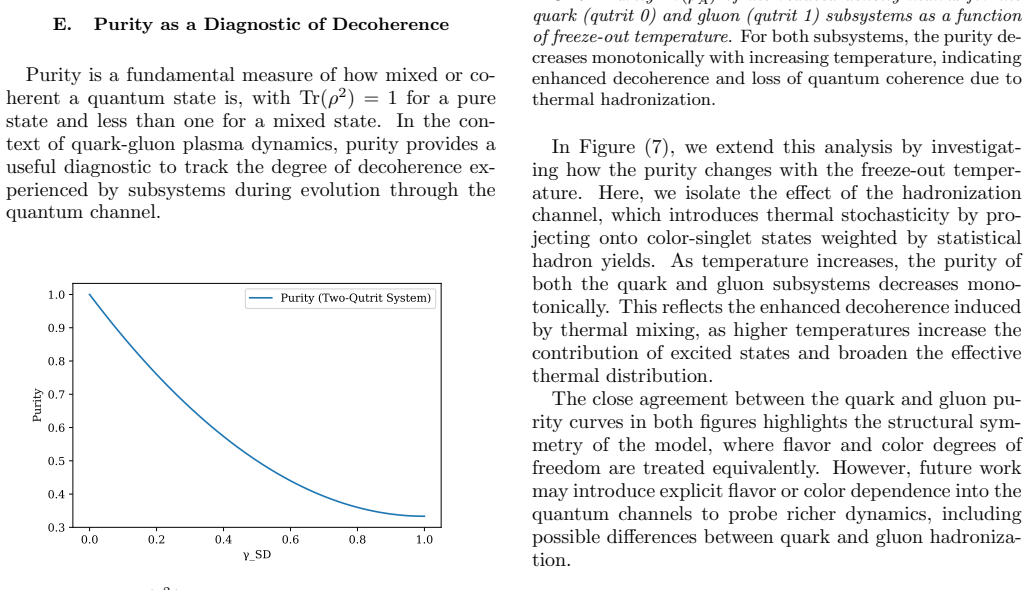
- [Section V.E, Fig. 6] The claimed purity behavior contradicts the model's own amplitude damping channel. Applying the qutrit amplitude damping operators of Eq. (10) to the two-qutrit color-singlet state |Ψ⟩ = (|rr⟩+|gg⟩+|bb⟩)/√3 gives the reduced density matrix ρ_A = diag((1+2γ)/3, (1-γ)/3, (1-γ)/3), whose purity is (1+2γ²)/3. This purity increases monotonically with γ, from 1/3 at γ=0 to 1 at γ=1. The caption and text of Figure 6 state that purity decreases monotonically, which is the opposite of what the equations in Section III.C and IV.A imply. This is not a minor typo: it invalidates the paper's use of purity as a diagnostic of decoherence and is inconsistent with Eq. (12), where entropy decreases with γ.
- [Section V.F and Section VI] The central conclusion is largely an artifact of the model's construction rather than an emergent result. Equation (12) explicitly gives the textbook amplitude-damping behavior for an initially entangled Bell state and is described in the text as 'as expected,' so the monotonic decrease of entanglement entropy with damping strength is not evidence that the QGP erases color entanglement. The hadronization weights are imported from statistical hadronization rather than derived from QCD, and the parameters γ_AD, γ_dep, γ_had are free. The numerical simulations therefore do not provide an independent test of the interpretation that 'entanglement entropy emerges as a natural order parameter' for the QGP-to-hadron transition.
minor comments (5)
- [Section V] The notation for the amplitude damping strength is inconsistent: Section V uses γ_SD while Section III.A and Eq. (8) define γ_AD.
- [Figure 5] The y-axis label '1e 6+5e 1' appears garbled and should be a normal numeric axis label for hadron yields.
- [Section II.B vs Section V.B] The text switches between 'depolarizing channel' and 'SU(3) dephasing' for the same decoherence process; these are different quantum channels and the terminology should be aligned.
- [Equation (15)] The notation P_π = |π⟩⟨rr, gg, bb| is ambiguous: it is unclear whether the bra is a product state, a superposition, or a shorthand for a trace over color indices. A precise definition of the operators and their domains is needed.
- [Figure 4 and Abstract] Figure 4 shows entropy increasing with temperature, while the abstract and conclusions emphasize monotonic entropy loss; the distinction between evolution in time and dependence on freeze-out temperature should be stated explicitly.
Circularity Check
Central entropy-loss 'prediction' is baked into the chosen channel ansatz; the hadron-yield figure restates the input Boltzmann weights.
-
self definitional
[Sec. II.C, V.C, and VI (Eq. 7; Fig. 4; Conclusions)]
"Importantly, our model does not include a sharp phase transition. The hadronization probability increases smoothly with temperature, governed by a saturating function of the form phad(T ) = 1 − exp(−nπ(T ))... As a result, the entanglement entropy exhibits a gradual increase with T ."
The composite channel Eq. (7) is built from amplitude damping (which drives the state toward a pure |0> by Eqs. (8)-(10)) and a hadronization channel whose projection probability is the smooth function phad(T)=1-exp(-nπ(T)). The paper's numerical 'finding' that S(T) is smooth and that entropy decreases monotonically is therefore not an independent result but a direct consequence of the operations chosen to define the QGP channel.
-
fitted input called prediction
[Sec. IV.A Eq. (15); Sec. V.D Fig. 5]
"Ki = √piPi, p i = e−Ei/T P j e−Ej/T , (15)... Figure (5) shows the resulting relative yields as a function of temperature. At low temperatures, pion production dominates due to their lower mass."
The thermal probabilities pi in Eq. (15) are inputs to the hadronization channel, taken directly from statistical hadronization Boltzmann factors. Figure 5 plots exactly these input weights as the 'relative yields' of pions and kaons, and the associated text calls them 'resulting relative yields.' No hadronization dynamics or QCD calculation is performed; the ratio p_π/p_K is the same Boltzmann factor that was inserted. The caption even says the plot is 'based on Boltzmann factors.' Thus a model input is presented as a derived prediction, which is circular by construction.
full rationale
The paper is transparent that it is proposing a toy open-quantum-system model, and the arithmetic leading from Eq. (7) to the entropy formulas is internally self-contained, not statistically fitted to data. There is no load-bearing self-citation chain: the only author self-citation [17] is listed as a possible future refinement and does not justify the main construction. However, the core evidential claim—that the QGP 'progressively erases color entanglement' and that entanglement entropy is a natural order parameter—is effectively equivalent to the model's own definition: amplitude damping drives states toward a pure reference state, and hadronization projects onto singlet states with prespecified smooth thermal weights. The monotonic entropy loss and smooth temperature dependence are therefore consequences of the ansatz, not independent support for it. Separately, the hadronization channel's 'projectors' Pi are not valid projection operators and the completeness relation asserted in Eq. (17) cannot hold for nontrivial thermal weights; that is a mathematical correctness problem, not a circularity, and it is not used to raise the score. Because the central result reduces by construction to the chosen channel decomposition, while no parameter was fit to the paper's own output, a score of 6 is appropriate.
Assumptions & free parameters
free parameters (4)
- γAD =
unspecified (chosen in [0,1])
- γdep =
unspecified (chosen in [0,1])
- γhad =
mentioned but never defined
- phad(T) = 1 - exp(-nπ(T)) =
nπ(T) unspecified
assumptions (5)
- standard math Kraus representation and CPTP map formalism for open quantum systems
- domain assumption QGP can be treated as a Markovian environment inducing Lindblad dynamics
- domain assumption Color degrees of freedom can be encoded as a three-level qutrit with the color-singlet initial state 1/sqrt3(|rr>+|gg>+|bb>)
- domain assumption Hadronization probabilities follow Boltzmann weights exp(-m_i/T) at T≈156 MeV
- ad hoc to paper The composite order AD then depolarizing then hadronization captures the physical sequence of QGP evolution
invented entities (1)
-
Stochastic hadronization channel Ehad
Cite this review
Pith. "Pith review of Quark-Gluon Plasma as a Quantum Channel: Entanglement, Decoherence, and Hadronization." pith.science (2026). https://pith.science/paper/ZD2263M6
@misc{pith2026250702202,
  author       = {Pith},
  title        = {Pith review of: Quark-Gluon Plasma as a Quantum Channel: Entanglement, Decoherence, and Hadronization},
  year         = {2026},
  howpublished = {\url{https://pith.science/paper/ZD2263M6}},
  note         = {Machine review of arXiv:2507.02202}
}
abstract
We propose a quantum information framework to model the quark-gluon plasma (QGP) as a composite quantum channel acting on a multi-qubit or multi-qutrit color-entangled system. The QGP's effects are represented by amplitude damping (jet quenching), $SU(3)$ depolarizing noise (decoherence), and a thermal hadronization channel projecting onto color-singlet states. This construction captures energy loss, decoherence, and confinement dynamics in a unified open quantum system framework. We analyze the evolution of entanglement entropy and purity under this composite channel. Amplitude damping reduces entropy by driving subsystems toward pure states, while decoherence increases mixedness. Hadronization further modifies correlations via thermal projections weighted by hadron masses and freeze-out temperature ($T \sim 156 \,\text{MeV}$). Numerical simulations show monotonic entropy and purity loss, consistent with entanglement degradation and confinement. Our results support interpreting the QGP as a noisy quantum channel that progressively erases color entanglement. This framework bridges quantum information theory and QCD, offering new insights into hadronization and non-perturbative dynamics in heavy-ion collisions.
Figures


Figures from the paper (3 more)


Forward citations
Cited by 1 Pith paper
-
Confinement in QCD: A Hybrid String Model with Vortex Corrections and Entanglement Entropy
The paper derives a logarithmic vortex correction to the Wilson loop and predicts that confinement drives a quark-antiquark Bell pair to maximal entropy, but the entropy increase is built into the model input.
Reference graph
Works this paper leans on
-
[1]
E. V. Shuryak, “Theory of Hadronic Plasma,” Sov. Phys. JETP 47, 212 (1978)
work page 1978
-
[2]
Both exhibit a decline in entropy, consistent with the physical picture of increas- ing decoherence
subsystems are tracked. Both exhibit a decline in entropy, consistent with the physical picture of increas- ing decoherence. The quark entropy generally falls more rapidly, in line with its primary role in hadronization. This reinforces the interpretation that amplitude damp- ing acts as a proxy for confinement and color neutraliza- tion. B. Composite Qua...
-
[3]
Superdense Matter: Neu- trons or Asymptotically Free Quarks?,
J. C. Collins and M. J. Perry, “Superdense Matter: Neu- trons or Asymptotically Free Quarks?,” Phys. Rev. Lett. 34, 1353 (1975)
work page 1975
-
[4]
Evidence for a New State of Matter: An Assessment of the Results from the CERN Lead Beam Programme,
U. Heinz and M. Jacob, “Evidence for a New State of Matter: An Assessment of the Results from the CERN Lead Beam Programme,” arXiv:nucl-th/0002042
-
[5]
M. A. Nielsen and I. L. Chuang, Quantum Computa- tion and Quantum Information , 10th Anniversary Edi- tion, Cambridge University Press (2010)
work page 2010
-
[6]
H.-P. Breuer and F. Petruccione, The Theory of Open Quantum Systems , Oxford University Press (2002)
work page 2002
-
[7]
Properties and Uses of the Wilson Flow in Lattice QCD,
M. L¨ uscher, “Properties and Uses of the Wilson Flow in Lattice QCD,” JHEP 2010, 071 (2010)
work page 2010
-
[8]
P. Di Francesco, P. Mathieu, and D. S´ en´ echal,Conformal Field Theory, Springer (1997)
work page 1997
Show all 18 references
-
[9]
Gattringer and C
C. Gattringer and C. B. Lang, Quantum Chromodynam- ics on the Lattice , Springer (2010)
2010
-
[10]
Kraus, States, Effects and Operations: Fundamental Notions of Quantum Theory , Springer (1983)
K. Kraus, States, Effects and Operations: Fundamental Notions of Quantum Theory , Springer (1983)
1983
-
[11]
Carmichael, An Open Systems Approach to Quantum Optics, Springer (1993)
H. Carmichael, An Open Systems Approach to Quantum Optics, Springer (1993)
1993
-
[12]
HIJING: A Monte Carlo model for multiple jet production in p p, p A and A A collisions,
X.-N. Wang and M. Gyulassy, “HIJING: A Monte Carlo model for multiple jet production in p p, p A and A A collisions,” Phys. Rev. D 44, 3501 (1991)
1991
-
[13]
Radiative energy loss of high energy partons traversing an expanding QCD plasma,
R. Baier, Y. L. Dokshitzer, A. H. Mueller, S. Peign´ e, and D. Schiff, “Radiative energy loss of high energy partons traversing an expanding QCD plasma,” Phys. Lett. B 345, 277 (1995)
1995
-
[14]
Jet Quenching in Heavy Ion Colli- sions,
U. A. Wiedemann, “Jet Quenching in Heavy Ion Colli- sions,” arXiv:0908.2306
-
[15]
Letessier and J
J. Letessier and J. Rafelski, Hadrons and Quark–Gluon Plasma, Cambridge University Press (2002)
2002
-
[16]
Decoding the phase structure of QCD via particle production at high energy,
A. Andronic, P. Braun-Munzinger, K. Redlich, and J. Stachel, “Decoding the phase structure of QCD via particle production at high energy,” Nature 561, 321– 330 (2018)
2018
-
[17]
Parti- cle production in heavy ion collisions,
P. Braun-Munzinger, K. Redlich, and J. Stachel, “Parti- cle production in heavy ion collisions,” in Quark Gluon Plasma 3 , World Scientific (2003)
2003
-
[18]
Flavor-Dependent Entanglement Entropy in the Veneziano Limit from Light-Front Holo- graphic QCD,
F. J. Twagirayezu, “Flavor-Dependent Entanglement Entropy in the Veneziano Limit from Light-Front Holo- graphic QCD,” arXiv:2506.15878 [hep-ph] (2025).https: //arxiv.org/abs/2506.15878
2025 arXiv
Reviewed August 6, 2026 · model on record in the stance chip above.
Discussion (0). Continue with ORCID to comment.