REVIEW 5 major objections 6 minor 22 references
Uncertainty-aware Reward Design Process
T0 review · 5 major / 6 minor · reviewed 2026-08-06 · deepseek-v4-flash
Pith's one-line read This paper argues that splitting reward design into LLM-proposed components and Bayesian-tuned intensities, with a self-consistency uncertainty score filtering candidates before simulation, yields better policies with half the search…
desk verdict URDP combines semantic-similarity deduplication with uncertainty-weighted BO for LLM reward design; the decoupling idea is sound and the experiments are extensive, but the evidence is under-powered and the central uncertainty metric is unvalidated. read the letter →
The pith
A machine-rendered reading of the paper's core claim, the machinery that carries it, and where it could break.
The reading
What carries the argument
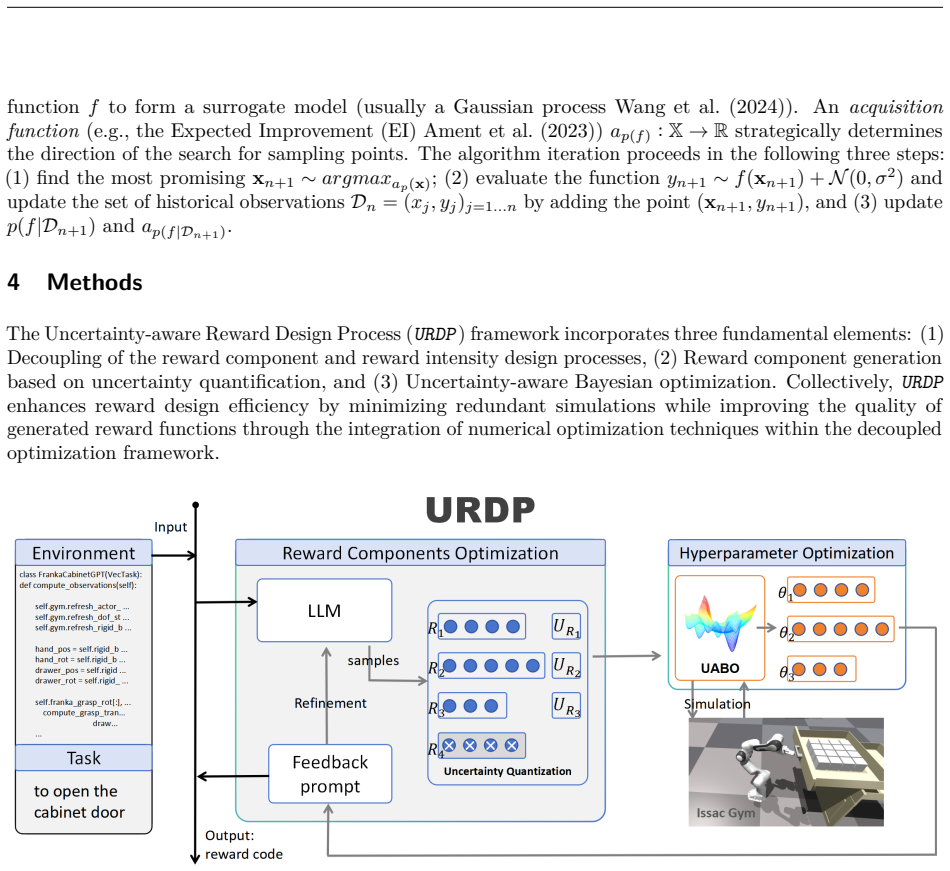
The load-bearing object is the self-consistency uncertainty score U(ri) defined in Eq. (2): for each LLM-generated reward component, it measures how frequently a near-duplicate appears among the K sampled candidates, using the maximum of a textual similarity (Python SequenceMatcher) and a semantic similarity (BGE-M3 embeddings) with a step threshold ω=0.95; high U means the component is rare or diverse across samples. This score does two jobs. In the outer loop it drives reward-code sampling and filtering, giving high-uncertainty components extra inner-loop refinement because they may be novel. In the inner loop it reshapes the Gaussian-process surrogate: the uncertainty values become dimension-specific length scales in an anisotropic Matern kernel (Eq. 5) and a penalty term in the uncertainty-accelerated expected-improvement acquisition function (Eqs. 7–8), so the optimizer is discouraged from wandering along dimensions with high U and focuses exploitation near the current best point. The surrounding mechanism is the alternating bi-level optimization that separates reward-component reasoning from reward-intensity tuning.
What would settle it
Rerun URDP's 35-task pipeline with each component's uncertainty score replaced by random scores drawn from the same distribution while keeping every other step identical; if success rates and simulation counts remain roughly unchanged, the reported gains do not come from the uncertainty information itself, because all that remains is filtering and the UABO penalty shaped by noise.
Extended reading notes
Core claim
On the paper's own terms, the central discovery is that the variability of an LLM's own reward-code proposals is usable signal. URDP computes an uncertainty score U(r) for each reward component from how often semantically or textually similar components appear across sampled candidates, treats low-uncertainty components as well-internalized knowledge and high-uncertainty components as novel or under-specified, filters redundant reward functions before simulation, and feeds the same uncertainty values into an anisotropic kernel and a penalized expected-improvement acquisition function so that Bayesian optimization spends fewer evaluations on directions the LLM considers uncertain. The paper claims that this alternating bi-level architecture—LLM in the outer loop for reward logic, UABO in the inner loop for reward intensity—outperforms existing methods in both reward quality and design efficiency: under identical simulation budgets, agents trained on URDP rewards reach higher success rates than Eureka on all three benchmarks, and URDP reaches its peak with 52.4% of Eureka's simulation episodes and 46.6% of its LLM calls; the paper also reports that URDP-designed rewards beat human-designed rewards on 89% of the 35 tasks.
Load-bearing premise
The load-bearing premise is that how much an LLM's proposed reward components resemble one another in wording and meaning is a reliable signal for whether those components are trustworthy, redundant, or worth exploring.
Editorial extensions
If this is right
- If URDP's central claim is right, LLM-based reward design need not spend simulation budget on every sampled candidate; pre-simulation uncertainty screening alone removes redundant evaluations.
- A decoupled setup in which Bayesian optimization, not the LLM, tunes reward intensities would become the default design for future automated reward engineering, since the LLM-only evolutionary baseline showed performance regressions and oscillatory behavior.
- High-uncertainty reward components, which the framework treats as potentially novel, can act as effective reward-shaping terms; removing them degrades final policy performance.
- Comparing URDP with standard BO shows that the uncertainty-aware kernel and acquisition penalty reach comparable reward quality with about 80% of the sampling budget on Isaac tasks.
- Across the three benchmarks, URDP outperforms human-designed rewards on 89% of tasks, suggesting automated pipelines can replace manual reward engineering.
Reading between the lines
- Generalizing the same trick: any expensive black-box evaluation of LLM proposals, such as prompt templates, controller gains, or code patches, could be made cheaper by scoring candidate diversity before simulation and using that score to shape the surrogate model.
- The novelty-exploration effect could be isolated by holding the UABO kernel fixed and assigning extra inner-loop iterations to the highest-uncertainty components versus randomly selected components, separating real novelty-seeking from mere budget redistribution.
- Because uncertainty is computed from code-string similarity, a component that is linguistically novel but functionally identical to existing components would be misclassified as high-uncertainty; a counterfactual test removing such components would reveal how much of the reported novelty effect is semantic versus lexical.
- The paper's own limitation note about spatial reasoning suggests the natural stress test: for tasks where grasp paths are blocked by obstacles, similarity-based uncertainty will not see the missing visuospatial constraint, so a video-language-model-grounded variant is the clear next boundary case.
Editorial analysis
A structured set of objections, weighed in public.
Referee Report
Summary. The paper proposes URDP, an LLM-based automated reward design framework that decouples reward component generation from reward-intensity hyperparameter optimization. In the outer loop, LLM-generated reward component samples are filtered using a self-consistency-derived uncertainty score U(r), and in the inner loop an uncertainty-aware Bayesian optimization (UABO) tunes reward intensities. The authors evaluate URDP on 35 tasks across IsaacGym, Dexterity, and ManiSkill2, reporting improved success rates and human-normalized scores relative to Eureka, Text2Reward, human-designed, and sparse rewards, with reduced numbers of simulation episodes and LLM calls. The main claimed contributions are simulation-free filtering of ineffective reward components, discovery of novel reward components via uncertainty, and an uncertainty-weighted kernel and acquisition function that accelerate BO convergence.
Significance. If the central claims held, the paper would make a useful contribution to automated reward design: the bi-level architecture is a sensible response to known limitations of pure LLM evolutionary search, and the broad 35-task evaluation is more extensive than in many prior works in this area. The paper also includes useful ablations (uncertainty filtering, decoupled optimization, UABO vs. LLM optimizers) and a good-faith discussion of limitations and LLM-agnostic behavior, which are strengths. However, the central empirical claims are currently under-supported: the uncertainty score is not validated as a predictor of reward-component quality, the headline performance gains are not reproduced by the reported tables, and several mechanisms appear internally inconsistent. The framework is plausible, but the evidence as presented is not yet sufficient to establish the claimed advances.
major comments (5)
- [Section 4.2, Eq. (2); Section 5.5 Disc-2] The uncertainty score U(r_i) is the load-bearing input to both the filtering step and UABO, but no experiment validates the assumption that similarity-based consistency correlates with reward-component quality. Section 4.2 asserts that high-consistency outputs are 'well-internalized, task-specific knowledge' and that divergent outputs 'demand more refinement,' yet no comparison is made against random filtering, against keeping all components, or against an oracle selection based on simulation. Moreover, Disc-2 (Section 5.5) shows that high-uncertainty components (U > 0.9) are often novel and contribute positively to reward shaping, which creates a direct tension with the use of high uncertainty to penalize exploration in Eq. (8). Please add a positive-control experiment: for a subset of tasks, compare URDP with (a) random component filtering at the same removal rate, (b) no filtering, and (c) an oracle that keeps components whose leave-one-out simulation impact is positive, and report the correlation between U(r) and per-component impact.
- [Section 5.3, Tables 2, 6, and 7] The headline performance claims are not supported by the reported numbers. The text states a 132% gain over Eureka on Isaac, but Table 2 gives (3.424 - 1.607)/1.607 ≈ 113%, not 132%. More seriously, Tables 6 and 7 report inconsistent values for the same tasks: for Ant, Eureka has HNS 1.527 with NOE 112 in Table 6, but HNS 0.828 with NOE 48 in Table 7, while URDP has HNS 1.556 in both tables; this suggests the comparison is being made at different simulation budgets without explanation. All reported results appear to be single runs, with no seed information, standard deviations, or significance tests. Because the central claim is that URDP improves both quality and efficiency, multi-seed runs with error bars and a clear statement of the evaluation budget for each method are required.
- [Section 5.4 Abl-1] The ablation shows that removing uncertainty screening increases NOE while achieving a comparable success rate, but it does not establish that the filtered components were ineffective. The observed savings could come simply from deduplicating lexically redundant samples, or from discarding useful components whose absence is compensated by other parts of the framework. To support the claim that the uncertainty signal identifies ineffective components, the authors should report, for at least a subset of tasks, the fraction of filtered components that would have made a positive contribution if kept (measured by simulation), and compare against random filtering at the same removal rate.
- [Section 4.3, Eq. (8); Section 5.5 Disc-2] The uEI acquisition function penalizes movement away from the incumbent more strongly along dimensions with high U(r_j), on the rationale that high-uncertainty directions should be exploited rather than explored. However, Section 5.5 Disc-2 reports that high-uncertainty reward components are frequently novel and that removing them degrades performance, implying that these directions are important. This is an internal inconsistency: the same signal is used both to allocate additional inner-loop iterations to high-uncertainty samples (Section 4.2) and to restrict hyperparameter exploration along those dimensions. The paper does not explain this conflict, and the reported efficiency gains may therefore be attributable to the decoupled BO alone rather than to the uncertainty weighting. Please run an ablation in which the weights in Eq. (8) are replaced by random or constant values while all other components of UABO are unchanged.
- [Appendix F, Theorem 2] The convergence proof for uEI assumes that the function f depends on only m variables and sets the weights λ_j to 0 for the relevant dimensions and ∞ for the irrelevant ones. The implemented algorithm, however, uses data-dependent weights U(r_j) that are not 0/∞ weights and for which no effective-dimension assumption is established. The stated rate of n^{-(ν∧1)/m} therefore does not follow for the actual uEI strategy. Please either provide a convergence result for the actual weighting scheme under explicit regularity conditions, or clearly present the existing proof as a heuristic motivation rather than a theorem about the implemented algorithm.
minor comments (6)
- [Section 4.2, Eq. (2)] Equation (2) is not syntactically well-defined: the step function is applied to a single similarity value with no second reward component, so the summation over i is unclear. Please restate it using the pairwise comparison shown in Algorithm 2 in Appendix C.1.
- [Table 1 and Appendix E] The 'Txet2Reward' label in Table 1 is a typo, and the aggregated numbers in Table 1 do not match the per-task averages in Appendix E for URDP on Isaac (e.g., average NOE is 349/9 ≈ 38.78, not 39.501; average NLC is 22/9 ≈ 2.444, not 2.495). Please verify all aggregate values.
- [Abstract and Section 2] The abstract uses 'Bidexterous Manipulation' while the body consistently uses 'Dexterity'; please unify the terminology.
- [Section 5.2] The text says 'We examine fore metrics' and then lists four metrics; please fix the typo to 'four'.
- [Appendix E and Table 7] The text says URDP performed best in 92% of tasks in Appendix E but says it outperforms compared methods on 89% of tasks in Table 7; please reconcile these percentages and state the tie-breaking rule.
- [General] No code release or seed specification is mentioned. Given the paper's reliance on stochastic LLM sampling and RL training, releasing code and seeds would substantially aid reproducibility and should be listed in the paper or supplement.
Circularity Check
No significant circularity: URDP's performance and efficiency claims are validated against external baselines and independent RL training metrics, not derived from its own fitted quantities.
full rationale
The paper's central derivation chain is self-contained against external benchmarks. The uncertainty score U(r_i) in Eq. 2 is computed from textual and semantic similarity among LLM-generated reward components; it is an internal quantity used to filter samples and to shape the Bayesian optimization kernel and acquisition function. The final claims, however, are evaluated by independent RL training (HNS, SR) and by directly measured simulation and LLM-call counts (NOE, NLC), compared against Eureka, Text2Reward, human-designed, and sparse rewards. No parameter is fitted to those benchmark scores, and the uncertainty scores are not defined in terms of the target success metrics. The method's reliance on the self-consistency principle cites external work (Wang et al., 2022), not the authors' own prior results, and no load-bearing self-citation chain is present. Ablations compare URDP with and without uncertainty screening and with standard BO, providing empirical, non-circular checks of the contribution of each component. The convergence analysis in Appendix F is a conditional mathematical statement about uEI under a low-dimensional effective subspace assumption, not a derivation of the empirical results from the assumptions. The acknowledged limitation in Appendix H concerns spatial reasoning and does not reveal any circular dependency. Overall, the uncertainty-quality correlation is an unvalidated assumption that poses a correctness risk, but it does not reduce any prediction to the paper's inputs by construction.
Assumptions & free parameters
free parameters (4)
- similarity threshold omega =
0.95
- number of reward samples K =
16
- high-uncertainty threshold =
0.9
- BO kernel hyperparameters =
not specified
assumptions (4)
- domain assumption Reinforcement learning tasks can be modeled as MDPs with reward R = f(r, theta), where r are reward components and theta are reward intensities
- domain assumption LLM self-consistency indicates reliability of generated reward components
- domain assumption BGE-M3 semantic similarity and SequenceMatcher textual similarity adequately detect semantically equivalent reward components
- standard math Matern kernel is positive semi-definite and Bull's (2011) convergence bound applies
invented entities (1)
-
reward component uncertainty score U(r)
Cite this review
Pith. "Pith review of Uncertainty-aware Reward Design Process." pith.science (2026). https://pith.science/paper/JOK6TUPJ
@misc{pith2026250702256,
  author       = {Pith},
  title        = {Pith review of: Uncertainty-aware Reward Design Process},
  year         = {2026},
  howpublished = {\url{https://pith.science/paper/JOK6TUPJ}},
  note         = {Machine review of arXiv:2507.02256}
}
read the original abstract
Designing effective reward functions is a cornerstone of reinforcement learning (RL), yet it remains a challenging process due to the inefficiencies and inconsistencies inherent in conventional reward engineering methodologies. Recent advances have explored leveraging large language models (LLMs) to automate reward function design. However, their suboptimal performance in numerical optimization often yields unsatisfactory reward quality, while the evolutionary search paradigm demonstrates inefficient utilization of simulation resources, resulting in prohibitively lengthy design cycles with disproportionate computational overhead. To address these challenges, we propose the Uncertainty-aware Reward Design Process (URDP), a novel framework that integrates large language models to streamline reward function design and evaluation in RL environments. URDP quantifies candidate reward function uncertainty based on self-consistency analysis, enabling simulation-free identification of ineffective reward components while discovering novel reward components. Furthermore, we introduce uncertainty-aware Bayesian optimization (UABO), which incorporates uncertainty estimation to significantly enhance hyperparameter configuration efficiency. Finally, we construct a bi-level optimization architecture by decoupling the reward component optimization and the hyperparameter tuning. URDP orchestrates synergistic collaboration between the reward logic reasoning of the LLMs and the numerical optimization strengths of the Bayesian Optimization. We conduct a comprehensive evaluation of URDP across 35 diverse tasks spanning three benchmark environments. Our experimental results demonstrate that URDP not only generates higher-quality reward functions but also achieves significant improvements in the efficiency of automated reward design compared to existing approaches.
Figures


Figures from the paper (6 more)


Reference graph
Works this paper leans on
-
[2]
Assume that the functionf depends only onm input variables,m<d , and remains constant along the otherd−m directions. Under such an assumption, with an appropriate choice of weighted parameters, the Uncertainty-accelerated Expected Improvement converges at least at raten−(ν∧1)/m, up to logarithmic factors, whereν is the parameter in Matern kernel. Proof. F...
work page 2011
-
[3]
For any given finite set of sample points˜p(1), ˜p(2),··· , ˜p(n), we denote the corresponding kernel matrix as ˜Kij = ˜k(˜p(i), ˜p(j)). (9) By performing coordinate scaling transformation on the sample points, we obtain new sample points p(i) = (˜p(i) 1 /l1,··· , ˜p(i) d /ld), i= 1, 2,··· ,n. (10) And the Matern kernel matrix is Kij =k(p(i),p (j)) (11) S...
work page 2011
-
[7]
From system 1 to system 2: A survey of reasoning large language models
Zhong-Zhi Li, Duzhen Zhang, Ming-Liang Zhang, Jiaxin Zhang, Zengyan Liu, Yuxuan Yao, Haotian Xu, Junhao Zheng, Pei-Jie Wang, Xiuyi Chen, et al. From system 1 to system 2: A survey of reasoning large language models. arXiv preprint arXiv:2502.17419,
-
[8]
Zhen Lin, Shubhendu Trivedi, and Jimeng Sun. Generating with confidence: Uncertainty quantification for black-box large language models.Transactions on Machine Learning Research. Aixin Liu, Bei Feng, Bing Xue, Bingxuan Wang, Bochao Wu, Chengda Lu, Chenggang Zhao, Chengqi Deng, Chenyu Zhang, Chong Ruan, et al. Deepseek-v3 technical report.arXiv preprint ar...
-
[10]
Gpt-4 technical report.arXiv preprint arXiv:2303.08774,
OpenAI. Gpt-4 technical report.arXiv preprint arXiv:2303.08774,
-
[11]
14 Alec Radford, Rewon Child Jeffrey Wu, David Luan, Dario Amodei, and Ilya Sutskever
URLhttps://arxiv.org/abs/2412.15115. 14 Alec Radford, Rewon Child Jeffrey Wu, David Luan, Dario Amodei, and Ilya Sutskever. Language models are unsupervised multitask learners.OpenAI blog,
-
[13]
Ola Shorinwa, Zhiting Mei, Justin Lidard, Allen Z Ren, and Anirudha Majumdar. A survey on uncertainty quantification of large language models: Taxonomy, open research challenges, and future directions.arXiv preprint arXiv:2412.05563,
-
[15]
Api is enough: Conformal prediction for large language models without logit-access
Jiayuan Su, Jing Luo, Hongwei Wang, and Lu Cheng. Api is enough: Conformal prediction for large language models without logit-access. InFindings of the Association for Computational Linguistics: EMNLP 2024, pp. 979–995,
work page 2024
Show all 22 references
-
[16]
Self-consistency improves chain of thought reasoning in language models.arXiv preprint arXiv:2203.11171,
Xuezhi Wang, Jason Wei, Dale Schuurmans, Quoc Le, Ed Huai hsin Chi, and Denny Zhou. Self-consistency improves chain of thought reasoning in language models.arXiv preprint arXiv:2203.11171,
-
[17]
Do phd-level llms truly grasp elementary addition? probing rule learning vs
Yang Yan, Yu Lu, Renjun Xu, and Zhenzhong Lan. Do phd-level llms truly grasp elementary addition? probing rule learning vs. memorization in large language models.arXiv preprint arXiv:2504.05262,
-
[18]
Outcome-refining process supervision for code generation.arXiv preprint arXiv:2412.15118,
Zhuohao Yu, Weizheng Gu, Yidong Wang, Zhengran Zeng, Jindong Wang, Wei Ye, and Shikun Zhang. Outcome-refining process supervision for code generation.arXiv preprint arXiv:2412.15118,
-
[19]
A comprehensive survey of reward models: Taxonomy, applications, challenges, and future
15 Jialun Zhong, Wei Shen, Yanzeng Li, Songyang Gao, Hua Lu, Yicheng Chen, Yang Zhang, Wei Zhou, Jinjie Gu, and Lei Zou. A comprehensive survey of reward models: Taxonomy, applications, challenges, and future. arXiv preprint arXiv:2504.12328,
-
[20]
The robot must push a movable chair from its initial location to a designated target region
This environment corresponds to the PushChair task. The robot must push a movable chair from its initial location to a designated target region. The chair is free to rotate and slide. The agent needs to make strategic contact with the chair body and adjust its pushing directio...
2024
-
[2012]
Self-refined large language model as automated reward function designer for deep reinforcement learning in robotics.arXiv preprint arXiv:2309.06687,
Jiayang Song, Zhehua Zhou, Jiawei Liu, Chunrong Fang, Zhan Shu, and Lei Ma. Self-refined large language model as automated reward function designer for deep reinforcement learning in robotics.arXiv preprint arXiv:2309.06687,
-
[2015]
A survey of confidence estimation and calibration in large language models
Jiahui Geng, Fengyu Cai, Yuxia Wang, Heinz Koeppl, Preslav Nakov, and Iryna Gurevych. A survey of confidence estimation and calibration in large language models. InProceedings of the 2024 Conference of the North American Chapter of the Association for Computational Linguistics...
2024
-
[2018]
Reasoning with language model is planning with world model
Shibo Hao, Yi Gu, Haodi Ma, Joshua Hong, Zhen Wang, Daisy Wang, and Zhiting Hu. Reasoning with language model is planning with world model. InProceedings of the 2023 Conference on Empirical Methods in Natural Language Processing, pp. 8154–8173,
2023
-
[2019]
Proximal policy optimization algorithms
John Schulman, Filip Wolski, Prafulla Dhariwal, Alec Radford, and Oleg Klimov. Proximal policy optimization algorithms. arXiv preprint arXiv:1707.06347,
-
[2021]
V-jepa 2: Self-supervised video models enable understanding, prediction and planning.arXiv preprint arXiv:2506.09985,
Mido Assran, Adrien Bardes, David Fan, Quentin Garrido, Russell Howes, Matthew Muckley, Ammar Rizvi, Claire Roberts, Koustuv Sinha, Artem Zholus, et al. V-jepa 2: Self-supervised video models enable understanding, prediction and planning.arXiv preprint arXiv:2506.09985,
-
[2022]
Empowering llms with logical reasoning: A comprehensive survey.arXiv preprint arXiv:2502.15652,
Fengxiang Cheng, Haoxuan Li, Fenrong Liu, Robert van Rooij, Kun Zhang, and Zhouchen Lin. Empowering llms with logical reasoning: A comprehensive survey.arXiv preprint arXiv:2502.15652,
-
[2023]
Language models (mostly) know what they know
Saurav Kadavath, Tom Conerly, Amanda Askell, Tom Henighan, Dawn Drain, Ethan Perez, Nicholas Schiefer, Zac Hatfield-Dodds, Nova DasSarma, Eli Tran-Johnson, et al. Language models (mostly) know what they know. arXiv preprint arXiv:2207.05221,
-
[2024]
Uncertainty quantification and confidence calibration in large language models: A survey.arXiv preprint arXiv:2503.15850,
Xiaoou Liu, Tiejin Chen, Longchao Da, Chacha Chen, Zhen Lin, and Hua Wei. Uncertainty quantification and confidence calibration in large language models: A survey.arXiv preprint arXiv:2503.15850,
-
[2025]
Tom B. Brown, Benjamin Mann, Nick Ryder, Melanie Subbiah, Jared Kaplan, Prafulla Dhariwal, Arvind Neelakantan, Pranav Shyam, Girish Sastry, Amanda Askell, Sandhini Agarwal, Ariel Herbert-Voss, Gretchen Krueger, Tom Henighan, Rewon Child, Aditya Ramesh, Daniel M. Ziegler, Jeffr...
1901
Reviewed August 6, 2026 · model on record in the stance chip above.
Discussion (0). Sign in to comment.