REVIEW 3 major objections 5 minor 297 references
Optimisation of amplification and gas mixture for directional Dark Matter searches with the CYGNO/INITIUM project
T0 review · 3 major / 5 minor · reviewed 2026-08-06 · deepseek-v4-flash
Pith's one-line read This thesis reports that adding a fifth electrode below the last GEM roughly doubles light yield, and that 1.6% SF6 in He:CF4 switches drift to negative ions with diffusion as low as 45 µm/√cm.
desk verdict Solid engineering-physics thesis with two genuinely new results—the extra-electrode light-yield doubling and atmospheric-pressure NID with SF6 optical readout—whose main caveat is that the 45 µm/√cm diffusion value needs a cleaner demonstration that the drifting species is purely ionic. read the letter →
The pith
A machine-rendered reading of the paper's core claim, the machinery that carries it, and where it could break.
The reading
What carries the argument
The load-bearing objects are the segmented amplification and readout chain: a triple stack of 50 µm gas electron multipliers (GEMs) followed by an extra electrode, read out optically by sCMOS cameras for the 2D projection and PMTs for the drift-coordinate timing. The second mechanism is negative ion drift (NID), in which an electronegative additive (SF6) captures primary electrons within micrometers; the resulting heavy negative ions stay thermal with the gas, cutting transverse diffusion while still producing photons during avalanche amplification. The statistical work uses the directional recoil angular distribution, which is peaked toward the Cygnus constellation and cannot be mimicked by backgrounds, inside likelihood-based limits and model-discrimination tests.
What would settle it
Measure the drift time of ionization from a pulsed source across a known drift gap in He:CF4 with 1.6% SF6 and compare the extracted mobility with published mobilities of SF5- and SF6- ions; if the mobility matches electron drift in the same mixture, the negative-ion attribution and the $45\,\mu\mathrm{m}/\sqrt{\mathrm{cm}}$ interpretation fail. A second check is to measure longitudinal diffusion versus drift distance: ion drift should show thermal-level scaling, while electron drift should not.
Extended reading notes
Core claim
Working with small CYGNO prototypes, the thesis sets out to raise the photon budget and preserve track quality of the optical TPC. It reports that inserting an additional electrode below the last GEM creates strong fields below the holes that boost light production by a factor close to 2 and reduce the intrinsic diffusion of the amplification structure by tens of micrometres, without degrading energy or spatial resolution. It further reports that adding 1.6% SF6 to He:CF4 makes primary electrons attach within a few micrometres, so that negative ions rather than electrons carry the drift signal; this negative-ion-drift operation is demonstrated at atmospheric pressure with gas gains of order $10^4$ and a measured diffusion coefficient as low as $45\,\mu\mathrm{m}/\sqrt{\mathrm{cm}}$. The final part of the thesis uses Bayesian and frequentist likelihoods with the expected CYGNO-30 response to show that directional readout strengthens exclusion limits in the WIMP mass–cross-section plane and that a directional detector can separate a standard halo WIMP signal from a supernova-produced dark-matter signal with far fewer events than a non-directional one.
Load-bearing premise
The load-bearing premise for the hardware claims is that the measured low diffusion in the SF6 mixture really comes from negative-ion drift rather than from electrons that somehow avoid attachment; the statistical projections also presuppose that the angular resolution and head-tail recognition used in the simulation will be achieved by the full-scale CYGNO-30 detector.
Editorial extensions
If this is right
- The extra-electrode configuration can be adopted in the next CYGNO stages to roughly double the collected light per event, effectively lowering the energy threshold at fixed GEM gain.
- NID operation with 1.6% SF6 keeps gas gains near $10^4$ while suppressing diffusion to $45\,\mu\mathrm{m}/\sqrt{\mathrm{cm}}$, which should sharpen track reconstruction and head-tail sense identification at low recoil energies.
- Directional information improves the exclusion limit that CYGNO-30 can set in the WIMP mass–cross-section plane relative to an energy-only analysis.
- A directional detector can distinguish a standard-halo WIMP signal from a supernova-boosted dark-matter signal with orders of magnitude fewer events than a non-directional detector.
- The measured amplification-stage diffusion reduction of tens of micrometers directly improves the resolution with which short, low-energy recoil tracks can be imaged.
Reading between the lines
- If NID works at atmospheric pressure with optical readout, the same 1.6% SF6 mixture could be combined with minority-carrier timing to add absolute position along the drift axis, a capability the thesis does not itself demonstrate but that the NID literature suggests.
- The amplification optimisation is not specific to dark matter; the same recipe could benefit any optical TPC that uses CF4 scintillation and needs more photons per event, such as low-energy electron-scattering or neutrino detectors.
- The model-discrimination result implies that directional detectors may be able to assign observed recoil events to specific dark-matter production mechanisms, not just to distinguish signal from background.
- A direct testable extension would be to repeat the NID diffusion measurement with SF6 fractions between 0.5% and 3% to map how diffusion and gain trade off, which the thesis only samples at 1.6%.
Editorial analysis
A structured set of objections, weighed in public.
Referee Report
Summary. This manuscript is the PhD thesis of G. Dho, posted on arXiv in July 2025, reporting detector R&D for the CYGNO/INITIUM directional dark-matter TPC. Three claims are central. First, in the amplification-stage optimisation study of Chapter 5, the addition of an extra electrode below the last GEM of the triple-GEM stack is reported to increase the light yield by a factor close to 2 in He:CF4 and to reduce the intrinsic diffusion of the amplification structure by tens of micrometres. Second, in Chapter 6, adding 1.6% SF6 to the He:CF4 mixture is reported to produce negative-ion-drift (NID) operation at atmospheric pressure, with gas gains of order 10^4 and a measured diffusion coefficient as low as 45 µm/√cm. Third, in Chapter 7, statistical studies project that the future directional CYGNO-30 detector can improve WIMP cross-section limits relative to non-directional analyses and can discriminate two dark-matter models with orders of magnitude fewer events. Chapters 1-3 provide a standard review of dark-matter evidence, direct-detection phenomenology, and the CYGNO apparatus.
Significance. If the claims hold, this is a solid and useful R&D contribution to gaseous directional dark-matter detection. The two hardware-level results, an electroluminescence-type enhancement of the light yield via an extra electrode below the last GEM, and the demonstration of NID operation at atmospheric pressure with an optical sCMOS/PMT readout, are directly relevant to the CYGNO/INITIUM programme and to the wider CYGNUS effort, since NID is conventionally associated with low-pressure charge readout rather than optical imaging at 1 bar. The statistical part of the thesis is transparent and complete: the directional likelihood used for the exclusion limits and the frequentist model-discrimination setup (WIMP versus supernova-emitted dark matter) are derived in detail, with the velocity-integral calculation given in full in Appendix A; the measured quantities in Chapters 5-6 (gain, light yield, diffusion) are direct observations rather than outputs fitted to the quantities they are claimed to predict, which keeps the amplification study credible.
major comments (3)
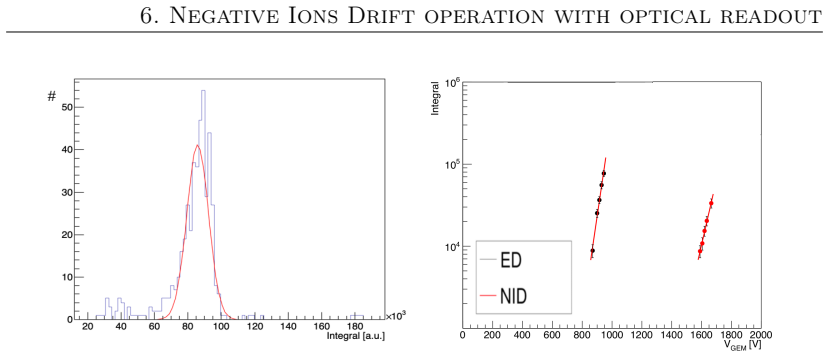
- [§6.3.1, §6.4] The headline claim that 1.6% SF6 produces NID operation with a diffusion coefficient as low as 45 µm/√cm is load-bearing and depends entirely on identifying the drifting species as negative ions rather than as a mixture of ions and surviving electrons. In the reproduced text, §6.3.1 describes drift-velocity and mobility measurements, but no quantitative SF6 electron-attachment fraction, no search for a prompt electron component in the PMT waveform, and no demonstration that the fitted mobility is field-independent (as expected for a single ion species) are shown. If attachment is incomplete, the sCMOS image integrates the prompt electron signal (arriving on the microsecond scale for a 50 cm drift) together with the delayed ion signal (millisecond scale), and the fitted diffusion coefficient becomes a convolution parameter rather than a pure ion-drift value; even a few percent of surviving electrons could bias the quoted number. Please either present the attachment-fraction measurement and a two-species waveform decomposition, or explicitly demonstrate single-species behaviour (for example, field-independent mobility and an arrival-time versus drift-distance relation with no prompt component), and report the resulting systematic uncertainty on the 45 µm/√cm value; if such tests exist elsewhere in the full thesis, they should be brought into §6.3-6.4 and reported together with the result, because as presented the claim is not fully supported.
- [§7.1.2, §7.1.7, §7.2.6] The projected CYGNO-30 limits and the model-discrimination conclusions rest on detector parameters (angular resolution, head-tail recognition efficiency, energy threshold, exposure, and the assumed gain and light yield) that the manuscript states as expectations rather than as measured full-scale performances. The text is honest about this, but the quantitative conclusions of the chapter, namely improved exclusion limits and 'orders of magnitude less events' for model discrimination, are not accompanied by a variation or robustness study over these parameters. I request a sensitivity scan (for example, angular resolution from 15° to 60°, head-tail efficiency from 50% to 100%, and threshold from 1 to 10 keV) to show where the directional advantage degrades or disappears; without it, the projected factors are conditional on unvalidated assumptions and their uncertainty cannot be assessed by the reader.
- [§5.3.2, §5.3.4] The abstract's 'factor close to 2' light-yield improvement and 'tens of micrometres' diffusion reduction are the summary claims of Chapter 5, but the reference configuration is not fully pinned down in the reproduced text: the light yield should be quoted per unit charge gain (or at matched total gain and electric fields), the reported diffusion reduction should be identified as transverse and/or longitudinal and connected to the analyses of §4.2-4.3 (55Fe spot shape versus alpha-track transverse profile), and the systematic uncertainties on both numbers should be propagated and quoted. The reviewer's assessment notes that the excerpt does not include the full uncertainty analysis; if it is present in the thesis, the posted version should display it in the results sections so that the factor-of-two headline is reproducible and comparable with the standard CYGNO configuration.
minor comments (5)
- [§2.3.2.3] The CYGNO entry of Table 2.2 and the surrounding text give the gas mixture as 'He:CF4 (64/40)', which conflicts with the 60/40 ratio used everywhere else (for example, §3.1.1); please correct this inconsistency.
- [§2.1.5.3, §2.3] Equations (2.28) and (2.30) are identical re-statements of the angular-rate dependence; use a cross-reference to the first equation rather than introducing a duplicated numbered formula.
- [abstract, §6.5] The phrase 'among the smallest ever measured in a gas detector' should be supported by a short comparison of diffusion coefficients from other NID detectors (for example, DRIFT with CS2-based mixtures and NEWAGE with SF6) or softened, since the reproduced text does not include the comparative values needed to substantiate the claim.
- [throughout] Several typos and duplicated words remain, including 'the the', 'Earth's rotation around its own axis', 'T able 1.1', and informal thesis-style passages in the acknowledgements; a careful proofread of the posted version is needed.
- [Introduction, §3] A brief explicit statement of which measurements and analyses are the candidate's own work and which are collaboration-level results (for example, LIME data, Garfield simulations, and previously published CYGNO results) would help the reader attribute the claims; this is customary for a thesis and is not clearly visible in the reproduced portion.
Circularity Check
No circular derivation: the thesis's new gain/light-yield/diffusion claims are direct prototype measurements, and its statistical projections use explicitly stated assumed detector parameters rather than fitted inputs.
full rationale
I walked the claimed derivation chain for the main results. The extra-electrode light-yield enhancement (factor close to 2) and the SF6 negative-ion-drift diffusion reduction (45 µm/√cm) are presented as measured quantities obtained with CYGNO prototypes in Chapters 5 and 6, not as quantities derived from a model that already contains them. The drift-velocity/mobility analysis in §6.3.1 is an internal cross-check of the NID identification; even if the attachment fraction is not quantified in the reproduced text, that would be an experimental systematic or correctness concern, not a circular step. Chapter 7 explicitly employs 'future expected performances of the CYGNO experiment' (angular resolution, energy ROI, detector response) as inputs to the Bayesian/frequentist projections; these are stated assumptions, not parameters fitted from data and then relabelled as predictions. The thesis does cite prior CYGNO work, e.g. 'A comprehensive overview of the CYGNO project can be found in [181]' and the 60/40 gas-mixture selection '[193,194]', but those self-citations support the detector concept and gas choice, not the new measurements of light yield, gain, amplification diffusion, or SF6/NID performance; the new results are standalone measurements. I found no equation in which an output equals an input by construction, no renamed fit, and no uniqueness argument whose force depends solely on an author-overlapping citation. The paper is therefore self-contained with respect to its new experimental claims, so the circularity score is 0.
Assumptions & free parameters
free parameters (6)
- SF6 concentration =
1.6%
- Extra electrode voltage =
not specified in abstract
- Angular resolution (projection) =
assumed in Section 7.2
- Head-tail recognition efficiency =
assumed in Section 7.2
- Energy threshold (CYGNO-30) =
1 keVee (claimed)
- Exposure (CYGNO-30) =
30 m^3 active volume
assumptions (5)
- domain assumption Standard Halo Model: isotropic Maxwell-Boltzmann WIMP velocity distribution with escape-velocity cutoff
- domain assumption WIMP-nucleus elastic scattering with SI (A^2 coherent) and SD (fluorine) couplings
- ad hoc to paper Detector response assumed for CYGNO-30 (gain, angular resolution, threshold) is achievable
- domain assumption Electron attachment to SF6 leads to negative ion drift at thermal velocity, producing the low diffusion
- domain assumption Garfield and Maxwell simulations accurately model gas avalanche behavior and electric field maps
Cite this review
Pith. "Pith review of Optimisation of amplification and gas mixture for directional Dark Matter searches with the CYGNO/INITIUM project." pith.science (2026). https://pith.science/paper/A6Y4EZ45
@misc{pith2026250702474,
  author       = {Pith},
  title        = {Pith review of: Optimisation of amplification and gas mixture for directional Dark Matter searches with the CYGNO/INITIUM project},
  year         = {2026},
  howpublished = {\url{https://pith.science/paper/A6Y4EZ45}},
  note         = {Machine review of arXiv:2507.02474}
}
read the original abstract
Astrophysical and cosmological observations suggest the existence of beyond standard model ingredient known as dark matter (DM). One of the most supported class of theories suggests that DM is composed of weakly interactive massive particles (WIMPs), possibly detectable via weak interaction with standard matter resulting in the recoil of the latter. The motion of the Sun and Earth with respect to the Galactic Centre is expected to induce a strong directional dependence in the recoil spectrum. Direct detection experiments capable of measuring the angular features of the recoils gain access to a wide range of advantages such as the possibility to positively claim a discovery of DM. The CYGNO project sets into this context, with the aim of deploying a large directional detector for rare event searches as DM. It exploits a gaseous time projection chamber filled with a He:CF4 gas mixture with a segmented amplification stage and granular optical readout. In this thesis, it is presented the work carried out with small CYGNO prototypes to maximise the light yield without degrading spatial and energy resolution, the addition of highly electronegative gases to induce a reduction of the electron cloud diffusion while drifting towards the amplification stage, very relevant to precisely measure the topological information of the recoil tracks. Moreover, the potential performances of directional detectors in the context of a direct DM search are analysed with the use of rigorous statistical tools both in the improvement in setting limits in the WIMP to nucleon sensitivity and in the capability of discerning two different DM models exploiting a directional detector.
Figures


Figures from the paper (89 more)








Reference graph
Works this paper leans on
-
[1]
PLANCK. Planck 2018 results. Astronomy: Astrophysics, 641 (2020):A6. doi:10.1051/0004-6361/201833910
-
[2]
C. Frenk, S. White.Dark matter and cosmic structure. Annalen der Physik, 524(9-10) (2012):507–534. doi:10.1002/andp.201200212
-
[3]
Bertone, et al
G. Bertone, et al. Particle dark matter: evidence, candidates and con- straints. Physics Reports, 405(5) (2005):279–390. doi:https://doi.org/10. 1016/j.physrep.2004.08.031
2005
-
[4]
L. E. Strigari.Galactic searches for dark matter. Physics Reports, 531(1) (2013):1–88. doi:10.1016/j.physrep.2013.05.004
-
[5]
K. G. Begeman, A. H. Broeils, R. H. Sanders.Extended rotation curves of spiral galaxies: dark haloes and modified dynamics. Monthly Notices of the Royal Astronomical Society, 249(3) (1991):523–537. doi:10.1093/mnras/ 249.3.523
doi:10.1093/mnras/ 1991
-
[6]
R. H. Sanders.The Dark Matter Problem: A Historical Perspective. Cam- bridge University Press (2010). doi:10.1017/CBO9781139192309
-
[7]
F. Zwicky. On the Masses of Nebulae and of Clusters of Nebulae. apj, 86 (1937):217. doi:10.1086/143864
doi:10.1086/143864 1937
-
[8]
S. Smith. The Mass of the Virgo Cluster. apj, 83 (1936):23. doi:10.1086/ 143697
1936
Show all 297 references
-
[9]
History of dark matter
G.Bertone, D.Hooper. History of dark matter. Reviews of Modern Physics, 90(4) (2018). doi:10.1103/revmodphys.90.045002
2018 doi
-
[10]
Bandiera, R
R. Bandiera, R. Maiolino, eds. Proceedings, 21st Texas Symposium on Relativistic Astrophysics (Texas in Tuscany): Florence, Italy, December 9-13, 2002. World Scientific, River Edge, N.J. (2003). doi:10.1142/5373
2003 doi
-
[11]
R. M. Wald.General Relativity. Chicago Univ. Pr., Chicago, USA (1984). doi:10.7208/chicago/9780226870373.001.0001
1984
-
[12]
Clowe, M
D. Clowe, M. Bradač, A. H. Gonzalez, M. Markevitch, S. W. Randall, C. Jones, D. Zaritsky.A Direct Empirical Proof of the Existence of Dark 217 D. Bibliography Matter. The Astrophysical Journal, 648(2) (2006):L109–L113. doi:10. 1086/508162
2006
-
[13]
Huterer.Weak lensing, dark matter and dark energy
D. Huterer.Weak lensing, dark matter and dark energy. General Relativity and Gravitation, 42(9) (2010):2177–2195. doi:10.1007/s10714-010-1051-z
2010 doi
-
[14]
C. Wegg, O. Gerhard, M. Portail. MOA-II Galactic microlensing con- straints: the inner Milky Way has a low dark matter fraction and a near maximal disc. Monthly Notices of the Royal Astronomical Society, 463(1) (2016):557–570. doi:10.1093/mnras/stw1954
2016 doi
-
[15]
E. W. Kolb, M. S. Turner. The Early Universe, vol. 69 (1990). doi:10. 1201/9780429492860
1990
-
[16]
M. Özer, M. Taha. A model of the universe free of cosmological prob- lems. Nuclear Physics B,287(1987):776–796. doi:https://doi.org/10.1016/ 0550-3213(87)90128-3
1987
-
[17]
Arbey, F
A. Arbey, F. Mahmoudi.Dark matter and the early Universe: A review. Progress in Particle and Nuclear Physics (2021):103865. doi:10.1016/j. ppnp.2021.103865
2021
-
[18]
E. L. Wright. Theoretical Overview of Cosmic Microwave Background Anisotropy (2003). doi:10.48550/ARXIV.ASTRO-PH/0305591
2003 doi
-
[19]
Sparre, C
M. Sparre, C. C. Hayward, V. Springel, M. Vogelsberger, S. Genel, P. Tor- rey, D. Nelson, D. Sijacki, L. Hernquist.The star formation main sequence and stellar mass assembly of galaxies in the Illustris simulation. Monthly Notices of the Royal Astronomical Society, 447(4) (201...
2015 doi
-
[20]
Springel, S
V. Springel, S. D. M. White, A. Jenkins, C. S. Frenk, N. Yoshida, L. Gao, J. Navarro, R. Thacker, D. Croton, J. Helly, J. A. Peacock, S. Cole, P. Thomas, H. Couchman, A. Evrard, J. Colberg, F. Pearce.Simulations of the formation, evolution and clustering of galaxies and quasar...
2005 doi
-
[21]
Ishiyama, M
T. Ishiyama, M. Enoki, M. A. R. Kobayashi, R. Makiya, M. Nagashima, T. Oogi.The ν2GC simulations: Quantifying the dark side of the universe in the Planck cosmology. pasj, 67(4) (2015):61. doi:10.1093/pasj/psv021
2015 doi
-
[22]
S. D. M. White, C. S. Frenk, M. Davis.Clustering in a neutrino-dominated universe. apjl, 274 (1983):L1–L5. doi:10.1086/184139
1983 doi
-
[23]
M. Milgrom. MOND theory. Canadian Journal of Physics , 93(2) (2015):107–118. doi:10.1139/cjp-2014-0211. 218
2015 doi
-
[24]
Famaey, S
B. Famaey, S. S. McGaugh.Modified Newtonian Dynamics (MOND): Ob- servational Phenomenology and Relativistic Extensions. Living Reviews in Relativity, 15(1) (2012). doi:10.12942/lrr-2012-10
2012 doi
- [25]
-
[26]
Milgrom.MOND vs
M. Milgrom.MOND vs. dark matter in light of historical parallels. Studies in History and Philosophy of Science Part B: Studies in History and Phi- losophy of Modern Physics, 71 (2020):170–195. doi:10.1016/j.shpsb.2020. 02.004
2020 doi
-
[27]
Skordis, T
C. Skordis, T. Złoś nik. New Relativistic Theory for Modified Newto- nian Dynamics. Physical Review Letters, 127(16) (2021). doi:10.1103/ physrevlett.127.161302
2021
-
[28]
G. W. Angus. Is an 11 eV sterile neutrino consistent with clusters, the cosmic microwave background and modified Newtonian dynamics? Monthly Notices of the Royal Astronomical Society, 394(1) (2009):527–532. doi: 10.1111/j.1365-2966.2008.14341.x
2009
-
[29]
S. S. McGaugh. Distinguishing between Cold Dark Matter and Modified Newtonian Dynamics: Predictions for the Microwave Background. The Astrophysical Journal, 523(2) (1999):L99–L102. doi:10.1086/312274
1999 doi
-
[30]
Y. B. Zel’dovich, I. D. Novikov.The Hypothesis of Cores Retarded during Expansion and the Hot Cosmological Model. sovast, 10 (1967):602
1967
-
[31]
Hawking.Gravitationally Collapsed Objects of Very Low Mass
S. Hawking.Gravitationally Collapsed Objects of Very Low Mass. Monthly Notices of the Royal Astronomical Society, 152(1) (1971):75–78. doi:10. 1093/mnras/152.1.75
1971
-
[32]
A. Coc, E. Vangioni. Primordial nucleosynthesis. International Journal of Modern Physics E , 26(08) (2017):1741002. doi:10.1142/ s0218301317410026
2017
-
[34]
B. Carr, F. Kühnel. Primordial Black Holes as Dark Matter: Recent Developments. Annual Review of Nuclear and Particle Science, 70(1) (2020):355–394. doi:10.1146/annurev-nucl-050520-125911
2020 doi
-
[35]
G. F. Chapline.Cosmological effects of primordial black holes. Nature,253 (1975). doi:https://doi.org/10.1038/253251a0
1975 doi
-
[36]
Billard, M
J. Billard, M. Boulay, S. Cebriá n, L. Covi, G. Fiorillo, A. Green, J. Kopp, B. Majorovits, K. Palladino, F. Petricca, L. R. (chair), M. Schumann.Di- rect detection of dark matter APPEC committee report. Reports on Progress in Physics, 85(5) (2022):056201. doi:10.1088/1361-663...
2022 doi
-
[37]
A. M. Green, B. J. Kavanagh. Primordial black holes as a dark matter candidate. Journal of Physics G: Nuclear and Particle Physics, 48(4) (2021):043001. doi:10.1088/1361-6471/abc534
2021 doi
-
[38]
Villanueva-Domingo, O
P. Villanueva-Domingo, O. Mena, S. Palomares-Ruiz.A Brief Review on Primordial Black Holes as Dark Matter. Frontiers in Astronomy and Space Sciences, 8 (2021). doi:10.3389/fspas.2021.681084
2021
-
[39]
J. Ellis. Limits of the Standard Model (2002). doi:10.48550/ARXIV. HEP-PH/0211168
2002 doi
-
[40]
H. M. Lee. Lectures on physics beyond the Standard Model. Journal of the Korean Physical Society, 78(11) (2021):985–1017. doi:10.1007/ s40042-021-00188-x
2021
-
[41]
J. Fan, A. Katz, L. Randall, M. Reece.Double-Disk Dark Matter. Physics of the Dark Universe,2(3)(2013):139–156. doi:10.1016/j.dark.2013.07.001
2013 doi
-
[42]
M. R. Lovell, V. Eke, C. S. Frenk, L. Gao, A. Jenkins, T. Theuns, J. Wang, S. D. M. White, A. Boyarsky, O. Ruchayskiy.The haloes of bright satellite galaxies in a warm dark matter universe. Monthly Notices of the Royal Astronomical Society, 420(3) (2012):2318–2324. doi:10.1111...
2012
-
[43]
O. E. Gerhard, D. N. Spergel.Dwarf Spheroidal Galaxies and the Mass of the Neutrino. APJ, 389 (1992):L9. doi:10.1086/186336
1992 doi
-
[44]
R. J. Scherrer, M. S. Turner. On the relic, cosmic abundance of stable, weakly interacting massive particles. Phys. Rev. D, 33 (1986):1585–1589. doi:10.1103/PhysRevD.33.1585
1986 doi
-
[45]
Bernal, M
N. Bernal, M. Heikinheimo, T. Tenkanen, K. Tuominen, V. Vaskonen. The dawn of FIMP Dark Matter: A review of models and constraints. International Journal of Modern Physics A, 32(27) (2017):1730023. doi: 10.1142/s0217751x1730023x
2017 doi
-
[46]
J. L. Feng. Dark Matter Candidates from Particle Physics and Meth- ods of Detection. Annual Review of Astronomy and Astrophysics, 48(1) (2010):495–545. doi:10.1146/annurev-astro-082708-101659
2010 doi
-
[47]
P. J. Fox.TASI Lectures on WIMPs and Supersymmetry. PoS,TASI2018 (2019):005. doi:10.22323/1.333.0005
2019 doi
-
[48]
Roszkowski, E
L. Roszkowski, E. M. Sessolo, S. Trojanowski.WIMP dark matter can- didates and searches—current status and future prospects. Reports on Progress in Physics, 81(6) (2018):066201. doi:10.1088/1361-6633/aab913. 220
2018 doi
-
[49]
Andriot, G
D. Andriot, G. L. Gó mez. Signatures of extra dimensions in gravita- tional waves. Journal of Cosmology and Astroparticle Physics, 2017(06) (2017):048–048. doi:10.1088/1475-7516/2017/06/048
2017 doi
-
[50]
P. D. Group.Review of Particle Physics. Progress of Theoretical and Ex- perimental Physics, 2020(8) (2020). doi:10.1093/ptep/ptaa104. 083C01
2020 doi
-
[51]
Appelquist, H.-C
T. Appelquist, H.-C. Cheng, B. A. Dobrescu.Bounds on universal extra dimensions. Physical Review D, 64(3) (2001). doi:10.1103/physrevd.64. 035002
2001 doi
-
[52]
Servant, T
G. Servant, T. M. Tait.Is the lightest Kaluza–Klein particle a viable dark matter candidate? Nuclear Physics B , 650(1-2) (2003):391–419. doi: 10.1016/s0550-3213(02)01012-x
2003 doi
-
[53]
R. D. Peccei, H. R. Quinn.CP Conservation in the Presence of Instantons. Phys. Rev. Lett., 38 (1977):1440–1443. doi:10.1103/PhysRevLett.38.1440
1977 doi
-
[54]
Abel, et al
C. Abel, et al. Measurement of the Permanent Electric Dipole Moment of the Neutron. Phys. Rev. Lett., 124(8) (2020):081803. doi:10.1103/ PhysRevLett.124.081803
2020
-
[55]
J. M. Pendlebury, et al.Revised experimental upper limit on the electric dipole moment of the neutron. Phys. Rev. D, 92(9) (2015):092003. doi: 10.1103/PhysRevD.92.092003
2015 doi
-
[56]
F. Wilczek. Problem of Strong P and T Invariance in the Presence of Instantons. Phys. Rev. Lett.,40(1978):279–282. doi:10.1103/PhysRevLett. 40.279
1978 doi
-
[57]
G. G. di Cortona, E. Hardy, J. P. Vega, G. Villadoro.The QCD axion, precisely. Journal of High Energy Physics, 2016(1) (2016). doi:10.1007/ jhep01(2016)034
2016
-
[58]
G. Raffelt. AXIONS IN ASTROPHYSICS AND COSMOLOGY(1995). doi:10.48550/ARXIV.HEP-PH/9502358
1995 doi
-
[59]
Sikivie.Axion Cosmology
P. Sikivie.Axion Cosmology. In Lecture Notes in Physics. Springer Berlin Heidelberg (2008), pp. 19–50. doi:10.1007/978-3-540-73518-2_2
2008 doi
-
[60]
Massó , F
E. Massó , F. Rota, G. Zsembinszki.Axion thermalization in the early uni- verse. Physical Review D, 66(2) (2002). doi:10.1103/physrevd.66.023004
2002 doi
-
[61]
I. G. Irastorza. An introduction to axions and their detection. SciPost Physics Lecture Notes(2022). doi:10.21468/scipostphyslectnotes.45
2022 doi
-
[62]
G. G. Raffelt. Axions—motivation, limits and searches. Journal of Physics A: Mathematical and Theoretical, 40(25) (2007):6607. doi:10. 1088/1751-8113/40/25/S05. 221 D. Bibliography
2007
-
[63]
M. H. e. a. Ahn.Measurement of neutrino oscillation by the K2K experi- ment. Phys. Rev. D, 74 (2006):072003. doi:10.1103/PhysRevD.74.072003
2006 doi
-
[64]
Dodelson, L
S. Dodelson, L. M. Widrow. Sterile neutrinos as dark matter. Physical Review Letters, 72(1) (1994):17–20. doi:10.1103/physrevlett.72.17
1994 doi
-
[65]
L. J. Hall, K. Jedamzik, J. March-Russell, S. M. West.Freeze-in production of FIMP dark matter. Journal of High Energy Physics, 2010(3) (2010). doi:10.1007/jhep03(2010)080
2010 doi
-
[66]
R.E. Shrock. Electromagnetic properties and decays of Dirac and Majorana neutrinos in a general class of gauge theories. Nuclear Physics B, 206(3) (1982):359–379. doi:https://doi.org/10.1016/0550-3213(82)90273-5
1982 doi
- [67]
-
[68]
Fabbrichesi, E
M. Fabbrichesi, E. Gabrielli, G. Lanfranchi. The Physics of the Dark Photon. Springer International Publishing (2021). doi:10.1007/ 978-3-030-62519-1
2021
-
[69]
Sigurdson, M
K. Sigurdson, M. Doran, A. Kurylov, R. R. Caldwell, M. Kamionkowski. Dark-matter electric and magnetic dipole moments. Phys. Rev. D, 70 (2004):083501. doi:10.1103/PhysRevD.70.083501
2004 doi
-
[70]
Boehm, T
C. Boehm, T. A. Enßlin, J. Silk.Can annihilating dark matter be lighter than a few GeVs? Journal of Physics G: Nuclear and Particle Physics, 30(3) (2004):279–285. doi:10.1088/0954-3899/30/3/004
2004 doi
-
[71]
Observable signatures of dark photons from supernovae
W.DeRocco, P.W.Graham, D.Kasen, G.Marques-Tavares, S.Rajendran. Observable signatures of dark photons from supernovae. Journal of High Energy Physics, 2019(2) (2019). doi:10.1007/jhep02(2019)171
2019 doi
- [72]
-
[73]
Buchmueller, C
O. Buchmueller, C. Doglioni, L.-T. Wang.Search for dark matter at col- liders. Nature Physics, 13(3) (2017):217–223. doi:10.1038/nphys4054
2017 doi
-
[74]
Battaglieri, M
M. Battaglieri, M. Bondí , A. Celentano, P. Cole, M. D. Napoli, R. D. Vita, L. Marsicano, N. Randazzo, E. Smith, M. Spreafico, M. Wood.Dark matter search with the BDX-MINI experiment. Physical Review D, 106(7) (2022). doi:10.1103/physrevd.106.072011
2022 doi
- [75]
-
[76]
P. Gondolo. Recoil momentum spectrum in directional dark matter detec- tors. Physical Review D, 66(10) (2002). doi:10.1103/physrevd.66.103513. 222
2002 doi
-
[77]
Lewin, P
J. Lewin, P. Smith. Review of mathematics, numerical factors, and corrections for dark matter experiments based on elastic nuclear recoil. Astroparticle Physics, 6(1) (1996):87–112. doi:https://doi.org/10.1016/ S0927-6505(96)00047-3
1996
-
[78]
R. W. Schnee. Introduction to dark matter experiments. In Physics of the Large and the Small. WORLD SCIENTIFIC (2011). doi:10.1142/ 9789814327183_0014
2011
-
[79]
Binney, S
J. Binney, S. Tremaine.Galactic Dynamics: Second Edition(2008)
2008
-
[80]
Baxter, et al.Recommended conventions for reporting results from direct dark matter searches
D. Baxter, et al.Recommended conventions for reporting results from direct dark matter searches. The European Physical Journal C, 81(10) (2021). doi:10.1140/epjc/s10052-021-09655-y
2021 doi
-
[81]
M. J. Reid, K. M. Menten, A. Brunthaler, X. W. Zheng, T. M. Dame, Y. Xu, J. Li, N. Sakai, Y. Wu, K. Immer, B. Zhang, A. Sanna, L. Moscadelli, K. L. J. Rygl, A. Bartkiewicz, B. Hu, L. H. Quiroga-Nuñ ez, H. J. van Langevelde.Trigonometric Parallaxes of High-mass Star-forming Reg...
2019 doi
-
[82]
Eilers, D
A.-C. Eilers, D. W. Hogg, H.-W. Rix, M. K. Ness.The Circular Velocity Curve of the Milky Way from 5 to 25 kpc. The Astrophysical Journal, 871(1) (2019):120. doi:10.3847/1538-4357/aaf648
2019 doi
-
[84]
Piffl, C
T. Piffl, C. Scannapieco, J. Binney, M. Steinmetz, R.-D. Scholz, M. E. K. Williams, R. S. de Jong, G. Kordopatis, G. Matijevič , O. Bienaymé, J. Bland-Hawthorn, C. Boeche, K. Freeman, B. Gibson, G. Gilmore, E. K. Grebel, A. Helmi, U. Munari, J. F. Navarro, Q. Parker, W. A. Rei...
2014 doi
-
[85]
Monari, B
G. Monari, B. Famaey, I. Carrillo, T. Piffl, M. Steinmetz, R. F. G. Wyse, F. Anders, C. Chiappini, K. Janßen.The escape speed curve of the Galaxy obtained from Gaia DR2 implies a heavy Milky Way. aap, 616 (2018):L9. doi:10.1051/0004-6361/201833748
2018 doi
-
[86]
J. F. Navarro, C. S. Frenk, S. D. M. White.The Structure of Cold Dark Matter Halos. The Astrophysical Journal, 462 (1996):563. doi:10.1086/ 177173. 223 D. Bibliography
1996
-
[87]
New experiment for WIMP direct search (NEWSdm)
Polukhina, Natalia, Starkov, Nikolai. New experiment for WIMP direct search (NEWSdm). EPJ Web Conf., 191 (2018):02023. doi:10.1051/ epjconf/201819102023
2018
-
[88]
K. Griest. Effect of the Sun’s gravity on the distribution and detection of dark matter near the Earth. Phys. Rev. D, 37 (1988):2703–2713. doi: 10.1103/PhysRevD.37.2703
1988 doi
-
[89]
Froborg, A
F. Froborg, A. R. Duffy.Annual modulation in direct dark matter searches. Journal of Physics G: Nuclear and Particle Physics, 47(9) (2020):094002. doi:10.1088/1361-6471/ab8e93
2020 doi
- [90]
- [91]
-
[92]
Vogelsberger, A
M. Vogelsberger, A. Helmi, V. Springel, S. D. M. White, J. Wang, C. S. Frenk, A. Jenkins, A. Ludlow, J. F. Navarro. Phase-space structure in the local dark matter distribution and its signature in direct detection ex- periments. Monthly Notices of the Royal Astronomical Societ...
2009
-
[93]
Pillepich, M
A. Pillepich, M. Kuhlen, J. Guedes, P. Madau. THE DISTRIBUTION OF DARK MATTER IN THE MILKY WAY’S DISK. The Astrophysical Journal, 784(2) (2014):161. doi:10.1088/0004-637X/784/2/161
2014 doi
-
[94]
C. W. Purcell, J. S. Bullock, M. Kaplinghat.THE DARK DISK OF THE MILKY WAY. The Astrophysical Journal, 703(2) (2009):2275. doi:10. 1088/0004-637X/703/2/2275
2009
-
[95]
Kurylov, M
A. Kurylov, M. Kamionkowski. Generalized analysis of the direct weakly interacting massive particle searches. Physical Review D, 69(6) (2004). doi:10.1103/physrevd.69.063503
2004 doi
-
[96]
Tovey, R
D. Tovey, R. Gaitskell, P. Gondolo, Y. Ramachers, L. Roszkowski. A new model-independent method for extracting spin-dependent cross section limits from dark matter searches. Physics Letters B, 488(1) (2000):17–26. doi:10.1016/s0370-2693(00)00846-7
2000 doi
-
[97]
Deans.The Radon Transform and Some of Its Applications
S. Deans.The Radon Transform and Some of Its Applications. John Wiley & Sons Ltd. (1983)
1983
-
[98]
J. Radon. ¨Uber die Bestimmung von Funktionen durch ihre Integralwerte l¨angs gewisser Mannigfaltigkeiten. Akad. Wiss., 262(69) (1917). 224
1917
-
[99]
Freese, M
K. Freese, M. Lisanti, C. Savage.Colloquium: Annual modulation of dark matter. Rev. Mod. Phys., 85 (2013):1561–1581. doi:10.1103/RevModPhys. 85.1561
2013 doi
-
[100]
Monroe, P
J. Monroe, P. Fisher.Neutrino backgrounds to dark matter searches. Phys- ical Review D, 76(3) (2007). doi:10.1103/physrevd.76.033007
2007 doi
-
[101]
Dębicki, K
Z. Dębicki, K. Jędrzejczak, J. Karczmarczyk, M. Kasztelan, R. Lewandowski, J. Orzechowski, J. Szabelski, M. Szepty- cka, P. Tokarski. Thermal neutrons at Gran Sasso . Nuclear Physics B - Proceedings Supplements , 196 (2009):429–432. doi: https://doi.org/10.1016/j.nuclphysbps.2...
2009 doi
-
[102]
D. G. Madland, E. D. Arthur, G. P. Estes, J. E. Stewart, M. Bozoian, R. T. Perry, T. A. Parish, T. H. Brown, T. R. England, W. B. Wilson, W. S. Charlton. SOURCES 4A: A Code for Calculating (alpha,n), Spontaneous Fission, and Delayed Neutron Sources and Spectra. doi:10.2172/15215
-
[103]
V. A. Kudryavtsev, L. Pandola, V. Tomasello.Neutron- and muon-induced background in underground physics experiments. The European Physical Journal A, 36(2) (2008):171–180. doi:10.1140/epja/i2007-10539-6
2008 doi
-
[104]
Westerdale, E
S. Westerdale, E. Shields, F. Calaprice.A prototype neutron veto for dark matter detectors. Astroparticle Physics, 79 (2016):10–22. doi:10.1016/j. astropartphys.2016.01.005
2016 doi
-
[105]
Schumann.Direct detection of WIMP dark matter: concepts and status
M. Schumann.Direct detection of WIMP dark matter: concepts and status. Journal of Physics G: Nuclear and Particle Physics,46(10)(2019):103003. doi:10.1088/1361-6471/ab2ea5
2019 doi
-
[106]
Aguayo Navarrete, R
E. Aguayo Navarrete, R. T. Kouzes, J. L. Orrell, T. J. Berguson, A. T. Greene. Estimation of Cosmic Induced Contamination in Ultra-low Back- ground Detector Materials. doi:10.2172/1056763
-
[107]
Billard, E
J. Billard, E. Figueroa-Feliciano, L. Strigari.Implication of neutrino back- grounds on the reach of next generation dark matter direct detection experi- ments. Physical Review D, 89(2) (2014). doi:10.1103/physrevd.89.023524
2014 doi
-
[108]
J. e. a. Aalbers. A Next-Generation Liquid Xenon Observatory for Dark Matter and Neutrino Physics(2022). doi:10.48550/ARXIV.2203.02309
2022 doi
-
[109]
Vahsen, et al.CYGNUS: Feasibility of a nuclear recoil observatory with directional sensitivity to dark matter and neutrinos(2020)
S. Vahsen, et al.CYGNUS: Feasibility of a nuclear recoil observatory with directional sensitivity to dark matter and neutrinos(2020)
2020
-
[110]
C. A. J. O’Hare. New Definition of the Neutrino Floor for Direct Dark Matter Searches. Physical Review Letters, 127(25) (2021). doi:10.1103/ physrevlett.127.251802. 225 D. Bibliography
2021
-
[111]
Krnjaic, N
G. Krnjaic, N. Toro, A. Berlin, B. Batell, N. Blinov, L. Darme, P. DeNiverville, P. Harris, C. Hearty, M. Hostert, K. J. Kelly, D. McKeen, S. Trojanowski, Y. D. Tsai.A Snowmass Whitepaper: Dark Matter Pro- duction at Intensity-Frontier Experiments(2022). doi:10.48550/ARXIV. 2207.00597
- [112]
-
[113]
C. A. O’Hare, A. M. Green, J. Billard, E. Figueroa-Feliciano, L. E. Strigari. Readout strategies for directional dark matter detection beyond the neutrino background. Physical Review D, 92(6) (2015). doi:10.1103/physrevd.92. 063518
2015 doi
-
[114]
Coarasa, J
I. Coarasa, J. Amaré, S. Cebrián, C. Cuesta, E. García, M. Martínez, M. A. Oliván, Y. Ortigoza, A. O. de Solórzano, J. Puimedón, A. Salinas, M. L. Sarsa, P. Villar, J. A. Villar.ANAIS-112 sensitivity in the search for dark matter annual modulation. The European Physical Journa...
2019 doi
-
[115]
Bernabei, et al
R. Bernabei, et al. Recent Results from DAMA/LIBRA and Compar- isons. Moscow Univ. Phys. Bull., 77(2) (2022):291–300. doi:10.3103/ S0027134922020138
2022
-
[116]
Gerbier, (forthe EDELWEISS Collaboration)
G. Gerbier, (forthe EDELWEISS Collaboration). Status of the EDELWEISS-II experiment. Journal of Physics: Conference Series , 120(4) (2008):042017. doi:10.1088/1742-6596/120/4/042017
2008 doi
-
[117]
Willers, et al.Direct dark matter search with the CRESST-III experi- ment - status and perspectives
M. Willers, et al.Direct dark matter search with the CRESST-III experi- ment - status and perspectives. J. Phys. Conf. Ser., 888(1) (2017):012209. doi:10.1088/1742-6596/888/1/012209
2017 doi
-
[118]
Angloher, P
G. Angloher, P. Carniti, L. Cassina, L. Gironi, C. Gotti, A. Gütlein, D. Hauff, M. Maino, S. S. Nagorny, L. Pagnanini, G. Pessina, F. Pet- ricca, S. Pirro, F. Pröbst, F. Reindl, K. Schäffner, J. Schieck, W. Seidel. The COSINUS project: perspectives of a NaI scintillating calor...
2016 doi
-
[119]
Agnese, et al
R. Agnese, et al. Projected Sensitivity of the SuperCDMS SNOLAB ex- periment. Phys. Rev. D, 95(8) (2017):082002. doi:10.1103/PhysRevD.95. 082002
2017 doi
-
[120]
Kuźniak, et al
M. Kuźniak, et al. DEAP-3600 Dark Matter Search. Nuclear and Par- ticle Physics Proceedings, 273-275 (2016):340–346. doi:https://doi.org/ 10.1016/j.nuclphysbps.2015.09.048. 37th International Conference on High Energy Physics (ICHEP). 226
2016 doi
-
[121]
Abe, et al.Light WIMP search in XMASS
K. Abe, et al.Light WIMP search in XMASS. Physics Letters B, 719(1) (2013):78–82. doi:https://doi.org/10.1016/j.physletb.2013.01.001
2013 doi
-
[122]
Aprile, et al
E. Aprile, et al. Search for New Physics in Electronic Recoil Data from XENONnT. Physical Review Letters, 129(16) (2022). doi:10.1103/ physrevlett.129.161805
2022
-
[123]
C. E. Aalseth, et al.DarkSide-20k: A 20 tonne two-phase LAr TPC for direct dark matter detection at LNGS. Eur. Phys. J. Plus, 133 (2018):131. doi:10.1140/epjp/i2018-11973-4
2018 doi
-
[124]
Amole, M
C. Amole, M. Ardid, I. Arnquist, D. Asner, D. Baxter, E. Behnke, M. Bressler, B. Broerman, G. Cao, C. Chen, et al. Dark matter search results from the complete exposure of the PICO-60 C3F8 bubble chamber. Physical Review D, 100(2) (2019). doi:10.1103/physrevd.100.022001
2019 doi
-
[125]
Buttazzo, P
D. Buttazzo, P. Panci, N. Rossi, A. Strumia.Annual modulations from secular variations: relaxing DAMA? Journal of High Energy Physics , 2020(4) (2020). doi:10.1007/jhep04(2020)137
2020 doi
-
[126]
J. H. Davis, C. McCabe, C. Bœhm. Quantifying the evidence for dark matter in CoGeNT data. Journal of Cosmology and Astroparticle Physics, 2014(08) (2014):014–014. doi:10.1088/1475-7516/2014/08/014
2014 doi
-
[127]
Messina, M
A. Messina, M. Nardecchia, S. Piacentini.Annual modulations from secular variations: not relaxing DAMA? Journal of Cosmology and Astroparticle Physics, 2020(04) (2020):037–037. doi:10.1088/1475-7516/2020/04/037
2020 doi
- [128]
-
[129]
Adhikari, et al
G. Adhikari, et al. Strong constraints from COSINE-100 on the DAMA dark matter results using the same sodium iodide target. Science Advances, 7(46) (2021). doi:10.1126/sciadv.abk2699
2021 doi
-
[130]
D. S. Akerib, et al.Limits on Spin-Dependent WIMP-Nucleon Cross Sec- tion Obtained from the Complete LUX Exposure. Phys. Rev. Lett., 118 (2017):251302. doi:10.1103/PhysRevLett.118.251302
2017 doi
- [131]
-
[132]
Takahashi, M
F. Takahashi, M. Yamada, W. Yin.XENON1T Excess from Anomaly-Free Axionlike Dark Matter and Its Implications for Stellar Cooling Anomaly. Physical Review Letters, 125(16) (2020). doi:10.1103/physrevlett.125. 161801. 227 D. Bibliography
2020 doi
-
[133]
Adari, et al
P. Adari, et al. EXCESS workshop: Descriptions of rising low- energy spectra. SciPost Physics Proceedings, (9) (2022). doi:10.21468/ scipostphysproc.9.001
2022
-
[134]
A. M. Green, B. Morgan. Optimizing WIMP directional detectors. As- troparticle Physics, 27(2-3) (2007):142–149. doi:10.1016/j.astropartphys. 2006.10.006
2007 doi
-
[135]
C. J. Copi, J. Heo, L. M. Krauss.Directional sensitivity, WIMP detection, and the galactic halo. Physics Letters B, 461(1) (1999):43–48. doi:https: //doi.org/10.1016/S0370-2693(99)00830-8
1999 doi
-
[136]
Billard, F
J. Billard, F. Mayet, D. Santos. Assessing the discovery potential of di- rectional detection of dark matter. Physical Review D, 85(3) (2012). doi: 10.1103/physrevd.85.035006
2012 doi
-
[137]
S. E. Vahsen, C. A. O’Hare, D. Loomba. Directional Recoil Detection. Annual Review of Nuclear and Particle Science, 71(1) (2021):189–224. doi:10.1146/annurev-nucl-020821-035016
2021 doi
-
[138]
S. K. Lee, A. H. Peter.Probing the local velocity distribution of WIMP dark matter with directional detectors. Journal of Cosmology and Astroparticle Physics, 2012(04) (2012):029–029. doi:10.1088/1475-7516/2012/04/029
2012 doi
-
[139]
B. J. Kavanagh, C. A. O’Hare.Reconstructing the three-dimensional local dark matter velocity distribution. Physical Review D, 94(12) (2016). doi: 10.1103/physrevd.94.123009
2016 doi
-
[140]
C. A. O’Hare, A. M. Green.Directional detection of dark matter streams. Physical Review D, 90(12) (2014). doi:10.1103/physrevd.90.123511
2014 doi
- [141]
-
[142]
J. M. D. Kruijssen, J. L. Pfeffer, M. Reina-Campos, R. A. Crain, N. Bas- tian. The formation and assembly history of the Milky Way revealed by its globular cluster population. Monthly Notices of the Royal Astronomical Society, 486(3) (2018):3180–3202. doi:10.1093/mnras/sty1609
2018 doi
-
[143]
Naidu, C.Conroy, A
R.P. Naidu, C.Conroy, A. Bonaca, B.D.Johnson, Y.-S.Ting, N. Caldwell, D. Zaritsky, P. A. Cargile.Evidence from the H3 Survey That the Stellar Halo Is Entirely Comprised of Substructure. The Astrophysical Journal, 901(1) (2020):48. doi:10.3847/1538-4357/abaef4
2020 doi
-
[144]
G. C. Myeong, N. W. Evans, V. Belokurov, N. C. Amorisco, S. E. Ko- posov. Halo substructure in the SDSS–Gaia catalogue: streams and clumps. Monthly Notices of the Royal Astronomical Society, 475(2) (2017):1537–
2017
-
[145]
Battat, et al.Readout technologies for directional WIMP Dark Matter detection
J. Battat, et al.Readout technologies for directional WIMP Dark Matter detection. Physics Reports, 662 (2016):1–46. doi:10.1016/j.physrep.2016. 10.001
2016 doi
-
[146]
Sekiya, M
H. Sekiya, M. Minowa, Y. Shimuzu, W. Suganuma, Y. Inoue.Dark matter search with direction sensitive scintillator. In Neutrino Oscillations and Their Origin. WORLD SCIENTIFIC (2005). doi:10.1142/9789812701824_ 0049
2005 doi
-
[147]
Belli, R
P. Belli, R. Bernabei, F. Cappella, V. Caracciolo, R. Cerulli, N. Cherubini, F. A. Danevich, A. Incicchitti, D. V. Kasperovych, V. Merlo, E. Piccinelli, O. G. Polischuk, V. I. Tretyak.Measurements of ZnWO4 anisotropic re- sponse to nuclear recoils for the ADAMO project. The Eu...
2020 doi
- [148]
-
[149]
D. R. Nygren. Columnar recombination: a tool for nuclear recoil direc- tional sensitivity in a xenon-based direct detection WIMP search. Jour- nal of Physics: Conference Series, 460(1) (2013):012006. doi:10.1088/ 1742-6596/460/1/012006
2013
-
[150]
Nakamura, S
K. Nakamura, S. Ban, M. Hirose, A. Ichikawa, Y. Ishiyama, A. Minamino, K. Miuchi, T. Nakaya, H. Sekiya, S. Tanaka, K. Ueshima.Angular depen- dence of columnar recombination in high pressure xenon gas using time profiles of scintillation emission. Journal of Instrumentation, 13...
2018 doi
-
[151]
T. Naka, T. Asada, T. Katsuragawa, K. Hakamata, M. Yoshimoto, K. Kuwabara, M. Nakamura, O. Sato, T. Nakano, Y. Tawara, G. De Lellis, C. Sirignano, N. D’Ambrossio. Fine grained nuclear emulsion for higher resolution tracking detector. Nuclear Instruments and Methods in Physics ...
2013 doi
-
[152]
Shiraishi, S
T. Shiraishi, S. Akamatsu, T. Naka, T. Asada, G. D. Lellis, V. Tioukov, G. Rosa, R. Kobayashi, N. D’Ambrosio, A. Alexandrov, O. Sato.Environ- mental sub-MeV neutron measurement at the Gran Sasso surface labora- tory with a super-fine-grained nuclear emulsion detector. Physical...
2023 doi
-
[153]
Nuclear Emulsions
A.Ariga, T.Ariga, G.DeLellis, A.Ereditato, K.Niwa. Nuclear Emulsions. Springer International Publishing, Cham (2020), pp. 383–438. doi:10.1007/ 978-3-030-35318-6_9. 229 D. Bibliography
2020
-
[154]
De Lellis.Nuclear Emulsions for WIMP Search with a directional mea- surement
G. De Lellis.Nuclear Emulsions for WIMP Search with a directional mea- surement. PoS, EPS-HEP2021 (2022):157. doi:10.22323/1.398.0157
2022 doi
-
[155]
S. A. Gorbunov, N. S. Konovalova.New Experiment NEWSdm for Direct Searches for Heavy Dark Matter Particles. Physics of Atomic Nuclei,83(1) (2020):83–91. doi:10.1134/S1063778820010056
2020 doi
-
[156]
Alexandrov, G
A. Alexandrov, G. De Lellis, V. Tioukov. A Novel Optical Scanning Technique with an Inclined Focusing Plane. Scientific Reports, 9(1) (2019):2870. doi:10.1038/s41598-019-39415-8
2019 doi
-
[157]
Betzig, G
E. Betzig, G. H. Patterson, R. Sougrat, O. W. Lindwasser, S. Olenych, J. S. Bonifacino, M. W. Davidson, J. Lippincott-Schwartz, H. F. Hess. Imaging intracellular fluorescent proteins at nanometer resolution. Science, 313(5793) (2006):1642–1645
2006
-
[158]
J. J. Mock, M. Barbic, D. R. Smith, D. A. Schultz, S. Schultz. Shape effects in plasmon resonance of individual colloidal silver nanoparticles. The Journal of Chemical Physics,116(15) (2002):6755–6759. doi:10.1063/ 1.1462610
2002
-
[159]
Alexandrov, T
A. Alexandrov, T. Asada, G. De Lellis, A. Di Crescenzo, V. Gentile, T. Naka, V. Tioukov, A. Umemoto. Super-resolution high-speed opti- cal microscopy for fully automated readout of metallic nanoparticles and nanostructures. Scientific Reports, 10(1) (2020):18773. doi:10.1038/ ...
2020
-
[160]
Di Marco, on behalf of the NEWS Collaboration.NEWS: Nuclear Emul- sions for WIMP Search
N. Di Marco, on behalf of the NEWS Collaboration.NEWS: Nuclear Emul- sions for WIMP Search. Journal of Physics: Conference Series, 718(4) (2016):042018. doi:10.1088/1742-6596/718/4/042018
2016 doi
-
[161]
Golovatiuk
A. Golovatiuk. Directional Dark Matter Search with the NEWSdm exper- iment. Journal of Physics: Conference Series, 2156(1) (2021):012044. doi:10.1088/1742-6596/2156/1/012044
2021 doi
-
[162]
J. N. Marx, D. R. Nygren.The Time Projection Chamber. Phys. Today, 31N10 (1978):46–53. doi:10.1063/1.2994775
1978 doi
-
[163]
D. R. Nygren. The Time Projection Chamber: A New 4 pi Detector for Charged Particles. eConf, C740805 (1974):58
1974
-
[164]
W. B. Atwood, et al.Performance of the ALEPH time projection chamber. Nucl. Instrum. Meth. A, 306 (1991):446–458. doi:10.1016/0168-9002(91) 90038-R
1991 doi
-
[165]
G. Knoll. Radiation Detection and Measurement (4th ed.). John Wiley, Hoboken, NJ (2010). 230
2010
-
[166]
F. Sauli. The gas electron multiplier (GEM): Operating principles and applications. Nuclear Instruments and Methods in Physics Research Section A: Accelerators, Spectrometers, Detectors and Associated Equipment, 805 (2016):2–24. doi:https://doi.org/10.1016/j.nima.2015.07.060. ...
2016 doi
-
[167]
Acciarri, et al.Long-Baseline Neutrino Facility (LBNF) and Deep Un- derground Neutrino Experiment (DUNE) Conceptual Design Report, Vol- ume 4 The DUNE Detectors at LBNF(2016)
R. Acciarri, et al.Long-Baseline Neutrino Facility (LBNF) and Deep Un- derground Neutrino Experiment (DUNE) Conceptual Design Report, Vol- ume 4 The DUNE Detectors at LBNF(2016). doi:10.48550/ARXIV.1601. 02984
2016 doi
-
[168]
W. Blum, L. Rolandi, W. Riegler.Particle detection with drift chambers. Particle Acceleration and Detection, ISBN = 9783540766834 (2008). doi: 10.1007/978-3-540-76684-1
2008 doi
-
[169]
Martoff, R
C. Martoff, R. Ayad, M. Katz-Hyman, G. Bonvicini, A. Schreiner.Neg- ative ion drift and diffusion in a TPC near 1 bar. Nuclear Instruments and Methods in Physics Research Section A: Accelerators, Spectrome- ters, Detectors and Associated Equipment, 555(1-2) (2005):55–58. doi: ...
2005 doi
-
[170]
Lewis, S
P. Lewis, S. Vahsen, I. Seong, M. Hedges, I. Jaegle, T. Thorpe.Absolute position measurement in a gas time projection chamber via transverse diffu- sion of drift charge. Nuclear Instruments and Methods in Physics Research Section A: Accelerators, Spectrometers, Detectors and A...
2015 doi
-
[172]
D. P. Snowden-Ifft. Discovery of multiple, ionization-created CS2 anions and a new mode of operation for drift chambers. Review of Scientific In- struments, 85(1) (2014):013303. doi:10.1063/1.4861908
2014 doi
-
[173]
T. D. collaboration. Improved sensitivity of the DRIFT-IId directional dark matter experiment using machine learning. Journal of Cosmology and Astroparticle Physics, 2021(07) (2021):014. doi:10.1088/1475-7516/2021/ 07/014
2021 doi
-
[174]
J. B. R. Battat, et al.First background-free limit from a directional dark matter experiment: results from a fully fiducialised DRIFT detector. Phys. Dark Univ., 9-10 (2015):1–7. doi:10.1016/j.dark.2015.06.001
2015 doi
-
[175]
J. B. R. Battat, E. Daw, A. Ezeribe, J.-L. Gauvreau, J. L. Harton, R. Lafler, E. R. Lee, D. Loomba, A. Lumnah, E. Miller, F. Mouton, 231 D. Bibliography A. Murphy, S. Paling, N. Phan, M. Robinson, S. Sadler, A. Scarff, F. S. II, D. Snowden-Ifft, N. Spooner.First measurement of...
2016 doi
-
[176]
Ikeda, K
T. Ikeda, K. Nakamura, T. Shimada, R. Yakabe, T. Hashimoto, H. Ishiura, T. Nakamura, H. Ito, K. Ichimura, K. Abe, K. Kobayashi, T. Tanimori, H. Kubo, A. Takada, H. Sekiya, A. Takeda, K. Miuchi.Direction-sensitive dark matter search with the low-background gaseous detector NEWA...
2021 doi
-
[177]
Hashimoto, K
T. Hashimoto, K. Miuchi, K. Nakamura, R. Yakabe, T. Ikeda, R. Taishaku, M. Nakazawa, H. Ishiura, A. Ochi, Y. Takeuchi.Development of a low- alpha-emitting µ-PIC for NEWAGE direction-sensitive dark-matter search. In AIP Conference Proceedings. Author(s) (2018). doi:10.1063/1.5019004
2018 doi
-
[178]
Yakabe, K
R. Yakabe, K. Nakamura, T. Ikeda, H. Ito, Y. Yamaguchi, R. Taishaku, M. Nakazawa, H. Ishiura, T. Nakamura, T. Shimada, T. Tanimori, H. Kubo, A. Takada, H. Sekiya, A. Takeda, K. Miuchi.First limits from a 3d-vector directional dark matter search with the NEWAGE-0.3b’ detector (2020)
2020
-
[179]
Ikeda, T
T. Ikeda, T. Shimada, H. Ishiura, K. D. Nakamura, T. Nakamura, K. Mi- uchi. Development of a negative ion micro TPC detector with SF6 gas for the directional dark matter search. JINST, 15(07) (2020):P07015. doi: 10.1088/1748-0221/15/07/P07015
2020 doi
-
[180]
Vahsen, M
S. Vahsen, M. Hedges, I. Jaegle, S. Ross, I. Seong, T. Thorpe, J. Yamaoka, J. Kadyk, M. Garcia-Sciveres.3-D tracking in a miniature time projection chamber. Nuclear Instruments and Methods in Physics Research Section A: Accelerators, Spectrometers, Detectors and Associated Equ...
2015 doi
-
[181]
F. D. Amaro, E. Baracchini, L. Benussi, S. Bianco, C. Capoccia, M. Caponero, D. S. Cardoso, G. Cavoto, A. Cortez, I. A. Costa, R. J. da Cruz Roque, E. Dané, G. Dho, F. D. Giambattista, E. Di Marco, G. G. di Cortona, G. D’Imperio, F. Iacoangeli, H. P. L. Júnior, G. S. P. Lopes,...
2022
-
[182]
Riffard, D
Q. Riffard, D. Santos, O. Guillaudin, G. Bosson, O. Bourrion, J. Bouvier, T. Descombes, J.-F. Muraz, L. Lebreton, D. Maire, P. Colas, I. Giomataris, J. Busto, D. Fouchez, J. Brunner, C. Tao.MIMAC low energy electron- recoil discrimination measured with fast neutrons. Journal o...
2016 doi
-
[183]
Tao, et al
Y. Tao, et al. Dark Matter Directionality Detection performance of the Micromegas-based µTPC-MIMAC detector. Nucl. Instrum. Meth. A, 1021 (2022):165412. doi:10.1016/j.nima.2021.165412
2022
-
[184]
J. B. Battat, C. Deaconu, G. Druitt, R. Eggleston, P. Fisher, P. Giampa, V. Gregoric, S. Henderson, I. Jaegle, J. Lawhorn, J. P. Lopez, J. Mon- roe, K. A. Recine, A. Strandberg, H. Tomita, S. Vahsen, H. Wellen- stein. The Dark Matter Time Projection Chamber 4Shooter directiona...
2014
-
[185]
Ahlen, J
S. Ahlen, J. Battat, T. Caldwell, C. Deaconu, D. Dujmic, W. Fedus, P. Fisher, F. Golub, S. Henderson, A. Inglis, A. Kaboth, G. Kohse, R. Lanza, A. Lee, J. Lopez, J. Monroe, T. Sahin, G. Sciolla, N. Skvorod- nev, H. Tomita, H. Wellenstein, I. Wolfe, R. Yamamoto, H. Yegoryan.Fir...
2011 doi
-
[186]
S. E. Vahsen, et al.CYGNUS: Feasibility of a nuclear recoil observatory with directional sensitivity to dark matter and neutrinos(2020)
2020
-
[187]
Veenhof.Garfield, a drift chamber simulation program
R. Veenhof.Garfield, a drift chamber simulation program. Conf. Proc. C, 9306149 (1993):66–71
1993
-
[188]
R. Veenhof. GARFIELD, recent developments. Nucl. Instrum. Meth. A, 419 (1998):726–730. doi:10.1016/S0168-9002(98)00851-1
1998 doi
-
[189]
L. M. S. Margato, A. Morozov, M. M. F. R. Fraga, L. Pereira, F. A. F. Fraga. Effective decay time of CF4 secondary scintillation. Journal of Instrumentation, 8(07) (2013):P07008–P07008. doi:10.1088/1748-0221/8/ 07/p07008
2013 doi
-
[190]
Fraga, F
M. Fraga, F. Fraga, S. Fetal, L. Margato, R. Marques, A. Policarpo. The GEM scintillation in He–CF4, Ar–CF4, Ar–TEA and Xe–TEA mix- tures. Nuclear Instruments and Methods in Physics Research Section A: Accelerators, Spectrometers, Detectors and Associated Equipment, 504(1) 233...
2003 doi
-
[191]
Morozov, L
A. Morozov, L. M. S. Margato, M. M. F. R. Fraga, L. Pereira, F. A. F. Fraga. Secondary scintillation in CF4: emission spectra and photon yields for MSGC and GEM. Journal of Instrumentation, 7(02) (2012):P02008– P02008. doi:10.1088/1748-0221/7/02/p02008
2012 doi
-
[192]
Kurihara, Z
M. Kurihara, Z. L. Petrovic, T. Makabe.Transport coefficients and scat- tering cross-sections for plasma modelling in CF4-Ar mixtures: a swarm analysis. Journal of Physics D: Applied Physics,33(17) (2000):2146–2153. doi:10.1088/0022-3727/33/17/309
2000 doi
-
[193]
Baracchini, et al
E. Baracchini, et al. Stability and detection performance of a GEM- based Optical Readout TPC with He/CF4 gas mixtures. Journal of Instru- mentation, 15(10) (2020):P10001–P10001. doi:10.1088/1748-0221/15/10/ p10001
2020 doi
-
[194]
Campagnola.Study and optimization of the light-yield of a triple-GEM detector
R. Campagnola.Study and optimization of the light-yield of a triple-GEM detector . Ph.D. thesis, Sapienza University of Rome, CERN-THESIS- 2018-027 (2018. http://cds.cern.ch/record/2313231)
2018
-
[195]
Agostinelli, et al.GEANT4: A Simulation toolkit
S. Agostinelli, et al.GEANT4: A Simulation toolkit. Nucl. Instrum. Meth. A, 506 (2003):250–303. doi:10.1016/S0168-9002(03)01368-8
2003 doi
-
[196]
Tripathy, P
A. Tripathy, P. K. Sahu, S. Swain, S. Sahu.Measurement of ion backflow fraction in GEM detectors. Nucl. Instrum. Meth. A, 1013 (2021):165596. doi:10.1016/j.nima.2021.165596
2021
-
[197]
F. Sauli. GEM: A new concept for electron amplification in gas detectors. Nucl. Instrum. Meth. A, 386 (1997):531–534. doi:10.1016/S0168-9002(96) 01172-2
1997 doi
-
[198]
V. C. Antochi, G. Cavoto, I. A. Costa, E. D. Marco, G. D’Imperio, F. Ia- coangeli, M. Marafini, A. Messina, D. Pinci, F. Renga, C. Voena, E. Barac- chini, A. Cortez, G. Dho, L. Benussi, S. Bianco, C. Capoccia, M. Caponero, G. Maccarrone, G. Mazzitelli, A. Orlandi, E. Paoletti,...
2020
-
[199]
Monteiro, L
C. Monteiro, L. Fernandes, J. Veloso, C. Oliveira, J. dos Santos.Secondary scintillation yield from GEM and THGEM gaseous electron multipliers for direct dark matter search. Physics Letters B, 714(1) (2012):18–23. doi: https://doi.org/10.1016/j.physletb.2012.06.066. 234
2012 doi
-
[200]
Charpak, W
G. Charpak, W. Dominik, N. Zaganidis. Optical imaging of the spatial distribution of beta-particles emerging from surfaces. Proceedings of the National Academy of Sciences, 86(6) (1989):1741–1745. doi:10.1073/pnas. 86.6.1741
1989 doi
-
[201]
Photonics
H. Photonics. Photomultiplier Tubes. Hamamatsu (2000)
2000
-
[202]
B. Razavi. Design of Analog CMOS Integrated Circuits. McGraw-Hill Education (2000)
2000
-
[203]
E. R. Fossum, D. B. Hondongwa.A Review of the Pinned Photodiode for CCD and CMOS Image Sensors. IEEE Journal of the Electron Devices Society, 2(3) (2014):33–43. doi:10.1109/JEDS.2014.2306412
2014
- [204]
-
[205]
H. Zhan, X. Zhang, L. Cao.Intrapixel effects of CCD and CMOS detectors. Journal of Instrumentation, 12(04) (2017):C04010–C04010. doi:10.1088/ 1748-0221/12/04/c04010
2017
- [206]
- [207]
-
[208]
Pritchard, et al.STIS Instrument Handbook(2022)
L. Pritchard, et al.STIS Instrument Handbook(2022)
2022
-
[209]
Petitdidier
N. Petitdidier. LSST: Characterization of the CCD sensors. Master’s thesis, KTH Engineering Sciences, Stockholm, SW (2015)
2015
-
[210]
Rowlands
A. Rowlands. Physics of Digital Photography. 2053-2563. IOP Publishing (2017). doi:10.1088/978-0-7503-1242-4
2017 doi
-
[211]
Baracchini, et al.First evidence of luminescence in a He/CF4 gas mix- ture induced by non-ionizing electrons
E. Baracchini, et al.First evidence of luminescence in a He/CF4 gas mix- ture induced by non-ionizing electrons. Journal of Instrumentation,15(08) (2020):P08018–P08018. doi:10.1088/1748-0221/15/08/p08018
2020 doi
-
[212]
Corradi, F
G. Corradi, F. Murtas, D. Tagnani. A novel High-Voltage System for a triple GEM detector. Nuclear Instruments and Methods in Physics Research Section A: Accelerators, Spectrometers, Detectors and Associated Equip- ment, 572(1) (2007):96–97. doi:https://doi.org/10.1016/j.nima.2006.10
2007 doi
-
[213]
F. Kuger. Micromesh-selection for the ATLAS New Small Wheel Mi- cromegas detectors. Journal of Instrumentation, 11(11) (2016):C11043. doi:10.1088/1748-0221/11/11/C11043. 235 D. Bibliography
2016 doi
-
[214]
Frontier Detectors for Frontier Physics
-
[215]
I. A. Costa, et al.Performance of optically readout GEM-based TPC with a 55Fe source. Journal of Instrumentation, 14(07) (2019):P07011–P07011. doi:10.1088/1748-0221/14/07/p07011
2019 doi
-
[216]
Marafini, V
M. Marafini, V. Patera, D. Pinci, A. Sarti, A. Sciubba, E. Spiriti.High granularity tracker based on a Triple-GEM optically read by a CMOS-based camera. JINST, 10(12) (2015):P12010. doi:10.1088/1748-0221/10/12/ P12010
2015 doi
-
[217]
Ester, H.-P
M. Ester, H.-P. Kriegel, J. Sander, X. Xu.A Density-based Algorithm for Discovering Clusters a Density-based Algorithm for Discovering Clusters in Large Spatial Databases with Noise. InProceedings of the Second Inter- national Conference on Knowledge Discovery and Data Mining,...
1996
-
[218]
IEEE Transactions on Nuclear Science, 65(1) (2018):604–608
Marafini, et al.Study of the Performance of an Optically Readout Triple- GEM. IEEE Transactions on Nuclear Science, 65(1) (2018):604–608. doi: 10.1109/TNS.2017.2778503
2018
-
[219]
Marquez-Neila and L
P. Marquez-Neila and L. Baumela and L. Alvarez.A Morphological Ap- proach to Curvature-Based Evolution of Curves and Surfaces. IEEE Trans- actions on Pattern Analysis and Machine Intelligence, 36(1) (2014):2–17
2014
-
[220]
Geodesic Active Contours
V.Caselles, R.Kimmel, G.Sapiro. Geodesic Active Contours. International Journal of Computer Vision, 22 (1997):61–79
1997
-
[221]
Belli, R
P. Belli, R. Bernabei, S. D’angelo, M. P. de Pascale, L. Paoluzi, R. San- tonico, N. Taborgna, N. Iucci, G. Villoresi.Deep underground neutron flux measurement with large BF3 counters. Il Nuovo Cimento A (1965-1970), 101 (1989):959–966
1989
- [222]
-
[223]
Bruno, W
G. Bruno, W. Fulgione. Flux measurement of fast neutrons in the Gran Sasso underground laboratory. The European Physical Journal C(2019)
2019
-
[224]
Haffke, L
M. Haffke, L. Baudis, T. Bruch, A. Ferella, T. M. Undagoitia, M. Schu- mann, Y.-F. Te, A. van der Schaaf. Background measurements in the Gran Sasso Underground Laboratory. Nuclear Instruments and Methods in Physics Research Section A: Accelerators, Spectrometers, Detectors and...
2011 doi
-
[225]
J. B. R. Battat, et al. Reducing DRIFT Backgrounds with a Submicron Aluminized-Mylar Cathode. Nucl. Instrum. Meth. A, 794 (2015):33–46. doi:10.1016/j.nima.2015.04.070
2015 doi
-
[226]
Daw, et al
E. Daw, et al. The DRIFT Directional Dark Matter Experiments. EAS Publ. Ser., 53 (2012):11–18. doi:10.1051/eas/1253002. 236
2012
-
[227]
Antochi, E
V. Antochi, E. Baracchini, G. Cavoto, E. D. Marco, M. Marafini, G. Mazz- itelli, D. Pinci, F. Renga, S. Tomassini, C. Voena.Combined readout of a triple-GEM detector. Journal of Instrumentation, 13(05) (2018):P05001. doi:10.1088/1748-0221/13/05/P05001
2018 doi
-
[228]
Castel, S
J. Castel, S. Cebrián, I. Coarasa, T. Dafni, J. Galán, F. J. Iguaz, I. G. Irastorza, G. Luzón, H. Mirallas, A. O. de Solórzano, E. Ruiz-Chóliz.Back- ground assessment for the TREX dark matter experiment. The European Physical Journal C, 79(9) (2019). doi:10.1140/epjc/s10052-019-7282-6
2019 doi
-
[229]
C. Bœhm, D. G. Cerdeño, P. A. N. Machado, A. Olivares-Del Campo, E. Perdomo, E. Reid. How high is the neutrino floor? JCAP , 01 (2019):043. doi:10.1088/1475-7516/2019/01/043
2019 doi
-
[230]
Agostini, et al.Comprehensive measurement ofpp-chain solar neutri- nos
M. Agostini, et al.Comprehensive measurement ofpp-chain solar neutri- nos. Nature, 562(7728) (2018):505–510. doi:10.1038/s41586-018-0624-y
2018 doi
-
[231]
Seguinot, T
J. Seguinot, T. Ypsilantis, A. Zichichi.A High rate solar neutrino detector with energy determination. Conf. Proc. C, 920310 (1992):289–313
1992
-
[232]
Bertuzzo, F
E. Bertuzzo, F. F. Deppisch, S. Kulkarni, Y. F. Perez Gonzalez, R. Zukanovich Funchal. Dark Matter and Exotic Neutrino Interac- tions in Direct Detection Searches. JHEP, 04 (2017):073. doi:10.1007/ JHEP04(2017)073
2017
-
[233]
Soffitta, F
P. Soffitta, F. Muleri, S. Fabiani, E. Costa, R. Bellazzini, A. Brez, M. Minuti, M. Pinchera, G. Spandre.Measurement of the position resolu- tion of the Gas Pixel Detector. Nucl. Instrum. Meth. A,700(2013):99–105. doi:10.1016/j.nima.2012.09.055
2013 doi
-
[234]
Arpesella, C
C. Arpesella, C. Broggini, C. Cattadori. A possible gas for solar neu- trino spectroscopy. Astropart. Phys., 4 (1996):333–341. doi:10.1016/ 0927-6505(95)00051-8
1996
-
[235]
Baracchini, et al.A density-based clustering algorithm for the CYGNO data analysis
E. Baracchini, et al.A density-based clustering algorithm for the CYGNO data analysis. JINST, 15(12) (2020):T12003. doi:10.1088/1748-0221/15/ 12/T12003
2020 doi
-
[236]
Y. Dong, S. Xu.A New Directional Weighted Median Filter for Removal of Random-Valued Impulse Noise. IEEE Signal Processing Letters, 14(3) (2007):193–196. doi:10.1109/LSP.2006.884014
2007
-
[237]
Mumford, J
D. Mumford, J. Shah.Optimal approximations by piecewise smooth func- tions and associated variational problems. Communications on Pure and Applied Mathematics, 42(5) (1989):577–685. doi:https://doi.org/10.1002/ cpa.3160420503
1989
-
[238]
Getreuer
P. Getreuer. Chan-Vese Segmentation. Image Processing On Line, 2 (2012):214–224. https://doi.org/10.5201/ipol.2012.g-cv. 237 D. Bibliography
2012 doi
-
[239]
S. Ramo. Currents Induced by Electron Motion. Proceedings of the IRE, 27(9) (1939):584–585. doi:10.1109/JRPROC.1939.228757
1939
-
[240]
R. Brun, F. Rademakers.ROOT — An object oriented data analysis frame- work. Nuclear Instruments and Methods in Physics Research Section A: Accelerators, Spectrometers, Detectors and Associated Equipment, 389(1) (1997):81–86. doi:https://doi.org/10.1016/S0168-9002(97)00048-X. N...
1997 doi
-
[241]
Baracchini, et al
E. Baracchini, et al. Identification of low energy nuclear recoils in a gas time projection chamber with optical readout. Measurement Science and Technology, 32(2) (2020):025902. doi:10.1088/1361-6501/abbd12
2020 doi
-
[242]
Shockley.Currents to conductors induced by a moving point charge
W. Shockley.Currents to conductors induced by a moving point charge. J. Appl. Phys., 9(10) (1938):635–636. doi:10.1063/1.1710367
1938 doi
-
[243]
T. Aoyama. Generalized gas gain formula for proportional counters . Nuclear Instruments and Methods in Physics Research Section A: Ac- celerators, Spectrometers, Detectors and Associated Equipment, 234(1) (1985):125–131. doi:https://doi.org/10.1016/0168-9002(85)90817-4
1985 doi
-
[244]
Thorpe, S
T. Thorpe, S. Vahsen. Avalanche gain and its effect on energy resolu- tion in GEM-based detectors. Nuclear Instruments and Methods in Physics Research Section A: Accelerators, Spectrometers, Detectors and Associ- ated Equipment (2022):167438. doi:https://doi.org/10.1016/j.nima...
2022 doi
-
[245]
Diethorn
W. Diethorn. A methane proportional counter system for natural radio- carbon measurements.Master’s thesis, Carnegie Inst. of Tech., Pittsburgh, PA (1956)
1956
-
[246]
Williams, R
A. Williams, R. Sara. Parameters affecting the resolution of a propor- tional counter. The International Journal of Applied Radiation and Iso- topes, 13(5) (1962):229–238. doi:https://doi.org/10.1016/0020-708X(62) 90115-1
1962 doi
-
[247]
Schlumbohm
H. Schlumbohm. Zur Statistik der Elektronenlawinen im ebenen Feld. III. Zeitschrift für Physik, 151(5) (1958):563–576. doi:10.1007/BF01338427. 238
1958 doi
-
[248]
Alkhazov
G. Alkhazov. Statistics of electron avalanches and ultimate resolution of proportional counters. Nuclear Instruments and Methods, 89 (1970):155–
1970
-
[249]
doi:https://doi.org/10.1016/0029-554X(70)90818-9
-
[250]
Martoff, D
C. Martoff, D. Snowden-Ifft, T. Ohnuki, N. Spooner, M. Lehner. Sup- pressing drift chamber diffusion without magnetic field. Nuclear Instru- ments and Methods in Physics Research Section A: Accelerators, Spec- trometers, Detectors and Associated Equipment, 440(2) (2000):355–35...
2000 doi
-
[251]
Negative Ion Time Projection Chamber operation with SF6 at nearly atmo- spheric pressure
E.Baracchini, G.Cavoto, G.Mazzitelli, F.Murtas, F.Renga, S.Tomassini. Negative Ion Time Projection Chamber operation with SF6 at nearly atmo- spheric pressure. JINST, 13(04) (2018):P04022. doi:10.1088/1748-0221/ 13/04/P04022
2018 doi
-
[252]
Ligtenberg, M
C. Ligtenberg, M. van Beuzekom, Y. Bilevych, K. Desch, H. van der Graaf, F. Hartjes, K. Heijhoff, J. Kaminski, P. Kluit, N. van der Kolk, G. Raven, J. Timmermans.On the properties of a negative-ion TPC pro- totype with GridPix readout. Nuclear Instruments and Methods in Physic...
2021 doi
-
[253]
N. S. Phan, R. Lafler, R. J. Lauer, E. R. Lee, D. Loomba, J. A. Matthews, E. H. Miller. The novel properties of SF6 for directional dark matter ex- periments. Journal of Instrumentation, 12 (2016):P02012 – P02012
2016
-
[254]
Ohnuki, D
T. Ohnuki, D. P. Snowden-Ifft, C. J. Martoff.Measurement of carbon disul- fide anion diffusion in a TPC. Nucl. Instrum. Meth. A, 463 (2001):142–
2001
-
[255]
doi:10.1016/S0168-9002(01)00222-4
-
[256]
Kinetic Theory of Mobility and Diffusion: Sections 5.1 – 5.2, chap. 5. John Wiley & Sons, Ltd (1988), pp. 137–193. doi:https://doi.org/10.1002/ 3527602852.ch5a
1988
-
[257]
Dion.The study of electronegative gases for Time Projection Chambers
M. Dion.The study of electronegative gases for Time Projection Chambers. Ph.D. thesis, Temple University (2009)
2009
-
[258]
S. Biagi. A multiterm Boltzmann analysis of drift velocity, diffusion, gain and magnetic-field effects in argon-methane-water-vapour mixtures. Nuclear Instruments and Methods in Physics Research Section A: Ac- celerators, Spectrometers, Detectors and Associated Equipment, 283(...
1989 doi
-
[259]
Alner, H
G. Alner, H. Araujo, R. Ayad, A. Bewick, J. Burwell, M. Carson, C. Chen, J. Davies, J. Dawson, T. Gamble, M. Garcia, J. Heidecker, A. Howard, M. Katz-Hyman, W. Jones, J. Kirkpatrick, V. Kudryavtsev, T. Lawson, V. Lebedenko, M. Lehner, J. Lewin, P. Lightfoot, I. Liubarsky, R. L...
2004
-
[260]
D. P. Snowden-Ifft, J. L. Gauvreau.High Precision Measurements of Car- bon Disulfide Negative Ion Mobility and Diffusion. Rev. Sci. Instrum., 84 (2013):053304. doi:10.1063/1.4803004
2013 doi
-
[261]
T. M. Miller, A. E. S. Miller, J. F. Paulson, X. Liu. Thermal electron attachment to SF4 and SF6. The Journal of Chemical Physics, 100(12) (1994):8841–8848. doi:10.1063/1.466738
1994 doi
-
[262]
L. G. Christophorou, J. K. Olthoff.Electron Interactions With SF6. Jour- nal of Physical and Chemical Reference Data, 29(3) (2000):267–330. doi: 10.1063/1.1288407
2000 doi
-
[263]
H. G. Crompton R.W.Thermal Electron Attachment to SF6 and CFCl3. Australian Journal of Physics, 36 (1983):15–30. doi:10.1071/PH830015
1983 doi
-
[264]
Z. L. Petrovic, R. W. Crompton.Thermal-electron attachment to SF6 at room temperature and 500K. Journal of Physics B: Atomic and Molecular Physics, 18(13) (1985):2777. doi:10.1088/0022-3700/18/13/024
1985 doi
-
[265]
Braun, S
M. Braun, S. Barsotti, S. Marienfeld, E. Leber, J. M. Weber, M. W. Ruf, H. Hotop. High resolution study of anion formation in low-energy elec- tron attachment to SF6 molecules in a seeded supersonic beam. The Euro- pean Physical Journal D - Atomic, Molecular, Optical and Plasm...
2005 doi
-
[266]
P. G. Datskos, L. G. Christophorou, J. G. Carter. Erratum: Effect of temperature on the attachment of slow (less than 1 eV) electrons to CH3Br [J. Chem. Phys. 97, 9031 (1992)]. The Journal of Chemical Physics,99(5) (1993):4238–4238. doi:10.1063/1.466078
1992 doi
-
[267]
Christophorou, J
L. Christophorou, J. Olthoff, D. Green. Gases for Electrical Insulation and Arc Interruption: Possible Present and Future Alternatives to Pure SF<sub>6</sub> (1997). doi:https://doi.org/10.6028/NIST.tn.1425
1997 doi
-
[268]
Spanel, S
P. Spanel, S. Matejcik, D. Smith.The varying influences of gas and elec- tron temperatures on the rates of electron attachment to some selected molecules. Journal of Physics B: Atomic, Molecular and Optical Physics, 28(14) (1995):2941. doi:10.1088/0953-4075/28/14/015
1995 doi
-
[269]
Compton, L
R. Compton, L. Christophorou, R. Huebner. Temporary negative ion resonances in benzene and benzene derivatives. Physics Letters, 23(11) (1966):656–658. doi:https://doi.org/10.1016/0031-9163(66)90211-3
1966 doi
-
[270]
A. A. Viggiano, T. M. Miller, J. F. Friedman, J. Troe.Low-energy electron attachment to SF6. III. From thermal detachment to the electron affinity of SF6. The Journal of Chemical Physics, 127(24) (2007):244305. doi: 10.1063/1.2804764. 240
2007 doi
-
[271]
R. L. Merlino, S.-H. Kim.Measurement of the electron attachment rates for SF6 and C7F14 at Te=0.2 eV in a magnetized Q machine plasma. The Journal of Chemical Physics, 129(22) (2008):224310. doi:10.1063/1. 3039078
2008 doi
-
[272]
Edelson, J
D. Edelson, J. E. Griffiths, K. B. McAfee.Autodetachment of Electrons in Sulfur Hexafluoride. The Journal of Chemical Physics, 37(4) (1962):917–
1962
-
[273]
Christophorou, D
L. Christophorou, D. McCorkle, A. Christodoulides. 6 - Electron At- tachment Processes. In L. Christophorou, ed., Electron–Molecule Inter- actions and their Applications. Academic Press (1984), pp. 477–617. doi: https://doi.org/10.1016/B978-0-12-174401-4.50011-0
1984 doi
-
[274]
C. E. Klots. Rate constants for unimolecular decomposition at thresh- old. Chemical Physics Letters, 38(1) (1976):61–64. doi:https://doi.org/ 10.1016/0009-2614(76)80255-2
1976 doi
-
[275]
Harland, J
P. Harland, J. Thynne. Decomposition of the metastable SF4− ion. In- organic and Nuclear Chemistry Letters, 7(1) (1971):29–31. doi:https: //doi.org/10.1016/0020-1650(71)80116-2
1971 doi
-
[276]
L. G. Christophorou.Atomic and Molecular Radiation Physics(1971)
1971
-
[277]
Christophorou
L. Christophorou. The Lifetimes of Metastable Negative Ions. vol. 46 of Advances in Electronics and Electron Physics. Academic Press (1978), pp. 55–129. doi:https://doi.org/10.1016/S0065-2539(08)60411-4
1978 doi
-
[278]
Collisional electron detachment and decomposition cross sections for SF6, SF5, and F− on SF6 and rare gas targets
Y.Wang, R.L.Champion, L.D.Doverspike, J.K.Olthoff, R.J.VanBrunt. Collisional electron detachment and decomposition cross sections for SF6, SF5, and F− on SF6 and rare gas targets. The Journal of Chemical Physics, 91(4) (1989):2254–2260. doi:10.1063/1.457033. 241 D. Bibliography
1989 doi
-
[279]
Fischle, J
H. Fischle, J. Heintze, B. Schmidt. Experimental determination of ion- ization cluster size distributions in counting gases. Nuclear Instruments and Methods in Physics Research Section A: Accelerators, Spectrome- ters, Detectors and Associated Equipment, 301(2) (1991):202–214....
1991 doi
-
[280]
R. W. Odom, D. L. Smith, J. H. Futrell.A study of electron attachment to SF6 and auto-detachment and stabilization of SF6-. Journal of Physics B: Atomic and Molecular Physics, 8(8) (1975):1349. doi:10.1088/0022-3700/ 8/8/026
1975 doi
-
[281]
M. S. Foster, J. Beauchamp.Chemical consequences of electron scaveng- ing by SF6 in radiolysis experiments. Chemical Physics Letters, 31(3) (1975):479–481. doi:https://doi.org/10.1016/0009-2614(75)85067-6
1975 doi
-
[282]
P. L. Patterson.Mobilities of Negative Ions in SF6. The Journal of Chem- ical Physics, 53(2) (1970):696–704. doi:10.1063/1.1674047
1970 doi
-
[283]
L. Ferrari. Diffusion coefficients of ions in lighter gases in an electric field. Chemical Physics, 206(1) (1996):9–34. doi:https://doi.org/10.1016/ 0301-0104(96)00013-4
1996
-
[284]
dos Santos
F.D.Amaro, C.Santos, J.F.C.A.Veloso, A.Breskin, R.Chechik, J.M.F. dos Santos. The Thick-COBRA: A New Gaseous Electron Multiplier for Radiation Detectors. JINST, 5 (2010):P10002. doi:10.1088/1748-0221/5/ 10/P10002
2010 doi
-
[285]
Cataldi, F
G. Cataldi, F. Grancagnolo, S. Spagnolo. Cluster counting in he- lium based gas mixtures. Nuclear Instruments and Methods in Physics Research Section A: Accelerators, Spectrometers, Detectors and Asso- ciated Equipment, 386(2) (1997):458–469. doi:https://doi.org/10.1016/ S0168...
1997
-
[286]
Chiarello, C
G. Chiarello, C. Chiri, G. Cocciolo, A. Corvaglia, F. Grancagnolo, M. Panareo, A. Pepino, F. Renga, G. Tassielli, C. Voena. Application of the Cluster Counting/Timing techniques to improve the performances of high transparency Drift Chamber for modern HEP experiments. Journal ...
2017 doi
-
[287]
Kinetic Theory of Mobility and Diffusion: Section 5.3, chap. 5. John Wiley & Sons, Ltd (1988), pp. 193–224. doi:https://doi.org/10.1002/3527602852. ch5b
1988 doi
-
[288]
A. G. e al.Bayesian Data Analysis(2013). doi:https://doi.org/10.1201/ b16018. 242
2013
-
[289]
D’Agostini.Bayesian reasoning in data analysis: A critical introduction (2003)
G. D’Agostini.Bayesian reasoning in data analysis: A critical introduction (2003)
2003
-
[290]
Ezeribe, C
A. Ezeribe, C. Eldridge, W. Lynch, R. Marcelo Gregorio, A. Scarff, N. Spooner. Demonstration of ThGEM-multiwire hybrid charge readout for directional dark matter searches. Nuclear Instruments and Methods in Physics Research Section A: Accelerators, Spectrometers, Detectors and...
2021
-
[291]
Roszkowski, R
L. Roszkowski, R. Ruiz de Austri, J. Silk, R. Trotta.On prospects for dark matter indirect detection in the Constrained MSSM. Physics Letters B, 671(1) (2009):10–14. doi:https://doi.org/10.1016/j.physletb.2008.11.061
2009 doi
-
[292]
Bayesian analysis of multiple direct detection experiments(2014)
C.Arina. Bayesian analysis of multiple direct detection experiments(2014)
2014
-
[293]
Aprile, et al.Dark Matter Search Results from a One Ton-Year Exposure of XENON1T
E. Aprile, et al.Dark Matter Search Results from a One Ton-Year Exposure of XENON1T. Phys. Rev. Lett., 121(11) (2018):111302. doi:10.1103/ PhysRevLett.121.111302
2018
-
[294]
Aprile, J
E. Aprile, J. Aalbers, F. Agostini, M. Alfonsi, L. Althueser, F. Amaro, V. Antochi, E. Angelino, F. Arneodo, D. Barge, et al.Light Dark Matter Search with Ionization Signals in XENON1T. Physical Review Letters, 123(25) (2019). doi:10.1103/physrevlett.123.251801
2019 doi
-
[295]
Plummer.JAGS: A Program for Analysis of Bayesian Graphical Models Using Gibbs Sampling
M. Plummer.JAGS: A Program for Analysis of Bayesian Graphical Models Using Gibbs Sampling. Proceedings of the 3rd International Workshop on Distributed Statistical Computing (DSC 2003)(2003):1–10
2003
-
[296]
Nakamura, et al.Low pressure gas study for a direction-sensitive dark matter search experiment with MPGD
K. Nakamura, et al.Low pressure gas study for a direction-sensitive dark matter search experiment with MPGD. JINST, 7 (2012):C02023. doi: 10.1088/1748-0221/7/02/C02023
2012 doi
-
[297]
Lindhard, V
J. Lindhard, V. Nielsen, M. Scharff, P. V. Thomsen.INTEGRAL EQUA- TIONS GOVERNING RADIATION EFFECTS. (NOTES ON ATOMIC COLLISIONS, III). Kgl. Danske Videnskab., Selskab. Mat. Fys. Medd
-
[300]
Agnes, I
P. Agnes, I. Albuquerque, T. Alexander, A. Alton, G. Araujo, D. Asner, M. Ave, H. Back, B. Baldin, G. Batignani, et al.Low-Mass Dark Matter Search with the DarkSide-50 Experiment. Physical Review Letters, 121(8) (2018). doi:10.1103/physrevlett.121.081307
2018 doi
-
[918]
doi:10.1063/1.1733191
-
[1548]
doi:10.1093/mnras/stx3262. 228
Reviewed August 6, 2026 · model on record in the stance chip above.
Discussion (0). Sign in to comment.