An Algorithm for Estimating α-Stabilizer R\'enyi Entropies via Purity
Pith reviewed 2026-05-19 06:42 UTC · model grok-4.3
The pith
A quantum channel on alpha copies of a state encodes its stabilizer Renyi entropy directly into the purity of the output state.
A machine-rendered reading of the paper's core claim, the machinery that carries it, and where it could break.
Core claim
There exists a state produced by the action of a channel on alpha copies of some state rho that encodes the alpha-Stabilizer Renyi Entropy of rho into its purity. This encoding permits an algorithm for measuring the entropies for all integers alpha greater than one by calling existing purity estimators. The algorithm is benchmarked on qubits with resource counts compared to prior methods, a non-stabilizerness/entanglement relationship is exhibited, and an instance of resource hiding is identified.
What carries the argument
A quantum channel applied to alpha copies of rho that produces an output state whose purity equals 2 to the power of minus the alpha-Stabilizer Renyi Entropy of rho.
If this is right
- The entropies become measurable for any integer alpha greater than one using standard purity estimators.
- Resource requirements for qubits can be directly compared with those of earlier algorithms.
- A concrete relationship between non-stabilizerness and entanglement appears inside the measurement routine.
- Cases of resource hiding can be exhibited within the same framework.
Where Pith is reading between the lines
- Similar channel constructions might reduce sample complexity for estimating magic on near-term hardware.
- The purity-encoding idea could be adapted to quantify other quantum resources if analogous channels exist.
- The demonstrated non-stabilizerness-entanglement link may motivate joint resource measures in hybrid protocols.
Load-bearing premise
The channel can be implemented on alpha copies of rho in a manner compatible with efficient purity measurement without hidden overheads that would break the direct encoding.
What would settle it
Apply the channel to alpha copies of a known state such as the T-state, estimate the output purity, and check whether it exactly matches the value predicted from the state's known alpha-Stabilizer Renyi Entropy.
Figures
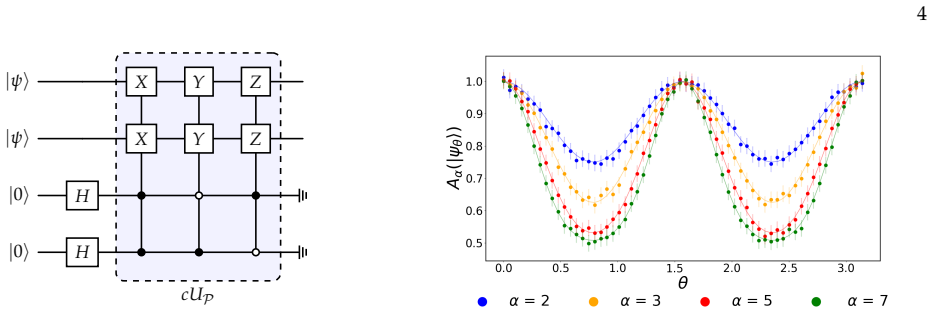
read the original abstract
Non-stabilizerness, or magic, is a resource for universal quantum computation in most fault-tolerant architectures; access to states with non-stabilizerness allows for non-classically simulable quantum computation to be performed. Quantifying this resource for unknown states is therefore essential to assessing their utility in quantum computation. The Stabilizer R\'enyi Entropies have emerged as a leading tool for achieving this, having already enabled one efficient algorithm for measuring non-stabilizerness. In addition, the Stabilizer R\'enyi Entropies have proven useful in developing connections between non-stabilizerness and other quantum phenomena. In this work, we introduce an alternative algorithm for measuring the Stabilizer R\'enyi Entropies of an unknown quantum state. Firstly, we show the existence of a state, produced from the action of a channel on $\alpha$ copies of some \ben{state $\rho$}, that encodes the $\alpha$-Stabilizer R\'enyi Entropy of $\rho$ into its purity. We detail several methods of applying this channel, and then, by employing existing purity-measuring algorithms, provide an algorithm for measuring the $\alpha$-Stabilizer R\'enyi Entropies for all integers $\alpha>1$. This algorithm is benchmarked for qubits and the resource requirements compared to other known algorithms. Finally, a non-stabilizerness/entanglement relationship is shown to exist in the algorithm, demonstrating a novel relationship between the two resources, before an instance of resource hiding is found.
Editorial analysis
A structured set of objections, weighed in public.
Referee Report
Summary. The paper claims to introduce an algorithm for estimating the α-Stabilizer Rényi Entropies of an unknown state ρ for integer α > 1. It first establishes the existence of a quantum channel Λ acting on α copies of ρ such that the purity Tr(σ²) of the output state σ = Λ(ρ⊗α) directly encodes the α-SRE of ρ. Several concrete methods for implementing this channel are described, after which existing purity-estimation routines are invoked to obtain the entropy values. The work includes qubit benchmarking, resource comparisons with prior algorithms, a demonstrated relationship between non-stabilizerness and entanglement within the algorithm, and an example of resource hiding.
Significance. If the purity-encoding identity survives the concrete channel implementations without hidden corrections or post-selection overheads, the algorithm would constitute a useful alternative route to quantifying magic, with potentially distinct sampling or circuit-depth trade-offs relative to existing SRE estimators. The explicit benchmarking and the non-stabilizerness–entanglement link would further strengthen the contribution, provided they rest on the same verified encoding.
major comments (1)
- [Section on channel application] Section on channel application: the central claim requires that Tr(σ²) for σ = Λ(ρ⊗α) equals (or is a simple function of) the α-SRE of ρ. The manuscript must explicitly verify that each listed implementation of Λ preserves this identity. If any method introduces ancillary qubits that are traced out or employs post-selection, the reduced-system purity generally acquires extra factors Tr(σ_anc²) and cross terms; these must be shown to equal unity or to be corrected by a known, efficiently computable multiplier. Without such a derivation or explicit statement that no tracing/post-selection occurs, the direct-encoding step remains unverified and load-bearing for the entire algorithm.
minor comments (2)
- [Benchmarking section] The abstract states that the algorithm is 'benchmarked for qubits'; the corresponding section should include a table or plot of sample complexity versus α and system size, together with direct numerical comparison to the prior SRE algorithm referenced in the introduction.
- [Throughout] Notation for the channel Λ and the output state σ should be introduced once in a dedicated paragraph and used consistently; currently the abstract and later sections appear to employ slightly different symbols for the same objects.
Simulated Author's Rebuttal
We thank the referee for their careful reading of the manuscript and for highlighting the need for explicit verification of the central purity-encoding identity. We address the major comment below and have revised the manuscript to incorporate the requested derivations and clarifications.
read point-by-point responses
-
Referee: Section on channel application: the central claim requires that Tr(σ²) for σ = Λ(ρ⊗α) equals (or is a simple function of) the α-SRE of ρ. The manuscript must explicitly verify that each listed implementation of Λ preserves this identity. If any method introduces ancillary qubits that are traced out or employs post-selection, the reduced-system purity generally acquires extra factors Tr(σ_anc²) and cross terms; these must be shown to equal unity or to be corrected by a known, efficiently computable multiplier. Without such a derivation or explicit statement that no tracing/post-selection occurs, the direct-encoding step remains unverified and load-bearing for the entire algorithm.
Authors: We agree that explicit verification of the encoding identity is necessary to rigorously establish the algorithm. While the original manuscript demonstrated the existence of the channel Λ and outlined several concrete implementations, we acknowledge that the preservation of Tr(σ²) = f(α-SRE(ρ)) was not derived in full detail for each case. In the revised manuscript we have added a dedicated subsection that supplies step-by-step calculations for every listed implementation. These derivations show that each implementation acts unitarily on the α copies of ρ without ancillary qubits that are traced out and without post-selection; consequently, no extraneous factors Tr(σ_anc²) or cross terms appear, and the output purity directly encodes the α-SRE. We have also inserted an explicit statement confirming the absence of such overheads. This revision directly addresses the referee’s concern and strengthens the load-bearing step of the algorithm. revision: yes
Circularity Check
No circularity: construction uses independent purity estimators on a new channel encoding
full rationale
The paper defines a channel Λ acting on α copies of ρ such that the purity of the output state directly encodes the α-SRE of ρ. It then invokes existing, separately developed purity estimation algorithms (e.g., those based on randomized measurements or swap tests) as black-box components to extract that purity. No parameter is fitted to the target SRE value, no self-citation supplies a uniqueness theorem that forces the channel form, and the encoding identity is presented as a derived mathematical fact rather than a renaming or tautology. The derivation chain therefore remains self-contained against external benchmarks and does not reduce to its own inputs by construction.
Axiom & Free-Parameter Ledger
axioms (1)
- domain assumption Standard quantum mechanics: density operators represent states and channels are completely positive trace-preserving maps
Reference graph
Works this paper leans on
-
[1]
Gottesman, Stabilizer codes and quantum error correction (California Institute of Technology, 1997)
D. Gottesman, Stabilizer codes and quantum error correction (California Institute of Technology, 1997)
work page 1997
- [2]
- [3]
-
[4]
E. T. Campbell and D. E. Browne, Phys. Rev. Lett. 104, 030503 (2010)
work page 2010
- [5]
- [6]
- [7]
-
[8]
G. Passarelli, R. Fazio, and P . Lucignano, Phys. Rev. A 110, 022436 (2024)
work page 2024
- [9]
-
[10]
S. F. E. Oliviero, L. Leone, and A. Hamma, Phys. Rev. A 106, 042426 (2022)
work page 2022
-
[11]
J. Chen, Y. Yan, and Y. Zhou, Quantum 8, 1351 (2024)
work page 2024
- [12]
-
[13]
P . S. Tarabunga, E. Tirrito, M. C. Ba ˜nuls, and M. Dal- monte, Phys. Rev. Lett. 133, 010601 (2024)
work page 2024
-
[14]
Efficient witnessing and testing of magic in mixed quantum states
T. Haug and P . S. Tarabunga, (2025), arXiv:2504.18098 [quant-ph]
work page internal anchor Pith review Pith/arXiv arXiv 2025
- [15]
-
[16]
A. Gu, L. Leone, S. Ghosh, J. Eisert, S. F. Yelin, and Y. Quek, Phys. Rev. Lett.132, 210602 (2024)
work page 2024
-
[17]
A. Gu, S. F. E. Oliviero, and L. Leone, (2024), arXiv:2403.19610 [quant-ph]
work page internal anchor Pith review arXiv 2024
-
[18]
E. Tirrito, P . S. Tarabunga, G. Lami, T. Chanda, L. Leone, S. F. E. Oliviero, M. Dalmonte, M. Collura, and A. Hamma, Phys. Rev. A 109, L040401 (2024)
work page 2024
-
[19]
T. Haug, S. Lee, and M. S. Kim, Phys. Rev. Lett. 132, 240602 (2024)
work page 2024
-
[20]
A. H. Salvatore F. E. Oliviero, Lorenzo Leone and S. Lloyd, npj Quantum Inf. 8, 148 (2022)
work page 2022
- [21]
-
[22]
M. A. Nielsen and I. L. Chuang, Quantum Computation and Quantum Information: 10th Anniversary Edition (Cam- bridge University Press, 2010)
work page 2010
-
[23]
Stabilisation of Quantum Computations by Symmetrisation
A. Barenco, A. Berthiaume, D. Deutsch, A. Ekert, R. Jozsa, and C. Macchiavello, (1996), arXiv:quant-ph/9604028 [quant-ph]
work page internal anchor Pith review Pith/arXiv arXiv 1996
-
[24]
H. Buhrman, R. Cleve, J. Watrous, and R. de Wolf, Phys. Rev. Lett. 87, 167902 (2001)
work page 2001
- [25]
-
[26]
Entanglement in the stabilizer formalism
D. Fattal, T. S. Cubitt, Y. Yamamoto, S. Bravyi, and I. L. Chuang, (2004), arXiv:quant-ph/0406168 [quant-ph]
work page internal anchor Pith review Pith/arXiv arXiv 2004
-
[27]
R. Horodecki, P . Horodecki, M. Horodecki, and K. Horodecki, Rev. Mod. Phys. 81, 865 (2009). Appendix A: Characteristic Distribution For all pure states, ρ = |ψ⟩⟨ψ|, the characteristic distribution can be defined as D(ρ) := d−1 ⟨ψ| Pj |ψ⟩2}, (A1) where Pn = {Pj}d2−1 j=0 . Firstly, note that d−1 ⟨ψ| Pj |ψ⟩2 is real as P† j = Pj. Moreover, d−1 ⟨ψ| Pj |ψ⟩2 ≥...
work page 2009
-
[28]
Aα(|ψ⟩) from the purity of EP (|ψ⟩⟨ψ|⊗α)’s output Here, we provide the proof of how Aα(|ψ⟩) is encoded into the purity of the state EP |ψ⟩⟨ψ|⊗α = d−2 d2−1 ∑ j=0 Pj|ψ⟩⟨ψ|Pj ⊗α. (B1) The purity of this state is given by tr EP |ψ⟩⟨ψ|⊗α 2 = d−4 d2−1 ∑ j,k=0 tr Pj|ψ⟩⟨ψ|PjPk|ψ⟩⟨ψ|Pk α = d−4 d2−1 ∑ j,k=0 ⟨ψ| PjPk|ψ⟩⟨ψ|PkPj |ψ⟩ α. (B2) It is then noted that PjPk ...
-
[29]
d2−1 ∑ i=0 |i⟩A ⊗ Pi |ψ⟩⊗α ˜B d2−1 ∑ j=0 ⟨j|A ⊗ ⟨ψ|⊗α ˜B P† j # = d−2 tr ˜B
Aα(|ψ⟩) from Purity of Ancilla’s Here, we provide the proof of how Aα(|ψ⟩) is encoded into the purity of the ancillary qubits in Alg. 2 by direct calculation. Initially, α copies of |ψ⟩ are prepared in a register, before appending 2n ancillary qubits prepared in the computa- tional basis state, leaving the complete register in the state |ψα⟩A ˜B = |0⟩⊗2n ...
-
[30]
Our Algorithm By repeating the swap test O(τ−2) times, γ = tr E α P (|ψ⟩⟨ψ|⊗α)2 can be measured to an additive error of τ. Each swap test uses two copies of E α P (|ψ⟩⟨ψ|⊗α), and each copy of E α P (|ψ⟩⟨ψ|⊗α) uses α copies of |ψ⟩. Hence, O(ατ−2) copies of |ψ⟩ are needed to measure γ to additive error τ, which can be shown using Chebyshev’s inequality. To ...
-
[31]
Let ρ be a state and O an observable such that one is aiming to find ⟨O⟩ρ = tr ρO
Quantum State T omography Here, the calculation of the resource requirements for measuring Aα(|ψ⟩) using quantum state tomography (QST) are detailed. Let ρ be a state and O an observable such that one is aiming to find ⟨O⟩ρ = tr ρO . (C1) To do this via QST, one first constructs an estimate of the state,ρest, and then calculates ⟨O⟩est = tr ρestO , (C2) v...
-
[32]
Direct Estimation a. Direct Estimation of Γ⊗nα Here, the aim is to estimate ⟨Γ⊗n α ⟩ψ2α = ⟨ψ|⊗2α Γ⊗n α |ψ⟩⊗2α to additive error ϵ by individually estimating the expec- tation value of each of the d Pauli-strings in Γ⊗n α , and then combining them via classical post-processing. For each Pauli-string Pj in Γ⊗n α , we assume k copies of |ψ⟩⊗2α are used to es...
discussion (0)
Sign in with ORCID, Apple, or X to comment. Anyone can read and Pith papers without signing in.