REVIEW 4 major objections 5 minor 1 cited by
MULTI-SCOUT: Multistatic Integrated Sensing and Communications in 5G and Beyond for Moving Target Detection, Positioning, and Tracking
T0 review · 4 major / 5 minor · reviewed 2026-08-06 · deepseek-v4-flash
Pith's one-line read This paper claims that a standard 5G Positioning Reference Signal, observed by multiple distributed receivers, can be turned into a multistatic radar-like sensing chain that detects, locates, and tracks moving targets with position errors…
desk verdict Tidy multistatic 5G PRS sensing chain, standard pieces and synthetic-only validation; the Doppler-grid mismatch is a real internal flaw, but the paper is worth a serious referee. read the letter →
The pith
A machine-rendered reading of the paper's core claim, the machinery that carries it, and where it could break.
The reading
What carries the argument
The load-bearing object is the coherent cross-ambiguity function (CAF): matched-filtering each receiver's samples against the known PRS waveform over a delay grid and a Doppler grid, with parabolic interpolation around the peak, converts the communication signal into bistatic range and radial velocity measurements. The downstream machinery is nonlinear least-squares trilateration (trust-region reflective solver with random restarts) to fuse bistatic range ellipses into a position, ridge-regularized inversion of the radial-speed equations to recover velocity, 2D non-maximum suppression plus a residual-minimizing assignment to associate peaks in multi-target scenes, and standard and extended Kalman filters with a polar-coordinate state to track the resulting position-velocity sequence.
What would settle it
A controlled field test with the paper's three-receiver equilateral geometry, a strong line-of-sight path, and a target at known position would settle it: if the cross-ambiguity global maximum frequently lands on a non-echo bin after direct-path subtraction, the reported ~5 m positioning and sub-0.5 m/s velocity errors will not reproduce.
Extended reading notes
Core claim
The central claim is that multistatic ISAC can be built entirely on existing 5G PRS: a single gNB transmits the standard periodic OFDM-PRS waveform while three or four receivers process the same signal via a coherent cross-ambiguity function, extracting bistatic ranges and radial velocities with sub-bin accuracy through parabolic interpolation. For one target, three non-collinear receivers in 2D (or four non-coplanar in 3D) give a unique position by nonlinear least-squares trilateration, and a ridge-regularized inversion of the Doppler equations gives the full velocity vector; a fourth receiver additionally lets the system estimate and remove a common clock bias. For multiple targets, 2D non-maximum suppression picks candidate peaks and the assignment that minimizes the sum of trilateration residuals pairs them across receivers. Feeding the position-velocity snapshots into a standard Kalman filter tracks linear motion, while an extended Kalman filter with a polar-coordinate state tracks linear and circular motion. The paper's simulations report average position errors around 5-10 m and speed errors around 0.2-0.5 m/s across the 2D, 3D, synchronized, and multi-target settings, with the EKF reducing circular-motion tracking error from 818.76 m to 63.89 m.
Load-bearing premise
Each receiver must remove the direct transmitter-to-receiver signal well enough that the strongest peak in its range-Doppler map is the target echo, not line-of-sight leakage, multipath, or clutter.
Editorial extensions
If this is right
- If the approach is correct, any 5G network with PRS coverage can serve as a passive radar system, with no additional sensing hardware or spectrum.
- Three synchronized receivers suffice for 2D positioning of a single target; a fourth receiver adds robustness to common clock bias, improving the practicality of distributed deployments.
- In 3D, four non-coplanar receivers extend the same delay-fusion chain to full spatial positioning, so altitude becomes observable.
- Multi-target scenes are handled by a residual-minimizing association step, and the EKF's polar-coordinate state allows tracking turning targets, not just straight-line motion.
Reading between the lines
- Beyond the paper's simulations: real 5G deployments have stronger direct-path leakage and multipath than the model's subtraction step assumes, so the reported errors are likely to degrade first at the CAF peak-selection stage; a hardware-in-the-loop test would quantify this.
- The paper fixes PRS numerology 0 and 15.36 MHz sampling; increasing bandwidth (higher subcarrier spacing) should sharpen range resolution roughly proportionally, a trade-off the paper leaves implicit.
- The association search over (N_T!)^M permutations grows factorially with target count; branch-and-bound is mentioned but untested, so scaling beyond two or three targets is an open question.
- The two symmetric low-cost assignments in Table XI show an inherent pairing ambiguity in the permutation search; using velocity consistency across time rather than a single snapshot is a natural error-correction step the paper does not explore.
Editorial analysis
A structured set of objections, weighed in public.
Referee Report
Summary. The paper proposes MULTI-SCOUT, a signal-processing chain for multistatic integrated sensing and communications (ISAC) using 5G Positioning Reference Signals. It estimates bistatic range and radial velocity at each receiver via a coherent cross-ambiguity function (CAF), fuses the ranges by nonlinear least-squares trilateration, recovers the target velocity by regularized linear inversion, extends the formulation to clock-bias estimation, 3D geometry, and multi-target association, and feeds the position/velocity estimates to standard and extended Kalman filters for tracking. Performance is evaluated through simulations in 2D and 3D, reporting position errors of about 5–10 m, speed errors of about 0.2–0.5 m/s, and angle errors of about 1–3 degrees, with KF/EKF tracking for linear and circular trajectories.
Significance. The paper is a useful system-level integration of standard estimation and tracking techniques, and it demonstrates a complete pipeline from PRS waveform generation through detection, positioning, association, and tracking. Its strengths include an explicit treatment of receiver clock bias, a 3D extension, and a combinatorial association mechanism for multiple targets. If the numerical claims are validated, the work could serve as a reference design for PRS-based multistatic ISAC. However, the evidence is entirely synthetic and generated from the same signal model that the estimator assumes; there are no comparisons with baselines or Cramér–Rao bounds, no variance measures across simulation runs, and the Doppler-grid mismatch described below directly affects the reported averages. These issues need to be addressed before the central claims can be accepted.
major comments (4)
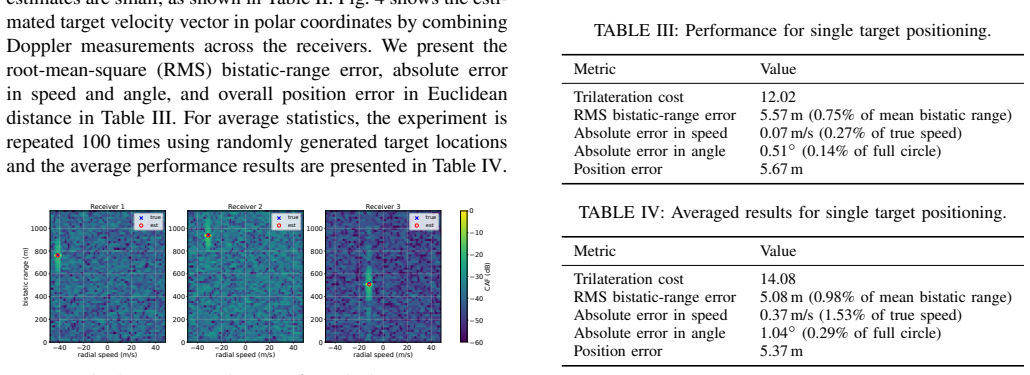
- [II.B and II.D, Eqs. (2)–(3)] The Doppler search grid is limited to f in [-400, 400] Hz, but the radial velocity in Eq. (2) can be as large as twice the target speed because the two unit vectors are summed. Since target speeds are sampled uniformly from 20 to 30 m/s, radial speeds up to about 60 m/s are possible, corresponding to Doppler shifts up to about 500 Hz at f_c = 2.5 GHz. For example, with t = (250, 144) m, r1 = (0, 0) m, p = (400, 0) m, and v = (30, 0) m/s, receiver 1 sees v_1 approximately 51.6 m/s, i.e., f_d approximately 430 Hz, which is outside the searched grid. Under the global-maximum CAF rule, such valid draws cannot be detected, so the averaged results in Tables IV and XV either exclude these draws or are contaminated by large errors. The Doppler grid should be enlarged (e.g., to at least +/-500 Hz) or the admissible speed range should be justified.
- [II.A] The entire detection chain assumes that after direct-path cancellation, the global maximum of the CAF is the target echo. The direct-path cancellation is described in one sentence (matching the received samples with the PRS and subtracting a scaled, time-shifted replica) with no implementation details, no model of residual cancellation error, and no sensitivity analysis. In a real 5G downlink, the direct-path signal is orders of magnitude stronger than the target echo, and any residual leakage or multipath will shift the CAF global maximum and break the subsequent trilateration, velocity, association, and tracking stages. Since all simulations assume ideal cancellation, the central claim of high-fidelity detection with 5G PRS is not yet supported. The authors should provide a direct-path cancellation model, quantify the residual error, or include a scenario with direct-path leakage.
- [II.A and II.D] The echo amplitude alpha_m in Eq. (3) is never defined. Section II.D lists transmit power, antenna gains, radar cross section, and noise variance, but no path-loss or radar equation links these parameters to alpha_m or to the signal-to-noise ratio. Consequently, the simulated CAF peaks and all reported errors depend on an unspecified constant, and the experiments are not reproducible or comparable with other work. Please provide the propagation model, the resulting SNR, and the mapping from system parameters to alpha_m.
- [V, Tables XII–XV] The multi-target experiments place the two targets far apart in bistatic range and Doppler (e.g., receiver 1 sees 290 m and 653 m, and -5.3 m/s and -38.1 m/s). Thus the association results do not exercise the claimed capability, stated in the Introduction, to preserve high-fidelity estimates 'even when echoes overlap.' The non-maximum-suppression procedure that selects exactly N_T peaks will fail when two targets appear in nearby delay and Doppler bins, but no such scenario is simulated or analyzed. Please either add an overlapping-echo case or temper the claim accordingly.
minor comments (5)
- [II.C] The number of random initializations for the Trust-Region Reflective solver is not specified; please state the number of seeds and the stopping criterion used.
- [VI, Table XVI] The 'total' measurement and filtering errors in Table XVI should be defined explicitly as cumulative over the 25 s track; without this clarification, the hundreds-of-meters values appear inconsistent with the per-snapshot errors of a few meters in Tables IV, VII, X, and XV.
- [V] The guard window sizes used in the 2D non-maximum suppression are not given; these values affect whether close peaks are resolved, so they should be reported and their effect discussed.
- [VI] The KF/EKF covariance matrices Q and R are stated without justification or sensitivity analysis; please explain the chosen values and their influence on the results.
- [General] All results are based on synthetic data generated from the same signal model the estimator assumes; a comparison with a Cramér–Rao bound or with a baseline estimator would significantly strengthen the significance of the reported accuracies.
Circularity Check
No circularity was found: each stage inverts the stated signal model, and the self-citations are background only.
full rationale
The derivation chain is self-contained. The CAF in (5) is applied to the received samples y_m[n] from (3); the peak delay/Doppler pairs produce the bistatic-range residuals in (7), which drive the nonlinear least-squares position solve in (6); (8) then inverts the linear radial-speed equations of (2) with fixed ridge regularization; the clock-bias extension (9) adds delta_t as an estimated unknown; the multi-target association minimizes the same trilateration cost; and the Kalman filters in Section VI consume the position/velocity snapshots. No parameter is fitted to the reported accuracy numbers, and no reported estimate is the same quantity as an input by construction. The self-citations [5], [10], and [11] appear only as related work and do not provide any load-bearing assumption, uniqueness theorem, or ansatz. The evaluation is a self-consistency simulation whose synthetic echoes obey the same signal model the estimator inverts; that is a validation limitation, not circularity. The Doppler-grid cap and direct-path-cancellation assumption noted by the reviewer are correctness and robustness concerns, not instances of reasoning from the conclusion. Therefore no circular step was identified.
Assumptions & free parameters
free parameters (6)
- Noise variance sigma_w^2 =
1e-3
- Ridge regularization epsilon =
1e-3
- KF process noise Q =
diag(1e-4, 1e-4, 1e-2, 1e-2)
- KF measurement noise R =
diag(10, 10, 1, 1)
- NMS guard window sizes
- Multi-start initialization box extension =
200 m beyond convex hull
assumptions (6)
- domain assumption Point-target, narrowband echo model (3): received signal is a delayed, Doppler-shifted replica of the known PRS plus additive white Gaussian noise.
- domain assumption Direct-path echoes are successfully canceled by matched filtering before CAF processing.
- domain assumption Target parameters (position, velocity) are constant over the coherent processing interval of K=128 PRS symbols.
- domain assumption For most of the paper receivers are synchronized; the time-synchronization extension treats only one common clock offset, not per-receiver clocks.
- standard math Three non-collinear receivers (2D) or four non-coplanar receivers (3D) provide a unique trilateration solution.
- domain assumption CAF global maxima correspond to targets; sidelobe and clutter peaks are suppressed by the Hann window and non-maximum suppression.
Cite this review
Pith. "Pith review of MULTI-SCOUT: Multistatic Integrated Sensing and Communications in 5G and Beyond for Moving Target Detection, Positioning, and Tracking." pith.science (2026). https://pith.science/paper/V3RGYGCW
@misc{pith2026250702613,
  author       = {Pith},
  title        = {Pith review of: MULTI-SCOUT: Multistatic Integrated Sensing and Communications in 5G and Beyond for Moving Target Detection, Positioning, and Tracking},
  year         = {2026},
  howpublished = {\url{https://pith.science/paper/V3RGYGCW}},
  note         = {Machine review of arXiv:2507.02613}
}
read the original abstract
This paper presents a complete signal-processing chain for multistatic integrated sensing and communications (ISAC) using 5G Positioning Reference Signal (PRS). We consider a distributed architecture in which one gNB transmits a periodic OFDM-PRS waveform while multiple spatially separated receivers exploit the same signal for target detection, parameter estimation and tracking. A coherent cross-ambiguity function (CAF) is evaluated to form a range-Doppler map from which the bistatic delay and radial velocity are extracted for every target. For a single target, bistatic delays are fused through nonlinear least-squares trilateration, yielding a geometric position estimate, and a regularized linear inversion of the radial-speed equations yields a two-dimensional velocity vector, where speed and heading are obtained. The approach is applied to 2D and 3D settings, extended to account for receiver clock synchronization bias, and generalized to multiple targets by resolving target association. The sequence of position-velocity estimates is then fed to standard and extended Kalman filters to obtain smoothed tracks. Our results show high-fidelity moving-target detection, positioning, and tracking using 5G PRS signals for multistatic ISAC.
Figures


Figures from the paper (5 more)


Forward citations
Cited by 1 Pith paper
-
Multi-UAV Tracking Evaluation Using 5G Uplink Signals on an O-RAN ISAC Simulation Testbed
In an O-RAN simulation testbed, three UAVs are detected far more often than they are tracked because two targets often share one detection, and emulation wall-clock delays distort the tracking metrics.
Reference graph
Works this paper leans on
-
[1]
Integrated sensing and communications: Toward dual-functional wire- less networks for 6G and beyond,
F. Liu, Y . Cui, C. Masouros, J. Xu, T. X. Han, Y . C. Eldar, and S. Buzzi, “Integrated sensing and communications: Toward dual-functional wire- less networks for 6G and beyond,”IEEE Journal on Selected Areas in Communications, 2022
work page 2022
-
[2]
A survey on fundamental limits of integrated sensing and communication,
A. Liuet al., “A survey on fundamental limits of integrated sensing and communication,”IEEE Communications Surveys & Tutorials, 2022
work page 2022
-
[3]
Integrating sensing and communi- cations for ubiquitous IoT: Applications, trends, and challenges,
Y . Cui, F. Liu, X. Jing, and J. Mu, “Integrating sensing and communi- cations for ubiquitous IoT: Applications, trends, and challenges,”IEEE Network, 2021
work page 2021
-
[4]
System-level analysis of joint sensing and communication based on 5G New Radio,
L. Pucci, E. Paolini, and A. Giorgetti, “System-level analysis of joint sensing and communication based on 5G New Radio,”IEEE Journal on Selected Areas in Communications, 2022
work page 2022
-
[5]
I-SCOUT: Integrated sensing and communications to uncover moving targets in NextG networks,
U. Demir, K. Davaslioglu, Y . E. Sagduyu, T. Erpek, G. Anderson, and S. Kompella, “I-SCOUT: Integrated sensing and communications to uncover moving targets in NextG networks,” inIEEE Military Communications Conference (MILCOM), 2024
work page 2024
-
[6]
Z. Weiet al., “5G PRS-based sensing: A sensing reference signal ap- proach for joint sensing and communication system,”IEEE Transactions on V ehicular Technology, 2022
work page 2022
-
[7]
5G network-based passive radar,
P. Samczy ´nskiet al., “5G network-based passive radar,”IEEE Transac- tions on Geoscience and Remote Sensing, 2021
work page 2021
-
[8]
5G-based passive radar utilizing channel response estimated via reference signals,
M. Wypich, R. Maksymiuk, and T. P. Zielinski, “5G-based passive radar utilizing channel response estimated via reference signals,”IEEE Transactions on Radar Systems, 2025
work page 2025
Show all 13 references
-
[9]
Integrated sensing and communication (ISAC) for vehicles: Bistatic radar with 5G-NR signals,
N. K. Nataraja, S. Sharma, K. Ali, F. Bai, R. Wang, and A. F. Molisch, “Integrated sensing and communication (ISAC) for vehicles: Bistatic radar with 5G-NR signals,”IEEE Trans. V eh. Technol., 2024
2024
-
[10]
Joint sensing and semantic communications with multi-task deep learning,
Y . E. Sagduyu, T. Erpek, A. Yener, and S. Ulukus, “Joint sensing and semantic communications with multi-task deep learning,”IEEE Communications Magazine, vol. 62, no. 9, pp. 74–81, 2024
2024
-
[11]
Will 6G be semantic communications? Opportunities and chal- lenges from task oriented and secure communications to integrated sensing,
——, “Will 6G be semantic communications? Opportunities and chal- lenges from task oriented and secure communications to integrated sensing,”IEEE Network, 2024
2024
-
[12]
Localization accu- racy improvement in multistatic ISAC with LoS/NLoS condition using 5G NR signals,
K. Khosroshahi, P. Sehier, S. Mekki, and M. Suppa, “Localization accu- racy improvement in multistatic ISAC with LoS/NLoS condition using 5G NR signals,” inIEEE Wireless Communications and Networking Conference (WCNC), 2025
2025
-
[13]
NR: physical channels and modulation,
3GPP, “NR: physical channels and modulation,” 3rd Generation Part- nership Project, Technical Specification (TS) 38.211, 2024, ver. 18.2.0
2024
Reviewed August 6, 2026 · model on record in the stance chip above.
Discussion (0). Continue with ORCID to comment.