REVIEW 1 major objections 6 minor 60 references
High-Order Deep Meta-Learning with Category-Theoretic Interpretation
T0 review · 1 major / 6 minor · reviewed 2026-08-06 · deepseek-v4-flash
Pith's one-line read A recursive stack of meta-learners, each generating virtual tasks and soft constraints for the level below, lets neural networks construct, solve, and generalise across hierarchies of tasks.
desk verdict A speculative framework paper with a genuinely interesting recursive architecture but no validation; reject as-is, though the core idea is worth revisiting after real experiments and a tightened formalization. read the letter →
The pith
A machine-rendered reading of the paper's core claim, the machinery that carries it, and where it could break.
The reading
What carries the argument
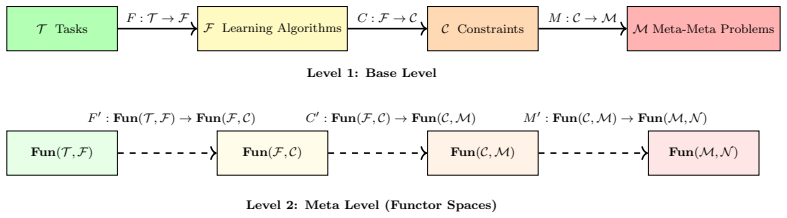
The central object is the recursive functor stack together with a virtual-task generator. Level 0 is an ordinary parameterised model; level 1's meta-learner is a functor mapping tasks to models, level 2's maps functors to functors, and so on. At each level a soft-constraint model $C_{\mathrm{soft}}(\phi_k)$ emits virtual tasks, penalised in the loss like collocation points in physics-informed neural networks (PINNs), and an adversarial generator $G_\phi$ maximises an exploration score $S_{\mathrm{explore}}$ to find tasks the lower learner finds difficult while a discriminator enforces plausibility. The exploration score rewards sharp difficulty transitions near a reference task or surprisingly stable performance across distant tasks, which is what drives discovery of constraint boundaries.
What would settle it
Run two identical recursive meta-learning stacks on the same real-task distribution, one selecting virtual tasks by the exploration score and the other using random virtual tasks or none, and compare held-out performance across new task families; if the exploration-driven stack does not generalise better, the claim that difficulty-maximising virtual tasks drive constraint discovery and regularisation is falsified.
Extended reading notes
Core claim
The paper's core claim is that recursively nesting meta-learners, where each level maps lower-level learners to improved learners and simultaneously generates virtual tasks and soft constraints for them, realises learning-to-learn at arbitrary order. Concretely, Algorithm 2 couples a lower-level learner with a generator that proposes synthetic tasks to maximise the learner's difficulty and a discriminator that keeps those tasks on a plausible manifold, and the meta-loss combines the real-task loss with a virtual-task penalty. The paper argues that this loop lets the meta-learner discover constraint-region boundaries and novel tasks, that recursive promotion of each meta-learner to learner creates an abstraction curriculum, and that the categorical formalisation shows a learner is determined by its behaviour across tasks, in the spirit of the Yoneda lemma, which says an object is captured by how all other objects map into it. It further claims that established methods, including standard meta-learning algorithms such as MAML and Reptile, consistency regularisation methods such as SimCLR and FixMatch, meta-regularisation, and curriculum learning, are degenerate cases of the framework.
Load-bearing premise
The load-bearing premise is that virtual tasks chosen to be hardest for the lower-level learner will improve its generalisation to real, unseen tasks; the paper asserts this regularisation effect but supplies no theoretical guarantee and no experiment for it.
Editorial extensions
If this is right
- At $K=1$ with no virtual tasks the framework reduces to standard meta-learning such as MAML and Reptile; with virtual tasks it covers augmentation and consistency methods such as SimCLR and FixMatch; at $K=2$ with learned constraints it covers meta-regularisation; pure recursion without virtual tasks is curriculum learning.
- Because each meta-learner is promoted to a learner at the next level, the hierarchy implements an abstraction curriculum: level 0 solves task instances, level 1 generalises across tasks within a domain, and level 2 generalises across families of domains.
- The whole stack composes into a single functor $L_K \circ \cdots \circ L_1$ from the task category to the model category, so higher-order meta-learning can be studied as fixed points of functorial transformations and as transformations between functor categories.
- The architecture is implementable with ordinary differentiable components, including hypernetworks, generative models, and adversarial generator-discriminator pairs, with nested optimisation carried out by automatic differentiation.
- In game-theoretic settings the hierarchy can learn equilibrium computation across team, coordination, and potential games, and can generate virtual games that reveal where a base algorithm's convergence behaviour changes qualitatively.
Reading between the lines
- Beyond the paper, the same loop could be tested as a data-efficiency recipe: replace hand-scheduled curricula with generator-chosen virtual tasks and compare held-out performance on a fixed real-task distribution, which the paper does not do.
- Beyond the paper, if behaviour-equivalent learners are genuinely interchangeable as the Yoneda-style reasoning suggests, probing a large pretrained model with a diverse bank of probe tasks could predict which fine-tuning strategies will work without any access to its internal weights.
- Beyond the paper, a clean controlled experiment would hold the real tasks fixed and vary only the exploration objective, for example predictive entropy versus loss-gradient norm versus the proposed contextual score, and check whether the difficulty-maximising choice changes which constraints emerge.
Editorial analysis
A structured set of objections, weighed in public.
Referee Report
Summary. The manuscript proposes a hierarchical deep meta-learning framework in which each meta-level generates virtual tasks (synthetic points with PINN-style soft penalties) that probe and regularize the learner at the level below, and in which meta-learners are recursively promoted to become learners at the next level. Section 2 specifies the architecture, an exploration criterion (Eq. 1) for generating 'difficult' virtual tasks, and three algorithms (Algorithms 1-3). Section 3 offers a category-theoretic reading, calling learners functors and meta-learners variously natural transformations, functors, and endofunctors, and invoking the Yoneda lemma to argue that learners are characterized by their external behavior and that the framework 'unifies existing meta-learning models'. Section 5 instantiates the ideas on game theory (Nash equilibria over a team/coordination/potential-game hierarchy) and reinforcement learning. The paper contains no theorems and no experiments; the claims of improved generalization, regularization, and unification are asserted rather than established.
Significance. If the framework performed as claimed, the contribution would be significant: recursive higher-order meta-learning with self-generated curricula, a PINN-style soft-constraint mechanism, and a compositional categorical lens is a worthwhile research direction, and the paper's worked examples (games, ODE families, policy-update objectives) indicate plausible use cases. The manuscript is candid in labeling some passages as speculative, and Algorithm 2's adversarial exploration mechanism (Eqs. 1-2) is concrete enough to implement. However, the paper ships no code, no empirical evaluation, no theorem statements, and no tested prediction; the categorical formalization is internally inconsistent (Section 3); and the claimed unification of MAML, Reptile, SimCLR, FixMatch, and curriculum learning is asserted without derivation. The current significance is therefore prospective: the paper outlines a research program rather than establishing results.
major comments (1)
- [Section 2.2, Eq. (1), Algorithms 1-3.] Section 5 (Degenerate Cases): the Abstract's claim that the framework 'unifies existing meta-learning models' is not supported by the examples given. For example, the paper states that with recursion depth K = 1 and no virtual tasks 'our framework reduces to standard meta-learning algorithms such as MAML or Reptile', but no derivation shows that Algorithm 1's K = 1 procedure (sampling a learner from meta-learner parameters, computing a composite loss, and updating the meta-learner) yields the MAML objective, which involves differentiating through inner-loop gradient steps on an initialization; the two are different mechanisms. The claims that SimCLR and FixMatch are recovered as 'rudimentary virtual task generation' and that curriculum learning corresponds to recursion without virtual tasks are analogies, not reductions: none of these methods' objectives is shown to arise as a special case of the loss Lk in Section 2.1. Since unification is a stated central outcome, the paper should either derive each claimed reduction explicitly (specializing Lk and showing equality, up to constants, with the target method's objective) or substantially weaken the claim.
minor comments (6)
- [Section 3; Section 2.2.] Section 3 contains the typo 'cateory' for 'category', and Section 2.2 (after Eq. (1)) contains 'are are thresholds'; both should be corrected.
- [Section 2.1; Algorithm 1.] The meta-loss is written in three mutually inconsistent forms: Section 2.1 first gives Lk(xi_k) = E_T[L_{k-1}(F_k(F_{k-1}), T)] + lambda*E_tildeT[L_virtual(F_k(F_{k-1}), tildeT)], then gives Lk = E_{T_k}[L_task(f*_{k-1}, T_{k-1}) + lambda*L_virtual(f*_{k-1}, tildeT_{k-1})], and Algorithm 1 writes Lk = L_task + lambda*L_virtual; the arguments (learner vs meta-learner vs base model) and level indices (k vs k-1) should be unified.
- [Eq. (1); Section 2.1.] The symbol lambda denotes two different quantities: the balance between real and virtual loss in Section 2.1 and the balance between the two exploration terms in Eq. (1); renaming one of them is needed to avoid ambiguity.
- [Section 2.2; Algorithm 2.] Section 2.2 states that the generator G_phi is 'conditioned on historical training feedback', but in Algorithm 2 the generator receives only latent codes z and no conditioning variable; the conditioning mechanism is never specified.
- [Section 5; Figure 2; References.] Section 5 refers to 'Figure 2.1', which does not match the figure numbering (the architecture figure is Figure 2, whose caption contains 'Adapts Metak-Learner to Domain'); the reference list contains malformed entries '[F AL17]' and '[KR W24]'.
- [Section 1; References.] The paper has no related-work section: prior higher-order meta-learning [BGCK00] and the surveys [VD02, HAMS21, HVRP21] are cited, but the claimed generalization over existing hierarchical meta-learning formulations is never argued against them.
Circularity Check
No significant circularity: the paper is an unvalidated proposal whose claims rest on asserted benefits, not on a derivation that reduces to its own inputs.
full rationale
I found no circular step in the derivation chain. The paper proposes a recursive meta-learning architecture: Algorithm 1 defines a multi-level loss with virtual-task penalties, Section 2.2 and Eq. (1) define an exploration score for generating difficult virtual tasks, Eq. (2) defines the generator objective, and Appendix A smooths the score. None of these steps yields a conclusion that was already assumed as an input. No parameter is fitted to data and then reported as a prediction; no theorem is imported from the author's prior work; and there are no load-bearing self-citations. The central claim that virtual tasks chosen for high difficulty improve held-out generalization (Section 2.2) is asserted without proof or experiment, but that is an absence of validation, not circularity: the benefit is not obtained by definitionally equating 'difficult' with 'useful for generalization.' Similarly, the 'unifies existing meta-learning models' claim is supported only by the Degenerate Cases section, which maps MAML, Reptile, SimCLR, FixMatch, and curriculum learning to special settings of the proposed recursion. That is an interpretive relabeling and an overclaim, but it is not a circular derivation: no result is shown to be equivalent to its own premise. The paper's weaknesses are evidential and formal, not circular.
Assumptions & free parameters
free parameters (3)
- lambda (constraint weight)
- beta, gamma (generator objective weights)
- alpha1, alpha2, epsilon1, epsilon2, delta (exploration thresholds)
assumptions (4)
- ad hoc to paper Neural learners and meta-learners can be modeled as functors preserving task composition.
- domain assumption Maximally difficult virtual tasks improve real-task generalization.
- domain assumption A meaningful task-space distance d and kernel K exist and can be computed.
- ad hoc to paper Yoneda lemma transfers to learners: external behavior across tasks fully characterizes a learner.
invented entities (3)
-
Virtual tasks / virtual points
-
Soft constraint model Csoft(phi_k)
-
Virtual point manifold V
Cite this review
Pith. "Pith review of High-Order Deep Meta-Learning with Category-Theoretic Interpretation." pith.science (2026). https://pith.science/paper/COYXDLJR
@misc{pith2026250702634,
  author       = {Pith},
  title        = {Pith review of: High-Order Deep Meta-Learning with Category-Theoretic Interpretation},
  year         = {2026},
  howpublished = {\url{https://pith.science/paper/COYXDLJR}},
  note         = {Machine review of arXiv:2507.02634}
}
read the original abstract
We introduce a new hierarchical deep learning framework for recursive higher-order meta-learning that enables neural networks (NNs) to construct, solve, and generalise across hierarchies of tasks. Central to this approach is a generative mechanism that creates \emph{virtual tasks} -- synthetic problem instances designed to enable the meta-learner to learn \emph{soft constraints} and unknown generalisable rules across related tasks. Crucially, this enables the framework to generate its own informative, task-grounded datasets thereby freeing machine learning (ML) training from the limitations of relying entirely on human-generated data. By actively exploring the virtual point landscape and seeking out tasks lower-level learners find difficult, the meta-learner iteratively refines constraint regions. This enhances inductive biases, regularises the adaptation process, and produces novel, unanticipated tasks and constraints required for generalisation. Each meta-level of the hierarchy corresponds to a progressively abstracted generalisation of problems solved at lower levels, enabling a structured and interpretable learning progression. By interpreting meta-learners as category-theoretic \emph{functors} that generate and condition a hierarchy of subordinate learners, we establish a compositional structure that supports abstraction and knowledge transfer across progressively generalised tasks. The category-theoretic perspective unifies existing meta-learning models and reveals how learning processes can be transformed and compared through functorial relationships, while offering practical design principles for structuring meta-learning. We speculate this architecture may underpin the next generation of NNs capable of autonomously generating novel, instructive tasks and their solutions, thereby advancing ML towards general artificial intelligence.
Figures


Figures from the paper (2 more)

Reference graph
Works this paper leans on
-
[1]
Diffusion-convolutional neural networks
James Atwood and Don Towsley. Diffusion-convolutional neural networks. Advances in neural information processing systems , 29, 2016
work page 2016
-
[2]
Steve Awodey. Category theory , volume 52. OUP Oxford, 2010
work page 2010
-
[3]
Richard C. Bishop and Robert H. Dorf. Modern control systems . Addison-Wesley Longman Publishing Co., Inc., United States, 2011
work page 2011
-
[4]
James Bradbury, Roy Frostig, Peter Hawkins, Matthew James Johnson, Chris Leary, Dougal Maclaurin, George Necula, Adam Paszke, Jake VanderPlas, Skye Wanderman-Milne, et al. Jax: Autograd and xla. Astrophysics Source Code Library , pages ascl--2111, 2021
work page 2021
-
[5]
A higher-order approach to meta-learning
Hilan Bensusan, Christophe G Giraud-Carrier, and Claire Julia Kennedy. A higher-order approach to meta-learning. ILP Work-in-progress reports , 35:44, 2000
work page 2000
-
[6]
A general framework for equivariant neural networks on reductive lie groups
Ilyes Batatia, Mario Geiger, Jose Munoz, Tess Smidt, Lior Silberman, and Christoph Ortner. A general framework for equivariant neural networks on reductive lie groups. Advances in Neural Information Processing Systems , 36:55260--55284, 2023
work page 2023
-
[7]
Yoshua Bengio, J \'e r \^o me Louradour, Ronan Collobert, and Jason Weston. Curriculum learning. In Proceedings of the 26th annual international conference on machine learning , pages 41--48, 2009
work page 2009
-
[8]
The mechanics of n-player differentiable games
David Balduzzi, Sebastien Racaniere, James Martens, Jakob Foerster, Karl Tuyls, and Thore Graepel. The mechanics of n-player differentiable games. In International Conference on Machine Learning , pages 354--363. PMLR, 2018
work page 2018
Show all 60 references
-
[9]
Metareg: Towards domain generalization using meta-regularization
Yogesh Balaji, Swami Sankaranarayanan, and Rama Chellappa. Metareg: Towards domain generalization using meta-regularization. Advances in neural information processing systems , 31, 2018
2018
-
[10]
Scientific machine learning through physics--informed neural networks: Where we are and what’s next
Salvatore Cuomo, Vincenzo Schiano Di Cola, Fabio Giampaolo, Gianluigi Rozza, Maziar Raissi, and Francesco Piccialli. Scientific machine learning through physics--informed neural networks: Where we are and what’s next. Journal of Scientific Computing , 92(3):88, 2022
2022
-
[11]
Settling the complexity of computing two-player nash equilibria
Xi Chen, Xiaotie Deng, and Shang-Hua Teng. Settling the complexity of computing two-player nash equilibria. J. ACM , 56(3), May 2009
2009
-
[12]
A simple framework for contrastive learning of visual representations
Ting Chen, Simon Kornblith, Mohammad Norouzi, and Geoffrey Hinton. A simple framework for contrastive learning of visual representations. In International conference on machine learning , pages 1597--1607. PmLR, 2020
2020
-
[13]
Variational autoencoder
Pinheiro Cinelli, Lucas, Matheus Ara \'u jo Marins, Eduardo Ant \'u nio Barros da Silva, and S \'e rgio Lima Netto. Variational autoencoder. In Variational methods for machine learning with applications to deep networks , pages 111--149. Springer, 2021
2021
-
[14]
Group equivariant convolutional networks
Taco Cohen and Max Welling. Group equivariant convolutional networks. In Maria Florina Balcan and Kilian Q. Weinberger, editors, Proceedings of The 33rd International Conference on Machine Learning , volume 48 of Proceedings of Machine Learning Research , pages 2990--2999, New...
2016
-
[15]
Meta-learning to compositionally generalize
Henry Conklin, Bailin Wang, Kenny Smith, and Ivan Titov. Meta-learning to compositionally generalize. arXiv preprint arXiv:2106.04252 , 2021
2021 arXiv
-
[16]
Model-agnostic meta-learning for fast adaptation of deep networks
Chelsea Finn, Pieter Abbeel, and Sergey Levine. Model-agnostic meta-learning for fast adaptation of deep networks. In International conference on machine learning , pages 1126--1135. PMLR, 2017
2017
-
[17]
Communication, coordination and nash equilibrium
Joseph Farrell. Communication, coordination and nash equilibrium. Economics Letters , 27(3):209--214, 1988
1988
-
[18]
Generalizing convolutional neural networks for equivariance to lie groups on arbitrary continuous data
Marc Finzi, Samuel Stanton, Pavel Izmailov, and Andrew Gordon Wilson. Generalizing convolutional neural networks for equivariance to lie groups on arbitrary continuous data. In International Conference on Machine Learning , pages 3165--3176. PMLR, 2020
2020
-
[19]
Automated curriculum learning for neural networks
Alex Graves, Marc G Bellemare, Jacob Menick, Remi Munos, and Koray Kavukcuoglu. Automated curriculum learning for neural networks. In international conference on machine learning , pages 1311--1320. Pmlr, 2017
2017
-
[20]
Long short-term memory
Alex Graves and Alex Graves. Long short-term memory. Supervised sequence labelling with recurrent neural networks , pages 37--45, 2012
2012
-
[21]
Self-awareness and the emergence of mind in primates
Gordon G Gallup Jr. Self-awareness and the emergence of mind in primates. American Journal of Primatology , 2(3):237--248, 1982
1982
-
[22]
Self-awareness and the evolution of social intelligence
Gordon G Gallup Jr. Self-awareness and the evolution of social intelligence. Behavioural Processes , 42(2-3):239--247, 1998
1998
-
[23]
Generative adversarial networks
Ian Goodfellow, Jean Pouget-Abadie, Mehdi Mirza, Bing Xu, David Warde-Farley, Sherjil Ozair, Aaron Courville, and Yoshua Bengio. Generative adversarial networks. Communications of the ACM , 63(11):139--144, 2020
2020
-
[24]
Lie groups, lie algebras, and representations
Brian C Hall. Lie groups, lie algebras, and representations. In Quantum Theory for Mathematicians , pages 333--366. Springer, 2013
2013
-
[25]
Meta-learning in neural networks: A survey
Timothy Hospedales, Antreas Antoniou, Paul Micaelli, and Amos Storkey. Meta-learning in neural networks: A survey. IEEE transactions on pattern analysis and machine intelligence , 44(9):5149--5169, 2021
2021
-
[26]
A survey of deep meta-learning
Mike Huisman, Jan N Van Rijn, and Aske Plaat. A survey of deep meta-learning. Artificial Intelligence Review , 54(6):4483--4541, 2021
2021
-
[27]
On the power of curriculum learning in training deep networks
Guy Hacohen and Daphna Weinshall. On the power of curriculum learning in training deep networks. In International conference on machine learning , pages 2535--2544. PMLR, 2019
2019
-
[28]
Sagar Imambi, Kolla Bhanu Prakash, and GR Kanagachidambaresan. Pytorch. Programming with TensorFlow: solution for edge computing applications , pages 87--104, 2021
2021
-
[29]
Integers, polynomials, and rings: a course in algebra
Ronald S Irving. Integers, polynomials, and rings: a course in algebra . Springer, 2004
2004
-
[30]
Physics-informed machine learning
George Em Karniadakis, Ioannis G Kevrekidis, Lu Lu, Paris Perdikaris, Sifan Wang, and Liu Yang. Physics-informed machine learning. Nature Reviews Physics , 3(6):422--440, 2021
2021
-
[31]
Formalizing the infinity-categorical yoneda lemma
Nikolai Kudasov, Emily Riehl, and Jonathan Weinberger. Formalizing the infinity-categorical yoneda lemma. In Proceedings of the 13th ACM SIGPLAN International Conference on Certified Programs and Proofs , pages 274--290, 2024
2024
-
[32]
Categories for the working mathematician
Saunders Mac Lane. Categories for the working mathematician. Graduate Texts in Mathematics , 1978
1978
-
[33]
Basic category theory , volume 143
Tom Leinster. Basic category theory , volume 143. Cambridge University Press, 2014
2014
-
[34]
The ai scientist: Towards fully automated open-ended scientific discovery
Chris Lu, Cong Lu, Robert Tjarko Lange, Jakob Foerster, Jeff Clune, and David Ha. The ai scientist: Towards fully automated open-ended scientific discovery. arXiv preprint arXiv:2408.06292 , 2024
2024 arXiv
-
[35]
Robot reinforcement learning on the constraint manifold
Puze Liu, Davide Tateo, Haitham Bou Ammar, and Jan Peters. Robot reinforcement learning on the constraint manifold. In Conference on Robot Learning , pages 1357--1366. PMLR, 2022
2022
-
[36]
Fictitious play property for games with identical interests
Dov Monderer and Lloyd S Shapley. Fictitious play property for games with identical interests. Journal of economic theory , 68(1):258--265, 1996
1996
-
[37]
Dov Monderer and Lloyd S. Shapley. Potential games. Games and Economic Behavior , 14(1):124--143, 1996
1996
-
[38]
Reptile: a scalable metalearning algorithm
Alex Nichol and John Schulman. Reptile: a scalable metalearning algorithm. arXiv preprint arXiv:1803.02999 , 2(3):4, 2018
2018 arXiv
-
[39]
An introduction to convolutional neural networks
Keiron O'shea and Ryan Nash. An introduction to convolutional neural networks. arXiv preprint arXiv:1511.08458 , 2015
2015 arXiv
-
[40]
A course in game theory
Martin J Osborne and Ariel Rubinstein. A course in game theory . MIT press, 1994
1994
-
[41]
Yoneda lemma for simplicial spaces
Nima Rasekh. Yoneda lemma for simplicial spaces. Applied Categorical Structures , 31(4):27, 2023
2023
-
[42]
Metacognition
Matthew G Rhodes. Metacognition. Teaching of Psychology , 46(2):168--175, 2019
2019
-
[43]
Riedmiller and A
M. Riedmiller and A. Lernen. Advanced supervised learning in multi-layer perceptrons — from backpropagation to adaptive learning algorithms. Computer Standards & Interfaces , 16(3):265--278, 1994
1994
-
[44]
Karniadakis
Maziar Raissi, Paris Perdikaris, and George E. Karniadakis. Physics-informed neural networks: A deep learning framework for solving forward and inverse problems involving nonlinear partial differential equations. Journal of Computational Physics , 378:686--707, 2019
2019
-
[45]
Reinforcement learning
Richard S Sutton, Andrew G Barto, et al. Reinforcement learning. Journal of Cognitive Neuroscience , 11(1):126--134, 1999
1999
-
[46]
Fixmatch: Simplifying semi-supervised learning with consistency and confidence
Kihyuk Sohn, David Berthelot, Nicholas Carlini, Zizhao Zhang, Han Zhang, Colin A Raffel, Ekin Dogus Cubuk, Alexey Kurakin, and Chun-Liang Li. Fixmatch: Simplifying semi-supervised learning with consistency and confidence. Advances in neural information processing systems , 33:...
2020
-
[47]
Metacognition
Norbert Schwarz. Metacognition. 2015
2015
-
[48]
Assessing metacognitive awareness
Gregory Schraw and Rayne Sperling Dennison. Assessing metacognitive awareness. Contemporary educational psychology , 19(4):460--475, 1994
1994
-
[49]
Metacognitive theories
Gregory Schraw and David Moshman. Metacognitive theories. Educational psychology review , 7:351--371, 1995
1995
-
[50]
Proximal policy optimization algorithms
John Schulman, Filip Wolski, Prafulla Dhariwal, Alec Radford, and Oleg Klimov. Proximal policy optimization algorithms. arXiv preprint arXiv:1707.06347 , 2017
2017 arXiv
-
[51]
A perspective view and survey of meta-learning
Ricardo Vilalta and Youssef Drissi. A perspective view and survey of meta-learning. Artificial intelligence review , 18:77--95, 2002
2002
-
[52]
Relaxing equivariance constraints with non-stationary continuous filters
Tycho van der Ouderaa, David W Romero, and Mark van der Wilk. Relaxing equivariance constraints with non-stationary continuous filters. Advances in Neural Information Processing Systems , 35:33818--33830, 2022
2022
-
[53]
Attention is all you need
Ashish Vaswani, Noam Shazeer, Niki Parmar, Jakob Uszkoreit, Llion Jones, Aidan N Gomez, ukasz Kaiser, and Illia Polosukhin. Attention is all you need. Advances in neural information processing systems , 30, 2017
2017
-
[54]
Q-learning
Christopher JCH Watkins and Peter Dayan. Q-learning. Machine learning , 8:279--292, 1992
1992
-
[55]
Wicklund
Robert A. Wicklund. Objective self-awareness. volume 8 of Advances in Experimental Social Psychology , pages 233--275. Academic Press, 1975
1975
-
[56]
Learning to reinforcement learn
Jane X Wang, Zeb Kurth-Nelson, Dhruva Tirumala, Hubert Soyer, Joel Z Leibo, Remi Munos, Charles Blundell, Dharshan Kumaran, and Matt Botvinick. Learning to reinforcement learn. arXiv preprint arXiv:1611.05763 , 2016
2016 arXiv
-
[57]
A comprehensive survey of continual learning: Theory, method and application
Liyuan Wang, Xingxing Zhang, Hang Su, and Jun Zhu. A comprehensive survey of continual learning: Theory, method and application. IEEE Transactions on Pattern Analysis and Machine Intelligence , 2024
2024
-
[58]
Raissi, M., Perdikaris, P., and Karniadakis, G.E. (2019). Physics-informed neural networks: A deep learning framework for solving forward and inverse problems involving nonlinear partial differential equations. Journal of Computational Physics, 378, 686–707
2019
-
[59]
Adámek, J., and Herrlich, H. (1994). Abstract and Concrete Categories: The Joy of Cats. Wiley
1994
-
[60]
Mac Lane, S. (1998). Categories for the Working Mathematician. Springer
1998
Reviewed August 6, 2026 · model on record in the stance chip above.
Discussion (0). Continue with ORCID to comment.