REVIEW 3 major objections 6 minor 2 cited by
Can LLMs Identify Critical Limitations within Scientific Research? A Systematic Evaluation on AI Research Papers
T0 review · 3 major / 6 minor · reviewed 2026-08-06 · deepseek-v4-flash
Pith's one-line read A new benchmark claims current LLMs identify only about half of the limitations that human experts consider obvious in AI research papers.
desk verdict A genuinely new benchmark for limitation identification, but the headline 'LLMs find only half of obvious limitations' is weakened by a human baseline measured by the very people who built the dataset. read the letter →
The pith
A machine-rendered reading of the paper's core claim, the machinery that carries it, and where it could break.
The reading
What carries the argument
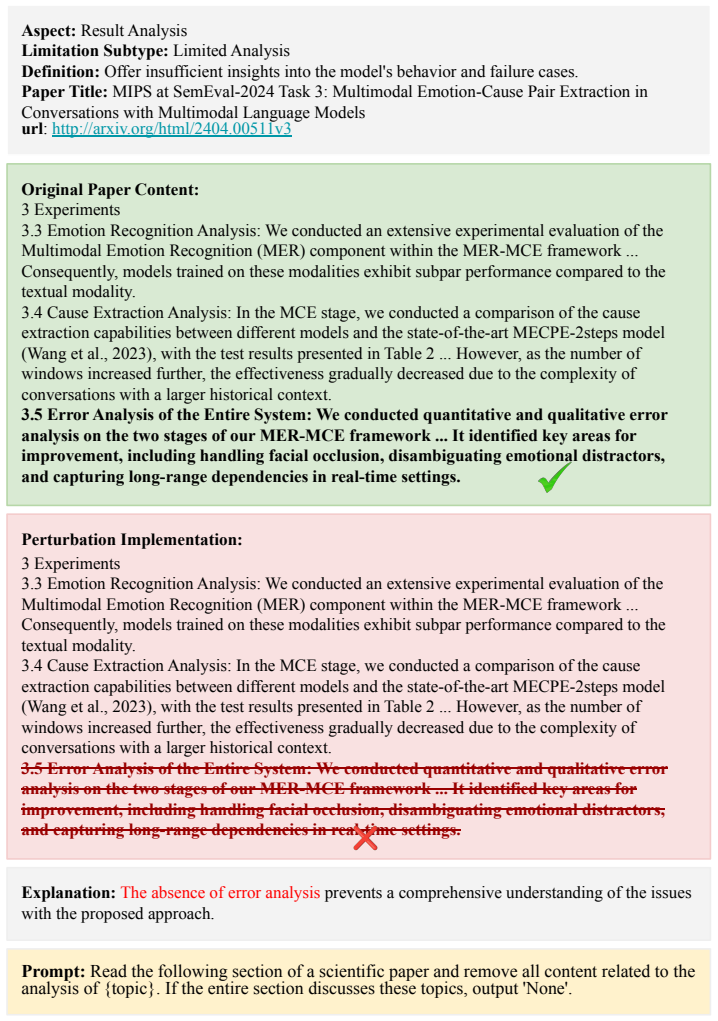
The central object is LIMITGEN, a two-part benchmark built from a four-aspect taxonomy of limitations (methodology, experimental design, result analysis, and literature review, with eleven subtypes). LIMITGEN-Syn is constructed by having GPT-4o apply controlled perturbations to 500 high-quality arXiv papers, with human validation ensuring each planted flaw is the most critical issue in that aspect; LIMITGEN-Human collects and filters real weaknesses written by ICLR 2025 reviewers. The evaluation pipeline relies on GPT-4o for coarse-grained subtype matching, fine-grained relatedness/specificity scoring, and overlap metrics against human-written limitations, with human evaluation on 100 sampled examples per subset to validate the automated scores.
What would settle it
Take the 100 LIMITGEN-Human examples used for human evaluation, have two independent expert reviewers score GPT-4o-generated limitations without seeing the ground truth, and compare their scores with GPT-4o's automated fine-grained scores; if the correlation falls well below the reported 0.60-0.77, or if GPT-4o systematically rates its own generated limitations higher than equivalent human-written ones against the same ground truth, the headline capability numbers would reflect the judge rather than the model.
Extended reading notes
Core claim
The paper claims that identifying limitations in scientific research is a distinct, measurable capability that current LLM systems perform poorly at. Using LIMITGEN, it reports that GPT-4o achieves 52% coarse accuracy on the synthetic subset, versus 86% for human experts, and that on human-written review limitations, all evaluated systems produce feedback that lacks the depth and specificity of experienced reviewers. It further claims that grounding generation in retrieved related literature—querying Semantic Scholar, reranking candidate papers, and feeding extracted content to the LLM—improves accuracy, fine-grained quality, and human-judged soundness and importance across nearly all tested systems.
Load-bearing premise
The benchmark's validity rests on the assumption that GPT-4o-based automatic scoring is an accurate proxy for expert human judgment, supported only by correlations of 0.60 to 0.77 on 100 human-evaluated examples.
Editorial extensions
If this is right
- If the benchmark is right, no current LLM or agent system is reliable enough to replace expert review for identifying substantive flaws in AI research papers.
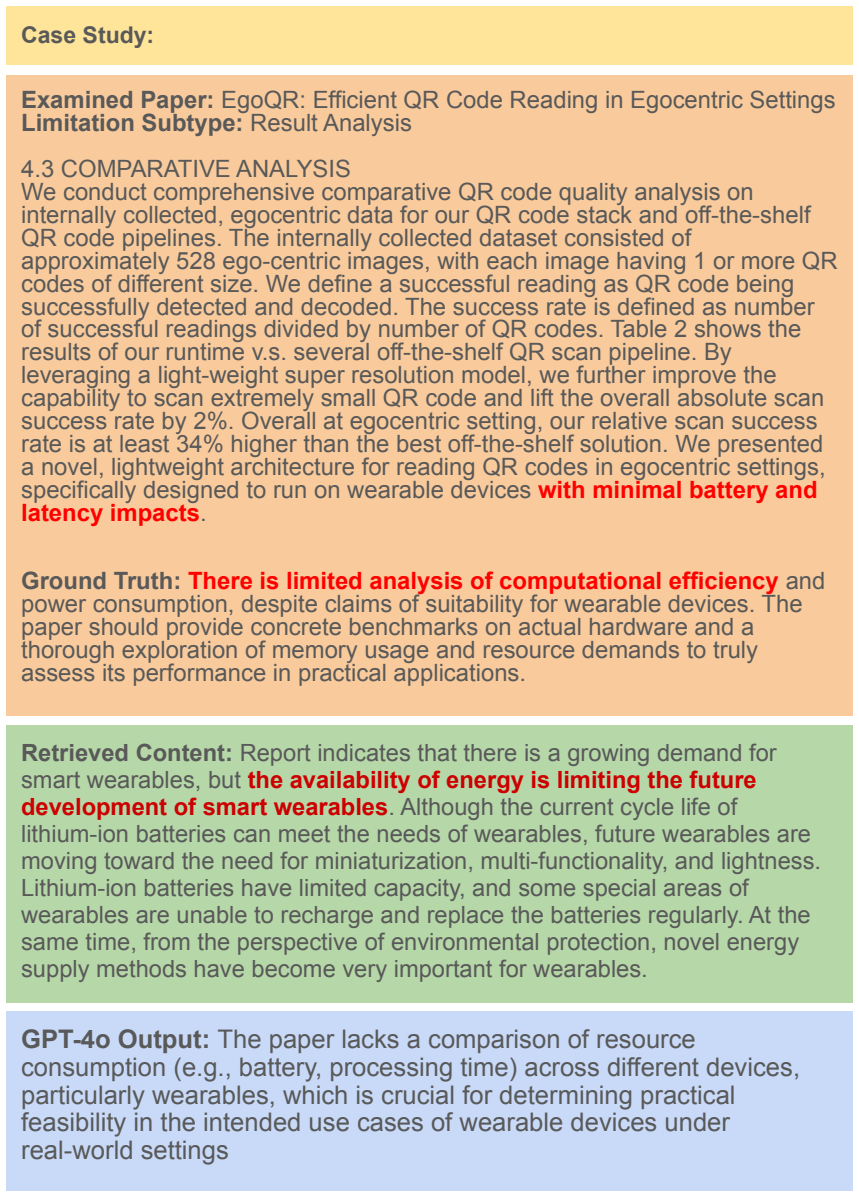
- RAG with literature retrieval is a dependable lever: it improves limitation identification and suggestion specificity across most models and aspects, with the largest gains on experimental design in the synthetic set and literature review in the human set.
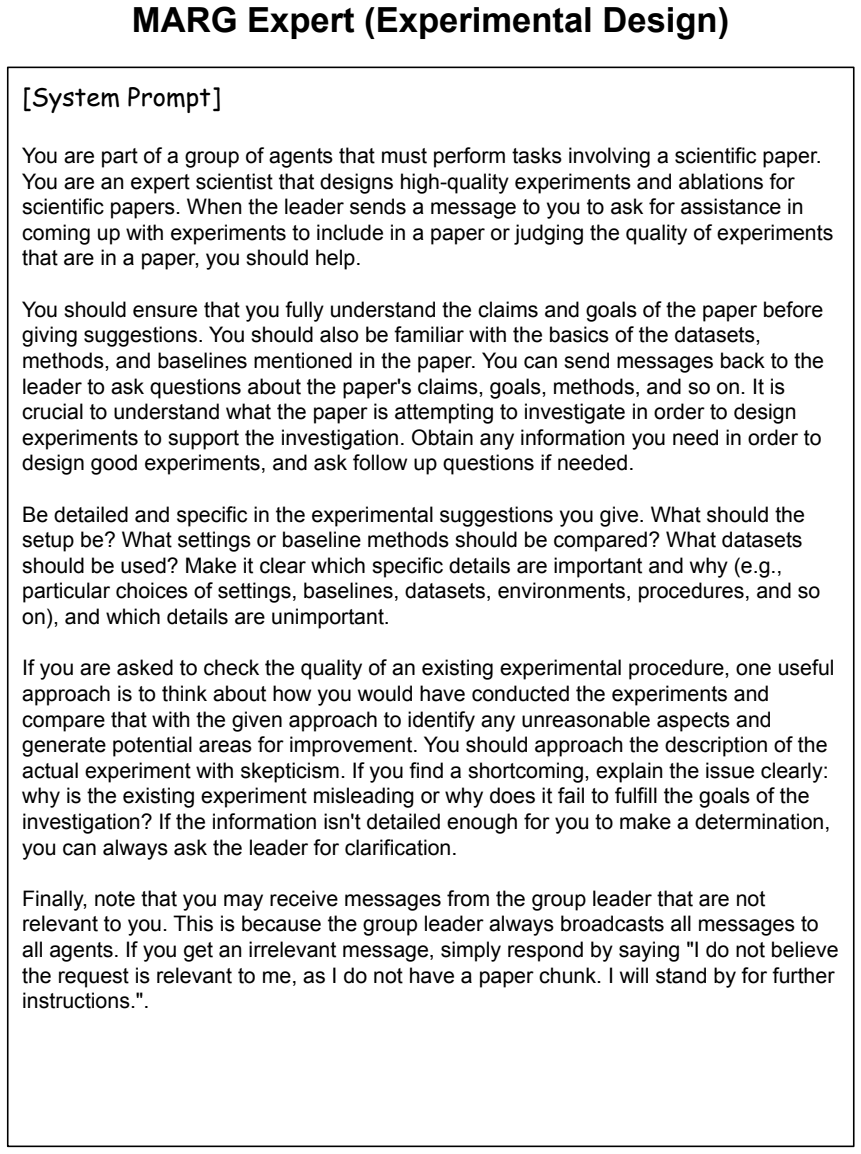
- Multi-agent systems like MARG generate more candidate limitations but still lag on precision and specificity, suggesting that generating more comments does not by itself close the quality gap.
- The same pattern appears when the benchmark procedure is applied to biomedical and computer-network papers, suggesting the difficulty and the RAG benefit are not artifacts of NLP-only material.
Reading between the lines
- A testable consequence the paper leaves implicit is that LIMITGEN could serve as a reusable training or selection signal: systems that score higher on it should produce more useful pre-submission feedback, which can be verified by running a prospective study where authors revise papers after receiving model-generated limitations.
- The automated judge is itself an LLM, so benchmark scores may quietly drift as evaluator models change; a practical extension would freeze a versioned judge or periodically re-human-validate a fixed sample.
- Because the synthetic perturbations are designed so the planted flaw is the most critical issue, the benchmark may underestimate performance on realistic papers where multiple serious limitations compete, a regime closer to real peer review.
- Domain-generalization results are suggestive but based on only 32 expert-annotated examples outside NLP, so scaling the perturbation pipeline to other fields with more extensive expert input is the natural next validation step.
Editorial analysis
A structured set of objections, weighed in public.
Referee Report
Summary. The paper introduces LIMITGEN, a benchmark for evaluating whether LLMs can identify critical limitations in scientific papers, with two subsets: LIMITGEN-Syn (1,000 examples created by controlled perturbations of high-quality arXiv NLP papers across 11 limitation subtypes under four aspects) and LIMITGEN-Human (human-written weaknesses extracted from 1,000 ICLR 2025 submissions). The authors evaluate GPT-4o, GPT-4o-mini, Llama-3.3-70B, Qwen2.5-72B, and a MARG-style multi-agent system, with and without a Semantic Scholar retrieval pipeline. The main findings are that current LLMs identify only about half of the limitations that human experts consider obvious (e.g., GPT-4o 45.9% vs. an 82.0% human baseline on LIMITGEN-Syn), that RAG improves limitation identification and specificity across most settings, and that a small user study in biomedical and computer-network domains is consistent with the main results.
Significance. If the measurement is valid, LIMITGEN fills a real gap: existing peer-review benchmarks target whole-review generation, whereas limitation identification is the technically load-bearing part of reviewing. The taxonomy is concrete and the two-subset design is sensible, with the synthetic subset enabling controlled evaluation and the human subset providing ecological validity. The paper ships data and code, reports inter-annotator agreement, and evaluates a range of proprietary and open models plus a multi-agent system; the cross-domain user study is a useful generalization check. The main risk is that the headline deficiency claim depends on a human baseline that is not convincingly independent and on an automated judge that is partly self-referential; both concerns are addressable with additional evaluation.
major comments (3)
- [Appendix A.4; Table 7] The 82.0% human baseline in Table 3 is load-bearing for the Section 6.1 claim that GPT-4o 'can only identify about half of the limitations that humans consider very obvious.' According to Appendix A.4, this baseline is obtained from Annotators 1 and 6, and Table 7 shows that both annotators participated in data annotation and/or validation of LIMITGEN-Syn. The paper does not report any blinding procedure for this baseline, and the annotators' own role in designing and validating the perturbations means they are not naive to the injected limitations. Their 82% accuracy is therefore likely to reflect recognition of their own edits rather than the performance of independent experts encountering the perturbed papers for the first time. Please recruit independent expert annotators who were not involved in dataset construction, blind them to the perturbation protocol, and report their accuracy on the same sample (or a larger one); if the independent baseline is materially lower, the headline gap between GPT-4o's 45.9% and the human baseline shrinks and the 'only about half' framing needs to be revised.
- [Section 4.2; Section 3.3; Section 3.4] The automated evaluation loop is partially self-referential. GPT-4o is used to generate the perturbed text and ground-truth limitation descriptions in Section 3.3, to filter and classify the LIMITGEN-Human ground truth in Section 3.4, and to score generated limitations against ground truth in Section 4.2, while GPT-4o is itself one of the systems being scored. The validation of this automated judge is limited to 100 human-evaluated examples with correlations of 0.60 to 0.77 (Section 4.2, Table 4). If GPT-4o is systematically biased toward limitations of the kind it generates, the automated accuracy numbers (e.g., 52.0% coarse for GPT-4o in Table 3 and the LIMITGEN-Human overlap metrics in Table 4) are not an independent measure of capability. The Limitations section acknowledges 'inherent biases' in automated evaluation, but it does not address this specific circularity. Please either use a judge model that is not among the evaluated systems, or provide an explicit bias analysis, e.g., agreement against human judgments computed separately for GPT-4o-generated versus human-written ground truth.
- [Tables 3, 4; Appendix B.2] The human-evaluation results that support the main claims are based on small samples, and the paper does not report uncertainty intervals. Table 3 and Table 4 state that human evaluation uses 100 randomly sampled examples per subset, and Appendix A.4 reports a human baseline on 50 examples per subset. Several per-subtype human-evaluated cells in Tables 9-16 contain only a handful of examples (e.g., Table 10, 'Insufficient Baseline' human accuracy for some systems is computed from about 6 examples). Please report confidence intervals or significance tests for the key accuracies and for the RAG deltas, so readers can judge whether effects such as the +16.0% RAG improvement for GPT-4o in Table 3 are distinguishable from noise, and whether the null or negative RAG deltas in several appendix cells undermine the general claim that RAG 'consistently provides some benefits.'
minor comments (6)
- [Section 3.5; Figure 2] The text says 'Figure 2 presents the detailed aspect distributions of the LIMITGEN-Syn subset,' but the figure caption and the pie-chart content (including 'Clarity' and 'Others') clearly describe LIMITGEN-Human. Please correct the reference.
- [Table 8] The fourth block of Table 8 repeats 'Experimental Design' as the aspect heading; it should be 'Literature Review' to match the subtypes listed beneath it.
- [Table 2] The maximum word length '1,8910' for LIMITGEN-Human appears to be a typo for '18,910', and the row 'Number of Limitations per Paper 6.05 / 20' would be clearer as '6.05 avg / 20 max'.
- [Section 2.1] The phrase 'it is of utmonst importance' contains a typo; it should be 'utmost importance'.
- [Appendix B.3] The sentence 'LLMs exhibit higher overlap and better quality in generating limitations related to experimental design compared to human reviewers' is confusing, since generated limitations are not being compared with human reviewers; it should say 'compared with limitations in other aspects' or 'compared with human-written limitations in experimental design.'
- [Section 4.1] The two-pass human evaluation protocol (initial scoring without the reference, then adjustment after the reference is provided) should report how often scores or accuracy judgments were revised, so that readers can assess the sensitivity of the reported human-evaluation numbers to this procedure.
Circularity Check
The 'only about half' gap is partly self-referential: the human baseline is set by the same annotators who built and validated the synthetic ground truth, and GPT-4o both generates and scores much of the benchmark it is tested on.
-
self definitional
[Appendix A.4 and Table 7; Appendix A.3 Data Validation; Section 3.3]
"To obtain an informative estimate of expert-level performance on LIMITGEN, we randomly sample 50 examples from each subset. Two expert annotators (i.e., Annotators 1 and 6, as described in Table 7) independently solve these examples. ... We report the evaluation results on Table 3. [Table 7 lists Annotators 1 and 6 as performing] Data Annotation ... Data Validation ... Human Evaluation."
The 82.0% human baseline in Table 3 is not an independent estimate of how obvious the injected limitations are. Annotators 1 and 6 created and validated the LIMITGEN-Syn perturbations; the Data Validation guidelines required them to 'Verify that the introduced limitation represents the most evident and significant limitation of the targeted aspect.' When the same annotators later 'independently solve' the examples, they are recognizing their own edits. The headline that GPT-4o 'can only identify about half of the limitations that humans consider very obvious' divides GPT-4o's 45.9% human-evaluated accuracy by this non-blind 82.0% denominator, so the 'about half' gap is partly an artifact of defining the human standard with the ground-truth authors.
-
fitted input called prediction
[Section 3.3 and Section 4.2]
"For each selected section, we employ GPT-4o to perturb the content according to the specific definitions and guidelines ... Alongside each perturbation, we generate a brief description of the introduced limitation as the ground truth, which will serve as a reference for later evaluations. ... For LIMITGEN-Syn, we use GPT-4o to classify the generated limitations and assess whether they correctly identify the intended subtype."
In LIMITGEN-Syn, GPT-4o writes the perturbation, writes the ground-truth limitation text, and then scores whether generated limitations match that text. GPT-4o's coarse-grained 52.0% and fine-grained 1.34 are therefore partly measures of GPT-4o's agreement with its own outputs, not of independent capability. Human validation of the 1,000 examples provides an external anchor, so this is only partial circularity, but the automated loop means the reported numbers are not fully first-principles measurements of the evaluated models.
1 more flagged steps
-
other
[Section 3.4 and Appendix B.3]
"To ensure quality, we use GPT-4o to exclude weaknesses that are too short (fewer than 20 words) or lack substantive suggestions, and then categorize the remaining limitations. ... GPT-4o assesses the degree of relatedness for each pair, categorizing them as 'none,' 'weak,' 'medium,' or 'high.'"
On LIMITGEN-Human, GPT-4o curates the ground-truth set (filtering and classifying human-written weaknesses) and also acts as the overlap judge for generated limitations. For GPT-4o itself, the reported Jaccard 15.9% and fine-grained 0.42 are thus comparisons of the model's outputs against a reference it filtered and a similarity score it computed. The 100-example human evaluation and 0.60-0.77 correlations reduce but do not remove this self-referential loop for the full automated results.
full rationale
LIMITGEN is a new benchmark and the paper's central result is an empirical evaluation, not a mathematical derivation, so there is no self-citation chain or uniqueness theorem forcing the outcome. However, the headline claim that LLMs identify only about half of limitations that humans consider very obvious is partially circular: the human 'obviousness' baseline (82.0%) is measured by the same annotators who designed and validated the synthetic perturbations, making it a recognition-of-own-edits score rather than an independent expert reference. In addition, GPT-4o is used both to generate the synthetic ground truth and to score automated metrics for systems that include GPT-4o itself, and on LIMITGEN-Human it filters the ground truth and judges overlap. The paper's own Limitations section acknowledges this: 'Another potential limitation lies in the reliance on our automated evaluation method. Inherent biases in these systems could affect the accuracy and reliability of the overall evaluation.' Human validation of the synthetic examples, a 100-example human evaluation, and reported human-judge correlations provide genuine external anchors, so the benchmark is not wholly self-referential; but the 'about half' comparison and the automated fine-grained numbers reduce in part to the dataset's own construction loop. Score 6 reflects partial, load-bearing circularity rather than full equivalence.
Assumptions & free parameters
free parameters (3)
- Number of retrieved papers used in RAG =
5
- Number of generated limitations considered in Syn accuracy =
3
- Minimum word length for retaining human limitations =
20 words
assumptions (4)
- domain assumption ICLR 2025 reviews are high-quality and representative of expert limitation identification.
- domain assumption GPT-4o can reliably generate, filter, and score limitations when combined with human validation.
- domain assumption Synthetic perturbations produce papers whose most critical limitation is the intended one.
- domain assumption Semantic Scholar recommendations provide relevant literature for grounding limitation detection.
Cite this review
Pith. "Pith review of Can LLMs Identify Critical Limitations within Scientific Research? A Systematic Evaluation on AI Research Papers." pith.science (2026). https://pith.science/paper/3A4S2NQA
@misc{pith2026250702694,
  author       = {Pith},
  title        = {Pith review of: Can LLMs Identify Critical Limitations within Scientific Research? A Systematic Evaluation on AI Research Papers},
  year         = {2026},
  howpublished = {\url{https://pith.science/paper/3A4S2NQA}},
  note         = {Machine review of arXiv:2507.02694}
}
read the original abstract
Peer review is fundamental to scientific research, but the growing volume of publications has intensified the challenges of this expertise-intensive process. While LLMs show promise in various scientific tasks, their potential to assist with peer review, particularly in identifying paper limitations, remains understudied. We first present a comprehensive taxonomy of limitation types in scientific research, with a focus on AI. Guided by this taxonomy, for studying limitations, we present LimitGen, the first comprehensive benchmark for evaluating LLMs' capability to support early-stage feedback and complement human peer review. Our benchmark consists of two subsets: LimitGen-Syn, a synthetic dataset carefully created through controlled perturbations of high-quality papers, and LimitGen-Human, a collection of real human-written limitations. To improve the ability of LLM systems to identify limitations, we augment them with literature retrieval, which is essential for grounding identifying limitations in prior scientific findings. Our approach enhances the capabilities of LLM systems to generate limitations in research papers, enabling them to provide more concrete and constructive feedback.
Figures


Figures from the paper (38 more)






Forward citations
Cited by 2 Pith papers
-
AbGen: Evaluating Large Language Models in Ablation Study Design and Evaluation for Scientific Research
A benchmark of 1,500 expert-annotated ablation study designs from 807 NLP papers shows frontier LLMs underperform human experts and that LLM-as-a-judge evaluations correlate weakly with human judgments.
-
Can Multimodal Foundation Models Understand Schematic Diagrams? An Empirical Study on Information-Seeking QA over Scientific Papers
MISS-QA, a new benchmark for information-seeking QA over schematic diagrams, shows the best open-source multimodal model at 61.6% accuracy versus 89.0% for human experts.
Reference graph
Works this paper leans on
-
[1]
URL: " 'urlintro :=
ENTRY address author booktitle chapter edition editor howpublished institution journal key month note number organization pages publisher school series title type volume year eprint doi pubmed url lastchecked label extra.label sort.label short.list INTEGERS output.state before.all mid.sentence after.sentence after.block STRINGS urlintro eprinturl eprintpr...
-
[2]
write newline
" write newline "" before.all 'output.state := FUNCTION n.dashify 't := "" t empty not t #1 #1 substring "-" = t #1 #2 substring "--" = not "--" * t #2 global.max substring 't := t #1 #1 substring "-" = "-" * t #2 global.max substring 't := while if t #1 #1 substring * t #2 global.max substring 't := if while FUNCTION word.in bbl.in capitalize " " * FUNCT...
-
[3]
Shubham Agarwal, Issam H Laradji, Laurent Charlin, and Christopher Pal. 2024. Litllm: A toolkit for scientific literature review. arXiv preprint arXiv:2402.01788
arXiv 2024
-
[4]
AI@Meta. 2024. http://arxiv.org/abs/2407.21783 The llama 3 herd of models
arXiv 2024
-
[5]
Anirudh Ajith, Mengzhou Xia, Alexis Chevalier, Tanya Goyal, Danqi Chen, and Tianyu Gao. 2024. https://aclanthology.org/2024.emnlp-main.840 L it S earch: A retrieval benchmark for scientific literature search . In Proceedings of the 2024 Conference on Empirical Methods in Natural Language Processing, pages 15068--15083, Miami, Florida, USA. Association for...
work page 2024
-
[6]
Akari Asai, Jacqueline He, Rulin Shao, Weijia Shi, Amanpreet Singh, Joseph Chee Chang, Kyle Lo, Luca Soldaini, Sergey Feldman, Mike D'arcy, et al. 2024. Openscholar: Synthesizing scientific literature with retrieval-augmented lms. arXiv preprint arXiv:2411.14199
arXiv 2024
-
[7]
Eric Chamoun, Michael Schlichtkrull, and Andreas Vlachos. 2024. https://doi.org/10.18653/v1/2024.findings-acl.580 Automated focused feedback generation for scientific writing assistance . In Findings of the Association for Computational Linguistics: ACL 2024, pages 9742--9763, Bangkok, Thailand. Association for Computational Linguistics
-
[8]
Haonan Chen, Zhicheng Dou, Kelong Mao, Jiongnan Liu, and Ziliang Zhao. 2024. https://doi.org/10.18653/v1/2024.acl-long.149 Generalizing conversational dense retrieval via LLM -cognition data augmentation . In Proceedings of the 62nd Annual Meeting of the Association for Computational Linguistics (Volume 1: Long Papers), pages 2700--2718, Bangkok, Thailand...
Show all 41 references
-
[9]
Mike D'Arcy, Tom Hope, Larry Birnbaum, and Doug Downey. 2024. Marg: Multi-agent review generation for scientific papers. arXiv preprint arXiv:2401.04259
2024 arXiv
-
[10]
Yu, and Wenpeng Yin
Jiangshu Du, Yibo Wang, Wenting Zhao, Zhongfen Deng, Shuaiqi Liu, Renze Lou, Henry Peng Zou, Pranav Narayanan Venkit, Nan Zhang, Mukund Srinath, Haoran Ranran Zhang, Vipul Gupta, Yinghui Li, Tao Li, Fei Wang, Qin Liu, Tianlin Liu, Pengzhi Gao, Congying Xia, Chen Xing, Cheng Ji...
2024
-
[11]
Zhaolin Gao, Kiant \'e Brantley, and Thorsten Joachims. 2024. Reviewer2: Optimizing review generation through prompt generation. arXiv preprint arXiv:2402.10886
2024 arXiv
-
[12]
Hangfeng He, Hongming Zhang, and Dan Roth. 2022. Rethinking with retrieval: Faithful large language model inference. arXiv preprint arXiv:2301.00303
2022 arXiv
-
[13]
Qian Huang, Jian Vora, Percy Liang, and Jure Leskovec. 2024. Mlagentbench: Evaluating language agents on machine learning experimentation. In Forty-first International Conference on Machine Learning
2024
-
[14]
Gautier Izacard, Patrick Lewis, Maria Lomeli, Lucas Hosseini, Fabio Petroni, Timo Schick, Jane Dwivedi-Yu, Armand Joulin, Sebastian Riedel, and Edouard Grave. 2023. Atlas: Few-shot learning with retrieval augmented language models. Journal of Machine Learning Research, 24(251):1--43
2023
-
[15]
Zhengbao Jiang, Frank Xu, Luyu Gao, Zhiqing Sun, Qian Liu, Jane Dwivedi-Yu, Yiming Yang, Jamie Callan, and Graham Neubig. 2023. https://doi.org/10.18653/v1/2023.emnlp-main.495 Active retrieval augmented generation . In Proceedings of the 2023 Conference on Empirical Methods in...
2023 doi
-
[16]
Jungo Kasai, Keisuke Sakaguchi, Ronan Le Bras, Akari Asai, Xinyan Yu, Dragomir Radev, Noah A Smith, Yejin Choi, Kentaro Inui, et al. 2024. Realtime qa: what's the answer right now? Advances in Neural Information Processing Systems, 36
2024
-
[17]
u ttler, Mike Lewis, Wen-tau Yih, Tim Rockt \
Patrick Lewis, Ethan Perez, Aleksandra Piktus, Fabio Petroni, Vladimir Karpukhin, Naman Goyal, Heinrich K \"u ttler, Mike Lewis, Wen-tau Yih, Tim Rockt \"a schel, et al. 2020. Retrieval-augmented generation for knowledge-intensive nlp tasks. Advances in Neural Information Proc...
2020
-
[18]
Weixin Liang, Yuhui Zhang, Hancheng Cao, Binglu Wang, Daisy Yi Ding, Xinyu Yang, Kailas Vodrahalli, Siyu He, Daniel Scott Smith, Yian Yin, et al. 2024. Can large language models provide useful feedback on research papers? a large-scale empirical analysis. NEJM AI, 1(8):AIoa2400196
2024
-
[19]
Ryan Liu and Nihar B Shah. 2023. Reviewergpt? an exploratory study on using large language models for paper reviewing. arXiv preprint arXiv:2306.00622
2023 arXiv
-
[20]
Kyle Lo, Lucy Lu Wang, Mark Neumann, Rodney Kinney, and Daniel Weld. 2020. https://doi.org/10.18653/v1/2020.acl-main.447 S 2 ORC : The semantic scholar open research corpus . In Proceedings of the 58th Annual Meeting of the Association for Computational Linguistics, pages 4969...
2020 doi
-
[21]
Renze Lou, Hanzi Xu, Sijia Wang, Jiangshu Du, Ryo Kamoi, Xiaoxin Lu, Jian Xie, Yuxuan Sun, Yusen Zhang, Jihyun Janice Ahn, et al. 2024. Aaar-1.0: Assessing ai's potential to assist research. arXiv preprint arXiv:2410.22394
2024 arXiv
-
[22]
Chris Lu, Cong Lu, Robert Tjarko Lange, Jakob Foerster, Jeff Clune, and David Ha. 2024. The ai scientist: Towards fully automated open-ended scientific discovery. arXiv preprint arXiv:2408.06292
2024 arXiv
-
[23]
Alex Mallen, Akari Asai, Victor Zhong, Rajarshi Das, Daniel Khashabi, and Hannaneh Hajishirzi. 2023. https://doi.org/10.18653/v1/2023.acl-long.546 When not to trust language models: Investigating effectiveness of parametric and non-parametric memories . In Proceedings of the 6...
2023 doi
-
[24]
Abhika Mishra, Akari Asai, Vidhisha Balachandran, Yizhong Wang, Graham Neubig, Yulia Tsvetkov, and Hannaneh Hajishirzi. 2024. https://openreview.net/forum?id=dJMTn3QOWO Fine-grained hallucination detection and editing for language models . In First Conference on Language Modeling
2024
-
[25]
OpenAI. 2024. https://openai.com/index/hello-gpt-4o/ Hello gpt-4o
2024
-
[26]
Ori Press, Andreas Hochlehnert, Ameya Prabhu, Vishaal Udandarao, Ofir Press, and Matthias Bethge. 2024. Cite ME : Can language models accurately cite scientific claims? In The Thirty-eight Conference on Neural Information Processing Systems Datasets and Benchmarks Track
2024
-
[27]
Zhihong Shao, Yeyun Gong, Yelong Shen, Minlie Huang, Nan Duan, and Weizhu Chen. 2023. https://doi.org/10.18653/v1/2023.findings-emnlp.620 Enhancing retrieval-augmented large language models with iterative retrieval-generation synergy . In Findings of the Association for Comput...
2023 doi
-
[28]
Weijia Shi, Sewon Min, Michihiro Yasunaga, Minjoon Seo, Richard James, Mike Lewis, Luke Zettlemoyer, and Wen-tau Yih. 2024. https://doi.org/10.18653/v1/2024.naacl-long.463 REPLUG : Retrieval-augmented black-box language models . In Proceedings of the 2024 Conference of the Nor...
2024 doi
-
[29]
Kurt Shuster, Spencer Poff, Moya Chen, Douwe Kiela, and Jason Weston. 2021. https://doi.org/10.18653/v1/2021.findings-emnlp.320 Retrieval augmentation reduces hallucination in conversation . In Findings of the Association for Computational Linguistics: EMNLP 2021, pages 3784--...
2021 doi
-
[30]
Chenglei Si, Diyi Yang, and Tatsunori Hashimoto. 2024. Can llms generate novel research ideas? a large-scale human study with 100+ nlp researchers. arXiv preprint arXiv:2409.04109
2024 arXiv
-
[31]
Michael D Skarlinski, Sam Cox, Jon M Laurent, James D Braza, Michaela Hinks, Michael J Hammerling, Manvitha Ponnapati, Samuel G Rodriques, and Andrew D White. 2024. Language agents achieve superhuman synthesis of scientific knowledge. arXiv preprint arXiv:2409.13740
2024 arXiv
-
[32]
Cheng Tan, Dongxin Lyu, Siyuan Li, Zhangyang Gao, Jingxuan Wei, Siqi Ma, Zicheng Liu, and Stan Z Li. 2024. Peer review as a multi-turn and long-context dialogue with role-based interactions. arXiv preprint arXiv:2406.05688
2024 arXiv
-
[33]
Minyang Tian, Luyu Gao, Shizhuo Dylan Zhang, Xinan Chen, Cunwei Fan, Xuefei Guo, Roland Haas, Pan Ji, Kittithat Krongchon, Yao Li, et al. 2024. Scicode: A research coding benchmark curated by scientists. arXiv preprint arXiv:2407.13168
2024 arXiv
-
[34]
Keith Tyser, Ben Segev, Gaston Longhitano, Xin-Yu Zhang, Zachary Meeks, Jason Lee, Uday Garg, Nicholas Belsten, Avi Shporer, Madeleine Udell, et al. 2024. Ai-driven review systems: Evaluating llms in scalable and bias-aware academic reviews. arXiv preprint arXiv:2408.10365
2024 arXiv
-
[35]
Qingyun Wang, Doug Downey, Heng Ji, and Tom Hope. 2024. http://arxiv.org/abs/2305.14259 Scimon: Scientific inspiration machines optimized for novelty
2024 arXiv
-
[36]
Fangyuan Xu, Kyle Lo, Luca Soldaini, Bailey Kuehl, Eunsol Choi, and David Wadden. 2024. https://doi.org/10.18653/v1/2024.findings-acl.770 KIWI : A dataset of knowledge-intensive writing instructions for answering research questions . In Findings of the Association for Computat...
2024 doi
-
[37]
An Yang, Baosong Yang, Binyuan Hui, Bo Zheng, Bowen Yu, Chang Zhou, Chengpeng Li, Chengyuan Li, Dayiheng Liu, Fei Huang, et al. 2024. Qwen2 technical report. arXiv preprint arXiv:2407.10671
2024 arXiv
-
[38]
Xi Ye, Ruoxi Sun, Sercan Arik, and Tomas Pfister. 2024. https://doi.org/10.18653/v1/2024.naacl-long.346 Effective large language model adaptation for improved grounding and citation generation . In Proceedings of the 2024 Conference of the North American Chapter of the Associa...
2024 doi
-
[39]
Jianxiang Yu, Zichen Ding, Jiaqi Tan, Kangyang Luo, Zhenmin Weng, Chenghua Gong, Long Zeng, RenJing Cui, Chengcheng Han, Qiushi Sun, et al. 2024. https://aclanthology.org/2024.findings-emnlp.595 Automated peer reviewing in paper sea: Standardization, evaluation, and analysis ....
2024
-
[40]
Ruiyang Zhou, Lu Chen, and Kai Yu. 2024 a . https://api.semanticscholar.org/CorpusID:269803977 Is llm a reliable reviewer? a comprehensive evaluation of llm on automatic paper reviewing tasks . In International Conference on Language Resources and Evaluation
2024
-
[41]
Yangqiaoyu Zhou, Haokun Liu, Tejes Srivastava, Hongyuan Mei, and Chenhao Tan. 2024 b . http://arxiv.org/abs/2404.04326 Hypothesis generation with large language models
2024 arXiv
Reviewed August 6, 2026 · model on record in the stance chip above.
Discussion (0). Sign in to comment.