REVIEW 4 major objections 5 minor 26 references
GAF-Guard: An Agentic Framework for Risk Management and Governance in Large Language Models
T0 review · 4 major / 5 minor · reviewed 2026-08-06 · deepseek-v4-flash
Pith's one-line read GAF-Guard claims that a use-case-centered agentic framework can cover the full LLM governance lifecycle—risk assessment before deployment, drift and risk monitoring after, and automated incident reporting—with about 90% average accuracy…
desk verdict Useful governance integration, but the τ-bench results in §4.2 are an LLM-judge scoring of 10 handcrafted trajectories, not a valid τ-bench measurement, and the empirical claim collapses. read the letter →
The pith
A machine-rendered reading of the paper's core claim, the machinery that carries it, and where it could break.
The reading
What carries the argument
The central mechanism is the orchestrator-worker agent architecture, with the workflow organized into three governance stages. The load-bearing components are the drift monitor—an LLM-as-a-judge module that scores prompt relevance with G-Eval using chain-of-thought criteria and a rolling average compared to a threshold—and Granite Guardian, a fine-tuned risk-detection model that flags risks in prompts and responses. τ-bench's pass^k metric supplies the consistency measurement by replaying ten hand-built customer-complaint trajectories against ground truth and using G-Eval to assign rewards.
What would settle it
Take a set of real customer-complaint prompts that a deployed chatbot actually receives, have human annotators label each prompt as on-topic or off-topic for the complaint use-case, and run GAF-Guard's drift monitor on the same prompts; if its classifications disagree with the human labels substantially more than the reported ~0.86 accuracy, then the synthetic-data evaluation overstates the framework's production readiness.
Extended reading notes
Core claim
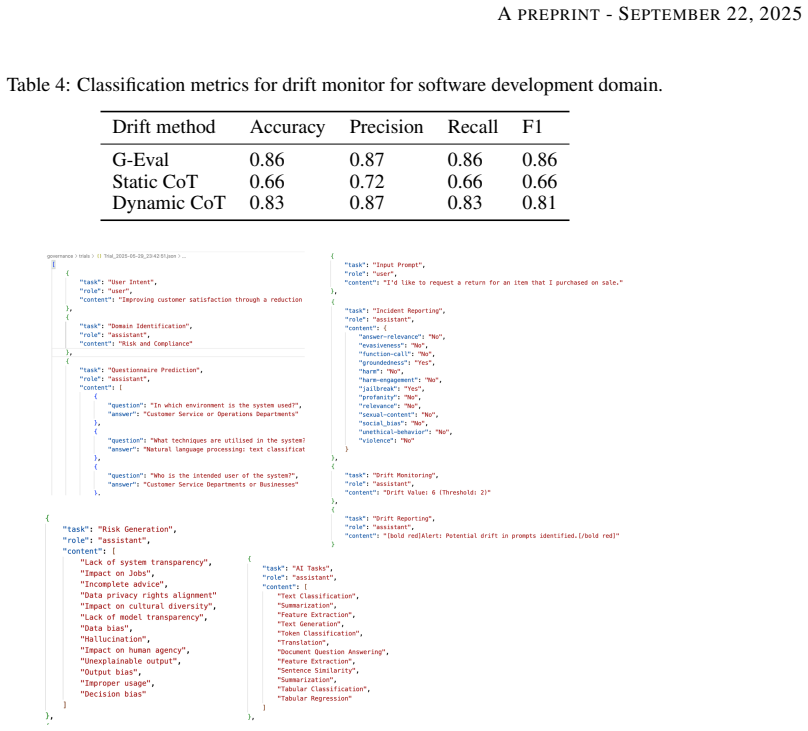
On the paper's own terms, GAF-Guard's central discovery is that the governance lifecycle can be implemented as a set of cooperating agents—an intent-to-questionnaire agent, a questionnaire-to-risk-identification agent, drift detectors, real-time monitors, and an incident reporter—orchestrated so that each stage feeds the next. The reported empirical finding is that on a customer-complaints use-case the full agentic workflow achieved an average accuracy of about 90%, with $pass^{3}$ consistency above 80%, meaning the workflow completed its tasks correctly and consistently across repeated runs as measured by τ-bench. The authors also report that a G-Eval-based drift monitor outperformed static and dynamic chain-of-thought classifiers for detecting prompts that stray from a software-development use-case, while a zero-shot relevance classifier failed entirely by labeling everything relevant.
Load-bearing premise
The results stand on the assumption that the hand-built synthetic prompts and trajectories used in evaluation resemble real user behavior, and that the G-Eval judge's scores are valid quality measurements; if either fails, the reported ~90% accuracy will not transfer to production.
Editorial extensions
If this is right
- A single deployment can move from intent to questionnaire to risk list to live monitors without switching tools.
- Drift detection performs best when prompts are judged against use-case-specific relevance criteria rather than generic templates.
- Multi-agent governance workflows can be scored for reliability with a pass^k consistency metric, not just per-agent accuracy.
- Real-time monitors can trigger incident notifications automatically when a policy violation or drift is detected.
- Human-in-the-loop review is built into the pre-deployment stage, letting users correct answers or risk assessments before monitoring begins.
Reading between the lines
- Extension: The framework's dependence on G-Eval as judge means its accuracy numbers inherit whatever biases that judge has; calibrating the judge against human annotations on the same trajectories is a natural next test.
- Extension: Because the drift monitor's advantage comes from use-case-specific chain-of-thought examples, the same recipe could be tried for other domains beyond software development, starting with legal or clinical prompts where off-topic drift is costly.
- Extension: The paper frames risk severity scoring as future work, but without severity the incident reporter cannot triage; adding severity would turn alerts into an actionable queue.
Editorial analysis
A structured set of objections, weighed in public.
Referee Report
Summary. The paper proposes GAF-Guard, an agentic framework for LLM governance that spans pre-deployment risk assessment (intent-to-questionnaire and questionnaire-to-risk identification agents with human-in-the-loop feedback), post-deployment monitoring (G-Eval based drift detectors and Granite Guardian based risk detection), and automated incident reporting. The framework is implemented with LangGraph and leverages the authors' Risk Atlas Nexus library. The evaluation in Section 4 has two parts: a per-agent drift-detection comparison on synthetic software-development prompts (Table 4, best accuracy 0.86 with G-Eval) and an end-to-end workflow evaluation of 10 customer-complaint trajectories using the τ-bench tool, reporting average accuracy 0.96, k^1=0.92, k^3=0.87 (Table 5), which the abstract summarizes as roughly 90% accuracy and pass^3 > 80%. The paper concludes that GAF-Guard effectively detects and manages risks across the LLM lifecycle.
Significance. The paper addresses a real gap: existing governance tools tend to cover isolated lifecycle stages rather than providing a use-case-aware, end-to-end governance workflow. The strengths are the modular agentic architecture, the explicit pre/post-deployment split, the inclusion of human-in-the-loop review, and the release of code on GitHub. The work also builds sensibly on prior governance infrastructure (Risk Atlas Nexus, Granite Guardian, G-Eval), and the Table 2 comparison usefully situates the framework against existing tools. However, the contribution is currently system/demonstration level: the empirical support for the central claim is thin, the τ-bench evaluation as reported is not a valid τ-bench measurement, the drift monitor is tested only on a software-development use-case while the workflow is tested on customer complaints, and no experiment measures whether the risks identified by the framework are correct or complete. If the evaluation is redone properly, the framework could be a useful contribution, but the present evidence is not sufficient to support the stated conclusions.
major comments (4)
- [Section 4.2, Table 5] The τ-bench evaluation is not a valid use of τ-bench as defined in [18]. In τ-bench, pass^k scores action-level correctness of tool-call sequences against the benchmark's own user simulator and action database. The paper instead compares each captured trajectory to a manually prepared ground-truth trajectory using G-Eval as an LLM judge, and then feeds those rewards to a 'τ-bench function.' With only 10 handcrafted trajectories, the reported pass^3=0.87 (roughly 8 or 9 successes) has a 95% confidence interval of approximately 0.44-0.97, so the claimed high consistency is statistically indistinguishable from chance. Moreover, the same G-Eval paradigm is used as the drift detector in Section 4.1, so any systematic judge bias would inflate both the drift-monitoring accuracy and the trajectory scores. The authors should either run the official τ-bench harness on a standard task suite or clearly relabel this as a small pilot study with an LLM-as-judge metric, and revise the abstract and conclusion claims accordingly.
- [Section 4.1, Table 4] The drift detector is evaluated only on synthetic prompts from the 'software development domain,' yet the end-to-end workflow in Section 4.2 is evaluated on 'customer complaints' trajectories. The 0.86 G-Eval accuracy in Table 4 therefore does not transfer to the customer-complaints use-case, and no drift-detection accuracy is reported for the use-case actually used in the workflow evaluation. The paper needs per-use-case drift evaluation with a description of the synthetic data size and construction, bootstrapped confidence intervals, and ideally human-validated labels before it can support the claim of real-time drift monitoring in production.
- [Section 4.2 and Appendix A] The workflow score measures how closely the captured trajectories match a manually written script; it does not measure whether the Risk Generation agent's identified risks are correct, complete, or appropriately prioritized for the use-case. The central claim is that GAF-Guard 'effectively detects and manages risks,' but no experiment reports risk-generation precision or recall against an independent expert risk list. The Limitations appendix candidly notes that the system offers no theoretical guarantees of detecting all risks, which makes empirical validation of risk correctness and coverage even more load-bearing. Without such an evaluation, high trajectory adherence does not demonstrate effective risk management.
- [Section 4.2, Table 5 and abstract] The text states that the agentic system achieved 'an average accuracy of approximately 90%' and 'pass^3 > 80%.' Table 5 reports average accuracy 0.96, k^1=0.92, k^3=0.87, so the 'approximately 90%' phrase is inconsistent with the table and understates the average while the pass^3 claim has the noted statistical fragility. Please report per-trajectory results, confidence intervals, and the exact number of successes for each k value. The current presentation does not provide enough information to assess the reliability of the workflow.
minor comments (5)
- [Section 4.2, first paragraph] There is a typo, 'evalutaion,' and the notation 'τ-bench metric (k^n)' does not match the standard pass^k notation used in [18]; please align the notation.
- [Figures 3 and 5] Figures 3 and 5 are rendered too small in the current PDF to verify the G-Eval criteria and the trajectory JSON schema; please enlarge them or move the full JSON example to an appendix.
- [Table 3] Table 3 lists model names (e.g., granite3.2:8b, granite3-guardian:2b, llama3.2, Deepseek) without versions, quantization, prompt templates, or inference parameters; these details are needed for reproducibility.
- [References [5] and [20]] References [5] and [20] appear to describe the same Usage Governance Advisor work in different venues; please cross-check and cite consistently to avoid duplication.
- [Table 2] The criteria in Table 2 (Implementation, Pre-deployment, Post-deployment, Holistic, User/use-case) are not defined; for example, 'Holistic' is not explained, and the checkmarks for GAF-Guard are based on the authors' self-assessment.
Circularity Check
No significant circularity: the framework's empirical claims rest on external benchmarks and held-out synthetic trajectory comparisons, not on a self-referential reduction.
full rationale
After walking the derivation chain, I find no step where an output is equivalent to an input by construction. The drift monitor's G-Eval accuracy (Table 4) is measured against an independently labeled synthetic set, and the full workflow tau-bench scores (Table 5) are computed by comparing agent trajectories with manually prepared ground truth using the G-Eval judge, which is a measurement choice rather than a derivation. Self-citations to [19], [20], and [22] support individual components, but those components are also backed by external content: Granite Guardian is benchmarked against external datasets (AegisSafetyTest, HarmBench), and Risk Atlas Nexus ingests NIST AI RMF and MIT AI Risk Repository. The Limitations section explicitly concedes that the system does not provide theoretical guarantees of detecting all risks, which is a completeness caveat rather than evidence of circularity. The replacement of tau-bench's action-level matching with G-Eval semantic scoring and the small 10-trajectory sample are validity concerns, but they do not reduce the claimed result to the paper's own fitted parameters by construction. Therefore no specific circular step can be exhibited.
Assumptions & free parameters
free parameters (3)
- drift threshold =
user-defined
- G-Eval criteria =
hand-authored (Fig. 3)
- τ-bench reward model =
G-Eval LLM judge (DeepSeek)
assumptions (4)
- domain assumption G-Eval LLM-as-a-judge yields valid relevance and quality scores
- domain assumption Author-generated synthetic prompts and trajectories are representative of real use
- domain assumption Risk Atlas Nexus taxonomy covers the relevant risk space
- domain assumption τ-bench pass^k with 10 trajectories measures reliability
Cite this review
Pith. "Pith review of GAF-Guard: An Agentic Framework for Risk Management and Governance in Large Language Models." pith.science (2026). https://pith.science/paper/3VBPNXGK
@misc{pith2026250702986,
  author       = {Pith},
  title        = {Pith review of: GAF-Guard: An Agentic Framework for Risk Management and Governance in Large Language Models},
  year         = {2026},
  howpublished = {\url{https://pith.science/paper/3VBPNXGK}},
  note         = {Machine review of arXiv:2507.02986}
}
read the original abstract
As Large Language Models (LLMs) continue to be increasingly applied across various domains, their widespread adoption necessitates rigorous monitoring to prevent unintended negative consequences and ensure robustness. Furthermore, LLMs must be designed to align with human values, like preventing harmful content and ensuring responsible usage. The current automated systems and solutions for monitoring LLMs in production are primarily centered on LLM-specific concerns like hallucination etc, with little consideration given to the requirements of specific use-cases and user preferences. This paper introduces GAF-Guard, a novel agentic framework for LLM governance that places the user, the use-case, and the model itself at the center. The framework is designed to detect and monitor risks associated with the deployment of LLM based applications. The approach models autonomous agents that identify risks, activate risk detection tools, within specific use-cases and facilitate continuous monitoring and reporting to enhance AI safety, and user expectations. The code is available at https://github.com/IBM/risk-atlas-nexus-demos/tree/main/gaf-guard.
Figures


Figures from the paper (2 more)

Reference graph
Works this paper leans on
-
[18]
Tau-bench: A benchmark for tool-agent-user interaction in real-world domains
Shunyu Yao, Noah Shinn, Pedram Razavi, and Karthik Narasimhan. Tau-bench: A benchmark for tool-agent-user interaction in real-world domains. arXiv preprint arXiv:2406.12045, 2024
arXiv 2024
-
[1]
Large language models (llms): Risks and policy implications
Alison Fang and J Perkins. Large language models (llms): Risks and policy implications. MIT Science Policy Review, 5:134–45, 2024
work page 2024
-
[2]
Oliver Bevan et. al. Implementing generative ai with speed and safety. https://www.mckinsey.com/capabilities/risk-and-resilience/our-insights/ implementing-generative-ai-with-speed-and-safety
-
[3]
Sopnendu Mohanty et. al. Emerging risks and opportunities of generative ai for banks. https://www. mas.gov.sg/-/media/mas-media-library/schemes-and-initiatives/ftig/project-mindforge/ emerging-risks-and-opportunities-of-generative-ai-for-banks.pdf
-
[4]
Sapan Dogra et. al. Generative ai in action opportunities and riskmanagement in financial ser- vices. https://www.ukfinance.org.uk/system/files/2025-01/Generative%20AI%20in% 20action-opportunities%20%26%20risk%20management%20in%20%20financial%20services.pdf
work page 2025
-
[5]
Elizabeth M. Daly, Sean Rooney, Seshu Tirupathi, Luis Garces-Erice, Inge Vejsbjerg, Frank Bagehorn, Dhaval Salwala, Christopher Giblin, Mira L. Wolf-Bauwens, Ioana Giurgiu, Michael Hind, and Peter Urbanetz. Usage governance advisor: From intent to ai governance, 2025
work page 2025
-
[6]
Owasp top 10 for llms and generative ai apps
OW ASP. Owasp top 10 for llms and generative ai apps. https://genai.owasp.org/llm-top-10/ , 2024
work page 2024
-
[7]
NIST. AI risk management framework. https://www.nist.gov/itl/ai-risk-management-framework , 2023
work page 2023
Show all 26 references
-
[8]
Contributors. Evals. https://github.com/openai/evals, 2023
2023
-
[9]
garak: A Framework for Security Probing Large Language Models
Leon Derczynski, Erick Galinkin, Jeffrey Martin, Subho Majumdar, and Nanna Inie. garak: A Framework for Security Probing Large Language Models. 2024
2024
-
[10]
NeMo guardrails: A toolkit for controllable and safe LLM applications with programmable rails
Traian Rebedea, Razvan Dinu, Makesh Narsimhan Sreedhar, Christopher Parisien, and Jonathan Cohen. NeMo guardrails: A toolkit for controllable and safe LLM applications with programmable rails. In Yansong Feng and Els Lefever, editors, Proceedings of the 2023 Conference on Empi...
2023
-
[11]
Examples as the prompt: A scalable approach for efficient llm adaptation in e-commerce
Jingying Zeng, Zhenwei Dai, Hui Liu, Samarth Varshney, Zhiji Liu, Chen Luo, Zhen Li, Qi He, and Xianfeng Tang. Examples as the prompt: A scalable approach for efficient llm adaptation in e-commerce. arXiv preprint arXiv:2503.13518, 2025
2025 arXiv
-
[12]
An llm-driven chatbot in higher education for databases and information systems
Alexander Tobias Neumann, Yue Yin, Sulayman Sowe, Stefan Decker, and Matthias Jarke. An llm-driven chatbot in higher education for databases and information systems. IEEE Transactions on Education, 2024
2024
-
[13]
Agent q: Advanced reasoning and learning for autonomous ai agents
Pranav Putta, Edmund Mills, Naman Garg, Sumeet Motwani, Chelsea Finn, Divyansh Garg, and Rafael Rafailov. Agent q: Advanced reasoning and learning for autonomous ai agents. arXiv preprint arXiv:2408.07199, 2024
2024 arXiv
-
[14]
Agentic ai: Autonomous intelligence for complex goals–a comprehensive survey
Deepak Bhaskar Acharya, Karthigeyan Kuppan, and B Divya. Agentic ai: Autonomous intelligence for complex goals–a comprehensive survey. IEEE Access, 2025
2025
-
[15]
G-eval: Nlg evaluation using gpt-4 with better human alignment
Yang Liu, Dan Iter, Yichong Xu, Shuohang Wang, Ruochen Xu, and Chenguang Zhu. G-eval: Nlg evaluation using gpt-4 with better human alignment. arXiv preprint arXiv:2303.16634, 2023
2023 arXiv
-
[16]
deepeval, May 2025
Jeffrey Ip and Kritin V ongthongsri. deepeval, May 2025
2025
-
[17]
Agentguard: Repurposing agentic orchestrator for safety evaluation of tool orchestration
Jizhou Chen and Samuel Lee Cong. Agentguard: Repurposing agentic orchestrator for safety evaluation of tool orchestration. arXiv preprint arXiv:2502.09809, 2025
2025 arXiv
-
[19]
Frank Bagehorn, Kristina Brimijoin, Elizabeth M. Daly, Jessica He, Michael Hind, Luis Garces-Erice, Christopher Giblin, Ioana Giurgiu, Jacquelyn Martino, Rahul Nair, David Piorkowski, Ambrish Rawat, John Richards, Sean Rooney, Dhaval Salwala, Seshu Tirupathi, Peter Urbanetz, K...
2025
-
[20]
Usage governance advisor: From intent to ai governance
Elizabeth M Daly, Seshu Tirupathi, Sean Rooney, Inge Vejsbjerg, Dhaval Salwala, Christopher Giblin, Frank Bagehorn, Luis Garces-Erice, Peter Urbanetz, and Mira L Wolf-Bauwens. Usage governance advisor: From intent to ai governance. In Proceedings of the AAAI Conference on Arti...
2025
-
[21]
Airo: An ontology for representing ai risks based on the proposed eu ai act and iso risk management standards
Delaram Golpayegani, Harshvardhan Pandit, and David Lewis. Airo: An ontology for representing ai risks based on the proposed eu ai act and iso risk management standards. In International Conference on Semantic Systems, 09 2022. 9 A PREPRINT - S EPTEMBER 22, 2025
2022
-
[22]
Daly, Michael Hind, Werner Geyer, Ambrish Rawat, Kush R
Inkit Padhi, Manish Nagireddy, Giandomenico Cornacchia, Subhajit Chaudhury, Tejaswini Pedapati, Pierre Dognin, Keerthiram Murugesan, Erik Miehling, Martín Santillán Cooper, Kieran Fraser, Giulio Zizzo, Muham- mad Zaid Hameed, Mark Purcell, Michael Desmond, Qian Pan, Zahra Ashk...
2024
-
[23]
Aegis: Online adaptive ai content safety moderation with ensemble of llm experts
Shaona Ghosh, Prasoon Varshney, Erick Galinkin, and Christopher Parisien. Aegis: Online adaptive ai content safety moderation with ensemble of llm experts. arXiv preprint arXiv:2404.05993, 2024
2024 arXiv
-
[24]
Harmbench: A standardized evaluation framework for automated red teaming and robust refusal
Mantas Mazeika, Long Phan, Xuwang Yin, Andy Zou, Zifan Wang, Norman Mu, Elham Sakhaee, Nathaniel Li, Steven Basart, Bo Li, et al. Harmbench: A standardized evaluation framework for automated red teaming and robust refusal. arXiv preprint arXiv:2402.04249, 2024
2024 arXiv
-
[25]
Llama guard: Llm-based input-output safeguard for human-ai conversations
Hakan Inan, Kartikeya Upasani, Jianfeng Chi, Rashi Rungta, Krithika Iyer, Yuning Mao, Michael Tontchev, Qing Hu, Brian Fuller, Davide Testuggine, et al. Llama guard: Llm-based input-output safeguard for human-ai conversations. arXiv preprint arXiv:2312.06674, 2023
2023 arXiv
-
[26]
Shieldgemma: Generative ai content moderation based on gemma
Wenjun Zeng, Yuchi Liu, Ryan Mullins, Ludovic Peran, Joe Fernandez, Hamza Harkous, Karthik Narasimhan, Drew Proud, Piyush Kumar, Bhaktipriya Radharapu, et al. Shieldgemma: Generative ai content moderation based on gemma. arXiv preprint arXiv:2407.21772, 2024. A Limitations The...
2024 arXiv
Reviewed August 6, 2026 · model on record in the stance chip above.
Discussion (0). Sign in to comment.