REVIEW 4 major objections 4 minor 1 cited by
On Frustration-Free Quantum Spin Models
T0 review · 4 major / 4 minor · reviewed 2026-08-06 · deepseek-v4-flash
Pith's one-line read The paper claims that frustration-free spin models are exactly the hereditary C*-subalgebras satisfying property (F), unifying the landscape in one poset and extending the concept to all AF algebras.
desk verdict Promising intrinsic characterization of frustration-free systems, but Eq. (3) as written is vacuous for infinite-dimensional algebras; fix the closure and the paper is solid. read the letter →
The pith
A machine-rendered reading of the paper's core claim, the machinery that carries it, and where it could break.
The reading
What carries the argument
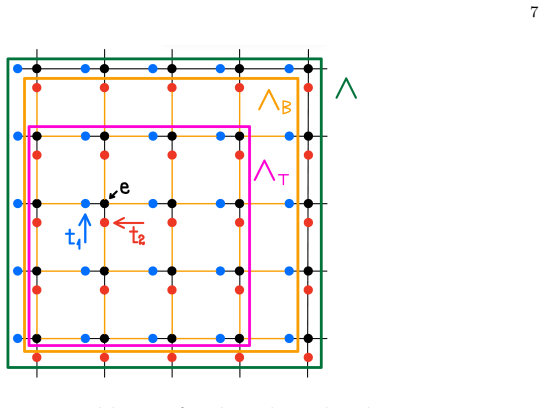
The central object is the hereditary C*-subalgebra with property (F): $B=\bigcup_{\Lambda\in K(G)}(B\cap\mathcal{S}_\Lambda)$, where $\mathcal{S}_\Lambda$ are the finite-dimensional local algebras. In each such $B$, the intersections $B\cap\mathcal{S}_\Lambda$ are corner algebras $p_\Lambda(B)\,\mathcal{S}_\Lambda\,p_\Lambda(B)$ with uniquely determined projections; property (F) makes $\{p_\Lambda(B)\}$ a frustration-free system and a localized approximate unit for $B$. The map $p$ of Theorem 4.3, with left inverse $p^{-1}$, is the mechanism: it converts the algebraic property (F) into the physically familiar nested projection families, and the rest of the paper's results flow through this identification. The supporting monotonicity $p_{\Lambda_1}p_{\Lambda_2}=p_{\Lambda_1}$ for $\Lambda_1\subseteq\Lambda_2$ is what turns local spectral projections into a frustration-free system.
What would settle it
On any finite cluster of a finitely generated amenable group, compute the spectral support projections $p_\Lambda$ of a frustration-free Hamiltonian and check $\mathrm{Ran}\,p_{\Lambda_2}\subseteq\mathrm{Ran}\,p_{\Lambda_1}$ for all $\Lambda_1\subsetneq\Lambda_2$; one failure of this nesting would put that model outside the classification diagram and settle the claim negatively.
Extended reading notes
Core claim
The central claim is that every frustration-free system of projections on $\mathcal{S}^{\otimes G}$ arises from, and is canonically subordinate to, a hereditary C*-subalgebra with property (F). Theorem 4.3 constructs the two maps: $B\mapsto\{p_\Lambda(B)\}$ is an injective, $G$-equivariant morphism of posets from $H_F(\mathcal{S}^{\otimes G})$ into the set of frustration-free proper systems, and $p^{-1}$ sends a projection system to $w\,\mathcal{S}^{\otimes G}w$ with $w=\sum_m 2^{-m}p_{\Lambda_m}$, giving a left inverse. The two maps realize frustration-free models as exactly the image of $H_F(\mathcal{S}^{\otimes G})$, so the intrinsic content of frustration-freeness is property (F). With this identification, a state is a frustration-free ground state precisely when its support is contained in the support of a property-(F) state, the frustration-free open projections are norm-dense among all open projections, the sharp LTQO condition is an SOT convergence statement, and a boundary algebra can be proposed as the relative commutant of the associated hereditary subalgebra.
Load-bearing premise
The framework rests on the known fact that the spectral support projections of any frustration-free model are nested, $p_{\Lambda_1}p_{\Lambda_2}=p_{\Lambda_1}$ for $\Lambda_1\subseteq\Lambda_2$; if a real frustration-free model violated this monotonicity, it would fall outside the classification by property (F).
Editorial extensions
If this is right
- Every frustration-free ground state is detected by property (F): a state is frustration-free exactly when its support in the pure-state space is contained in the support of a state whose hereditary subalgebra satisfies property (F) (Theorem 5.7).
- The frustration-free open projections are dense among all open projections of the double dual in the norm topology, extending the spin-chain result to arbitrary finitely generated amenable groups (Proposition 6.7).
- A frustration-free system has a unique ground state if and only if the strong-operator equation $\mathrm{SOT}\text{-}\lim (p_\Lambda^\perp a p_\Lambda^\perp-\omega(a)p_\Lambda^\perp)=0$ holds for some state $\omega$, which is the optimal form of LTQO (Theorem 6.12).
- For half-lattice models on $\mathbb{Z}^d$, the relative commutant of the property-(F) hereditary subalgebra supplies a boundary algebra under no further assumptions, and it agrees with the LTO-based boundary algebra when the strengthened LTO conditions hold (Definition 6.15 and Theorem 6.24).
- Because property (F) is formulated with a finite-dimensional filtration, frustration-freeness becomes a definable notion for any AF algebra, not just spin algebras over groups (Definition 4.8).
Reading between the lines
- One implicit consequence is that the same physical Hamiltonian can sit inside different AF filtrations and appear frustration-free in one but not another; the paper's Definition 4.8 makes the filtration part of the data, so a filtration-independent notion of frustration-freeness would require a separate argument.
- A practical diagnostic suggested by Theorem 6.12: compute the finite-system expressions $p_\Lambda^\perp a p_\Lambda^\perp-\omega(a)p_\Lambda^\perp$ for a dense set of local observables; convergence to zero in the strong operator topology is exactly the criterion for a unique frustration-free ground state, so this can be tested numerically on finite clusters.
- The boundary algebra defined as a relative commutant is expected to act as the envelope for specialized boundary algebras in the literature, and its Morita equivalence with the bulk, shown in Proposition 6.25, makes the holographic correspondence a direct algebraic consequence of frustration-freeness rather than of the stronger LTO axioms.
Editorial analysis
A structured set of objections, weighed in public.
Referee Report
Summary. The paper proposes an operator-algebraic classification of frustration-free quantum spin models on the Cayley graph of a finitely generated amenable group. For the UHF algebra S⊗G, it introduces frustration-free systems of projections and relates them, through G-equivariant poset morphisms, to hereditary C*-subalgebras satisfying property (F) (Eq. (3)), to open projections in the double dual, and to subsets of pure state space, summarized in diagram (4). The main results are an injectivity/left-inverse theorem (Thm. 4.3), a density theorem for frustration-free open projections (Prop. 6.7), an intrinsic characterization of frustration-free ground states (Thm. 5.7), an optimal local-topological-quantum-order condition for unique ground states (Thm. 6.12), and a proposal for a boundary algebra under only frustration-freeness (Def. 6.15, Thm. 6.24). The central conceptual claim is that property (F) intrinsically characterizes frustration-freeness and can serve to extend the notion to arbitrary AF algebras.
Significance. If the central definition is corrected, this is a valuable contribution. The paper gives a genuinely intrinsic, parameter-free description of frustration-freeness by reducing the landscape of models to a poset of hereditary C*-subalgebras; it proves explicit G-equivariant correspondences, including a density result that sharpens the known Z case, and an optimal LTQO criterion. The boundary-algebra proposal is natural, and the authors are honest in labeling the connection to the boundary algebras of [20] as a conjecture that holds only under a strengthened LTO4 condition (Conjecture 6.20, Prop. 6.22, Remark 6.21). No machine-checked proofs or code are supplied, but the arguments rely on standard C*-algebraic facts and appear sound once the property-(F) definition is made mathematically precise. The main issue, described below, is load-bearing but readily fixable within the manuscript's scope.
major comments (4)
- [§1, Eq. (3); §4, Definition 4.8] As printed, property (F) is the literal set equality B = ∪_{Λ∈K(G)}(B∩S_Λ). Since each S_Λ is finite-dimensional, each B∩S_Λ is a finite-dimensional subspace, hence closed and nowhere dense in any infinite-dimensional B. By the Baire category theorem, the countable union cannot equal B. Thus no infinite-dimensional hereditary C*-subalgebra of S⊗G satisfies (F), and the poset H_F(S⊗G) collapses to trivial objects; diagram (4) would not describe any nontrivial frustration-free model. The proofs, however, use a density interpretation: Lemma 4.1 approximates arbitrary b∈B by elements of B∩S_Λ, and Theorem 4.3(2) proves property (F) by norm approximation. The definition must be replaced by the closure condition B = \overline{∪_{Λ}(B∩S_Λ)}, with the same correction in Definition 4.8 and in the proof of Proposition 4.11. With that change, the main arguments appear to go through, but this is a central definition and the fix must be made consistently throughout the paper.
- [§4, Theorem 4.3(2)] In constructing B = wS⊗Gw with w = Σ 2^{-m} p_{Λ_m}, the proof asserts that {p_Λ} is an approximate unit for B and then uses this to conclude that p_{Λ_n} w a w p_{Λ_n} ∈ B∩S_{Λ_n}. This requires p_Λ ∈ B, but membership is not proved. A repair is available: for Λ ⊆ Λ_n one has p_Λ ≤ p_{Λ_n} and p_{Λ_n} ≤ 2^{n-1} w, and since wS⊗Gw is hereditary, p_Λ, p_{Λ_n} ∈ B; then the products used are indeed in B∩S_{Λ_n}. This step, and the claimed independence of B from the cofinal sequence {Λ_m}, should be stated and proved explicitly.
- [§4.2, Proposition 4.11] The proof writes B = ∪_n B_n as a set equality and concludes in Eq. (68) that uBu* equals ∪_Λ (uBu*∩S_Λ) exactly. For an infinite-dimensional hereditary B the union ∪_n B_n is only dense in B, not equal to it; the same Baire-category obstruction as in property (F) applies. The proposition should be reformulated as asserting that uBu* satisfies the closure version of property (F), or that the local intersections are dense in uBu*. The subsequent density theorem, Proposition 6.7, only needs the closure version and remains valid.
- [§2, Example 2.6, Eq. (29)] The statement 'dim V_Λ ≤ |Λ\Λ_B| < dim H_Λ' is not correct as written: the dimension bound is not the number of sites in Λ\Λ_B but the number of configurations on that set, namely (dim H)^{|Λ\Λ_B|}. The intended strict inclusion still holds, since the vectors in V_Λ are built from a fixed vector in H_{Λ_B} tensored with arbitrary vectors in H_{Λ\Λ_B}, but the displayed inequality should be corrected.
minor comments (4)
- [§2, Proposition 2.9 proof] In the proof, the notation around Eq. (40)-(42) is inconsistent: the index 'n-p' appears where 'p-n' or 'm' seems intended, and the threshold conditions for injectivity of Γ_r should be stated consistently with the definition in Eq. (36)-(37).
- [§6.3, Proposition 6.17] The annihilator computation is terse: the identification of the largest open projection q with qp=0 and the conclusion that q⊥ is the closure of p should be expanded, since this is the key step equating the annihilator with p⊥S⊗Z_+^d p⊥ ∩ S⊗Z_+^d.
- [§6.3, Conjecture 6.20 and Remark 6.21] The connection to the boundary algebra of [20] is explicitly conjectural and depends on a strengthened LTO4 condition that the authors state must still be checked for existing models. This is a clear limitation that should be kept prominent in the introduction and abstract, since the unconditional boundary-algebra proposal (Def. 6.15) is independent of that conjecture.
- [Throughout] The paper repeatedly uses the notation 'B = ∪_n B_n' and '∪_Λ S_Λ' in places where only dense union is meant. Since the literal reading is central to property (F), the authors should add a global convention stating that all such unions of non-closed sets are understood as closures, or use the closure symbol explicitly.
Circularity Check
No significant circularity; the paper's constructions are self-contained and do not reduce to fitted inputs or self-citations.
full rationale
The claimed derivation chain is not circular. The central equivalence is proved by direct construction: Theorem 4.3(2) builds, from a frustration-free system {p_Λ}, the element w = Σ 2^{-m} p_{Λ_m} and the hereditary C*-subalgebra B = wSw, and then shows that {p_Λ} is an approximate unit for B and that B satisfies property (F). The proof uses only the defining monotonicity (11) and standard approximations; it does not presuppose the conclusion. Conversely, Lemma 4.1 derives a frustration-free system from a hereditary subalgebra satisfying property (F) via the unique projections p_Λ(B). There are no fitted parameters, no predicted quantities read back from inputs, and no self-citations: the external inputs ([1], [15], [20], [31]) are independent prior work, not by the present authors. The comparison with the boundary algebra of [20] is explicitly labeled a conjecture and is conditional on a strengthened LTO4 assumption (Remark 6.21), so it is not used to force the paper's own definitions. A separate, non-circular correctness concern is that property (F) as printed in Eq. (3), B = ∪_Λ (B∩S_Λ), is a literal set equality; for an infinite-dimensional B this conflicts with the density/approximation arguments actually used in Lemma 4.1 and Theorem 4.3(2), which prove closure under norm approximation rather than literal union. This would be a definitional/vacuity bug or typo, not an equivalence-by-construction, and therefore does not raise the circularity score.
Assumptions & free parameters
assumptions (4)
- domain assumption The spectral supporting projections p_Lambda of a frustration-free inner-limit derivation satisfy p_Lambda1 p_Lambda2 = p_Lambda1 for Lambda1 subseteq Lambda2 (Eq. 11).
- standard math Standard C*-algebra facts: the bijection between states and left ideals (Thm 3.1), hereditary subalgebras and left ideals (Thm 3.3), lattice isomorphism with subsets of pure states (Prop 3.4), open projections in the double dual (Prop 6.4).
- standard math The unitary conjugation theorem for filtrations of AF algebras (Prop 4.10, from [13]).
- ad hoc to paper The strengthened LTO4 condition (x p_perp = 0 implies x = 0 for x in B(Lambda subset Delta)).
Cite this review
Pith. "Pith review of On Frustration-Free Quantum Spin Models." pith.science (2026). https://pith.science/paper/JYANZC5U
@misc{pith2026250703201,
  author       = {Pith},
  title        = {Pith review of: On Frustration-Free Quantum Spin Models},
  year         = {2026},
  howpublished = {\url{https://pith.science/paper/JYANZC5U}},
  note         = {Machine review of arXiv:2507.03201}
}
abstract
The goal of our work is to characterize the landscape of the frustration-free quantum spin models over the Cayley graph of a finitely generated group $G$. This is achieved by establishing $G$-equivariant morphisms from the partially ordered space of frustration-free models to the partially ordered spaces 1) of hereditary $C^\ast$-algebras of the underlying UHF quasi-local algebra of observables, 2) of open projections in its double dual, and 3) of subsets of pure state space. Our main result consists of an intrinsic characterization of the images of these morphisms, which captures the essence of frustration-freeness and enables us to extend the concept to generic AF-algebras. Additionally, using well established facts about AF-algebras, we prove density theorems, provide intrinsic characterizations of frustration-free ground states, and propose a definition of a boundary algebra for models constrained to half-lattices, under the sole assumption of frustration-freeness.
Figures
Forward citations
Cited by 1 Pith paper
-
On a C*-Diagonal Generated by the Toric Code
The toric-code stabilizer algebra is a C*-diagonal of M_{2^∞} equivalent to the canonical diagonal.
Reference graph
Works this paper leans on
-
[31]
B. Nachtergaele, R. Sims, A. Young,Stability of the bulk gap for frustration-free topologically ordered quantum lattice systems, Letters in Mathematical Physics114, 24 (2024). [2, 5, 19]
work page 2024
- [20]
-
[1]
I. Affleck, T. Kennedy, E. H. Lieb, H. Tasaki,Valence bond ground states in isotropic quantum antiferromagnets, Commun. Math. Phys. 115, 477-528 (1988). [2, 7, 17]
work page 1988
-
[2]
C. A. Akemann,The general Stone–Weierstrass problem, J. Funct. Anal.4, 277–294 (1969). [20, 21]
work page 1969
-
[3]
C. A. Akemann,Left ideal structure ofC ∗-algebras, Journal of Functional Analysis6, 305-317 (1970). [20]
work page 1970
-
[4]
C. A. Akemann, T. Bice,HereditaryC ∗-subalgebra lattices, Advances in Mathematics 285, 101–137 (2015). [12, 20]
work page 2015
- [5]
-
[6]
J Bosa, G. Tornetta, J. Zacharias,Open projections and suprema in the Cuntz semi- group, Math. Proc. Camb. Phil. Soc.164, 135–146 (2018). [3]
work page 2018
Show all 39 references
-
[7]
Bratteli, D
O. Bratteli, D. W. Robinson,Unbounded Derivations of C*-Algebras, Commun. Math. Phys.42, 253-268 (1975). [5]
1975
-
[8]
Brattell, D
O. Brattell, D. W. Robinson,Operator algebras and quantum statistical mechanics 1, (Springer, Berlin, 1997). [1, 11]
1997
-
[9]
Brattell, D
O. Brattell, D. W. Robinson,Operator algebras and quantum statistical mechanics 2, (Springer, Berlin, 1997). [1, 5]
1997
-
[10]
L. G. Brown,Stable isomorphism of hereditary subalgebras ofC ∗-algebras, Pacific Journal of Mathematics71, 335-348 (1977). [25]
1977
-
[11]
K. T. Coward, G. A. Elliott, C. Ivanescu,The Cuntz semigroup as an invariant for C ∗- algebras, J. Reine Angew. Math.623, 161–193 (2008). [26] 27
2008
-
[12]
Cuntz,Dimension functions on simple C*-algebras, Math
J. Cuntz,Dimension functions on simple C*-algebras, Math. Ann.233, 145–153 (1978). [26]
1978
-
[13]
Davidson,C ∗-algebras by example, (AMS, Providence, 1996)
K. Davidson,C ∗-algebras by example, (AMS, Providence, 1996). [16]
1996
-
[14]
G. A. Elliott, D. Kucerovsky,A relative double commutant theorem for hereditary sub-C*-algebras, C. R. Math. Rep. Acad. Sci. Canada29, 22-27 (2007). [23]
2007
-
[15]
Fannes, B
M. Fannes, B. Nachtergaele, and R. F. Werner,Finitely Correlated States on Quan- tum Spin Chains, Commun. Math. Phys.144,443-490 (1992). [3, 9, 10]
1992
-
[16]
Gardella, L
E. Gardella, L. Santiago,The equivariant Cuntz semigroup, Proc. London Math. Soc. 114, 189-241 (2017). [26]
2017
-
[17]
Gardella, F
E. Gardella, F. Perera,The modern theory of Cuntz semigroups ofC ∗-algebras, EMS Surv. Math. Sci. (2024), published online first. [26]
2024
-
[18]
Gr¨ atzer, Lattice theory, (Dover, Mineola, 2009)
G. Gr¨ atzer, Lattice theory, (Dover, Mineola, 2009). [15]
2009
-
[19]
S. S. Jahromi, R. Or´ us,Universal tensor-network algorithm for any infinite lattice, Phys. Rev. B99, 195105 (2019). [7]
2019
-
[21]
Kitaev1, L
A. Kitaev1, L. Kong,Models for gapped boundaries and domain walls, Commun. Math. Phys. 313, 351–373 (2012). [22, 25]
2012
-
[22]
Kong,Some universal properties of Levin-Wen models, XVIIth International Con- gress on Mathematical Physics, 444-455 (2013)
L. Kong,Some universal properties of Levin-Wen models, XVIIth International Con- gress on Mathematical Physics, 444-455 (2013). [22, 25]
2013
-
[23]
Kucerovsky,Double commutants of hereditary subalgebras of a corona, Journal of Functional Analysis219, 245-254 (2005)
D. Kucerovsky,Double commutants of hereditary subalgebras of a corona, Journal of Functional Analysis219, 245-254 (2005). [23]
2005
-
[24]
A. J. Lazar, D. C. Taylor,Approximately finite dimensionalC ∗-algebras and Bratteli diagrams, Transactions of the American Mathematical Society259, 599-619 (1980). [6]
1980
-
[25]
A. J. Lazar,AF algebras with a lattice of projections, Math. Scand.50, 135-144 (1982). [6]
1982
-
[26]
A. J. Lazar,AF algebras with directed sets of finite dimensional∗-subalgebras, Trans- actions of the American Mathematical Society275, 709-721 (1983). [6]
1983
-
[27]
A. J. Lazar, S. K. Tsui, S. Wright,Derivations from hereditary subalgebras, Can. J. Math.38, 109-126 (1986). [16]
1986
-
[28]
G. J. Murphy,C ∗-algebras and operator theory, (Academic Press, Boston, 1990). [11, 12]
1990
-
[29]
Nachtergaele,The spectral gap for some spin chains with discrete symmetry break- ing, Commun
B. Nachtergaele,The spectral gap for some spin chains with discrete symmetry break- ing, Commun. Math. Phys.175, 565-606 (1996). [2]
1996
-
[30]
Nachtergaele, A
B. Nachtergaele, A. Young, A. Lucia, M. Lemm, H. Abdul-Rahman,A class of two- dimensional AKLT models with a gap, in Analytic Trends in Mathematical Physics (2021). [7]
2021
-
[32]
Ogata,Classification of gapped ground state phases in quantum spin systems, International Congress of Mathematicians12, 4142-4161 (2023)
Y. Ogata,Classification of gapped ground state phases in quantum spin systems, International Congress of Mathematicians12, 4142-4161 (2023). [2]
2023
-
[33]
Ortega, M
E. Ortega, M. Rørdam, H. Thiel,The Cuntz semigroup and comparison of open projections, Journal of Functional Analysis260, 3474–3493 (2011). [24, 26]
2011
-
[34]
G. K. Pederson,C ∗-algebras and their automorphism groups, (Academic Press, Lon- don, 1996). [21]
1996
-
[35]
Renault,A Groupoid approach toC ∗-algebras, (Springer-Verlag, Berlin, 1980)
J. Renault,A Groupoid approach toC ∗-algebras, (Springer-Verlag, Berlin, 1980). [4]
1980
-
[36]
Sherman,The second adjoint of aC ∗-algebra, Proc
S. Sherman,The second adjoint of aC ∗-algebra, Proc. Inter. Congress Math.1, 470 (1950). [19]
1950
-
[37]
D. D. Spiegel, M. J. Pflaum,On the weak contractibility of the space of pure states, J. Func. Anal.288, 110809 (2025). [11] 28 D. P. OJITO, E. PRODAN, AND T. STOIBER
2025
-
[38]
K. R. Strung,An introduction toC ∗-algebras program, (Birkh¨ auser, Basel, 2019). [6, 13]
2019
-
[39]
Takeda,Conjugate spaces of operator algebras, Proc
Z. Takeda,Conjugate spaces of operator algebras, Proc. Japan Acad.30, 90-95 (1954). [19] Department of Physics and Department of Mathematical Sciences, Yeshiva University, New York, NY 10016, USA, danilo.poloojito@yu.edu Department of Physics and Department of Mathematical Sci...
1954
Reviewed August 6, 2026 · model on record in the stance chip above.
Discussion (0). Continue with ORCID to comment.