REVIEW 3 major objections 6 minor 85 references
LACONIC: A 3D Layout Adapter for Controllable Image Creation
T0 review · 3 major / 6 minor · reviewed 2026-08-06 · deepseek-v4-flash
Pith's one-line read A lightweight adapter trained on paired 3D layouts and cameras makes a frozen pretrained text-to-image model respect 3D geometry, support arbitrary viewpoints, and model off-screen scene context.
desk verdict LACONIC is a well-scoped, honest 3D layout adapter with real gains over 2D-conditioned baselines; the 'camera control' claim is narrower than advertised because intrinsics are fixed, but the paper says so itself, and the remaining issues are fixable. read the letter →
The pith
A machine-rendered reading of the paper's core claim, the machinery that carries it, and where it could break.
The reading
What carries the argument
The load-bearing object is the semantic 3D bounding box representation of a scene, combined with a camera reframing transform. Each object is encoded by a shared module that combines sinusoidal positional encodings of position, size, and a continuous rotation representation with text embeddings from the model's own text encoder; an optional floor plan is encoded by a PointNet. A transformer encoder turns the object and floor tokens into a scene conditioning sequence, which is injected into the frozen diffusion backbone through decoupled cross-attention: the image query attends to layout key/values and the result is added to the text-conditioned hidden state with a strength weight $\gamma$. The camera reframing, expressed as $p_i^C = R_C^\top(p_i - p_C)$ and $R_i^C = R_C^\top R_i$, maps world geometry to the target view and lets one scene render consistently from any requested viewpoint.
What would settle it
Train LACONIC on HyperSim-style synthetic scenes but evaluate on a held-out set rendered with a different field of view (for example 60 degrees instead of 90 degrees), keeping layouts and cameras otherwise identical; if FID and SOC degrade sharply relative to the matched-intrinsics setting, the consistent-intrinsics assumption is the load-bearing cause. A more direct check is to generate the same scene at two focal lengths and measure whether projected object centers in the outputs match the ground-truth projections from the camera-reframing equation.
Extended reading notes
Core claim
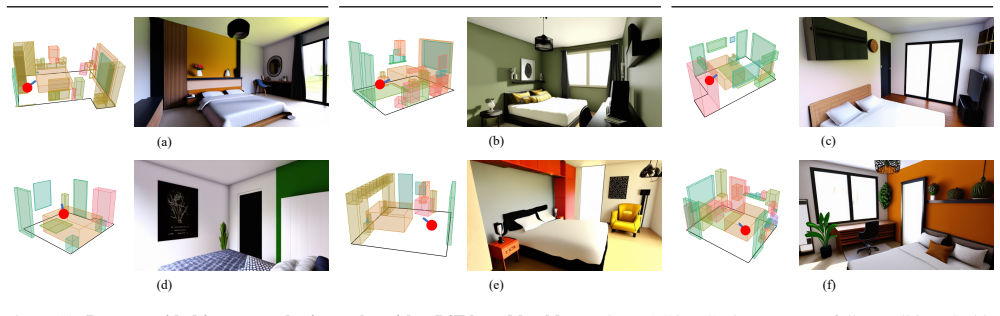
LACONIC's central claim is that a lightweight adapter trained on paired (3D layout, camera) to image data can inject 3D awareness into a frozen pretrained text-to-image diffusion model without retraining the backbone. The conditioning signal is an unordered set of objects, each described by a semantic 3D bounding box (center, size, rotation, and an open-vocabulary text caption), plus an optional floor plan point cloud and the camera's extrinsics. Before encoding, every object is transformed into camera coordinates, so the network sees the scene exactly as the target view does; this closed-form reframing is what makes viewpoint control and multi-view consistency possible. Because every object in the 3D scene is part of the conditioning sequence, off-screen items influence the render, for example letting a window outside the frame light the room. At inference the adapter supports camera control, per-object geometric edits, open-vocabulary restyling, and scene-level text prompting, and the paper reports that it outperforms the prior supervised baseline and a from-scratch-trained diffusion model on FID, KID, IS, and its object-level SOC metric.
Load-bearing premise
Every training and test image must be rendered with the same camera intrinsics; if a dataset mixes different focal lengths or real photos, the camera-reframing transform misplaces every object in the image, breaking both layout adherence and viewpoint control.
Editorial extensions
If this is right
- A single trained adapter can render the same 3D scene from arbitrary camera viewpoints with consistent object structure, because the conditioning is view-independent.
- Users can move, rotate, resize, add, or remove individual objects in 3D and regenerate the image; global text restyling changes materials and style on the relevant objects without leaking to floors or ceilings.
- Because the full 3D context is conditioned, off-screen elements are represented, so deleting a window changes the global illumination of the generated room.
- The adapter transfers to a different diffusion backbone architecture with only a retrained adapter, suggesting the 3D layout control is not tied to a specific UNet implementation.
- Object-level adherence can be measured with the paper's SOC metric, which crops visible objects and correlates their CLIP similarity with their captions.
Reading between the lines
- A natural stress test is to train or evaluate on real photographs with unknown or varied camera intrinsics; the paper's own limitation section suggests this is where the camera-reframing assumption would break, so a variant that estimates or marginalizes over intrinsics is the obvious next step.
- The same conditioning could be chained with an inverse step: use a depth or layout estimator on a single image to recover a semantic 3D layout, then use LACONIC to re-render from new viewpoints, turning the method into a 3D-aware image-to-video or editing pipeline.
- Because the scene sequence treats objects as unordered tokens, the adapter could likely be trained jointly with a 3D scene synthesis model so a generated layout can be rendered immediately; the authors note NeRF-style continuous scene representations as future work.
- The consistent-camera-intrinsics assumption suggests a testable extension: learn or predict a per-sample focal length and feed it into the reframing transform, broadening applicability beyond synthetic indoor renders.
Editorial analysis
A structured set of objections, weighed in public.
Referee Report
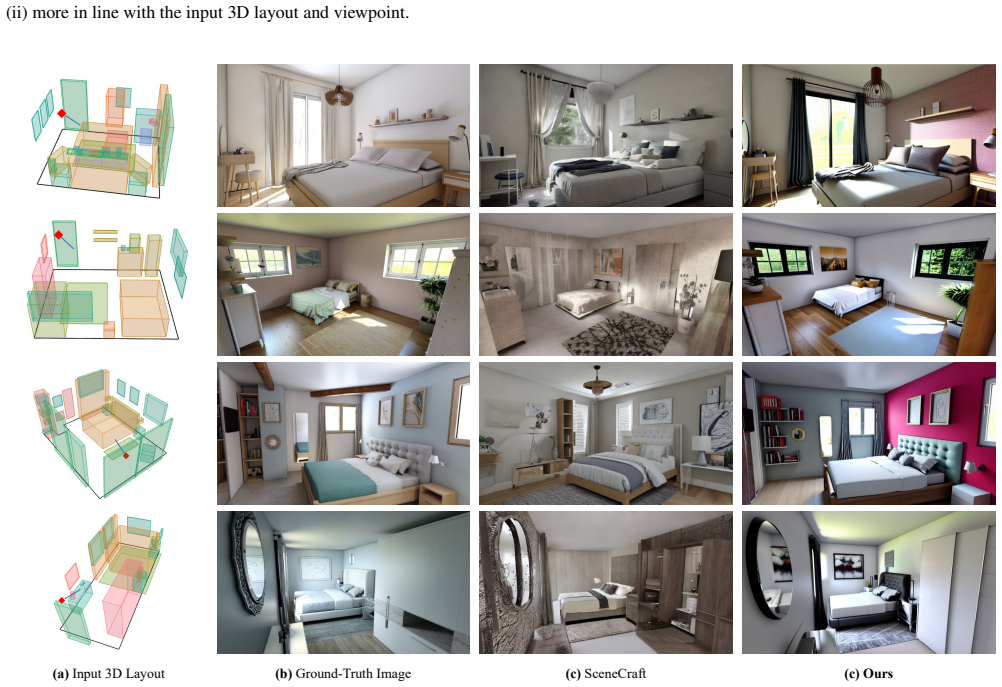
Summary. LACONIC proposes a trainable adapter that conditions a frozen text-to-image diffusion model on an explicit 3D semantic layout: per-object 3D bounding boxes with free-form language captions, an optional floor plan point cloud, and a target camera pose. The adapter encodes objects with a shared MLP and a transformer encoder, then injects the resulting tokens through decoupled cross-attention (Eqs. 2-3), with supervised training on rendered layout-image pairs under the assumption of consistent camera intrinsics. The paper reports strong quantitative gains over SceneCraft and a from-scratch diffusion baseline on HyperSim (Table 1), an ablation of the camera reframing and transformer encoder (Table 2), a perceptual study favoring LACONIC, and qualitative demonstrations of multi-view generation, object editing, text restyling, and DiT compatibility. The central claim is that semantic 3D boxes plus camera pose are a sufficient, view-consistent control signal for high-quality image synthesis from a frozen prior.
Significance. Assuming the results hold, LACONIC is a significant practical contribution to layout-guided image synthesis. It combines a parametric 3D representation with a lightweight adapter, and the evidence is consistent: large FID/KID margins over SceneCraft (9.50 vs 39.36 FID), ablations isolating camera reframing and the transformer encoder, a 638-vote perceptual study favoring LACONIC by 71.2% on realism and 89.0% on layout adherence, and a DiT-backbone demonstration. The supervised objective is standard and not circular. The main caveat is that the camera-control claim is restricted by the fixed-intrinsics assumption, which is acknowledged in Section D.
major comments (3)
- [Section 3.2, Eq. (4), Section D] The camera-conditioning mechanism is invariant to intrinsic parameters, and this limits the headline "camera control" claim. Eq. (4) feeds the adapter only the extrinsic mapping (p_C, R_C); focal length and principal point are not part of y. Under the stated assumption of consistent intrinsics the model can memorize the single projection, but at test time a user-provided camera with different intrinsics maps the same camera-space tokens to different pixel locations, so the layout condition is systematically misaligned. Section D explicitly attributes "unnatural perspective... distorted floors and objects" to this assumption. Please either incorporate intrinsics into the conditioning (or train with varying intrinsics), or qualify the abstract and Section 4 claims to "camera control with fixed intrinsic parameters" and report results under that restriction.
- [Section A.2.1 and Abstract] The claim to "account for the entire context of a scene, i.e., both on and off-screen items" is not supported by the training/evaluation protocol on HyperSim. The conditioning sequence is built by prioritizing visible objects from the target rendering and is capped at N=50, while HyperSim scenes have a median of 54 objects (and average 121), so off-screen objects will frequently be dropped. The only supporting evidence is the qualitative window-removal example in Figure 4. Please provide a controlled experiment that varies off-screen objects (e.g., ablating off-screen lighting sources) and quantifies their effect, or restrict the claim to the cases actually evaluated.
- [Section 4.2 and Figure 1(e-h)] Multi-view consistency is presented as a core capability ("maintaining a consistent 3D structure across views"), but no quantitative evaluation of cross-view consistency is provided. The three views in Figure 1 are qualitative, and the evaluation in Section 4.1 does not include a correspondence, depth, or pose-based consistency metric. Please add a quantitative multi-view consistency evaluation, for example by generating images from held-out camera poses for the same 3D layout and measuring geometric correspondence against ground-truth renderings, or by a user study specifically targeting view consistency.
minor comments (6)
- [Table 1] "w/otext prompt" is a typo; it should read "w/o text prompt".
- [Section 4.1 vs Supplementary A.2.1] The main paper states 326 unique HyperSim layouts, while the supplementary material states 323 unique scenes; please reconcile the numbers.
- [Supplementary A.6] The SOC metric thresholds (alpha=0.4, 2% area filter, exclusion of "other" NYU40 class) are not accompanied by a sensitivity analysis; a short robustness check would help assess the metric's stability.
- [Supplementary C.3] The perceptual study reports preference rates of 71.2% and 89.0% but no confidence intervals or statistical significance test; a binomial test or bootstrapped CI would strengthen the claim.
- [Supplementary B] The DiT generalization section is qualitative only; consider adding a sentence noting that no quantitative metrics are reported for the SD3 adapter, or adding a small quantitative comparison.
- [Figure 13] The caption labels (a)-(c) are not visually marked in the figure itself, making the failure examples harder to map; please add the labels directly in the image.
Circularity Check
No significant circularity: LACONIC's layout-conditioned generation is a supervised adapter trained against an external image target, and its headline results come from independent image-quality metrics and an external baseline.
full rationale
The paper's derivation chain is a standard supervised adapter training loop: Eq. (1) optimizes a denoising objective conditioned on a 3D layout y drawn from paired (layout, camera, image) data; Eq. (4) expresses object poses in camera coordinates; and the adapter is trained on HyperSim and a custom bedroom dataset. The layout input is external conditioning, not a fitted constant, and the evaluated outputs (FID/KID/IS/CLIP/SOC) compare generated images against external reference distributions or pretrained CLIP embeddings. The SOC metric is newly proposed and uses ground-truth 2D boxes for crop selection and CLIP for semantic matching; its filtering choices (alpha = 0.4, 2% area floor, NYU40 exclusion) are evaluation-design decisions and do not make the reported table values true by construction. The assumption of consistent camera intrinsics (Sec. 3.2) and the admitted perspective failures (Sec. D) bound the claimed camera control rather than reduce the method to its inputs; Eq. (4) is a geometric transformation, not a fitted re-prediction of the output. Self-citations ([38] Debara, with [46, 67, 74]) are invoked only as architectural inspiration for the layout encoder and are not load-bearing as evidence for the central claim. No step in the derivation is equivalent to its input by definition.
Assumptions & free parameters
free parameters (4)
- gamma (adapter strength, Eq. 3) =
0.0 to 0.85 at inference, user-set
- SOC visibility threshold alpha =
0.4
- Layout dropout rate pdrop =
0.15
- Max conditioning objects N=50 =
50
assumptions (5)
- domain assumption Consistent camera intrinsics across all training samples (Section 3.2).
- domain assumption Semantic 3D bounding boxes plus captions and camera pose are a sufficient generative condition for the target image.
- domain assumption VLM-generated object captions are accurate enough to supervise object appearance.
- domain assumption CLIP similarity between an object crop and its caption measures layout and semantic adherence.
- standard math Standard background: diffusion denoising objective, classifier-free guidance, attention mechanisms.
Cite this review
Pith. "Pith review of LACONIC: A 3D Layout Adapter for Controllable Image Creation." pith.science (2026). https://pith.science/paper/MXPVNC7K
@misc{pith2026250703257,
  author       = {Pith},
  title        = {Pith review of: LACONIC: A 3D Layout Adapter for Controllable Image Creation},
  year         = {2026},
  howpublished = {\url{https://pith.science/paper/MXPVNC7K}},
  note         = {Machine review of arXiv:2507.03257}
}
read the original abstract
Existing generative approaches for guided image synthesis of multi-object scenes typically rely on 2D controls in the image or text space. As a result, these methods struggle to maintain and respect consistent three-dimensional geometric structure, underlying the scene. In this paper, we propose a novel conditioning approach, training method and adapter network that can be plugged into pretrained text-to-image diffusion models. Our approach provides a way to endow such models with 3D-awareness, while leveraging their rich prior knowledge. Our method supports camera control, conditioning on explicit 3D geometries and, for the first time, accounts for the entire context of a scene, i.e., both on and off-screen items, to synthesize plausible and semantically rich images. Despite its multi-modal nature, our model is lightweight, requires a reasonable number of data for supervised learning and shows remarkable generalization power. We also introduce methods for intuitive and consistent image editing and restyling, e.g., by positioning, rotating or resizing individual objects in a scene. Our method integrates well within various image creation workflows and enables a richer set of applications compared to previous approaches.
Figures


Figures from the paper (14 more)







Reference graph
Works this paper leans on
-
[1]
Jimmy Lei Ba, Jamie Ryan Kiros, and Geoffrey E Hin- ton. Layer normalization. arXiv preprint arXiv:1607.06450,
-
[2]
Loosec- ontrol: Lifting controlnet for generalized depth conditioning
Shariq Farooq Bhat, Niloy Mitra, and Peter Wonka. Loosec- ontrol: Lifting controlnet for generalized depth conditioning. In ACM SIGGRAPH 2024 Conference Papers , pages 1–11,
2024
-
[3]
Sutherland, Michael Arbel, and Arthur Gretton
Mikołaj Bi ´nkowski, Dougal J. Sutherland, Michael Arbel, and Arthur Gretton. Demystifying MMD GANs. In Inter- national Conference on Learning Representations (ICLR) ,
-
[4]
Generative novel view synthesis with 3d-aware diffusion models
Eric R Chan, Koki Nagano, Matthew A Chan, Alexander W Bergman, Jeong Joon Park, Axel Levy, Miika Aittala, Shalini De Mello, Tero Karras, and Gordon Wetzstein. Generative novel view synthesis with 3d-aware diffusion models. In Proceedings of the IEEE/CVF International Conference on Computer Vision (ICCV), pages 4217–4229, 2023. 2
2023
-
[5]
Training-free layout control with cross-attention guidance
Minghao Chen, Iro Laina, and Andrea Vedaldi. Training-free layout control with cross-attention guidance. In Proceed- ings of the IEEE/CVF Winter Conference on Applications of Computer Vision (WACV), pages 5343–5353, 2024. 3
2024
-
[6]
Set-the-scene: Global-local training for generating controllable nerf scenes
Dana Cohen-Bar, Elad Richardson, Gal Metzer, Raja Giryes, and Daniel Cohen-Or. Set-the-scene: Global-local training for generating controllable nerf scenes. In Proceedings of the IEEE/CVF International Conference on Computer Vision (ICCV), pages 2920–2929, 2023. 3
2023
-
[7]
Build-a-scene: Interactive 3d layout control for diffusion-based image gen- eration
Abdelrahman Eldesokey and Peter Wonka. Build-a-scene: Interactive 3d layout control for diffusion-based image gen- eration. In The Thirteenth International Conference on Learning Representations (ICLR), 2025. 2, 3, 8, 17
work page 2025
-
[8]
Scaling recti- fied flow transformers for high-resolution image synthesis
Patrick Esser, Sumith Kulal, Andreas Blattmann, Rahim Entezari, Jonas M ¨uller, Harry Saini, Yam Levi, Dominik Lorenz, Axel Sauer, Frederic Boesel, et al. Scaling recti- fied flow transformers for high-resolution image synthesis. In Forty-first International Conference on Machine Learning (ICML), 2024. 8, 15, 16
work page 2024
Show all 85 references
-
[9]
PyTorch Lightning, 2019
William Falcon and The PyTorch Lightning team. PyTorch Lightning, 2019. 14
2019
-
[10]
Ctrl-room: Controllable text-to-3d room meshes generation with layout constraints
Chuan Fang, Yuan Dong, Kunming Luo, Xiaotao Hu, Rakesh Shrestha, and Ping Tan. Ctrl-room: Controllable text-to-3d room meshes generation with layout constraints. arXiv preprint arXiv:2310.03602, 2023. 2, 3
2023
-
[11]
The stable signature: Rooting watermarks in latent diffusion models
Pierre Fernandez, Guillaume Couairon, Herv ´e J ´egou, Matthijs Douze, and Teddy Furon. The stable signature: Rooting watermarks in latent diffusion models. In Proceed- ings of the IEEE/CVF International Conference on Com- puter Vision (ICCV), pages 22466–22477, 2023. 18
2023
-
[12]
3d-front: 3d furnished rooms with layouts and semantics
Huan Fu, Bowen Cai, Lin Gao, Ling-Xiao Zhang, Jiaming Wang, Cao Li, Qixun Zeng, Chengyue Sun, Rongfei Jia, Binqiang Zhao, et al. 3d-front: 3d furnished rooms with layouts and semantics. In Proceedings of the IEEE/CVF In- ternational Conference on Computer Vision (ICCV) , pages...
2021
-
[13]
Srinivasan, Jonathan T
Ruiqi Gao, Aleksander Holynski, Philipp Henzler, Arthur Brussee, Ricardo Martin Brualla, Pratul P. Srinivasan, Jonathan T. Barron, and Ben Poole. CAT3d: Create anything in 3d with multi-view diffusion models. InThe Thirty-eighth Annual Conference on Neural Information Processi...
2024
-
[14]
Nerfdiff: Single-image view synthesis with nerf-guided dis- tillation from 3d-aware diffusion
Jiatao Gu, Alex Trevithick, Kai-En Lin, Joshua M Susskind, Christian Theobalt, Lingjie Liu, and Ravi Ramamoorthi. Nerfdiff: Single-image view synthesis with nerf-guided dis- tillation from 3d-aware diffusion. In International Confer- ence on Machine Learning (ICML) , pages 118...
2023
-
[15]
Gaussian error linear units (gelus)
Dan Hendrycks and Kevin Gimpel. Gaussian error linear units (gelus). arXiv preprint arXiv:1606.08415, 2016. 14
2016 arXiv
-
[16]
Clipscore: A reference-free evaluation met- ric for image captioning
Jack Hessel, Ari Holtzman, Maxwell Forbes, Ronan Le Bras, and Yejin Choi. Clipscore: A reference-free evaluation met- ric for image captioning. arXiv preprint arXiv:2104.08718,
-
[17]
Gans trained by a two time-scale update rule converge to a local nash equilib- rium
Martin Heusel, Hubert Ramsauer, Thomas Unterthiner, Bernhard Nessler, and Sepp Hochreiter. Gans trained by a two time-scale update rule converge to a local nash equilib- rium. Advances in Neural Information Processing Systems (NeurIPS), 30, 2017. 7
2017
-
[18]
Classifier-free diffusion guidance
Jonathan Ho and Tim Salimans. Classifier-free diffusion guidance. In NeurIPS 2021 Workshop on Deep Generative Models and Downstream Applications, 2021. 5
2021
-
[19]
Denoising diffu- sion probabilistic models
Jonathan Ho, Ajay Jain, and Pieter Abbeel. Denoising diffu- sion probabilistic models. Advances in Neural Information Processing Systems (NeurIPS), 33:6840–6851, 2020. 2, 14
2020
-
[20]
Video dif- fusion models
Jonathan Ho, Tim Salimans, Alexey Gritsenko, William Chan, Mohammad Norouzi, and David J Fleet. Video dif- fusion models. Advances in Neural Information Processing Systems (NeurIPS), 35:8633–8646, 2022. 2
2022
-
[21]
Text2room: Extracting textured 3d meshes from 2d text-to-image models
Lukas H ¨ollein, Ang Cao, Andrew Owens, Justin Johnson, and Matthias Nießner. Text2room: Extracting textured 3d meshes from 2d text-to-image models. In Proceedings of the IEEE/CVF International Conference on Computer Vision (ICCV), pages 7909–7920, 2023. 2
2023
-
[22]
LoRA: Low-rank adaptation of large language models
Edward J Hu, yelong shen, Phillip Wallis, Zeyuan Allen- Zhu, Yuanzhi Li, Shean Wang, Lu Wang, and Weizhu Chen. LoRA: Low-rank adaptation of large language models. InIn- ternational Conference on Learning Representations (ICLR),
-
[23]
Elucidating the design space of diffusion-based generative models
Tero Karras, Miika Aittala, Timo Aila, and Samuli Laine. Elucidating the design space of diffusion-based generative models. Advances in Neural Information Processing Systems (NeurIPS), 35:26565–26577, 2022. 2
2022
-
[24]
Controllable text-to-image generation
Bowen Li, Xiaojuan Qi, Thomas Lukasiewicz, and Philip Torr. Controllable text-to-image generation. Advances in 9 neural information processing systems (NeurIPS), 32, 2019. 2
2019
-
[25]
Blip: Bootstrapping language-image pre-training for uni- fied vision-language understanding and generation
Junnan Li, Dongxu Li, Caiming Xiong, and Steven Hoi. Blip: Bootstrapping language-image pre-training for uni- fied vision-language understanding and generation. In In- ternational Conference on Machine Learning (ICML), pages 12888–12900. PMLR, 2022. 5
2022
-
[26]
Grains: Generative re- cursive autoencoders for indoor scenes
Manyi Li, Akshay Gadi Patil, Kai Xu, Siddhartha Chaudhuri, Owais Khan, Ariel Shamir, Changhe Tu, Baoquan Chen, Daniel Cohen-Or, and Hao Zhang. Grains: Generative re- cursive autoencoders for indoor scenes. ACM Transactions on Graphics (TOG), 38(2):1–16, 2019. 3
2019
-
[27]
Gligen: Open-set grounded text-to-image generation
Yuheng Li, Haotian Liu, Qingyang Wu, Fangzhou Mu, Jian- wei Yang, Jianfeng Gao, Chunyuan Li, and Yong Jae Lee. Gligen: Open-set grounded text-to-image generation. InPro- ceedings of the IEEE/CVF Conference on Computer Vision and Pattern Recognition (CVPR), pages 22511–22521, 2...
2023
-
[28]
Unraveling the hidden environmental impacts of ai solutions for environment
Anne-Laure Ligozat, Julien Lef `evre, Aur ´elie Bugeau, and Jacques Combaz. Unraveling the hidden environmental impacts of ai solutions for environment. arXiv preprint arXiv:2110.11822, 2021. 18
2021 arXiv
-
[29]
Yaron Lipman, Ricky T. Q. Chen, Heli Ben-Hamu, Maxim- ilian Nickel, and Matthew Le. Flow matching for genera- tive modeling. In The Eleventh International Conference on Learning Representations (ICLR), 2023. 2, 16
2023
-
[30]
Visual instruction tuning
Haotian Liu, Chunyuan Li, Qingyang Wu, and Yong Jae Lee. Visual instruction tuning. Advances in Neural Information Processing Systems (NeurIPS) , 36:34892–34916, 2023. 5, 14
2023
-
[31]
SINGAPO: Single image con- trolled generation of articulated parts in objects
Jiayi Liu, Denys Iliash, Angel X Chang, Manolis Savva, and Ali Mahdavi-Amiri. SINGAPO: Single image con- trolled generation of articulated parts in objects. In The Thirteenth International Conference on Learning Represen- tations (ICLR), 2025. 2
2025
-
[32]
One-2-3-45: Any single image to 3d mesh in 45 seconds without per-shape optimiza- tion
Minghua Liu, Chao Xu, Haian Jin, Linghao Chen, Mukund Varma T, Zexiang Xu, and Hao Su. One-2-3-45: Any single image to 3d mesh in 45 seconds without per-shape optimiza- tion. Advances in Neural Information Processing Systems (NeurIPS), 36, 2023. 2
2023
-
[33]
Decoupled weight decay regularization
Ilya Loshchilov and Frank Hutter. Decoupled weight decay regularization. arXiv preprint arXiv:1711.05101, 2017. 14
2017 arXiv
-
[34]
Dpm-solver: A fast ode solver for dif- fusion probabilistic model sampling in around 10 steps
Cheng Lu, Yuhao Zhou, Fan Bao, Jianfei Chen, Chongxuan Li, and Jun Zhu. Dpm-solver: A fast ode solver for dif- fusion probabilistic model sampling in around 10 steps. Ad- vances in Neural Information Processing Systems (NeurIPS), 35:5775–5787, 2022. 15
2022
-
[35]
Power hungry processing: Watts driving the cost of ai deployment? In Proceedings of the 2024 ACM conference on fairness, ac- countability, and transparency, pages 85–99, 2024
Sasha Luccioni, Yacine Jernite, and Emma Strubell. Power hungry processing: Watts driving the cost of ai deployment? In Proceedings of the 2024 ACM conference on fairness, ac- countability, and transparency, pages 85–99, 2024. 18
2024
-
[36]
Repaint: Inpainting using denoising diffusion probabilistic models
Andreas Lugmayr, Martin Danelljan, Andres Romero, Fisher Yu, Radu Timofte, and Luc Van Gool. Repaint: Inpainting using denoising diffusion probabilistic models. In Proceed- ings of the IEEE/CVF Conference on Computer Vision and Pattern Recognition (CVPR), pages 11461–11471, 2022. 6
2022
-
[37]
Gonzalez, Zhifeng Chen, Russ Salakhutdi- nov, and Ion Stoica
Michael Luo, Justin Wong, Brandon Trabucco, Yanping Huang, Joseph E. Gonzalez, Zhifeng Chen, Russ Salakhutdi- nov, and Ion Stoica. Stylus: Automatic adapter selection for diffusion models. In The Thirty-eighth Annual Conference on Neural Information Processing Systems (NeurIPS...
2024
-
[38]
Debara: Denoising-based 3d room arrangement generation
L ´eopold Maillard, Nicolas Sereyjol-Garros, Tom Durand, and Maks Ovsjanikov. Debara: Denoising-based 3d room arrangement generation. In Advances in Neural Informa- tion Processing Systems (NeurIPS) , pages 109202–109232,
-
[39]
Object 3dit: Language-guided 3d-aware image editing
Oscar Michel, Anand Bhattad, Eli VanderBilt, Ranjay Kr- ishna, Aniruddha Kembhavi, and Tanmay Gupta. Object 3dit: Language-guided 3d-aware image editing. Advances in Neural Information Processing Systems (NeurIPS), 36, 2023. 2
2023
-
[40]
T2i-adapter: Learning adapters to dig out more controllable ability for text-to-image diffusion models
Chong Mou, Xintao Wang, Liangbin Xie, Yanze Wu, Jian Zhang, Zhongang Qi, and Ying Shan. T2i-adapter: Learning adapters to dig out more controllable ability for text-to-image diffusion models. In Proceedings of the AAAI Conference on Artificial Intelligence, pages 4296–4304, 2024. 2, 3
2024
-
[41]
Glide: Towards photorealis- tic image generation and editing with text-guided diffusion models
Alexander Quinn Nichol, Prafulla Dhariwal, Aditya Ramesh, Pranav Shyam, Pamela Mishkin, Bob Mcgrew, Ilya Sutskever, and Mark Chen. Glide: Towards photorealis- tic image generation and editing with text-guided diffusion models. In International Conference on Machine Learning (I...
2022
-
[42]
Maxime Oquab, Timoth ´ee Darcet, Th´eo Moutakanni, Huy V . V o, Marc Szafraniec, Vasil Khalidov, Pierre Fernandez, Daniel HAZIZA, Francisco Massa, Alaaeldin El-Nouby, Mido Assran, Nicolas Ballas, Wojciech Galuba, Russell Howes, Po-Yao Huang, Shang-Wen Li, Ishan Misra, Michael ...
2024
-
[43]
Diffusion handles enabling 3d edits for diffusion models by lifting ac- tivations to 3d
Karran Pandey, Paul Guerrero, Matheus Gadelha, Yannick Hold-Geoffroy, Karan Singh, and Niloy J Mitra. Diffusion handles enabling 3d edits for diffusion models by lifting ac- tivations to 3d. In Proceedings of the IEEE/CVF Conference on Computer Vision and Pattern Recognition (...
2024
-
[44]
Generative layout modeling using con- straint graphs
Wamiq Para, Paul Guerrero, Tom Kelly, Leonidas J Guibas, and Peter Wonka. Generative layout modeling using con- straint graphs. In Proceedings of the IEEE/CVF Interna- tional Conference on Computer Vision (ICCV), pages 6690– 6700, 2021. 3
2021
-
[45]
Benchmark for compositional text-to- image synthesis
Dong Huk Park, Samaneh Azadi, Xihui Liu, Trevor Darrell, and Anna Rohrbach. Benchmark for compositional text-to- image synthesis. In Thirty-fifth Conference on Neural Infor- mation Processing Systems Datasets and Benchmarks Track (Round 1), 2021. 2
2021
-
[46]
Atiss: Autore- gressive transformers for indoor scene synthesis
Despoina Paschalidou, Amlan Kar, Maria Shugrina, Karsten Kreis, Andreas Geiger, and Sanja Fidler. Atiss: Autore- gressive transformers for indoor scene synthesis. Advances in Neural Information Processing Systems (NeurIPS) , 34: 12013–12026, 2021. 3, 4, 5, 13 10
2021
-
[47]
Pytorch: An im- perative style, high-performance deep learning library
Adam Paszke, Sam Gross, Francisco Massa, Adam Lerer, James Bradbury, Gregory Chanan, Trevor Killeen, Zeming Lin, Natalia Gimelshein, Luca Antiga, et al. Pytorch: An im- perative style, high-performance deep learning library. Ad- vances in Neural Information Processing Systems ...
2019
-
[48]
Scalable diffusion mod- els with transformers
William Peebles and Saining Xie. Scalable diffusion mod- els with transformers. In Proceedings of the IEEE/CVF In- ternational Conference on Computer Vision (ICCV) , pages 4195–4205, 2023. 2, 16
2023
-
[49]
Grounded text-to-image synthesis with attention refocusing
Quynh Phung, Songwei Ge, and Jia-Bin Huang. Grounded text-to-image synthesis with attention refocusing. In Pro- ceedings of the IEEE/CVF Conference on Computer Vision and Pattern Recognitio (CVPR), pages 7932–7942, 2024. 2
2024
-
[50]
Movie gen: A cast of media foundation models
Adam Polyak, Amit Zohar, Andrew Brown, Andros Tjandra, Animesh Sinha, Ann Lee, Apoorv Vyas, Bowen Shi, Chih- Yao Ma, Ching-Yao Chuang, et al. Movie gen: A cast of media foundation models. arXiv preprint arXiv:2410.13720,
-
[51]
Barron, and Ben Milden- hall
Ben Poole, Ajay Jain, Jonathan T. Barron, and Ben Milden- hall. Dreamfusion: Text-to-3d using 2d diffusion. In The Eleventh International Conference on Learning Representa- tions (ICLR), 2023. 3
2023
-
[52]
Pointnet: Deep learning on point sets for 3d classification and segmentation
Charles R Qi, Hao Su, Kaichun Mo, and Leonidas J Guibas. Pointnet: Deep learning on point sets for 3d classification and segmentation. In Proceedings of the IEEE Conference on Computer Vision and Pattern Recognition (CVPR), pages 652–660, 2017. 5, 13
2017
-
[53]
Learn- ing transferable visual models from natural language super- vision
Alec Radford, Jong Wook Kim, Chris Hallacy, Aditya Ramesh, Gabriel Goh, Sandhini Agarwal, Girish Sastry, Amanda Askell, Pamela Mishkin, Jack Clark, et al. Learn- ing transferable visual models from natural language super- vision. In International Conference on Machine Learning...
2021
-
[54]
Hypersim: A photorealistic syn- thetic dataset for holistic indoor scene understanding
Mike Roberts, Jason Ramapuram, Anurag Ranjan, Atulit Kumar, Miguel Angel Bautista, Nathan Paczan, Russ Webb, and Joshua M Susskind. Hypersim: A photorealistic syn- thetic dataset for holistic indoor scene understanding. In Proceedings of the IEEE/CVF International Conference o...
2021
-
[55]
High-resolution image synthesis with latent diffusion models
Robin Rombach, Andreas Blattmann, Dominik Lorenz, Patrick Esser, and Bj ¨orn Ommer. High-resolution image synthesis with latent diffusion models. In Proceedings of the IEEE/CVF Conference on Computer Vision and Pattern Recognition (CVPR), pages 10684–10695, 2022. 2, 3, 7, 13, 15
2022
-
[56]
U- net: Convolutional networks for biomedical image segmen- tation
Olaf Ronneberger, Philipp Fischer, and Thomas Brox. U- net: Convolutional networks for biomedical image segmen- tation. In Medical image computing and computer-assisted intervention–MICCAI 2015: 18th international conference, Munich, Germany, October 5-9, 2015, proceedings, pa...
2015
-
[57]
Ipadapter- instruct: Resolving ambiguity in image-based conditioning using instruct prompts
Ciara Rowles, Shimon Vainer, Dante De Nigris, Slava Elizarov, Konstantin Kutsy, and Simon Donn ´e. Ipadapter- instruct: Resolving ambiguity in image-based conditioning using instruct prompts. In European Conference on Com- puter Vision (ECCV), pages 54–70. Springer, 2025. 16
2025
-
[58]
Photorealistic text-to-image diffusion models with deep language understanding
Chitwan Saharia, William Chan, Saurabh Saxena, Lala Li, Jay Whang, Emily L Denton, Kamyar Ghasemipour, Raphael Gontijo Lopes, Burcu Karagol Ayan, Tim Salimans, et al. Photorealistic text-to-image diffusion models with deep language understanding. Advances in Neural Information...
2022
-
[59]
Improved techniques for training gans
Tim Salimans, Ian Goodfellow, Wojciech Zaremba, Vicki Cheung, Alec Radford, and Xi Chen. Improved techniques for training gans. Advances in Neural Information Process- ing Systems (NeurIPS), 29, 2016. 7
2016
-
[60]
Watermark anything with localized messages
Tom Sander, Pierre Fernandez, Alain Durmus, Teddy Furon, and Matthijs Douze. Watermark anything with localized messages. arXiv preprint arXiv:2411.07231, 2024. 18
2024 arXiv
-
[61]
Controlroom3d: Room gen- eration using semantic proxy rooms
Jonas Schult, Sam Tsai, Lukas H ¨ollein, Bichen Wu, Jialiang Wang, Chih-Yao Ma, Kunpeng Li, Xiaofang Wang, Felix Wimbauer, Zijian He, et al. Controlroom3d: Room gen- eration using semantic proxy rooms. In Proceedings of the IEEE/CVF Conference on Computer Vision and Pattern Re...
2024
-
[62]
MVDream: Multi-view diffusion for 3d gen- eration
Yichun Shi, Peng Wang, Jianglong Ye, Long Mai, Kejie Li, and Xiao Yang. MVDream: Multi-view diffusion for 3d gen- eration. In The Twelfth International Conference on Learn- ing Representations, 2024. 3
2024
-
[63]
Indoor segmentation and support inference from rgbd images
Nathan Silberman, Derek Hoiem, Pushmeet Kohli, and Rob Fergus. Indoor segmentation and support inference from rgbd images. In Computer Vision–ECCV 2012: 12th Eu- ropean Conference on Computer Vision, Florence, Italy, Oc- tober 7-13, 2012, Proceedings, Part V 12 , pages 746–760...
2012
-
[64]
Make-a-video: Text-to-video generation without text-video data
Uriel Singer, Adam Polyak, Thomas Hayes, Xi Yin, Jie An, Songyang Zhang, Qiyuan Hu, Harry Yang, Oron Ashual, Oran Gafni, Devi Parikh, Sonal Gupta, and Yaniv Taigman. Make-a-video: Text-to-video generation without text-video data. In The Eleventh International Conference on Lea...
2023
-
[65]
Denoising diffusion implicit models
Jiaming Song, Chenlin Meng, and Stefano Ermon. Denoising diffusion implicit models. arXiv preprint arXiv:2010.02502, 2020. 15
2010 arXiv
-
[66]
Score-based generative modeling through stochastic differential equa- tions
Yang Song, Jascha Sohl-Dickstein, Diederik P Kingma, Ab- hishek Kumar, Stefano Ermon, and Ben Poole. Score-based generative modeling through stochastic differential equa- tions. In International Conference on Learning Represen- tations (ICLR), 2021. 2
2021
-
[67]
Diffuscene: Denoising diffu- sion models for generative indoor scene synthesis
Jiapeng Tang, Yinyu Nie, Lev Markhasin, Angela Dai, Justus Thies, and Matthias Nießner. Diffuscene: Denoising diffu- sion models for generative indoor scene synthesis. In Pro- ceedings of the IEEE/CVF Conference on Computer Vision and Pattern Recognition (CVPR), pages 20507–20...
2024
-
[68]
Mvdiffusion: Enabling holistic multi- view image generation with correspondence-aware diffu- sion
Shitao Tang, Fuyang Zhang, Jiacheng Chen, Peng Wang, and Yasutaka Furukawa. Mvdiffusion: Enabling holistic multi- view image generation with correspondence-aware diffu- sion. In Advances in Neural Information Processing Systems (NeurIPS), pages 51202–51233, 2023. 2
2023
-
[69]
Attention is all you need
Ashish Vaswani, Noam Shazeer, Niki Parmar, Jakob Uszko- reit, Llion Jones, Aidan N Gomez, Łukasz Kaiser, and Illia Polosukhin. Attention is all you need. Advances in Neural 11 Information Processing Systems (NeurIPS) , 30, 2017. 3, 4, 5, 13, 14
2017
-
[70]
Diffusers: State-of-the-art diffu- sion models
Patrick von Platen, Suraj Patil, Anton Lozhkov, Pedro Cuenca, Nathan Lambert, Kashif Rasul, Mishig Davaadorj, Dhruv Nair, Sayak Paul, William Berman, Yiyi Xu, Steven Liu, and Thomas Wolf. Diffusers: State-of-the-art diffu- sion models. https://github.com/huggingface/ diffusers...
2022
-
[71]
Diffusion models are geometry critics: Single im- age 3d editing using pre-trained diffusion priors
Ruicheng Wang, Jianfeng Xiang, Jiaolong Yang, and Xin Tong. Diffusion models are geometry critics: Single im- age 3d editing using pre-trained diffusion priors. In Euro- pean Conference on Computer Vision (ECCV) , pages 441–
-
[72]
Seman- tic image synthesis via diffusion models
Weilun Wang, Jianmin Bao, Wengang Zhou, Dongdong Chen, Dong Chen, Lu Yuan, and Houqiang Li. Seman- tic image synthesis via diffusion models. arXiv preprint arXiv:2207.00050, 2022. 3
2022
-
[73]
Novel view synthesis with diffusion models
Daniel Watson, William Chan, Ricardo Martin Bru- alla, Jonathan Ho, Andrea Tagliasacchi, and Mohammad Norouzi. Novel view synthesis with diffusion models. In The Eleventh International Conference on Learning Repre- sentations (ICLR), 2023. 2
2023
-
[74]
Lego-net: Learning regular rearrangements of ob- jects in rooms
Qiuhong Anna Wei, Sijie Ding, Jeong Joon Park, Rahul Sajnani, Adrien Poulenard, Srinath Sridhar, and Leonidas Guibas. Lego-net: Learning regular rearrangements of ob- jects in rooms. In Proceedings of the IEEE/CVF Conference on Computer Vision and Pattern Recognition (CVPR), p...
2023
-
[75]
Hud- son, Igor Gilitschenski, Yusuf Aytar, Sjoerd van Steenkiste, Kelsey R Allen, and Thomas Kipf
Ziyi Wu, Yulia Rubanova, Rishabh Kabra, Drew A. Hud- son, Igor Gilitschenski, Yusuf Aytar, Sjoerd van Steenkiste, Kelsey R Allen, and Thomas Kipf. Neural assets: 3d-aware multi-object scene synthesis with image diffusion models. In The Thirty-eighth Annual Conference on Neural...
2024
-
[76]
3d-aware image generation using 2d diffusion mod- els
Jianfeng Xiang, Jiaolong Yang, Binbin Huang, and Xin Tong. 3d-aware image generation using 2d diffusion mod- els. In Proceedings of the IEEE/CVF International Confer- ence on Computer Vision (ICCV) , pages 2383–2393, 2023. 2
2023
-
[77]
Scenecraft: Layout-guided 3d scene generation
Xiuyu Yang, Yunze Man, Junkun Chen, and Yu-Xiong Wang. Scenecraft: Layout-guided 3d scene generation. Ad- vances in Neural Information Processing Systems (NeurIPS), 37:82060–82084, 2024. 2, 3, 5, 6, 7, 8, 14, 15, 17, 18, 19
2024
-
[78]
Reco: Region-controlled text-to-image genera- tion
Zhengyuan Yang, Jianfeng Wang, Zhe Gan, Linjie Li, Kevin Lin, Chenfei Wu, Nan Duan, Zicheng Liu, Ce Liu, Michael Zeng, et al. Reco: Region-controlled text-to-image genera- tion. In Proceedings of the IEEE/CVF Conference on Com- puter Vision and Pattern Recognition (CVPR), page...
2023
-
[79]
Ip- adapter: Text compatible image prompt adapter for text-to- image diffusion models
Hu Ye, Jun Zhang, Sibo Liu, Xiao Han, and Wei Yang. Ip- adapter: Text compatible image prompt adapter for text-to- image diffusion models. arXiv preprint arXiv:2308.06721,
-
[80]
Scannet++: A high-fidelity dataset of 3d in- door scenes
Chandan Yeshwanth, Yueh-Cheng Liu, Matthias Nießner, and Angela Dai. Scannet++: A high-fidelity dataset of 3d in- door scenes. In Proceedings of the IEEE/CVF International Conference on Computer Vision (ICCV), pages 12–22, 2023. 2
2023
-
[81]
Commonscenes: Generating commonsense 3d indoor scenes with scene graphs
Guangyao Zhai, Evin Pınar ¨Ornek, Shun-Cheng Wu, Yan Di, Federico Tombari, Nassir Navab, and Benjamin Busam. Commonscenes: Generating commonsense 3d indoor scenes with scene graphs. Advances in Neural Information Process- ing Systems (NeurIPS), 36, 2024. 3
2024
-
[82]
Adding conditional control to text-to-image diffusion models
Lvmin Zhang, Anyi Rao, and Maneesh Agrawala. Adding conditional control to text-to-image diffusion models. In Proceedings of the IEEE/CVF International Conference on Computer Vision (ICCV), pages 3836–3847, 2023. 2, 3, 15, 17
2023
-
[83]
Layoutdiffusion: Controllable diffu- sion model for layout-to-image generation
Guangcong Zheng, Xianpan Zhou, Xuewei Li, Zhongang Qi, Ying Shan, and Xi Li. Layoutdiffusion: Controllable diffu- sion model for layout-to-image generation. In Proceedings of the IEEE/CVF Conference on Computer Vision and Pat- tern Recognition (CVPR), pages 22490–22499, 2023. 3
2023
-
[84]
Bias in generative ai
Mi Zhou, Vibhanshu Abhishek, Timothy Derdenger, Jaymo Kim, and Kannan Srinivasan. Bias in generative ai. arXiv preprint arXiv:2403.02726, 2024. 18
2024 arXiv
-
[85]
The great wave
Yi Zhou, Connelly Barnes, Jingwan Lu, Jimei Yang, and Hao Li. On the continuity of rotation representations in neu- ral networks. In Proceedings of the IEEE/CVF Conference on Computer Vision and Pattern Recognition (CVPR), pages 5745–5753, 2019. 5, 13 12 LACONIC: A 3D Layout A...
2019
Reviewed August 6, 2026 · model on record in the stance chip above.
Discussion (0). Sign in to comment.