REVIEW 2 major objections 5 minor 52 references
Impact of charge-density-wave pattern on the superconducting gap in V-based kagome superconductors
T0 review · 2 major / 5 minor · reviewed 2026-08-06 · deepseek-v4-flash
Pith's one-line read K/RbV3Sb5 have fully gapped, nearly isotropic s-wave pairing, unlike CsV3Sb5, and the CDW stacking pattern explains the difference.
desk verdict New penetration-depth data show K/RbV3Sb5 are fully gapped and isotropic, but the CDW-stacking explanation trips on its own numbers for Rb. read the letter →
The pith
A machine-rendered reading of the paper's core claim, the machinery that carries it, and where it could break.
The reading
What carries the argument
The load-bearing object is the $d_{xz}$-orbital kagome-lattice band in the $2\times2\times2$ CDW state, folded so the three van Hove points move to the zone center $\Gamma$. In-plane hopping is modulated by $\delta t$, with $\delta t>0$ for the tri-hexagonal (TrH) bond order and $\delta t<0$ for the star-of-David (SoD) bond order; the vertical stacking of these patterns decides the low-energy spectrum. The identity carrying the argument is the condition $4|\delta t| \gtrsim |E_{\rm vHS}|$: when it holds, the TrH-TrH stacking opens a hybridization gap around $\Gamma$ and removes the $d_{xz}$ Fermi pockets, while a TrH-SoD stacking leaves one pocket alive. The paper uses a three-dimensional $(d_{xz}, d_{yz})$ kagome model to show that pocket survival tracks the stacking, and connects the surviving pockets to bond-order fluctuations that produce anisotropic $s$-wave pairing.
What would settle it
Measure the low-temperature Fermi surface of clean RbV3Sb5 by angle-resolved photoemission with enough resolution to see the folded zone-center pockets: if small $d_{xz}$-orbital pockets are present, the TrH-TrH pocket-removal mechanism that is supposed to make the gap isotropic is not operating.
Extended reading notes
Core claim
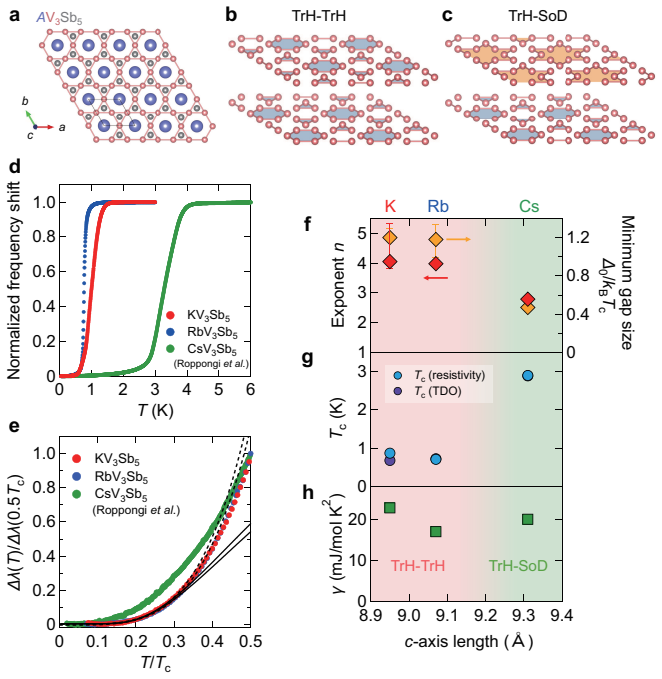
The central discovery is that the superconducting order parameter in KV3Sb5 and RbV3Sb5 is an isotropic, sign-preserving $s$-wave gap, established by Meissner-state penetration depth measurements showing exponential low-temperature behavior with $n > 2$ and by irradiation studies in which low-energy excitations stay almost unchanged. In CsV3Sb5 the same measurement protocol yields a strongly anisotropic gap that becomes more isotropic with irradiation. The paper attributes this contrast to the CDW bond-order stacking: a $\pi$-shifted tri-hexagonal (TrH-TrH) pattern in K/Rb reconstructs the $d_{xz}$-orbital band so that the three van Hove points merge at the folded $\Gamma$ point and, under hybridization, the small Fermi pockets disappear; the TrH-SoD pattern in Cs keeps one such pocket, and the associated bond-order fluctuations drive anisotropic $s$-wave pairing with a higher $T_c$.
Load-bearing premise
The explanation relies on the CDW pattern in K and Rb actually erasing the small electronic pockets tied to the van Hove points; with the paper's own numbers that erasure criterion is met for K but not for Rb, so if the pockets survive in Rb the isotropic-gap story for Rb loses its support.
Editorial extensions
If this is right
- KV3Sb5 and RbV3Sb5 have sign-preserving isotropic s-wave gaps, so ordinary nonmagnetic impurities should not suppress their Tc, consistent with the observed Tc increase on irradiation.
- The charge-density-wave order competes with superconductivity in K/Rb: irradiation that lowers TCDW raises Tc, so tuning CDW strength is a route to controlling Tc in this family.
- In CsV3Sb5 the CDW stacking preserves the dxz-orbital van Hove pockets, and the resulting bond-order fluctuations are the reason its gap is anisotropic and its Tc is higher; removing the star-of-David layers should remove both effects.
- The double-peaked superconducting dome in CsV3Sb5 under pressure or doping likely reflects a change in CDW stacking and bond-order fluctuation strength rather than a simple density-of-states effect.
Reading between the lines
- The paper's stated parameters ($|\delta t|=0.015$ eV and $|E_{\rm vHS}|\approx0.08$ eV for Rb) do not satisfy its own pocket-removal condition $4|\delta t| \gtrsim |E_{\rm vHS}|$ for Rb, so the isotropic-gap explanation for Rb currently rests on a premise the numbers do not clearly support; low-temperature ARPES on RbV3Sb5 would test it directly.
- If the stacking mechanism is right, the same logic predicts that any AV3Sb5 variant whose CDW stacking develops a star-of-David component should show anisotropic gap and enhanced Tc, a testable prediction the paper does not explicitly state.
- The irradiation-induced Tc increase in K/Rb could be converted into a quantitative measure of SC-CDW competition strength, for example by fitting the slope $dT_c/d\rho_0$ to a model with a single competing-order coupling, giving a pressure-free way to compare competition across the whole family.
Editorial analysis
A structured set of objections, weighed in public.
Referee Report
Summary. The paper reports magnetic penetration depth measurements on K/RbV3Sb5 using the tunnel diode oscillator technique in the Meissner state, combined with controlled electron irradiation, and compares the results with a previous study of CsV3Sb5. The authors find that K/RbV3Sb5 exhibit fully gapped, nearly isotropic s-wave superconductivity, with minimal change in the penetration depth upon irradiation and an increase in Tc with disorder, whereas CsV3Sb5 shows a strongly anisotropic s-wave gap that is suppressed by impurities. They attribute this difference to distinct CDW stacking patterns: the TrH-TrH stacking in K/Rb is argued to remove the dxz-orbital van Hove Fermi pockets, while the TrH-SoD stacking in Cs preserves one pocket, leading to anisotropic s-wave pairing and enhanced Tc via bond-order fluctuations. The paper claims to establish a systematic SC-CDW framework across the AV3Sb5 family.
Significance. The experimental findings are significant and timely: they provide bulk, Meissner-state evidence for fully gapped isotropic s-wave pairing in K/RbV3Sb5, contradicting earlier nodal-gap suggestions, and they systematically compare the gap anisotropy across the entire AV3Sb5 family using a phase-sensitive impurity-dependence approach. The observation that Tc increases with electron irradiation in K/Rb, opposite to Cs, is a valuable constraint on the SC-CDW competition. If the theoretical attribution is correct, the paper would establish a direct link between CDW stacking patterns and the superconducting gap structure. The theoretical model is not fitted to the SC data, and the experimental analysis is careful, including multiple fitting forms and error estimates. However, the theoretical explanation currently suffers from a quantitative inconsistency for RbV3Sb5, which weakens the central claim as written.
major comments (2)
- [Theoretical analysis, around Fig. 4j] The pocket-removal condition for the TrH-TrH state is stated as 4|δt| ≳ |EvHS|, and the text sets |δt| = 0.015 eV and quotes |EvHS| = 0.06, 0.08, and 0.10 eV for K, Rb, and Cs, respectively. With these values, 4|δt| = 0.06 eV, so the condition is only marginally satisfied for K (0.06 eV ≥ 0.06 eV) and fails for Rb (0.06 eV < 0.08 eV). Consequently, the model does not predict the disappearance of the two dxz-orbital Fermi pockets in RbV3Sb5, which is one of the two compounds whose isotropic gap is a headline experimental result. The central theoretical attribution for Rb is therefore not supported by the paper's own parameters; the authors should either provide material-specific values of δt (e.g., from first-principles calculations) or revise the mechanism.
- [Theoretical analysis, paragraph after Fig. 4j] The authors explicitly state that "the stacking pattern of BO in our samples is not experimentally confirmed." Since the proposed explanation of the gap isotropy in K/RbV3Sb5 relies on the TrH-TrH stacking and the gap anisotropy in CsV3Sb5 on the TrH-SoD stacking, the connection between the measured gap structure and the assumed CDW pattern is conditional on an unverified assumption. The paper should either provide evidence for the stacking in the measured crystals or discuss how robust the conclusions are to alternative stacking patterns.
minor comments (5)
- [Abstract] The abstract mentions "previous vortex-state studies suggesting nodal SC in K/RbV3Sb5," but the main text only cites a µSR study (Ref. [44]) for this; please clarify the relevant literature or adjust the wording.
- [Figure 2 caption] In the caption of Fig. 2, "filled brue circles" should read "filled blue circles."
- [Text around Fig. 4j] The text uses "greaterorsimilar" for the ≳ symbol; please ensure proper typesetting in the final version.
- [Fig. 1f and related text] The actual values of Δ0/kBTc and their error bars are shown in Fig. 1f but are not quoted in the text; including representative values would make the quantitative claim easier to assess.
- [Supplementary Information] The Supplementary Information, which is said to discuss the discrepancy with the µSR study, is not included in the arXiv submission; please ensure it is available for review or summarize the discussion in the main text.
Circularity Check
The measured K/Rb versus Cs gap dichotomy is new and independent, but the causal attribution to CDW stacking is carried by same-group bond-order-fluctuation theory and a hand-set δt that, on the paper's own numbers, fails to remove Rb's vHS pockets.
-
self citation load bearing
[Main text near end of theory section, after Fig. 4j, 'Considering the reported differences in the CDW patterns...']
"Theoretically, the dxz-orbital vHS states play an essential role in the quantum fluctuations and SC [4, 5]. Therefore, although the stacking pattern of BO in our samples is not experimentally confirmed, we expect substantial BO fluctuations derived by the dxz-orbital vHSs and associated electron correlations only in CsV3Sb5, which induce an anisotropic gap structure in CsV3Sb5 in contrast to an isotropic gap in K/RbV3Sb5."
The central causal premise—that surviving dxz-orbital vHS pockets generate bond-order fluctuations that produce an anisotropic s-wave gap and enhanced Tc—is cited to Refs [4,5], whose authors (Tazai, Yamakawa, Kontani) are coauthors here. That prior theory was developed to account for the same group's earlier CsV3Sb5 penetration-depth data (Ref [37], overlapping authorship), and is now re-invoked to 'explain' that same compound's anisotropy. The K/Rb side adds a new empirical contrast, so the central claim is not definitionally forced; however, the causal explanation is load-bearing self-citation rather than an independent, externally checked derivation.
full rationale
The experimental content—Meissner-state penetration depth, electron-irradiation impurity control, and the resulting n>2, large Δ0/kBTc for K/Rb versus the smaller Δ0/kBTc for Cs—is self-contained; no SC gap data are used to fit the theoretical parameters. There is no fitted-input-called-prediction or self-definitional reduction. The main circularity concern is the explanatory layer: the paper attributes the gap-anisotropy difference to CDW stacking via the bond-order-fluctuation mechanism of Refs [4,5] by the same Tazai/Kontani group, a mechanism previously constructed to explain the same group's CsV3Sb5 data. That is a genuine self-citation load-bearing step, though the new K/Rb comparison gives the claim independent observational content. In addition, an internal-support gap weakens the theoretical branch: with the hand-set |δt|=0.015 eV, 4|δt|=0.06 eV while the paper's own first-principles |EvHS| values are 0.06 (K), 0.08 (Rb), and 0.10 (Cs) eV; the stated pocket-removal condition 4|δt| ≳ |EvHS| therefore fails for RbV3Sb5, the very compound whose isotropic gap the mechanism is invoked to explain. This is an internal consistency problem rather than a circularity, but it means the CDW-pattern explanation is not currently established for the full K/Rb pair. Overall circularity is moderate: the data are not circular, while the theoretical attribution is substantially self-referential and parameter-sensitive.
Assumptions & free parameters
free parameters (4)
- Bond-order hopping modulation |δt| =
0.015 eV
- Model van Hove energy |EvHS| in the single-orbital model =
≈ 0.05 eV (model); 0.06, 0.08, 0.10 eV for K, Rb, Cs from first principles
- Kagome lattice hopping parameters (t, tyz, txz-yz, t', t_perp_yz, onsite dyz) =
t = 0.5, tyz = 1.0, txz-yz = ±0.05, t' = -0.08, t_perp_yz = 0.02, onsite dyz = 2.3 (eV)
- Electron number N =
17.8 for the 24-site model; 11.6 for the single-orbital model
assumptions (4)
- domain assumption The CDW stacking patterns are TrH-TrH (π-shifted) in K/Rb and TrH-SoD (or 2x2x4 with SoD layers) in Cs.
- domain assumption The dxz-orbital van Hove singularities and bond-order fluctuations dominate the SC pairing and determine the gap anisotropy.
- domain assumption Low-temperature Meissner-state Δλ(T) is governed by quasiparticle excitations and can be modeled by power-law and single-gap exponential forms.
- domain assumption Electron irradiation creates nonmagnetic point defects without changing the lattice constant or carrier density.
Cite this review
Pith. "Pith review of Impact of charge-density-wave pattern on the superconducting gap in V-based kagome superconductors." pith.science (2026). https://pith.science/paper/RWS5GFIN
@misc{pith2026250703266,
  author       = {Pith},
  title        = {Pith review of: Impact of charge-density-wave pattern on the superconducting gap in V-based kagome superconductors},
  year         = {2026},
  howpublished = {\url{https://pith.science/paper/RWS5GFIN}},
  note         = {Machine review of arXiv:2507.03266}
}
abstract
Kagome metals $A$V$_3$Sb$_5$ ($A=$ K, Rb, Cs) provide a compelling platform to explore the interplay between superconductivity (SC) and charge-density-wave (CDW) orders. While distinct CDW orders have been identified in K/RbV$_3$Sb$_5$ versus CsV$_3$Sb$_5$, their influence on the SC order parameter remains unresolved. Here, we investigate low-energy quasiparticle excitations in $A$V$_3$Sb$_5$, uncovering a striking difference in SC gap anisotropy: K/RbV$_3$Sb$_5$ exhibit fully gapped, nearly isotropic $s$-wave states, in contrast to the strongly anisotropic SC gap in CsV$_3$Sb$_5$. Contrary to previous vortex-state studies suggesting nodal SC in K/RbV$_3$Sb$_5$, our Meissner-state measurements in high-quality crystals demonstrate fully gapped states with reduced anisotropy compared to CsV$_3$Sb$_5$. Impurity scattering introduced via electron irradiation in K/RbV$_3$Sb$_5$ has a minimal impact on low-energy excitations, and it induces an increase in the SC transition temperature $T_{\rm c}$, consistent with more isotropic $s$-wave SC competing with CDW order. Our theoretical analysis attributes the observed SC gap anisotropy differences to distinct CDW modulation patterns: the star-of-David structure unique to CsV$_3$Sb$_5$ preserves van Hove singularities near the Fermi level, promoting anisotropic $s$-wave SC with enhanced $T_{\rm c}$ via bond-order fluctuations. These findings establish a systematic framework for understanding the interplay between SC and CDW orders in $A$V$_3$Sb$_5$, driven by electron correlations.
Figures


Figures from the paper (1 more)

Reference graph
Works this paper leans on
-
[1]
Wang, W.-S., Li, Z.-Z., Xiang, Y.-Y. & Wang, Q.-H. Compet ing electronic orders on kagome lattices at van hove filling. Phys. Rev. B 87, 115135 (2013). URL https://link.aps.org/ doi/10.1103/PhysRevB.87.115135
-
[2]
Kiesel, M. L., Platt, C. & Thomale, R. Unconventional Fer mi surface instabilities in the kagome hubbard model. Phys. Rev. Lett. 110, 126405 (2013). URL https://link.aps.org/ doi/10.1103/PhysRevLett.110.126405
-
[3]
Wu, X. et al. Nature of unconventional pairing in the kagome superconduc tors AV3Sb5 (A = K , Rb, Cs). Phys. Rev. Lett. 127, 177001 (2021). URL https://link.aps.org/doi/ 10.1103/PhysRevLett.127.177001
-
[4]
Tazai, R., Yamakawa, Y., Onari, S. & Kontani, H. Mechanis m of exotic density-wave and beyond-migdal unconventional superconductivity in kagom e metal AV3Sb5 (A = K , Rb, Cs). Science Advances 8, eabl4108 (2022). URL https://www.science.org/doi/abs/10.1126/ sciadv.abl4108
work page 2022
-
[5]
Tazai, R., Yamakawa, Y. & Kontani, H. Charge-loop curren t order and Z3 nematicity mediated by bond order fluctuations in kagome metals. Nature Communications 14, 7845 (2023). URL https://doi.org/10.1038/s41467-023-42952-6
-
[6]
Wilson, S. D. & Ortiz, B. R. AV3Sb5 kagome superconductors. Nature Reviews Materials 9, 420–432 (2024). URL https://doi.org/10.1038/s41578-024-00677-y . 13
-
[7]
Ortiz, B. R. et al. CsV3Sb5: A Z2 topological kagome metal with a superconducting ground state. Phys. Rev. Lett. 125, 247002 (2020). URL https://link.aps.org/doi/10.1103/ PhysRevLett.125.247002
work page 2020
-
[8]
Ortiz, B. R. et al. Superconductivity in the Z2 kagome metal KV 3Sb5. Phys. Rev. Mater. 5, 034801 (2021). URL https://link.aps.org/doi/10.1103/PhysRevMaterials.5.034801
Show all 52 references
-
[9]
Yin, Q. et al. Superconductivity and normal-state properties of kagome m etal RbV3Sb5 single crystals. Chinese Physics Letters 38, 037403 (2021). URL https://dx.doi.org/10.1088/ 0256-307X/38/3/037403
2021
-
[10]
Du, F. et al. Pressure-induced double superconducting domes and charge instability in the kagome metal KV 3Sb5. Phys. Rev. B 103, L220504 (2021). URL https://link.aps.org/ doi/10.1103/PhysRevB.103.L220504
2021 doi
-
[11]
Wang, N. N. et al. Competition between charge-density-wave and superconduc tivity in the kagome metal RbV 3Sb5. Phys. Rev. Res. 3, 043018 (2021). URL https://link.aps.org/ doi/10.1103/PhysRevResearch.3.043018
2021 doi
-
[12]
Chen, K. Y. et al. Double superconducting dome and triple enhancement of Tc in the kagome superconductor CsV 3Sb5 under high pressure. Phys. Rev. Lett. 126, 247001 (2021). URL https://link.aps.org/doi/10.1103/PhysRevLett.126.247001
2021 doi
-
[13]
Yu, F. H. et al. Unusual competition of superconductivity and charge-dens ity-wave state in a compressed topological kagome metal. Nature Communications 12, 3645 (2021). URL https://doi.org/10.1038/s41467-021-23928-w
2021 doi
-
[14]
Yang, S.-Y. et al. Giant, unconventional anomalous hall effect in the metallic f rustrated magnet candidate, KV 3Sb5. Science Advances 6, eabb6003 (2020). URL https://www.science.org/ doi/abs/10.1126/sciadv.abb6003
2020 doi
-
[15]
Jiang, Y.-X. et al. Unconventional chiral charge order in kagome superconduct or KV3Sb5. Nature Materials 20, 1353–1357 (2021). URL https://doi.org/10.1038/ s41563-021-01034-y
2021
-
[16]
Guo, C. et al. Switchable chiral transport in charge-ordered kagome meta l CsV 3Sb5. Nature 611, 461–466 (2022). URL https://doi.org/10.1038/s41586-022-05127-9
2022 doi
-
[17]
Mielke, C. et al. Time-reversal symmetry-breaking charge order in a kagome s uperconductor. Nature 602, 245–250 (2022). URL https://doi.org/10.1038/s41586-021-04327-z . 14
2022 doi
-
[18]
Xu, Y. et al. Three-state nematicity and magneto-optical Kerr effect in th e charge density waves in kagome superconductors. Nature Physics 18, 1470–1475 (2022). URL https://doi. org/10.1038/s41567-022-01805-7
2022 doi
-
[19]
Asaba, T. et al. Evidence for an odd-parity nematic phase above the charge-d ensity-wave transition in a kagome metal. Nature Physics 20, 40–46 (2024). URL https://doi.org/10. 1038/s41567-023-02272-4
2024
-
[20]
Zhao, H. et al. Cascade of correlated electron states in the kagome superco nductor CsV 3Sb5. Nature 599, 216–221 (2021). URL https://doi.org/10.1038/s41586-021-03946-w
2021 doi
-
[21]
Xiang, Y. et al. Twofold symmetry of c-axis resistivity in topological kago me superconductor CsV3Sb5 with in-plane rotating magnetic field. Nature Communications 12, 6727 (2021). URL https://doi.org/10.1038/s41467-021-27084-z
2021 doi
-
[22]
Li, H. et al. Rotation symmetry breaking in the normal state of a kagome su percon- ductor KV 3Sb5. Nature Physics 18, 265–270 (2022). URL https://doi.org/10.1038/ s41567-021-01479-7
2022
-
[23]
Nie, L. et al. Charge-density-wave-driven electronic nematicity in a ka gome superconductor. Nature 604, 59–64 (2022). URL https://doi.org/10.1038/s41586-022-04493-8
2022 doi
-
[24]
Li, H. et al. Unidirectional coherent quasiparticles in the high-tempe rature rotational sym- metry broken phase of AV3Sb5 kagome superconductors. Nature Physics 19, 637–643 (2023). URL https://doi.org/10.1038/s41567-022-01932-1
2023 doi
-
[25]
& Kontani, H
Tazai, R., Yamakawa, Y. & Kontani, H. Drastic magnetic- field-induced chiral current order and emergent current-bond-field interplay in kagome metals . Proceedings of the National Academy of Sciences 121, e2303476121 (2024). URL https://www.pnas.org/doi/abs/10. 1073/pnas.2303476121
2024
-
[26]
Shumiya, N. et al. Intrinsic nature of chiral charge order in the kagome superc onductor RbV3Sb5. Phys. Rev. B 104, 035131 (2021). URL https://link.aps.org/doi/10.1103/ PhysRevB.104.035131
2021
-
[27]
Kang, M. et al. Charge order landscape and competition with superconducti vity in kagome metals. Nature Materials 22, 186–193 (2023). URL https://doi.org/10.1038/ s41563-022-01375-2
2023
-
[28]
Kautzsch, L. et al. Structural evolution of the kagome superconductors AV3Sb5 (A = K, Rb, Cs) through charge density wave order. Phys. Rev. Mater. 7, 024806 (2023). URL 15 https://link.aps.org/doi/10.1103/PhysRevMaterials.7.024806
2023 doi
-
[29]
Kato, T. et al. Three-dimensional energy gap and origin of charge-density wave in kagome superconductor KV 3Sb5. Communications Materials 3, 30 (2022). URL https://doi.org/ 10.1038/s43246-022-00255-1
2022 doi
-
[30]
Frassineti, J. et al. Microscopic nature of the charge-density wave in the kagome supercon- ductor RbV 3Sb5. Phys. Rev. Res. 5, L012017 (2023). URL https://link.aps.org/doi/10. 1103/PhysRevResearch.5.L012017
2023
-
[31]
Ortiz, B. R. et al. Fermi surface mapping and the nature of charge-density-wav e order in the kagome superconductor CsV 3Sb5. Phys. Rev. X 11, 041030 (2021). URL https://link. aps.org/doi/10.1103/PhysRevX.11.041030
2021 doi
-
[32]
Li, C. et al. Coexistence of two intertwined charge density waves in a kag ome system. Phys. Rev. Res. 4, 033072 (2022). URL https://link.aps.org/doi/10.1103/PhysRevResearch. 4.033072
2022 doi
-
[33]
Hu, Y. et al. Coexistence of trihexagonal and star-of-david pattern in t he charge density wave of the kagome superconductor AV3Sb5. Phys. Rev. B 106, L241106 (2022). URL https://link.aps.org/doi/10.1103/PhysRevB.106.L241106
2022 doi
-
[34]
M., Kaboudvand, F., Ortiz, B
Oey, Y. M., Kaboudvand, F., Ortiz, B. R., Seshadri, R. & W ilson, S. D. Tuning charge density wave order and superconductivity in the kago me metals KV 3Sb5−x Snx and RbV3Sb5−x Snx. Phys. Rev. Mater. 6, 074802 (2022). URL https://link.aps.org/doi/10. 1103/PhysRevMaterials.6.074802
2022
-
[35]
Oey, Y. M. et al. Fermi level tuning and double-dome superconductivity in th e kagome metal CsV3Sb5−xSnx. Phys. Rev. Mater. 6, L041801 (2022). URL https://link.aps.org/doi/ 10.1103/PhysRevMaterials.6.L041801
2022 doi
-
[36]
Zheng, L. et al. Emergent charge order in pressurized kagome superconducto r CsV3Sb5. Nature 611, 682–687 (2022). URL https://doi.org/10.1038/s41586-022-05351-3
2022 doi
-
[37]
Roppongi, M. et al. Bulk evidence of anisotropic s-wave pairing with no sign change in the kagome superconductor CsV 3Sb5. Nature Communications 14, 667 (2023). URL https: //doi.org/10.1038/s41467-023-36273-x
2023 doi
-
[38]
Mu, C. et al. S-wave superconductivity in kagome metal CsV 3Sb5 revealed by 121/123Sb NQR and 51V NMR measurements. Chinese Physics Letters 38, 077402 (2021). URL https: //dx.doi.org/10.1088/0256-307X/38/7/077402 . 16
2021 doi
-
[39]
Gupta, R. et al. Microscopic evidence for anisotropic multigap supercondu ctivity in the CsV3Sb5 kagome superconductor. npj Quantum Materials 7, 49 (2022). URL https:// doi.org/10.1038/s41535-022-00453-7
2022 doi
-
[40]
Xu, H.-S. et al. Multiband superconductivity with sign-preserving order p arameter in kagome superconductor CsV 3Sb5. Phys. Rev. Lett. 127, 187004 (2021). URL https://link.aps. org/doi/10.1103/PhysRevLett.127.187004
2021 doi
-
[41]
Duan, W. et al. Nodeless superconductivity in the kagome metal CsV 3Sb5. Science China Physics, Mechanics & Astronomy 64, 107462 (2021). URL https://doi.org/10.1007/ s11433-021-1747-7
2021
-
[42]
Grant, M. J. et al. Superconducting energy gap structure of CsV 3Sb5 from magnetic pene- tration depth measurements. Journal of Physics: Condensed Matter 37, 065601 (2024). URL https://dx.doi.org/10.1088/1361-648X/ad8d2b
2024 doi
-
[43]
Mine, A. et al. Direct observation of anisotropic cooper pairing in kagome superconductor CsV3Sb5. URL https://arxiv.org/abs/2404.18472
-
[44]
Guguchia, Z. et al. Tunable unconventional kagome superconductivity in charg e ordered RbV3Sb5 and KV 3Sb5. Nature Communications 14, 153 (2023). URL https://doi.org/10. 1038/s41467-022-35718-z
2023
-
[45]
Cho, K. et al. Using controlled disorder to probe the interplay between ch arge order and superconductivity in NbSe 2. Nature Communications 9, 2796 (2018). URL https://doi. org/10.1038/s41467-018-05153-0
2018 doi
-
[46]
Leroux, M. et al. Disorder raises the critical temperature of a cuprate super conduc- tor. Proceedings of the National Academy of Sciences 116, 10691–10697 (2019). URL https://www.pnas.org/doi/abs/10.1073/pnas.1817134116
2019 doi
-
[47]
Mizukami, Y. et al. Disorder-induced topological change of the superconducti ng gap structure in iron pnictides. Nature Communications 5, 5657 (2014). URL https://doi.org/10.1038/ ncomms6657
2014
-
[48]
Nagashima, T. et al. Lifting of gap nodes by disorder in tetragonal FeSe 1−xSx supercon- ductors. Phys. Rev. Lett. 133, 156506 (2024). URL https://link.aps.org/doi/10.1103/ PhysRevLett.133.156506
2024
-
[49]
& Kontani, H
Tazai, R., Yamakawa, Y., Morimoto, T. & Kontani, H. Quan tum-metric-induced giant and reversible nonreciprocal transport phenomena in chiral lo op-current phases of kagome metals. 17 URL https://arxiv.org/abs/2408.04233
-
[50]
C., Christensen, M
Holbæk, S. C., Christensen, M. H., Kreisel, A. & Anderse n, B. M. Unconventional supercon- ductivity protected from disorder on the kagome lattice. Phys. Rev. B 108, 144508 (2023). URL https://link.aps.org/doi/10.1103/PhysRevB.108.144508
2023 doi
-
[51]
M., Thomale, R
Denner, M. M., Thomale, R. & Neupert, T. Analysis of char ge order in the kagome metal AV3Sb5 (A = K , Rb, Cs). Phys. Rev. Lett. 127, 217601 (2021). URL https://link.aps. org/doi/10.1103/PhysRevLett.127.217601
2021 doi
-
[52]
K., Kim, S.-W
Barman, C. K., Kim, S.-W. & Kim, Y. Stacking-dependent v an hove singularity shifts in three- dimensional charge density waves of kagome metals AV3Sb5 (A = K, Rb, Cs). Current Applied Physics 68, 31–38 (2024). URL https://www.sciencedirect.com/science/article/pii/ S15671739240...
2024
Reviewed August 6, 2026 · model on record in the stance chip above.
Discussion (0). Continue with ORCID to comment.