REVIEW 4 major objections 5 minor 50 references
NOVO: Unlearning-Compliant Vision Transformers
T0 review · 4 major / 5 minor · reviewed 2026-08-06 · deepseek-v4-flash
Pith's one-line read A vision transformer can be made to forget any requested class on the fly, simply by removing that class's learned key token.
desk verdict NOVO is a genuinely new training-time unlearning mechanism with strong results, but the 'any request' claim outruns the tested mask distribution. read the letter →
The pith
A machine-rendered reading of the paper's core claim, the machinery that carries it, and where it could break.
The reading
What carries the argument
The load-bearing object is the per-class learnable key, a small prompt token generated by a token network from a multi-hot vector marking the retain and forget class sets, concatenated to the CLS and image tokens at every transformer layer. Prediction requires both the base weights and the keys: the classifier reads the CLS token together with the retain/forget key tokens, and because the base weights are trained only in the presence of the keys, dropping a key removes the only route to that class's information. Equally important is the drop-and-expansion random mask strategy, which prevents the model from shortcutting by predicting labels from which classes happen to be in the batch, and the deep prompting scheme that re-injects the same key tokens at all layers.
What would settle it
Take the fully trained NOVO, remove all key tokens, and run a simple linear classifier on features extracted from the base weights for a forgotten class. If the classifier identifies that class's samples above chance, the claim that withholding keys irreversibly erases information from the weights is falsified.
Extended reading notes
Core claim
The central claim is that a transformer can be made unlearning-compliant by giving each class a learnable key token and training the base weights and the keys jointly, so that neither part alone can produce predictions. At inference, removing the key for a requested class irreversibly erases that class from the model's behavior: the paper reports near-zero accuracy on the forget set and near-zero membership-inference-attack scores, with retained-class accuracy slightly above a freshly retrained model in the single-class and multi-class settings tested. The architecture injects multi-hot retain/forget masks into every layer as prompt tokens, and the training objective combines cross-entropy on the retain set with a loss that drives the forget-set logits to a uniform distribution plus an inverse cross-entropy term that makes the model misclassify forget-set samples. The drop-and-expansion strategy randomly removes classes actually present in the batch and adds classes actually absent, breaking the correlation between ground-truth labels and the mask, which the paper identifies as the reason the model forgets at all when the requested classes are present.
Load-bearing premise
The whole scheme rests on the assumption that the random retain/forget masks drawn during training represent every request the model will get later, including very large or semantically correlated forget sets and repeated sequential deletions.
Editorial extensions
If this is right
- Any class or sub-class can be erased at inference time by removing its key, so unlearning becomes a constant-time operation once the model is trained.
- Retained-class accuracy does not degrade as the forget set grows; in the paper's CIFAR100 runs it rises from 91.8 to 96.6 when forgetting 10, 40, or 80 classes, while the comparison methods degrade substantially.
- Membership inference attack scores land near zero on forgotten classes, indicating the forget-set samples are not distinguishable from unseen data in the unlearned model.
- Because the keys control which classes can be predicted, NOVO doubles as a controllable classifier that only outputs the subset of classes whose keys are present.
- Sub-class forgetting works by removing the sub-class key, though accuracy on the forget sub-class is lower than for full classes because similar sibling sub-classes remain.
Reading between the lines
- The generalization guarantee is empirical: the training-time mask distribution covers subsets up to 160 classes in the paper's tests, but the full space of possible requests is exponentially larger, so an adversarial or unusual future request could fall outside the learned regime.
- If key withdrawal applies to instances rather than classes, NOVO could be extended to instance-level unlearning by assigning each training example its own key, which the authors note as future work.
- A risk the paper does not quantify is that an attacker with access to several keyed checkpoints might compare internal activations across keys and reconstruct removed information, so irreversibility should be tested against attackers with checkpoint access, not just the single-model membership inference attack used in the paper.
- The same prompt-conditioning design could support continual learning by adding new classes as new keys without retraining existing keys, though the paper does not test this.
Editorial analysis
A structured set of objections, weighed in public.
Referee Report
Summary. The manuscript proposes NOVO, a vision-transformer architecture in which each class or sub-class is associated with a learnable key, and unlearning is simulated during training by splitting each mini-batch into proxy retain and forget class sets encoded as multi-hot vectors. At inference, forgetting a class is performed by removing its key, requiring no fine-tuning or access to the forget/retain sets. The paper reports experiments on CIFAR10/20/100 and TinyImageNet-200 with ViT, CAIT, and SWIN architectures across multiple resolutions, comparing against SSD, ASSD, SalUn, retrain, and other baselines. NOVO achieves near-zero forget-set accuracy in most class-level settings while retaining or exceeding baseline retain accuracy, and ablations show that the drop-and-expansion strategy, deep prompting, and the inverse cross-entropy loss are important for the reported behavior.
Significance. Conditional on the generalization claim, NOVO is an interesting new direction: it reframes unlearning as a training-time design choice rather than a post-hoc operation, and the reported consistency across architectures, datasets, and resolutions is encouraging. The paper's strengths include a clear architectural recipe, ablations that isolate the critical drop-and-expansion mechanism, and evaluation under random forget-set permutations with standard deviations in one table. The main weakness is that the central claim—that NOVO can forget any future class/sub-class request—is tested only on a limited slice of the 2^C mask space, and the 'irreversible erasure' claim rests on MIA scores and t-SNE visualizations rather than a broader security evaluation.
major comments (4)
- [Sec. 3.5 and Sec. 5] The central claim in the abstract and Sec. 1 that NOVO can forget 'any set of classes/sub-classes' is not established by the current experiments. The drop-and-expansion strategy in Sec. 3.5 samples ra uniformly from [0, |Ya|) and ru from [0, |Y \ Ya|), so the training distribution over masks is concentrated on mid-sized retain sets and effectively never presents extreme masks such as retaining a single class out of 100. Sec. 5 explicitly shows that without drop-and-expansion the model forgets nothing (Af = 88.6 for CIFAR100-ED), so the entire mechanism depends on this mask distribution generalizing to arbitrary future requests. The evaluations in Tables 2 and 4 cover sequential masks [0, Cf) and random masks with three seeds, but not retain sets of size below 10 (except CIFAR10 with Cf=8), not semantically structured forget sets such as all classes of one superclass, and not repeated sequential requests. Please add stress tests for these regimes or provide a formal argument that the sampled mask distribution sufficiently covers the space of possible requests.
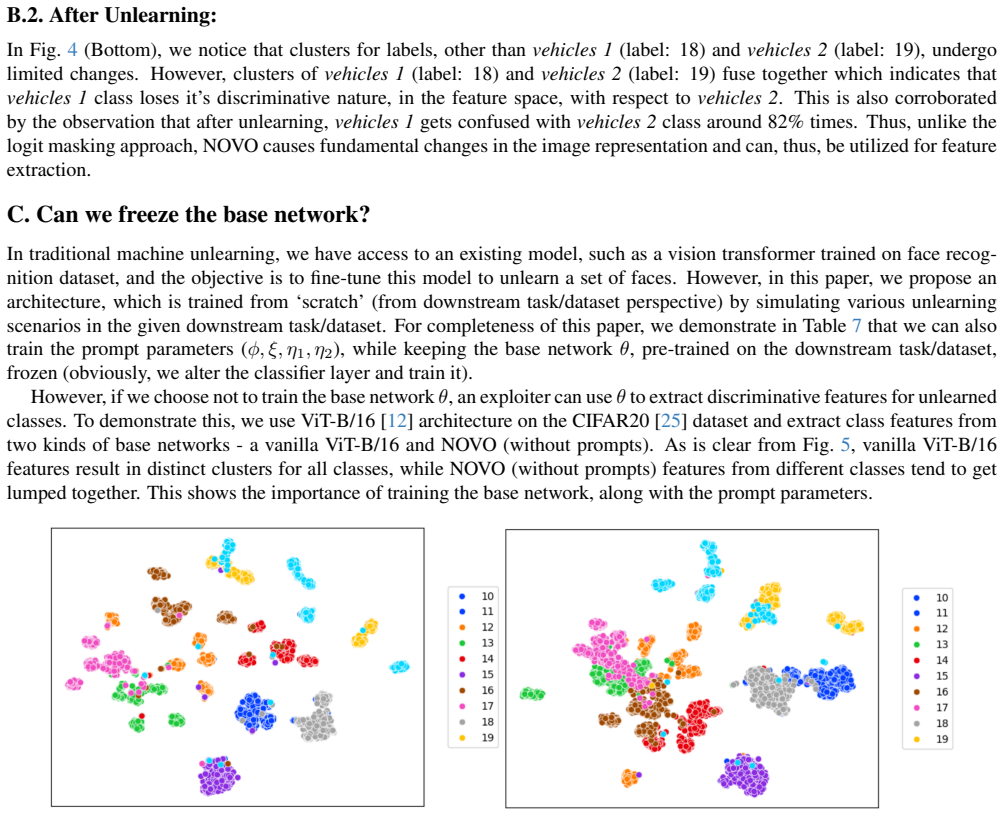
- [Sec. 3.6.4, Sec. 5, Appendix C] The claim that withholding a key 'irreversibly erases information' is supported only by MIA scores in Table 1 and a t-SNE plot in Appendix B. Logistic-regression MIA is one attack family, and t-SNE inspection is qualitative; neither rules out other membership-inference variants, attribute inference, or feature-reconstruction attacks. Moreover, Appendix C reports that when the base network is frozen, NOVO achieves Af = 1.2–3.9 (Table 7), which is not complete erasure and must be reconciled with the irreversibility statement. Please specify the threat model and provide stronger evidence—for example, linear probing on hidden representations, multiple MIA variants, or a formal notion of erasure—before claiming irreversible erasure.
- [Table 3 and Sec. 4.2] The sub-class forgetting result does not support the strong claim of complete forgetting. In Table 3, NOVO's mean forget accuracy is 14.4%, far from the 0.0% values reported for class-level forgetting. The text acknowledges this but does not analyze why sub-class unlearning is incomplete or whether the residual 14.4% is acceptable under the paper's own definition of forgetting. Since the abstract and introduction explicitly include sub-class unlearning in the scope, this result needs a more careful treatment, and the claim should be qualified accordingly.
- [Tables 1, 2, 3, 5] Most comparisons are reported as single numbers without error bars or seeds. Given that the key results are retain accuracies within 1–2 points of retrain and forget accuracies of exactly 0.0, the absence of variance makes it difficult to judge whether NOVO's retain advantage is statistically significant and whether the 0.0 values are exact or rounded. The random multi-class table (Table 4, right) includes standard deviations; please provide similar statistics for the sequential, single-class, and ablation experiments.
minor comments (5)
- [References] References [44] and [45] appear to be the same paper ('Going deeper with image transformers'); please check the citation numbering and deduplicate.
- [Table 4] The caption for Table 4 merges two different experimental setups (CAIT on CIFAR100 and random multi-class forgetting with ViT) into one caption, which is confusing. Please separate the captions or clearly delineate the two blocks.
- [Appendix D and Fig. 6] Figure 6 in the appendix appears to duplicate Figure 3 in the main text; if they are intentionally the same, one should be removed or cross-referenced.
- [Sec. 3.2 and Sec. 3.5] The symbol Ya is first defined as the unique classes present in a batch and then redefined in Eq. (9) as the new retain set after drop-and-expansion; please use distinct notation to avoid confusion.
- [Appendix A, Table 6] The confusion matrix in Table 6 is difficult to read due to the abbreviated labels and formatting; please reformat it with clear row/column headers and class names.
Circularity Check
No significant circularity: the unlearning behavior is a learned conditional response evaluated on held-out requests, not an input-equivalent fit.
full rationale
The paper's chain is an architecture plus a training scheme, not a derivation that re-imports its conclusion. The forward pass (Eqs. 2-8) maps input tokens, retain mask A, and forget mask U to logits, and the training objective (Eqs. 11-15) optimizes the model to behave differently on A versus U. The central claim—on-the-fly forgetting for future requests—is tested by feeding held-out masks (sequential [0,Cf) and random selections with three seeds, Tables 2-4) that were not used to fit any parameter. The drop-and-expansion strategy (Sec. 3.5) is a data-augmentation over the mask distribution, and the ablation (Table 5) shows the model fails without it, confirming that the mechanism is learned rather than forced by construction. No parameter is fitted to the test forget sets; no load-bearing result is imported from a self-citation; no uniqueness theorem or ansatz is smuggled in via author citations. The only caveat is that the tested mask set does not cover extreme or semantically structured configurations (e.g., a single retained class, correlated forget classes), which is a generalization/robustness concern, not circularity. Therefore score 0.
Assumptions & free parameters
free parameters (3)
- Class/sub-class keys (learnable prompts) =
Not stated; learned during training
- Token networks and projection weights (phi, xi, eta1, eta2) =
Not stated; about 3% of model parameters
- Loss weights beta, gamma, tau =
Tuned; exact values not specified
assumptions (3)
- ad hoc to paper The random drop-and-expansion strategy generates a sufficiently representative distribution over retain/forget masks.
- domain assumption Membership inference attack (logistic regression from [15]) is a valid proxy for whether information about the forget set remains.
- domain assumption Jointly training base weights and prompts removes discriminative class information from the base weights alone.
Cite this review
Pith. "Pith review of NOVO: Unlearning-Compliant Vision Transformers." pith.science (2026). https://pith.science/paper/SVZ55E3Z
@misc{pith2026250703281,
  author       = {Pith},
  title        = {Pith review of: NOVO: Unlearning-Compliant Vision Transformers},
  year         = {2026},
  howpublished = {\url{https://pith.science/paper/SVZ55E3Z}},
  note         = {Machine review of arXiv:2507.03281}
}
read the original abstract
Machine unlearning (MUL) refers to the problem of making a pre-trained model selectively forget some training instances or class(es) while retaining performance on the remaining dataset. Existing MUL research involves fine-tuning using a forget and/or retain set, making it expensive and/or impractical, and often causing performance degradation in the unlearned model. We introduce {\pname}, an unlearning-aware vision transformer-based architecture that can directly perform unlearning for future unlearning requests without any fine-tuning over the requested set. The proposed model is trained by simulating unlearning during the training process itself. It involves randomly separating class(es)/sub-class(es) present in each mini-batch into two disjoint sets: a proxy forget-set and a retain-set, and the model is optimized so that it is unable to predict the forget-set. Forgetting is achieved by withdrawing keys, making unlearning on-the-fly and avoiding performance degradation. The model is trained jointly with learnable keys and original weights, ensuring withholding a key irreversibly erases information, validated by membership inference attack scores. Extensive experiments on various datasets, architectures, and resolutions confirm {\pname}'s superiority over both fine-tuning-free and fine-tuning-based methods.
Figures


Figures from the paper (3 more)


Reference graph
Works this paper leans on
-
[1]
https://oag.ca.gov/privacy/ccpa, 2018
California consumer privacy act (ccpa). https://oag.ca.gov/privacy/ccpa, 2018. 1, 2
work page 2018
-
[2]
General data protection regulation (gdpr). https://gdpr- info.eu/, 2018. 1, 2
work page 2018
-
[3]
Josh Achiam, Steven Adler, Sandhini Agarwal, Lama Ah- mad, Ilge Akkaya, Florencia Leoni Aleman, Diogo Almeida, Janko Altenschmidt, Sam Altman, Shyamal Anadkat, et al. Gpt-4 technical report. arXiv preprint arXiv:2303.08774 ,
-
[4]
Machine unlearning
Lucas Bourtoule, Varun Chandrasekaran, Christopher A Choquette-Choo, Hengrui Jia, Adelin Travers, Baiwu Zhang, David Lie, and Nicolas Papernot. Machine unlearning. In 2021 IEEE Symposium on Security and Privacy (SP) , pages 141–159. IEEE, 2021. 2
2021
-
[5]
Towards making systems for- get with machine unlearning
Yinzhi Cao and Junfeng Yang. Towards making systems for- get with machine unlearning. In 2015 IEEE Symposium on Security and Privacy, pages 463–480. IEEE, 2015. 2
work page 2015
-
[6]
Learning to unlearn: Instance-wise unlearning for pre-trained classifiers, 2024
Sungmin Cha, Sungjun Cho, Dasol Hwang, Honglak Lee, Taesup Moon, and Moontae Lee. Learning to unlearn: Instance-wise unlearning for pre-trained classifiers, 2024. 3
work page 2024
-
[7]
Boundary unlearning: Rapid forgetting of deep net- works via shifting the decision boundary
Min Chen, Weizhuo Gao, Gaoyang Liu, Kai Peng, and Chen Wang. Boundary unlearning: Rapid forgetting of deep net- works via shifting the decision boundary. In Proceedings of the IEEE/CVF Conference on Computer Vision and Pattern Recognition, pages 7766–7775, 2023. 1
2023
-
[8]
Can bad teaching induce forgetting? unlearning in deep networks using an incompetent teacher
Vikram S Chundawat, Ayush K Tarun, Murari Mandal, and Mohan Kankanhalli. Can bad teaching induce forgetting? unlearning in deep networks using an incompetent teacher. In Proceedings of the Thirty-Seventh AAAI Conference on Artificial Intelligence, 2023. 2, 5, 14, 15
work page 2023
Show all 50 references
-
[9]
Zero-shot machine unlearning
Vikram S Chundawat, Ayush K Tarun, Murari Mandal, and Mohan Kankanhalli. Zero-shot machine unlearning. IEEE Transactions on Information Forensics and Security , 2023. 1, 2, 5, 14, 15
2023
-
[10]
Imagenet: A large-scale hierarchical image database
Jia Deng, Wei Dong, Richard Socher, Li-Jia Li, Kai Li, and Li Fei-Fei. Imagenet: A large-scale hierarchical image database. In 2009 IEEE Conference on Computer Vision and Pattern Recognition, pages 248–255, 2009. 7
2009
-
[11]
Internlm-xcomposer2: Mastering free-form text-image composition and compre- hension in vision-language large model
Xiaoyi Dong, Pan Zhang, Yuhang Zang, Yuhang Cao, Bin Wang, Linke Ouyang, Xilin Wei, Songyang Zhang, Haodong Duan, Maosong Cao, et al. Internlm-xcomposer2: Mastering free-form text-image composition and compre- hension in vision-language large model. arXiv preprint arXiv:2401.1...
2024 arXiv
-
[12]
An image is worth 16x16 words: Trans- formers for image recognition at scale
Alexey Dosovitskiy, Lucas Beyer, Alexander Kolesnikov, Dirk Weissenborn, Xiaohua Zhai, Thomas Unterthiner, Mostafa Dehghani, Matthias Minderer, Georg Heigold, Syl- vain Gelly, et al. An image is worth 16x16 words: Trans- formers for image recognition at scale. arXiv preprint a...
2010 arXiv
-
[13]
Challenging forgets: Unveiling the worst-case forget sets in machine unlearning
Chongyu Fan, Jiancheng Liu, Alfred Hero, and Sijia Liu. Challenging forgets: Unveiling the worst-case forget sets in machine unlearning. In European Conference on Computer Vision, pages 278–297. Springer, 2024. 1
2024
-
[14]
Salun: Empowering machine un- learning via gradient-based weight saliency in both image classification and generation
Chongyu Fan, Jiancheng Liu, Yihua Zhang, Eric Wong, Den- nis Wei, and Sijia Liu. Salun: Empowering machine un- learning via gradient-based weight saliency in both image classification and generation. In The Twelfth International Conference on Learning Representations, 2024. 3, 5, 7
2024
-
[15]
Fast machine unlearning without retraining through selective synaptic dampening
Jack Foster, Stefan Schoepf, and Alexandra Brintrup. Fast machine unlearning without retraining through selective synaptic dampening. In Proceedings of the AAAI Confer- ence on Artificial Intelligence, pages 12043–12051, 2024. 2, 3, 5, 6, 7, 8, 14, 15
2024
-
[16]
How to train vision transformer on small-scale datasets? In 33rd British Machine Vision Conference 2022, BMVC 2022, London, UK, November 21-24, 2022
Hanan Gani, Muzammal Naseer, and Mohammad Yaqub. How to train vision transformer on small-scale datasets? In 33rd British Machine Vision Conference 2022, BMVC 2022, London, UK, November 21-24, 2022. BMV A Press, 2022. 7
2022
-
[17]
Mixed-privacy for- getting in deep networks
Aditya Golatkar, Alessandro Achille, Avinash Ravichan- dran, Marzia Polito, and Stefano Soatto. Mixed-privacy for- getting in deep networks. In Proceedings of the IEEE/CVF Conference on Computer Vision and Pattern Recognition , pages 792–801, 2021. 1
2021
-
[18]
Amne- siac machine learning
Laura Graves, Vineel Nagisetty, and Vijay Ganesh. Amne- siac machine learning. In Proceedings of the AAAI Confer- ence on Artificial Intelligence, pages 11516–11524, 2021. 2, 5, 14, 15
2021
-
[19]
Certified data removal from machine learning models
Chuan Guo, Tom Goldstein, Awni Hannun, and Laurens Van Der Maaten. Certified data removal from machine learning models. In International Conference on Machine Learning, pages 3832–3842. PMLR, 2020
2020
-
[20]
Towards independence criterion in ma- chine unlearning of features and labels
Ling Han, Nanqing Luo, Hao Huang, Jing Chen, and Mary- Anne Hartley. Towards independence criterion in ma- chine unlearning of features and labels. arXiv preprint arXiv:2403.08124, 2024. 1
2024 arXiv
-
[21]
Model sparsity can simplify machine unlearning, 2024
Jinghan Jia, Jiancheng Liu, Parikshit Ram, Yuguang Yao, Gaowen Liu, Yang Liu, Pranay Sharma, and Sijia Liu. Model sparsity can simplify machine unlearning, 2024. 2, 3
2024
-
[22]
Vi- sual prompt tuning
Menglin Jia, Luming Tang, Bor-Chun Chen, Claire Cardie, Serge Belongie, Bharath Hariharan, and Ser-Nam Lim. Vi- sual prompt tuning. In European Conference on Computer Vision (ECCV), 2022. 3
2022
-
[23]
Layer attack unlearning: Fast and accurate machine unlearning via layer level attack and knowledge distillation
Hyunjune Kim, Sangyong Lee, and Simon S Woo. Layer attack unlearning: Fast and accurate machine unlearning via layer level attack and knowledge distillation. In Proceed- ings of the AAAI Conference on Artificial Intelligence, pages 21241–21248, 2024. 1
2024
-
[24]
Overcoming catastrophic forgetting in neu- ral networks
James Kirkpatrick, Razvan Pascanu, Neil Rabinowitz, Joel Veness, Guillaume Desjardins, Andrei A Rusu, Kieran Milan, John Quan, Tiago Ramalho, Agnieszka Grabska- Barwinska, et al. Overcoming catastrophic forgetting in neu- ral networks. Proceedings of the national academy of sc...
2017
-
[25]
Learning multiple layers of features from tiny images
Alex Krizhevsky, Geoffrey Hinton, et al. Learning multiple layers of features from tiny images. 2009. 5, 6, 7, 11, 12
2009
-
[26]
Towards unbounded machine unlearn- ing
Meghdad Kurmanji, Peter Triantafillou, Jamie Hayes, and Eleni Triantafillou. Towards unbounded machine unlearn- ing. Advances in neural information processing systems, 36,
-
[27]
Ya Le and Xuan S. Yang. Tiny imagenet visual recognition challenge. 2015. 5
2015
-
[28]
Blip-2: Bootstrapping language-image pre-training with 9 frozen image encoders and large language models
Junnan Li, Dongxu Li, Silvio Savarese, and Steven Hoi. Blip-2: Bootstrapping language-image pre-training with 9 frozen image encoders and large language models. arXiv preprint arXiv:2301.12597, 2023. 1
2023 arXiv
-
[29]
Erm-ktp: Knowledge-level machine un- learning via knowledge transfer
Shen Lin, Xiaoyu Zhang, Chenyang Chen, Xiaofeng Chen, and Willy Susilo. Erm-ktp: Knowledge-level machine un- learning via knowledge transfer. In Proceedings of the IEEE/CVF Conference on Computer Vision and Pattern Recognition, pages 20147–20155, 2023. 1, 3, 7
2023
-
[30]
Continual learning and private unlearning
Bo Liu, Qiang Liu, and Peter Stone. Continual learning and private unlearning. In Conference on Lifelong Learning Agents, pages 243–254. PMLR, 2022. 1
2022
-
[31]
Visual instruction tuning
Haotian Liu, Chunyuan Li, Qingyang Wu, and Yong Jae Lee. Visual instruction tuning. Advances in neural information processing systems, 36, 2024. 1
2024
-
[32]
Model spar- sity can simplify machine unlearning
Jiancheng Liu, Parikshit Ram, Yuguang Yao, Gaowen Liu, Yang Liu, PRANAY SHARMA, Sijia Liu, et al. Model spar- sity can simplify machine unlearning. Advances in Neural Information Processing Systems, 36, 2024. 1
2024
-
[33]
Swin transformer: Hierarchical vision transformer using shifted windows
Ze Liu, Yutong Lin, Yue Cao, Han Hu, Yixuan Wei, Zheng Zhang, Stephen Lin, and Baining Guo. Swin transformer: Hierarchical vision transformer using shifted windows. In Proceedings of the IEEE/CVF international conference on computer vision, pages 10012–10022, 2021. 1, 2, 3, 5, 7
2021
-
[34]
Fair machine unlearning: Data removal while mitigating disparities
Alex Oesterling, Jiaqi Ma, Flavio Calmon, and Himabindu Lakkaraju. Fair machine unlearning: Data removal while mitigating disparities. In International Conference on Arti- ficial Intelligence and Statistics , pages 3736–3744. PMLR,
-
[35]
Partially blinded unlearning: Class unlearning for deep networks a bayesian perspective
Subhodip Panda, Shashwat Sourav, et al. Partially blinded unlearning: Class unlearning for deep networks a bayesian perspective. arXiv preprint arXiv:2403.16246, 2024. 1
2024 arXiv
-
[36]
amnesia–towards machine learning mod- els that can forget user data very fast
Sebastian Schelter. amnesia–towards machine learning mod- els that can forget user data very fast. In 1st International Workshop on Applied AI for Database Systems and Applica- tions (AIDB19), 2019. 1
2019
-
[37]
Parameter-tuning-free data entry error unlearning with adap- tive selective synaptic dampening, 2024
Stefan Schoepf, Jack Foster, and Alexandra Brintrup. Parameter-tuning-free data entry error unlearning with adap- tive selective synaptic dampening, 2024. 2, 3, 5, 7, 14, 15
2024
-
[38]
Feder- ated unlearning: a perspective of stability and fairness.arXiv preprint arXiv:2402.01276, 2024
Jiaqi Shao, Tao Lin, Xuanyu Cao, and Bing Luo. Feder- ated unlearning: a perspective of stability and fairness.arXiv preprint arXiv:2402.01276, 2024. 1
2024 arXiv
-
[39]
Label- agnostic forgetting: A supervision-free unlearning in deep models
Shaofei Shen, Chenhao Zhang, Yawen Zhao, Alina Bialkowski, Weitong Tony Chen, and Miao Xu. Label- agnostic forgetting: A supervision-free unlearning in deep models. arXiv preprint arXiv:2404.00506, 2024
2024 arXiv
-
[40]
Deep regression unlearning
Ayush K Tarun, Vikram S Chundawat, Murari Mandal, and Mohan Kankanhalli. Deep regression unlearning. arXiv preprint arXiv:2210.08196, 2022
2022 arXiv
-
[41]
Deep regression unlearn- ing
Ayush Kumar Tarun, Vikram Singh Chundawat, Murari Mandal, and Mohan Kankanhalli. Deep regression unlearn- ing. In International Conference on Machine Learning , pages 33921–33939. PMLR, 2023
2023
-
[42]
Fast yet effective machine unlearning
Ayush K Tarun, Vikram S Chundawat, Murari Mandal, and Mohan Kankanhalli. Fast yet effective machine unlearning. IEEE Transactions on Neural Networks and Learning Sys- tems, 2023. 1, 2, 3, 5
2023
-
[43]
Unrolling sgd: Understanding factors in- fluencing machine unlearning
Anvith Thudi, Gabriel Deza, Varun Chandrasekaran, and Nicolas Papernot. Unrolling sgd: Understanding factors in- fluencing machine unlearning. In 2022 IEEE 7th European Symposium on Security and Privacy (EuroS&P), pages 303–
2022
-
[44]
Going deeper with im- age transformers
Hugo Touvron, Matthieu Cord, Alexandre Sablayrolles, Gabriel Synnaeve, and Herv´e J´egou. Going deeper with im- age transformers. CoRR, abs/2103.17239, 2021. 3, 5, 7
2021 arXiv
-
[45]
Going deeper with im- age transformers
Hugo Touvron, Matthieu Cord, Alexandre Sablayrolles, Gabriel Synnaeve, and Herv´e J´egou. Going deeper with im- age transformers. In Proceedings of the IEEE/CVF interna- tional conference on computer vision, pages 32–42, 2021. 2, 7
2021
-
[46]
Llama 2: Open foundation and fine-tuned chat models.arXiv preprint arXiv:2307.09288, 2023
Hugo Touvron, Louis Martin, Kevin Stone, Peter Albert, Amjad Almahairi, Yasmine Babaei, Nikolay Bashlykov, Soumya Batra, Prajjwal Bhargava, Shruti Bhosale, et al. Llama 2: Open foundation and fine-tuned chat models.arXiv preprint arXiv:2307.09288, 2023. 1
2023 arXiv
-
[47]
Visualizing data using t-sne
Laurens van der Maaten and Geoffrey Hinton. Visualizing data using t-sne. Journal of Machine Learning Research, 9 (86):2579–2605, 2008. 11
2008
-
[48]
A comparative study of open-source large language models, gpt-4 and claude 2: Multiple-choice test taking in nephrology
Sean Wu, Michael Koo, Lesley Blum, Andy Black, Liyo Kao, Fabien Scalzo, and Ira Kurtz. A comparative study of open-source large language models, gpt-4 and claude 2: Multiple-choice test taking in nephrology. arXiv preprint arXiv:2308.04709, 2023. 1
2023 arXiv
-
[49]
Delta- grad: Rapid retraining of machine learning models
Yinjun Wu, Edgar Dobriban, and Susan Davidson. Delta- grad: Rapid retraining of machine learning models. In In- ternational Conference on Machine Learning, pages 10355– 10366. PMLR, 2020. 1
2020
-
[50]
Arcane: An efficient architecture for exact machine unlearning
Haonan Yan, Xiaoguang Li, Ziyao Guo, Hui Li, Fenghua Li, and Xiaodong Lin. Arcane: An efficient architecture for exact machine unlearning. In IJCAI, page 19, 2022. 1 10 A. What are forget classes misclassified as? Table 6. Confusion matrix 0 (aq mml) 8 (crnvr) 14 (ppl) 19 (vh ...
2022
Reviewed August 6, 2026 · model on record in the stance chip above.
Discussion (0). Sign in to comment.