REVIEW 6 major objections 6 minor 72 references
CPKD: Clinical Prior Knowledge-Constrained Diffusion Models for Surgical Phase Recognition in Endoscopic Submucosal Dissection
T0 review · 6 major / 6 minor · reviewed 2026-08-06 · deepseek-v4-flash
Pith's one-line read The paper claims that treating surgical phase recognition as conditional denoising of phase sequences, constrained by clinical rules written in temporal logic, sets new state-of-the-art results on ESD820 and Cholec80.
desk verdict Strong ESD results and a sensible diffusion formulation, but the CPKC logic unit's math does not check out and the paper needs major revision. read the letter →
The pith
A machine-rendered reading of the paper's core claim, the machinery that carries it, and where it could break.
The reading
What carries the argument
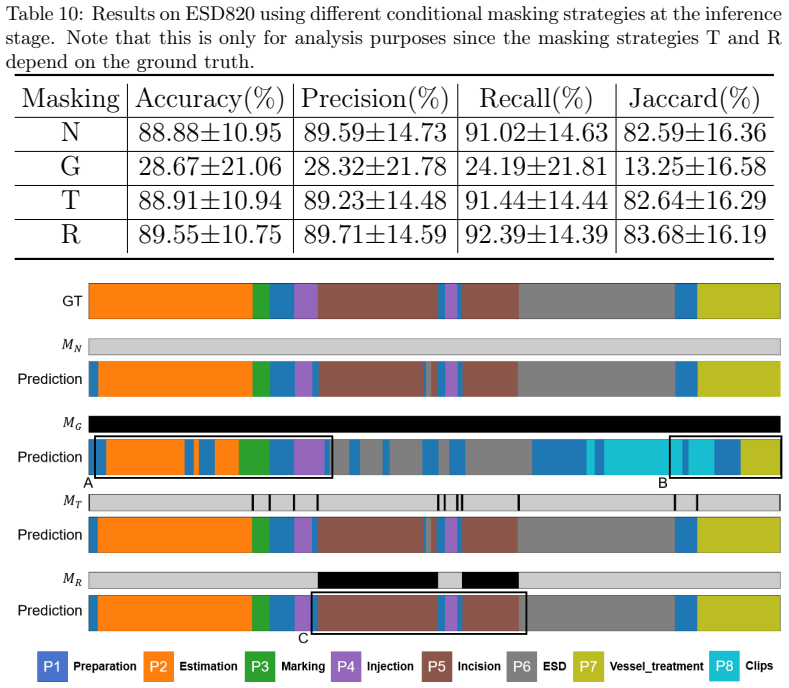
The load-bearing object is a denoising diffusion process over one-hot phase sequences, in which a decoder $D_\varphi$ conditioned on masked spatial-temporal features $F_T$ reconstructs ground-truth phases from Gaussian noise; at inference, eight skipped denoising steps refine a random sequence into the final prediction. Three conditional masks modulate $F_T$ during training: a global all-zero mask that leaves only positional and timestamp cues, a phase-transition mask that blanks features near soft boundaries, and a phase-relation mask that removes entire phase segments so the decoder must infer them from neighbors. The CPKC unit takes three ESD workflow rules written as LTL-style formulas and evaluates them with a differentiable parser built from smooth min and max operators with a smoothing parameter $\gamma$, yielding a phase-logic loss $L_{PL}$ that is added to cross-entropy, temporal smoothness, and boundary-alignment losses; a soundness theorem guarantees that, in the $\gamma \to \infty$ limit, positive evaluation implies the formula is satisfied.
What would settle it
Re-run the ESD820 experiment with the CPKC logic loss removed while holding all other settings fixed, and with the exact LTL formulas and the value of $\gamma$ reported: the paper's Table 7 shows Jaccard 81.41 without CPKC and 82.59 with it, so a re-implementation that sees the gap shrink below noise or reverse as $\gamma$ varies would falsify the claim that clinical constraints, rather than the smoothing schedule, drive the gain. A complementary check is to feed CPKD test videos whose phase order deliberately violates the three rules: if the model still assigns high confidence to impossible transitions, the logic constraint is not actually binding.
Extended reading notes
Core claim
On the paper's own terms, the discovery is that a diffusion-based generative model conditioned on spatial-temporal video features can serve as the state of the art for surgical phase recognition, and that injecting clinical prior knowledge through logic constraints materially improves both correctness and coherence. On ESD820, CPKD reports 88.88% accuracy, 89.59% precision, 91.02% recall, and 82.59% Jaccard, exceeding the previous best by 2.53, 3.55, 2.22, and 4.69 percentage points respectively; the same model reaches 94.15% accuracy, 94.12% recall, and 85.61% Jaccard on Cholec80, with precision close to the best comparator. Ablations attribute the gains to the interaction of the three masking strategies, especially relation masking, with the diffusion process, and to the CPKC logic loss, which visibly repairs violations such as injection or ESD appearing after Clips. The paper also reports that CPKD remains competitive on a 95-video two-center external set, with expected degradation from different tools and endoscopist experience.
Load-bearing premise
The load-bearing premise is that the three clinical rules elicited from endoscopists are the correct and complete phase-order constraints for ESD, and that the differentiable parser with its finite smoothing parameter enforces them faithfully enough that the training-time logic loss, not just extra tuning, is what improves the model.
Editorial extensions
If this is right
- If the ESD820 results hold, diffusion-based phase-sequence generation is now a competitive alternative to multi-stage TCNs and transformers, with best reported accuracy, precision, recall, and Jaccard on that dataset.
- Because CPKC and the masking strategies act only during training, the inference cost is just the eight-step denoising pass, so the logical-consistency gains do not add a runtime penalty.
- The CPKC logic regularizer can be applied at any temporal location by changing the start index of the formula evaluation, so the same machinery can enforce constraints on local segments rather than only the whole video.
- The transfer to Cholec80 suggests the generative framework is not ESD-specific, and the external multi-center results indicate it carries over to new centers with some expected degradation.
Reading between the lines
- A natural transfer target the paper leaves implicit is other procedure domains with strong phase ordering, such as cataract surgery, laparoscopy, or colonoscopy; the same LTL rule machinery would apply if the rules are rewritten for those workflows.
- Because Theorem 1 holds only as $\gamma \to \infty$ and the paper never reports the value of $\gamma$ or the exact formulas for the three rules, a reproducibility-minded follow-up should ablate CPKC across a range of smoothing schedules; the 1.18-point Jaccard gain, from 81.41 without CPKC to 82.59 with it, is the number such a study would need to reproduce.
- The inference-time masking probes suggest the model internalizes position and relation priors strongly enough that masking relation segments at test time even improves results, hinting that an ensemble over different test-time masks could yield a further accuracy boost beyond what the paper reports.
- The paper's claim that correcting one logical error fixes cascading effects on neighboring predictions is a testable generative-dynamics hypothesis: intervene on a single denoising step by clamping an erroneous phase, and measure whether downstream frame quality improves as the paper predicts.
Editorial analysis
A structured set of objections, weighed in public.
Referee Report
Summary. The paper introduces CPKD, a conditional denoising diffusion framework for surgical phase recognition, focused on endoscopic submucosal dissection (ESD). The architecture couples a Swin-Transformer-based spatial-temporal feature extractor with a diffusion decoder that iteratively refines phase sequences, and a Clinical Prior Knowledge-Constraint (CPKC) unit intended to enforce expert-derived phase-ordering rules through a differentiable temporal-logic parser. The method is evaluated on ESD820, Cholec80, and a two-center external dataset, with state-of-the-art claims on ESD820, a reported SOTA-level result on Cholec80 for a variant labeled STFE+Diffusion, and ablation studies for masking strategies, conditioning layers, loss components, inference steps, and CPKC weighting. The central claim is that a diffusion-based generator, constrained with clinical phase logic, outperforms existing discriminative multi-stage refiners.
Significance. If the claims were fully supported, the paper would be a valuable demonstration that a generative diffusion formulation, rather than a multi-stage discriminative refinement cascade, can achieve state-of-the-art surgical phase recognition while providing interpretable clinical constraints. The work has clear strengths: it applies diffusion to a relatively underexplored surgical-video task, provides a fairly extensive ablation on ESD820, reports FPS, includes an external generalization check, and is transparent about some limitations (inference cost, small-dataset Cholec80 behavior, ESD-specific CPKC). However, the CPKC unit is the component whose ablation yields a claimed gain (Table 7), and its theoretical foundation is currently unsound as written; the Cholec80 and external-dataset evidence is also reported in a way that overstates the full method. The empirical study is promising but the manuscript needs substantial technical correction before the central contribution can be judged.
major comments (6)
- [§4.5, Eqs. (13)–(14) and Theorem 1] The claimed limit underlying Theorem 1 is incorrect. With min_γ{p}=−γ log Σ_i e^{−p_i/γ}, for any finite set of N>1 values, as γ→∞ one has min_γ{p} = −γ log N + O(1), which diverges to −∞; max_γ diverges to +∞. Hence in the limit used for soundness, an OR node is always positive and an AND node always negative irrespective of the predictions, so Theorem 1 is false as stated and the CPKC regularization is not justified by the given formulas. The standard smooth minimum that converges to the minimum as γ→∞ is −(1/γ) log Σ e^{−γ p_i}; the authors should adopt a correct definition, state the finite γ actually used in training, or prove soundness for the finite-γ evaluator as implemented.
- [§4.5, Eqs. (17)–(18)] The weak-until and since operators are incompletely specified. For φ1 W φ2, the semantics explicitly permit φ2 never to hold (in which case φ1 must hold forever), but Eq. (17) defines the value by a minimum over [t,k] where k is the first index with f_k(φ2,P_t)>0; if no such k exists, the evaluation is undefined. For φ1 S φ2, the stated semantics are a past-time property ("φ2 has been true and φ1 held since then"), but Eq. (18) searches for a future k≥t, which is inconsistent with the stated semantics. These operators must be made total and correctly oriented (e.g., by defaulting to an evaluation over the whole remaining sequence for W, and by using k≤t for S).
- [§4.6, Eq. (22) and §4.5 clinical rules] Equation (22) defines L_PL = log(1+e^{−x})(f0(ϕ,P_t)) without defining x; the intended loss is presumably a softplus of the satisfaction score f0(ϕ,P_t), but as written it cannot be implemented. Relatedly, the three clinical rules are given only in natural language; the corresponding LTL formulas, the atomic phase assignment (P1–P8), and the finite γ used in the experiments are never reported. Without these, the CPKC ablation in Table 7 cannot be reproduced or checked, and the claim that the +1.07 accuracy / +1.18 Jaccard gain is due to clinical-logic constraints is unverified.
- [§5.2.2, Table 3 and Abstract] The Cholec80 table reports "STFE+Diffusion (Ours)" and does not include the CPKC component, yet the abstract and Section 5.2.2 claim that CPKD achieves superior or comparable performance on Cholec80. If CPKC is only defined for ESD phase logic, the claim should be restricted to STFE+Diffusion on Cholec80, or the full CPKD should be evaluated with appropriate phase constraints. As presented, the headline claim overstates the evidence.
- [§5.4, Table 9] The external multi-center validation compares CPKD only against its own internal test-set performance. There is no comparison with any prior method, and no details are provided on how the 95 videos from two centers were selected or annotated. This supports a generalization check but not the paper's comparative claims, and the 0.98% accuracy / 5.47% Jaccard drop is not analyzed statistically.
- [§5.2 and §5.3] All comparative and ablation claims are based on means and standard deviations, with no significance tests, confidence intervals, or per-video paired analyses. The main CPKC gain (Table 7) is +1.07 accuracy and +1.18 Jaccard on a dataset with per-video std greater than 10; without a test, it is unclear whether this difference is reliable. I request pairwise significance tests or at least confidence intervals for the central claims.
minor comments (6)
- [§5.4] The text says "as shown in Table 5" when it should refer to Table 9 for the internal/external comparison.
- [§1 and §4.5] There are small textual errors: "phase transition making" should be "phase transition masking" in the contributions list, and "infection" in the third clinical rule should presumably be "incision".
- [§4.3] Equation (6) states Y_T ∈ [0,1]^{T×C} after adding Gaussian noise to the hard-label ground truth; the later note that sequences are normalized to [-1,1] should come earlier to avoid an apparent inconsistency.
- [§4.5] Equation (10) gives a type signature that is difficult to parse; please clarify the domain of f_t and how multi-dimensional predictions are indexed.
- [§4.6] The description of the boundary alignment loss in Eq. (21) is unclear: the sentence "the boundary probabilities in the denoised sequence P_t are computed as the dot product of phase probabilities from neighboring frames in 1−P_s,i · P_s,i+1" should be rewritten as an explicit formula.
- [Fig. 5 caption] The figure caption says the constraint "a person cannot Incision before Vessel_treatment" is formalized as φ=(¬P7 W P5), but P5 is Incision and P7 is Vessel_treatment in the phase numbering; please check that the formula and phase indices match the intended clinical ordering.
Circularity Check
No significant circularity: evaluation is a standard supervised train/test protocol with external benchmarks; CPKC is a training-time regularizer, and the paper's mathematical gaps are correctness risks, not definitional reductions.
full rationale
The derivation chain is not circular in any of the enumerated senses. The central claim is an empirical comparison on held-out test splits: ESD820 (586/74/160 videos), Cholec80 (40/40 videos), and an external 95-video multicenter set. Ground-truth phase annotations are external supervision, not outputs of the model or fits to the test set. The CPKC unit is a training-time regularizer: its loss LPL evaluates predicted probabilities Pt against LTL formulas derived from procedural protocols, and the reported gains are measured against ground-truth labels on a held-out test set, so the constraint is not a renamed prediction and no fitted parameter is relabeled as a prediction. Hyperparameters (lambda weights, masking ratios, diffusion steps) are chosen on validation and reported in ablations, including the paper's own note that the T and R masking strategies depend on ground truth and are used only for analysis. The paper does cite its own prior work for the ESD820 dataset and the SPRMamba baseline, but the dataset is published independently in Scientific Data and the baseline is a standard comparator; these self-citations are not load-bearing assumptions that force the conclusion. The skeptical concerns about CPKC are real but are correctness risks, not circularity: Theorem 1 is asserted 'by construction', yet the γ→∞ limit of the soft min/max is not the claimed min/max for sequences longer than one element; Eq. (17) leaves weak-until undefined when the consequent never holds; Eq. (22) uses an undefined x; and the exact LTL formulas and the finite γ used in experiments are never reported. If the parser is unsound, the CPKC ablation gain is unverified, but it is not equivalent to its input by construction. Accordingly, no critical circular step can be exhibited.
Assumptions & free parameters
free parameters (5)
- Loss weights lambda_CE, lambda_SMO, lambda_BD, lambda_PL =
0.5, 0.025, 0.1, 0.1
- Diffusion inference steps =
8
- Conditioning feature layer =
R_phi layer 11 (ESD820), layer 9 (Cholec80)
- DTL smoothing parameter gamma =
not reported
- Phase transition mask threshold =
0.5 on soft boundary probability
assumptions (5)
- domain assumption The three clinical rules (marking/estimation before injection/incision/ESD/vessel/clips; injection/incision/ESD before vessel/clips; any of the four stages implies the other three appear) correctly describe ESD phase logic.
- domain assumption The differentiable temporal logic semantics with softplus/min-gamma/max-gamma approximations (from Xu et al. 2022) remain sound at the finite gamma used in training.
- domain assumption Gaussian continuous noise on one-hot phase labels is a meaningful generative model for discrete phase sequences.
- domain assumption The annotation labels and phase definitions in the ESD820 dataset are reliable.
- domain assumption Random selection among the four masks (with unspecified probabilities) yields the described prior-learning behavior.
Cite this review
Pith. "Pith review of CPKD: Clinical Prior Knowledge-Constrained Diffusion Models for Surgical Phase Recognition in Endoscopic Submucosal Dissection." pith.science (2026). https://pith.science/paper/7TL5DPFV
@misc{pith2026250703295,
  author       = {Pith},
  title        = {Pith review of: CPKD: Clinical Prior Knowledge-Constrained Diffusion Models for Surgical Phase Recognition in Endoscopic Submucosal Dissection},
  year         = {2026},
  howpublished = {\url{https://pith.science/paper/7TL5DPFV}},
  note         = {Machine review of arXiv:2507.03295}
}
read the original abstract
Gastrointestinal malignancies constitute a leading cause of cancer-related mortality worldwide, with advanced-stage prognosis remaining particularly dismal. Originating as a groundbreaking technique for early gastric cancer treatment, Endoscopic Submucosal Dissection has evolved into a versatile intervention for diverse gastrointestinal lesions. While computer-assisted systems significantly enhance procedural precision and safety in ESD, their clinical adoption faces a critical bottleneck: reliable surgical phase recognition within complex endoscopic workflows. Current state-of-the-art approaches predominantly rely on multi-stage refinement architectures that iteratively optimize temporal predictions. In this paper, we present Clinical Prior Knowledge-Constrained Diffusion (CPKD), a novel generative framework that reimagines phase recognition through denoising diffusion principles while preserving the core iterative refinement philosophy. This architecture progressively reconstructs phase sequences starting from random noise and conditioned on visual-temporal features. To better capture three domain-specific characteristics, including positional priors, boundary ambiguity, and relation dependency, we design a conditional masking strategy. Furthermore, we incorporate clinical prior knowledge into the model training to improve its ability to correct phase logical errors. Comprehensive evaluations on ESD820, Cholec80, and external multi-center demonstrate that our proposed CPKD achieves superior or comparable performance to state-of-the-art approaches, validating the effectiveness of diffusion-based generative paradigms for surgical phase recognition.
Figures


Figures from the paper (9 more)


Reference graph
Works this paper leans on
-
[1]
Junjie Huang, Don Eliseo Lucero-Prisno III, Lin Zhang, Wanghong Xu, Sunny H Wong, Siew C Ng, and Martin CS Wong. Updated epidemi- ology of gastrointestinal cancers in east asia.Nature reviews Gastroen- terology & hepatology, 20(5):271–287, 2023
work page 2023
-
[2]
Yang Lyu, Fuda Xie, Bonan Chen, Wing Sum Shin, Wei Chen, Yulong He, Kam Tong Leung, Gary MK Tse, Jun Yu, Ka Fai To, et al. The nerve cells in gastrointestinal cancers: from molecular mechanisms to clinical intervention.Oncogene, 43(2):77–91, 2024
work page 2024
-
[3]
Thomas R McCarty, Ahmad Najdat Bazarbashi, Kelly E Hathorn, Christopher C Thompson, and Hiroyuki Aihara. Endoscopic submu- cosal dissection (esd) versus transanal endoscopic microsurgery (tem) for treatment of rectal tumors: a comparative systematic review and meta-analysis.Surgical endoscopy, 34:1688–1695, 2020. 34
work page 2020
-
[4]
Lena Maier-Hein, Swaroop S Vedula, Stefanie Speidel, Nassir Navab, Ron Kikinis, Adrian Park, Matthias Eisenmann, Hubertus Feussner, Germain Forestier, Stamatia Giannarou, et al. Surgical data sci- ence for next-generation interventions.Nature Biomedical Engineering, 1(9):691–696, 2017
work page 2017
-
[5]
Arnaud Huaulmé, Pierre Jannin, Fabian Reche, Jean-Luc Faucheron, Alexandre Moreau-Gaudry, and Sandrine Voros. Offline identification of surgical deviations in laparoscopic rectopexy.Artificial Intelligence in Medicine, 104:101837, 2020
work page 2020
-
[6]
Tom Vercauteren, Mathias Unberath, Nicolas Padoy, and Nassir Navab. Cai4cai: the rise of contextual artificial intelligence in computer-assisted interventions.Proceedings of the IEEE, 108(1):198–214, 2019
work page 2019
-
[7]
Tecno: Surgi- cal phase recognition with multi-stage temporal convolutional networks
Tobias Czempiel, Magdalini Paschali, Matthias Keicher, Walter Simson, Hubertus Feussner, Seong Tae Kim, and Nassir Navab. Tecno: Surgi- cal phase recognition with multi-stage temporal convolutional networks. InMedical Image Computing and Computer Assisted Intervention– MICCAI 2020: 23rd International Conference, Lima, Peru, October 4–8, 2020, Proceedings,...
work page 2020
-
[8]
Not end-to-end: Ex- plore multi-stage architecture for online surgical phase recognition
Fangqiu Yi, Yanfeng Yang, and Tingting Jiang. Not end-to-end: Ex- plore multi-stage architecture for online surgical phase recognition. In Proceedings of the Asian Conference on Computer Vision, pages 2613– 2628, 2022
work page 2022
Show all 72 references
-
[9]
Swnet: Surgical workflow recognition with deep convolutional network
Bokai Zhang, Amer Ghanem, Alexander Simes, Henry Choi, Andrew Yoo, and Andrew Min. Swnet: Surgical workflow recognition with deep convolutional network. InMedical imaging with deep learning, pages 855–869. PMLR, 2021
2021
-
[10]
Trans-svnet: Accurate phase recognition from surgical videos via hybrid embedding aggregation transformer
Xiaojie Gao, Yueming Jin, Yonghao Long, Qi Dou, and Pheng-Ann Heng. Trans-svnet: Accurate phase recognition from surgical videos via hybrid embedding aggregation transformer. InMedical Image Comput- ing and Computer Assisted Intervention–MICCAI 2021: 24th Interna- tional Confe...
2021
-
[11]
Opera: Attention-regularized transformers for surgical phase recognition
Tobias Czempiel, Magdalini Paschali, Daniel Ostler, Seong Tae Kim, Benjamin Busam, and Nassir Navab. Opera: Attention-regularized transformers for surgical phase recognition. InMedical Image Com- puting and Computer Assisted Intervention–MICCAI 2021: 24th Inter- national Confe...
2021
-
[12]
Sprmamba: Surgical phase recognition for endoscopic submucosal dissection with mamba
Xiangning Zhang, Jinnan Chen, Qingwei Zhang, Chengfeng Zhou, Zhengjie Zhang, Xiaobo Li, and Dahong Qian. Sprmamba: Surgical phase recognition for endoscopic submucosal dissection with mamba. arXiv preprint arXiv:2409.12108, 2024
2024 arXiv
-
[13]
Sr-mamba: Effective surgical phase recognition with state space model.arXiv preprint arXiv:2407.08333, 2024
Rui Cao, Jiangliu Wang, and Yun-Hui Liu. Sr-mamba: Effective surgical phase recognition with state space model.arXiv preprint arXiv:2407.08333, 2024
2024 arXiv
-
[14]
Tempo- ral convolutional networks: A unified approach to action segmentation
Colin Lea, Rene Vidal, Austin Reiter, and Gregory D Hager. Tempo- ral convolutional networks: A unified approach to action segmentation. Springer International Publishing, 2016
2016
-
[15]
Ms-tcn: Multi-stage tempo- ral convolutional network for action segmentation
Yazan Abu Farha and Jurgen Gall. Ms-tcn: Multi-stage tempo- ral convolutional network for action segmentation. InProceedings of the IEEE/CVF conference on computer vision and pattern recognition, pages 3575–3584, 2019
2019
-
[16]
Attention is all you need.Advances in neural information processing systems, 30, 2017
Ashish Vaswani, Noam Shazeer, Niki Parmar, Jakob Uszkoreit, Llion Jones, Aidan N Gomez, Łukasz Kaiser, and Illia Polosukhin. Attention is all you need.Advances in neural information processing systems, 30, 2017
2017
-
[17]
Deep learning in surgical workflow analysis: A review of phase and step recognition.IEEE journal of biomedical and health informatics, 27(11):5405–5417, 2023
Kubilay Can Demir, Hannah Schieber, and Tobias WeiseDaniel Roth- Matthias MayAndreas MaierSeung Hee Yang. Deep learning in surgical workflow analysis: A review of phase and step recognition.IEEE journal of biomedical and health informatics, 27(11):5405–5417, 2023
2023
-
[18]
Diffusion models in vision: A survey.IEEE Transactions on Pattern Analysis and Machine Intelligence, 45(9):20, 2023
FlorinelAlinCroitoru, VladHondru, RaduTudorIonescu, andMubarak Shah. Diffusion models in vision: A survey.IEEE Transactions on Pattern Analysis and Machine Intelligence, 45(9):20, 2023. 36
2023
-
[19]
Diffusion models beat gans on image synthesis.Advances in neural information processing systems, 34:8780–8794, 2021
Prafulla Dhariwal and Alexander Nichol. Diffusion models beat gans on image synthesis.Advances in neural information processing systems, 34:8780–8794, 2021
2021
-
[20]
Denoising diffusion prob- abilistic models.Advances in neural information processing systems, 33:6840–6851, 2020
Jonathan Ho, Ajay Jain, and Pieter Abbeel. Denoising diffusion prob- abilistic models.Advances in neural information processing systems, 33:6840–6851, 2020
2020
-
[21]
Denoising diffusion implicit models.arXiv preprint arXiv:2010.02502, 2020
Jiaming Song, Chenlin Meng, and Stefano Ermon. Denoising diffusion implicit models.arXiv preprint arXiv:2010.02502, 2020
2010 arXiv
-
[22]
Renji endoscopic submucosal dissection video data set for early gastric cancer.Scientific Data, 12(1):238, 2025
Jinnan Chen, Xiangning Zhang, Chunjiang Gu, Tang Cao, Jinneng Wang, Zhao Li, Yiming Song, Liuyi Yang, Zhengjie Zhang, Qingwei Zhang, et al. Renji endoscopic submucosal dissection video data set for early gastric cancer.Scientific Data, 12(1):238, 2025
2025
-
[23]
Endonet: a deep architecture for recognition tasks on laparoscopic videos.IEEE transactions on med- ical imaging, 36(1):86–97, 2016
Andru P Twinanda, Sherif Shehata, Didier Mutter, Jacques Marescaux, Michel De Mathelin, and Nicolas Padoy. Endonet: a deep architecture for recognition tasks on laparoscopic videos.IEEE transactions on med- ical imaging, 36(1):86–97, 2016
2016
-
[24]
Sv-rcnet: workflow recognition from surgical videos using recurrent convolutional network.IEEE transactions on medical imaging, 37(5):1114–1126, 2017
Yueming Jin, Qi Dou, Hao Chen, Lequan Yu, Jing Qin, Chi-Wing Fu, and Pheng-Ann Heng. Sv-rcnet: workflow recognition from surgical videos using recurrent convolutional network.IEEE transactions on medical imaging, 37(5):1114–1126, 2017
2017
-
[25]
Abdolrahim Kadkhodamohammadi, Imanol Luengo, and Danail Stoy- anov. Patg: position-aware temporal graph networks for surgical phase recognition on laparoscopic videos.International Journal of Computer Assisted Radiology and Surgery, 17(5):849–856, 2022
2022
-
[26]
PhD thesis, Université de Strasbourg, 2017
Andru Putra Twinanda.Vision-based approaches for surgical activity recognition using laparoscopic and RBGD videos. PhD thesis, Université de Strasbourg, 2017
2017
-
[27]
Skit: a fast key informa- tion video transformer for online surgical phase recognition
Yang Liu, Jiayu Huo, Jingjing Peng, Rachel Sparks, Prokar Dasgupta, Alejandro Granados, and Sebastien Ourselin. Skit: a fast key informa- tion video transformer for online surgical phase recognition. InProceed- ings of the IEEE/CVF International Conference on Computer Vision, ...
2023
-
[28]
Multi-task recurrent convolutional network with correlation loss for surgical video analysis.Medical Image Analysis, 59:101572, 2020
Yueming Jin, Huaxia Li, Qi Dou, Hao Chen, Jing Qin, Chi-Wing Fu, and Pheng-Ann Heng. Multi-task recurrent convolutional network with correlation loss for surgical video analysis.Medical Image Analysis, 59:101572, 2020
2020
-
[29]
Sanat Ramesh, Diego Dall’Alba, Cristians Gonzalez, Tong Yu, Pietro Mascagni, Didier Mutter, Jacques Marescaux, Paolo Fiorini, and Nicolas Padoy. Multi-task temporal convolutional networks for joint recognition of surgical phases and steps in gastric bypass procedures.Internati...
2021
-
[30]
Last: Latent space- constrained transformers for automatic surgical phase recognition and tool presence detection.IEEE Transactions on Medical Imaging, 42(11):3256–3268, 2023
Rong Tao, Xiaoyang Zou, and Guoyan Zheng. Last: Latent space- constrained transformers for automatic surgical phase recognition and tool presence detection.IEEE Transactions on Medical Imaging, 42(11):3256–3268, 2023
2023
-
[31]
Visual modalities-based multimodal fusion for surgical phase recognition.Com- puters in Biology and Medicine, 166:107453, 2023
Bogyu Park, Hyeongyu Chi, Bokyung Park, Jiwon Lee, Hye Su Jin, Sunghyun Park, Woo Jin Hyung, and Min-Kook Choi. Visual modalities-based multimodal fusion for surgical phase recognition.Com- puters in Biology and Medicine, 166:107453, 2023
2023
-
[32]
Egosurgery- phase: a dataset of surgical phase recognition from egocentric open surgery videos
Ryo Fujii, Masashi Hatano, Hideo Saito, and Hiroki Kajita. Egosurgery- phase: a dataset of surgical phase recognition from egocentric open surgery videos. InInternational Conference on Medical Image Com- puting and Computer-Assisted Intervention, pages 187–196. Springer, 2024
2024
-
[33]
Arthrophase: A novel dataset and method for phase recognition in arthroscopic video.arXiv preprint arXiv:2502.07431, 2025
Ali Bahari Malayeri, Matthias Seibold, Nicola Cavalcanti, Jonas Hein, Sascha Jecklin, Lazaros Vlachopoulos, Sandro Fucentese, San- dro Hodel, and Philipp Furnstahl. Arthrophase: A novel dataset and method for phase recognition in arthroscopic video.arXiv preprint arXiv:2502.07...
2025 arXiv
-
[34]
Text-driven adaptation of foundation models for few-shot surgical workflow analysis.arXiv preprint arXiv:2501.09555, 2025
Tingxuan Chen, Kun Yuan, Vinkle Srivastav, Nassir Navab, and Nico- las Padoy. Text-driven adaptation of foundation models for few-shot surgical workflow analysis.arXiv preprint arXiv:2501.09555, 2025
2025 arXiv
-
[35]
Lovit: Long video transformer for surgical phase recognition
Yang Liu, Maxence Boels, Luis C Garcia-Peraza-Herrera, Tom Vercauteren, Prokar Dasgupta, Alejandro Granados, and Sebastien 38 Ourselin. Lovit: Long video transformer for surgical phase recognition. Medical Image Analysis, 99:103366, 2025
2025
-
[36]
Less is more: Surgical phase recognition from timestamp supervision.IEEE Transactions on Medical Imaging, 42(6):1897–1910, 2023
Xinpeng Ding, Xinjian Yan, Zixun Wang, Wei Zhao, Jian Zhuang, Xi- aowei Xu, and Xiaomeng Li. Less is more: Surgical phase recognition from timestamp supervision.IEEE Transactions on Medical Imaging, 42(6):1897–1910, 2023
1910
-
[37]
Generative modeling by estimating gradients of the data distribution.Advances in neural information pro- cessing systems, 32, 2019
Yang Song and Stefano Ermon. Generative modeling by estimating gradients of the data distribution.Advances in neural information pro- cessing systems, 32, 2019
2019
-
[38]
Improved techniques for training score- based generative models.Advances in neural information processing systems, 33:12438–12448, 2020
Yang Song and Stefano Ermon. Improved techniques for training score- based generative models.Advances in neural information processing systems, 33:12438–12448, 2020
2020
-
[39]
High-resolution image synthesis with latent diffusion models
Robin Rombach, Andreas Blattmann, Dominik Lorenz, Patrick Esser, and Björn Ommer. High-resolution image synthesis with latent diffusion models. InProceedings of the IEEE/CVF conference on computer vision and pattern recognition, pages 10684–10695, 2022
2022
-
[40]
Latent diffusion energy-based model for interpretable text modeling.arXiv preprint arXiv:2206.05895, 2022
Peiyu Yu, Sirui Xie, Xiaojian Ma, Baoxiong Jia, Bo Pang, Ruiqi Gao, Yixin Zhu, Song-Chun Zhu, and Ying Nian Wu. Latent diffusion energy-based model for interpretable text modeling.arXiv preprint arXiv:2206.05895, 2022
2022 arXiv
-
[41]
Vector quantized diffusion model for text-to-image synthesis.arXiv e-prints, 2021
Shuyang Gu, Dong Chen, Jianmin Bao, FangWen, Bo Zhang, Dongdong Chen, Lu Yuan, and Baining Guo. Vector quantized diffusion model for text-to-image synthesis.arXiv e-prints, 2021
2021
-
[42]
Diffusionclip: Text-guided diffusion models for robust image manipulation
Gwanghyun Kim, Taesung Kwon, and Jong Chul Ye. Diffusionclip: Text-guided diffusion models for robust image manipulation. InPro- ceedings of the IEEE/CVF conference on computer vision and pattern recognition, pages 2426–2435, 2022
2022
-
[43]
Max W. Y. Lam, Jun Wang, Dan Su, and Dong Yu. Bddm: Bilateral denoising diffusion models for fast and high-quality speech synthesis. arXiv preprint arXiv:2203.13508, 2022. 39
2022 arXiv
-
[44]
Binaural- grad: A two-stage conditional diffusion probabilistic model for binaural audio synthesis.Advances in Neural Information Processing Systems, 35:23689–23700, 2022
Yichong Leng, Zehua Chen, Junliang Guo, Haohe Liu, Jiawei Chen, Xu Tan, Danilo Mandic, Lei He, Xiangyang Li, Tao Qin, et al. Binaural- grad: A two-stage conditional diffusion probabilistic model for binaural audio synthesis.Advances in Neural Information Processing Systems, 35...
2022
-
[45]
Pixelasparam: A gra- dient view on diffusion sampling with guidance
Anh-Dung Dinh, Daochang Liu, and Chang Xu. Pixelasparam: A gra- dient view on diffusion sampling with guidance. InInternational Con- ference on Machine Learning, pages 8120–8137. PMLR, 2023
2023
-
[46]
Diffusiondet: Diffusion model for object detection
Shoufa Chen, Peize Sun, Yibing Song, and Ping Luo. Diffusiondet: Diffusion model for object detection. InProceedings of the IEEE/CVF international conference on computer vision, pages 19830–19843, 2023
2023
-
[47]
Label-efficient semantic segmentation with diffu- sion models.arXiv preprint arXiv:2112.03126, 2021
Dmitry Baranchuk, Ivan Rubachev, Andrey Voynov, Valentin Khrulkov, and Artem Babenko. Label-efficient semantic segmentation with diffu- sion models.arXiv preprint arXiv:2112.03126, 2021
2021 arXiv
-
[48]
Segdiff: Image segmentation with diffusion probabilistic models.arXiv e-prints, 2021
Tomer Amit, Eliya Nachmani, Tal Shaharbany, and Lior Wolf. Segdiff: Image segmentation with diffusion probabilistic models.arXiv e-prints, 2021
2021
-
[49]
Diffusion models for video prediction and infilling.arXiv preprint arXiv:2206.07696, 2022
Tobias Höppe, Arash Mehrjou, Stefan Bauer, Didrik Nielsen, and An- drea Dittadi. Diffusion models for video prediction and infilling.arXiv preprint arXiv:2206.07696, 2022
2022 arXiv
-
[50]
Diffusion prob- abilistic modeling for video generation.Entropy; International and In- terdisciplinary Journal of Entropy and Information Studies, 25(10):22, 2023
Ruihan Yang, Prakhar Srivastava, and Stephan Mandt. Diffusion prob- abilistic modeling for video generation.Entropy; International and In- terdisciplinary Journal of Entropy and Information Studies, 25(10):22, 2023
2023
-
[51]
Diffusing surrogate dreams of video scenes to predict video memorability.arXiv preprint arXiv:2212.09308, 2022
Lorin Sweeney, Graham Healy, and Alan F Smeaton. Diffusing surrogate dreams of video scenes to predict video memorability.arXiv preprint arXiv:2212.09308, 2022
2022 arXiv
-
[52]
Refined semantic enhancement towards frequency diffusion for video captioning
Xian Zhong, Zipeng Li, Shuqin Chen, Kui Jiang, Chen Chen, and Mang Ye. Refined semantic enhancement towards frequency diffusion for video captioning. InProceedings of the AAAI conference on artificial intelli- gence, volume 37, pages 3724–3732, 2023. 40
2023
-
[53]
Understanding diffusion models: A unified perspective
Calvin Luo. Understanding diffusion models: A unified perspective. arXiv e-prints, 2022
2022
-
[54]
Diffusionclip: Text-guided image manipulation using diffusion models.arXiv preprint arXiv:2110.02711, 2021
Gwanghyun Kim and Jong Chul Ye. Diffusionclip: Text-guided image manipulation using diffusion models.arXiv preprint arXiv:2110.02711, 2021
2021 arXiv
-
[55]
Diffusion autoencoders: Toward a meaningful and decodable representation
KonpatPreechakul, NattanatChatthee, SuttisakWizadwongsa, andSu- pasorn Suwajanakorn. Diffusion autoencoders: Toward a meaningful and decodable representation. InProceedings of the IEEE/CVF con- ference on computer vision and pattern recognition, pages 10619–10629, 2022
2022
-
[56]
Swin transformer: Hierarchical vision transformer using shifted windows
Ze Liu, Yutong Lin, Yue Cao, Han Hu, Yixuan Wei, Zheng Zhang, Stephen Lin, and Baining Guo. Swin transformer: Hierarchical vision transformer using shifted windows. InProceedings of the IEEE/CVF international conference on computer vision, pages 10012–10022, 2021
2021
-
[57]
Asformer: Transformer for action segmentation.arXiv preprint arXiv:2110.08568, 2021
Fangqiu Yi, Hongyu Wen, and Tingting Jiang. Asformer: Transformer for action segmentation.arXiv preprint arXiv:2110.08568, 2021
2021 arXiv
-
[58]
The temporal logic of programs
Amir Pnueli. The temporal logic of programs. In18th annual symposium on foundations of computer science (sfcs 1977), pages 46–57. ieee, 1977
1977
-
[59]
Don’t pour cereal into coffee: Differentiable temporal logic for temporal action segmentation.Advances in Neural Information Processing Systems, 35:14890–14903, 2022
Ziwei Xu, Yogesh Rawat, Yongkang Wong, Mohan S Kankanhalli, and Mubarak Shah. Don’t pour cereal into coffee: Differentiable temporal logic for temporal action segmentation.Advances in Neural Information Processing Systems, 35:14890–14903, 2022
2022
-
[60]
Bridge-prompt: Towards ordinal action understanding in instructional videos
Muheng Li, Lei Chen, Yueqi Duan, Zhilan Hu, Jianjiang Feng, Jie Zhou, and Jiwen Lu. Bridge-prompt: Towards ordinal action understanding in instructional videos. InProceedings of the IEEE/CVF conference on computer vision and pattern recognition, pages 19880–19889, 2022
2022
-
[61]
Temporal memory relation network for workflow recognition from surgical video.IEEE Transactions on Medical Imaging, 40(7):1911–1923, 2021
Yueming Jin, Yonghao Long, Cheng Chen, Zixu Zhao, Qi Dou, and Pheng-Ann Heng. Temporal memory relation network for workflow recognition from surgical video.IEEE Transactions on Medical Imaging, 40(7):1911–1923, 2021
1911
-
[62]
Single-and multi-task architectures for surgical 41 workflow challenge at m2cai 2016.arXiv preprint arXiv:1610.08844, 2016
AndruPTwinanda, DidierMutter, JacquesMarescaux, MicheldeMath- elin, and Nicolas Padoy. Single-and multi-task architectures for surgical 41 workflow challenge at m2cai 2016.arXiv preprint arXiv:1610.08844, 2016
2016 arXiv
-
[63]
Multi-task recurrent convolutional network with correlation loss for surgical video analysis.Medical image analysis, 59:101572, 2020
Yueming Jin, Huaxia Li, Qi Dou, Hao Chen, Jing Qin, Chi-Wing Fu, and Pheng-Ann Heng. Multi-task recurrent convolutional network with correlation loss for surgical video analysis.Medical image analysis, 59:101572, 2020
2020
-
[64]
Deep resid- uallearningforimagerecognition
Kaiming He, Xiangyu Zhang, Shaoqing Ren, and Jian Sun. Deep resid- uallearningforimagerecognition. InProceedings of the IEEE conference on computer vision and pattern recognition, pages 770–778, 2016
2016
-
[65]
Decoupled weight decay regulariza- tion.arXiv preprint arXiv:1711.05101, 2017
Ilya Loshchilov and Frank Hutter. Decoupled weight decay regulariza- tion.arXiv preprint arXiv:1711.05101, 2017
2017 arXiv
-
[66]
Automated artificial intelligence– based phase-recognition system for esophageal endoscopic submucosal dissection (with video).Gastrointestinal Endoscopy, 99(5):830–838, 2024
Tasuku Furube, Masashi Takeuchi, Hirofumi Kawakubo, Yusuke Maeda, Satoru Matsuda, Kazumasa Fukuda, Rieko Nakamura, Motohiko Kato, Naohisa Yahagi, and Yuko Kitagawa. Automated artificial intelligence– based phase-recognition system for esophageal endoscopic submucosal dissectio...
2024
-
[67]
Intelligent surgical workflow recognition for endoscopic submucosal dissection with real-time animal study.Nature Communications, 14(1):6676, 2023
Jianfeng Cao, Hon-Chi Yip, Yueyao Chen, Markus Scheppach, Xiaobei Luo, Hongzheng Yang, Ming Kit Cheng, Yonghao Long, Yueming Jin, Philip Wai-Yan Chiu, et al. Intelligent surgical workflow recognition for endoscopic submucosal dissection with real-time animal study.Nature Commu...
2023
-
[68]
Exploring segment-level semantics for online phase recognition from surgical videos.IEEE Transactions on Medical Imaging, 41(11):3309–3319, 2022
Xinpeng Ding and Xiaomeng Li. Exploring segment-level semantics for online phase recognition from surgical videos.IEEE Transactions on Medical Imaging, 41(11):3309–3319, 2022
2022
-
[69]
Surgformer: Sur- gical transformer with hierarchical temporal attention for surgical phase recognition
Shu Yang, Luyang Luo, Qiong Wang, and Hao Chen. Surgformer: Sur- gical transformer with hierarchical temporal attention for surgical phase recognition. InInternational Conference on Medical Image Computing and Computer-Assisted Intervention, pages 606–616. Springer, 2024
2024
-
[70]
On the pitfalls of batch normalization for end-to-end video learning: a study on surgical workflow analysis.Medical Image Analysis, 94:103126, 2024
Dominik Rivoir, Isabel Funke, and Stefanie Speidel. On the pitfalls of batch normalization for end-to-end video learning: a study on surgical workflow analysis.Medical Image Analysis, 94:103126, 2024. 42
2024
-
[71]
Dpm-solver: A fast ode solver for diffusion probabilistic model sampling in around 10 steps.Advances in Neural Information Processing Systems, 35:5775–5787, 2022
Cheng Lu, Yuhao Zhou, Fan Bao, Jianfei Chen, Chongxuan Li, and Jun Zhu. Dpm-solver: A fast ode solver for diffusion probabilistic model sampling in around 10 steps.Advances in Neural Information Processing Systems, 35:5775–5787, 2022
2022
-
[72]
Progressive distillation for fast sam- pling of diffusion models.arXiv preprint arXiv:2202.00512, 2022
Tim Salimans and Jonathan Ho. Progressive distillation for fast sam- pling of diffusion models.arXiv preprint arXiv:2202.00512, 2022. 43
2022 arXiv
Reviewed August 6, 2026 · model on record in the stance chip above.
Discussion (0). Sign in to comment.