REVIEW 4 major objections 6 minor 104 references
Scaffolding Recursive Divergence and Convergence in Story Ideation
T0 review · 4 major / 6 minor · reviewed 2026-08-06 · deepseek-v4-flash
Pith's one-line read The paper claims that a story-ideation interface which scaffolds recursive divergence and multi-direction convergence lets writers explore more unexpected directions and produce outcomes they judge more worth the effort than a…
desk verdict The design contribution is real, but the reported Wilcoxon statistics are mathematically impossible for n=16, so the headline empirical claims collapse until fixed. read the letter →
The pith
A machine-rendered reading of the paper's core claim, the machinery that carries it, and where it could break.
The reading
What carries the argument
The central object is the recursive divergence–convergence loop, implemented as a shopping cart of abstract directions paired with a mutant tracker. The language model first proposes high-level directions for modifying a highlighted passage; each direction can be expanded into sub-directions; users then check multiple directions and one click synthesizes a concrete 'mutant' story passage reflecting all of them, with prior outputs kept in a tracker for comparison. This makes user intention an explicit intermediate artifact instead of a one-shot prompt, which is what carries the argument that control and ownership can be preserved during AI-assisted ideation.
What would settle it
A longitudinal within-subject study in which writers use Reverger on their own stories over several weeks would settle the claim; if exploration breadth and perceived control converge with the single-layer baseline once the novelty of recursive menus and mutant tracking wears off, the central claim fails.
Extended reading notes
Core claim
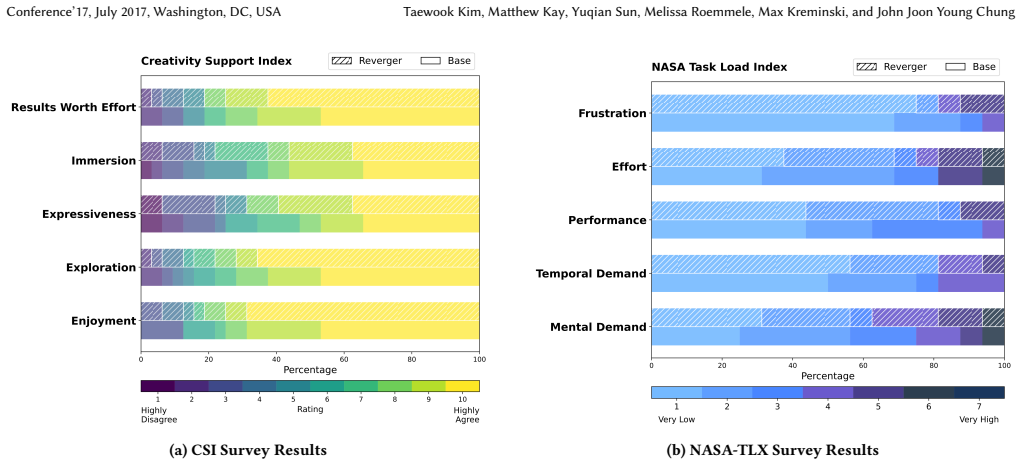
Reverger shows that the missing capability in LLM-based story tools is not more idea generation but structured movement between abstraction and instantiation. For divergence, the system generates eight disjoint high-level modification directions and recursively generates four sub-directions for any direction; for convergence, it lets users check multiple directions and instantiate a single coherent story variation that reflects all of them. The within-subject comparison against a baseline with recursion and multi-selection disabled found significantly higher perceived exploration, enjoyment, and results-worth-effort, and interaction logs show users reaching satisfying outcomes with fewer generated variations while exploring deeper direction hierarchies. The authors interpret these findings as support for designing interfaces that keep human judgment in the loop rather than letting the AI automatically fill the gap between an abstract desire and a concrete artifact.
Load-bearing premise
The load-bearing premise is that ten-minute, non-blinded sessions with self-report surveys and interaction logs measure real creative support, rather than participants rewarding a visibly more elaborate interface.
Editorial extensions
If this is right
- Writers can explore deeper levels of abstraction (third through seventh levels) and, surprisingly, more second-level directions than when recursion is disabled.
- Selecting multiple directions simultaneously reduces the number of generated variations needed to reach a satisfactory outcome.
- Perceived creativity support improves on exploration, enjoyment, and results-worth-effort without raising measured cognitive load.
- The same workflow supports a spectrum of uses, from localized stylistic refinements of a single passage to major conceptual mutations of a whole story.
- An interface that preserves visible user choices can sustain a sense of ownership even when the final text is largely AI-generated.
Reading between the lines
- The two-mode loop should transfer to image editing and UI generation, where highlighting a region and synthesizing selected style or content directions could replace prompt-only iteration; the paper hints at this but does not test it.
- A longitudinal study with writers' own drafts over several weeks would separate genuine workflow benefit from the novelty of recursive menus, a limitation the authors themselves flag.
- The value of multi-direction synthesis likely depends on the semantic disjointness of the proposed directions; measuring whether recursive sub-directions overlap would be a testable extension.
- The ownership finding suggests a general design pattern: surfacing an explicit trail of the user's selections may protect authorial agency, but this mechanism is not yet isolated from the effect of simply having more options.
Editorial analysis
A structured set of objections, weighed in public.
Referee Report
Summary. The paper presents Reverger, an LLM-powered creativity support tool that scaffolds recursive divergence (exploring hierarchical high-level directions for story modifications) and multi-direction convergence (selecting multiple directions and synthesizing them into concrete story variations). The authors contribute a system design, implementation details with LLM prompts, and a within-subject user study (n=16) comparing Reverger to a baseline that disables two key features. They report significant CSI differences in enjoyment, exploration, and results worth effort, and support these with interaction logs and interview excerpts. The paper also discusses usage patterns, ownership, and limitations.
Significance. The design concept is well-motivated and the system is clearly described, including the prompting strategy and interface. If the empirical claims held, the work would be a useful contribution to creativity support tool research by directly addressing recursive divergence and multi-direction convergence. The qualitative findings—particularly the varied usage patterns, the sense of ownership, and the concerns about over-reliance—are valuable and well presented. However, the quantitative backbone is invalid as reported: the Wilcoxon signed-rank z-values in Section 6.1 are mathematically impossible for n=16, and the paper's own table contradicts a key descriptive statistic. These problems undermine the central comparative claims in the abstract. The study is exploratory, and the authors correctly acknowledge the novelty effect and short session duration in Section 7.3, but the statistical reporting must be corrected before the headline claims can be accepted.
major comments (4)
- [§6.1] The reported Wilcoxon signed-rank z-values cannot occur with n=16 paired observations. For this sample size, the test statistic W has mean n(n+1)/4 = 68 and variance n(n+1)(2n+1)/24 = 374, so the maximum possible |z| is 68/sqrt(374) ≈ 3.52. The paper reports z = −4.56, −4.56, −4.82, and −4.04 for the CSI comparisons, all of which are impossible. The associated p-values are also internally inconsistent (e.g., identical z = −4.56 with p = .02 and p = .038). Because these are the only inferential statistics supporting the abstract's claims about improved exploration, enjoyment, and effort-worthy outcomes, the quantitative basis for those claims collapses as reported. Please re-run the analysis with an appropriate exact nonparametric test and report the correct statistics, or remove the inferential claims.
- [§6.2.2 and Table 2] The text states that participants "generated 127 synthesized variations across variations with multiple directions using our system," but Table 2 shows the totals for two-direction, three-direction, four-direction, five-direction, six-direction, and seven-direction convergence attempts as 48, 30, 6, 1, 2, and 1, respectively, which sum to 88, not 127. This inconsistency affects the substantive claim that Reverger allowed participants to discover satisfactory outcomes in fewer iterations. Please verify the data and correct either the table or the text.
- [§5.1 and §6.2] The baseline condition disables two features simultaneously: D.2 (recursive sub-direction exploration) and C.1 (multi-selection synthesis). The experimental design therefore supports only a holistic comparison between the full Reverger system and a stripped version; it cannot isolate the effect of recursive divergence from the effect of multi-direction convergence. Yet Section 6.2.1 attributes the exploration benefits specifically to the divergence features and Section 6.2.2 attributes the synthesis benefits specifically to the convergence features. These causal attributions are not supported by the study design. Please temper the language or reframe the findings as observations about the integrated system.
- [§6.1] The CSI analysis tests five subscales, and the paper reports unadjusted p-values. Even if the z-values were correct, a Bonferroni correction for five comparisons would set the threshold at p < .01, and the reported values (p = .02, .038, .003) would not all survive; only the results worth effort comparison (p = .003) would remain significant. Please address multiple-comparison concerns in the revised analysis.
minor comments (6)
- [Figure 4] The survey result figures appear to show box plots or dot plots, but the text does not describe what is displayed (e.g., median, interquartile range, individual paired scores). Please add a brief description in the caption or text.
- [§5.1] The baseline description says users "can select only one high-level direction by checking /check-square(C.1)," but the baseline also disables D.2. This is slightly confusing because C.1 still exists in the baseline; please clarify the exact state of each feature in the baseline.
- [§5.4.2] The paper mentions that some participants were allowed to continue beyond the 10-minute task, but it does not report how many did or how much extra time was taken. This information would help readers assess the comparability of sessions.
- [§4.2.2] The prompt for C.2 includes requirements about highlighting phrases and words (Requirement 1 and 2), but the text does not explicitly explain these design choices. A sentence connecting these requirements to the goal of helping users see how their selected directions were realized would improve the presentation.
- [Table 1] The columns for System and Story in Sessions 1 and 2 are redundant given the Latin-square description; consider reducing the table or adding a note to help readers parse the design in one pass.
- [§4] The term "mutant story" is used in the interface and in Table 2, but it is not defined in the main text. Please define it at first use to avoid confusion.
Circularity Check
No significant circularity: the study's comparative claims rest on an empirical within-subject user study, not on a definitional or self-citational derivation.
full rationale
Reverger's central claims are empirical outcomes of a 16-participant within-subject study comparing the full tool to a stripped baseline, not results derived from definitions or fitted parameters. The abstract's statements about exploring more unexpected and diverse directions and about effort-worthy outcomes are supported by CSI survey responses, NASA-TLX scores, interaction logs, and interview quotes. The baseline disables the recursive-exploration (D.2) and multi-selection (C.1) features, so the finding that Reverger exposes more directions is partly a consequence of the manipulation; however, that is the experimental contrast being evaluated, not a circular derivation, and the paper does not define exploration or outcome quality in terms of the enabled features. Self-citations (e.g., [15, 18, 19, 53, 56-58]) appear in related-work and discussion contexts but are not load-bearing for the headline results, and no uniqueness theorem or prior-work ansatz is invoked to force the design choice. The reported Wilcoxon z-values that exceed the theoretical maximum for n=16 are a statistical correctness issue, not a circularity issue; they do not make the derivation self-referential. Accordingly, no circular step can be quoted or exhibited, and the circularity score is 0.
Assumptions & free parameters
free parameters (3)
- Number of high-level directions per search =
8
- Number of sub-directions per recursion =
4
- LLM and sampling settings =
claude-3-sonnet-20240229, default settings
assumptions (4)
- domain assumption Divergent and convergent thinking, interleaved recursively, are the core processes in creative story ideation.
- domain assumption The stripped baseline tool fairly represents existing CSTs such as Luminate and Wordcraft.
- domain assumption CSI and NASA-TLX self-reports after 10-minute tasks capture genuine creativity support rather than demand characteristics or novelty effects.
- domain assumption The LLM outputs faithfully instantiate the selected high-level directions.
Cite this review
Pith. "Pith review of Scaffolding Recursive Divergence and Convergence in Story Ideation." pith.science (2026). https://pith.science/paper/GZHUD4SA
@misc{pith2026250703307,
  author       = {Pith},
  title        = {Pith review of: Scaffolding Recursive Divergence and Convergence in Story Ideation},
  year         = {2026},
  howpublished = {\url{https://pith.science/paper/GZHUD4SA}},
  note         = {Machine review of arXiv:2507.03307}
}
read the original abstract
Human creative ideation involves both exploration of diverse ideas (divergence) and selective synthesis of explored ideas into coherent combinations (convergence). While processes of divergence and convergence are often interleaved and nested, existing AI-powered creativity support tools (CSTs) lack support for sophisticated orchestration of divergence and convergence. We present Reverger, an AI-powered CST that helps users ideate variations of conceptual directions for modifying a story by scaffolding flexible iteration between divergence and convergence. For divergence, our tool enables recursive exploration of alternative high-level directions for modifying a specific part of the original story. For convergence, it allows users to collect explored high-level directions and synthesize them into concrete variations. Users can then iterate between divergence and convergence until they find a satisfactory outcome. A within-subject study revealed that Reverger permitted participants to explore more unexpected and diverse high-level directions than a comparable baseline. Reverger users also felt that they had more fine-grained control and discovered more effort-worthy outcomes.
Figures


Figures from the paper (2 more)

Reference graph
Works this paper leans on
- [1]
-
[2]
Barrett R Anderson, Jash Hemant Shah, and Max Kreminski. 2024. Homog- enization Effects of Large Language Models on Human Creative Ideation. In Proceedings of the 16th Conference on Creativity & Cognition (Chicago, IL, USA) (C&C ’24). Association for Computing Machinery, New York, NY, USA, 413–425. https://doi.org/10.1145/3635636.3656204
arXiv 2024
-
[3]
Anthropic. 2024. Claude 3. https://claude.ai/
2024
-
[4]
Akari Asai, Jacqueline He, Rulin Shao, Weijia Shi, Amanpreet Singh, Joseph Chee Chang, Kyle Lo, Luca Soldaini, Sergey Feldman, Mike D’arcy, David Wadden, Matt Latzke, Minyang Tian, Pan Ji, Shengyan Liu, Hao Tong, Bohao Wu, Yanyu Xiong, Luke Zettlemoyer, Graham Neubig, Dan Weld, Doug Downey, Wen tau Yih, Pang Wei Koh, and Hannaneh Hajishirzi. 2024. OpenSch...
arXiv 2024
-
[5]
J. Baer. 2014. Creativity and Divergent Thinking: A Task-Specific Approach. Taylor & Francis. https://books.google.com/books?id=DdCAEAAAQBAJ
2014
-
[6]
Beaty, Paul J
Roger E. Beaty, Paul J. Silvia, Emily C. Nusbaum, Emanuel Jauk, and Mathias Benedek. 2014. The roles of associative and executive processes in creative cognition. Memory & Cognition 42, 7 (2014), 1186–1197. https://doi.org/10. 3758/s13421-014-0428-8
2014
-
[7]
good science
S. J. Bird. 2014. Socially responsible science is more than "good science". Journal of Microbiology & Biology Education 15, 2 (2014), 169–172. https://doi.org/10. 1128/jmbe.v15i2.870
2014
-
[8]
Dennis R. Brophy. 2001. Comparing the Attributes, Activities, and Performance of Divergent, Convergent, and Combination Thinkers. Creativity Research Journal 13, 3-4 (2001), 439–455. https://doi.org/10.1207/S15326934CRJ1334_20
Show all 104 references
-
[9]
Alice Cai, Steven R Rick, Jennifer L Heyman, Yanxia Zhang, Alexandre Fil- ipowicz, Matthew Hong, Matt Klenk, and Thomas Malone. 2023. DesignAID: Using Generative AI and Semantic Diversity for Design Inspiration. In Pro- ceedings of The ACM Collective Intelligence Conference (D...
2023
-
[11]
Erin Cherry and Celine Latulipe. 2014. Quantifying the Creativity Support of Digital Tools through the Creativity Support Index. ACM Trans. Comput.-Hum. Interact. 21, 4, Article 21 (June 2014), 25 pages. https://doi.org/10.1145/2617588
2014 doi
-
[12]
Cheng-Han Chiang and Hung-yi Lee. 2023. Can Large Language Models Be an Alternative to Human Evaluations?. In Proceedings of the 61st Annual Meeting of the Association for Computational Linguistics (Volume 1: Long Pa- pers), Anna Rogers, Jordan Boyd-Graber, and Naoaki Okazaki ...
2023 doi
-
[13]
DaEun Choi, Sumin Hong, Jeongeon Park, John Joon Young Chung, and Juho Kim. 2024. CreativeConnect: Supporting Reference Recombination for Graphic Design Ideation with Generative AI. InProceedings of the 2024 CHI Conference on Human Factors in Computing Systems (Honolulu, HI, U...
2024
-
[14]
Christiano, Jan Leike, Tom B
Paul F. Christiano, Jan Leike, Tom B. Brown, Miljan Martic, Shane Legg, and Dario Amodei. 2017. Deep reinforcement learning from human preferences. In Proceedings of the 31st International Conference on Neural Information Processing Systems (Long Beach, California, USA) (NIPS’...
2017
-
[15]
John Joon Young Chung and Eytan Adar. 2023. PromptPaint: Steering Text-to- Image Generation Through Paint Medium-like Interactions. In Proceedings of the 36th Annual ACM Symposium on User Interface Software and Technology (San Francisco, CA, USA) (UIST ’23). Association for Co...
2023
-
[16]
John Joon Young Chung, Shiqing He, and Eytan Adar. 2021. The Intersection of Users, Roles, Interactions, and Technologies in Creativity Support Tools. In Proceedings of the 2021 ACM Designing Interactive Systems Conference (Virtual Event, USA) (DIS ’21). Association for Comput...
2021
-
[17]
John Joon Young Chung, Wooseok Kim, Kang Min Yoo, Hwaran Lee, Eytan Adar, and Minsuk Chang. 2022. TaleBrush: Sketching Stories with Generative Pretrained Language Models. InProceedings of the 2022 CHI Conference on Human Factors in Computing Systems (New Orleans, LA, USA) (CHI...
2022
-
[18]
John Joon Young Chung and Max Kreminski. 2024. Patchview: LLM-powered Worldbuilding with Generative Dust and Magnet Visualization. In Proceedings of the 37th Annual ACM Symposium on User Interface Software and Technology (Pittsburg, PA, USA) (UIST ’24). Association for Computi...
2024
-
[19]
John Joon Young Chung, Melissa Roemmele, and Max Kreminski. 2024. Toyteller: Toy-Playing with Character Symbols for AI-Powered Visual Storytelling. In Adjunct Proceedings of the 37th Annual ACM Symposium on User Interface Software and Technology (Pittsburgh, PA, USA) (UIST Adj...
2024
-
[20]
Elizabeth Clark, Anne Spencer Ross, Chenhao Tan, Yangfeng Ji, and Noah A. Smith. 2018. Creative Writing with a Machine in the Loop: Case Studies on Slo- gans and Stories. In Proceedings of the 23rd International Conference on Intelligent User Interfaces (Tokyo, Japan) (IUI ’18...
2018
-
[21]
Kate Compton and Michael Mateas. 2015. Casual Creators. In International Conference on Computational Creativity . 228–235
2015
-
[22]
Nigel Cross. 2004. Expertise in design: an overview. Design Studies 25, 5 (2004), 427–441. https://doi.org/10.1016/j.destud.2004.06.002 Expertise in Design
2004 doi
-
[23]
Csikszentmihalyi
M. Csikszentmihalyi. 2009. Creativity: Flow and the Psychology of Discovery and . HarperCollins. https://books.google.com/books?id=aci_Ea4c6woC
2009
-
[24]
A.M. Dean. 2001. Experimental Design: Overview. In International Encyclopedia of the Social & Behavioral Sciences , Neil J. Smelser and Paul B. Baltes (Eds.). Pergamon, Oxford, 5090–5096. https://doi.org/10.1016/B0-08-043076-7/00417-4
2001 doi
-
[25]
Dean, Jillian M
Douglas L. Dean, Jillian M. Hender, Thomas L. Rodgers, and Eric L. Santanen
-
[26]
Desmond and P.J
J.M. Desmond and P.J. Hawkes. 2015. Adaptation: Studying Film and Literature . McGraw-Hill Companies. https://books.google.com/books?id=NIW0jgEACAAJ
2015
-
[27]
Paramveer S Dhillon, Somayeh Molaei, Jiaqi Li, Maximilian Golub, Shaochun Zheng, and Lionel Peter Robert. 2024. Shaping Human-AI Collaboration: Varied Scaffolding Levels in Co-writing with Language Models. In Proceedings of the CHI Conference on Human Factors in Computing Syst...
2024
-
[28]
Dow, Alana Glassco, Jonathan Kass, Melissa Schwarz, Daniel L
Steven P. Dow, Alana Glassco, Jonathan Kass, Melissa Schwarz, Daniel L. Schwartz, and Scott R. Klemmer. 2011. Parallel prototyping leads to better design results, more divergence, and increased self-efficacy. ACM Trans. Comput.-Hum. Interact. 17, 4, Article 18 (Dec. 2011), 24 ...
2011 doi
-
[29]
Fiona Draxler, Anna Werner, Florian Lehmann, Matthias Hoppe, Albrecht Schmidt, Daniel Buschek, and Robin Welsch. 2024. The AI Ghostwriter Effect: When Users do not Perceive Ownership of AI-Generated Text but Self-Declare as Authors. ACM Trans. Comput.-Hum. Interact. 31, 2, Art...
2024 doi
-
[30]
https://doi.org/10.17705/1jais.00106
-
[31]
Fauconnier and M
G. Fauconnier and M. Turner. 2002. The Way We Think: Conceptual Blending And The Mind’s Hidden Complexities . Basic Books. https://books.google.com/ books?id=jEjuAAAAMAAJ
2002
-
[32]
Shiran Dudy, Thulasi Tholeti, Resmi Ramachandranpillai, Muhammad Ali, Toby Jia-Jun Li, and Ricardo Baeza-Yates. 2025. Unequal Opportunities: Examining the Bias in Geographical Recommendations by Large Language Models. In Proceedings of the 30th International Conference on Inte...
2025
-
[33]
Linda Flower and John R. Hayes. 1980. The Cognition of Discovery: Defining a Rhetorical Problem. College Composition and Communication 31, 1 (Feb 1980), 21–32. https://doi.org/10.2307/356630
1980 doi
-
[34]
Finke, T.B
R.A. Finke, T.B. Ward, and S.M. Smith. 1996. Creative Cognition: Theory, Re- search, and Applications . MIT Press. https://books.google.com/books?id= YrxNEAAAQBAJ
1996
-
[35]
Liane Gabora. 2010. Revenge of the “Neurds”: Characterizing Creative Thought in Terms of the Structure and Dynamics of Memory.Creativity Research Journal 22, 1 (2010), 1–13. https://doi.org/10.1080/10400410903579494
2010 doi
-
[36]
Jonas Frich, Lindsay MacDonald Vermeulen, Christian Remy, Michael Mose Biskjaer, and Peter Dalsgaard. 2019. Mapping the Landscape of Creativity Support Tools in HCI. In Proceedings of the 2019 CHI Conference on Human Factors in Computing Systems (Glasgow, Scotland Uk) (CHI ’19...
2019
-
[37]
Georgiev and Danko D
Georgi V. Georgiev and Danko D. Georgiev. 2018. Enhancing user creativity: Semantic measures for idea generation. Knowledge-Based Systems 151 (2018), 1–15. https://doi.org/10.1016/j.knosys.2018.03.016
2018 doi
-
[38]
Ge Gao, Alexey Taymanov, Eduardo Salinas, Paul Mineiro, and Dipendra Misra
-
[39]
Katy Ilonka Gero and Lydia B. Chilton. 2019. Metaphoria: An Algorithmic Companion for Metaphor Creation. In Proceedings of the 2019 CHI Conference on Human Factors in Computing Systems (Glasgow, Scotland Uk) (CHI ’19) . Association for Computing Machinery, New York, NY, USA, 1...
2019
-
[40]
Katy Ilonka Gero, Vivian Liu, and Lydia Chilton. 2022. Sparks: Inspiration for Science Writing using Language Models. In Proceedings of the 2022 ACM Designing Interactive Systems Conference (Virtual Event, Australia) (DIS ’22). Association for Computing Machinery, New York, NY...
2022
-
[41]
Katy Gero, Alex Calderwood, Charlotte Li, and Lydia Chilton. 2022. A Design Space for Writing Support Tools Using a Cognitive Process Model of Writing. In Proceedings of the First Workshop on Intelligent and Interactive Writing Assistants (In2Writing 2022), Ting-Hao ’Kenneth’ ...
2022 doi
-
[42]
Gabriela Goldschmidt. 2016. Linkographic Evidence for Concurrent Divergent and Convergent Thinking in Creative Design. Creativity Research Journal 28, 2 (2016), 115–122. https://doi.org/10.1080/10400419.2016.1162497
2016
-
[43]
Google. 2024. Gemini. https://gemini.google.com/
2024
-
[44]
Vinod Goel. 2014. Creative brains: designing in the real world †. Frontiers in Human Neuroscience 8 (2014). https://doi.org/10.3389/fnhum.2014.00241
2014
-
[45]
Hart and Lowell E
Sandra G. Hart and Lowell E. Staveland. 1988. Development of NASA-TLX (Task Load Index): Results of Empirical and Theoretical Research. In Human Mental Workload, Peter A. Hancock and Najmedin Meshkati (Eds.). Advances in Psychology, Vol. 52. North-Holland, 139–183. https://doi...
1988 doi
-
[46]
Shirley Anugrah Hayati, Minhwa Lee, Dheeraj Rajagopal, and Dongyeop Kang
-
[47]
Guilford
J.P. Guilford. 1967. The Nature of Human Intelligence . McGraw-Hill. https: //books.google.com/books?id=T-ZJAAAAMAAJ
1967
-
[48]
Jennifer Jacobs, Sumit Gogia, Radomír M˘ech, and Joel R. Brandt. 2017. Support- ing Expressive Procedural Art Creation through Direct Manipulation. InProceed- ings of the 2017 CHI Conference on Human Factors in Computing Systems . ACM, Denver Colorado USA, 6330–6341. https://d...
2017
-
[49]
Jansson and Steven M
David G. Jansson and Steven M. Smith. 1991. Design fixation. Design Studies 12, 1 (1991), 3–11. https://doi.org/10.1016/0142-694X(91)90003-F
1991 doi
-
[50]
In Proceedings of the 2024 Conference on Empirical Methods in Natural Language Processing, Yaser Al-Onaizan, Mohit Bansal, and Yun-Nung Chen (Eds.)
How Far Can We Extract Diverse Perspectives from Large Language Models?. In Proceedings of the 2024 Conference on Empirical Methods in Natural Language Processing, Yaser Al-Onaizan, Mohit Bansal, and Yun-Nung Chen (Eds.). Association for Computational Linguistics, Miami, Flori...
2024
-
[51]
Kowe Kadoma, Marianne Aubin Le Quere, Xiyu Jenny Fu, Christin Munsch, Danaë Metaxa, and Mor Naaman. 2024. The Role of Inclusion, Control, and Ownership in Workplace AI-Mediated Communication. In Proceedings of the CHI Conference on Human Factors in Computing Systems . 1–10
2024
-
[52]
Jeffrey Heer. 2019. Agency plus automation: Designing artificial intelligence into interactive systems. Proceedings of the National Academy of Sciences 116, 6 (2019), 1844–1850. https://doi.org/10.1073/pnas.1807184115
2019 doi
-
[53]
Taewook Kim, Hyomin Han, Eytan Adar, Matthew Kay, and John Joon Young Chung. 2024. Authors’ Values and Attitudes Towards AI-bridged Scalable Personalization of Creative Language Arts. In Proceedings of the 2024 CHI Con- ference on Human Factors in Computing Systems (Honolulu, ...
2024
-
[54]
David Krakauer. 2016. Will A.I. Harm Us? Better to Ask How We’ll Reckon With Our Hybrid Nature. https://nautil.us/blog/will-ai-harm-us-better-to-ask- how-well-reckon-with-our-hybrid-nature. Accessed on 2021-07-01
2016
-
[55]
Pengcheng Jiang, Cao Xiao, Minhao Jiang, Parminder Bhatia, Taha Kass-Hout, Jimeng Sun, and Jiawei Han. 2025. Reasoning-Enhanced Healthcare Predictions with Knowledge Graph Community Retrieval. In The Thirteenth International Conference on Learning Representations . https://ope...
2025
-
[56]
Max Kreminski, Melanie Dickinson, Noah Wardrip-Fruin, and Michael Mateas
-
[57]
Jeongyeon Kim, Sangho Suh, Lydia B Chilton, and Haijun Xia. 2023. Metapho- rian: Leveraging Large Language Models to Support Extended Metaphor Cre- ation for Science Writing. In Proceedings of the 2023 ACM Designing Interactive Systems Conference (Pittsburgh, PA, USA) (DIS ’23...
2023 doi
-
[58]
Max Kreminski and Michael Mateas. 2021. Reflective Creators. In International Conference on Computational Creativity . 309–318
2021
-
[59]
Harsh Kumar, Jonathan Vincentius, Ewan Jordan, and Ashton Anderson. 2025. Human Creativity in the Age of LLMs: Randomized Experiments on Divergent and Convergent Thinking. In Proceedings of the CHI Conference on Human Factors in Computing Systems (CHI ’25) . ACM, Yokohama, Jap...
2025
-
[60]
Krasilovsky
A. Krasilovsky. 2017. Great Adaptations: Screenwriting and Global Storytelling . Taylor & Francis. https://books.google.com/books?id=v0c4DwAAQBAJ
2017
-
[61]
Jingyi Li, Eric Rawn, Jacob Ritchie, Jasper Tran O’Leary, and Sean Follmer. 2023. Beyond the Artifact: Power as a Lens for Creativity Support Tools. InProceedings of the 36th Annual ACM Symposium on User Interface Software and Technology (San Francisco, CA, USA)(UIST ’23). Ass...
2023
-
[62]
Youn-Kyung Lim, Erik Stolterman, and Josh Tenenberg. 2008. The anatomy of prototypes: Prototypes as filters, prototypes as manifestations of design ideas. ACM Trans. Comput.-Hum. Interact. 15, 2, Article 7 (July 2008), 27 pages. https://doi.org/10.1145/1375761.1375762
2008
-
[63]
Max Kreminski and Chris Martens. 2022. Unmet creativity support needs in computationally supported creative writing. In Proceedings of the First Workshop on Intelligent and Interactive Writing Assistants (In2Writing 2022) . 74–82
2022
-
[64]
Yiren Liu, Si Chen, Haocong Cheng, Mengxia Yu, Xiao Ran, Andrew Mo, Yiliu Tang, and Yun Huang. 2024. How AI Processing Delays Foster Creativity: Explor- ing Research Question Co-Creation with an LLM-based Agent. In Proceedings of the 2024 CHI Conference on Human Factors in Com...
2024
-
[65]
Tao Long, Katy Ilonka Gero, and Lydia B Chilton. 2024. Not Just Novelty: A Longitudinal Study on Utility and Customization of an AI Workflow. In Proceedings of the 2024 ACM Designing Interactive Systems Conference . 782–803
2024
-
[66]
Lam, Zixian Ma, Anne Li, Izequiel Freitas, Dakuo Wang, James A
Michelle S. Lam, Zixian Ma, Anne Li, Izequiel Freitas, Dakuo Wang, James A. Landay, and Michael S. Bernstein. 2023. Model Sketching: Centering Concepts in Early-Stage Machine Learning Model Design. In Proceedings of the 2023 CHI Conference on Human Factors in Computing Systems...
2023
-
[67]
Todd Lubart. 2016. Creativity and Convergent Thinking: Reflections, Connec- tions and Practical Considerations. RUDN Journal of Psychology and Pedagogics 4 (2016), 7–15
2016
-
[68]
I. Mani. 2013. Computational Modeling of Narrative . Morgan & Claypool. https://books.google.com/books?id=vco4oyBrN2kC
2013
-
[69]
David Lin. 2025. Semantic Pinching. https://github.com/chuanenlin/ semanticpinching
2025
-
[70]
Midjourney. 2025. Midjourney. https://www.midjourney.com/home
2025
-
[71]
Anirban Mukherjee and Hannah H Chang. 2023. Managing the creative frontier of generative AI: The novelty-usefulness tradeoff.California Management Review (2023)
2023
-
[72]
2019.Ask not what AI can do, but what AI should do: towards a framework of task delegability
Brian Lubars and Chenhao Tan. 2019.Ask not what AI can do, but what AI should do: towards a framework of task delegability . Curran Associates Inc., Red Hook, NY, USA
2019
-
[73]
OpenAI. 2025. Introducing Deep Research. https://openai.com/index/ introducing-deep-research/
2025
-
[74]
Massimiliano Palmiero. 2020. Chapter 4 - The relationships between abstraction and creativity. In Creativity and the Wandering Mind , David D. Preiss, Diego Cosmelli, and James C. Kaufman (Eds.). Academic Press, 73–90. https://doi.org/ 10.1016/B978-0-12-816400-6.00004-3
2020 doi
-
[75]
Damien Masson, Young-Ho Kim, and Fanny Chevalier. 2025. Textoshop: In- teractions Inspired by Drawing Software to Facilitate Text Editing. In Proceed- ings of the CHI Conference on Human Factors in Computing Systems (CHI ’25) (Yokohama, Japan, April 26–May 1, 2025). ACM, New Y...
2025
- [76]
-
[77]
Savvas Petridis, Michael Terry, and Carrie J Cai. 2024. PromptInfuser: How Tightly Coupling AI and UI Design Impacts Designers’ Workflows. In Proceed- ings of the 2024 ACM Designing Interactive Systems Conference (Copenhagen, Denmark) (DIS ’24). Association for Computing Machi...
2024
-
[78]
OpenAI. 2022. ChatGPT. https://openai.com/chatgpt/
2022
-
[79]
Kevin Pu, KJ Feng, Tovi Grossman, Tom Hope, Bhavana Dalvi Mishra, Matt Latzke, Jonathan Bragg, Joseph Chee Chang, and Pao Siangliulue. 2025. IdeaSynth: Iterative Research Idea Development Through Evolving and Com- posing Idea Facets with Literature-Grounded Feedback. In CHI Co...
2025
-
[80]
Christian Remy, Lindsay MacDonald Vermeulen, Jonas Frich, Michael Mose Biskjaer, and Peter Dalsgaard. 2020. Evaluating creativity support tools in HCI research. In Proceedings of the 2020 ACM Designing Interactive Systems Conference. 457–476
2020
-
[81]
Bernstein
Joon Sung Park, Lindsay Popowski, Carrie Cai, Meredith Ringel Morris, Percy Liang, and Michael S. Bernstein. 2022. Social Simulacra: Creating Populated Prototypes for Social Computing Systems. In Proceedings of the 35th Annual ACM Symposium on User Interface Software and Techn...
2022
-
[82]
Rochberg-Halton
E. Rochberg-Halton. 1984. Object relations, role models, and cultivation of the self. Environment and Behavior 16, 3 (1984), 335–368. https://doi.org/10.1177/ 0013916584163003
1984
-
[83]
Robin Rombach, Andreas Blattmann, Dominik Lorenz, Patrick Esser, and Björn Ommer. 2022. High-Resolution Image Synthesis with Latent Diffusion Models. Proceedings of the IEEE/CVF Conference on Computer Vision and Pattern Recogni- tion (CVPR) (2022), 10674–10685. https://doi.org...
2022
-
[84]
Pierce, Tatiana Kostova, and Kurt T
Jon L. Pierce, Tatiana Kostova, and Kurt T. Dirks. 2001. Toward a Theory of Psychological Ownership in Organizations.The Academy of Management Review 26, 2 (2001), 298–310. http://www.jstor.org/stable/259124
2001
-
[85]
Mark A. Runco. 2010. Creativity: Theories and Themes: Research, Development, and Practice . Academic Press. https://books.google.com/books?id=nJlfKE- meqEC
2010
-
[86]
Sawyer and D
R.K. Sawyer and D. Henriksen. 2024. Explaining Creativity: The Science of Human Innovation. Oxford University Press. https://books.google.com/books? id=Nw3kEAAAQBAJ
2024
-
[87]
Mohi Reza, Nathan M Laundry, Ilya Musabirov, Peter Dushniku, Zhi Yuan “Michael” Yu, Kashish Mittal, Tovi Grossman, Michael Liut, Anastasia Kuzminykh, and Joseph Jay Williams. 2024. ABScribe: Rapid Exploration & Organization of Multiple Writing Variations in Human-AI Co-Writing...
2024
-
[88]
Ben Shneiderman and Pattie Maes. 1997. Direct manipulation vs. interface agents. Interactions 4, 6 (Nov. 1997), 42–61. https://doi.org/10.1145/267505.267514
1997
-
[89]
Chenglei Si, Diyi Yang, and Tatsunori Hashimoto. 2025. Can LLMs Generate Novel Research Ideas? A Large-Scale Human Study with 100+ NLP Researchers. In The Thirteenth International Conference on Learning Representations . https: //openreview.net/forum?id=M23dTGWCZy Scaffolding ...
2025
-
[90]
Mark A. Runco. 1991. The Evaluative, Valuative, and Divergent Thinking of Children. The Journal of Creative Behavior 25, 4 (1991), 311–319. https: //doi.org/10.1002/j.2162-6057.1991.tb01143.x
1991
-
[91]
Sangho Suh, Jian Zhao, and Edith Law. 2022. CodeToon: Story Ideation, Auto Comic Generation, and Structure Mapping for Code-Driven Storytelling. In Proceedings of the 35th Annual ACM Symposium on User Interface Software and Technology (Bend, OR, USA) (UIST ’22). Association fo...
2022 doi
-
[92]
Konstantinos Thomas, Giorgos Filandrianos, Maria Lymperaiou, Chrysoula Zerva, and Giorgos Stamou. 2024. ”I Never Said That”: A dataset, taxonomy and baselines on response clarity classification. In Findings of the Association for Computational Linguistics: EMNLP 2024 , Yaser A...
2024 doi
-
[93]
Lam, Joey Hejna, Yijia Shao, Hyundong Justin Cho, Michael S
Omar Shaikh, Michelle S. Lam, Joey Hejna, Yijia Shao, Hyundong Justin Cho, Michael S. Bernstein, and Diyi Yang. 2025. Aligning Language Models with Demonstrated Feedback. In The Thirteenth International Conference on Learning Representations. https://openreview.net/forum?id=1qGkuxI9UX
2025
-
[94]
Willemsen, Isabelle C
Robin H. Willemsen, Isabelle C. de Vink, Evelyn H. Kroesbergen, and Ard W. Lazonder. 2023. The role of creative thinking in children’s scientific reasoning. Thinking Skills and Creativity 49 (2023), 101375. https://doi.org/10.1016/j.tsc. 2023.101375
2023
-
[95]
Jason Wu, Kashyap Todi, Joannes Chan, Brad A Myers, and Ben Lafreniere. 2024. FrameKit: A Tool for Authoring Adaptive UIs Using Keyframes. In Proceedings of the 29th International Conference on Intelligent User Interfaces (Greenville, SC, USA) (IUI ’24). Association for Comput...
2024
-
[96]
Sangho Suh, Meng Chen, Bryan Min, Toby Jia-Jun Li, and Haijun Xia. 2024. Luminate: Structured Generation and Exploration of Design Space with Large Language Models for Human-AI Co-Creation. In Proceedings of the 2024 CHI Conference on Human Factors in Computing Systems (Honolu...
2024
-
[97]
Ann Yuan, Andy Coenen, Emily Reif, and Daphne Ippolito. 2022. Wordcraft: Story Writing With Large Language Models. In Proceedings of the 27th In- ternational Conference on Intelligent User Interfaces (Helsinki, Finland) (IUI ’22). Association for Computing Machinery, New York,...
2022
-
[98]
Lvmin Zhang and Maneesh Agrawala. 2024. Transparent Image Layer Diffusion using Latent Transparency. ACM Trans. Graph. 43, 4, Article 100 (July 2024), 15 pages. https://doi.org/10.1145/3658150
2024 doi
-
[100]
David Zhou and Sarah Sterman. 2024. Ai.llude: Investigating Rewriting AI- Generated Text to Support Creative Expression. In Proceedings of the 16th Conference on Creativity & Cognition (Chicago, IL, USA) (C&C ’24) . Asso- ciation for Computing Machinery, New York, NY, USA, 241...
2024
-
[102]
Ziming Wu, Taewook Kim, Quan Li, and Xiaojuan Ma. 2019. Understanding and Modeling User-Perceived Brand Personality from Mobile Application UIs. In Proceedings of the 2019 CHI Conference on Human Factors in Computing Systems (Glasgow, Scotland Uk) (CHI ’19). Association for Co...
2019
-
[105]
Lei Zhang, Jin Pan, Jacob Gettig, Steve Oney, and Anhong Guo. 2024. VRCopilot: Authoring 3D Layouts with Generative AI Models in VR. In Proceedings of the 37th Annual ACM Symposium on User Interface Software and Technology (Pittsburgh, PA, USA) (UIST ’24). Association for Comp...
2024
-
[2006]
Journal of the Association for Information Systems 7, 10 (2006),
Identifying Quality, Novel, and Creative Ideas: Constructs and Scales for Idea Evaluation. Journal of the Association for Information Systems 7, 10 (2006),
2006
-
[2022]
In Proceedings of the Eighteenth AAAI Conference on Artificial Intelligence and Interactive Digital Entertainment (Pomona, CA, USA) (AIIDE’22)
Loose ends: a mixed-initiative creative interface for playful storytelling. In Proceedings of the Eighteenth AAAI Conference on Artificial Intelligence and Interactive Digital Entertainment (Pomona, CA, USA) (AIIDE’22). AAAI Press, Article 15, 9 pages. https://doi.org/10.1609/...
-
[2024]
arXiv preprint arXiv:2404.15269 (2024)
Aligning llm agents by learning latent preference from user edits. arXiv preprint arXiv:2404.15269 (2024)
2024 arXiv
-
[5366]
https://doi.org/10.18653/v1/2024.emnlp-main.306
2024 doi
Reviewed August 6, 2026 · model on record in the stance chip above.
Discussion (0). Sign in to comment.