REVIEW 4 major objections 3 minor 8 references
On Combining Two Server Control Policies for Energy Efficiency
T0 review · 4 major / 3 minor · reviewed 2026-08-06 · deepseek-v4-flash
Pith's one-line read This paper argues that turning a server off and scaling its speed do not combine synergistically: for any load, one mechanism dominates and the other adds only minor cost savings.
desk verdict A clearly posed question about combining speed scaling and on/off control, but the paper's central no-synergy claim rests entirely on experiments the reader never sees. read the letter →
The pith
A machine-rendered reading of the paper's core claim, the machinery that carries it, and where it could break.
The reading
What carries the argument
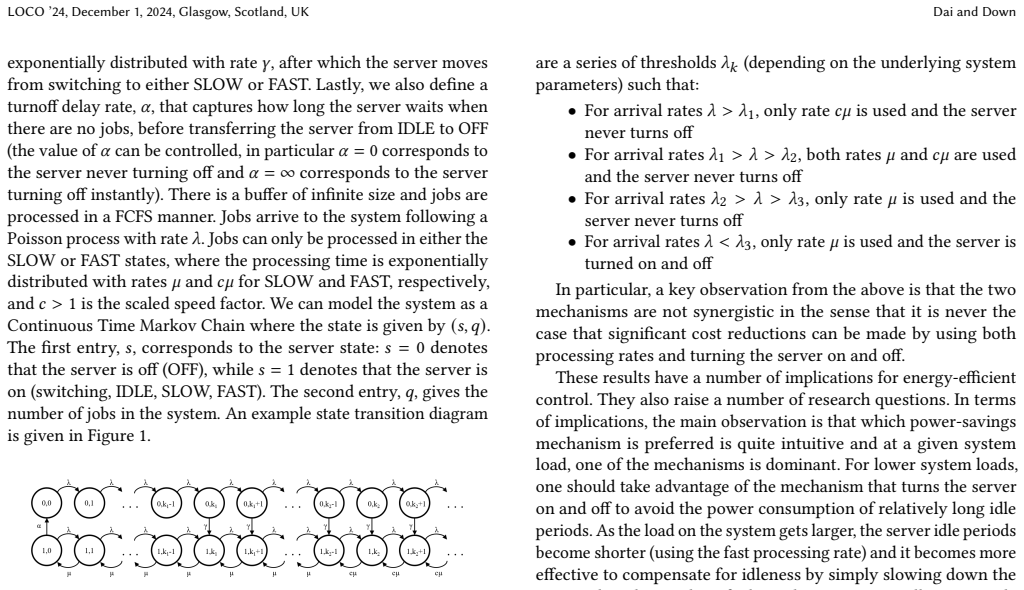
The central object is a continuous-time Markov chain with state $(s,q)$, where $s$ records whether the server is off or on (and whether it is switching, idle, slow, or fast) and $q$ counts jobs in the system. Arrivals are Poisson with rate $\lambda$; service is exponential at rate $\mu$ in SLOW and $c\mu$ in FAST; the setup time is exponential with rate $\gamma$; and the turnoff delay is controlled by rate $\alpha$. Two thresholds, $k_1$ and $k_2$, determine when the server starts turning on and when it shifts to the fast speed. The cost function $E[R]+\beta E[P]$ reduces everything to a single objective, and the argument works by solving the steady-state distribution numerically over a broad parameter grid and comparing the best costs across policy regimes.
What would settle it
Re-run the cost comparison with near-deterministic setup times or with a continuum of speed choices; if at any load a combined on/off plus speed-scaling policy beats the best single-mechanism policy by more than a few percent, the no-synergy claim fails.
Extended reading notes
Core claim
The paper's central claim is that, in the CTMC model with Poisson arrivals, exponential service at rates $\mu$ and $c\mu$, exponential setup rate $\gamma$, and turnoff delay rate $\alpha$, the on/off and speed-scaling mechanisms do not compound. It reports a series of arrival-rate thresholds $\lambda_1 > \lambda_2 > \lambda_3$ such that: for $\lambda > \lambda_1$ the server stays on and runs only at fast rate $c\mu$; for $\lambda_1 > \lambda > \lambda_2$ it stays on and uses both rates; for $\lambda_2 > \lambda > \lambda_3$ it stays on and uses only slow rate $\mu$; and for $\lambda < \lambda_3$ it turns off when idle and uses only slow rate $\mu$. The key observation, presented as a numerical finding rather than a theorem, is that it is never the case that significant cost reductions come from using both processing rates and turning the server on and off at once. The statement carries the condition $p_f/(c\mu) > p_s/\mu$, meaning the faster rate is not always preferable once power per unit work is accounted for.
Load-bearing premise
The load-bearing premise is that setup times and service times are exponentially distributed and that the server has exactly two speeds; if real switching delays are not memoryless or a continuum of speeds is available, the threshold structure and the no-synergy conclusion could fail.
Editorial extensions
If this is right
- Below a utilization threshold, the recommended simple policy is to turn the server off when idle and run at the slow speed; above it, keep the server on and use speed scaling.
- Adding the second mechanism to the dominant one reduces cost only slightly, so complex joint controllers buy little in this model.
- For high loads, the fast rate alone is best, so setup delays and off/on cycling can be avoided entirely.
- For low loads, speed scaling adds little once the server can be turned off, so a single slow speed plus on/off control suffices.
- The paper expects the single-server insight to carry over to multiserver systems, which would make cluster-level energy policies simpler.
Reading between the lines
- If the no-synergy conclusion depends on the memoryless setup assumption, then with deterministic or heavy-tailed setup times a combined policy might win at intermediate loads; the paper does not test this.
- Varying the weight $\beta$ should shift the arrival-rate thresholds monotonically, giving a quantitative prediction that could be checked without leaving the paper's own CTMC solver.
- For multiserver systems the paper only conjectures carryover; a cluster-level extension could show whether per-server thresholds remain independent or need coordination.
- Because arrival rates are hard to measure in practice, queue-length-based hysteresis policies might approximate the load-based threshold policy; the paper flags this as an open question.
Signed reviews
Editorial analysis
A structured set of objections, weighed in public.
Referee Report
Summary. The paper studies a single-server queue with Poisson arrivals, exponential service times, two processing rates μ and cμ, and the ability to switch the server off after an idle delay of rate α. The cost is a linear combination of mean response time and mean power consumption, Eq. (1). The authors assert, based on unspecified 'extensive numerical experiments,' that using both speed scaling and on/off control together never yields significant cost savings over the better single mechanism, and they describe four load regimes separated by thresholds λ1, λ2, λ3. No proofs, numerical data, or experimental details are included; the paper states that explicit steady-state results are planned for a full paper.
Significance. If established, the no-synergy result would be practically useful: it would justify a simple load-dependent policy (on/off at slow speed for low load; speed scaling for high load) and would complement the structural results in [1] and [6]. The paper also raises a research question worth asking. However, the present manuscript provides only an informal claim: there are no reproducible experiments, no quantitative measure of 'small' cost decrease, and no derivation of the threshold structure. The significance paragraph should therefore be read as indicating potential, not achieved, contribution.
major comments (4)
- [Section 3 (Key observation)] The central claim that the two mechanisms are not synergistic is stated as a 'key observation' but is supported only by 'Extensive numerical experiments have been performed'; no definition of 'small' or 'significant' is given, no parameter grid, no sample results, and no experimental script or data are provided. This makes the headline result unverifiable. Since the paper explicitly defers the 'general, explicit results' to a full paper, the current manuscript offers no way for the reader to check the claim.
- [Section 3 (Threshold structure)] The asserted threshold structure (the four bullet points with λ1, λ2, λ3) is presented with the phrase 'It appears'; no proof is supplied, and the one stated condition p_f/(cμ) > p_s/μ is never shown to be sufficient for the existence or ordering of the thresholds. The MDP result [1] cited in the introduction is not used to establish the structure, so it cannot rescue the claim.
- [Section 2 (Model scope)] The model assumes exponential setup times and service times and exactly two speeds. The paper does not test robustness to non-exponential setup delays or to a continuum of speeds, yet the concluding 'simple policy' recommendation appears to generalize beyond these assumptions. If the claim is intended only for the exponential two-speed CTMC, that domain restriction should be stated; even for that restricted domain, the claim still requires the missing numerical evidence.
- [Section 2 and Figure 1] Figure 1 and the surrounding text appear to be copied verbatim from a thesis (with the lines 'Master of Science– Guang Mo', 'Figure 4.1', 'Table 4.1'), and the figure does not unambiguously define the state space (s,q) relative to the five server states described in the text. This is a serious presentation defect that prevents the reader from verifying the model before reaching the results.
minor comments (3)
- [Section 2] The turnoff delay rate α is described with α = ∞; please clarify how the CTMC handles an infinite transition rate (or define the α = ∞ case separately as an immediate transition).
- [Abstract and Section 3] The phrase 'we suggest' in the abstract and 'It appears' in Section 3 are too weak for the paper's central claim; if the results are numerical, include confidence intervals or a formal conjecture.
- [References] References [2] and [5] are web pages without access dates, and [5] has inconsistent year (2018 in the URL vs 2022 in the text).
Circularity Check
No significant circularity; the no-synergy conclusion is an unreproduced numerical observation rather than a derivation.
full rationale
The paper's central claim (Section 3, 'the two mechanisms are not synergistic') is presented as a summary of the authors' own numerical experiments, not as a theorem derived from the model equations. The threshold structure is introduced with 'It appears' and no fitting-to-data or parameter-estimation step is used to generate a prediction; the observation is the direct object of the numerical search, so it is not a fitted input renamed as a prediction. The only self-citations ([1] and [7]) are background references on optimal policies for removable-server and dynamic-rate queues; the key observation is not justified by those citations, so they are not load-bearing. The manuscript flags its own evidential limitations ('we plan to make available in a full paper', 'Extensive numerical experiments have been performed') and the absence of a stated definition of 'significant' or 'small' in the synergy statement; this is a reproducibility and precision concern, not circularity. No equation in the paper reduces to its own input by construction. Verdict: no significant circularity.
Assumptions & free parameters
free parameters (3)
- k1 (turn-on threshold) =
not specified; optimized numerically by load
- k2 (speed-scaling threshold) =
not specified; optimized numerically by load
- idle turn-off delay alpha =
not specified; extremes alpha=0 and alpha=infinity discussed
assumptions (4)
- domain assumption Exponential setup time with rate gamma; Poisson arrivals; exponential processing at rates mu and c mu.
- domain assumption Cost is E[R] + beta E[P] with beta > 0 fixed.
- domain assumption The faster processing rate cannot always be preferred: p_f/(c mu) > p_s/mu.
- standard math The CTMC has a stationary distribution for the arrival rates studied.
Cite this review
Pith. "Pith review of On Combining Two Server Control Policies for Energy Efficiency." pith.science (2026). https://pith.science/paper/7B3BAPL7
@misc{pith2026250703510,
  author       = {Pith},
  title        = {Pith review of: On Combining Two Server Control Policies for Energy Efficiency},
  year         = {2026},
  howpublished = {\url{https://pith.science/paper/7B3BAPL7}},
  note         = {Machine review of arXiv:2507.03510}
}
read the original abstract
Two popular server control policies are available for reducing energy consumption while maintaining acceptable performance levels: server speed scaling and the ability to turn servers off (and on). In this work, we explore the question of whether there are synergistic effects between these two mechanisms. To do this, we employ a continuous-time Markov chain model where the server can be turned off (and turning the server back on takes some time) and where the speed of the server can take on two values: a nominal operating speed and a reduced operating speed. For a cost function that is linear in the mean response time and server power consumption, we suggest that the mechanisms are not synergistic in that for all system loads, one mechanism is dominant in that if the other mechanism is also employed, there is only a small decrease in cost.
Figures
Reference graph
Works this paper leans on
-
[1]
Badian-Pessot, P., Down, D.G. and Lewis, M.E. Optimal control policies for an M/M/1 queue with a removable server and dynamic service rates. Probability in the Engineering and Informational Sciences , 35:189-209, 2021
work page 2021
-
[6]
Lu, X., S. Aalto, and Lassila, P. Performance-energy trade-off in data centers: Input of switching delay. Proceedings of the 22nd IEEE ITC Specialist Seminar on Energy Efficient and Green Networking (IEEEGN) . IEEE. 50-55, 2013
work page 2013
-
[2]
Energy Innovation. How much energy do data centers really use? https://energyinnovation.org/2020/03/17/how-much-energy-do-data-centers- really-use/ March 17, 2020
work page 2020
-
[3]
Gandhi, A., Gupta, V., Harchol-Balter, M. and Kozuch, M. Optimality analysis of energy-performance trade-off for server farm management. Performance Evaluation, 67:1155–1171, 2010
work page 2010
-
[4]
George, J. and Harrison, J. Dynamic control of a queue with adjustable service rate. Operations Research, 49:720–731, 2001
work page 2001
-
[5]
How to stop data centres from gobbling up the world’s electricity
Jones, N. How to stop data centres from gobbling up the world’s electricity. https://www.nature.com/articles/d41586-018-06610-y 2022
work page 2022
-
[7]
Maccio, V. and Down, D. On optimal policies for energy-aware servers. Perfor- mance Evaluation, 90:36–52, 2015
work page 2015
-
[8]
Wierman, A., Andrew, L. and Tang, A. Power-aware speed scaling in Processor Sharing systems: Optimality and robustness. Performance Evaluation, 69:601–622, 2012
work page 2012
Reviewed August 6, 2026 · model on record in the stance chip above.
Discussion (0). Continue with ORCID to comment.