REVIEW 4 major objections 4 minor 30 references
Benchmarking Vector, Graph and Hybrid Retrieval Augmented Generation (RAG) Pipelines for Open Radio Access Networks (ORAN)
T0 review · 4 major / 4 minor · reviewed 2026-08-06 · deepseek-v4-flash
Pith's one-line read Graph-based retrieval answers ORAN specification questions more accurately than vector-only RAG.
desk verdict Useful ORAN-specific RAG benchmark with open code, but the headline gains are overbroad and statistically unsupported as written. read the letter →
The pith
A machine-rendered reading of the paper's core claim, the machinery that carries it, and where it could break.
The reading
What carries the argument
The central machinery is a knowledge graph constructed from the 74 ORAN specification documents by an LLM-based entity-relationship extractor using a five-category entity schema covering organizations, architecture, standards, technologies, and references. For a query, key entities are extracted, a graph traversal retrieves connected nodes and relationships, and that subgraph is passed to the generator; Hybrid GraphRAG concatenates vector-retrieved chunks first and graph-retrieved context second, instructing the LLM to prioritize the vector context and supplement with graph structure. The evaluation machinery is a set of reference-free LLM-based metrics for faithfulness, answer relevance, and context relevance, plus ground-truth multiple-choice accuracy for factual correctness.
What would settle it
Counting the nodes and edges in the constructed knowledge graph and measuring what fraction of the entities mentioned in the 74 specification documents are actually represented would directly test the coverage assumption; if the graph omits a large share of entities outside the five categories, then GraphRAG's higher context relevance could be an artifact of curation rather than of graph traversal.
Extended reading notes
Core claim
The paper's central claim is that replacing or supplementing vector-similarity retrieval with graph traversal changes how well a RAG system answers ORAN specification questions, and in most respects for the better. On 600 multiple-choice questions drawn from a larger ORAN benchmark, the graph-based pipelines exceed the vector baseline in faithfulness (0.59 vs. 0.55) and factual correctness (Hybrid 0.58 vs. Vector 0.48), while plain GraphRAG provides the most context-relevant retrieved passages (0.56 vs. 0.51 for Vector RAG and 0.45 for Hybrid). The paper interprets these results as evidence that structured, relationship-rich retrieval supports multi-hop reasoning and reduces hallucination, with the trade-off that hybrid concatenation can add verbose or tangential context.
Load-bearing premise
The load-bearing premise is that the knowledge graph built from the 74 ORAN documents covers roughly the same information as the vector store built from the same documents, so any performance difference reflects the retrieval strategy rather than missing graph coverage.
Editorial extensions
If this is right
- Hybrid GraphRAG should be preferred for ORAN tasks where factual completeness matters, such as generating xApps or rApps, because it achieves the highest factual correctness with the lowest variability (0.58 ± 0.10).
- GraphRAG should be preferred where concise, on-topic context matters, such as latency-sensitive root-cause analysis or intent-driven network management, because it retrieves the most context-relevant passages.
- Both graph-based pipelines reduce hallucinations: their faithfulness scores beat the vector baseline by 4 points and show lower variance across difficulty levels.
- Retrieval-strategy choice does not change answer relevance much (all pipelines score around 0.72–0.74), suggesting that response focus is governed more by the generator and prompt than by the retriever.
- Vector RAG remains competitive on easy questions (0.61 factual correctness) but loses its edge on medium and hard questions, implying that direct semantic-similarity retrieval alone is insufficient for multi-hop reasoning.
Reading between the lines
- The reported comparison cannot rule out that the graph pipelines' advantage is partly a coverage artifact: the paper gives no count of nodes, edges, or entity types in the constructed graph, so the graph's higher context relevance may reflect the curated five-category schema rather than graph-based retrieval per se.
- A direct test of the thesis would be to rerun the same 600 questions with an unrestricted entity schema or a different graph constructor; if the ranking of retrieval strategies flips, the paper's conclusions are specific to its graph-building pipeline, not to graphs in general.
- The hybrid's low context relevance (0.45) relative to both competitors suggests that simply concatenating vector and graph contexts, with vector content placed first, may inject redundant or tangential passages; a re-ranking or selective fusion stage could plausibly preserve the factual-correctness gain without the relevance penalty.
- Because a single generator and a single embedding model underlie all pipelines, the measured gaps may shift with different model choices; extending the benchmark across generators and embedding models would show whether the ranking is robust.
Editorial analysis
A structured set of objections, weighed in public.
Referee Report
Summary. The paper presents a comparative evaluation of three retrieval-augmented generation pipelines—Vector RAG, GraphRAG, and Hybrid GraphRAG—on ORAN specification documents, using 600 questions from ORAN-Bench-13K and four RAGAS-based metrics: faithfulness, answer relevance, context relevance, and factual correctness. The authors claim that graph-based variants outperform traditional vector RAG, with Hybrid GraphRAG improving factual correctness and GraphRAG improving context relevance. The paper reports mean scores and standard deviations across difficulty levels, includes a qualitative example, and releases code for reproducibility.
Significance. If the reported gains are confirmed, this would be a useful domain-specific benchmark for RAG architectures in telecommunications, an area with limited systematic evaluation. The paper's strengths include using an external benchmark (ORAN-Bench-13K), an established evaluation framework (RAGAS), a publicly available code repository, and a stratified question set across difficulty levels. The comparison isolates retrieval strategy as the main variable, and the paper is explicit about the experimental configuration. However, the central claim currently outruns the evidence because the key differences are within the reported variability and no significance testing is provided; the headline percentages also do not align with the table they are supposed to summarize.
major comments (4)
- [Abstract and Section IV-B, Table II] The claim that 'both GraphRAG and Hybrid GraphRAG outperform traditional RAG' is broader than the data in Table II. Hybrid GraphRAG's context relevance is 0.45±0.05, lower than Vector RAG's 0.51±0.11, so the 'outperform' statement fails for at least one metric. In addition, the abstract's '8%' improvement in factual correctness does not match Table II: 0.58 versus 0.48 is a 10-percentage-point difference (about 21% relative), and the '11%' context-relevance improvement corresponds to GraphRAG versus Hybrid GraphRAG (0.56 versus 0.45), not to GraphRAG versus Vector RAG (0.56 versus 0.51, about 10%). The summary statistics and the conclusions drawn from them need to be reconciled.
- [Section IV-B, Table II] No significance testing, confidence intervals, or effect sizes are reported, and the standard deviations in Table II are stated to capture variability across difficulty levels, not across the three repeats or the 600 questions. With only three difficulty-level means, the standard error of the mean is roughly 0.10/√3 ≈ 0.058 for factual correctness and context relevance, so the key gaps—Hybrid versus Vector factual correctness (0.10) and Graph versus Vector context relevance (0.05)—are below two and one standard errors, respectively. The paper should either report per-question paired tests (e.g., McNemar or bootstrap) or temper the 'outperform' language to 'numerically higher in this study.'
- [Section III-A, III-E, and Table I] The comparison assumes that the knowledge graph built by the Neo4j LLM Knowledge Graph Builder with the five-category entity schema has coverage comparable to the vector store built from the same 74 documents, but no graph statistics are provided. Without node counts, edge counts, entity coverage rates, or retrieval hit rates, the observed differences in context relevance and factual correctness could reflect incomplete graph construction rather than the intrinsic properties of graph retrieval. Reporting these statistics would substantially strengthen the claim that retrieval strategy, not graph completeness, drives the results.
- [Section IV-A] The paper does not state which LLM is used as the judge for the RAGAS metrics. If Gemini 1.5 Flash (the generator) is also used for evaluation, there is a same-model self-evaluation confound that could bias the metric scores. Please specify the judge model(s) and, if applicable, justify that the judge is independent of the generator or show sensitivity to the judge choice.
minor comments (4)
- [Section III-D] The benchmark is referred to as 'ORAN-13K' in the introduction and 'ORAN-Bench-13K' in Section III-D; please use a single consistent name.
- [Section IV-B] The sentence 'GraphRAG follows with an average score of 0.50' omits the reported standard deviation (0.50±0.17); please include it for consistency with the rest of the discussion.
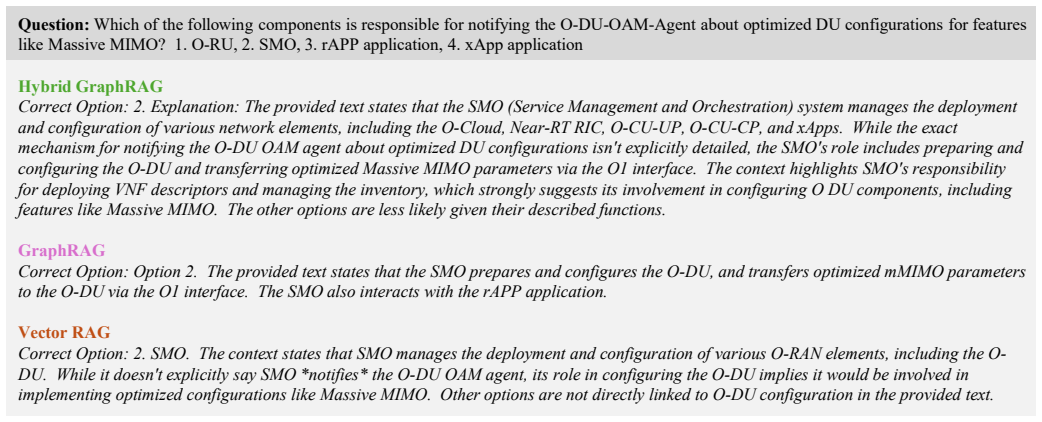
- [Figure 4] Figure 4 is difficult to interpret in its current form because the axis labels and legend are not clearly legible; please enlarge the fonts or provide a higher-resolution version.
- [Reference [28]] The reference for ORAN specifications contains an apparent typo ('h. Developed by HA VIT'); please correct the author field.
Circularity Check
No circularity found: the comparison is an external benchmark study with fixed pipeline settings and no fitted-parameter prediction, so no claimed result reduces to its own inputs.
full rationale
The paper's central claim is an empirical ranking of three retrieval pipelines on ORAN specifications. The benchmark (ORAN-Bench-13K) and metric definitions (RAGAS faithfulness, answer relevance, context relevance; factual correctness as accuracy against ground truth) are external to the paper. No parameter is fitted to the results: retrieval settings (top-4 chunks, 1024-token chunks, Gemini 1.5 Flash, embedding-001) are fixed before evaluation and are not tuned on the test questions. The graph pipeline uses a predefined five-category schema and the Neo4j builder, but the paper does not derive a prediction from that schema; it measures actual retrieved contexts and answers. The only construction-level concern is that Hybrid GraphRAG deliberately concatenates vector and graph contexts, which makes a lower context-relevance score unsurprising, but the paper reports this as a measured trade-off rather than as a predicted consequence. The lack of significance testing over the reported differences is a statistical-rigor issue, not a circularity issue. No load-bearing self-citation chain appears in the references.
Assumptions & free parameters
free parameters (3)
- top_k retrieved chunks =
4
- chunk_size =
1024 tokens, no overlap
- entity_schema =
5 categories (organisations, architecture, standards, technology, references)
assumptions (3)
- domain assumption RAGAS-style LLM-based metrics (faithfulness, answer relevance, context relevance) are valid proxies for response quality
- domain assumption The 600-question stratified subset of ORAN-Bench-13K is representative of the full benchmark
- domain assumption Ground truth labels in ORAN-Bench-13K are correct and answerable from the 74-document corpus
Cite this review
Pith. "Pith review of Benchmarking Vector, Graph and Hybrid Retrieval Augmented Generation (RAG) Pipelines for Open Radio Access Networks (ORAN)." pith.science (2026). https://pith.science/paper/Z63SRBWM
@misc{pith2026250703608,
  author       = {Pith},
  title        = {Pith review of: Benchmarking Vector, Graph and Hybrid Retrieval Augmented Generation (RAG) Pipelines for Open Radio Access Networks (ORAN)},
  year         = {2026},
  howpublished = {\url{https://pith.science/paper/Z63SRBWM}},
  note         = {Machine review of arXiv:2507.03608}
}
read the original abstract
Generative AI (GenAI) is expected to play a pivotal role in enabling autonomous optimization in future wireless networks. Within the ORAN architecture, Large Language Models (LLMs) can be specialized to generate xApps and rApps by leveraging specifications and API definitions from the RAN Intelligent Controller (RIC) platform. However, fine-tuning base LLMs for telecom-specific tasks remains expensive and resource-intensive. Retrieval-Augmented Generation (RAG) offers a practical alternative through in-context learning, enabling domain adaptation without full retraining. While traditional RAG systems rely on vector-based retrieval, emerging variants such as GraphRAG and Hybrid GraphRAG incorporate knowledge graphs or dual retrieval strategies to support multi-hop reasoning and improve factual grounding. Despite their promise, these methods lack systematic, metric-driven evaluations, particularly in high-stakes domains such as ORAN. In this study, we conduct a comparative evaluation of Vector RAG, GraphRAG, and Hybrid GraphRAG using ORAN specifications. We assess performance across varying question complexities using established generation metrics: faithfulness, answer relevance, context relevance, and factual correctness. Results show that both GraphRAG and Hybrid GraphRAG outperform traditional RAG. Hybrid GraphRAG improves factual correctness by 8%, while GraphRAG improves context relevance by 11%.
Figures


Figures from the paper (1 more)

Reference graph
Works this paper leans on
-
[1]
Telecomrag: Taming telecom standards with retrieval augmented generation and llms,
G. M. Yilma, J. A. Ayala-Romero, A. Garcia-Saavedra, and X. Costa- Perez, “Telecomrag: Taming telecom standards with retrieval augmented generation and llms,”ACM SIGCOMM Computer Communication Re- view, vol. 54, no. 3, pp. 18–23, 2025
2025
-
[2]
Telco-rag: Navigating the challenges of retrieval-augmented language models for telecommunications,
A.-L. Bornea, F. Ayed, A. De Domenico, N. Piovesan, and A. Maatouk, “Telco-rag: Navigating the challenges of retrieval-augmented language models for telecommunications,”arXiv preprint arXiv:2404.15939, 2024
arXiv 2024
-
[3]
Knowledge Pyramid Construction for Multi-Level Retrieval-Augmented Generation
R. Chen, X. Zhang, J. Wu, W. Fan, X.-Y . Wei, and Q. Li, “Knowledge pyramid construction for multi-level retrieval-augmented generation,” arXiv preprint arXiv:2407.21276, 2024
work page Pith review arXiv 2024
-
[4]
From local to global: A graph rag approach to query-focused summarization,
D. Edge, H. Trinh, N. Cheng, J. Bradley, A. Chao, A. Mody, S. Truitt, D. Metropolitansky, R. O. Ness, and J. Larson, “From local to global: A graph rag approach to query-focused summarization,”arXiv preprint arXiv:2404.16130, 2024
arXiv 2024
-
[5]
Hy- bridrag: Integrating knowledge graphs and vector retrieval augmented generation for efficient information extraction,
B. Sarmah, D. Mehta, B. Hall, R. Rao, S. Patel, and S. Pasquali, “Hy- bridrag: Integrating knowledge graphs and vector retrieval augmented generation for efficient information extraction,” inProceedings of the 5th ACM International Conference on AI in Finance, 2024, pp. 608– 616
2024
-
[6]
A survey of graph retrieval- augmented generation for customized large language models,
Q. Zhang, S. Chen, Y . Bei, Z. Yuan, H. Zhou, Z. Hong, J. Dong, H. Chen, Y . Chang, and X. Huang, “A survey of graph retrieval- augmented generation for customized large language models,”arXiv preprint arXiv:2501.13958, 2025
arXiv 2025
-
[7]
Llm-xapp: A large language model empowered radio resource management xapp for 5g o-ran,
X. Wu, J. Farooq, Y . Wang, and J. Chen, “Llm-xapp: A large language model empowered radio resource management xapp for 5g o-ran,” in Proceedings of the Symposium on Networks and Distributed Systems Security (NDSS), Workshop on Security and Privacy of Next-Generation Networks (FutureG 2025), San Diego, CA, 2025
work page 2025
-
[8]
D. Yuan, H. Zhou, D. Wu, X. Liu, H. Chen, Y . Xinet al., “En- hancing large language models (llms) for telecommunications using knowledge graphs and retrieval-augmented generation,”arXiv preprint arXiv:2503.24245, 2025
work page Pith review arXiv 2025
Show all 30 references
-
[9]
Llm-based policy generation for intent-based management of applications,
K. Dzeparoska, J. Lin, A. Tizghadam, and A. Leon-Garcia, “Llm-based policy generation for intent-based management of applications,” in2023 19th International Conference on Network and Service Management (CNSM). IEEE, 2023, pp. 1–7
2023
-
[10]
When graph meets retrieval augmented generation for wireless networks: A tutorial and case study,
Y . Xiong, R. Zhang, Y . Liu, D. Niyato, Z. Xiong, Y .-C. Liang, and S. Mao, “When graph meets retrieval augmented generation for wireless networks: A tutorial and case study,”arXiv preprint arXiv:2412.07189, 2024
2024 arXiv
-
[11]
Evaluation of retrieval-augmented generation: A survey,
H. Yu, A. Gan, K. Zhang, S. Tong, Q. Liu, and Z. Liu, “Evaluation of retrieval-augmented generation: A survey,” inCCF Conference on Big Data. Springer, 2024, pp. 102–120
2024
-
[12]
Judging llm-as-a-judge with mt-bench and chatbot arena,
L. Zheng, W.-L. Chiang, Y . Sheng, S. Zhuang, Z. Wu, Y . Zhuang, Z. Lin, Z. Li, D. Li, E. Xinget al., “Judging llm-as-a-judge with mt-bench and chatbot arena,”Advances in Neural Information Processing Systems, vol. 36, pp. 46 595–46 623, 2023
2023
-
[13]
Ragas: Automated evaluation of retrieval augmented generation,
S. Es, J. James, L. E. Anke, and S. Schockaert, “Ragas: Automated evaluation of retrieval augmented generation,” inProceedings of the 18th Conference of the European Chapter of the Association for Computa- tional Linguistics: System Demonstrations, 2024, pp. 150–158
2024
-
[14]
Oran-bench-13k: An open source benchmark for assessing llms in open radio access networks,
P. Gajjar and V . K. Shah, “Oran-bench-13k: An open source benchmark for assessing llms in open radio access networks,”arXiv preprint arXiv:2407.06245, 2024
2024 arXiv
-
[15]
Retrieval- augmented generation for knowledge-intensive nlp tasks,
P. Lewis, E. Perez, A. Piktus, F. Petroni, V . Karpukhin, N. Goyal, H. K ¨uttler, M. Lewis, W.-t. Yih, T. Rockt ¨aschelet al., “Retrieval- augmented generation for knowledge-intensive nlp tasks,”Advances in neural information processing systems, vol. 33, pp. 9459–9474, 2020
2020
-
[16]
Evaluation of rag metrics for question answering in the telecom domain,
S. Roychowdhury, S. Soman, H. Ranjani, N. Gunda, V . Chhabra, and S. K. Bala, “Evaluation of rag metrics for question answering in the telecom domain,”arXiv preprint arXiv:2407.12873, 2024
2024 arXiv
-
[17]
Ares: An automated evaluation framework for retrieval-augmented generation systems,
J. Saad-Falcon, O. Khattab, C. Potts, and M. Zaharia, “Ares: An automated evaluation framework for retrieval-augmented generation systems,”arXiv preprint arXiv:2311.09476, 2023
2023 arXiv
-
[18]
Rageval: Scenario specific rag evaluation dataset generation framework,
K. Zhu, Y . Luo, D. Xu, R. Wang, S. Yu, S. Wang, Y . Yan, Z. Liu, X. Han, Z. Liuet al., “Rageval: Scenario specific rag evaluation dataset generation framework,”arXiv preprint arXiv:2408.01262, 2024
2024 arXiv
-
[19]
Rag vs. graphrag: A systematic evaluation and key insights,
H. Han, H. Shomer, Y . Wang, Y . Lei, K. Guo, Z. Hua, B. Long, H. Liu, and J. Tang, “Rag vs. graphrag: A systematic evaluation and key insights,”arXiv preprint arXiv:2502.11371, 2025
2025
-
[20]
Causalrag: Integrating causal graphs into retrieval-augmented generation,
N. Wang, X. Han, J. Singh, J. Ma, and V . Chaudhary, “Causalrag: Integrating causal graphs into retrieval-augmented generation,”arXiv preprint arXiv:2503.19878, 2025
2025
-
[21]
Domain-specific retrieval-augmented generation using vector stores, knowledge graphs, and tensor factorization,
R. C. Barron, V . Grantcharov, S. Wanna, M. E. Eren, M. Bhattarai, N. Solovyev, G. Tompkins, C. Nicholas, K. Ø. Rasmussen, C. Matuszek et al., “Domain-specific retrieval-augmented generation using vector stores, knowledge graphs, and tensor factorization,” in2024 Interna- tion...
2024
-
[22]
Introduction to the neo4j llm knowledge graph builder,
J. Hoppa, “Introduction to the neo4j llm knowledge graph builder,” Mar 2025. [Online]. Available: https://neo4j.com/blog/developer/ llm-knowledge-graph-builder/
2025
-
[23]
Llmgraphtransformer - langchain experimental graph transformer module,
LangChain, “Llmgraphtransformer - langchain experimental graph transformer module,” accessed: 2025-06-30. [Online]. Available: https: //api.python.langchain.com/en/latest/graph transformers/langchain experimental.graph transformers.llm.LLMGraphTransformer.html
2025
-
[24]
Neo4j auradb: Fully managed graph database,
I. Neo4j, “Neo4j auradb: Fully managed graph database,” 2025, accessed: April 7, 2025. [Online]. Available: https://neo4j.com/product/ auradb/
2025
-
[25]
Pypdfloader — langchain documentation,
LangChain Inc., “Pypdfloader — langchain documentation,” https:// python.langchain.com/docs/integrations/document loaders/pypdfloader/, 2025, accessed: 2025-04-21
2025
-
[26]
Recursivecharactertextsplitter,
LangChain, “Recursivecharactertextsplitter,” 2025, accessed: April 7, 2025. [Online]. Available: https://api.python. langchain.com/en/latest/character/langchain text splitters.character. RecursiveCharacterTextSplitter.html
2025
-
[27]
Chroma: The ai-native open-source embed- ding database,
Chroma Core Contributors, “Chroma: The ai-native open-source embed- ding database,” https://github.com/chroma-core/chroma, 2025, accessed: 2025-04-21
2025
-
[28]
Ran downloads
h. Developed by HA VIT, “Ran downloads.” [Online]. Available: https://specifications.o-ran.org/specifications
-
[29]
Gemini 1.5: Unlocking multimodal understanding across millions of tokens of context, 2024,
G. Team, P. Georgiev, V . I. Lei, R. Burnell, L. Bai, A. Gulatiet al., “Gemini 1.5: Unlocking multimodal understanding across millions of tokens of context, 2024,”URL https://arxiv. org/abs/2403.05530, 2024
2024 arXiv
-
[30]
Telecomgpt: A framework to build telecom-specfic large language models,
H. Zou, Q. Zhao, Y . Tian, L. Bariah, F. Bader, T. Lestable, and M. Debbah, “Telecomgpt: A framework to build telecom-specfic large language models,”arXiv preprint arXiv:2407.09424, 2024
2024 arXiv
Reviewed August 6, 2026 · model on record in the stance chip above.
Discussion (0). Sign in to comment.