REVIEW 3 major objections 5 minor 2 cited by
3D PixBrush: Image-Guided Local Texture Synthesis
T0 review · 3 major / 5 minor · reviewed 2026-08-06 · deepseek-v4-flash
Pith's one-line read A single reference image can now localize and paint a region on a 3D mesh, with no scribbles or bounding boxes needed.
desk verdict A practical and clearly presented method for image-guided local texturing of meshes; the main weakness is thin quantitative evidence for the key mechanism, but the ablations are convincing enough to warrant peer review. read the letter →
The pith
A machine-rendered reading of the paper's core claim, the machinery that carries it, and where it could break.
The reading
What carries the argument
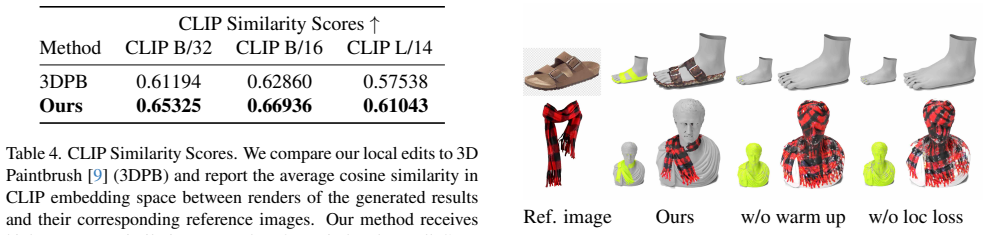
The central mechanism is localization-modulated image guidance (LMIG), which works inside score distillation sampling: at each optimization step, the current predicted localization probabilities on the mesh are rendered and thresholded into a 2D mask, and this mask is multiplied into the image cross-attention features of an IP-Adapter at every UNet layer. This makes the image guidance active only inside the region the model currently believes is the edit area, so the reference image's style and structure are transferred locally. Two supporting pieces carry the rest: explicit foreground masking of the predicted texture by the predicted localization, which lets gradients from image-guided texture renders flow back into the localization network, and a text-only warm-up phase of about 1000 iterations that gives the system a coarse global placement before image guidance is added.
What would settle it
Take a reference image containing two visually distinct objects, extract the IP-Adapter image-token cross-attention maps at an intermediate UNet layer, and threshold them; if one token's map activates both objects at comparable strength, the global-token premise is supported, whereas if tokens already separate the objects spatially, the paper's account of the mechanism would be called into question.
Extended reading notes
Core claim
The paper's central claim is that image-guided local texture editing on meshes can be fully automated: no user-provided scribbles, bounding boxes, or masks. It introduces localization-modulated image guidance (LMIG), which couples a continuously updated predicted localization mask with the cross-attention features of an IP-Adapter image-conditioned diffusion model during score distillation sampling. By masking the image cross-attention with the current localization prediction, the image guidance is confined to the region of interest, allowing the reference image to refine both the texture and the shape of the localization. The method first runs a text-only warm-up to place the region coarsely, then jointly optimizes localization and texture so that the final mask conforms to details such as a sharp V-neck or round glass frames. The authors report that on tested examples the approach produces accurate localizations and textures without any spatial user input, and they demonstrate applications such as compositing multiple local edits and applying local deformation guided by the predicted mask.
Load-bearing premise
The method relies on the premise that IP-Adapter's image tokens encode only global image information without spatially distinct region representations, so masking their cross-attention with the predicted region truly confines the image guidance; if those tokens already localize, this explanation of why LMIG works would no longer hold.
Editorial extensions
If this is right
- 3D artists can specify local edits with a reference photo plus a short text label, removing the bottleneck of hand-drawn masks or boxes.
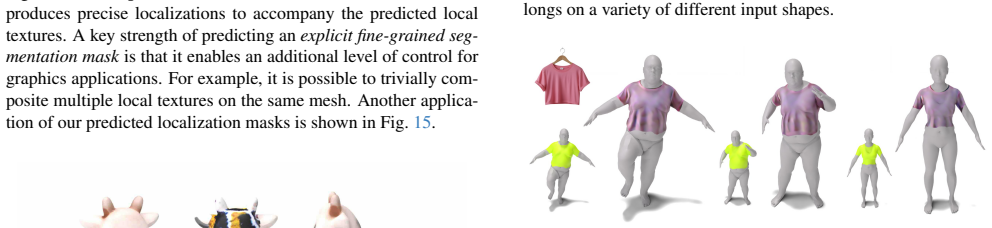
- Because the mask is explicit and fine-grained, local textures can be composited onto existing global textures or stacked with other local edits on the same mesh.
- The localization automatically adapts to the reference image's structure, so text prompts no longer need to describe appearance details that are hard to capture in words.
- The predicted mask enables downstream graphics operations such as local geometric deformation confined to the edited region, and it works even on meshes with non-trivial topology.
- Quantitative comparisons against text-only local editing show higher CLIP R-Precision, higher CLIP similarity, lower LPIPS, and better user-study scores on the tested examples.
Reading between the lines
- If IP-Adapter's image tokens are truly global as the paper assumes, LMIG should transfer to other conditioning adapters and other 3D representations, potentially unlocking image-driven local editing in NeRFs, Gaussian splats, and video—an extension the authors themselves flag as future work.
- The reported decoupling—text sets global location, image refines local shape—suggests that as image encoders become more spatial, the text warm-up could shrink or disappear entirely, making the pipeline even more automatic.
- A direct test of the paper's core premise: measure whether IP-Adapter image-token cross-attention maps already localize distinct objects in a reference image; if they do, the explanation for why masking helps would need revision.
- The explicit, editable mask output invites downstream applications the paper only hints at, such as animating the textured region, applying physics-based deformation, or using the mask as a control signal for editing in other domains.
Editorial analysis
A structured set of objections, weighed in public.
Referee Report
Summary. 3D PixBrush proposes an optimization-based method to synthesize a local texture on a 3D mesh from a reference image and a text prompt. Two MLPs predict a soft localization mask and a texture map on the mesh surface, and the optimization combines a text-driven SDS localization loss (with a warm-up phase) and an IP-Adapter image-guidance SDS loss. The core contribution is Localization Modulated Image Guidance (LMIG, Eq. (3)-(4)), which multiplies IP-Adapter's image cross-attention features by a downsampled binary version of the current predicted mask, thereby restricting image guidance to the edit region. The paper claims to be the first to produce image-guided local textures and corresponding masks without user-provided spatial input, and supports this with qualitative results on diverse meshes, ablations, a CLIP R-Precision comparison to 3D Paintbrush, and a perceptual study.
Significance. The proposed task and mechanism are timely and practically relevant for 3D content creation. If the claims hold, the method would be a useful step beyond text-only local editing (e.g., 3D Paintbrush) and beyond image-guided global texturing (e.g., EASI-Tex), because it jointly predicts a mask and a texture from a single reference image. Strengths include the simplicity of the LMIG idea, the breadth of qualitative results (many object classes, mesh types, and robustness experiments in the supplementary material), the explicit ablation showing that removing the CA mask or the warm-up degrades results, and the demonstration of practical applications such as compositing and local deformation. The paper would benefit, however, from stronger quantitative evidence that the predicted masks are geometrically accurate and that the image-guidance localization is attributable to LMIG.
major comments (3)
- [Section 3.4] The premise that IP-Adapter image tokens 'capture global information about the overall image without containing spatially distinct representations of different regions' is load-bearing for the design of LMIG, but it is asserted without citation or direct evidence. Because IP-Adapter's image encoder is a CLIP ViT, which produces patch-level embeddings with spatial structure, this premise is not obviously true. Please provide a direct test, e.g., visualize the IP-Adapter cross-attention maps for several reference images and show that they are spatially uniform, or cite existing analyses of IP-Adapter attention. If the premise is false, the masking in Eq. (3) would still be an empirical design choice, but its motivation in the text would need to be revised.
- [Section 4.3 / Fig. 7] The ablation that removes the cross-attention masking (LMIG) is presented only qualitatively. Since the central claim includes producing masks that are 'locally precise,' the paper should quantify localization accuracy. Please report a metric such as IoU or boundary F-score between predicted masks (in 2D renderings or on the mesh) and reference segmentations (e.g., obtained from SAM or manual annotation) for a set of examples, and show the change when the CA mask is removed and when the warm-up is removed. The existing R-Precision metric in Table 1 measures texture-image alignment, not whether the image guidance is actually local.
- [Table 1 and supplementary tables] The R-Precision numbers are percentages over an unreported number of examples (the values suggest 21, and the supplementary reports 10 for the perceptual study but not for this table). Without the sample size, confidence intervals, or a paired significance test, the claim that '3D PixBrush consistently outperforms 3D Paintbrush' is not statistically supported. Please report N, the per-example results, and a paired test (e.g., Wilcoxon signed-rank) for the main comparison.
minor comments (5)
- [Fig. 7 caption] In the caption, 'course' should be 'coarse' ('obtain a coarse localization').
- [Section 4.1] In the Specificity paragraph, 'adherering' should be 'adhering'.
- [Supplementary Table 5] The table title contains a typo: 'Evalutation' should be 'Evaluation'.
- [Abstract and Section 1] The text says the method 'does not require any user input,' but the method takes a text prompt describing the object type. Please clarify that the claim refers to spatial input (scribbles or bounding boxes) and that a text prompt is still required.
- [Section 4.2] Please specify the number of examples used in the CLIP R-Precision evaluation and describe the retrieval protocol (how many render views are used per mesh and how the candidate set is constructed).
Circularity Check
No constructed circularity found; the central optimization is self-contained, with only minor reliance on the authors' prior pipeline components.
full rationale
The paper's derivation does not reduce any predicted quantity to its own input by construction. The localization mask M is an optimized variable, not a fitted parameter: it is used to mask the IP-Adapter cross-attention in Eq. (3), and the same SDS gradient in Eq. (4) refines the texture and, through explicit texture masking, the localization. This is a feedback loop, not a tautology, because the objective also contains an independent text-driven localization loss (Sec. 3.3), a warm-up phase, and a pretrained IP-Adapter supervision that is not optimized against the evaluation metrics. The CLIP R-Precision, CLIP similarity, LPIPS, and perceptual evaluations measure fidelity to the conditioning reference image, which is an appropriate benchmark for image-guided local texturing rather than a circular metric; the method does not directly optimize those metrics. The text-guided localization component follows the authors' prior 3D Highlighter [8], and the texture masking follows 3D Paintbrush [9], but these are modular engineering components and are not invoked as an externally verified uniqueness theorem; no load-bearing claim in the paper is justified solely by self-citation. The Section 3.4 premise that IP-Adapter image tokens 'capture global information about the overall image without containing spatially distinct representations of different regions' is an empirical assumption about a fixed pretrained model and is not a constructed equivalence; it is a correctness risk rather than a circular step. A legitimate validation concern is that the causal role of the cross-attention masking is supported only by the qualitative ablation in Fig. 7, with no quantitative mask-quality metric such as IoU, but the absence of such a metric is an evaluation gap, not circularity.
Assumptions & free parameters
free parameters (5)
- localization warm-up iterations =
1000
- total optimization iterations =
11000
- IP-Adapter image weight w =
not reported
- localization mask threshold =
not reported
- camera sampling ranges =
elevation 0-60 deg (0-150 for some meshes), azimuth 0-360, radius 1-1.5
assumptions (3)
- domain assumption IP-Adapter image cross-attention tokens are global, not spatially localized
- domain assumption Text-driven localization loss provides a globally correct coarse placement that the image guidance can refine
- domain assumption Score distillation on rendered views yields gradients that meaningfully improve both texture and localization network parameters
Cite this review
Pith. "Pith review of 3D PixBrush: Image-Guided Local Texture Synthesis." pith.science (2026). https://pith.science/paper/L3RLJLNA
@misc{pith2026250703731,
  author       = {Pith},
  title        = {Pith review of: 3D PixBrush: Image-Guided Local Texture Synthesis},
  year         = {2026},
  howpublished = {\url{https://pith.science/paper/L3RLJLNA}},
  note         = {Machine review of arXiv:2507.03731}
}
read the original abstract
We present 3D PixBrush, a method for performing image-driven edits of local regions on 3D meshes. 3D PixBrush predicts a localization mask and a synthesized texture that faithfully portray the object in the reference image. Our predicted localizations are both globally coherent and locally precise. Globally - our method contextualizes the object in the reference image and automatically positions it onto the input mesh. Locally - our method produces masks that conform to the geometry of the reference image. Notably, our method does not require any user input (in the form of scribbles or bounding boxes) to achieve accurate localizations. Instead, our method predicts a localization mask on the 3D mesh from scratch. To achieve this, we propose a modification to the score distillation sampling technique which incorporates both the predicted localization and the reference image, referred to as localization-modulated image guidance. We demonstrate the effectiveness of our proposed technique on a wide variety of meshes and images.
Figures


Figures from the paper (14 more)






Forward citations
Cited by 2 Pith papers
-
Best Segmentation Buddies for Image-Shape Correspondence
The work defines Best Segmentation Buddies as vertices on a 3D shape whose nearest image pixel under distilled features falls inside a given 2D segment, then uses the same features to segment the shape in 3D.
-
Advances in Neural 3D Mesh Texturing: A Survey
A literature survey that organizes neural 3D mesh texturing methods into a taxonomy spanning early GAN-based approaches to modern diffusion pipelines, while reviewing architectures, datasets, evaluation, and open challenges.
Reference graph
Works this paper leans on
-
[1]
Zero-shot 3d shape correspon- dence
Ahmed Abdelreheem, Abdelrahman Eldesokey, Maks Ovs- janikov, and Peter Wonka. Zero-shot 3d shape correspon- dence. In SIGGRAPH Asia 2023 Conference Papers, pages 1–11, 2023. 3
work page 2023
-
[2]
Satr: Zero-shot semantic segmentation of 3d shapes
Ahmed Abdelreheem, Ivan Skorokhodov, Maks Ovsjanikov, and Peter Wonka. Satr: Zero-shot semantic segmentation of 3d shapes. In ICCV, 2023. 3
work page 2023
- [3]
-
[4]
Mesh2tex: Generating mesh textures from image queries
Alexey Bokhovkin, Shubham Tulsiani, and Angela Dai. Mesh2tex: Generating mesh textures from image queries. arXiv preprint arXiv:2304.05868, 2023. 2
arXiv 2023
-
[5]
Text2tex: Text-driven tex- ture synthesis via diffusion models
Dave Zhenyu Chen, Yawar Siddiqui, Hsin-Ying Lee, Sergey Tulyakov, and Matthias Nießner. Text2tex: Text-driven tex- ture synthesis via diffusion models. In ICCV, 2023. 3
work page 2023
-
[6]
Fantasia3d: Disentangling geometry and appearance for high-quality text-to-3d content creation
Rui Chen, Yongwei Chen, Ningxin Jiao, and Kui Jia. Fantasia3d: Disentangling geometry and appearance for high-quality text-to-3d content creation. arXiv preprint arXiv:2303.13873, 2023. 3
arXiv 2023
-
[7]
Gaussianeditor: Swift and control- lable 3d editing with gaussian splatting
Yiwen Chen, Zilong Chen, Chi Zhang, Feng Wang, Xi- aofeng Yang, Yikai Wang, Zhongang Cai, Lei Yang, Huaping Liu, and Guosheng Lin. Gaussianeditor: Swift and control- lable 3d editing with gaussian splatting. In Proceedings of the IEEE/CVF Conference on Computer Vision and Pattern Recognition, pages 21476–21485, 2024. 3
work page 2024
-
[8]
3d highlighter: Localizing regions on 3d shapes via text descriptions
Dale Decatur, Itai Lang, and Rana Hanocka. 3d highlighter: Localizing regions on 3d shapes via text descriptions. In CVPR, 2023. 3, 5
work page 2023
Show all 70 references
-
[9]
3d paintbrush: Local stylization of 3d shapes with cascaded score distillation
Dale Decatur, Itai Lang, Kfir Aberman, and Rana Hanocka. 3d paintbrush: Local stylization of 3d shapes with cascaded score distillation. In Proceedings of the IEEE/CVF Confer- ence on Computer Vision and Pattern Recognition (CVPR) , pages 4473–4483, 2024. 1, 3, 5, 6, 7, 8, 2
2024
-
[10]
Geometry in style: 3d stylization via surface normal deformation
Nam Anh Dinh, Itai Lang, Hyunwoo Kim, Oded Stein, and Rana Hanocka. Geometry in style: 3d stylization via surface normal deformation. In Proceedings of the Computer Vision and Pattern Recognition Conference (CVPR), pages 28456– 28467, 2025. 3
2025
-
[11]
Unified implicit neural styliza- tion
Zhiwen Fan, Yifan Jiang, Peihao Wang, Xinyu Gong, Dejia Xu, and Zhangyang Wang. Unified implicit neural styliza- tion. In European Conference on Computer Vision , pages 636–654. Springer, 2022. 2
2022
-
[12]
Get3d: A generative model of high quality 3d tex- tured shapes learned from images
Jun Gao, Tianchang Shen, Zian Wang, Wenzheng Chen, Kangxue Yin, Daiqing Li, Or Litany, Zan Gojcic, and Sanja Fidler. Get3d: A generative model of high quality 3d tex- tured shapes learned from images. In Advances In Neural Information Processing Systems, 2022. 3
2022
-
[13]
Tm-net: Deep generative networks for textured meshes
Lin Gao, Tong Wu, Yu-Jie Yuan, Ming-Xian Lin, Yu-Kun Lai, and Hao Zhang. Tm-net: Deep generative networks for textured meshes. ACM Transactions on Graphics (TOG), 40 (6):1–15, 2021. 2
2021
-
[14]
Textdeformer: Geometry manipu- lation using text guidance
William Gao, Noam Aigerman, Thibault Groueix, V ova Kim, and Rana Hanocka. Textdeformer: Geometry manipu- lation using text guidance. In ACM SIGGRAPH 2023 Con- ference Proceedings, pages 1–11, 2023. 3
2023
-
[15]
Instruct-nerf2nerf: Edit- ing 3d scenes with instructions
Ayaan Haque, Matthew Tancik, Alexei A Efros, Aleksander Holynski, and Angjoo Kanazawa. Instruct-nerf2nerf: Edit- ing 3d scenes with instructions. ICCV, 2023. 3
2023
-
[16]
Deep geometric texture synthesis
Amir Hertz, Rana Hanocka, Raja Giryes, and Daniel Cohen- Or. Deep geometric texture synthesis. ACM Transactions on Graphics (TOG), 39(4):108–1, 2020. 2
2020
-
[17]
Prompt-to-prompt im- age editing with cross attention control
Amir Hertz, Ron Mokady, Jay Tenenbaum, Kfir Aberman, Yael Pritch, and Daniel Cohen-Or. Prompt-to-prompt im- age editing with cross attention control. arXiv preprint arXiv:2208.01626, 2022. 6
2022 arXiv
-
[18]
Denoising dif- fusion probabilistic models
Jonathan Ho, Ajay Jain, and Pieter Abbeel. Denoising dif- fusion probabilistic models. Advances in neural information processing systems, 33:6840–6851, 2020. 1, 3
2020
-
[19]
Cascaded diffusion models for high fidelity image generation
Jonathan Ho, Chitwan Saharia, William Chan, David J Fleet, Mohammad Norouzi, and Tim Salimans. Cascaded diffusion models for high fidelity image generation. The Journal of Machine Learning Research, 23(1):2249–2281, 2022. 3
2022
-
[20]
Stylemesh: Style transfer for indoor 3d scene reconstruc- tions
Lukas H ¨ollein, Justin Johnson, and Matthias Nießner. Stylemesh: Style transfer for indoor 3d scene reconstruc- tions. In Proceedings of the IEEE/CVF Conference on Com- puter Vision and Pattern Recognition , pages 6198–6208,
-
[21]
Adversarial texture optimization from rgb-d scans
Jingwei Huang, Justus Thies, Angela Dai, Abhijit Kundu, Chiyu Jiang, Leonidas J Guibas, Matthias Nießner, Thomas Funkhouser, et al. Adversarial texture optimization from rgb-d scans. In Proceedings of the IEEE/CVF Conference on Computer Vision and Pattern Recognition , pages 1...
2020
-
[22]
Noise-free score distillation, 2023
Oren Katzir, Or Patashnik, Daniel Cohen-Or, and Dani Lischinski. Noise-free score distillation, 2023. 3
2023
-
[23]
3d gaussian splatting for real-time 9 radiance field rendering
Bernhard Kerbl, Georgios Kopanas, Thomas Leimk ¨uhler, and George Drettakis. 3d gaussian splatting for real-time 9 radiance field rendering. ACM Trans. Graph., 42(4):139–1,
-
[24]
Meshup: Multi-target mesh deformation via blended score distillation
Hyunwoo Kim, Itai Lang, Noam Aigerman, Thibault Groueix, Vladimir G Kim, and Rana Hanocka. Meshup: Multi-target mesh deformation via blended score distillation. arXiv preprint arXiv:2408.14899, 2024. 3
2024 arXiv
-
[25]
Imagenet classification with deep convolutional neural net- works
Alex Krizhevsky, Ilya Sutskever, and Geoffrey E Hinton. Imagenet classification with deep convolutional neural net- works. Advances in neural information processing systems , 25, 2012. 2
2012
-
[26]
Tango: Text-driven photorealistic and robust 3d stylization via lighting decom- position
Jiabao Lei, Yabin Zhang, Kui Jia, et al. Tango: Text-driven photorealistic and robust 3d stylization via lighting decom- position. Advances in Neural Information Processing Sys- tems, 35:30923–30936, 2022. 2
2022
-
[27]
Blip-2: Bootstrapping language-image pre-training with frozen image encoders and large language models
Junnan Li, Dongxu Li, Silvio Savarese, and Steven Hoi. Blip-2: Bootstrapping language-image pre-training with frozen image encoders and large language models. In In- ternational conference on machine learning , pages 19730– 19742. PMLR, 2023. 5, 7, 1
2023
-
[28]
Focaldreamer: Text- driven 3d editing via focal-fusion assembly
Yuhan Li, Yishun Dou, Yue Shi, Yu Lei, Xuanhong Chen, Yi Zhang, Peng Zhou, and Bingbing Ni. Focaldreamer: Text- driven 3d editing via focal-fusion assembly. arXiv preprint arXiv:2308.10608, 2023. 1, 3
2023 arXiv
-
[29]
Magic3d: High-resolution text-to-3d content creation
Chen-Hsuan Lin, Jun Gao, Luming Tang, Towaki Takikawa, Xiaohui Zeng, Xun Huang, Karsten Kreis, Sanja Fidler, Ming-Yu Liu, and Tsung-Yi Lin. Magic3d: High-resolution text-to-3d content creation. In CVPR, 2023. 3
2023
-
[30]
Kim, Siddhartha Chaud- huri, Noam Aigerman, and Alec Jacobson
Hsueh-Ti Derek Liu, Vladimir G. Kim, Siddhartha Chaud- huri, Noam Aigerman, and Alec Jacobson. Neural subdivi- sion. ACM Trans. Graph., 39(4), 2020. 2
2020
-
[31]
Stylerf: Zero-shot 3d style transfer of neural radiance fields
Kunhao Liu, Fangneng Zhan, Yiwen Chen, Jiahui Zhang, Yingchen Yu, Abdulmotaleb El Saddik, Shijian Lu, and Eric P Xing. Stylerf: Zero-shot 3d style transfer of neural radiance fields. In Proceedings of the IEEE/CVF Conference on Computer Vision and Pattern Recognition , pages 8...
2023
-
[32]
One-2-3-45: Any single image to 3d mesh in 45 seconds without per-shape optimization.arXiv preprint arXiv:2306.16928, 2023
Minghua Liu, Chao Xu, Haian Jin, Linghao Chen, Zexiang Xu, Hao Su, et al. One-2-3-45: Any single image to 3d mesh in 45 seconds without per-shape optimization.arXiv preprint arXiv:2306.16928, 2023. 3
2023 arXiv
-
[33]
Zero-1-to-3: Zero-shot one image to 3d object, 2023
Ruoshi Liu, Rundi Wu, Basile Van Hoorick, Pavel Tok- makov, Sergey Zakharov, and Carl V ondrick. Zero-1-to-3: Zero-shot one image to 3d object, 2023. 3
2023
-
[34]
Score distillation via reparametrized ddim
Artem Lukoianov, Haitz S ´aez de Oc ´ariz Borde, Kristjan Greenewald, Vitor Campagnolo Guizilini, Timur Bagaut- dinov, Vincent Sitzmann, and Justin Solomon. Score distillation via reparametrized ddim. arXiv preprint arXiv:2405.15891, 2024. 3
2024 arXiv
-
[35]
X-mesh: Towards fast and accurate text-driven 3d styliza- tion via dynamic textual guidance
Yiwei Ma, Xiaoqing Zhang, Xiaoshuai Sun, Jiayi Ji, Haowei Wang, Guannan Jiang, Weilin Zhuang, and Rongrong Ji. X-mesh: Towards fast and accurate text-driven 3d styliza- tion via dynamic textual guidance. In Proceedings of the IEEE/CVF International Conference on Computer Visio...
2023
-
[36]
Latent-nerf for shape-guided generation of 3d shapes and textures
Gal Metzer, Elad Richardson, Or Patashnik, Raja Giryes, and Daniel Cohen-Or. Latent-nerf for shape-guided generation of 3d shapes and textures. In CVPR, 2023. 3
2023
-
[37]
Text2mesh: Text-driven neural stylization for meshes
Oscar Michel, Roi Bar-On, Richard Liu, Sagie Benaim, and Rana Hanocka. Text2mesh: Text-driven neural stylization for meshes. In CVPR, pages 13492–13502, 2022. 2, 3
2022
-
[38]
Srinivasan, Matthew Tancik, Jonathan T
Ben Mildenhall, Pratul P. Srinivasan, Matthew Tancik, Jonathan T. Barron, Ravi Ramamoorthi, and Ren Ng. Nerf: Representing scenes as neural radiance fields for view syn- thesis. In ECCV, 2020. 2, 9
2020
-
[39]
Clip-mesh: Generating textured meshes from text using pretrained image-text models
Nasir Mohammad Khalid, Tianhao Xie, Eugene Belilovsky, and Tiberiu Popa. Clip-mesh: Generating textured meshes from text using pretrained image-text models. InSIGGRAPH Asia 2022 conference papers, pages 1–8, 2022. 2
2022
-
[40]
Texture fields: Learning tex- ture representations in function space
Michael Oechsle, Lars Mescheder, Michael Niemeyer, Thilo Strauss, and Andreas Geiger. Texture fields: Learning tex- ture representations in function space. InCVPR, pages 4531– 4540, 2019. 2
2019
-
[41]
Automatic differentiation in pytorch
Adam Paszke, Sam Gross, Soumith Chintala, Gregory Chanan, Edward Yang, Zachary DeVito, Zeming Lin, Al- ban Desmaison, Luca Antiga, and Adam Lerer. Automatic differentiation in pytorch. In NIPS-W, 2017. 2
2017
-
[42]
Easi-tex: Edge-aware mesh texturing from sin- gle image
Sai Raj Kishore Perla, Yizhi Wang, Ali Mahdavi-Amiri, and Hao Zhang. Easi-tex: Edge-aware mesh texturing from sin- gle image. ACM Transactions on Graphics (Proceedings of SIGGRAPH), 43(4), 2024. 1, 3
2024
-
[43]
Barron, and Ben Milden- hall
Ben Poole, Ajay Jain, Jonathan T. Barron, and Ben Milden- hall. Dreamfusion: Text-to-3d using 2d diffusion. In ICLR,
-
[44]
Magic123: One image to high-quality 3d object generation using both 2d and 3d diffusion priors.arXiv preprint arXiv:2306.17843,
Guocheng Qian, Jinjie Mai, Abdullah Hamdi, Jian Ren, Aliaksandr Siarohin, Bing Li, Hsin-Ying Lee, Ivan Sko- rokhodov, Peter Wonka, Sergey Tulyakov, et al. Magic123: One image to high-quality 3d object generation using both 2d and 3d diffusion priors.arXiv preprint arXiv:2306.17843,
-
[45]
Learning transferable visual models from natural language supervi- sion
Alec Radford, Jong Wook Kim, Chris Hallacy, Aditya Ramesh, Gabriel Goh, Sandhini Agarwal, Girish Sastry, Amanda Askell, Pamela Mishkin, Jack Clark, et al. Learning transferable visual models from natural language supervi- sion. In International conference on machine learning, ...
2021
-
[46]
On the spectral bias of neural networks
Nasim Rahaman, Aristide Baratin, Devansh Arpit, Felix Draxler, Min Lin, Fred Hamprecht, Yoshua Bengio, and Aaron Courville. On the spectral bias of neural networks. In International conference on machine learning, 2019. 4
2019
-
[47]
Texture: Text-guided texturing of 3d shapes
Elad Richardson, Gal Metzer, Yuval Alaluf, Raja Giryes, and Daniel Cohen-Or. Texture: Text-guided texturing of 3d shapes. In ACM TOG, 2023. 3
2023
-
[48]
High-resolution image synthesis with latent diffusion models
Robin Rombach, Andreas Blattmann, Dominik Lorenz, Patrick Esser, and Bj ¨orn Ommer. High-resolution image synthesis with latent diffusion models. In Proceedings of the IEEE/CVF conference on computer vision and pattern recognition, pages 10684–10695, 2022. 1, 3
2022
-
[49]
Dreambooth: Fine tuning text-to-image diffusion models for subject-driven generation
Nataniel Ruiz, Yuanzhen Li, Varun Jampani, Yael Pritch, Michael Rubinstein, and Kfir Aberman. Dreambooth: Fine tuning text-to-image diffusion models for subject-driven generation. In Proceedings of the IEEE/CVF Conference on Computer Vision and Pattern Recognition, pages 22500...
2023
-
[50]
Nerf-insert: 3d local editing with multimodal control signals
Benet Oriol Sabat, Alessandro Achille, Matthew Trager, and Stefano Soatto. Nerf-insert: 3d local editing with multimodal control signals. arXiv preprint arXiv:2404.19204, 2024. 3, 4
2024 arXiv
-
[51]
Photorealistic text-to-image diffusion models with deep language understanding
Chitwan Saharia, William Chan, Saurabh Saxena, Lala Li, Jay Whang, Emily L Denton, Kamyar Ghasemipour, Raphael Gontijo Lopes, Burcu Karagol Ayan, Tim Salimans, et al. Photorealistic text-to-image diffusion models with deep language understanding. Advances in neural information...
2022
-
[52]
V ox-e: Text-guided voxel editing of 3d ob- jects
Etai Sella, Gal Fiebelman, Peter Hedman, and Hadar Averbuch-Elor. V ox-e: Text-guided voxel editing of 3d ob- jects. In ICCV, 2023. 1
2023
-
[53]
Mvdream: Multi-view diffusion for 3d gen- eration
Yichun Shi, Peng Wang, Jianglong Ye, Mai Long, Kejie Li, and Xiao Yang. Mvdream: Multi-view diffusion for 3d gen- eration. arXiv preprint arXiv:2308.16512, 2023. 3
2023 arXiv
-
[54]
Texturify: Generating textures on 3d shape surfaces
Yawar Siddiqui, Justus Thies, Fangchang Ma, Qi Shan, Matthias Nießner, and Angela Dai. Texturify: Generating textures on 3d shape surfaces. In European Conference on Computer Vision, pages 72–88. Springer, 2022. 2
2022
-
[55]
Very deep convolutional networks for large-scale image recognition
Karen Simonyan. Very deep convolutional networks for large-scale image recognition. arXiv preprint arXiv:1409.1556, 2014. 2
2014 arXiv
-
[56]
Srinivasan, Ben Mildenhall, Sara Fridovich-Keil, Nithin Raghavan, Utkarsh Singhal, Ravi Ra- mamoorthi, Jonathan T
Matthew Tancik, Pratul P. Srinivasan, Ben Mildenhall, Sara Fridovich-Keil, Nithin Raghavan, Utkarsh Singhal, Ravi Ra- mamoorthi, Jonathan T. Barron, and Ren Ng. Fourier fea- tures let networks learn high frequency functions in low di- mensional domains. 2020. 4
2020
-
[57]
Dreamgaussian: Generative gaussian splatting for effi- cient 3d content creation
Jiaxiang Tang, Jiawei Ren, Hang Zhou, Ziwei Liu, and Gang Zeng. Dreamgaussian: Generative gaussian splatting for effi- cient 3d content creation. arXiv preprint arXiv:2309.16653,
-
[58]
Textmesh: Gen- eration of realistic 3d meshes from text prompts
Christina Tsalicoglou, Fabian Manhardt, Alessio Tonioni, Michael Niemeyer, and Federico Tombari. Textmesh: Gen- eration of realistic 3d meshes from text prompts. arXiv preprint arXiv:2304.12439, 2023. 3
2023 arXiv
-
[59]
Yeh, and Greg Shakhnarovich
Haochen Wang, Xiaodan Du, Jiahao Li, Raymond A. Yeh, and Greg Shakhnarovich. Score jacobian chaining: Lifting pretrained 2d diffusion models for 3d generation. In CVPR,
-
[60]
Gaussianeditor: Editing 3d gaussians delicately with text instructions
Junjie Wang, Jiemin Fang, Xiaopeng Zhang, Lingxi Xie, and Qi Tian. Gaussianeditor: Editing 3d gaussians delicately with text instructions. In Proceedings of the IEEE/CVF Con- ference on Computer Vision and Pattern Recognition, pages 20902–20911, 2024. 3
2024
-
[61]
Deep hybrid self-prior for full 3d mesh generation
Xingkui Wei, Zhengqing Chen, Yanwei Fu, Zhaopeng Cui, and Yinda Zhang. Deep hybrid self-prior for full 3d mesh generation. In Proceedings of the IEEE/CVF International Conference on Computer Vision, pages 5805–5814, 2021. 2
2021
-
[62]
Ip- adapter: Text compatible image prompt adapter for text-to- image diffusion models
Hu Ye, Jun Zhang, Sibo Liu, Xiao Han, and Wei Yang. Ip- adapter: Text compatible image prompt adapter for text-to- image diffusion models. arXiv preprint arXiv:2308.06721,
-
[63]
3dstylenet: Creating 3d shapes with geometric and texture style variations
Kangxue Yin, Jun Gao, Maria Shugrina, Sameh Khamis, and Sanja Fidler. 3dstylenet: Creating 3d shapes with geometric and texture style variations. InProceedings of the IEEE/CVF International Conference on Computer Vision, pages 12456– 12465, 2021. 2
2021
-
[64]
Arf: Artistic radiance fields
Kai Zhang, Nick Kolkin, Sai Bi, Fujun Luan, Zexiang Xu, Eli Shechtman, and Noah Snavely. Arf: Artistic radiance fields. In European Conference on Computer Vision, pages 717–733. Springer, 2022. 2
2022
-
[65]
Adding conditional control to text-to-image diffusion models
Lvmin Zhang, Anyi Rao, and Maneesh Agrawala. Adding conditional control to text-to-image diffusion models. In Proceedings of the IEEE/CVF International Conference on Computer Vision, pages 3836–3847, 2023. 1, 3
2023
-
[66]
The unreasonable effectiveness of deep features as a perceptual metric
Richard Zhang, Phillip Isola, Alexei A Efros, Eli Shecht- man, and Oliver Wang. The unreasonable effectiveness of deep features as a perceptual metric. In Proceedings of the IEEE conference on computer vision and pattern recogni- tion, pages 586–595, 2018. 1, 2
2018
-
[67]
Meshsegmenter: Zero- shot mesh semantic segmentation via texture synthesis
Ziming Zhong, Yanyu Xu, Jing Li, Jiale Xu, Zhengxin Li, Chaohui Yu, and Shenghua Gao. Meshsegmenter: Zero- shot mesh semantic segmentation via texture synthesis. In European Conference on Computer Vision, pages 182–199. Springer, 2024. 3
2024
-
[68]
Hifa: High-fidelity text- to-3d with advanced diffusion guidance
Joseph Zhu and Peiye Zhuang. Hifa: High-fidelity text- to-3d with advanced diffusion guidance. arXiv preprint arXiv:2305.18766, 2023. 3
2023 arXiv
-
[69]
Dreameditor: Text-driven 3d scene editing with neural fields
Jingyu Zhuang, Chen Wang, Lingjie Liu, Liang Lin, and Guanbin Li. Dreameditor: Text-driven 3d scene editing with neural fields. In SIGGRAPH Asia, 2023. 1, 3
2023
-
[70]
Tip-editor: An accurate 3d editor fol- lowing both text-prompts and image-prompts
Jingyu Zhuang, Di Kang, Yan-Pei Cao, Guanbin Li, Liang Lin, and Ying Shan. Tip-editor: An accurate 3d editor fol- lowing both text-prompts and image-prompts. ACM Trans- actions on Graphics (TOG), 43(4):1–12, 2024. 1, 3, 4 11 3D PixBrush: Image-Guided Local Texture Synthesis Su...
2024
Reviewed August 6, 2026 · model on record in the stance chip above.
Discussion (0). Sign in to comment.