REVIEW 3 major objections 6 minor 27 references
Generalized Locomotion in Out-of-distribution Conditions with Robust Transformer
T0 review · 3 major / 6 minor · reviewed 2026-08-06 · deepseek-v4-flash
Pith's one-line read A transformer policy trained on clean walking and one leg failure can keep a robot walking through unseen leg failures and sensor corruption.
desk verdict A strong hexapod damage result makes this worth reviewing, but the action-token mechanism is under-identified and several plots lack statistics. read the letter →
The pith
A machine-rendered reading of the paper's core claim, the machinery that carries it, and where it could break.
The reading
What carries the argument
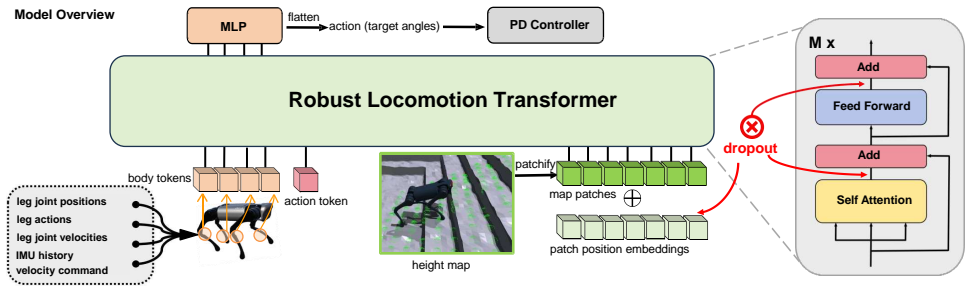
The load-bearing mechanism is the tokenization of the robot body into leg tokens, each containing ten steps of joint positions, joint velocities, previous actions, velocity command, and IMU history, projected by a shared MLP; a linear embedding of the previous action forms an action token. The action token replaces learnable position embeddings as the source of position information, so legs can query their roles through attention, allowing experience to transfer from one limb to another. Robustness to perceptual noise is carried by two consistent dropout operations in the two-layer encoder: feature dropout at rate 0.1 after attention and feed-forward layers, and patch position-embedding dropout at rate 0.75. Consistency means the same dropout mask is used at rollout and at update, which allows a high dropout rate to be used without destabilizing policy-gradient training.
What would settle it
A direct test would be to train ROLT exactly as described, with healthy walking plus one locked leg, and then evaluate it on failures outside the tested set: a hip joint locked, a leg with two joints disabled, partial motor weakening rather than full lock, or a change in payload. If the robot falls within seconds on any of these, the claim that one leg's fault experience transfers to arbitrary new limb failures would be falsified. Similarly, injecting noise into proprioception while keeping the elevation map clean would test whether the robustness mechanism really re-anchors on trusted body state or only on the specific perception corruption studied.
Extended reading notes
Core claim
On the paper's own terms, the central discovery is that a transformer can transfer fault-tolerance experience across limbs if position information is made data-dependent. Instead of adding fixed position embeddings to leg tokens, ROLT appends an action token encoding the previous action, and each leg token infers its spatial role through attention to this token. In the hexapod damage test, this design keeps the robot from falling in all nine unseen joint-failure conditions over 20 seconds, while the baselines fall in most of the same tests. The consistent-dropout half of the claim is that dropping features and patch position embeddings, with the same mask during rollout and update, produces a policy that handles high- and low-frequency perceptual noise even though it was trained with clean elevation maps. Attention visualizations are used to argue that position-embedding dropout makes the network shift its focus to trustworthy patches instead of anchoring to learned positions.
Load-bearing premise
The load-bearing premise is that the held-out failures tested (three other limping legs, nine joint disables, and three real-world perturbations) stand in for the entire class of out-of-distribution dynamic and perceptual changes; the paper does not formally characterize that class, so if the success is specific to these particular failures or to the simulation distribution, the broad robustness claim would not follow.
Editorial extensions
If this is right
- If the central claim is right, a locomotion policy does not need to be trained in every failure mode; one or a few fault experiences can generalize to other limbs of the same body plan.
- The same architecture, with the number of leg tokens changed, transfers from a four-legged to a six-legged robot, suggesting the controller is scalable to morphologies built from repeated limb modules.
- Because noise robustness comes from a dropout strategy and attention rather than from adding Gaussian noise to training observations, policies can be trained on clean data and still deployed where sensors are corrupted or missing.
- The hexapod's redundant joints can be exploited by the controller to keep walking when motors are disabled, so the method could be used for fault-tolerant operation on robots whose training time must be kept short.
Reading between the lines
- A natural extension the paper does not test is whether body tokenization transfers to any control problem with modular repeated structure, such as multi-finger hands, multi-robot teams, or configurable limbs, where combinatorial generalization across modules is desired.
- The position-embedding dropout result suggests a general recipe for sensor-fusion robustness: make the network doubt the spatial anchoring of one modality so it re-anchors using a trusted modality; the paper demonstrates this with elevation maps, but it may extend to depth cameras, lidar, or tactile arrays.
- A stress test the paper does not run is corruption of the proprioceptive channel itself; because the attention re-anchors on proprioception, noise injected into joint encoders or IMUs could be the first failure point.
- The training set is framed as limited, but the experiments cover only discrete lock-or-disable joint failures; whether the mechanism extends to continuous parameter drifts, such as gradually weakening motors or changing payload, is left open.
Editorial analysis
A structured set of objections, weighed in public.
Referee Report
Summary. The paper proposes ROLT, a transformer-based locomotion policy whose two main design elements are body tokenization (each leg is a token, plus an action token that replaces data-independent position embeddings) and consistent dropout (feature dropout and patch-PE dropout applied with the same mask during rollout and update). The policy is trained with PPO in IsaacGym on the Unitree A1 and a hexapod, using only a few damaged conditions and clean elevation observations. Evaluation covers simulated limb stiffness changes, unseen joint failures on the hexapod, low- and high-frequency elevation-map noise, and three real-world perturbations on a Unitree Go1. The paper claims that ROLT generalizes across limbs and to unseen perceptual noise better than MLP, Roll-Drop, RMA, and ROAM baselines.
Significance. If the reported results hold, this is a useful empirical contribution: it demonstrates that a transformer with body-level tokenization can transfer fault-tolerant behavior across limbs after training on only a handful of damage conditions, and that a consistent-dropout scheme can improve robustness to observation corruption without explicit noise injection during training. The hexapod damage results in Table II, which include means and standard deviations, are concrete evidence for the dynamics-generalization claim, and the real-world transfer experiments add practical credibility. The central architectural interpretation, namely that the action token acts as a data-dependent position encoding, is plausible but is not decisively supported by the current ablations; this should be fixed before the mechanism claim is accepted.
major comments (3)
- [Sec. III-A, Eq. (2) and Sec. IV-A, Module PE ablation] The Module PE ablation changes two variables at once: it removes the action token and it adds learnable per-leg position embeddings. The action token is not only a positional query; it is also the only token that carries the previous target angles of all joints, i.e., a global action-context signal. Therefore the large gap between ROLT and Module PE in the hexapod damage test (Table II) could be explained by the loss of this global context, or by the introduction of per-leg embeddings, rather than by the absence of a data-dependent position-query mechanism. I agree with the stress-test concern that this is a real confound. Please add ablations that separate these factors, such as ROLT with per-leg learnable PE added in addition to the action token, or Module PE with a non-positional global token carrying the same action vector, and/or attention analyses showing that leg tokens use the action token specifically for position information.
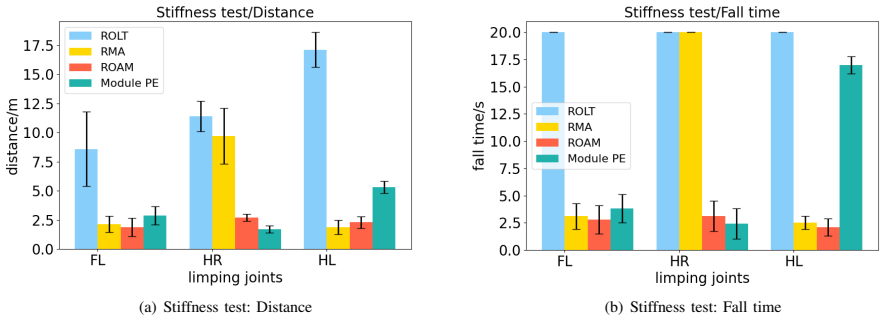
- [Sec. IV-A, Fig. 3 and Sec. IV-B, Figs. 6-7] The A1 stiffness test and both perceptual-noise tests are presented only as plots, with no numeric tables, no number of seeds, no standard deviations, and no test-episode counts. These experiments are load-bearing for the paper's claims of dynamics generalization and perceptual robustness, so without variance information the reader cannot assess whether ROLT's advantage is statistically meaningful or whether the curves reflect one or a few favorable runs. Please report mean/std tables and seed counts for the stiffness and noise experiments, as is already done for the hexapod damage test.
- [Sec. IV-C, Table III] The real-world experiments report means and standard deviations but do not state the number of trials per condition, and they compare against only RMA. Given the small distances involved (0.0-4.8 m over 10 s) and the strength of the claim that ROLT generalizes in real-world deployment, this table needs the number of runs per condition and ideally per-trial results. Without these details, the real-world conclusion is difficult to evaluate.
minor comments (6)
- [Sec. IV-B, Figs. 6-7] The figure captions appear to be swapped: the text says low-frequency noise results are shown in Figure 6 and high-frequency noise results in Figure 7, but the captions read "Fig. 6. High-frequency noise test results" and "Fig. 7. Low-frequency noise test results."
- [Table II] The fall-time entry for HRC is truncated as "6.74±3."; please provide the full value.
- [Throughout] There are several typos and grammar issues, including "prioprocetion," "hexpodal," "contary," "wired gait" (should be "weird gait"), "Gussian," "a extremely," and "both ROLT maintain." A careful proofreading pass is needed.
- [Sec. IV-D, Fig. 8] The attention visualization is described as averaging "the attention score of the map patches on each leg token," but the text does not specify which attention heads or layers are averaged; please specify the exact aggregation to make the analysis reproducible.
- [Table I] The foot airtime reward term is listed without a coefficient, while all other reward terms have one; please clarify whether it has a coefficient or is intentionally unweighted.
- [Sec. III-C] The text says that consistent dropout applies the same mask during rollout and update, but it is not stated whether the same mask is shared across parallel environments or across time steps; please clarify the implementation.
Circularity Check
No significant circularity: ROLT's generalization and robustness claims are empirical outcomes evaluated against external baselines and ablations, not reduced to fitted inputs or self-citations.
full rationale
The paper's central claims are empirical: training a transformer policy with body tokenization and consistent dropout in limited dynamic and clean-observation settings, then evaluating under held-out leg failures and sensor noise. Nothing in the method fits a parameter to the test conditions. The training distribution is explicitly disjoint from test failures: for the stiffness test, the paper trains in healthy conditions and front-right limping and tests when two other legs are limping; for the hexapod damage test, training disables only FRT, MRT and MLC while the nine test conditions are all the remaining calf and thigh joints. The perceptual-noise tests train with clean elevation maps and inject noise only at test time. Dropout rates are fixed hyperparameters (feature dropout 0.1, PE dropout 0.75), not tuned on test outcomes. The comparisons against MLP, Roll-Drop, RMA, ROAM, and the Module PE / No PE Drop / No Feature Drop ablations are external benchmarks, so the results are falsifiable rather than definitionally guaranteed. The action-token position-query explanation is potentially under-identified because the Module PE ablation changes two factors at once, but this is a confound in an ablation, not circularity: the empirical generalization result does not depend on that explanation being uniquely identified. References to consistent dropout [23] and Roll-Drop [24] are prior external work, not self-citations, and no uniqueness theorem is imported from the authors' own papers. I find no step where an equation or claim reduces, by construction, to its own input.
Assumptions & free parameters
free parameters (4)
- feature dropout rate =
0.1
- PE dropout rate =
0.75
- hidden dimension =
160
- number of transformer encoder layers =
2
assumptions (4)
- domain assumption Legs of a legged robot have similar structure and can share control knowledge through tokenization
- domain assumption The action token supplies sufficient data-dependent positional information to leg tokens
- domain assumption Proprioception is more precise than exteroception under noise
- domain assumption Training with a limited set of failures plus healthy walking is representative for generalization to other failures
Cite this review
Pith. "Pith review of Generalized Locomotion in Out-of-distribution Conditions with Robust Transformer." pith.science (2026). https://pith.science/paper/IEJQ7NKD
@misc{pith2026250704039,
  author       = {Pith},
  title        = {Pith review of: Generalized Locomotion in Out-of-distribution Conditions with Robust Transformer},
  year         = {2026},
  howpublished = {\url{https://pith.science/paper/IEJQ7NKD}},
  note         = {Machine review of arXiv:2507.04039}
}
read the original abstract
To succeed in the real world, robots must deal with situations that differ from those seen during training. Those out-of-distribution situations for legged robot mainly include challenging dynamic gaps and perceptual gaps. Here we study the problem of robust locomotion in such novel situations. While previous methods usually rely on designing elaborate training and adaptation techniques, we approach the problem from a network model perspective. Our approach, RObust Locomotion Transformer(ROLT),a variation of transformer,could achieve robustness in a variety of unseen conditions. ROLT introduces two key designs: body tokenization and consistent dropout. Body tokenization supports knowledge share across different limbs, which boosts generalization ability of the network. Meanwhile, a novel dropout strategy enhances the policy's robustness to unseen perceptual noise. We conduct extensive experiments both on quadruped and hexapod robots. Results demonstrate that ROLT is more robust than existing methods. Although trained in only a few dynamic settings, the learned policy generalizes well to multiple unseen dynamic conditions. Additionally, despite training with clean observations, the model handles challenging corruption noise during testing.
Figures


Figures from the paper (5 more)


Reference graph
Works this paper leans on
-
[1]
Learning agile and dynamic motor skills for legged robots,
J. Hwangbo, J. Lee, A. Dosovitskiy, D. Bellicoso, V . Tsounis, V . Koltun, and M. Hutter, “Learning agile and dynamic motor skills for legged robots,” Science Robotics, vol. 4, no. 26, p. eaau5872, 2019
2019
-
[2]
Learning robust perceptive locomotion for quadrupedal robots in the wild,
T. Miki, J. Lee, J. Hwangbo, L. Wellhausen, V . Koltun, and M. Hutter, “Learning robust perceptive locomotion for quadrupedal robots in the wild,” Science Robotics , vol. 7, no. 62, p. eabk2822, 2022
work page 2022
-
[3]
Rma: Rapid motor adaptation for legged robots,
A. Kumar, Z. Fu, D. Pathak, and J. Malik, “Rma: Rapid motor adaptation for legged robots,” arXiv preprint arXiv:2107.04034 , 2021
arXiv 2021
-
[4]
Legged locomotion in challenging terrains using egocentric vision,
A. Agarwal, A. Kumar, J. Malik, and D. Pathak, “Legged locomotion in challenging terrains using egocentric vision,” in Conference on Robot Learning. PMLR, 2023, pp. 403–415
2023
-
[5]
Learn- ing quadrupedal locomotion over challenging terrain,
J. Lee, J. Hwangbo, L. Wellhausen, V . Koltun, and M. Hutter, “Learn- ing quadrupedal locomotion over challenging terrain,”Science robotics, vol. 5, no. 47, p. eabc5986, 2020
work page 2020
-
[6]
Dreamwaq: Learning robust quadrupedal locomotion with implicit terrain imagination via deep reinforcement learning,
I. M. A. Nahrendra, B. Yu, and H. Myung, “Dreamwaq: Learning robust quadrupedal locomotion with implicit terrain imagination via deep reinforcement learning,” in 2023 IEEE International Conference on Robotics and Automation (ICRA) . IEEE, 2023, pp. 5078–5084
2023
-
[7]
Hybrid internal model: A simple and efficient learner for agile legged locomotion,
J. Long, Z. Wang, Q. Li, J. Gao, L. Cao, and J. Pang, “Hybrid internal model: A simple and efficient learner for agile legged locomotion,” arXiv preprint arXiv:2312.11460 , 2023
arXiv 2023
-
[8]
You only live once: Single-life reinforcement learning,
A. Chen, A. Sharma, S. Levine, and C. Finn, “You only live once: Single-life reinforcement learning,” Advances in Neural Information Processing Systems, vol. 35, pp. 14 784–14 797, 2022
work page 2022
Show all 27 references
-
[9]
Legged robots that keep on learning: Fine-tuning locomotion policies in the real world,
L. Smith, J. C. Kew, X. B. Peng, S. Ha, J. Tan, and S. Levine, “Legged robots that keep on learning: Fine-tuning locomotion policies in the real world,” in 2022 International Conference on Robotics and Automation (ICRA). IEEE, 2022, pp. 1593–1599
2022
-
[10]
Adapt on-the-go: Behavior modulation for single-life robot deployment,
A. S. Chen, G. Chada, L. Smith, A. Sharma, Z. Fu, S. Levine, and C. Finn, “Adapt on-the-go: Behavior modulation for single-life robot deployment,” arXiv preprint arXiv:2311.01059 , 2023
2023 arXiv
-
[11]
Attention is all you need,
A. Vaswani, N. Shazeer, N. Parmar, J. Uszkoreit, L. Jones, A. N. Gomez, Ł. Kaiser, and I. Polosukhin, “Attention is all you need,” Advances in neural information processing systems , vol. 30, 2017
2017
-
[12]
Sim- to-real transfer for quadrupedal locomotion via terrain transformer,
H. Lai, W. Zhang, X. He, C. Yu, Z. Tian, Y . Yu, and J. Wang, “Sim- to-real transfer for quadrupedal locomotion via terrain transformer,” in 2023 IEEE International Conference on Robotics and Automation (ICRA). IEEE, 2023, pp. 5141–5147
2023
-
[13]
Barkour: Bench- marking animal-level agility with quadruped robots,
K. Caluwaerts, A. Iscen, J. C. Kew, W. Yu, T. Zhang, D. Freeman, K.-H. Lee, L. Lee, S. Saliceti, V . Zhuang et al. , “Barkour: Bench- marking animal-level agility with quadruped robots,” arXiv preprint arXiv:2305.14654, 2023
2023 arXiv
-
[14]
Learning humanoid locomotion with transformers,
I. Radosavovic, T. Xiao, B. Zhang, T. Darrell, J. Malik, and K. Sreenath, “Learning humanoid locomotion with transformers,” arXiv preprint arXiv:2303.03381 , 2023
2023 arXiv
-
[15]
Learning vision-guided quadrupedal locomotion end-to-end with cross-modal transformers,
R. Yang, M. Zhang, N. Hansen, H. Xu, and X. Wang, “Learning vision-guided quadrupedal locomotion end-to-end with cross-modal transformers,” arXiv preprint arXiv:2107.03996 , 2021
2021 arXiv
-
[16]
Intriguing properties of vision transformers,
M. M. Naseer, K. Ranasinghe, S. H. Khan, M. Hayat, F. Shahbaz Khan, and M.-H. Yang, “Intriguing properties of vision transformers,” Ad- vances in Neural Information Processing Systems , vol. 34, pp. 23 296– 23 308, 2021
2021
-
[17]
An image is worth 16x16 words: Transformers for image recognition at scale,
A. Dosovitskiy, L. Beyer, A. Kolesnikov, D. Weissenborn, X. Zhai, T. Unterthiner, M. Dehghani, M. Minderer, G. Heigold, S. Gelly et al., “An image is worth 16x16 words: Transformers for image recognition at scale,” arXiv preprint arXiv:2010.11929 , 2020
2010 arXiv
-
[18]
Making transformers solve compositional tasks,
S. Ontanón, J. Ainslie, V . Cvicek, and Z. Fisher, “Making transformers solve compositional tasks,” arXiv preprint arXiv:2108.04378 , 2021
2021 arXiv
-
[19]
Metamorph: Learning universal controllers with transformers,
A. Gupta, L. Fan, S. Ganguli, and L. Fei-Fei, “Metamorph: Learning universal controllers with transformers,” arXiv preprint arXiv:2203.11931, 2022
2022 arXiv
-
[20]
Dropout: a simple way to prevent neural networks from overfitting,
N. Srivastava, G. Hinton, A. Krizhevsky, I. Sutskever, and R. Salakhut- dinov, “Dropout: a simple way to prevent neural networks from overfitting,” The journal of machine learning research , vol. 15, no. 1, pp. 1929–1958, 2014
1929
-
[21]
Unidrop: A simple yet effective technique to improve transformer without extra cost,
Z. Wu, L. Wu, Q. Meng, Y . Xia, S. Xie, T. Qin, X. Dai, and T.-Y . Liu, “Unidrop: A simple yet effective technique to improve transformer without extra cost,” arXiv preprint arXiv:2104.04946 , 2021
2021 arXiv
-
[22]
Informative dropout for robust representation learning: A shape-bias perspective,
B. Shi, D. Zhang, Q. Dai, Z. Zhu, Y . Mu, and J. Wang, “Informative dropout for robust representation learning: A shape-bias perspective,” in International Conference on Machine Learning . PMLR, 2020, pp. 8828–8839
2020
-
[23]
Consistent dropout for policy gradi- ent reinforcement learning,
M. Hausknecht and N. Wagener, “Consistent dropout for policy gradi- ent reinforcement learning,” arXiv preprint arXiv:2202.11818 , 2022
2022 arXiv
-
[24]
Roll-drop: accounting for observation noise with a single parameter,
L. Campanaro, D. De Martini, S. Gangapurwala, W. Merkt, and I. Havoutis, “Roll-drop: accounting for observation noise with a single parameter,” in Learning for Dynamics and Control Conference . PMLR, 2023, pp. 718–730
2023
-
[25]
Learning modular robot control policies,
J. Whitman, M. Travers, and H. Choset, “Learning modular robot control policies,” IEEE Transactions on Robotics , 2023
2023
-
[26]
Proximal policy optimization algorithms,
J. Schulman, F. Wolski, P. Dhariwal, A. Radford, and O. Klimov, “Proximal policy optimization algorithms,” arXiv preprint arXiv:1707.06347, 2017
2017 arXiv
-
[27]
Learning to walk in minutes using massively parallel deep reinforcement learning,
N. Rudin, D. Hoeller, P. Reist, and M. Hutter, “Learning to walk in minutes using massively parallel deep reinforcement learning,” in Conference on Robot Learning . PMLR, 2022, pp. 91–100
2022
Reviewed August 6, 2026 · model on record in the stance chip above.
Discussion (0). Sign in to comment.