REVIEW 2 major objections 5 minor 66 references
PromptSR: Cascade Prompting for Lightweight Image Super-Resolution
T0 review · 2 major / 5 minor · reviewed 2026-08-06 · deepseek-v4-flash
Pith's one-line read A lightweight super-resolution network with 0.78M parameters can match the reconstruction quality of an 11.9M-parameter SwinIR by using downscaled image features as global anchor prompts.
desk verdict A solid lightweight SR architecture with a genuinely novel cascading-prompt idea, but the SOTA claim is not backed by its own Table I and Eq. (8) has a self-referential bug that must be fixed before the numbers can be trusted. read the letter →
The pith
A machine-rendered reading of the paper's core claim, the machinery that carries it, and where it could break.
The reading
What carries the argument
The cascade prompting block (CPB) is the unit that carries the argument. Its global anchor prompting layer (GAPL) builds anchor prompts from downscaled features and propagates global information through two cross-attention steps, while its two local prompting layers (LPLs) combine window-based self-attention with category-based self-attention guided by the GAPL's attention maps. An anchor-prompt update rule, $P_i = \alpha P_{i-1} + (1-\alpha) P_i$, carries consistent global priors across blocks inside a residual group while blocking cross-group mixing.
What would settle it
Run PromptSR and a window-only baseline on images engineered to lack cross-scale similarity, such as white noise or aperiodic stochastic textures; if the anchor prompts stop helping, the cross-scale assumption is doing the work. A cleaner control is to replace anchors $A$ with random learned vectors of the same shape and check whether the downscaled-image anchors still win.
Extended reading notes
Core claim
The central claim is that natural-image cross-scale similarity is enough to carry global context in lightweight super-resolution. PromptSR downscales the input feature by a factor of $d=8$ to create anchors $A$, enhances them with cross-attention over the full key/value space, and uses the resulting anchor prompts $P$ to prompt the full-resolution features. The two local prompting layers then reuse the coarse and fine similarity maps from this global step to group tokens into irregular windows for category-based self-attention, refining details while staying globally informed. On five public benchmarks the model outperforms state-of-the-art lightweight methods with under 780K parameters, and the authors report that it performs comparably to SwinIR (11.9M parameters) at $ imes4$ on Urban100 and Manga109.
Load-bearing premise
The whole scheme rests on natural images being self-similar across scale, so that an 8x-downscaled version of the image still contains the structure needed to guide the full-resolution reconstruction.
Editorial extensions
If this is right
- With PromptSR, lightweight super-resolution models can claim a global receptive field at the same order of computational cost as window-based attention, not quadratic in image size.
- A 0.78M-parameter network is reported to match SwinIR (11.9M parameters) on Urban100 $ imes4$ and Manga109 $ imes4$, so high-quality super-resolution becomes plausible on resource-constrained devices.
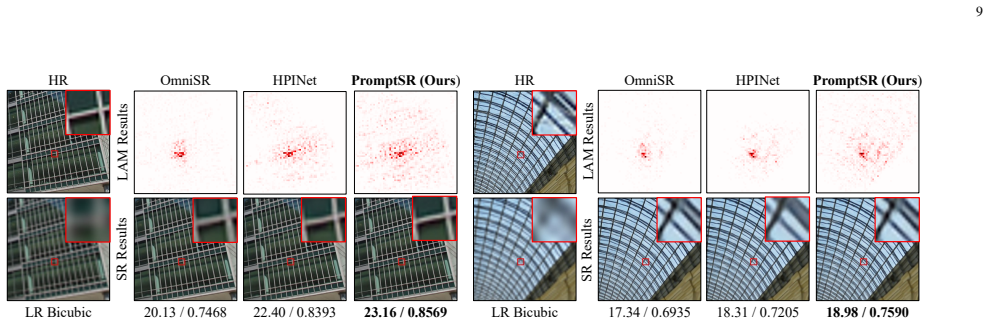
- The gains are concentrated on structured, repetitive textures where global context matters most, such as Urban100 and Manga109, while gains on simpler natural-image benchmarks are smaller.
- Ablations show the three prompting stages are additive: anchor prompting helps, coarse prompting helps more, and fine prompting adds the rest, so the coarse-to-fine cascade is load-bearing.
Reading between the lines
- If cross-scale similarity is doing the work, PromptSR should lose its edge on images with no self-similar structure, such as white noise or aperiodic stochastic textures; this is a testable consequence the paper does not run.
- The paper's own t-SNE analysis shows the anchor prompts discard some semantic information, so coupling anchors with a semantic classifier could push lightweight super-resolution further.
- Because the prompting module is a drop-in block around attention, the same CPB design could be transplanted to other transformer-based restoration tasks, such as denoising or deblurring, that also rely on global context.
- The downscale ratio $d=8$ is a sweet spot in the paper's ablations; the behavior of larger ratios on higher-resolution inputs is unexplored and could sharpen the cost-performance trade-off.
Editorial analysis
A structured set of objections, weighed in public.
Referee Report
Summary. The paper proposes PromptSR, a lightweight image super-resolution network built from cascade prompting blocks (CPBs). Each CPB contains a global anchor prompting layer (GAPL) that constructs low-dimensional anchor prompts from downscaled features via cross-scale attention, followed by two local prompting layers (LPLs) that use the GAPL's similarity maps to guide category-based and window-based self-attention. The authors claim state-of-the-art performance on five benchmarks with 0.78M parameters, and that the method matches a 12M-parameter SwinIR model. The paper includes complexity analysis, ablations, LAM visualizations, and a limitation discussion.
Significance. If the architecture works as described, the GAPL idea is a plausible way to achieve a global receptive field at near-window-attention cost, and the complexity bound in Table II is correctly derived. The ablation study is thorough and generally supports the contribution of each prompting component. However, the central empirical claim of state-of-the-art superiority is not substantiated by the reported numbers, and the anchor update formula in Eq. (8) is mathematically self-contradictory. These issues prevent me from recommending acceptance at this stage.
major comments (2)
- [Section III-B, Eq. (8)] Equation (8) defines the anchor prompt update as P^i = αP^{i-1} + (1−α)P^i. Since P^i appears on both sides, subtracting (1−α)P^i from both sides gives αP^i = αP^{i-1}, and for α ≠ 0 this forces P^i = P^{i-1}. Thus the update as written is the identity and cannot compute the 'adaptive anchor prompt update' that the paper describes. Please rewrite with a distinct symbol for the newly constructed prompts (e.g., \tilde P^i) and clarify the update schedule within each residual group.
- [Section IV-B, Table I] The text states that 'our proposed model can consistently outperform existing methods on all five benchmark datasets,' but the table shows the opposite. For example, PromptSR is worse than ATD-light on Set14 ×2 (34.10 vs 34.11), BSD100 ×2 (32.37 vs 32.39), BSD100 ×3 (29.30 vs 29.32), and Set5 ×4 (32.61 vs 32.62), with a tie on BSD100 ×4. Because the favorable margins on other benchmarks are typically 0.01–0.03 dB, and no code, seeds, or repeated runs are provided, the claimed superiority is not established. I recommend either providing statistical significance tests (e.g., paired tests across multiple seeds) or revising the claim to 'comparable or better in most cases.'
minor comments (5)
- [Section IV-D, Table V] The parameter counts for different downscale ratios d are unexpected: d=2 gives 534K, d=4 gives 540K, and d=8 gives 562K. Since the linear projections in the GAPL are applied with shared weights, the number of anchors should not change the parameter count. Please clarify why the parameter counts differ, or correct the table.
- [Section IV-D, Table VI] The text says that α=0 'resulted in a significant drop in performance,' but the table shows only a 0.01 dB drop on Urban100 (26.62 vs 26.63) and a 0.12 dB drop on Manga109 (30.86 vs 30.98). The characterization 'significant' is an overstatement and should be adjusted.
- [Section III-B, Eq. (10)] The expression M_fine = Q(Kp + A)^T / √C has ambiguous parentheses; it should be written as M_fine = Q (Kp + A)^T / √C to make clear that the transpose applies to the sum.
- [Section IV-B] The paper uses the names 'OminiSR' and 'OmniSR' inconsistently (e.g., in the quantitative results paragraph). Please standardize to 'OmniSR' as in the reference list.
- [Section III-C] The paper mentions 'sub-category size in CSA' in the implementation details but never defines this concept in the method section. Please add a definition or explanation of how the sub-category size is used in category-based self-attention.
Circularity Check
One self-referential equation in the anchor-prompt update makes that component vacuous by construction, while the central empirical derivation is otherwise independent.
-
self definitional
[Section III-B, Equation (8), page 5]
"This process is formulated as follows: P i = αP i−1 + (1− α)P i (8) where P i−1 and P i represent constructed APs from the CPB of i − 1 and i within single RG, respectively, and α represents a small constant that controls the weight assigned to the last constructed APs of i − 1."
The update equation defines P^i in terms of the same P^i that appears on the right-hand side. Subtracting (1−α)P^i from both sides gives αP^i = αP^{i−1}, so for any α ≠ 0 the equation forces P^i = P^{i−1}; for α = 0 it is the tautology P^i = P^i. The 'adaptive anchor prompt update' therefore reduces to a no-op (or an arbitrary identity) by construction, and the claimed mixing of previous and current anchors cannot implement the described retention of global priors. The α-ablation in Table VI is disconnected from this equation, since all nonzero α choices are mathematically equivalent under the written formula.
full rationale
The paper's central claim is an empirical architecture comparison: PromptSR is trained with a standard L1 loss (Eq. 5) and evaluated on five public benchmarks. There is no fitted constant or derived quantity whose prediction is equivalent to its input. The GAPL cross-attention to downscaled anchors is a well-posed multi-scale attention operation; the reuse of M_coarse and M_fine as prompts in the LPLs is a stated design choice, not a circular derivation. The complexity upper bounds in Table II are independent algebraic estimates. Self-citations (refs 20, 21, 35, 45) appear only as related-work support for low-level vision and prompting, and none carries a load-bearing uniqueness theorem or supplies the method's core premise; the cross-scale-similarity premise is attributed to an external work (ref 19). The one concrete circular step is Eq. (8), where P^i is defined in terms of itself, algebraically forcing P^i = P^{i-1} (or a tautology at α=0); this invalidates the written anchor-update mechanism and the corresponding α-ablation narrative, but it does not reduce the overall SOTA claim to its inputs. Hence a moderate-low score reflecting one localized self-definitional step, with the central empirical derivation remaining independent.
Assumptions & free parameters
free parameters (4)
- downscale ratio d =
8
- anchor update weight alpha =
0.01
- window size ws =
16x16
- sub-category size in CSA =
128
assumptions (2)
- domain assumption Natural images exhibit cross-scale similarity; structures such as edges persist across different scales.
- domain assumption Tokens assigned to the same category by coarse/fine similarity maps form meaningful groups for self-attention.
invented entities (1)
-
Anchor Prompts (APs)
Cite this review
Pith. "Pith review of PromptSR: Cascade Prompting for Lightweight Image Super-Resolution." pith.science (2026). https://pith.science/paper/ZXGSKJBC
@misc{pith2026250704118,
  author       = {Pith},
  title        = {Pith review of: PromptSR: Cascade Prompting for Lightweight Image Super-Resolution},
  year         = {2026},
  howpublished = {\url{https://pith.science/paper/ZXGSKJBC}},
  note         = {Machine review of arXiv:2507.04118}
}
read the original abstract
Although the lightweight Vision Transformer has significantly advanced image super-resolution (SR), it faces the inherent challenge of a limited receptive field due to the window-based self-attention modeling. The quadratic computational complexity relative to window size restricts its ability to use a large window size for expanding the receptive field while maintaining low computational costs. To address this challenge, we propose PromptSR, a novel prompt-empowered lightweight image SR method. The core component is the proposed cascade prompting block (CPB), which enhances global information access and local refinement via three cascaded prompting layers: a global anchor prompting layer (GAPL) and two local prompting layers (LPLs). The GAPL leverages downscaled features as anchors to construct low-dimensional anchor prompts (APs) through cross-scale attention, significantly reducing computational costs. These APs, with enhanced global perception, are then used to provide global prompts, efficiently facilitating long-range token connections. The two LPLs subsequently combine category-based self-attention and window-based self-attention to refine the representation in a coarse-to-fine manner. They leverage attention maps from the GAPL as additional global prompts, enabling them to perceive features globally at different granularities for adaptive local refinement. In this way, the proposed CPB effectively combines global priors and local details, significantly enlarging the receptive field while maintaining the low computational costs of our PromptSR. The experimental results demonstrate the superiority of our method, which outperforms state-of-the-art lightweight SR methods in quantitative, qualitative, and complexity evaluations. Our code will be released at https://github.com/wenyang001/PromptSR.
Figures


Figures from the paper (8 more)




Reference graph
Works this paper leans on
-
[19]
Efficient and explicit modelling of image hierarchies for image restoration,
Y . Li, Y . Fan, X. Xiang, D. Demandolx, R. Ranjan, R. Timofte, and L. Van Gool, “Efficient and explicit modelling of image hierarchies for image restoration,” in Proceedings of the IEEE/CVF Conference on Computer Vision and Pattern Recognition , pp. 18278–18289, 2023
work page 2023
-
[41]
L. Zhang, Y . Li, X. Zhou, X. Zhao, and S. Gu, “Transcending the limit of local window: Advanced super-resolution transformer with adaptive token dictionary,” in Proceedings of the IEEE/CVF Conference on Computer Vision and Pattern Recognition , pp. 2856–2865, 2024
work page 2024
-
[1]
Accurate image super-resolution using very deep convolutional networks,
J. Kim, J. K. Lee, and K. M. Lee, “Accurate image super-resolution using very deep convolutional networks,” in Proceedings of the IEEE conference on computer vision and pattern recognition , pp. 1646–1654, 2016
work page 2016
-
[2]
Densely connected convolutional networks,
G. Huang, Z. Liu, L. Van Der Maaten, and K. Q. Weinberger, “Densely connected convolutional networks,” in Proceedings of the IEEE con- ference on computer vision and pattern recognition , pp. 4700–4708, 2017
work page 2017
-
[3]
Image super- resolution using very deep residual channel attention networks,
Y . Zhang, K. Li, K. Li, L. Wang, B. Zhong, and Y . Fu, “Image super- resolution using very deep residual channel attention networks,” in Proceedings of the European conference on computer vision (ECCV) , pp. 286–301, 2018
work page 2018
-
[4]
Image super-resolution using knowledge distillation,
Q. Gao, Y . Zhao, G. Li, and T. Tong, “Image super-resolution using knowledge distillation,” inAsian Conference on Computer Vision, pp. 527– 541, Springer, 2018
work page 2018
-
[5]
Fast, accurate, and lightweight super-resolution with cascading residual network,
N. Ahn, B. Kang, and K.-A. Sohn, “Fast, accurate, and lightweight super-resolution with cascading residual network,” in Proceedings of the European conference on computer vision (ECCV) , pp. 252–268, 2018
work page 2018
-
[6]
Lightweight image super- resolution with information multi-distillation network,
Z. Hui, X. Gao, Y . Yang, and X. Wang, “Lightweight image super- resolution with information multi-distillation network,” in Proceedings of the 27th acm international conference on multimedia , pp. 2024–2032, 2019
work page 2024
Show all 66 references
-
[7]
Lapar: Linearly- assembled pixel-adaptive regression network for single image super- resolution and beyond,
W. Li, K. Zhou, L. Qi, N. Jiang, J. Lu, and J. Jia, “Lapar: Linearly- assembled pixel-adaptive regression network for single image super- resolution and beyond,” Advances in Neural Information Processing Systems, vol. 33, pp. 20343–20355, 2020
2020
-
[8]
Swinir: Image restoration using swin transformer,
J. Liang, J. Cao, G. Sun, K. Zhang, L. Van Gool, and R. Timofte, “Swinir: Image restoration using swin transformer,” in Proceedings of the IEEE/CVF international conference on computer vision , pp. 1833–1844, 2021
2021
-
[9]
N-gram in swin transformers for efficient lightweight image super-resolution,
H. Choi, J. Lee, and J. Yang, “N-gram in swin transformers for efficient lightweight image super-resolution,” in Proceedings of the IEEE/CVF conference on computer vision and pattern recognition , pp. 2071–2081, 2023
2023
-
[10]
Shufflemixer: An efficient convnet for image super-resolution,
L. Sun, J. Pan, and J. Tang, “Shufflemixer: An efficient convnet for image super-resolution,” Advances in Neural Information Processing Systems, vol. 35, pp. 17314–17326, 2022. 13
2022
-
[11]
Lightweight image super- resolution with superpixel token interaction,
A. Zhang, W. Ren, Y . Liu, and X. Cao, “Lightweight image super- resolution with superpixel token interaction,” in Proceedings of the IEEE/CVF International Conference on Computer Vision , pp. 12728– 12737, 2023
2023
-
[12]
Srformer: Permuted self-attention for single image super-resolution,
Y . Zhou, Z. Li, C.-L. Guo, S. Bai, M.-M. Cheng, and Q. Hou, “Srformer: Permuted self-attention for single image super-resolution,” in Proceedings of the IEEE/CVF International Conference on Computer Vision, pp. 12780–12791, 2023
2023
-
[13]
Omni aggregation networks for lightweight image super-resolution,
H. Wang, X. Chen, B. Ni, Y . Liu, and L. jinfan, “Omni aggregation networks for lightweight image super-resolution,” in Conference on Computer Vision and Pattern Recognition , 2023
2023
-
[14]
From coarse to fine: Hierarchical pixel integration for lightweight image super-resolution,
J. Liu, C. Chen, J. Tang, and G. Wu, “From coarse to fine: Hierarchical pixel integration for lightweight image super-resolution,” in Proceedings of the AAAI Conference on Artificial Intelligence , vol. 37, pp. 1666–1674, 2023
2023
-
[15]
Edge-oriented convolution block for real-time super resolution on mobile devices,
X. Zhang, H. Zeng, and L. Zhang, “Edge-oriented convolution block for real-time super resolution on mobile devices,” in Proceedings of the 29th ACM International Conference on Multimedia , pp. 4034–4043, 2021
2021
-
[16]
Single image super-resolution from transformed self-exemplars,
J.-B. Huang, A. Singh, and N. Ahuja, “Single image super-resolution from transformed self-exemplars,” in Proceedings of the IEEE conference on computer vision and pattern recognition , pp. 5197–5206, 2015
2015
-
[17]
Pre-train, prompt, and predict: A systematic survey of prompting methods in natural language processing,
P. Liu, W. Yuan, J. Fu, Z. Jiang, H. Hayashi, and G. Neubig, “Pre-train, prompt, and predict: A systematic survey of prompting methods in natural language processing,” ACM Computing Surveys, vol. 55, no. 9, pp. 1–35, 2023
2023
-
[18]
Promp- tir: Prompting for all-in-one image restoration,
V . Potlapalli, S. W. Zamir, S. H. Khan, and F. Shahbaz Khan, “Promp- tir: Prompting for all-in-one image restoration,” Advances in Neural Information Processing Systems , vol. 36, pp. 71275–71293, 2023
2023
-
[20]
Bitstream-corrupted jpeg images are restorable: Two-stage compensation and alignment framework for image restoration,
W. Liu, Y . Wang, K.-H. Yap, and L.-P. Chau, “Bitstream-corrupted jpeg images are restorable: Two-stage compensation and alignment framework for image restoration,” in Proceedings of the IEEE/CVF Conference on Computer Vision and Pattern Recognition , pp. 9979–9988, 2023
2023
-
[21]
Bitstream- corrupted video recovery: A novel benchmark dataset and method,
T. Liu, K. Wu, Y . Wang, W. Liu, K.-H. Yap, and L.-P. Chau, “Bitstream- corrupted video recovery: A novel benchmark dataset and method,” Advances in Neural Information Processing Systems , vol. 36, pp. 68420– 68433, 2023
2023
-
[22]
End-to-end deep video compression based on hierarchical temporal context learning,
K. Wu, Z. Li, Y . Yang, Q. Liu, and X.-P. Zhang, “End-to-end deep video compression based on hierarchical temporal context learning,” IEEE Transactions on Multimedia , 2025
2025
-
[23]
Image super-resolution using deep convolutional networks,
C. Dong, C. C. Loy, K. He, and X. Tang, “Image super-resolution using deep convolutional networks,” IEEE transactions on pattern analysis and machine intelligence , vol. 38, no. 2, pp. 295–307, 2015
2015
-
[24]
Enhanced deep residual networks for single image super-resolution,
B. Lim, S. Son, H. Kim, S. Nah, and K. Mu Lee, “Enhanced deep residual networks for single image super-resolution,” in Proceedings of the IEEE conference on computer vision and pattern recognition workshops, pp. 136–144, 2017
2017
-
[25]
Accurate and efficient image super-resolution via global-local adjusting dense network,
X. Zhang, P. Gao, S. Liu, K. Zhao, G. Li, L. Yin, and C. W. Chen, “Accurate and efficient image super-resolution via global-local adjusting dense network,” IEEE Transactions on multimedia , vol. 23, pp. 1924– 1937, 2020
1924
-
[26]
Ddistill-sr: Reparameterized dynamic distillation network for lightweight image super-resolution,
Y . Wang, T. Su, Y . Li, J. Cao, G. Wang, and X. Liu, “Ddistill-sr: Reparameterized dynamic distillation network for lightweight image super-resolution,” IEEE Transactions on Multimedia , vol. 25, pp. 7222– 7234, 2022
2022
-
[27]
Latticenet: Towards lightweight image super-resolution with lattice block,
X. Luo, Y . Xie, Y . Zhang, Y . Qu, C. Li, and Y . Fu, “Latticenet: Towards lightweight image super-resolution with lattice block,” in Computer Vision–ECCV 2020: 16th European Conference, Glasgow, UK, August 23–28, 2020, Proceedings, Part XXII 16 , pp. 272–289, Springer, 2020
2020
-
[28]
Understanding the effective receptive field in deep convolutional neural networks,
W. Luo, Y . Li, R. Urtasun, and R. Zemel, “Understanding the effective receptive field in deep convolutional neural networks,”Advances in neural information processing systems , vol. 29, 2016
2016
-
[29]
Scaling up your kernels to 31x31: Revisiting large kernel design in cnns,
X. Ding, X. Zhang, J. Han, and G. Ding, “Scaling up your kernels to 31x31: Revisiting large kernel design in cnns,” in Proceedings of the IEEE/CVF conference on computer vision and pattern recognition , pp. 11963–11975, 2022
2022
-
[30]
Real-time image super-resolution using recursive depthwise separable convolution network,
K.-W. Hung, Z. Zhang, and J. Jiang, “Real-time image super-resolution using recursive depthwise separable convolution network,” IEEE Access, vol. 7, pp. 99804–99816, 2019
2019
-
[31]
Smfanet: A lightweight self-modulation feature aggregation network for efficient image super- resolution,
M. Zheng, L. Sun, J. Dong, and J. Pan, “Smfanet: A lightweight self-modulation feature aggregation network for efficient image super- resolution,” in European Conference on Computer Vision , pp. 359–375, Springer, 2025
2025
-
[32]
Camixersr: Only details need more
Y . Wang, Y . Liu, S. Zhao, J. Li, and L. Zhang, “Camixersr: Only details need more" attention",” in Proceedings of the IEEE/CVF Conference on Computer Vision and Pattern Recognition , pp. 25837–25846, 2024
2024
-
[33]
Mambair: A simple baseline for image restoration with state-space model,
H. Guo, J. Li, T. Dai, Z. Ouyang, X. Ren, and S.-T. Xia, “Mambair: A simple baseline for image restoration with state-space model,” in European conference on computer vision , pp. 222–241, Springer, 2025
2025
-
[34]
An image is worth 16x16 words: Transformers for image recognition at scale,
A. Dosovitskiy, L. Beyer, A. Kolesnikov, D. Weissenborn, X. Zhai, T. Unterthiner, M. Dehghani, M. Minderer, G. Heigold, S. Gelly, et al., “An image is worth 16x16 words: Transformers for image recognition at scale,” arXiv preprint arXiv:2010.11929 , 2020
2010 arXiv
-
[35]
Bytenet: Rethinking multimedia file fragment classification through visual per- spectives,
W. Liu, K. Wu, T. Liu, Y . Wang, K.-H. Yap, and L.-P. Chau, “Bytenet: Rethinking multimedia file fragment classification through visual per- spectives,” IEEE Transactions on Multimedia , 2024
2024
-
[36]
Lite vision transformer with enhanced self-attention,
C. Yang, Y . Wang, J. Zhang, H. Zhang, Z. Wei, Z. Lin, and A. Yuille, “Lite vision transformer with enhanced self-attention,” in Proceedings of the IEEE/CVF Conference on Computer Vision and Pattern Recognition , pp. 11998–12008, 2022
2022
-
[37]
Lightvit: To- wards light-weight convolution-free vision transformers,
T. Huang, L. Huang, S. You, F. Wang, C. Qian, and C. Xu, “Lightvit: To- wards light-weight convolution-free vision transformers,” arXiv preprint arXiv:2207.05557, 2022
2022 arXiv
-
[38]
A dynamic residual self-attention net- work for lightweight single image super-resolution,
K. Park, J. W. Soh, and N. I. Cho, “A dynamic residual self-attention net- work for lightweight single image super-resolution,” IEEE Transactions on Multimedia, vol. 25, pp. 907–918, 2021
2021
-
[39]
Cross-receptive focused inference network for lightweight image super- resolution,
W. Li, J. Li, G. Gao, W. Deng, J. Zhou, J. Yang, and G.-J. Qi, “Cross-receptive focused inference network for lightweight image super- resolution,” IEEE Transactions on Multimedia , vol. 26, pp. 864–877, 2023
2023
-
[40]
Efficient long-range attention network for image super-resolution,
X. Zhang, H. Zeng, S. Guo, and L. Zhang, “Efficient long-range attention network for image super-resolution,” in European Conference on Computer Vision , pp. 649–667, Springer, 2022
2022
-
[42]
Image processing gnn: Breaking rigidity in super-resolution,
Y . Tian, H. Chen, C. Xu, and Y . Wang, “Image processing gnn: Breaking rigidity in super-resolution,” in Proceedings of the IEEE/CVF Conference on Computer Vision and Pattern Recognition , pp. 24108–24117, 2024
2024
-
[43]
The power of scale for parameter- efficient prompt tuning,
B. Lester, R. Al-Rfou, and N. Constant, “The power of scale for parameter- efficient prompt tuning,” arXiv preprint arXiv:2104.08691 , 2021
2021 arXiv
-
[44]
Prefix-tuning: Optimizing continuous prompts for generation,
X. L. Li and P. Liang, “Prefix-tuning: Optimizing continuous prompts for generation,” arXiv preprint arXiv:2101.00190 , 2021
2021 arXiv
-
[45]
Empowering large language model for continual video question answering with collaborative prompting,
C. Cai, Z. Wang, J. Gao, W. Liu, Y . Lu, R. Zhang, and K.-H. Yap, “Empowering large language model for continual video question answering with collaborative prompting,” in Proceedings of the 2024 Conference on Empirical Methods in Natural Language Processing , pp. 3921–3932, 2024
2024
-
[46]
Unifying image processing as visual prompting question answering,
Y . Liu, X. Chen, X. Ma, X. Wang, J. Zhou, Y . Qiao, and C. Dong, “Unifying image processing as visual prompting question answering,” arXiv preprint arXiv:2310.10513 , 2023
2023 arXiv
-
[47]
Seeing the unseen: A frequency prompt guided transformer for image restoration,
S. Zhou, J. Pan, J. Shi, D. Chen, L. Qu, and J. Yang, “Seeing the unseen: A frequency prompt guided transformer for image restoration,” arXiv preprint arXiv:2404.00288, 2024
2024 arXiv
-
[48]
Heterogeneous prompt-guided entity inferring and distilling for scene- text aware cross-modal retrieval,
Z. Zhao, L. Li, J. Zhang, Y . Sun, X. Sheng, H. Yin, and S. Jiang, “Heterogeneous prompt-guided entity inferring and distilling for scene- text aware cross-modal retrieval,” in Proceedings of the AAAI Conference on Artificial Intelligence , 2025
2025
-
[49]
Domain shared and specific prompt learning for incremental monocular depth estimation,
Z. Yang, L. Li, J. Zhang, T. Wang, Y . Sun, and C. Yan, “Domain shared and specific prompt learning for incremental monocular depth estimation,” in Proceedings of the 32nd ACM International Conference on Multimedia, pp. 8306–8315, 2024
2024
-
[50]
Dynamic strategy prompt reasoning for emotional support conversation,
Y . Liu, L. Li, Y . Tu, B. Zhang, Z.-J. Zha, and Q. Huang, “Dynamic strategy prompt reasoning for emotional support conversation,” IEEE Transactions on Multimedia , 2024
2024
-
[51]
Docres: A generalist model toward unifying document image restoration tasks,
J. Zhang, D. Peng, C. Liu, P. Zhang, and L. Jin, “Docres: A generalist model toward unifying document image restoration tasks,” in Proceed- ings of the IEEE/CVF Conference on Computer Vision and Pattern Recognition, pp. 15654–15664, 2024
2024
-
[52]
Activating more pixels in image super-resolution transformer,
X. Chen, X. Wang, J. Zhou, Y . Qiao, and C. Dong, “Activating more pixels in image super-resolution transformer,” in Proceedings of the IEEE/CVF conference on computer vision and pattern recognition, pp. 22367–22377, 2023
2023
-
[53]
Ttst: A top- k token selective transformer for remote sensing image super-resolution,
Y . Xiao, Q. Yuan, K. Jiang, J. He, C.-W. Lin, and L. Zhang, “Ttst: A top- k token selective transformer for remote sensing image super-resolution,” IEEE Transactions on Image Processing , 2024
2024
-
[54]
Crossvit: Cross-attention multi- scale vision transformer for image classification,
C.-F. R. Chen, Q. Fan, and R. Panda, “Crossvit: Cross-attention multi- scale vision transformer for image classification,” in Proceedings of the 14 IEEE/CVF international conference on computer vision , pp. 357–366, 2021
2021
-
[55]
Fast and accurate single image super- resolution via information distillation network,
Z. Hui, X. Wang, and X. Gao, “Fast and accurate single image super- resolution via information distillation network,” in Proceedings of the IEEE conference on computer vision and pattern recognition , pp. 723– 731, 2018
2018
-
[56]
Ntire 2017 challenge on single image super-resolution: Dataset and study,
E. Agustsson and R. Timofte, “Ntire 2017 challenge on single image super-resolution: Dataset and study,” in Proceedings of the IEEE conference on computer vision and pattern recognition workshops , pp. 126–135, 2017
2017
-
[57]
Low- complexity single-image super-resolution based on nonnegative neighbor embedding,
M. Bevilacqua, A. Roumy, C. Guillemot, and M. L. Alberi-Morel, “Low- complexity single-image super-resolution based on nonnegative neighbor embedding,” 2012
2012
-
[58]
On single image scale-up using sparse-representations,
R. Zeyde, M. Elad, and M. Protter, “On single image scale-up using sparse-representations,” in Curves and Surfaces: 7th International Conference, Avignon, France, June 24-30, 2010, Revised Selected Papers 7, pp. 711–730, Springer, 2012
2010
-
[59]
A database of human segmented natural images and its application to evaluating segmentation algorithms and measuring ecological statistics,
D. Martin, C. Fowlkes, D. Tal, and J. Malik, “A database of human segmented natural images and its application to evaluating segmentation algorithms and measuring ecological statistics,” in Proceedings Eighth IEEE International Conference on Computer Vision. ICCV 2001 , vol. 2...
2001
-
[60]
Sketch-based manga retrieval using manga109 dataset,
Y . Matsui, K. Ito, Y . Aramaki, A. Fujimoto, T. Ogawa, T. Yamasaki, and K. Aizawa, “Sketch-based manga retrieval using manga109 dataset,” Multimedia Tools and Applications , vol. 76, pp. 21811–21838, 2017
2017
-
[61]
Second-order attention network for single image super-resolution,
T. Dai, J. Cai, Y . Zhang, S.-T. Xia, and L. Zhang, “Second-order attention network for single image super-resolution,” in Proceedings of the IEEE/CVF conference on computer vision and pattern recognition , pp. 11065–11074, 2019
2019
-
[62]
Image super-resolution with non-local sparse attention,
Y . Mei, Y . Fan, and Y . Zhou, “Image super-resolution with non-local sparse attention,” in Proceedings of the IEEE/CVF conference on computer vision and pattern recognition , pp. 3517–3526, 2021
2021
-
[63]
Interpreting super-resolution networks with local attribution maps,
J. Gu and C. Dong, “Interpreting super-resolution networks with local attribution maps,” in Proceedings of the IEEE/CVF Conference on Computer Vision and Pattern Recognition , pp. 9199–9208, 2021
2021
-
[64]
Imagenet classification with deep convolutional neural networks,
A. Krizhevsky, I. Sutskever, and G. E. Hinton, “Imagenet classification with deep convolutional neural networks,” Advances in neural information processing systems, vol. 25, 2012
2012
-
[65]
Se- mantic segmentation guided real-world super-resolution,
A. Aakerberg, A. S. Johansen, K. Nasrollahi, and T. B. Moeslund, “Se- mantic segmentation guided real-world super-resolution,” in Proceedings of the IEEE/CVF Winter Conference on Applications of Computer Vision , pp. 449–458, 2022
2022
-
[66]
Seesr: Towards semantics-aware real-world image super-resolution,
R. Wu, T. Yang, L. Sun, Z. Zhang, S. Li, and L. Zhang, “Seesr: Towards semantics-aware real-world image super-resolution,” in Proceedings of the IEEE/CVF conference on computer vision and pattern recognition , pp. 25456–25467, 2024. Wenyang Liu (Student Member, IEEE) received ...
2024
Reviewed August 6, 2026 · model on record in the stance chip above.
Discussion (0). Sign in to comment.