Towards Lightest Low-Light Image Enhancement Architecture for Mobile Devices
Pith reviewed 2026-05-19 05:20 UTC · model grok-4.3
The pith
LiteIE enhances low-light images to 19.04 dB PSNR using 58 parameters and no labeled data on mobile devices.
A machine-rendered reading of the paper's core claim, the machinery that carries it, and where it could break.
Core claim
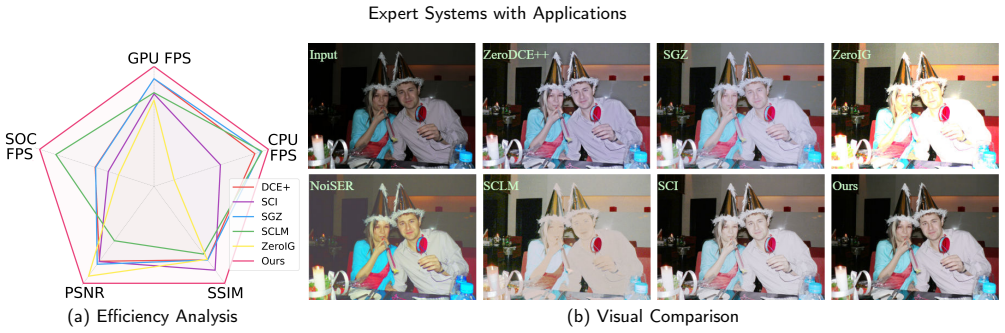
LiteIE is an ultra-lightweight unsupervised enhancement framework consisting of a backbone-agnostic feature extractor with only two convolutional layers and a parameter-free Iterative Restoration Module. It is trained with an unsupervised objective integrating exposure control, edge-aware smoothness, and multi-scale color consistency losses. On the LOL dataset it reaches 19.04 dB PSNR, 1.4 dB above state-of-the-art while using 0.07% of the parameters, and runs at 30 FPS for 4K images on Snapdragon 8 Gen 3 with 58 parameters.
What carries the argument
The parameter-free Iterative Restoration Module, which reuses compact image features from two convolutional layers to progressively recover fine details without adding learnable parameters.
If this is right
- Real-time low-light enhancement at 4K resolution becomes practical on edge devices with limited computational resources.
- The need for large-scale paired datasets is eliminated for training effective enhancers.
- Generalization across diverse low-light conditions improves through the multi-scale consistency losses.
- Deployment on resource-constrained platforms is facilitated by the extreme parameter efficiency.
Where Pith is reading between the lines
- Similar parameter-free iterative modules could be adapted for other mobile image processing tasks such as denoising or deblurring.
- Exploring different iteration counts in the restoration module could reveal speed-quality trade-offs on specific hardware.
- Integration into on-device camera pipelines might enable video enhancement without added hardware cost.
Load-bearing premise
The unsupervised training objective that combines exposure control, edge-aware smoothness, and multi-scale color consistency losses is sufficient to train a high-quality generalizable enhancer without any labeled paired data.
What would settle it
Applying LiteIE to a new low-light test set with ground-truth pairs and checking whether its PSNR falls below that of supervised competitors on the same data.
Figures


read the original abstract
Real-time low-light image enhancement on mobile and embedded devices requires models that balance visual quality and computational efficiency. Existing deep learning methods often rely on large networks and labeled datasets, limiting their deployment on resource-constrained platforms. In this paper, we propose LiteIE, an ultra-lightweight unsupervised enhancement framework that eliminates dependence on large-scale supervision and generalizes well across diverse conditions. We design a backbone-agnostic feature extractor with only two convolutional layers to produce compact image features enhancement tensors. In addition, we develop a parameter-free Iterative Restoration Module, which reuses the extracted features to progressively recover fine details lost in earlier enhancement steps, without introducing any additional learnable parameters. We further propose an unsupervised training objective that integrates exposure control, edge-aware smoothness, and multi-scale color consistency losses. Experiments on the LOL dataset, LiteIE achieves 19.04 dB PSNR, surpassing SOTA by 1.4 dB while using only 0.07\% of its parameters. On a Snapdragon 8 Gen 3 mobile processor, LiteIE runs at 30 FPS for 4K images with just 58 parameters, enabling real-time deployment on edge devices. These results establish LiteIE as an efficient and practical solution for low-light enhancement on resource-limited platforms.
Editorial analysis
A structured set of objections, weighed in public.
Referee Report
Summary. The manuscript proposes LiteIE, an ultra-lightweight unsupervised low-light image enhancement framework for mobile devices. It consists of a backbone-agnostic feature extractor using only two convolutional layers to generate compact features and enhancement tensors, paired with a parameter-free Iterative Restoration Module that reuses features for progressive detail recovery. Training relies on an unsupervised objective combining exposure control, edge-aware smoothness, and multi-scale color consistency losses. The central empirical claims are that LiteIE achieves 19.04 dB PSNR on the LOL dataset (surpassing SOTA by 1.4 dB while using 0.07% of the parameters) and runs at 30 FPS for 4K images on Snapdragon 8 Gen 3 with only 58 parameters.
Significance. If the reported PSNR, parameter count, and runtime results hold under fair and reproducible conditions, the work would be significant for real-time computer vision on edge devices. The extreme parameter efficiency (58 parameters) combined with a parameter-free iterative module and fully unsupervised training removes reliance on large labeled datasets, which could enable broader deployment of low-light enhancement on resource-constrained platforms. The design choices demonstrate that high performance need not require large model capacity.
major comments (2)
- [Abstract] Abstract: The headline claim of 19.04 dB PSNR (1.4 dB above SOTA) with only 0.07% of the parameters is load-bearing for the contribution, yet the abstract provides no details on the specific SOTA baselines compared, their parameter counts, implementation sources, data splits on LOL, or evaluation protocol. Without this information, the efficiency and performance assertions cannot be verified or reproduced from the given text.
- [Unsupervised Training Objective] Unsupervised training objective: The paper states that the combination of exposure control, edge-aware smoothness, and multi-scale color consistency losses is sufficient to train a high-quality enhancer without any paired ground truth. However, no ablation isolating the contribution of each loss term or direct comparison of the identical two-conv + parameter-free architecture trained with a supervised L1/L2 objective on the same LOL splits is reported. Given the deliberately minimal capacity, this assumption directly supports the 19.04 dB claim and requires explicit validation.
minor comments (1)
- [Abstract] Abstract: The phrasing 'Experiments on the LOL dataset, LiteIE achieves 19.04 dB PSNR...' is grammatically incomplete and should be revised for clarity (e.g., 'On the LOL dataset, LiteIE achieves...').
Simulated Author's Rebuttal
We thank the referee for their thoughtful review and constructive feedback on our manuscript. We address each of the major comments below and outline the revisions we plan to make to strengthen the paper.
read point-by-point responses
-
Referee: [Abstract] Abstract: The headline claim of 19.04 dB PSNR (1.4 dB above SOTA) with only 0.07% of the parameters is load-bearing for the contribution, yet the abstract provides no details on the specific SOTA baselines compared, their parameter counts, implementation sources, data splits on LOL, or evaluation protocol. Without this information, the efficiency and performance assertions cannot be verified or reproduced from the given text.
Authors: We agree with the referee that additional details in the abstract would enhance the verifiability of our claims. In the revised manuscript, we will update the abstract to specify the SOTA method being compared (the one with the highest reported PSNR on the LOL dataset), include its parameter count for context, clarify the LOL data splits used, and briefly describe the evaluation protocol. This revision will make the performance and efficiency assertions more transparent without altering the core claims. revision: yes
-
Referee: [Unsupervised Training Objective] Unsupervised training objective: The paper states that the combination of exposure control, edge-aware smoothness, and multi-scale color consistency losses is sufficient to train a high-quality enhancer without any paired ground truth. However, no ablation isolating the contribution of each loss term or direct comparison of the identical two-conv + parameter-free architecture trained with a supervised L1/L2 objective on the same LOL splits is reported. Given the deliberately minimal capacity, this assumption directly supports the 19.04 dB claim and requires explicit validation.
Authors: We acknowledge the value of ablations to validate the loss terms. We will add an ablation study in the experiments section of the revised paper to isolate the contribution of each loss component (exposure control, edge-aware smoothness, and multi-scale color consistency) to the overall performance. Regarding a direct comparison with supervised L1/L2 training on the same architecture, we note that our work focuses on the unsupervised setting to eliminate the need for paired data, which is a key advantage for practical deployment. We can include a discussion on this point in the revised manuscript. revision: partial
Circularity Check
No circularity: empirical results from unsupervised training on standard benchmarks
full rationale
The paper describes an architecture (two-conv feature extractor plus parameter-free Iterative Restoration Module) and an unsupervised objective (exposure control + edge-aware smoothness + multi-scale color consistency losses) then reports measured PSNR on the LOL dataset. These are experimental outcomes after training, not quantities obtained by algebraic reduction to the paper's own equations or by renaming fitted parameters as predictions. No self-citation is invoked as a uniqueness theorem or load-bearing premise for the performance numbers, and the 19.04 dB figure is not defined in terms of the training losses themselves. The derivation chain is therefore self-contained as a standard empirical validation of a proposed model and loss combination.
Axiom & Free-Parameter Ledger
Lean theorems connected to this paper
-
IndisputableMonolith/Cost/FunctionalEquation.leanwashburn_uniqueness_aczel unclear?
unclearRelation between the paper passage and the cited Recognition theorem.
We further propose an unsupervised training objective that integrates exposure control, edge-aware smoothness, and multi-scale color consistency losses.
-
IndisputableMonolith/Foundation/AlphaCoordinateFixation.leanJ_uniquely_calibrated_via_higher_derivative unclear?
unclearRelation between the paper passage and the cited Recognition theorem.
LiteIE achieves 19.04 dB PSNR... with just 58 parameters
What do these tags mean?
- matches
- The paper's claim is directly supported by a theorem in the formal canon.
- supports
- The theorem supports part of the paper's argument, but the paper may add assumptions or extra steps.
- extends
- The paper goes beyond the formal theorem; the theorem is a base layer rather than the whole result.
- uses
- The paper appears to rely on the theorem as machinery.
- contradicts
- The paper's claim conflicts with a theorem or certificate in the canon.
- unclear
- Pith found a possible connection, but the passage is too broad, indirect, or ambiguous to say the theorem truly supports the claim.
Reference graph
Works this paper leans on
-
[1]
Transform coefficient histogram-based image enhancement algorithms using contrast en- tropy
Agaian, S.S., Silver, B., Panetta, K.A., 2007. Transform coefficient histogram-based image enhancement algorithms using contrast en- tropy. IEEE transactions on image processing 16, 741–758
work page 2007
-
[2]
Bychkovsky, V., Paris, S., Chan, E., Durand, F., 2011. Learning photographicglobaltonaladjustmentwithadatabaseofinput/output image pairs, in: The Twenty-Fourth IEEE Conference on Computer Vision and Pattern Recognition
work page 2011
-
[3]
IQA-PyTorch: Pytorch toolbox for im- age quality assessment
Chen, C., Mo, J., 2022. IQA-PyTorch: Pytorch toolbox for im- age quality assessment. [Online]. Available: https://github.com/ chaofengc/IQA-PyTorch
work page 2022
-
[4]
Fast Context-Based Low-Light Image Enhancement via Neu- ral Implicit Representations
Chobola, T., Liu, Y., Zhang, H., Schnabel, J.A., Peng, T., 2024. Fast Context-Based Low-Light Image Enhancement via Neu- ral Implicit Representations. Springer Nature Switzerland. p. 413–430. URL: http://dx.doi.org/10.1007/978-3-031-73016-0_24 , doi:10.1007/978-3-031-73016-0_24
-
[5]
Guo, C., Li, C., Guo, J., Loy, C.C., Hou, J., Kwong, S., Cong, R.,
- [6]
-
[7]
Lime:Low-lightimageenhancement via illumination map estimation
Guo,X.,Li,Y.,Ling,H.,2016. Lime:Low-lightimageenhancement via illumination map estimation. IEEE Transactions on image pro- cessing 26, 982–993
work page 2016
-
[8]
Hai, J., Xuan, Z., Yang, R., Hao, Y., Zou, F., Lin, F., Han, S., 2023. R2rnet: Low-light image enhancement via real-low to real-normal network.JournalofVisualCommunicationandImageRepresentation 90, 103712
work page 2023
-
[9]
Low-light image enhancementwithsemi-decoupleddecomposition
Hao, S., Han, X., Guo, Y., Xu, X., Wang, M., 2020. Low-light image enhancementwithsemi-decoupleddecomposition. IEEEtransactions on multimedia 22, 3025–3038
work page 2020
-
[10]
Hu, C., Hu, Y., Xu, L., Guo, Y., Cai, Z., Jing, X., Liu, P., 2024a. Jte- cflow for low-light enhancement and zero-element pixels restoration with application to night traffic monitoring images. IEEE Transac- tions on Intelligent Transportation Systems
-
[11]
Zmar-snflow: Restoration for low-light images with massive zero-element pixels
Hu, C., Zhang, B., Hu, K., Xu, L., Wu, F., Cai, Z., Ye, M., Lu, X., 2024b. Zmar-snflow: Restoration for low-light images with massive zero-element pixels. Computers and Electrical Engineering 120, 109750
-
[12]
A reflectance re- weighted retinex model for non-uniform and low-light image en- hancement
Jia, F., Wong, H.S., Wang, T., Zeng, T., 2023. A reflectance re- weighted retinex model for non-uniform and low-light image en- hancement. Pattern Recognition 144, 109823
work page 2023
-
[13]
Lightendiffusion: Unsupervisedlow-lightimageenhancementwithlatent-retinexdiffu- sion models
Jiang, H., Luo, A., Liu, X., Han, S., Liu, S., 2024. Lightendiffusion: Unsupervisedlow-lightimageenhancementwithlatent-retinexdiffu- sion models. arXiv preprint arXiv:2407.08939 . Guangrui Bai et al.:Preprint submitted to Elsevier Page 11 of 12 Expert Systems with Applications
-
[14]
Low-lightimageenhancementwithquality-orientedpseudo labelsviasemi-supervisedcontrastivelearning
Jiang, N., Cao, Y., Zhang, X.Y., Wang, D.H., He, Y., Wang, C., Zhu, S.,2025. Low-lightimageenhancementwithquality-orientedpseudo labelsviasemi-supervisedcontrastivelearning. ExpertSystemswith Applications 276, 127106
work page 2025
-
[15]
Enlightengan: Deep light enhancement without paired supervision
Jiang, Y., Gong, X., Liu, D., Cheng, Y., Fang, C., Shen, X., Yang, J., Zhou, P., Wang, Z., 2021. Enlightengan: Deep light enhancement without paired supervision. IEEE transactions on image processing 30, 2340–2349
work page 2021
-
[16]
Land, E.H., McCann, J.J., 1971. Lightness and retinex theory. Josa 61, 1–11
work page 1971
-
[17]
Contrast enhancement based on layereddifferencerepresentationof2dhistograms
Lee, C., Lee, C., Kim, C.S., 2013. Contrast enhancement based on layereddifferencerepresentationof2dhistograms. IEEEtransactions on image processing 22, 5372–5384
work page 2013
-
[18]
Low-lightimageandvideoenhancementusingdeeplearning: A survey
Li, C., Guo, C., Han, L., Jiang, J., Cheng, M.M., Gu, J., Loy, C.C., 2021a. Low-lightimageandvideoenhancementusingdeeplearning: A survey. IEEE transactions on pattern analysis and machine intelli- gence 44, 9396–9416
-
[19]
Learning to enhance low-light image via zero-reference deep curve estimation
Li, C., Guo, C., Loy, C.C., 2021b. Learning to enhance low-light image via zero-reference deep curve estimation. IEEE transactions on pattern analysis and machine intelligence 44, 4225–4238
-
[20]
Li,J.,Wang,Y.,Wang,C.,Tai,Y.,Qian,J.,Yang,J.,Wang,C.,Li,J., Huang,F.,2019. Dsfd:dualshotfacedetector,in:Proceedingsofthe IEEE/CVF conference on computer vision and pattern recognition, pp. 5060–5069
work page 2019
-
[21]
Liang, Z., Li, C., Zhou, S., Feng, R., Loy, C.C., 2023. Iterative prompt learning for unsupervised backlit image enhancement, in: ProceedingsoftheIEEE/CVFInternationalConferenceonComputer Vision, pp. 8094–8103
work page 2023
-
[22]
Liu, R., Ma, L., Zhang, J., Fan, X., Luo, Z., 2021. Retinex-inspired unrolling with cooperative prior architecture search for low-light imageenhancement,in:ProceedingsoftheIEEE/CVFconferenceon computer vision and pattern recognition, pp. 10561–10570
work page 2021
-
[23]
Ntire 2024 challenge on low light image enhancement: Methods and results
Liu,X.,Wu,Z.,Li,A.,Vasluianu,F.A.,Zhang,Y.,Gu,S.,Zhang,L., Zhu, C., Timofte, R., Jin, Z., et al., 2024. Ntire 2024 challenge on low light image enhancement: Methods and results. arXiv preprint arXiv:2404.14248
-
[24]
Ma, K., Zeng, K., Wang, Z., 2015. Perceptual quality assessment for multi-exposureimagefusion.IEEETransactionsonImageProcessing 24, 3345–3356
work page 2015
-
[25]
Ma, L., Ma, T., Liu, R., Fan, X., Luo, Z., 2022. Toward fast, flexible, and robust low-light image enhancement, in: Proceedings of the IEEE/CVF conference on computer vision and pattern recognition, pp. 5637–5646
work page 2022
-
[26]
Ni, Z., Yang, W., Wang, H., Wang, S., Ma, L., Kwong, S., 2022. Cycle-interactive generative adversarial network for robust unsu- pervised low-light enhancement, in: Proceedings of the 30th ACM International Conference on Multimedia, pp. 1484–1492
work page 2022
-
[27]
Pan, J., Zhai, D., Bai, Y., Jiang, J., Zhao, D., Liu, X., 2022. Cheby- lighter: Optimal curve estimation for low-light image enhancement, in: Proceedings of the 30th ACM international conference on multi- media, pp. 1358–1366
work page 2022
-
[28]
Pizer, S.M., Amburn, E.P., Austin, J.D., Cromartie, R., Geselowitz, A.,Greer,T.,terHaarRomeny,B.,Zimmerman,J.B.,Zuiderveld,K.,
-
[29]
Computer vision, graphics, and image processing 39, 355–368
Adaptive histogram equalization and its variations. Computer vision, graphics, and image processing 39, 355–368
-
[30]
Lr3m: Robust low- light enhancement via low-rank regularized retinex model
Ren, X., Yang, W., Cheng, W.H., Liu, J., 2020. Lr3m: Robust low- light enhancement via low-rank regularized retinex model. IEEE Transactions on Image Processing 29, 5862–5876
work page 2020
-
[31]
Shi, Y., Liu, D., Zhang, L., Tian, Y., Xia, X., Fu, X., 2024. Zero- ig: zero-shot illumination-guided joint denoising and adaptive en- hancement for low-light images, in: Proceedings of the IEEE/CVF conference on computer vision and pattern recognition, pp. 3015– 3024
work page 2024
-
[32]
Very Deep Convolutional Networks for Large-Scale Image Recognition
Simonyan,K.,2014.Verydeepconvolutionalnetworksforlarge-scale image recognition. arXiv preprint arXiv:1409.1556
work page internal anchor Pith review Pith/arXiv arXiv 2014
- [33]
-
[34]
Exploring clip for assessing the look and feel of images, in: AAAI
Wang, J., Chan, K.C., Loy, C.C., 2023. Exploring clip for assessing the look and feel of images, in: AAAI
work page 2023
-
[35]
Naturalness preserved enhancement algorithm for non-uniform illumination images
Wang, S., Zheng, J., Hu, H.M., Li, B., 2013. Naturalness preserved enhancement algorithm for non-uniform illumination images. IEEE transactions on image processing 22, 3538–3548
work page 2013
-
[36]
Deep Retinex Decomposition for Low-Light Enhancement
Wei, C., Wang, W., Yang, W., Liu, J., 2018. Deep retinex decompo- sition for low-light enhancement. arXiv preprint arXiv:1808.04560
work page internal anchor Pith review Pith/arXiv arXiv 2018
-
[37]
Self- referencedeepadaptivecurveestimationforlow-lightimageenhance- ment
Wen, J., Wu, C., Zhang, T., Yu, Y., Swierczynski, P., 2023. Self- referencedeepadaptivecurveestimationforlow-lightimageenhance- ment. arXiv preprint arXiv:2308.08197
-
[38]
Wu, W., Weng, J., Zhang, P., Wang, X., Yang, W., Jiang, J., 2022. Uretinex-net: Retinex-based deep unfolding network for low-light imageenhancement,in:ProceedingsoftheIEEE/CVFconferenceon computer vision and pattern recognition, pp. 5901–5910
work page 2022
-
[39]
Xia, Y., Xu, F., Zheng, Q., 2023. Zero-shot adaptive low light en- hancement with retinex decomposition and hybrid curve estimation, in:2023InternationalJointConferenceonNeuralNetworks(IJCNN), IEEE. pp. 1–8
work page 2023
-
[40]
Upt-flow: Multi-scale transformer-guided normalizing flow for low-light image enhancement
Xu, L., Hu, C., Hu, Y., Jing, X., Cai, Z., Lu, X., 2025. Upt-flow: Multi-scale transformer-guided normalizing flow for low-light image enhancement. Pattern Recognition 158, 111076
work page 2025
-
[41]
Igdnet:Zero-shotrobustunder- exposed image enhancement via illumination-guided and denoising
Yan,H.,Huang,J.,Huang,T.,2025a. Igdnet:Zero-shotrobustunder- exposed image enhancement via illumination-guided and denoising. arXiv preprint arXiv:2507.02445
-
[42]
Yan, H., Huang, J., Zheng, M., Tang, Y., 2025b. Zero-shot image segmentationforsceneobjectsbasedonthel0gradientminimization andadaptivesuperpixelmethod. NeuralComputingandApplications , 1–21
-
[43]
Yan,H.,Li,A.,Zhang,X.,Liu,Z.,Shi,Z.,Zhu,C.,Zhang,L.,2025c. Mobileie: An extremely lightweight and effective convnet for real- time image enhancement on mobile devices, in: Proceedings of the IEEE/CVF International Conference on Computer Vision
-
[44]
Advancing image understanding in poor visibility environments: A collective benchmarkstudy
Yang, W., Yuan, Y., Ren, W., Liu, J., Scheirer, W.J., Wang, Z., Zhang, T., Zhong, Q., Xie, D., Pu, S., et al., 2020. Advancing image understanding in poor visibility environments: A collective benchmarkstudy. IEEETransactionsonImageProcessing29,5737– 5752
work page 2020
-
[45]
Yi, X., Xu, H., Zhang, H., Tang, L., Ma, J., 2023. Diff-retinex: Rethinking low-light image enhancement with a generative diffusion model,in:ProceedingsoftheIEEE/CVFInternationalConferenceon Computer Vision, pp. 12302–12311
work page 2023
-
[46]
Beyond brightening low-light images
Zhang, Y., Guo, X., Ma, J., Liu, W., Zhang, J., 2021. Beyond brightening low-light images. International Journal of Computer Vision 129, 1013–1037
work page 2021
-
[47]
Zhang, Y., Teng, B., Yang, D., Chen, Z., Ma, H., Li, G., Ding, W.,
-
[48]
IEEE Transactions on Circuits and Systems for Video Technology 34, 5995–6008
Learningasingleconvolutionallayermodelforlowlightimage enhancement. IEEE Transactions on Circuits and Systems for Video Technology 34, 5995–6008
-
[49]
Zhang, Y., Zhang, J., Guo, X., 2019. Kindling the darkness: A practicallow-lightimageenhancer,in:Proceedingsofthe27thACM international conference on multimedia, pp. 1632–1640
work page 2019
-
[50]
Zhang, Z., Zhao, S., Jin, X., Xu, M., Yang, Y., Yan, S., Wang, M.,
-
[51]
IEEE Transactions on Pattern Analysis and Machine Intelligence
Noise self-regression: A new learning paradigm to enhance low-light images without task-related data. IEEE Transactions on Pattern Analysis and Machine Intelligence
-
[52]
Zheng, S., Gupta, G., 2022. Semantic-guided zero-shot learn- ing for low-light image/video enhancement, in: Proceedings of the IEEE/CVFWinterconferenceonapplicationsofcomputervision,pp. 581–590
work page 2022
-
[53]
Cwfas-net: Low- light image enhancement using curvelet wavelet attention and fourier transform
Zhou, H., Cao, C., Tong, J., Zheng, K., 2025. Cwfas-net: Low- light image enhancement using curvelet wavelet attention and fourier transform. Expert Systems with Applications 278, 127263
work page 2025
-
[54]
Zhu,A.,Zhang,L.,Shen,Y.,Ma,Y.,Zhao,S.,Zhou,Y.,2020. Zero- shot restoration of underexposed images via robust retinex decom- position, in: 2020 IEEE International Conference on Multimedia and Expo (ICME), IEEE. pp. 1–6. Guangrui Bai et al.:Preprint submitted to Elsevier Page 12 of 12
work page 2020
discussion (0)
Sign in with ORCID, Apple, or X to comment. Anyone can read and Pith papers without signing in.