REVIEW 2 major objections 9 minor 136 references
An Aligned Sub-Neptune Revealed with MAROON-X and a Tendency Towards Alignment for Small Planets
T0 review · 2 major / 9 minor · reviewed 2026-08-06 · deepseek-v4-flash
Pith's one-line read This paper establishes that sub-Neptune TOI-1759A b is spin-orbit aligned, with a projected obliquity of $|\lambda|=4^\circ\pm18^\circ$, and that small planets generally tend toward alignment.
desk verdict New aligned sub-Neptune measurement is careful and valuable, but the alignment claim is prior-dependent and the population trends are confirmatory. read the letter →
The pith
A machine-rendered reading of the paper's core claim, the machinery that carries it, and where it could break.
The reading
What carries the argument
The load-bearing mechanism is the Rossiter-McLaughlin effect: as a transiting planet blocks part of the rotating stellar disk, the star's apparent radial velocity shifts in a way that depends on the projected obliquity $\lambda$. The authors model that anomaly with the analytic RM prescription of Hirano et al. (2010), and avoid the usual degeneracy between $\lambda$ and $v\sin i$ by sampling the star's radius and rotation period to obtain the equatorial velocity, then drawing $v\sin i$ from the stellar inclination, following Stefánsson et al. (2022). The same joint fit includes TESS and MuSCAT3 light curves, and a 100,000-realization noise simulation sets a false-alarm probability below about 1% for the RM detection.
What would settle it
Obtain an independent measurement of TOI-1759A's rotation period, for example from long-baseline photometric spot modulation or a longer sequence of spectropolarimetric Stokes V observations; if the ~18-day signal is confirmed as the rotation period, the joint RM fit would need to be redone with $v_\mathrm{eq}\approx1.7$ km/s, and the claimed alignment could fail to survive.
Extended reading notes
Core claim
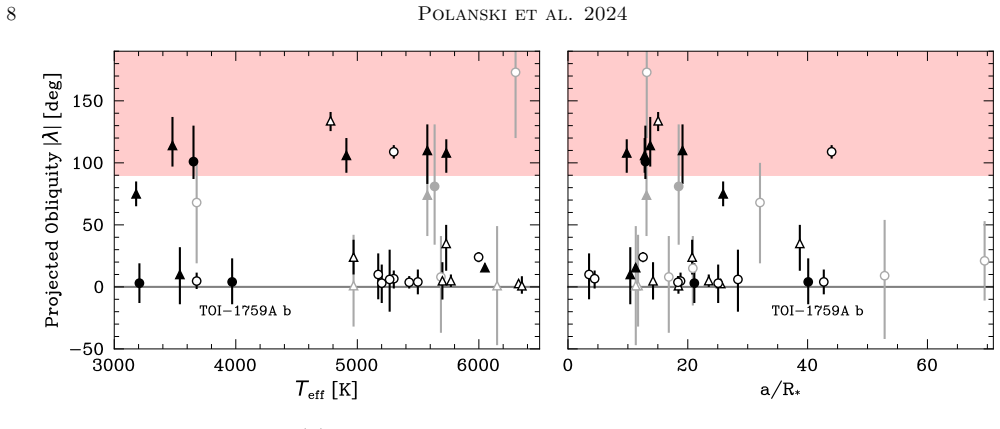
On the paper's own terms, the central discovery is that TOI-1759A b has a spin-orbit angle consistent with alignment: a sky-projected obliquity of $|\lambda|=4^\circ\pm18^\circ$ and a true obliquity of $\psi=24^\circ\pm12^\circ$, which rules out a polar orbit at $4.7\sigma$ confidence. The measurement comes from MAROON-X radial velocities taken during a transit, modeled jointly with TESS and MuSCAT3 photometry under a stellar rotation prior. Placing this planet in the growing sample of planets with $R<8\,R_\oplus$, the paper finds that small planets tend toward alignment, that aligned planets are more often in compact multi-planet systems, and that misaligned planets are more often isolated, a difference it quantifies at roughly $3\sigma$. It also finds that most misaligned small planets have radii between 4 and 8 Earth radii, while sub-Neptunes and super-Earths are preferentially aligned; TOI-1759A b joins K2-25 b as one of only two well-aligned single sub-Neptunes known.
Load-bearing premise
The result rests on the assumption that the host star's rotation period is about 35 days; if the competing ~18-day periodogram peak were the true rotation period, the equatorial velocity would nearly double to about 1.7 km/s, changing the amplitude scale against which the obliquity is measured.
Editorial extensions
If this is right
- TOI-1759A b becomes the longest-period single sub-Neptune with a measured obliquity, joining K2-25 b as one of only two well-aligned single sub-Neptunes known to date.
- If small planets generally form aligned, then most sub-Neptunes and super-Earths, especially in compact multi-planet systems, should continue to show low obliquities as more are measured.
- The population result implies that large obliquities among sub-Jovian planets are preferentially found in isolated systems with radii between 4 and 8 Earth radii, and that hidden giant companions are not yet required by the radial-velocity data.
- The lack of detected giant companions in most single-planet systems weakens the case that such companions universally drive the polar orbits seen in that population.
- Future intra-system obliquity measurements, with more than one planet per system, will directly test whether compact systems share a common aligned plane.
Reading between the lines
- A direct test of the paper's picture would be to measure obliquities for a dozen single sub-Neptunes with $a/R_\ast>30$; the cool-disk-migration scenario predicts they should be aligned, whereas scattering scenarios predict a broad distribution.
- The injection-recovery limits reach only about 2-3 AU for a few systems, so wide-orbit giant or stellar companions beyond that radius could still explain the polar sub-Saturns; long-baseline radial-velocity monitoring of systems like GJ 3470 would settle that.
- Because the RM amplitude is only about 1.5 m/s against roughly 1 m/s residuals, the alignment claim is best treated as provisional until a second transit is observed with similar precision; the false-alarm test addresses white noise but not correlated stellar activity.
Editorial analysis
A structured set of objections, weighed in public.
Referee Report
Summary. This paper measures the spin-orbit obliquity of the sub-Neptune TOI-1759A b from a single MAROON-X transit observation, jointly modeled with MuSCAT3 and TESS photometry. The fit yields a sky-projected obliquity |λ| = 4° ± 18° and a true obliquity ψ = 24° ± 12°, indicating an aligned system; the paper quotes a 4.7σ exclusion of polar orbits. At P = 18.85 d and a/R* = 40, this would make TOI-1759A b the longest-period single sub-Neptune with a measured obliquity. The paper also compiles the current sample of obliquity measurements for planets with R < 8 R⊕ (36 planets), reporting a 2/3 aligned versus 1/3 misaligned split, a tendency for misaligned planets to be isolated rather than in compact systems (3.1σ, consistent with Radzom et al. 2024), and preferential alignment at larger a/R*. Injection and recovery tests on archival radial velocities quantify the sensitivity to giant companions for the single-planet systems.
Significance. If the alignment measurement is robust, TOI-1759A b is a valuable anchor for small-planet formation scenarios: a single sub-Neptune on a relatively wide orbit, aligned with its host star, with no detected companion and no significant eccentricity, favoring disk-driven migration over scattering or secular excitation. The population compilation, while small, is a useful and carefully hedged synthesis that reproduces and extends recent results on the alignment of compact systems, the isolation of misaligned planets, and the a/R* dependence. Strengths of the paper include fully machine-readable data tables (Table E2 and Table C1), a 100,000-simulation false-alarm analysis, explicit documentation of the low-impact-parameter v sin i–λ degeneracy in Appendix A, and candid statements of the remaining limitations (rotation-period ambiguity, uncorrelated-noise assumption). The two headline quantitative claims — the 4.7σ polar exclusion and, to a lesser extent, the 3.1σ isolation trend — are conditional on modeling choices that the current text does not fully test.
major comments (2)
- [§4.2, Table 1, Appendix A] The central claims — |λ| = 4° ± 18° and the 4.7σ exclusion of polar orbits — are anchored by the rotation-period prior Prot ~ N(35, 5) d, which caps v sin i at the equatorial velocity veq ≈ 1.0 km/s. The paper's stated reason for rejecting the ~18-day periodogram peak, that rotation signals appear at Prot or harmonics, is heuristic, and the origin of the ~18-day feature is never established (it could be the planet's own orbital signal at P = 18.85 d, an activity harmonic, or the true rotation period). Because the RM signal at b = 0.125 constrains essentially only the product sqrt(1 − b²) v sin i cos λ (Appendix A), a true rotation period of ~18 d (veq ≈ 1.7 km/s) would allow the same ~1.5 m/s amplitude with v sin i ≈ 1.7 km/s and cos λ ≈ 0.56 (λ ≈ 56°), and the derived ψ would change as well. The paper should test the robustness of the alignment claim by re-running the RM fit with the Prot prior centered at ~18 d and with a much wider prior (e.g., N(35, 15) d), reporting the resulting λ, v sin i, and ψ posteriors and the polar-exclusion significance in each case. The text should also identify the 18-day periodogram feature explicitly, for example by comparing its frequency with the 18.85 d orbital frequency.
- [§4.3, §4.3.1] The false-alarm analysis in §4.3 simulates 100,000 datasets with uncorrelated Gaussian noise (plus a fixed red-blue covariance), and the paper explicitly acknowledges that correlated noise is ignored. Since the measured RM amplitude (1.5 m/s) is only about 1.5 times the residual RMS (~1 m/s), the <1% false-alarm probability should be re-derived under a correlated-noise model — for example, a Gaussian process with a periodicity near the stellar rotation period, or a red-noise jitter term — before the RM detection can be considered secure. The activity-indicator correlations in §4.3.1 provide partial reassurance, but the Na D correlations are flagged by the authors as depending on a single discrepant observation, so they do not by themselves rule out activity contamination of the in-transit RVs. A quantitative false-alarm estimate that includes correlated noise would make the detection claim robust.
minor comments (9)
- [Table 1] The β prior is listed as N(3500, 500) under a km/s column header, but the values are given in m/s; the entry should be N(3.5, 0.5).
- [Table 1] The ψ posterior is written as 24+12/+11; the two error bars should be given as 24+12/−11, or simply 24 ± 12 as in the abstract.
- [§4.3] 'Maximum a priori estimate' should read 'maximum a posteriori estimate.'
- [§4.1] Typo: 'macrotuburlence' should be 'macroturbulence.'
- [Table 1] The σGP prior descriptions 'Γ−1(eσFlux,std(Flux))' are garbled; the inverse-gamma parameterization should be written out explicitly.
- [§4.2] The '4.7σ polar exclusion' is quoted as if the λ posterior were Gaussian, but the posterior is asymmetric (λ = −4+19/−18); please report the posterior probability mass at |λ| above a defined polar threshold (e.g., 80°) and state the threshold used.
- [§5.2, Figure 7d] The text says that all compact systems are aligned with the exception of HD 3167 c and AU Mic c, while Figure 7d marks a single compact, misaligned planet; please clarify which systems satisfy the strict misalignment definition in footnote 1.
- [§3.1, §5.4] The fixed eccentricity of zero is not justified in the text; please cite the literature constraints on e for TOI-1759A b or marginalize over e with an informative prior.
- [§5] A brief discussion of selection effects in the R < 8 R⊕ obliquity sample (e.g., RM detectability as a function of v sin i, transit depth, and host-star brightness) would strengthen the population-level interpretation.
Circularity Check
No significant circularity: the alignment claim rests on an external rotation-period prior, not on a fitted parameter renamed as a prediction; the paper openly documents the v sin i-λ degeneracy.
full rationale
The central derivation is not circular. The Rossiter-McLaughlin model uses the physically motivated parameterization v sin i = veq sqrt(1-cos^2 i*) with veq = 2πR*/Prot, following Stefansson et al. (2022). The rotation period and stellar radius are external inputs from Martioli et al. (2022) and Polanski et al. (2024), not quantities fitted to the MAROON-X in-transit data. The RM amplitude constrains a product involving v sin i and cos λ, and the Appendix A corner plot explicitly shows that without the rotational prior the posterior has a long high-v sin i tail that widens λ. The paper's 4.7σ polar-orbit exclusion is therefore conditional on the adopted ~35-day rotation period, but this is a transparent modeling assumption rather than a circular reduction: no equation is defined in terms of the target result, and no fitted parameter is later relabeled as a prediction. The population-level alignment trend is assembled from TEPCAT and NASA Exoplanet Archive data with a resampling test, independent of any fitted parameters from this paper's RM analysis. The self-citation to Polanski et al. (2024) supports the rotation period detection, but the primary detection is from Martioli et al. (2022) via SPIRou Stokes V, so the self-citation is corroborating and not load-bearing. The only substantive caveat, that an alternative 18-day rotation period would change the v sin i prior and reopen the obliquity degeneracy, is a robustness concern rather than a circularity.
Assumptions & free parameters
free parameters (2)
- Stellar rotation period prior central value =
35 days
- Line broadening parameter beta =
3.5 km/s
assumptions (5)
- domain assumption The RM model of Hirano et al. (2010) accurately describes the RV anomaly for this star and planet.
- domain assumption The orbit is circular (eccentricity = 0).
- domain assumption The red and blue MAROON-X arms can be modeled with a common RM model and zero point.
- domain assumption The noise model for the false-alarm simulation (Gaussian with covariance between red and blue arms) adequately represents the data noise.
- domain assumption The TEPCAT-based sample of 36 planets is representative enough to infer population-level obliquity trends.
Cite this review
Pith. "Pith review of An Aligned Sub-Neptune Revealed with MAROON-X and a Tendency Towards Alignment for Small Planets." pith.science (2026). https://pith.science/paper/3UM4VRQT
@misc{pith2026250704291,
  author       = {Pith},
  title        = {Pith review of: An Aligned Sub-Neptune Revealed with MAROON-X and a Tendency Towards Alignment for Small Planets},
  year         = {2026},
  howpublished = {\url{https://pith.science/paper/3UM4VRQT}},
  note         = {Machine review of arXiv:2507.04291}
}
abstract
We present the Rossiter-McLaughlin measurement of the sub-Neptune TOI-1759A b with MAROON-X. A joint analysis with MuSCAT3 photometry and nine additional TESS transits produces a sky-projected obliquity of $|\lambda|$= $4^\circ\pm18^{\circ}$. We also derive a true obliquity of $\psi$=24$\pm12^{\circ}$ making this planet consistent with full alignment albeit to $<1\sigma$. With a period of 18.85 days and an $a/R_{*}$ of 40, TOI-1759A b is the longest period single sub-Neptune to have a measured obliquity. It joins a growing number of smaller planets which have had this measurement made and, along with K2-25 b, is the only single, aligned sub-Neptune known to date. We also provide an overview of the emerging distribution of obliquity measurements for planets with R$<8$ R$_{\oplus}$. We find that these types of planets tend toward alignment, especially the sub-Neptunes and super-Earths implying a dynamically cool formation history. The majority of misaligned planets in this category have 4$<$R$\leq$8 R$_{\oplus}$ and are more likely to be isolated than planets rather than in compact systems. We find this result to be significant at the $3\sigma$ level, consistent with previous studies. In addition, we conduct injection and recovery testing on available archival radial velocity data to put limits on the presence of massive companions in these systems. Current archival data is insufficient for most systems to have detected a giant planet.
Figures


Figures from the paper (5 more)




Reference graph
Works this paper leans on
-
[1]
, " * write output.state after.block = add.period write newline
ENTRY address archivePrefix author booktitle chapter doi edition editor eprint howpublished institution journal key month number organization pages publisher school series title misctitle type volume year version url label extra.label sort.label short.list INTEGERS output.state before.all mid.sentence after.sentence after.block FUNCTION init.state.consts ...
-
[2]
write newline
" write newline "" before.all 'output.state := FUNCTION format.url url empty "" new.block "" url * "" * if FUNCTION format.eprint eprint empty "" archivePrefix empty "" archivePrefix "arXiv" = new.block " " eprint * " " * new.block " " eprint * " " * if if if FUNCTION format.doi doi empty "" " " doi * " " * if FUNCTION format.pid doi empty eprint empty ur...
-
[3]
AyVH١ Fg , wgPtF 0x#oB=/ bHX <XW2 RE K ߣ8;L>Q O B 2 R #9=a c9, P
thebibliography [1] 20pt to REFERENCES 6pt =0pt -12pt 10pt plus 3pt =0pt =0pt =1pt plus 1pt =0pt =0pt -12pt =13pt plus 1pt =20pt =13pt plus 1pt \@M =10000 =-1.0em =0pt =0pt 0pt =0pt =1.0em @enumiv\@empty 10000 10000 `\.\@m \@noitemerr \@latex@warning Empty `thebibliography' environment \@ifnextchar \@reference \@latexerr Missing key on reference command E...
arXiv 1986
-
[4]
Agol , E., Dorn , C., Grimm , S. L., et al. 2021, , 2, 1, 10.3847/PSJ/abd022
-
[5]
L., Chen , X., Ciardi , D., et al
Akeson , R. L., Chen , X., Ciardi , D., et al. 2013, , 125, 989, 10.1086/672273
doi:10.1086/672273 2013
-
[6]
Albrecht , S., Winn , J. N., Butler , R. P., et al. 2012, , 744, 189, 10.1088/0004-637X/744/2/189
-
[7]
Albrecht , S., Winn , J. N., Johnson , J. A., et al. 2011, , 738, 50, 10.1088/0004-637X/738/1/50
-
[8]
R., Collier Cameron , A., Gillon , M., et al
Anderson , D. R., Collier Cameron , A., Gillon , M., et al. 2011, , 534, A16, 10.1051/0004-6361/201117597
Show all 136 references
-
[9]
N., Daylan , T., et al
Badenas-Agusti , M., G \"u nther , M. N., Daylan , T., et al. 2020, , 160, 113, 10.3847/1538-3881/aba0b5
2020 doi
-
[10]
Barros , S. C. C., Gosselin , H., Lillo-Box , J., et al. 2017, , 608, A25, 10.1051/0004-6361/201731276
2017 doi
-
[11]
S., et al
Basilicata , M., Giacobbe , P., Bonomo , A. S., et al. 2024, , 686, A127, 10.1051/0004-6361/202347659
2024 doi
-
[12]
2024, , 167, 70, 10.3847/1538-3881/ad1330
Beard , C., Robertson , P., Dai , F., et al. 2024, , 167, 70, 10.3847/1538-3881/ad1330
2024 doi
-
[13]
Behmard , A., Dai , F., & Howard , A. W. 2022, , 163, 160, 10.3847/1538-3881/ac53a7
2022 doi
-
[14]
2014, , 66, 94, 10.1093/pasj/psu069
Benomar , O., Masuda , K., Shibahashi , H., & Suto , Y. 2014, , 66, 94, 10.1093/pasj/psu069
2014 doi
-
[15]
2012, , 546, A27, 10.1051/0004-6361/201219623
Bonfils , X., Gillon , M., Udry , S., et al. 2012, , 546, A27, 10.1051/0004-6361/201219623
2012 doi
-
[16]
2021, The Exoplanet Characterization Toolkit (ExoCTK), 1.0.0, Zenodo, 10.5281/zenodo.4556063
Bourque, M., Espinoza, N., Filippazzo, J., et al. 2021, The Exoplanet Characterization Toolkit (ExoCTK), 1.0.0, Zenodo, 10.5281/zenodo.4556063
2021 doi
-
[17]
2018, , 619, A1, 10.1051/0004-6361/201833154
Bourrier , V., Dumusque , X., Dorn , C., et al. 2018, , 619, A1, 10.1051/0004-6361/201833154
2018 doi
-
[18]
2021, , 654, A152, 10.1051/0004-6361/202141527
Bourrier , V., Lovis , C., Cretignier , M., et al. 2021, , 654, A152, 10.1051/0004-6361/202141527
2021 doi
-
[19]
2022 a , , 668, A31, 10.1051/0004-6361/202243778
Bourrier , V., Deline , A., Krenn , A., et al. 2022 a , , 668, A31, 10.1051/0004-6361/202243778
2022 doi
-
[20]
R., Allart , R., et al
Bourrier , V., Zapatero Osorio , M. R., Allart , R., et al. 2022 b , , 663, A160, 10.1051/0004-6361/202142559
2022 doi
-
[21]
2023, , 669, A63, 10.1051/0004-6361/202245004
Bourrier , V., Attia , M., Mallonn , M., et al. 2023, , 669, A63, 10.1051/0004-6361/202245004
2023 doi
-
[22]
L., Seifahrt , A., et al
Brady , M., Bean , J. L., Seifahrt , A., et al. 2023, , 165, 129, 10.3847/1538-3881/acb5f7
2023 doi
-
[23]
T., Petigura , E
Brady , M. T., Petigura , E. A., Knutson , H. A., et al. 2018, , 156, 147, 10.3847/1538-3881/aad773
2018 doi
-
[24]
L., Weiss , L
Brinkman , C. L., Weiss , L. M., Dai , F., et al. 2023, , 165, 88, 10.3847/1538-3881/acad83
2023 doi
-
[25]
K., Soares-Furtado , M., Vanderburg , A., et al
Capistrant , B. K., Soares-Furtado , M., Vanderburg , A., et al. 2024, , 167, 54, 10.3847/1538-3881/ad1039
2024 doi
-
[26]
2021, , 645, A71, 10.1051/0004-6361/202039042
Carleo , I., Desidera , S., Nardiello , D., et al. 2021, , 645, A71, 10.1051/0004-6361/202039042
2021 doi
-
[27]
2022, , 509, 1075, 10.1093/mnras/stab2669
Castro-Gonz \'a lez , A., D \' ez Alonso , E., Men \'e ndez Blanco , J., et al. 2022, , 509, 1075, 10.1093/mnras/stab2669
2022 doi
-
[28]
2025, , 169, 308, 10.3847/1538-3881/adc933
Christian , S., Vanderburg , A., Becker , J., et al. 2025, , 169, 308, 10.3847/1538-3881/adc933
2025 doi
- [29]
-
[30]
A., Gonz \'a lez-Payo , J., et al
Cifuentes , C., Caballero , J. A., Gonz \'a lez-Payo , J., et al. 2025, , 693, A228, 10.1051/0004-6361/202452527
2025 doi
-
[31]
2011, , 529, A75, 10.1051/0004-6361/201116451
Claret , A., & Bloemen , S. 2011, , 529, A75, 10.1051/0004-6361/201116451
2011 doi
-
[32]
2023, , 165, 33, 10.3847/1538-3881/aca327
Dai , F., Masuda , K., Beard , C., et al. 2023, , 165, 33, 10.3847/1538-3881/aca327
2023 doi
-
[33]
2020, , 642, A31, 10.1051/0004-6361/202038416
Damasso , M., Sozzetti , A., Lovis , C., et al. 2020, , 642, A31, 10.1051/0004-6361/202038416
2020 doi
-
[34]
Demangeon , O. D. S., Faedi , F., H \'e brard , G., et al. 2018, , 610, A63, 10.1051/0004-6361/201731735
2018 doi
-
[35]
M., Bryant , E., et al
Doyle , L., Cegla , H. M., Bryant , E., et al. 2022, , 516, 298, 10.1093/mnras/stac2178
2022 doi
-
[36]
J., Kraus , A
Dupuy , T. J., Kraus , A. L., Kratter , K. M., et al. 2022, , 512, 648, 10.1093/mnras/stac306
2022 doi
- [37]
-
[38]
2022, , 163, 133, 10.3847/1538-3881/ac4af0
Espinoza , N., Pall \'e , E., Kemmer , J., et al. 2022, , 163, 133, 10.3847/1538-3881/ac4af0
2022 doi
- [39]
-
[40]
I., Stef \'a nsson , G., Petrovich , C., et al
Espinoza-Retamal , J. I., Stef \'a nsson , G., Petrovich , C., et al. 2024 b , , 168, 185, 10.3847/1538-3881/ad70b8
2024 doi
-
[41]
C., Bitsch , B., & Isella , A
Esteves , L., Izidoro , A., Winter , O. C., Bitsch , B., & Isella , A. 2023, , 521, 5776, 10.1093/mnras/stad756
2023 doi
-
[42]
C., & Winn , J
Fabrycky , D. C., & Winn , J. N. 2009, , 696, 1230, 10.1088/0004-637X/696/2/1230
2009 doi
-
[43]
R., Nabbie , E., Huang , C
Fairnington , T. R., Nabbie , E., Huang , C. X., et al. 2024, , 527, 8768, 10.1093/mnras/stad3036
2024 doi
-
[44]
D., Montet , B
Feinstein , A. D., Montet , B. T., Johnson , M. C., et al. 2021, , 162, 213, 10.3847/1538-3881/ac1f24
2021 doi
-
[45]
B., Mulders , G
Fernandes , R. B., Mulders , G. D., Pascucci , I., Mordasini , C., & Emsenhuber , A. 2019, , 874, 81, 10.3847/1538-4357/ab0300
2019 doi
-
[46]
2016, The Journal of Open Source Software, 1, 24, 10.21105/joss.00024
Foreman-Mackey, D. 2016, The Journal of Open Source Software, 1, 24, 10.21105/joss.00024
2016 doi
-
[47]
2018, Research Notes of the American Astronomical Society, 2, 31, 10.3847/2515-5172/aaaf6c
Foreman-Mackey , D. 2018, Research Notes of the American Astronomical Society, 2, 31, 10.3847/2515-5172/aaaf6c
2018 doi
-
[48]
W., Lang , D., & Goodman , J
Foreman-Mackey , D., Hogg , D. W., Lang , D., & Goodman , J. 2013, , 125, 306, 10.1086/670067
2013 doi
-
[49]
2021, arXiv e-prints, arXiv:2105.01994
Foreman-Mackey , D., Luger , R., Agol , E., et al. 2021, arXiv e-prints, arXiv:2105.01994. 2105.01994
2021 arXiv
-
[50]
C., Stef \'a nsson , G., Mahadevan , S., et al
Frazier , R. C., Stef \'a nsson , G., Mahadevan , S., et al. 2023, , 944, L41, 10.3847/2041-8213/acba18
2023 doi
-
[51]
J., et al
Fukui , A., Narita , N., Tristram , P. J., et al. 2011, , 63, 287, 10.1093/pasj/63.1.287
2011 doi
-
[52]
J., Rosenthal , L
Fulton , B. J., Rosenthal , L. J., Hirsch , L. A., et al. 2021, , 255, 14, 10.3847/1538-4365/abfcc1
2021 doi
-
[53]
Gaia Collaboration , Vallenari , A., Brown , A. G. A., et al. 2023, , 674, A1, 10.1051/0004-6361/202243940
2023 doi
-
[54]
M., et al
Gillon , M., Jehin , E., Lederer , S. M., et al. 2016, , 533, 221, 10.1038/nature17448
2016 doi
-
[55]
A., Gorgas , J., et al
Gonz \'a lez-Payo , J., Caballero , J. A., Gorgas , J., et al. 2024, , 689, A302, 10.1051/0004-6361/202450048
2024 doi
-
[56]
2011, , 527, L11, 10.1051/0004-6361/201016331
H \'e brard , G., Ehrenreich , D., Bouchy , F., et al. 2011, , 527, L11, 10.1051/0004-6361/201016331
2011 doi
-
[57]
R., Triaud , A
Hellier , C., Anderson , D. R., Triaud , A. H. M. J., et al. 2019, , 488, 3067, 10.1093/mnras/stz1903
2019 doi
-
[58]
J., Mulders , G
Hippke , M., David , T. J., Mulders , G. D., & Heller , R. 2019, , 158, 143, 10.3847/1538-3881/ab3984
2019 doi
-
[59]
2010, , 709, 458, 10.1088/0004-637X/709/1/458
Hirano , T., Suto , Y., Taruya , A., et al. 2010, , 709, 458, 10.1088/0004-637X/709/1/458
2010 doi
-
[60]
N., et al
Hirano , T., Suto , Y., Winn , J. N., et al. 2011, , 742, 69, 10.1088/0004-637X/742/2/69
2011 doi
-
[61]
N., et al
Hirano , T., Gaidos , E., Winn , J. N., et al. 2020 a , , 890, L27, 10.3847/2041-8213/ab74dc
2020 doi
-
[62]
2020 b , , 899, L13, 10.3847/2041-8213/aba6eb
Hirano , T., Krishnamurthy , V., Gaidos , E., et al. 2020 b , , 899, L13, 10.3847/2041-8213/aba6eb
2020 doi
-
[63]
2024, , 530, 3117, 10.1093/mnras/stae998
Hirano , T., Gaidos , E., Harakawa , H., et al. 2024, , 530, 3117, 10.1093/mnras/stae998
2024 doi
-
[64]
2021, Proceedings of the National Academy of Science, 118, e2017418118, 10.1073/pnas.2017418118
Hjorth , M., Albrecht , S., Hirano , T., et al. 2021, Proceedings of the National Academy of Science, 118, e2017418118, 10.1073/pnas.2017418118
2021 doi
-
[65]
B., Hirano , T., et al
Hjorth , M., Justesen , A. B., Hirano , T., et al. 2019, , 484, 3522, 10.1093/mnras/stz139
2019 doi
-
[66]
N., et al
Izidoro , A., Bitsch , B., Raymond , S. N., et al. 2021, , 650, A152, 10.1051/0004-6361/201935336
2021 doi
-
[67]
M., Twicken , J
Jenkins , J. M., Twicken , J. D., McCauliff , S., et al. 2016, in Society of Photo-Optical Instrumentation Engineers (SPIE) Conference Series, Vol. 9913, Software and Cyberinfrastructure for Astronomy IV, ed. G. Chiozzi & J. C. Guzman , 99133E, 10.1117/12.2233418
2016 doi
-
[68]
C., David , T
Johnson , M. C., David , T. J., Petigura , E. A., et al. 2022, , 163, 247, 10.3847/1538-3881/ac6271
2022 doi
-
[69]
\'A ., Bayliss , D., et al
Jord \'a n , A., Bakos , G. \'A ., Bayliss , D., et al. 2020, , 160, 222, 10.3847/1538-3881/aba530
2020 doi
-
[70]
H., Winn , J
Knudstrup , E., Albrecht , S. H., Winn , J. N., et al. 2024, , 690, A379, 10.1051/0004-6361/202450627
2024 doi
-
[71]
R., Crossfield , I
Kosiarek , M. R., Crossfield , I. J. M., Hardegree-Ullman , K. K., et al. 2019, , 157, 97, 10.3847/1538-3881/aaf79c
2019 doi
-
[72]
Kraft , R. P. 1967, , 150, 551, 10.1086/149359
1967 doi
- [73]
-
[74]
Kunovac Hod z i \'c , V., Triaud , A. H. M. J., Cegla , H. M., Chaplin , W. J., & Davies , G. R. 2021, , 502, 2893, 10.1093/mnras/stab237
2021 doi
-
[75]
2023, AstroJacobLi/smplotlib: v0.0.9, v0.0.9, Zenodo, 10.5281/zenodo.8126529
Li, J. 2023, AstroJacobLi/smplotlib: v0.0.9, v0.0.9, Zenodo, 10.5281/zenodo.8126529
2023 doi
-
[76]
E., Schutte , M., Hebb , L., et al
Libby-Roberts , J. E., Schutte , M., Hebb , L., et al. 2023, , 165, 249, 10.3847/1538-3881/accc2f
2023 doi
-
[77]
Lightkurve Collaboration , Cardoso , J. V. d. M., Hedges , C., et al. 2018, Lightkurve: Kepler and TESS time series analysis in Python . 1812.013
2018
-
[78]
M., Winn , J
Louden , E. M., Winn , J. N., Petigura , E. A., et al. 2021, , 161, 68, 10.3847/1538-3881/abcebd
2021 doi
-
[79]
M., Wang , S., Winn , J
Louden , E. M., Wang , S., Winn , J. N., et al. 2024, , 968, L2, 10.3847/2041-8213/ad4b1b
2024 doi
-
[80]
2022, , 163, 101, 10.3847/1538-3881/ac3d38
Lubin , J., Van Zandt , J., Holcomb , R., et al. 2022, , 163, 101, 10.3847/1538-3881/ac3d38
2022 doi
-
[81]
2023, , 959, L5, 10.3847/2041-8213/ad0fea
Lubin , J., Wang , X.-Y., Rice , M., et al. 2023, , 959, L5, 10.3847/2041-8213/ad0fea
2023 doi
-
[82]
A., Van Zandt , J., et al
Lubin , J., Petigura , E. A., Van Zandt , J., et al. 2024, , 168, 196, 10.3847/1538-3881/ad79ed
2024 doi
-
[83]
P., Leleu , A., et al
Luque , R., Osborn , H. P., Leleu , A., et al. 2023, , 623, 932, 10.1038/s41586-023-06692-3
2023 doi
- [84]
-
[85]
W., Newton , E
Mann , A. W., Newton , E. R., Rizzuto , A. C., et al. 2016, , 152, 61, 10.3847/0004-6256/152/3/61
2016 doi
-
[86]
W., Johnson , M
Mann , A. W., Johnson , M. C., Vanderburg , A., et al. 2020, , 160, 179, 10.3847/1538-3881/abae64
2020 doi
-
[87]
2022, , 660, A86, 10.1051/0004-6361/202142540
Martioli , E., H \'e brard , G., Fouqu \'e , P., et al. 2022, , 660, A86, 10.1051/0004-6361/202142540
2022 doi
-
[88]
Masuda , K., & Winn , J. N. 2020, , 159, 81, 10.3847/1538-3881/ab65be
2020 doi
-
[89]
B., McQuillan , A., & Goldstein , E
Mazeh , T., Perets , H. B., McQuillan , A., & Goldstein , E. S. 2015, , 801, 3, 10.1088/0004-637X/801/1/3
2015 doi
-
[90]
McLaughlin , D. B. 1924, , 60, 22, 10.1086/142826
1924 doi
-
[91]
C., & Spalding , C
Millholland , S. C., & Spalding , C. 2020, , 905, 71, 10.3847/1538-4357/abc4e5
2020 doi
-
[92]
M., Howard , A
Mills , S. M., Howard , A. W., Weiss , L. M., et al. 2019, , 157, 145, 10.3847/1538-3881/ab0899
2019 doi
-
[93]
2020, in Society of Photo-Optical Instrumentation Engineers (SPIE) Conference Series, Vol
Narita , N., Fukui , A., Yamamuro , T., et al. 2020, in Society of Photo-Optical Instrumentation Engineers (SPIE) Conference Series, Vol. 11447, Society of Photo-Optical Instrumentation Engineers (SPIE) Conference Series, 114475K, 10.1117/12.2559947
2020 doi
-
[94]
2025, LMFIT: Non-Linear Least-Squares Minimization and Curve-Fitting for Python, 1.3.3, Zenodo, 10.5281/zenodo.15014437
Newville, M., Otten, R., Nelson, A., et al. 2025, LMFIT: Non-Linear Least-Squares Minimization and Curve-Fitting for Python, 1.3.3, Zenodo, 10.5281/zenodo.15014437
2025 doi
-
[95]
2023, , 669, A40, 10.1051/0004-6361/202244120
Orell-Miquel , J., Nowak , G., Murgas , F., et al. 2023, , 669, A40, 10.1051/0004-6361/202244120
2023 doi
-
[96]
A., Howard , A
Petigura , E. A., Howard , A. W., Marcy , G. W., et al. 2017, , 154, 107, 10.3847/1538-3881/aa80de
2017 doi
-
[97]
A., Marcy , G
Petigura , E. A., Marcy , G. W., Winn , J. N., et al. 2018, , 155, 89, 10.3847/1538-3881/aaa54c
2018 doi
-
[98]
J., Kratter , K
Petrovich , C., Mu \ n oz , D. J., Kratter , K. M., & Malhotra , R. 2020, , 902, L5, 10.3847/2041-8213/abb952
2020 doi
-
[99]
A., et al
Piaulet , C., Benneke , B., Rubenzahl , R. A., et al. 2020, arXiv e-prints, arXiv:2011.13444. 2011.13444
2020 arXiv
-
[100]
S., Lubin , J., Beard , C., et al
Polanski , A. S., Lubin , J., Beard , C., et al. 2024, , 272, 32, 10.3847/1538-4365/ad4484
2024 doi
-
[101]
2019, , 488, 3568, 10.1093/mnras/stz1817
Pu , B., & Lai , D. 2019, , 488, 3568, 10.1093/mnras/stz1817
2019 doi
-
[102]
T., Dong , J., Rice , M., et al
Radzom , B. T., Dong , J., Rice , M., et al. 2024, , 168, 116, 10.3847/1538-3881/ad61d8
2024 doi
-
[103]
2024, , 167, 126, 10.3847/1538-3881/ad1bed
Rice , M., Gerbig , K., & Vanderburg , A. 2024, , 167, 126, 10.3847/1538-3881/ad1bed
2024 doi
-
[104]
2022 a , , 926, L17, 10.3847/2041-8213/ac502d
Rice , M., Wang , S., & Laughlin , G. 2022 a , , 926, L17, 10.3847/2041-8213/ac502d
2022 doi
-
[105]
2022 b , , 164, 104, 10.3847/1538-3881/ac8153
Rice , M., Wang , S., Wang , X.-Y., et al. 2022 b , , 164, 104, 10.3847/1538-3881/ac8153
2022 doi
-
[106]
J., Fulton , B
Rosenthal , L. J., Fulton , B. J., Hirsch , L. A., et al. 2021, , 255, 8, 10.3847/1538-4365/abe23c
2021 doi
-
[107]
Rossiter , R. A. 1924, , 60, 15, 10.1086/142825
1924 doi
-
[108]
A., Dai , F., Howard , A
Rubenzahl , R. A., Dai , F., Howard , A. W., et al. 2021, , 161, 119, 10.3847/1538-3881/abd177
2021 doi
-
[109]
A., Howard , A
Rubenzahl , R. A., Howard , A. W., Halverson , S., et al. 2024, , 971, L40, 10.3847/2041-8213/ad6985
2024 doi
-
[110]
C., Winn , J
Sanchis-Ojeda , R., Fabrycky , D. C., Winn , J. N., et al. 2012, , 487, 449, 10.1038/nature11301
2012 doi
-
[111]
N., Marcy , G
Sanchis-Ojeda , R., Winn , J. N., Marcy , G. W., et al. 2013, , 775, 54, 10.1088/0004-637X/775/1/54
2013 doi
-
[112]
1962, Annales d'Astrophysique, 25, 18
Schatzman , E. 1962, Annales d'Astrophysique, 25, 18
1962
-
[113]
L., & Schwab , C
Seifahrt , A., St \"u rmer , J., Bean , J. L., & Schwab , C. 2018, in Society of Photo-Optical Instrumentation Engineers (SPIE) Conference Series, Vol. 10702, Ground-based and Airborne Instrumentation for Astronomy VII, ed. C. J. Evans , L. Simard , & H. Takami , 107026D, 10.1...
2018 doi
-
[114]
L., St \"u rmer , J., et al
Seifahrt , A., Bean , J. L., St \"u rmer , J., et al. 2020, in Society of Photo-Optical Instrumentation Engineers (SPIE) Conference Series, Vol. 11447, Ground-based and Airborne Instrumentation for Astronomy VIII, ed. C. J. Evans , J. J. Bryant , & K. Motohara , 114471F, 10.11...
2020 doi
-
[115]
2011, , 417, 2166, 10.1111/j.1365-2966.2011.19399.x
Southworth , J. 2011, , 417, 2166, 10.1111/j.1365-2966.2011.19399.x
2011
-
[116]
2020, , 160, 192, 10.3847/1538-3881/abb13a
Stefansson , G., Mahadevan , S., Maney , M., et al. 2020, , 160, 192, 10.3847/1538-3881/abb13a
2020 doi
-
[117]
2022, , 931, L15, 10.3847/2041-8213/ac6e3c
Stef \`a nsson , G., Mahadevan , S., Petrovich , C., et al. 2022, , 931, L15, 10.3847/2041-8213/ac6e3c
2022 doi
-
[118]
St \"u rmer , J., Seifahrt , A., Schwab , C., & Bean , J. L. 2017, Journal of Astronomical Telescopes, Instruments, and Systems, 3, 025003, 10.1117/1.JATIS.3.2.025003
2017 doi
-
[119]
2021, Nature Astronomy, 6, 232, 10.1038/s41550-021-01533-7
Su \'a rez Mascare \ n o , A., Damasso , M., Lodieu , N., et al. 2021, Nature Astronomy, 6, 232, 10.1038/s41550-021-01533-7
2021 doi
-
[120]
W., et al
Teng , H.-Y., Dai , F., Howard , A. W., et al. 2024, , 168, 194, 10.3847/1538-3881/ad7022
2024 doi
-
[121]
Triaud , A. H. M. J. 2018, in Handbook of Exoplanets, ed. H. J. Deeg & J. A. Belmonte , 2, 10.1007/978-3-319-55333-7_2
2018 doi
-
[122]
Triaud , A. H. M. J., Collier Cameron , A., Queloz , D., et al. 2010, , 524, A25, 10.1051/0004-6361/201014525
2010 doi
-
[123]
A., Rogers , J., et al
Tyler , D., Petigura , E. A., Rogers , J., et al. 2025, , 169, 109, 10.3847/1538-3881/ada121
2025 doi
-
[124]
2018, , 478, 4866, 10.1093/mnras/sty1390
Van Eylen , V., Dai , F., Mathur , S., et al. 2018, , 478, 4866, 10.1093/mnras/sty1390
2018 doi
-
[125]
A., et al
Vanderburg , A., Plavchan , P., Johnson , J. A., et al. 2016, , 459, 3565, 10.1093/mnras/stw863
2016 doi
-
[126]
2024, , 973, L21, 10.3847/2041-8213/ad7469
Wang , X.-Y., Rice , M., Wang , S., et al. 2024, , 973, L21, 10.3847/2041-8213/ad7469
2024 doi
-
[127]
N., Fabrycky , D., Albrecht , S., & Johnson , J
Winn , J. N., Fabrycky , D., Albrecht , S., & Johnson , J. A. 2010, , 718, L145, 10.1088/2041-8205/718/2/L145
2010 doi
-
[128]
N., Petigura , E
Winn , J. N., Petigura , E. A., Morton , T. D., et al. 2017, , 154, 270, 10.3847/1538-3881/aa93e3
2017 doi
-
[129]
P., Zhou , G., Quinn , S
Wirth , C. P., Zhou , G., Quinn , S. N., et al. 2021, , 917, L34, 10.3847/2041-8213/ac13a9
2021 doi
-
[130]
A., Butler , R
Wittenmyer , R. A., Butler , R. P., Horner , J., et al. 2020, , 491, 5248, 10.1093/mnras/stz3378
2020 doi
-
[131]
M., Plavchan , P
Wittrock , J. M., Plavchan , P. P., Cale , B. L., et al. 2023, , 166, 232, 10.3847/1538-3881/acfda8
2023 doi
-
[132]
2017, , 468, 3223, 10.1093/mnras/stx668
Xu , W., & Lai , D. 2017, , 468, 3223, 10.1093/mnras/stx668
2017 doi
-
[133]
2025, , 536, 2046, 10.1093/mnras/stae2655
Yu , H., Garai , Z., Cretignier , M., et al. 2025, , 536, 2046, 10.1093/mnras/stae2655
2025 doi
-
[134]
E., Eastman , J
Yu , L., Rodriguez , J. E., Eastman , J. D., et al. 2018, , 156, 127, 10.3847/1538-3881/aad6e7
2018 doi
-
[135]
Zak , J., Boffin , H. M. J., Sedaghati , E., et al. 2024, , 687, L2, 10.1051/0004-6361/202450570
2024 doi
-
[136]
L., Kunovac , V., Brewer , J
Zhao , L. L., Kunovac , V., Brewer , J. M., et al. 2023, Nature Astronomy, 7, 198, 10.1038/s41550-022-01837-2
2023 doi
Reviewed August 6, 2026 · model on record in the stance chip above.
Discussion (0). Sign in to comment.