REVIEW 4 major objections 6 minor 42 references
Exploring Remote Physiological Signal Measurement under Dynamic Lighting Conditions at Night: Dataset, Experiment, and Analysis
T0 review · 4 major / 6 minor · reviewed 2026-08-06 · deepseek-v4-flash
Pith's one-line read This paper introduces DLCN, a public video dataset of 98 people recorded under four dynamic nighttime lighting scenarios, and reports that current remote heart-rate-from-video methods degrade sharply when lighting intensity or position…
desk verdict DLCN is a genuinely useful new rPPG dataset for nighttime dynamic lighting, but the benchmark numbers in Tables II and IV need re-running once the cross-validation split is properly specified. read the letter →
The pith
A machine-rendered reading of the paper's core claim, the machinery that carries it, and where it could break.
The reading
What carries the argument
The load-bearing object is the DLCN dataset itself, together with its controlled-variable design: the four scenarios are the combination of two lighting dimensions (intensity fixed versus varying, and light position fixed versus varying), with illuminance ranging from 10 to 100 lux, which lets the authors isolate dynamic lighting as the cause of performance drops while keeping heart-rate range and illumination level as separate factors. On top of that, the Happy-rPPG Toolkit provides a unified implementation of the baselines and the evaluation protocol, including non-overlapping 160-frame clips, five-fold cross-validation, bandpass filtering, and the standard rPPG metrics (MAE, RMSE, Pearson correlation, SNR). This combination turns the dataset into a benchmark: the same preprocessing and loss function are applied to all deep models, so Table II can be read as a controlled comparison of robustness to lighting dynamics.
What would settle it
Re-run the intra-dataset evaluation on DLCN using a subject-exclusive split, assigning each volunteer's eight clips to a single fold, and compare the resulting MAE with Table II; a material increase in any scenario would show the published benchmark numbers are inflated by identity or context leakage.
Extended reading notes
Core claim
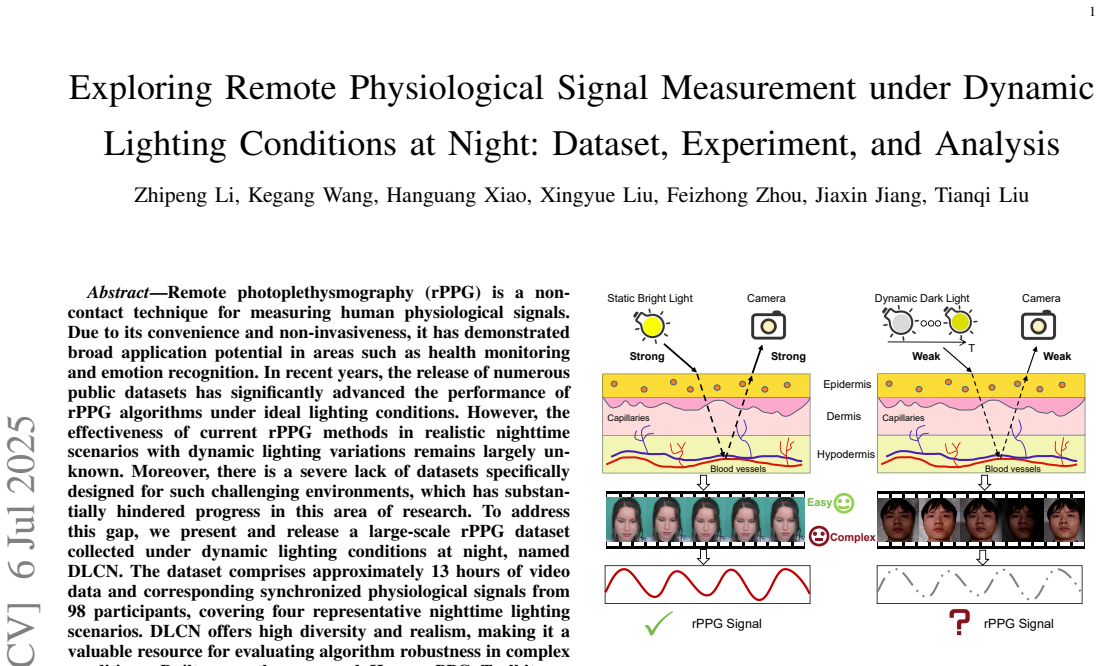
DLCN is positioned as the first publicly available rPPG dataset that systematically targets complex, real-world nighttime lighting variations, combining 784 videos from 98 volunteers with synchronized PPG, heart rate, and blood-oxygen labels. The paper's measurements show that dynamic lighting is the bottleneck: traditional methods (ICA, CHROM, POS) drop from MAEs near 8–11 bpm in the stable FI&FP scenario to 19.2–29.8 bpm in the VI&VP scenario, and deep learning models also degrade, with PhysFormer's MAE rising from 1.282 bpm to 5.343 bpm. Cross-dataset experiments reinforce the point: models trained on static-light benchmarks such as UBFC-rPPG, PURE, and COHFACE transfer poorly to DLCN's dynamic scenarios, and controlled experiments that train on FI&FP and test on the other scenarios produce MAEs around 7–22 bpm. The paper also reports that temporal augmentation and temporal normalization narrow the gap caused by heart-rate and illumination distribution shifts.
Load-bearing premise
The reported benchmark numbers assume that the five-fold cross-validation splits clips so that all clips from the same person and the same one-minute recording stay in a single fold, but the paper does not state this, and if clips from one video appear in both training and test sets, the MAE, RMSE, rho, and SNR values would be optimistically biased.
Editorial extensions
If this is right
- Future rPPG models aiming at real nighttime deployment should be evaluated on DLCN's VI&VP scenario, and matching or beating PhysFormer's 5.343 bpm MAE there becomes a concrete robustness milestone.
- The FI&FP-to-VI&VP controlled experiments separate dynamic lighting from low illumination and heart-rate range, so their numbers give a direct measure of how much robustness is lost specifically to lighting motion.
- Cross-dataset results imply that models trained only on static-light datasets are not deployment-ready for nighttime environments, since even the best transferred model reaches only 3.944 bpm MAE in the easiest DLCN scenario and 14.611 bpm in the hardest.
- Temporal augmentation and temporal normalization are simple fixes that the paper shows improve cross-dataset generalization, giving immediate candidate ingredients for stronger nighttime rPPG pipelines.
- DLCN's four-scenario design provides a standard stress test for the rPPG community, making it possible to compare new methods against a fixed, public benchmark rather than against self-collected data.
Reading between the lines
- The paper does not propose a new rPPG model, but its controlled lighting taxonomy suggests that explicitly estimating or disentangling the illumination component, rather than learning robust features implicitly, may be the fastest route to closing the VI&VP gap.
- One testable extension is to generate synthetic dynamic-light videos by overlaying flicker and moving shadows on static-light datasets; if such augmentation reduces DLCN MAE substantially, data diversity rather than architecture is the main missing ingredient.
- For safety-critical applications such as nighttime driver monitoring, the Table II numbers imply a practical threshold question: whether an MAE of about 5.3 bpm at rest, and higher during exercise, is accurate enough to drive alerting decisions, which the paper does not address.
- The dataset currently limits participants to ages 18–30 and does not systematically vary skin tone or body motion, so re-running the same benchmark on a more diverse cohort would test whether the dynamic-lighting failure pattern generalizes.
Editorial analysis
A structured set of objections, weighed in public.
Referee Report
Summary. This paper presents DLCN, a new rPPG dataset containing 784 one-minute videos from 98 participants under four nighttime lighting conditions (fixed/varying intensity crossed with fixed/varying light-source position), with synchronized PPG, HR, and SpO2 signals. The authors also release the Happy-rPPG Toolkit and use it to evaluate three traditional and three deep-learning rPPG methods in intra-dataset, cross-dataset, and cross-scenario settings. The central empirical claim is that traditional methods almost completely fail under dynamic nighttime lighting, while deep-learning methods degrade but retain partial stability; for example, PhysFormer MAE increases from 1.282 bpm in FI&FP to 5.343 bpm in VI&VP. The paper further reports poor cross-dataset generalization and shows that temporal augmentation and temporal normalization improve robustness.
Significance. If the dataset is publicly released and the evaluation is sound, DLCN fills a genuine gap in rPPG benchmarking by providing a large, controlled, and realistic resource for dynamic nighttime lighting. The dataset design is thoughtful: it includes multiple lighting conditions, broad heart-rate coverage through rest and exercise states, and synchronized physiological references. The Happy-rPPG Toolkit, if usable and maintained, could support reproducible comparisons. The qualitative finding that dynamic lighting degrades both traditional and deep-learning methods is consistent across Tables II-IV and is actionable for future algorithm development. However, the quantitative benchmark values and the strength of the generalization claims depend critically on the evaluation protocol, which needs correction.
major comments (4)
- [Section IV-A] The five-fold cross-validation procedure is described only at the clip level: 'All samples were segmented into non-overlapping clips of 160 frames... experiments were conducted using five-fold cross-validation.' The paper never states that all clips from the same recording or the same subject are confined to a single fold. With 784 one-minute recordings and clips of 5.3 seconds each, a random clip-level split can place clips from the same video or the same participant in both training and test sets. This allows models to memorize subject-specific skin tone, background, and illumination offsets, which would inflate the MAE/RMSE improvements and rho/SNR values reported in Tables II and IV. Please specify the split strategy (subject-level or recording-level) and, if the current split is not at that level, recompute all intra-dataset and cross-scenario results with a leakage-free protocol.
- [Section III-B-3 / Fig. 4(c)] The paper plots the distribution of 'average RGB values of each video frame' as a proxy for illumination, but it labels this as 'illuminance' and reports values in lux, e.g., 'COHFACE's illumination intensity is mainly concentrated within the 70–100 lux range.' Average RGB brightness is not a calibrated physical illuminance measurement; it depends on camera response, exposure, and white balance. Since the authors collected luxmeter readings for DLCN, those should be used for the DLCN distribution, and cross-dataset comparisons should not be expressed in lux unless the RGB values are calibrated. As written, this mislabeling undermines the 'lower illumination intensity' comparison across datasets.
- [Section V-A / Table IV] The cross-scenario experiment trains models on the FI&FP scenario and tests them on VI&FP, FI&VP, and VI&VP. Because every subject was recorded under all four lighting conditions, the same 98 subjects appear in both training and test. The model can exploit subject identity (skin tone, face shape, static background) to improve test performance, so the reported MAEs (e.g., PhysFormer MAE 15.604 in VI&VP) do not measure generalization to unseen subjects under dynamic lighting. This experiment should be re-run with a subject-exclusive split, for example by training on FI&FP from a subset of subjects and testing on dynamic lighting conditions from held-out subjects.
- [Section I / Section II-B] The paper claims that DLCN is 'the first publicly available dataset that systematically targets complex, real-world nighttime lighting variations,' but Section II-B lists MR-NIRP [5] as a public rPPG dataset, and Section II-C describes it as containing nighttime driving scenarios with occlusions and dynamic illumination. Please clarify how DLCN differs from MR-NIRP (e.g., scale, systematic variation, controlled design) and provide concrete evidence for the novelty claim, or soften the 'first' wording to avoid an unsupported priority claim.
minor comments (6)
- [Section II-B title] The heading 'Public rPPG Datasetss' contains a typo ('Datasetss'); it should read 'Datasets.'
- [Table II] The column header 'CHROME' should read 'CHROM' to match the text and the cited reference [7].
- [Section IV-A / Tables II-IV] No variance or confidence intervals are reported for the five-fold cross-validation metrics. Please report mean ± standard deviation (or per-subject intervals) so readers can assess the reliability of the differences between lighting conditions and methods.
- [Sections V-B and V-C] The temporal augmentation and temporal normalization methods are only cited, not described. Please provide brief descriptions of these techniques so that the ablation experiments in Tables V and VI are self-contained.
- [Fig. 4(c)] The y-axis label 'illuminance' should be corrected to 'mean RGB brightness' (or replaced with actual luxmeter measurements) to avoid the units error discussed in the major comments.
- [Abstract / Section I] The paper states that the dataset and code are publicly available, but the only link given is the GitHub repository for the toolkit. Please provide a direct link or clear instructions for accessing the DLCN dataset itself.
Circularity Check
No significant circularity: only minor non-load-bearing self-citations (e.g., the temporal normalization module [41]); all labels and benchmarks are externally grounded.
full rationale
The paper's central claims are the construction of the DLCN dataset, benchmark comparisons of existing rPPG methods, and the release of the Happy-rPPG Toolkit. None of these involves deriving a predicted quantity from fitted parameters that are then renamed as predictions. Ground-truth physiological signals were acquired with an external CONTEC CMS50E pulse oximeter and synchronized with video via PhysRecorder, so labels do not come from any model output. The experimental tables report standard MAE, RMSE, rho, and SNR values on data splits; no parameter is fitted to these test metrics and then called a prediction. The paper's own ablations (temporal augmentation and the temporal normalization module from [41]) are optional analyses, not the basis of the dataset contribution or the main benchmark conclusions. Several self-citations appear ([6], [38], [39], [41]) but they are contextual, tooling-related, or ablation-related, and none is load-bearing for the primary claims. A clip-level five-fold cross-validation split could raise a leakage/validity concern, but that is a correctness risk, not circularity: it does not make any result equivalent to its inputs by construction.
Assumptions & free parameters
assumptions (5)
- domain assumption The CONTEC CMS50E fingertip pulse oximeter provides accurate PPG, HR, and SpO2 reference signals during all recordings.
- domain assumption PhysRecorder correctly synchronizes video frames and physiological samples throughout recording.
- ad hoc to paper Mean RGB brightness is comparable across datasets as a proxy for physical illuminance in lux.
- domain assumption Clip-level five-fold cross-validation without subject/video-disjoint folds gives unbiased performance estimates.
- domain assumption MTCNN detects and crops faces reliably at the low and dynamic light levels in DLCN.
Cite this review
Pith. "Pith review of Exploring Remote Physiological Signal Measurement under Dynamic Lighting Conditions at Night: Dataset, Experiment, and Analysis." pith.science (2026). https://pith.science/paper/NC5RJC3Z
@misc{pith2026250704306,
  author       = {Pith},
  title        = {Pith review of: Exploring Remote Physiological Signal Measurement under Dynamic Lighting Conditions at Night: Dataset, Experiment, and Analysis},
  year         = {2026},
  howpublished = {\url{https://pith.science/paper/NC5RJC3Z}},
  note         = {Machine review of arXiv:2507.04306}
}
read the original abstract
Remote photoplethysmography (rPPG) is a non-contact technique for measuring human physiological signals. Due to its convenience and non-invasiveness, it has demonstrated broad application potential in areas such as health monitoring and emotion recognition. In recent years, the release of numerous public datasets has significantly advanced the performance of rPPG algorithms under ideal lighting conditions. However, the effectiveness of current rPPG methods in realistic nighttime scenarios with dynamic lighting variations remains largely unknown. Moreover, there is a severe lack of datasets specifically designed for such challenging environments, which has substantially hindered progress in this area of research. To address this gap, we present and release a large-scale rPPG dataset collected under dynamic lighting conditions at night, named DLCN. The dataset comprises approximately 13 hours of video data and corresponding synchronized physiological signals from 98 participants, covering four representative nighttime lighting scenarios. DLCN offers high diversity and realism, making it a valuable resource for evaluating algorithm robustness in complex conditions. Built upon the proposed Happy-rPPG Toolkit, we conduct extensive experiments and provide a comprehensive analysis of the challenges faced by state-of-the-art rPPG methods when applied to DLCN. The dataset and code are publicly available at https://github.com/dalaoplan/Happp-rPPG-Toolkit.
Figures


Figures from the paper (5 more)


Reference graph
Works this paper leans on
-
[41]
A plug-and- play temporal normalization module for robust remote photoplethysmog- raphy,
K. Wang, J. Tang, Y . Wei, M. Liu, X. Liu, and Y . Wang, “A plug-and- play temporal normalization module for robust remote photoplethysmog- raphy,” arXiv preprint arXiv:2411.15283 , 2024
arXiv 2024
-
[5]
Near-infrared imaging photoplethysmography during driving,
E. M. Nowara, T. K. Marks, H. Mansour, and A. Veeraraghavan, “Near-infrared imaging photoplethysmography during driving,” IEEE Transactions on Intelligent Transportation Systems , vol. 23, no. 4, pp. 3589–3600, 2020
work page 2020
-
[1]
Camera measurement of physiological vital signs,
D. McDuff, “Camera measurement of physiological vital signs,” ACM Computing Surveys, vol. 55, no. 9, pp. 1–40, 2023
work page 2023
-
[2]
Non-contact video-based pulse rate measurement on a mobile service robot,
R. Stricker, S. M ¨uller, and H.-M. Gross, “Non-contact video-based pulse rate measurement on a mobile service robot,” in The 23rd IEEE Inter- national Symposium on Robot and Human Interactive Communication . IEEE, 2014, pp. 1056–1062
work page 2014
-
[3]
Ubfc-phys: A multimodal database for psychophysiological studies of social stress,
R. M. Sabour, Y . Benezeth, P. De Oliveira, J. Chappe, and F. Yang, “Ubfc-phys: A multimodal database for psychophysiological studies of social stress,” IEEE Transactions on Affective Computing , vol. 14, no. 1, pp. 622–636, 2021
work page 2021
-
[4]
J. Speth, N. Vance, A. Czajka, K. W. Bowyer, D. Wright, and P. Flynn, “Deception detection and remote physiological monitoring: A dataset and baseline experimental results,” in 2021 IEEE International Joint Conference on Biometrics (IJCB) . IEEE, 2021, pp. 1–8
work page 2021
-
[6]
Remote pho- toplethysmography for heart rate measurement: A review,
H. Xiao, T. Liu, Y . Sun, Y . Li, S. Zhao, and A. Avolio, “Remote pho- toplethysmography for heart rate measurement: A review,” Biomedical Signal Processing and Control , vol. 88, p. 105608, 2024
work page 2024
-
[7]
Robust pulse rate from chrominance-based rppg,
G. De Haan and V . Jeanne, “Robust pulse rate from chrominance-based rppg,” IEEE Transactions on Biomedical Engineering , vol. 60, no. 10, pp. 2878–2886, 2013
2013
Show all 42 references
-
[8]
Algorithmic principles of remote ppg,
W. Wang, A. C. Den Brinker, S. Stuijk, and G. De Haan, “Algorithmic principles of remote ppg,” IEEE Transactions on Biomedical Engineer- ing, vol. 64, no. 7, pp. 1479–1491, 2016
2016
-
[9]
Advancements in non- contact, multiparameter physiological measurements using a webcam,
M.-Z. Poh, D. J. McDuff, and R. W. Picard, “Advancements in non- contact, multiparameter physiological measurements using a webcam,” IEEE Transactions on Biomedical Engineering , vol. 58, no. 1, pp. 7–11, 2010
2010
-
[10]
Mmpd: Multi-domain mobile video physiology dataset,
J. Tang, K. Chen, Y . Wang, Y . Shi, S. Patel, D. McDuff, and X. Liu, “Mmpd: Multi-domain mobile video physiology dataset,” in 2023 45th Annual International Conference of the IEEE Engineering in Medicine & Biology Society (EMBC) . IEEE, 2023, pp. 1–5
2023
-
[11]
Efficientphys: Enabling simple, fast and accurate camera-based cardiac measurement,
X. Liu, B. Hill, Z. Jiang, S. Patel, and D. McDuff, “Efficientphys: Enabling simple, fast and accurate camera-based cardiac measurement,” in Proceedings of the IEEE/CVF Winter Conference on Applications of Computer Vision, 2023, pp. 5008–5017
2023
-
[12]
Remote photoplethysmograph signal measurement from facial videos using spatio-temporal networks,
Z. Yu, X. Li, and G. Zhao, “Remote photoplethysmograph signal measurement from facial videos using spatio-temporal networks,” arXiv preprint arXiv:1905.02419, 2019
1905 arXiv
-
[13]
Physformer: Facial video-based physiological measurement with temporal difference transformer,
Z. Yu, Y . Shen, J. Shi, H. Zhao, P. H. Torr, and G. Zhao, “Physformer: Facial video-based physiological measurement with temporal difference transformer,” in Proceedings of the IEEE/CVF Conference on Computer Vision and Pattern Recognition , 2022, pp. 4186–4196
2022
-
[14]
Image enhancement for remote photoplethysmography in a low-light environment,
L. Xi, W. Chen, C. Zhao, X. Wu, and J. Wang, “Image enhancement for remote photoplethysmography in a low-light environment,” in 2020 15th IEEE International Conference on Automatic Face and Gesture Recognition (FG 2020) . IEEE, 2020, pp. 1–7
2020
-
[15]
Vipl-hr: A multi-modal database for pulse estimation from less-constrained face video,
X. Niu, H. Han, S. Shan, and X. Chen, “Vipl-hr: A multi-modal database for pulse estimation from less-constrained face video,” in Computer Vision–ACCV 2018: 14th Asian Conference on Computer Vision, Perth, Australia, December 2–6, 2018, Revised Selected Papers, Part V 14 . Spr...
2018
-
[16]
Remote plethysmo- graphic imaging using ambient light
W. Verkruysse, L. O. Svaasand, and J. S. Nelson, “Remote plethysmo- graphic imaging using ambient light.” Optics Express , vol. 16, no. 26, pp. 21 434–21 445, 2008
2008
-
[17]
Measuring pulse rate with a webcam,
M. Lewandowska and J. Nowak, “Measuring pulse rate with a webcam,” Journal of Medical Imaging and Health Informatics , vol. 2, no. 1, pp. 87–92, 2012
2012
-
[18]
Improved motion robustness of remote-ppg by using the blood volume pulse signature,
G. De Haan and A. Van Leest, “Improved motion robustness of remote-ppg by using the blood volume pulse signature,” Physiological Measurement, vol. 35, no. 9, p. 1913, 2014
1913
-
[19]
A novel algorithm for remote photoplethysmography: Spatial subspace rotation,
W. Wang, S. Stuijk, and G. De Haan, “A novel algorithm for remote photoplethysmography: Spatial subspace rotation,” IEEE Transactions on Biomedical Engineering , vol. 63, no. 9, pp. 1974–1984, 2015
1974
-
[20]
Local group invariance for heart rate estimation from face videos in the wild,
C. S. Pilz, S. Zaunseder, J. Krajewski, and V . Blazek, “Local group invariance for heart rate estimation from face videos in the wild,” in Proceedings of the IEEE Conference on Computer Vision and Pattern Recognition Workshops, 2018, pp. 1254–1262
2018
-
[21]
Deepphys: Video-based physiological mea- surement using convolutional attention networks,
W. Chen and D. McDuff, “Deepphys: Video-based physiological mea- surement using convolutional attention networks,” in Proceedings of the European Conference on Computer Vision (ECCV) , 2018, pp. 349–365
2018
-
[22]
Multi-task temporal shift attention networks for on-device contactless vitals measurement,
X. Liu, J. Fromm, S. Patel, and D. McDuff, “Multi-task temporal shift attention networks for on-device contactless vitals measurement,” Ad- vances in Neural Information Processing Systems , vol. 33, pp. 19 400– 19 411, 2020
2020
-
[23]
Tsm: Temporal shift module for efficient video understanding,
J. Lin, C. Gan, and S. Han, “Tsm: Temporal shift module for efficient video understanding,” in Proceedings of the IEEE/CVF International Conference on Computer Vision , 2019, pp. 7083–7093
2019
-
[24]
Bigsmall: Efficient multi-task learning for disparate spatial and temporal physiological measurements,
G. Narayanswamy, Y . Liu, Y . Yang, C. Ma, X. Liu, D. McDuff, and S. Patel, “Bigsmall: Efficient multi-task learning for disparate spatial and temporal physiological measurements,” in Proceedings of the IEEE/CVF Winter Conference on Applications of Computer Vision , 2024, pp. ...
2024
-
[25]
Slowfast networks for video recognition,
C. Feichtenhofer, H. Fan, J. Malik, and K. He, “Slowfast networks for video recognition,” in Proceedings of the IEEE/CVF International Conference on Computer Vision , 2019, pp. 6202–6211
2019
-
[26]
Rtrppg: An ultra light 3dcnn for real-time remote photoplethysmography,
D. Botina-Monsalve, Y . Benezeth, and J. Miteran, “Rtrppg: An ultra light 3dcnn for real-time remote photoplethysmography,” in Proceedings of the IEEE/CVF Conference on Computer Vision and Pattern Recognition , 2022, pp. 2146–2154
2022
-
[27]
Lstc-rppg: Long short-term convolutional network for remote photoplethysmography,
J. S. Lee, G. Hwang, M. Ryu, and S. J. Lee, “Lstc-rppg: Long short-term convolutional network for remote photoplethysmography,” in Proceedings of the IEEE/CVF Conference on Computer Vision and Pattern Recognition, 2023, pp. 6015–6023
2023
-
[28]
Jamsnet: A remote pulse extraction network based on joint attention and multi-scale fusion,
C. Zhao, H. Wang, H. Chen, W. Shi, and Y . Feng, “Jamsnet: A remote pulse extraction network based on joint attention and multi-scale fusion,” IEEE Transactions on Circuits and Systems for Video Technology , vol. 33, no. 6, pp. 2783–2797, 2022
2022
-
[29]
ibvp dataset: Rgb-thermal rppg dataset with high resolution signal quality labels,
J. Joshi and Y . Cho, “ibvp dataset: Rgb-thermal rppg dataset with high resolution signal quality labels,” Electronics, vol. 13, no. 7, p. 1334, 2024
2024
-
[30]
Rhythm- former: Extracting patterned rppg signals based on periodic sparse attention,
B. Zou, Z. Guo, J. Chen, J. Zhuo, W. Huang, and H. Ma, “Rhythm- former: Extracting patterned rppg signals based on periodic sparse attention,” Pattern Recognition, vol. 164, p. 111511, 2025
2025
-
[31]
Spiking-physformer: camera-based remote photoplethysmography with parallel spike-driven transformer,
M. Liu, J. Tang, Y . Chen, H. Li, J. Qi, S. Li, K. Wang, J. Gan, Y . Wang, and H. Chen, “Spiking-physformer: camera-based remote photoplethysmography with parallel spike-driven transformer,” Neural Networks, vol. 185, p. 107128, 2025
2025
-
[32]
Synrhythm: Learning a deep heart rate estimator from general to specific,
X. Niu, H. Han, S. Shan, and X. Chen, “Synrhythm: Learning a deep heart rate estimator from general to specific,” in 2018 24th International Conference on Pattern Recognition (ICPR) . IEEE, 2018, pp. 3580– 3585
2018
-
[33]
Rhythmnet: End-to-end heart rate estimation from face via spatial-temporal representation,
X. Niu, S. Shan, H. Han, and X. Chen, “Rhythmnet: End-to-end heart rate estimation from face via spatial-temporal representation,” IEEE Transactions on Image Processing , vol. 29, pp. 2409–2423, 2019
2019
-
[34]
Dual-gan: Joint bvp and noise modeling for remote physiological measurement,
H. Lu, H. Han, and S. K. Zhou, “Dual-gan: Joint bvp and noise modeling for remote physiological measurement,” inProceedings of the IEEE/CVF Conference on Computer Vision and Pattern Recognition , 2021, pp. 12 404–12 413
2021
-
[35]
Un- supervised skin tissue segmentation for remote photoplethysmography,
S. Bobbia, R. Macwan, Y . Benezeth, A. Mansouri, and J. Dubois, “Un- supervised skin tissue segmentation for remote photoplethysmography,” Pattern Recognition Letters , vol. 124, pp. 82–90, 2019
2019
-
[36]
A reproducible study on remote heart rate measurement,
G. Heusch, A. Anjos, and S. Marcel, “A reproducible study on remote heart rate measurement,” arXiv preprint arXiv:1709.00962 , 2017
2017 arXiv
-
[37]
Generalization of video-based heart rate estimation methods to low illumination and elevated heart rates,
B. Acharya, W. Saakyan, B. Hammer, and H. Drimalla, “Generalization of video-based heart rate estimation methods to low illumination and elevated heart rates,” arXiv preprint arXiv:2503.11697 , 2025
2025 arXiv
-
[38]
Camera-based hrv prediction for remote learning environments,
K. Wang, Y . Wei, J. Tang, Y . Wang, M. Tong, J. Gao, Y . Ma, and Z. Zhao, “Camera-based hrv prediction for remote learning environments,” arXiv preprint arXiv:2305.04161, 2023
2023 arXiv
-
[39]
rppg-toolbox: Deep remote ppg toolbox,
X. Liu, G. Narayanswamy, A. Paruchuri, X. Zhang, J. Tang, Y . Zhang, R. Sengupta, S. Patel, Y . Wang, and D. McDuff, “rppg-toolbox: Deep remote ppg toolbox,” Advances in Neural Information Processing Sys- tems, vol. 36, pp. 68 485–68 510, 2023. 12
2023
-
[40]
Joint face detection and alignment using multitask cascaded convolutional networks,
K. Zhang, Z. Zhang, Z. Li, and Y . Qiao, “Joint face detection and alignment using multitask cascaded convolutional networks,” IEEE Signal Processing Letters , vol. 23, no. 10, pp. 1499–1503, 2016
2016
-
[42]
Recovering physiological signals from facial videos: Recent advances and applications in intelligent vehicles,
G. Xiang, Y . Ou, J. Li, L. Wang, Y . Hu, X. Wang, X. Wu, and Y . Peng, “Recovering physiological signals from facial videos: Recent advances and applications in intelligent vehicles,” IEEE Transactions on Intelligent V ehicles, vol. 9, no. 10, pp. 6576–6598, 2024
2024
Reviewed August 6, 2026 · model on record in the stance chip above.
Discussion (0). Continue with ORCID to comment.