REVIEW 2 major objections 3 minor 3 cited by
P\'olya's conjecture up to $\epsilon$-loss and quantitative estimates for the remainder of Weyl's law
T0 review · 2 major / 3 minor · reviewed 2026-08-06 · deepseek-v4-flash
Pith's one-line read This paper proves that for every bounded Lipschitz domain and any ε>0, all sufficiently large Dirichlet eigenvalues satisfy the Pólya inequality up to a factor (1+ε), with an explicit threshold.
desk verdict Strong new results on exact Pólya classes for irregular domains, but the headline epsilon-loss theorem for all Lipschitz domains rests on a false 'obvious' Lipschitz claim about the rectangle complement. read the letter →
The pith
A machine-rendered reading of the paper's core claim, the machinery that carries it, and where it could break.
The reading
What carries the argument
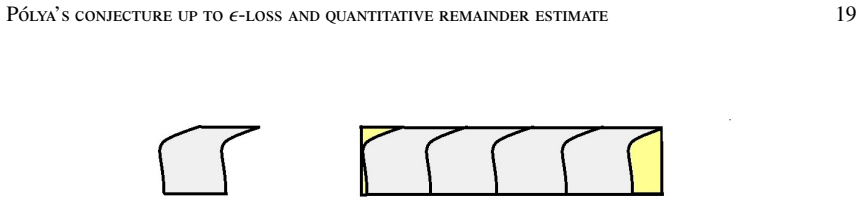
The argument rests on two main components. First, refined Riesz-means estimates for one-dimensional intervals (Lemma 2.1 and Lemma 2.2) feed into a product-domain estimate (Theorem 2.3), giving counting-function upper bounds with an explicit negative lower-order term C_1(n−1)|Ω₂|√λ. Second, the minimal admissible rectangle R = $R^{{n−1}}$ × I_min, the smallest rectangle of width equal to the domain's width that contains Ω, enables a proof that avoids Neumann eigenvalues: monotonicity gives N_Ω(λ) ≤ N_R(λ) − N_{R\Ω}(λ), and the lower bound for N_{R\Ω} comes from a Whitney decomposition of R\Ω together with explicit lower bounds for the counting function on cubes (Lemmas 3.4 and 3.7).
What would settle it
For a concrete Lipschitz domain that touches the boundary of its minimal admissible rectangle (for example, a rectangle with a thin slit attached to one face), compute the measure of {x ∈ R\Ω : dist(x, ∂(R\Ω)) < ε} for small ε and check whether it is bounded by C_Lip(Ω) ε |∂(R\Ω)| with the constant from (1.6); if the bound fails, the upper-bound estimate (1.9) and Theorem 1.3 are not established by this proof.
Extended reading notes
Core claim
The central discovery is a quantitative two-sided estimate for the Dirichlet eigenvalue counting function on every bounded Lipschitz domain, with all constants explicit, obtained without using Neumann eigenvalues. The upper bound states that for each k, k is at most the Weyl term plus a lower-order boundary term controlled by C_Lip(Ω)|∂(R\Ω)| times an explicit expression involving λ_k; the lower bound is the analogous Weyl term minus a boundary term. As a corollary, for any ε > 0 there is an explicit Λ(ε,Ω) such that the ε-loss Pólya inequality holds for all eigenvalues above Λ. The proof combines refined Riesz-means estimates on product domains with a Whitney decomposition of the domain and of the complement of its minimal enclosing rectangle, together with monotonicity of Dirichlet eigenvalues.
Load-bearing premise
The proof assumes without proof that the complement of the minimal enclosing rectangle, R\Ω, is a Lipschitz domain whose boundary layer has measure at most C_Lip(Ω) ε |∂(R\Ω)|; if this fails for a domain touching the rectangle's faces or with corners, the main upper bound and Theorem 1.3 would not follow.
Editorial extensions
If this is right
- On every bounded Lipschitz domain, the ε-loss version of Pólya's conjecture holds for all eigenvalues above an explicit threshold, so verifying the full conjecture reduces to checking finitely many small eigenvalues.
- The new remainder estimate is uniform in λ with explicit constants, giving a quantitative answer to the question of a uniform remainder for Weyl's law without invoking Neumann eigenvalues.
- Strip-tiling domains, and hence all triangles in the plane, satisfy an inequality stronger than Pólya's conjecture, with a negative lower-order term proportional to λ_k^{(n−1)/2}.
- In all dimensions n ≥ 2, there exist domains with rather irregular shapes (strip-tiling domains with admissible cubes removed) that satisfy Pólya's conjecture exactly, not merely up to ε.
- For convex domains the threshold Λ(ε,Ω) can be taken smaller, since the Lipschitz-layer constant reduces to 1.
Reading between the lines
- If the explicit threshold Λ(ε,Ω) can be computed for a given domain, Pólya's conjecture for that domain could in principle be settled by a finite numerical verification of the finitely many eigenvalues below the threshold.
- The main obstruction to the full conjecture appears to be the lower bound on counting functions of complements R\Ω; improving the Whitney-type decomposition or using a better covering may yield the full conjecture, not just the ε-loss version.
- The explicit constants in the remainder estimate could be tested against numerical eigenvalue computations on standard domains such as rectangles and balls to gauge how sharp the boundary-layer coefficient is.
- The construction with strip-tiling domains and removable cubes might extend to removing more general admissible sets whose counting-function lower bound is known, beyond dyadic cubes.
Editorial analysis
A structured set of objections, weighed in public.
Referee Report
Summary. The paper proposes a quantitative path toward Pólya's conjecture for Dirichlet eigenvalues on bounded Lipschitz domains. Its central result, Theorem 1.3, states that for every ε∈(0,1) and every bounded Lipschitz domain Ω⊂R^n, all eigenvalues λ_k(Ω) above an explicit threshold Λ(ε,Ω) satisfy the ε-loss Pólya bound k≤(1+ε)|Ω|ω(n)(2π)^{-n}λ_k(Ω)^{n/2}. This is derived from Theorem 1.5, a two-sided quantitative remainder estimate for the Weyl counting function with explicit constants, obtained without Neumann eigenvalues. The paper also proves refined eigenvalue estimates on strip-tiling domains and product domains, and exhibits classes of domains with irregular boundaries on which the full Pólya conjecture holds. The arguments use elementary one-dimensional eigenvalue estimates, a Laptev-type product argument, Whitney decompositions, and explicit counting estimates on cubes.
Significance. If the main results are correct, the paper makes a substantial contribution to a longstanding problem: it reduces the ε-loss form of Pólya's conjecture for all Lipschitz domains to a finite verification below an explicit eigenvalue threshold, and it provides new classes of non-tiling, non-product domains where the full conjecture holds. Strengths of the paper include the explicit nature of all constants, the elementary and checkable one-dimensional estimates in Section 2, the derivation of improved estimates for strip-tiling domains and triangles, and the clear statement of the computational reduction in Theorem 1.3. The paper does not rely on unproved numerical computations or fitted parameters, and it gives credit to the prior works it builds on. However, one load-bearing geometric assertion in the proof of Theorem 1.5 is not proved and is in fact false as stated, which prevents the paper from being accepted in its present form.
major comments (2)
- [Section 4, Step 2 of the proof of Theorem 1.5 (before Eq. (4.2))] The sentence 'Obviously, Ω1=R\Ω is also a Lipschitz domain' is not correct. For example, take Ω={(x,y)∈(0,1)^2 : (x−1/2)^2<y<1}. This is a bounded Lipschitz domain, and R=(0,1)^2 is its minimal admissible rectangle, but Ω1={0<y<(x−1/2)^2} has a cusp at (1/2,0), where the two boundary arcs y=0 and y=(x−1/2)^2 are tangent; Ω1 therefore does not satisfy the cone condition at that point. The subsequent estimate (4.2) is asserted without proof, and it is exactly what is needed to apply Step 1 to Ω1 and to obtain the upper bound (1.9). Since Theorem 1.3 depends on (1.9), this is a load-bearing gap. I am not claiming that (4.2) is necessarily false for Lipschitz Ω; a direct boundary-layer estimate for R\Ω may well be true. But the manuscript must supply a proof, or replace the auxiliary domain by one for which the estimate is proved.
- [Corollary 1.6, proof in Section 4] The proof of Corollary 1.6 is only a sketch: the displayed boundary-layer estimate |{x∈R\Ω: dist(x,∂Ω)<ε}| ≤ |∂R\∂Ω| ε is justified by the phrase 'convexity of R and Ω would imply' and a reference to Figure 5. This estimate is used for the convex case of Theorem 1.3, so it is not a cosmetic detail. The proof should be written out in full, specifying how the Whitney decomposition with respect to ∂Ω gives the claimed constant, or the corollary should be restated with a proof.
minor comments (3)
- [Section 4, Step 2] The word 'Obviously' should be removed, and the notation '∂R∩∂Ω1' clarified: it is used as if ∂R and ∂Ω1 have a well-defined common boundary portion, which needs explanation once the boundary-layer estimate is properly proved.
- [Lemma 3.7] In the proof of Lemma 3.7, several inequalities are asserted with '>' without displaying the algebraic verification, especially in the estimate for n≥4; a short calculation or an appendix would improve readability and checkability.
- [Theorem 1.3] The proof shows that the function f(Λ) is monotone decreasing, and existence of Λ(ε,Ω) follows; it would be helpful to state explicitly in the theorem that Λ(ε,Ω) is the unique solution of (1.7) and (1.8), respectively.
Circularity Check
No significant circularity: the main bound derives from independent external ingredients; the weakest point is an unproved geometric premise, not a circular reduction.
full rationale
The proof of Theorem 1.3 passes through Theorem 1.5, whose ingredients are Pólya's theorem for tiling domains (external, [37]), Laptev's product-domain argument, explicit one-dimensional Riesz-mean estimates (Lemmas 2.1-2.2), Whitney decompositions, monotonicity of Dirichlet eigenvalues, and the boundary-layer hypothesis (1.6). None of these inputs is equivalent to the target epsilon-loss Pólya bound. The constants C1, C2, CLip, and the threshold Lambda(epsilon,Omega) are explicit functions of the domain's geometry; they are not fitted to eigenvalue data, and no eigenvalue is used to calibrate an unknown parameter. The 'better than Pólya' estimates in Theorem 1.10 are derived, not assumed, from the refined product estimates. The only author self-citation ([15], cited alongside [10,12,13,16,27,33] for lower-order-term improvements) is contextual and not load-bearing. The genuine weakness is Section 4, Step 2, where the assertion that Omega1 = R \ Omega is 'obviously' a Lipschitz domain and the boundary-layer estimate (4.2) are unproved and can fail for a Lipschitz Omega tangent to a face of the minimal rectangle; however, this is a missing premise, not a circular one. Pólya's conjecture is never assumed for Omega or Omega1. Consequently, no circular step is present.
Assumptions & free parameters
assumptions (7)
- standard math Pólya's conjecture holds for tiling domains, in particular for rectangles.
- standard math Seeley's two-term Weyl expansion for smooth domains with remainder bound (3.1).
- standard math Rayleigh-Faber-Krahn and Krahn-Szegő inequalities for the first two Dirichlet eigenvalues.
- standard math Whitney decomposition of open sets into dyadic cubes with the listed properties.
- standard math The semigroup and Aizenman-Lieb principle for Riesz means of eigenvalues.
- domain assumption The complement R\Ω of a Lipschitz domain in its minimal admissible rectangle is a Lipschitz domain with boundary-layer constant bounded in terms of CLip(Ω).
- domain assumption H^1_0 functions on disjoint Lipschitz subdomains extend by zero to the enclosing rectangle, giving N_{Ω∪Ω1}≤N_R.
Cite this review
Pith. "Pith review of P\'olya's conjecture up to $\epsilon$-loss and quantitative estimates for the remainder of Weyl's law." pith.science (2026). https://pith.science/paper/QAU7VI4X
@misc{pith2026250704307,
  author       = {Pith},
  title        = {Pith review of: P\'olya's conjecture up to $\epsilon$-loss and quantitative estimates for the remainder of Weyl's law},
  year         = {2026},
  howpublished = {\url{https://pith.science/paper/QAU7VI4X}},
  note         = {Machine review of arXiv:2507.04307}
}
abstract
Let $\Omega\subset\mathbb{R}^n$ be a bounded Lipschitz domain. For any $\epsilon\in (0,1)$ we show that for any Dirichlet eigenvalue $\lambda_k(\Omega)>\Lambda(\epsilon,\Omega)$, it holds \begin{align*} k&\le (1+\epsilon)\frac{|\Omega|\omega(n)}{(2\pi)^n}\lambda_k(\Omega)^{n/2}, \end{align*} where $\Lambda(\epsilon,\Omega)$ is given explicitly. This reduces the $\epsilon$-loss version of P\'olya's conjecture to a computational problem. This estimate is based on quantitative estimates on the remainder of the Weyl law with explicit constants, which we give a new proof without using Neumann eigenvalues. Our arguments in deriving such uniform estimates yield also, in all dimensions $n\ge 2$, classes of domains that may even have rather irregular shapes or boundaries but satisfy P\'olya's conjecture. Another key observation is that on strip-tiling domains (and therefore any triangles for instance) one actually has better eigenvalue estimates than P\'olya conjectured.
Figures


Figures from the paper (2 more)

Forward citations
Cited by 3 Pith papers
-
P\'olya's Conjecture for the Neumann Eigenvalues on Euclidean Balls
Every Euclidean ball in dimension d≥2 satisfies Pólya's Neumann inequality N^<(E) ≥ (ω_d/(2π)^d)|B|E^{d/2} at all energies E≥0.
-
P\'{o}lya's conjecture for higher-dimensional Neumann balls
For every d≥3 and every λ≥0, the Neumann counting function of the unit d-ball satisfies N(λ) ≥ w_d λ^d, so Pólya's conjecture holds for all Euclidean balls.
-
Krahn--Szeg\H{o} type inequalities and nodal domain methods on graphs
Krahn-Szegő inequalities are established for trees and the Aouchiche-Hansen conjecture is settled via a new nodal domain theorem for adjacency matrices on graphs.
Reference graph
Works this paper leans on
-
[1]
and Lieb E.H., On semiclassical bounds for eigenvalues of Schr ¨odinger op- erators,Phys
Aizenman M. and Lieb E.H., On semiclassical bounds for eigenvalues of Schr ¨odinger op- erators,Phys. Lett. A66 (1978), no. 6, 427-429. [15]
work page 1978
-
[2]
Berezin F.A., Covariant and contravariant symbols of operators,Izv. Akad. Nauk SSSR Ser. Mat.36 (1972), 1134-1167. [4, 5]
work page 1972
-
[3]
Bucur D., Henrot A., Maximization of the second non-trivial Neumann eigenvalue,Acta Math.222 (2019), no. 2, 337-361. [3]
work page 2019
-
[4]
Connes A., Trace formula in noncommutative geometry and the zeros of the Riemann zeta function,Sel. math., New ser. 5, 29 (1999), 29-106. [2]
work page 1999
-
[5]
Courant R., ¨Uber die Eigenwerte bei den Differentialgleichungen der mathematischen Physik,Math Z.(1920) no. 7, 1-57. [2, 6]
work page 1920
-
[6]
and Hilbert D.,Methods of Mathematical Physics, Wiley, New York, 1989
Courant R. and Hilbert D.,Methods of Mathematical Physics, Wiley, New York, 1989. [2, 6]
work page 1989
-
[7]
A., P ´olya’s conjecture for Euclidean balls, Invent
Filonov N., Levitin M., Polterovich I., Sher D. A., P ´olya’s conjecture for Euclidean balls, Invent. Math.234 (2023), no. 1, 129-169. [3, 9]
work page 2023
-
[8]
A., P ´olya’s conjecture for Dirichlet eigen- values of annuli, arXiv:2505.21737
Filonov N., Levitin M., Polterovich I., Sher D. A., P ´olya’s conjecture for Dirichlet eigen- values of annuli, arXiv:2505.21737. [3, 9]
Show all 41 references
-
[9]
Cambridge University Press, 2023
Frank R., Laptev A., Weidl T.,Schr¨ odinger operators: Eigenvalues and Lieb-Thirring in- equalities. Cambridge University Press, 2023. [3, 4, 6, 40]
2023
-
[10]
Reine Angew
Frank R.L., Larson S., Two-term spectral asymptotics for the Dirichlet Laplacian in a Lip- schitz domain,J. Reine Angew. Math.766 (2020), 195-228. [4]
2020
-
[11]
Math.241 (2025), 999-1079
Frank R.L., Larson S., Riesz means asymptotics for Dirichlet and Neumann Laplacians on Lipschitz domains,Invent. Math.241 (2025), 999-1079. [3, 6, 40]
2025
-
[12]
Pure Appl
Frank R.L., Larson S., Semiclassical inequalities for Dirichlet and Neumann Laplacians on convex domains,Comm. Pure Appl. Math.79 (2026), 762-822. [4]
2026
-
[13]
Frank R.L., Larson S., Pfeiffer P., Improved semiclassical eigenvalue estimates for the Laplacian and the Landau Hamiltonian,J. Spectr. Theory16 (2026), 243-270. [4]
2026
-
[14]
Fathizadeh F., Khalkhali M., Weyl’s law and Connes’ trace theorem for the Noncommuta- tive Two Torus,Lett. Math. Physics103 (2013), 1-18. [2]
2013
-
[15]
Gan Z., Jiang R., Lin F., The improved Berezin-Li-Yau inequality and Kr ¨oger inequality and consequences,Sci. Math. China, to appear. [4]
-
[16]
Geisinger L., Laptev A., Weidl T., Geometrical versions of improved Berezin-Li-Yau in- equalities,J. Spectr. Theory1 (2011), 87-109. [4, 5] P´oly a’s conjecture up toϵ-loss and quantitative remainder estimate41
2011
-
[17]
Girouard A., Nadirashvili N., Polterovich I., Maximization of the second positive Neumann eigenvalue for planar domains,J. Differ. Geom.83(3), 637-661 (2009). [3]
2009
-
[18]
Texts in Math., 249 Springer, New York, 2008, xvi+489 pp
Grafakos L.,Classical Fourier analysis, Grad. Texts in Math., 249 Springer, New York, 2008, xvi+489 pp. [34]
2008
-
[19]
He X., Wang Z.Q., P ´olya’s conjecture for thin products, arXiv:2402.12093. [9, 32]
-
[20]
Henrot A.,Extremum problems for eigenvalues of elliptic operators, Front. Math. Birkh¨auser Verlag, Basel, 2006, x+202 pp. [3, 32]
2006
-
[21]
H ¨ormander L., The spectral function of an elliptic operator,Acta Math., 121, 193-218 (1968). [2]
1968
-
[22]
III, Grundlehren Math
H ¨ormander L.,The analysis of linear partial differential operators. III, Grundlehren Math. Wiss., 274 [Fundamental Principles of Mathematical Sciences] Springer-Verlag, Berlin, 1985, viii+525 pp. [2, 7, 21]
1985
-
[23]
Ivrii V ., Second term of the spectral asymptotic expansion of the Laplace-Beltrami operator on manifolds with boundary,Funct. Anal. Appl.14, 98-106 (1980). [3]
1980
-
[24]
Ivrii V ., 100 years of Weyl’s law,Bull. Math. Sci.6 (2016), 379-452. [2]
2016
-
[25]
Kac M.,Can One Hear the Shape of a Drum?, American Mathematical Monthly, 73 (1966), 1-23. [2]
1966
-
[26]
Khalkhali M.,Weyl Law at 101, https://www.math.uwo.ca/faculty/khalkhali/files/Collo- qWestern2012.pdf. [2]
-
[27]
Kova ˇr´ık H., Vugalter S., Weidl T., Two-dimensional Berezin-Li-Yau inequalities with a correction term,Comm. Math. Phys.287 (2009), 959-981. [4, 5]
2009
-
[28]
Laptev A., Dirichlet and Neumann eigenvalue problems on domains in Euclidean spaces,J. Funct. Anal.151 (1997), 531-545. [3, 4, 9, 10, 15]
1997
-
[29]
Laptev A., Weidl T., Sharp Lieb-Thirring inequalities in high dimensions,Acta Math.184 (2000), 87-111. [15]
2000
-
[30]
Larson S., On the remainder term of the Berezin inequality on a convex domain,Proc. Amer. Math. Soc.145 (2017), 2167-2181. [16, 40]
2017
-
[31]
Li P., Yau S.T., On the Schr ¨odinger equation and the eigenvalue problem,Comm. Math. Phys.88 (1983), 309-318. [4]
1983
-
[32]
Lord Rayleigh B.,The Theory of Sound, Cambridge University Press, 1877. [2]
-
[33]
Melas A.D., A lower bound for sums of eigenvalues of the Laplacian,Proc. Amer. Math. Soc.131 (2003), 631-636. [4, 5]
2003
-
[34]
Netrusov Yu., Safarov Yu., Weyl asymptotic formula for the Laplacian on domains with rough boundaries,Comm. Math. Phys.253 (2005), no. 2, 481-509. [3, 6, 40]
2005
-
[35]
Pinsky M.A., The eigenvalues of an equilateral triangle,SIAM J. Math. Anal.11 (1980), no. 5, 819-827. [8]
1980
-
[36]
Mathematics and plausible reasoning, vol
P ´olya G.,Patterns of plausible inference. Mathematics and plausible reasoning, vol. II, Princeton University Press, Princeton, NJ, 1954, x+190 pp. [3]
1954
-
[37]
London Math
P ´olya G., On the eigenvalues of vibrating membranes,Proc. London Math. Soc.(3) 11 (1961), 419-433. [3, 8, 9, 10] 42 R. Jiang& F.H. Lin
1961
-
[38]
Safarov Yu., Vassiliev D.,The Asymptotic Distribution of Eigenvalues of Partial Differ- ential Operators, Translations of Mathematical Monographs, vol. 155. Am. Math. Soc., Providence (1997). [3]
1997
-
[39]
in Math.29 (1978), 244-269
Seeley R., A sharp asymptotic remainder estimate for the eigenvalues of the Laplacian in a domain ofR 3,Adv. in Math.29 (1978), 244-269. [2, 7, 21]
1978
-
[40]
Seeley R., An estimate near the boundary for the spectral function of the Laplace operator, Amer. J. Math.102 (1980), 869-902. [2, 7, 21]
1980
-
[41]
Weyl H., ¨Uber die Asymptotische Verteilung der Eigenwerte, Nachr. Konigl. Ges. Wiss. G¨ottingen, 110-117 (1911). [2] Renjin Jiang Academy for Multidisciplinary Studies Capital Normal University Beijing 100048 rejiang@cnu.edu.cn Fanghua Lin Courant Institute of Mathematical Sc...
1911
Reviewed August 6, 2026 · model on record in the stance chip above.
Discussion (0). Continue with ORCID to comment.