REVIEW 4 major objections 4 minor 1 cited by
TinyProto: Communication-Efficient Federated Learning with Sparse Prototypes in Resource-Constrained Environments
T0 review · 4 major / 4 minor · reviewed 2026-08-06 · deepseek-v4-flash
Pith's one-line read TinyProto shows that class-wise sparse prototypes cut federated learning communication by up to 10x while keeping or improving accuracy.
desk verdict A real but conditional improvement in prototype-based FL: the sparsification and scaling combo cuts communication substantially, but the accuracy gain rests on a per-dataset scaling constant that is never shown to correct per-class sample-count bias. read the letter →
The pith
A machine-rendered reading of the paper's core claim, the machinery that carries it, and where it could break.
The reading
What carries the argument
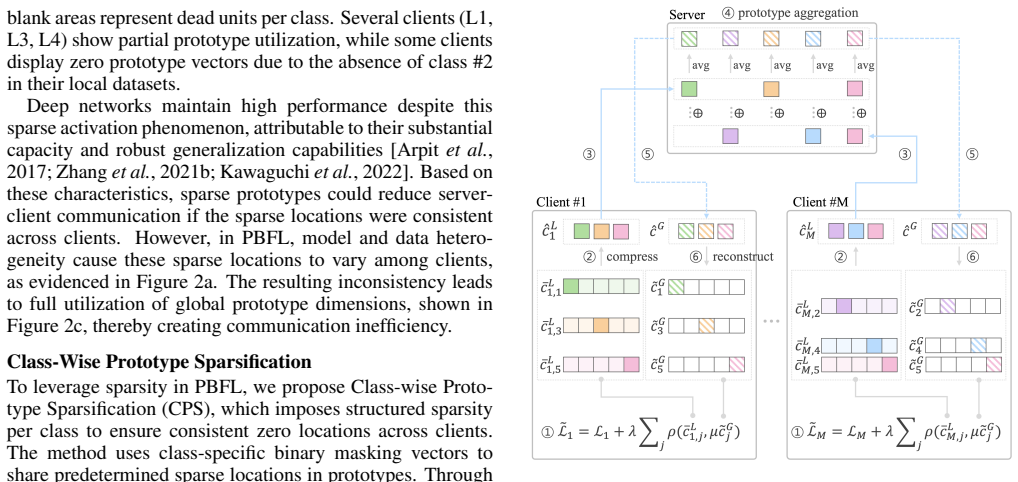
The central object is Class-wise Prototype Sparsification (CPS): each class $j$ gets a binary mask $m_j \in \{0,1\}^d$ that selects $s$ of $d$ prototype coordinates, and all clients and the server keep that support fixed for the class. The mask defines the sparsification operator $S(\bar{c}; m) = \bar{c} \odot m$, which keeps a full-dimensional but structured sparse prototype for local regularization, and the compression operator $C(\bar{c}; m)$, which transmits only the entries where the mask is one. The second mechanism is the scaled aggregation rule $\hat{c}_j^G = (1/|N_j|)\sum_{i \in N_j} n_{i,j}\hat{c}_{i,j}^L$, followed by the hyperparameter $\mu$ in the regularization loss $R_i = \sum_j \rho(\bar{c}_{i,j}^L, \mu \tilde{c}_j^G)$, which rescales the global prototype so that class-count weighting improves training instead of destabilizing it.
What would settle it
Run TinyProto-FT on a dataset with strongly skewed per-client class counts and record, for each class and round, the effective amplification $(\sum_i n_{i,j})/|N_j|$ applied before $\mu$ rescaling. If per-class prototype magnitudes drift relative to the local feature scale and the regularization loss for clients with rare classes grows against FedTGP, the claim that one constant can absorb the bias is falsified.
Extended reading notes
Core claim
On its own terms, TinyProto makes two claims that reinforce each other. First, class-wise prototype sparsification with fixed per-class masks makes prototype communication depend on a small compressed dimension $s$ rather than the full feature dimension $d$, without shrinking the model's decision layer. Second, adaptive prototype scaling--multiplying each local prototype by its class sample count before aggregation and then rescaling the global prototype by a constant $\mu$--captures class-wise client importance while hiding the raw sample counts. The experimental assertion is that these mechanisms stack: TinyProto-FT transmits $0.29$M parameters per round on TinyImageNet versus $2.93$M for FedProto and FedTGP, yet reaches $27.29\%$ accuracy against $19.44\%$ for FedTGP and $22.98\%$ for FedDistill; on CIFAR-100 it transmits $0.15$M versus $0.29$M for FedDistill and reaches $45.94\%$ accuracy versus $39.52\%$.
Load-bearing premise
The load-bearing premise is that a single hyperparameter $\mu$, tuned per dataset, can correct the class-dependent scaling bias created when the server averages scaled prototypes and normalizes by client count instead of by total class sample count.
Editorial extensions
If this is right
- Per-round communication cost for prototype-based federated learning drops from $\sum_i (K_i+K) \times d$ to $\sum_i (K_i+K) \times s$, so the method stays cheap as feature dimension grows.
- Because clients send scaled prototypes rather than raw counts, the server never receives $n_{i,j}$ directly, removing the privacy exposure in weighted FedProto aggregation.
- CPS layers onto existing prototype methods: both TinyProto-FP and TinyProto-FT match or beat their base methods while transmitting about 10x less per round.
- Sparsified prototypes retain the full decision-layer capacity during training, so the gains come from communication compression rather than from shrinking the model.
- With $s=50$, TinyProto-FT outperforms the most communication-efficient dense baseline, FedDistill, on CIFAR-100 and TinyImageNet while avoiding logit-level privacy exposure.
Reading between the lines
- A natural extension the paper does not run is per-class $\mu$ values; since the scaling bias in Eq. (10) is class-dependent, class-adaptive rescaling would directly test whether one constant can absorb it.
- The same mask-plus-scaling recipe could be applied to logit-based distillation, shrinking class-by-class logit vectors the same way, although logits have no naturally fixed support.
- Because CPS masks are fixed at initialization, an unexplored alternative is choosing masks from local activation statistics; comparing fixed masks against activation-selected masks would quantify the cost of zero client-side computation.
- The convergence argument depends on fixed support, so adaptive masks would need a new proof; an empirical study of periodic mask reassignment would show whether fixed support is necessary or merely convenient.
Editorial analysis
A structured set of objections, weighed in public.
Referee Report
Summary. The paper proposes TinyProto, a prototype-based federated learning method that combines class-wise prototype sparsification (CPS) with an adaptive prototype-scaling rule. CPS assigns each class a fixed binary mask and transmits only s non-zero prototype coordinates; scaling multiplies each local prototype by the local class sample count at the client and aggregates these scaled prototypes by a simple average at the server (Eq. 10), then applies a scalar µ to the global prototype in the prototype-regularization loss (Eq. 11). TinyProto is instantiated on FedProto (TinyProto-FP) and FedTGP (TinyProto-FT). Experiments on CIFAR-10, CIFAR-100, and TinyImageNet report that TinyProto-FT with s=50 and scaling reaches 88.47%, 45.94%, and 27.29% accuracy respectively, with per-round communication of 0.02M, 0.15M, and 0.29M parameters, and the paper claims communication reductions of up to 10x over FedProto/FedTGP and up to 4x over FedDistill. A convergence argument for CPS is sketched in Appendix B by adapting Lemma 2 of FedProto.
Significance. If the reported results are robust, TinyProto would be a practically useful building block: sparsification is applied only to transmitted prototypes (no extra client-side pruning or fine-tuning), the masks are shared once, and the method is compatible with heterogeneous client back-ends. The communication accounting in Tables 1, 2, and 5 is transparent, and the 3-seed experiments make the headline numbers reproducible in principle; source code is linked. The main technical question is not the sparsification step, which is sound, but the scaling construction in Eqs. (10)-(11), on which the accuracy gains depend. Because the gains over FedTGP appear only when scaling is enabled, the method's central claim will stand or fall on that mechanism.
major comments (4)
- [Section 4.2, Eqs. (10)-(11); Table 5] The aggregation in Eq. (10) is not the weighted average of Eq. (4); it equals the correct sample-count-weighted prototype multiplied by A_j = (1/|N_j|) sum_{i in N_j} n_{i,j}. The subsequent global scaling in Eq. (11) applies one dataset-level constant µ to every class and every round. Under the Dirichlet(alpha=0.1) partition used in Section 5.1, A_j can vary substantially from class to class, and with partial client participation it would vary across rounds. A single scalar cannot absorb a per-class, per-round scale mismatch. Since Table 5 shows that the large accuracy improvement materializes only when scaling is enabled (TinyProto-FT at s=50 without scaling is below FedTGP on all three datasets, while with scaling it is higher by roughly 9 points on CIFAR-100), the central claim rests on an unvalidated rescaling assumption. Please provide a per-class/per-round analysis of A_j, replace the constant µ with a class-dependent correction, or show empirically that the norm of mu * tilde{c}^G_j is class-insensitive.
- [Appendix C] The statement that 'server-side normalization using a constant mu' addresses 'high variance in n_{i,j}' is internally inconsistent: multiplying all global prototypes by the same number neither reduces the variance of n_{i,j} nor normalizes the per-class scale differences introduced by Eq. (10). If the intended operation is something other than scalar multiplication (e.g., division by a per-class statistic or by an estimate of total class sample count), it needs to be stated explicitly. As written, the description does not explain why the FedTGP variant avoids the distortion it identifies for direct scaling.
- [Section 5.3, Table 5] The sentence 'Despite reducing dimensionality for sharing information through prototype sparsification, CPS maintains or slightly improves performance' is contradicted by the no-scaling rows of Table 5: TinyProto-FT without scaling underperforms FedTGP at every reported s (e.g., s=50: 85.91 vs 86.32 on CIFAR-10, 35.26 vs 36.92 on CIFAR-100, and 18.51 vs 19.44 on TinyImageNet). If the claim is meant to apply only to the full TinyProto (CPS plus scaling), it should be reworded; as written it misstates the ablation evidence.
- [Appendix B, Eqs. (13)-(17)] The convergence argument for CPS is not complete. The step from Eq. (15) to Eq. (16) treats the global prototypes after aggregation as S applied to a weighted sum of local prototypes, and the inequality in Eq. (15) is not justified: for a fixed feature vector f, lambda ||f - S(C_{t+2})||^2 - lambda ||f - S(C_{t+1})||^2 is not bounded above by lambda ||S(C_{t+2}) - S(C_{t+1})|| without additional assumptions on f. The manuscript says the rest 'proceeds identically' to FedProto, but the presented derivation is too sparse to verify that the same convergence rate is preserved. This does not affect the experimental claims directly, but the claimed theoretical guarantee needs either a complete proof or a clearly stated reduction to a specific lemma/equation of FedProto.
minor comments (4)
- [Section 5.1] There is a typo in the baseline list: 'FedTPG' should be 'FedTGP'.
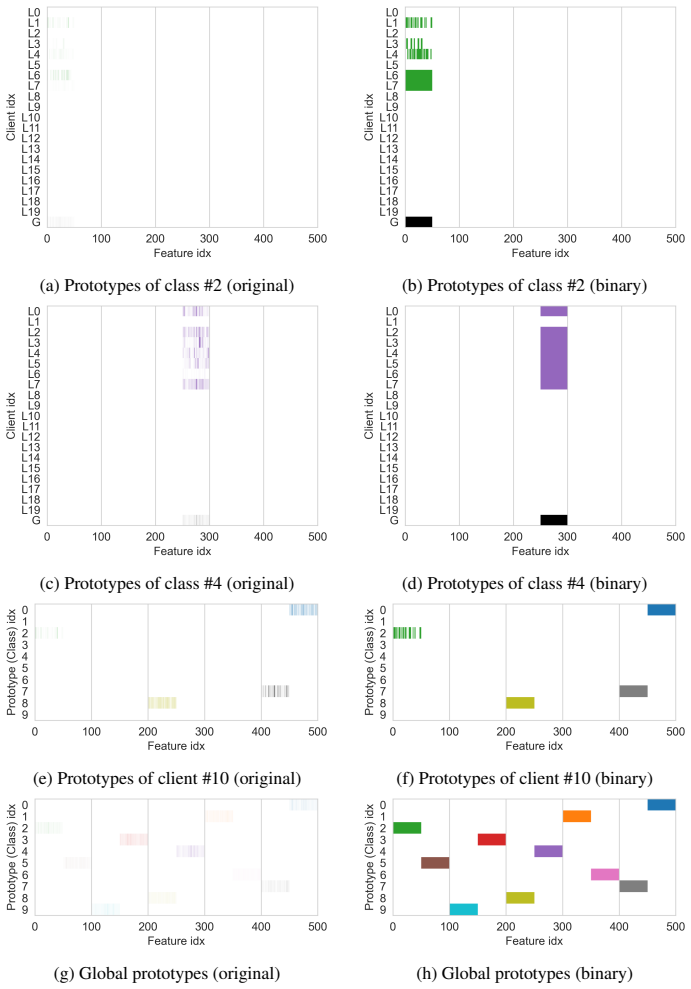
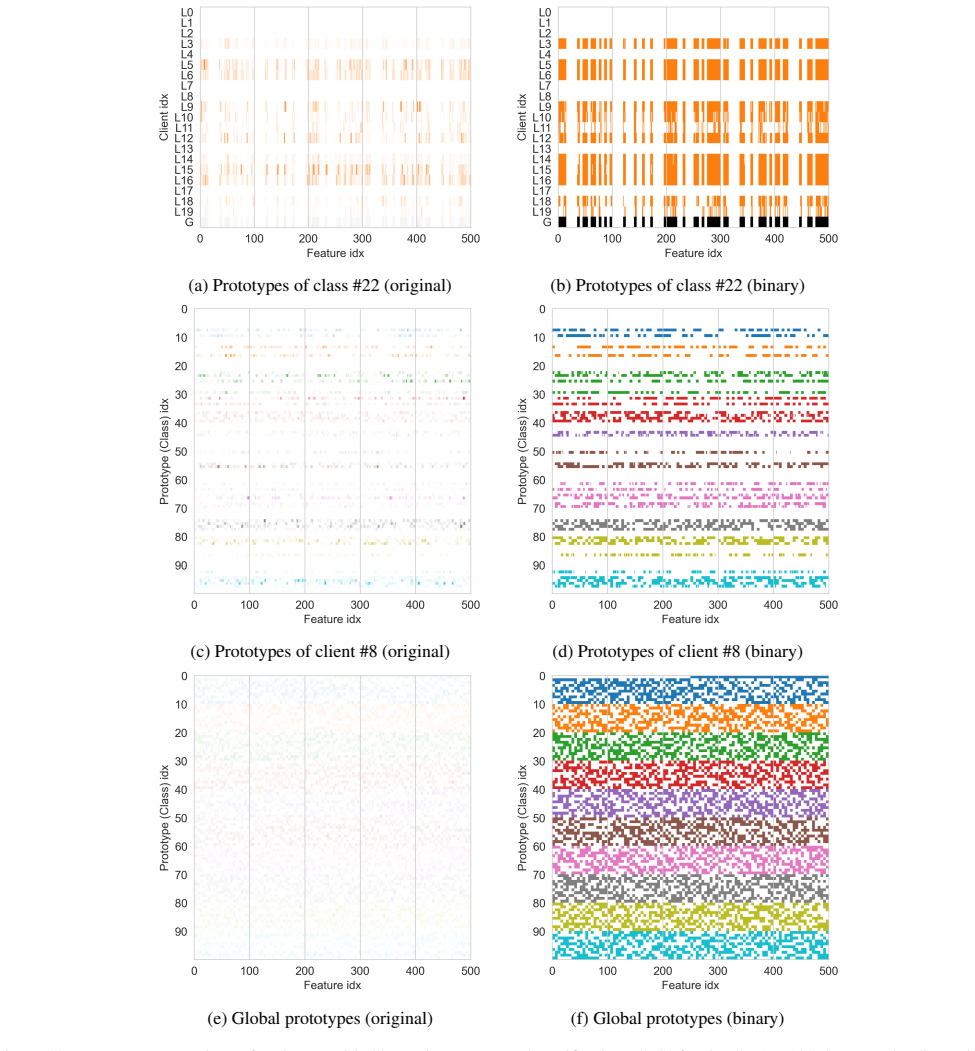
- [Figure 2 caption] The caption says 'The CPS dimension s set to 50' even though panels (a) and (c) show prototypes without CPS; clarify which panels use s=50.
- [Table 2] The per-round communication cost for TinyProto omits the one-time mask transmission described in Algorithm 1, where masks are sent to each client not in S^{t-1}; state explicitly that mask transmission is a one-time cost.
- [Section 5.2] The claim that 'FedDistill cannot leverage CPS-style compression since logits must maintain their dense representation' is stated without justification; a brief explanation of why masking or compressing logit vectors would break the algorithm would be helpful.
Circularity Check
No significant circularity found: the central accuracy and communication claims are empirical or follow from explicit design choices, not from self-citation or by-construction reductions.
full rationale
TinyProto's load-bearing claims are the 10x/4x communication reduction and the accuracy improvements of TinyProto-FT. The communication reduction follows directly from the stated cost formula in Table 2 (TinyProto transmits s=50 of d=500 dimensions), which is an accounting identity, not a prediction that reduces to a fitted parameter; the accuracy claims are benchmark results against external baselines (FedProto, FedTGP, FedDistill, etc.) and are not derived from the method's equations. The convergence analysis explicitly imports FedProto's published Lemma 2/Theorem 2 (Tan et al., 2022), an external, checkable result by different authors; extending it with Assumption 1 is a proof step, not a self-citation loop. The prototype scaling in Eqs. (10)-(11) contains a tuned hyperparameter mu and a per-class scale factor, but the paper does not claim to predict the experimental outcomes from those equations; mu is a grid-searched hyperparameter, and the measured accuracy is evidence, not a by-construction restatement. No uniqueness theorem, ansatz-smuggling, or renaming of known results was found. Robustness caveats about mu and per-class variance are correctness and experimental-design concerns, not circularity. The reader's take similarly characterizes the result as a 2.0 caution rather than circularity, and the paper is otherwise self-contained against external benchmarks. Therefore the appropriate circularity score is 0.
Assumptions & free parameters
free parameters (4)
- CPS dimension s =
50
- global scaling constant mu =
1.5e-4 (CIFAR-10), 1.5e-3 (CIFAR-100, TinyImageNet)
- regularization weight lambda =
1
- prototype dimension d =
500
assumptions (3)
- domain assumption ReLU-activated decision layers contain about 50% dead units per class, so sparse prototypes can preserve task-relevant signal
- ad hoc to paper The sparsification operator S has fixed support per class and is non-expansive (Assumption 1)
- standard math FedProto's Lemma 2 and Theorem 2 correctly characterize convergence of prototype-based FL under the stated conditions
Cite this review
Pith. "Pith review of TinyProto: Communication-Efficient Federated Learning with Sparse Prototypes in Resource-Constrained Environments." pith.science (2026). https://pith.science/paper/OSW2T7TR
@misc{pith2026250704327,
  author       = {Pith},
  title        = {Pith review of: TinyProto: Communication-Efficient Federated Learning with Sparse Prototypes in Resource-Constrained Environments},
  year         = {2026},
  howpublished = {\url{https://pith.science/paper/OSW2T7TR}},
  note         = {Machine review of arXiv:2507.04327}
}
read the original abstract
Communication efficiency in federated learning (FL) remains a critical challenge for resource-constrained environments. While prototype-based FL reduces communication overhead by sharing class prototypes-mean activations in the penultimate layer-instead of model parameters, its efficiency decreases with larger feature dimensions and class counts. We propose TinyProto, which addresses these limitations through Class-wise Prototype Sparsification (CPS) and adaptive prototype scaling. CPS enables structured sparsity by allocating specific dimensions to class prototypes and transmitting only non-zero elements, while adaptive scaling adjusts prototypes based on class distributions. Our experiments show TinyProto reduces communication costs by up to 4x compared to existing methods while maintaining performance. Beyond its communication efficiency, TinyProto offers crucial advantages: achieving compression without client-side computational overhead and supporting heterogeneous architectures, making it ideal for resource-constrained heterogeneous FL.
Figures


Figures from the paper (9 more)




Forward citations
Cited by 1 Pith paper
-
Dissecting Federated-Graph Aggregation under Domain Shift: Importance-Aware Aggregation via Empirical Analysis
A top-rho gradient masking plus influence-weighted averaging method (FedIA) improves federated graph learning accuracy and stability under domain shift.
Reference graph
Works this paper leans on
-
[1]
A closer look at memorization in deep networks
Devansh Arpit, Stanis aw Jastrzebski, Nicolas Ballas, David Krueger, Emmanuel Bengio, Maxinder S Kanwal, Tegan Maharaj, Asja Fischer, Aaron Courville, Yoshua Bengio, et al. A closer look at memorization in deep networks. In International conference on machine learning , pages 233--242. PMLR, 2017
work page 2017
-
[2]
On bridging generic and personalized federated learning for image classification
Hong-You Chen and Wei-Lun Chao. On bridging generic and personalized federated learning for image classification. arXiv preprint arXiv:2107.00778 , 2021
arXiv 2021
-
[3]
Song Han, Huizi Mao, and William J Dally. Deep compression: Compressing deep neural networks with pruning, trained quantization and huffman coding. arXiv preprint arXiv:1510.00149 , 2015
arXiv 2015
-
[4]
Learning both weights and connections for efficient neural network
Song Han, Jeff Pool, John Tran, and William Dally. Learning both weights and connections for efficient neural network. Advances in neural information processing systems , 28, 2015
work page 2015
-
[5]
Adaptive gradient sparsification for efficient federated learning: An online learning approach
Pengchao Han, Shiqiang Wang, and Kin K Leung. Adaptive gradient sparsification for efficient federated learning: An online learning approach. In 2020 IEEE 40th international conference on distributed computing systems (ICDCS) , pages 300--310. IEEE, 2020
work page 2020
-
[6]
Eunjeong Jeong, Seungeun Oh, Hyesung Kim, Jihong Park, Mehdi Bennis, and Seong-Lyun Kim. Communication-efficient on-device machine learning: Federated distillation and augmentation under non-iid private data. arXiv preprint arXiv:1811.11479 , 2018
arXiv 2018
-
[7]
Model pruning enables efficient federated learning on edge devices
Yuang Jiang, Shiqiang Wang, Victor Valls, Bong Jun Ko, Wei-Han Lee, Kin K Leung, and Leandros Tassiulas. Model pruning enables efficient federated learning on edge devices. IEEE Transactions on Neural Networks and Learning Systems , 34(12):10374--10386, 2022
work page 2022
-
[8]
Scaffold: Stochastic controlled averaging for federated learning
Sai Praneeth Karimireddy, Satyen Kale, Mehryar Mohri, Sashank Reddi, Sebastian Stich, and Ananda Theertha Suresh. Scaffold: Stochastic controlled averaging for federated learning. In International conference on machine learning , pages 5132--5143. PMLR, 2020
work page 2020
Show all 42 references
-
[9]
Generalization in deep learning
Kenji Kawaguchi, Leslie Pack Kaelbling, and Yoshua Bengio. Generalization in deep learning. In Mathematical Aspects of Deep Learning . Cambridge University Press, 2022
2022
-
[10]
Learning multiple layers of features from tiny images
Alex Krizhevsky, Geoffrey Hinton, et al. Learning multiple layers of features from tiny images. 2009
2009
-
[11]
Tiny imagenet visual recognition challenge
Ya Le and Xuan Yang. Tiny imagenet visual recognition challenge. CS 231N , 7(7):3, 2015
2015
-
[12]
Fedmd: Heterogenous federated learning via model distillation
Daliang Li and Junpu Wang. Fedmd: Heterogenous federated learning via model distillation. arXiv preprint arXiv:1910.03581 , 2019
1910 arXiv
-
[13]
Fedmask: Joint computation and communication-efficient personalized federated learning via heterogeneous masking
Ang Li, Jingwei Sun, Xiao Zeng, Mi Zhang, Hai Li, and Yiran Chen. Fedmask: Joint computation and communication-efficient personalized federated learning via heterogeneous masking. In Proceedings of the 19th ACM Conference on Embedded Networked Sensor Systems , pages 42--55, 2021
2021
-
[14]
Think locally, act globally: Federated learning with local and global representations
Paul Pu Liang, Terrance Liu, Liu Ziyin, Nicholas B Allen, Randy P Auerbach, David Brent, Ruslan Salakhutdinov, and Louis-Philippe Morency. Think locally, act globally: Federated learning with local and global representations. arXiv preprint arXiv:2001.01523 , 2020
2001 arXiv
-
[15]
Ensemble distillation for robust model fusion in federated learning
Tao Lin, Lingjing Kong, Sebastian U Stich, and Martin Jaggi. Ensemble distillation for robust model fusion in federated learning. Advances in neural information processing systems , 33:2351--2363, 2020
2020
-
[16]
Dying relu and initialization: Theory and numerical examples
Lu Lu, Yeonjong Shin, Yanhui Su, and George Em Karniadakis. Dying relu and initialization: Theory and numerical examples. arXiv preprint arXiv:1903.06733 , 2019
1903 arXiv
-
[17]
Shufflenet v2: Practical guidelines for efficient cnn architecture design
Ningning Ma, Xiangyu Zhang, Hai-Tao Zheng, and Jian Sun. Shufflenet v2: Practical guidelines for efficient cnn architecture design. In Proceedings of the European conference on computer vision (ECCV) , pages 116--131, 2018
2018
-
[18]
Communication-efficient learning of deep networks from decentralized data
Brendan McMahan, Eider Moore, Daniel Ramage, Seth Hampson, and Blaise Aguera y Arcas. Communication-efficient learning of deep networks from decentralized data. In Artificial intelligence and statistics , pages 1273--1282. PMLR, 2017
2017
-
[19]
Federated learning for internet of things: A comprehensive survey
Dinh C Nguyen, Ming Ding, Pubudu N Pathirana, Aruna Seneviratne, Jun Li, and H Vincent Poor. Federated learning for internet of things: A comprehensive survey. IEEE Communications Surveys & Tutorials , 23(3):1622--1658, 2021
2021
-
[20]
Mobilenetv2: Inverted residuals and linear bottlenecks
Mark Sandler, Andrew Howard, Menglong Zhu, Andrey Zhmoginov, and Liang-Chieh Chen. Mobilenetv2: Inverted residuals and linear bottlenecks. In Proceedings of the IEEE conference on computer vision and pattern recognition , pages 4510--4520, 2018
2018
-
[21]
Robust and communication-efficient federated learning from non-iid data
Felix Sattler, Simon Wiedemann, Klaus-Robert M \"u ller, and Wojciech Samek. Robust and communication-efficient federated learning from non-iid data. IEEE transactions on neural networks and learning systems , 31(9):3400--3413, 2019
2019
-
[22]
Federated mutual learning
Tao Shen, Jie Zhang, Xinkang Jia, Fengda Zhang, Gang Huang, Pan Zhou, Kun Kuang, Fei Wu, and Chao Wu. Federated mutual learning. arXiv preprint arXiv:2006.16765 , 2020
2006 arXiv
-
[23]
Sparsified sgd with memory
Sebastian U Stich, Jean-Baptiste Cordonnier, and Martin Jaggi. Sparsified sgd with memory. Advances in neural information processing systems , 31, 2018
2018
-
[24]
Going deeper with convolutions
Christian Szegedy, Wei Liu, Yangqing Jia, Pierre Sermanet, Scott Reed, Dragomir Anguelov, Dumitru Erhan, Vincent Vanhoucke, and Andrew Rabinovich. Going deeper with convolutions. In Proceedings of the IEEE conference on computer vision and pattern recognition , pages 1--9, 2015
2015
-
[25]
Fedproto: Federated prototype learning across heterogeneous clients
Yue Tan, Guodong Long, Lu Liu, Tianyi Zhou, Qinghua Lu, Jing Jiang, and Chengqi Zhang. Fedproto: Federated prototype learning across heterogeneous clients. In Proceedings of the AAAI Conference on Artificial Intelligence , volume 36, pages 8432--8440, 2022
2022
-
[26]
Efficientnet: Rethinking model scaling for convolutional neural networks
Mingxing Tan. Efficientnet: Rethinking model scaling for convolutional neural networks. arXiv preprint arXiv:1905.11946 , 2019
1905 arXiv
-
[27]
Adaptive communication strategies to achieve the best error-runtime trade-off in local-update sgd
Jianyu Wang and Gauri Joshi. Adaptive communication strategies to achieve the best error-runtime trade-off in local-update sgd. Proceedings of Machine Learning and Systems , 1:212--229, 2019
2019
-
[28]
Adaptive federated learning in resource constrained edge computing systems
Shiqiang Wang, Tiffany Tuor, Theodoros Salonidis, Kin K Leung, Christian Makaya, Ting He, and Kevin Chan. Adaptive federated learning in resource constrained edge computing systems. IEEE journal on selected areas in communications , 37(6):1205--1221, 2019
2019
-
[29]
Svdfed: Enabling communication-efficient federated learning via singular-value-decomposition
Haolin Wang, Xuefeng Liu, Jianwei Niu, and Shaojie Tang. Svdfed: Enabling communication-efficient federated learning via singular-value-decomposition. In IEEE INFOCOM 2023-IEEE Conference on Computer Communications , pages 1--10. IEEE, 2023
2023
-
[30]
Why go full? elevating federated learning through partial network updates, 2024
Haolin Wang, Xuefeng Liu, Jianwei Niu, Wenkai Guo, and Shaojie Tang. Why go full? elevating federated learning through partial network updates, 2024
2024
-
[31]
Learning structured sparsity in deep neural networks
Wei Wen, Chunpeng Wu, Yandan Wang, Yiran Chen, and Hai Li. Learning structured sparsity in deep neural networks. In Advances in Neural Information Processing Systems , pages 2074--2082, 2016
2016
-
[32]
Communication-efficient federated learning via knowledge distillation
Chuhan Wu, Fangzhao Wu, Lingjuan Lyu, Yongfeng Huang, and Xing Xie. Communication-efficient federated learning via knowledge distillation. Nature communications , 13(1):2032, 2022
2022
-
[33]
Efficient federated learning on resource-constrained edge devices based on model pruning
Tingting Wu, Chunhe Song, and Peng Zeng. Efficient federated learning on resource-constrained edge devices based on model pruning. Complex & Intelligent Systems , 9(6):6999--7013, 2023
2023
-
[34]
Decoupling general and personalized knowledge in federated learning via additive and low-rank decomposition
Xinghao Wu, Xuefeng Liu, Jianwei Niu, Haolin Wang, Shaojie Tang, Guogang Zhu, and Hao Su. Decoupling general and personalized knowledge in federated learning via additive and low-rank decomposition. In Proceedings of the 32nd ACM International Conference on Multimedia , pages ...
2024
-
[35]
Deep mutual learning
Ying Zhang, Tao Xiang, Timothy M Hospedales, and Huchuan Lu. Deep mutual learning. In CVPR , 2018
2018
-
[36]
A survey on federated learning
Chen Zhang, Yu Xie, Hang Bai, Bin Yu, Weihong Li, and Yuan Gao. A survey on federated learning. Knowledge-Based Systems , 216:106775, 2021
2021
-
[37]
Understanding deep learning (still) requires rethinking generalization
Chiyuan Zhang, Samy Bengio, Moritz Hardt, Benjamin Recht, and Oriol Vinyals. Understanding deep learning (still) requires rethinking generalization. Communications of the ACM , 64(3):107--115, 2021
2021
-
[38]
Fedduap: Federated learning with dynamic update and adaptive pruning using shared data on the server
Hong Zhang, Ji Liu, Juncheng Jia, Yang Zhou, Huaiyu Dai, and Dejing Dou. Fedduap: Federated learning with dynamic update and adaptive pruning using shared data on the server. arXiv preprint arXiv:2204.11536 , 2022
2022 arXiv
-
[39]
Fedtgp: Trainable global prototypes with adaptive-margin-enhanced contrastive learning for data and model heterogeneity in federated learning
Jianqing Zhang, Yang Liu, Yang Hua, and Jian Cao. Fedtgp: Trainable global prototypes with adaptive-margin-enhanced contrastive learning for data and model heterogeneity in federated learning. In Proceedings of the AAAI Conference on Artificial Intelligence , volume 38, pages ...
2024
-
[40]
Deep residual networks for hyperspectral image classification
Zilong Zhong, Jonathan Li, Lingfei Ma, Han Jiang, and He Zhao. Deep residual networks for hyperspectral image classification. In 2017 IEEE international geoscience and remote sensing symposium (IGARSS) , pages 1824--1827. IEEE, 2017
2017
-
[41]
Data-Free Knowledge Distillation for Heterogeneous Federated Learning
Zhuangdi Zhu, Junyuan Hong, and Jiayu Zhou. Data-Free Knowledge Distillation for Heterogeneous Federated Learning . In ICML , 2021
2021
-
[42]
write newline
" write newline "" before.all 'output.state := FUNCTION fin.entry add.period write newline FUNCTION new.block output.state before.all = 'skip after.block 'output.state := if FUNCTION new.sentence output.state after.block = 'skip output.state before.all = 'skip after.sentence '...
Reviewed August 6, 2026 · model on record in the stance chip above.
Discussion (0). Sign in to comment.