REVIEW 5 major objections 5 minor 64 references
Wavelet Policy: Lifting Scheme for Policy Learning in Long-Horizon Tasks
T0 review · 5 major / 5 minor · reviewed 2026-08-06 · deepseek-v4-flash
Pith's one-line read A learnable lifting scheme applies wavelet decomposition to policy learning, claiming better long-horizon control across five robotic benchmarks.
desk verdict A plausible learnable lifting-scheme architecture for policy sequences, but the wavelet claim is unverified and the gains are mostly within error bars; still worth a serious referee. read the letter →
The pith
A machine-rendered reading of the paper's core claim, the machinery that carries it, and where it could break.
The reading
What carries the argument
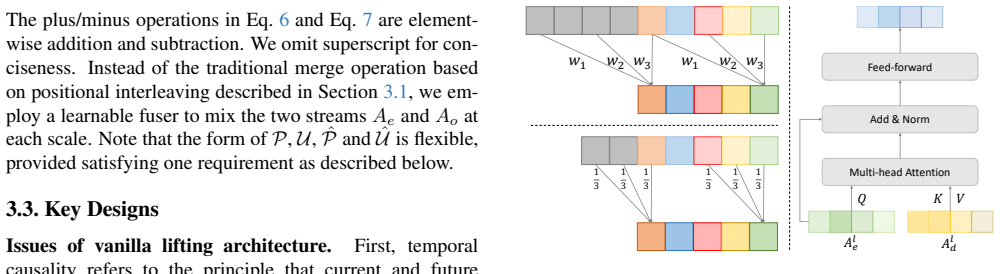
The central object is the wavelet policy network, an end-to-end lifting scheme in which the usual fixed predict and update filters are replaced by causal dilated convolutions and the even/odd split is replaced by Transformer-based splitters that copy the input to both streams (a redundant lifting scheme). The approximation stream is meant to carry the coarse trend, the detail stream the fine fluctuations, and a Transformer cross-attention fuser with query from the approximation and key/value from the detail recombines them, implementing reconstruction from coarse to fine. The matching losses are the approximation loss, which enforces that each approximation stream has the same local average as the stream above it, and the detail loss, which compresses the fine components; these are added to the task-specific imitation loss. This machinery is what carries the argument that multi-scale frequency decomposition, rather than a manually chosen wavelet or a plain sequence model, is responsible for the reported gains.
What would settle it
Measure the power spectra of the trained approximation and detail streams on a held-out sequence. If the approximation stream does not concentrate measurably more energy at low frequencies than the detail stream, or if removing the approximation and detail losses leaves performance unchanged, the claim that a learnable multi-scale wavelet decomposition drives the gains is refuted.
Extended reading notes
Core claim
On its own terms, the paper's central discovery is that a fully learnable lifting scheme can serve as the sequence-to-sequence backbone of a policy network and that doing so improves long-horizon control. Observations are split into two streams, a learnable predict network extracts a detail stream and a learnable update network produces an approximation stream, and this is repeated over $L$ scales; converters then map the observation-domain streams into action-domain streams, and a synthesis side with inverse update/predict networks and Transformer fusers reassembles the action sequence by starting from the coarsest approximation and adding details back one scale at a time. Two regularizers push the network to behave like a true wavelet transform: an approximation loss that forces each coarse stream to match the local average of the finer stream above it, and a detail loss that keeps the fine components small. The paper reports that this design matches or beats strong baselines on all five benchmarks, with the largest gains in the later stages of long tasks, and that it tracks the multi-modal behavior distribution of human demonstrations more closely.
Load-bearing premise
The paper's results rest on the assumption that the trained network genuinely splits sequences into coarse trend and fine detail streams, and that this split—not merely the causal structure—is what improves long-horizon performance.
Editorial extensions
If this is right
- If the central claim is right, learned policies should show their largest gains in the later stages of long tasks, exactly where error accumulation is worst; the Kitchen T4 and T5 results are the paper's main evidence for this.
- The same wavelet backbone can replace the action-generation decoder inside at least two common policy families—transformer behavior cloning and diffusion policy—without changing the rest of the pipeline, so the recipe is modular.
- Because the wavelet structure is learned rather than fixed, no task-specific choice of wavelet family (Haar, Daubechies, etc.) is needed, and the ablation against Haar and DB2 supports the claim that learnability helps.
- The two extra losses are simple smooth-L1 penalties added to the task loss, so the method does not require new supervision signals beyond expert demonstrations.
- Improved robustness on Transport-mh, the mixed-skill demonstration set, suggests that the decomposition also helps when training data is noisy or heterogeneous.
Reading between the lines
- Extension: the paper never shows that the trained network actually separates frequencies; a direct spectral test of the approximation versus detail streams would settle whether the gains come from wavelet decomposition or from the causal residual structure alone.
- Extension: if the coarse-to-fine synthesis is genuinely beneficial, the architecture should generalize to horizons longer than the training window without retraining, since low-frequency planning is scale-invariant; this can be tested by evaluating on extended rollouts.
- Extension: the redundant lifting scheme with Transformer splitters is close to an attention-based residual network; comparing against a matched-parameter gated residual baseline without the split/update structure would isolate what the wavelet formulation adds.
- Extension: the same decomposition could be applied directly to raw sensory streams such as video or tactile signals, where denoising at multiple scales might improve perception as well as action generation; this is not tested in the paper.
Editorial analysis
A structured set of objections, weighed in public.
Referee Report
Summary. This paper proposes Wavelet Policy, a sequence-to-sequence policy network built on a learnable lifting scheme. Observation sequences are split into two streams, passed through learnable causal-dilated-convolution predict/update blocks at multiple scales, converted into action streams, and recombined by a synthesis stage with Transformer fusers; training combines a task loss with approximation and detail losses (Eqs. 8-10). The method is evaluated on CARLA, Franka Kitchen, Push-T, Transport, and D3IL, with two instantiations (BeT-Wavelet and DP-Wavelet), and the authors claim superior or comparable performance to BeT, VQ-BeT, IBC, and DP-Transformer.
Significance. If the claimed multi-scale decomposition were verified, the coarse-to-fine action generation idea would be a useful contribution to long-horizon imitation learning, and the paper's breadth across five environments is a strength. The manuscript is generally clearly written and the experiments follow established benchmarks. However, the central mechanism—that the learned lifting blocks separate frequencies—is not demonstrated, and the empirical gains are mostly within one standard deviation of baselines. The paper does not ship code or checkpoints, and no significance tests are reported. These issues currently limit the paper to a preliminary architecture study rather than a validated method.
major comments (5)
- [Section 3.4, Eq. (10)] The total loss is written as L = Lapprox + alpha*Lapprox + beta*Ldetail, which duplicates the Lapprox term and omits the Ltask term introduced in the text. This is not a minor typo because it defines the training objective; please correct the equation and clarify the exact loss used in all experiments.
- [Section 5 and Figure 1] The central wavelet claim is not validated. Figure 1 demonstrates frequency decomposition using a fixed Haar wavelet on raw joint angles, not using the trained network. Tables 5 and 6 do not show that the learned P, U, P-hat, and U-hat produce approximation and detail streams with distinct spectral content. Please add quantitative analysis of the learned decomposition (e.g., spectral analysis of the streams or reconstruction-error measurements) or an ablation that removes the multi-scale structure while preserving causality.
- [Section 4.3, Tables 1, 3, and 4] No significance tests or seed-level results are reported, and many differences are within one standard deviation of the baselines (e.g., CARLA 0.847 +/- 0.090 vs. 0.832 +/- 0.167; Kitchen T2 0.775 +/- 0.057 vs. 0.775 +/- 0.046; Push-T 0.958 +/- 0.016 vs. 0.942 +/- 0.014). The claim of "superior or comparable" performance is therefore under-supported. Please report per-seed numbers and appropriate paired significance tests or effect sizes.
- [Section 5, Table 5] The causal-versus-noncausal convolution comparison tests causality, not the wavelet structure. Because the splitter copies the input to both streams (Section 3.3), the architecture may reduce to a generic causal residual sequence model; the contribution of the hierarchical coarse-to-fine composition is untested. Please add an ablation that keeps causal dilated convolutions but removes the hierarchical lifting structure (e.g., a single-scale residual stream with the same parameter count).
- [Section 3.3] The use of Transformer splitters that copy the input to both streams and a cross-attention fuser deviates substantially from the classical even/odd split of the lifting scheme. The connection to lifting is loose, and the learnable P and U may not correspond to a bona fide multi-resolution transform. Please justify this design more formally (e.g., showing invertibility or near-perfect reconstruction after training) or moderate the wavelet terminology.
minor comments (5)
- [Table 3] The entry for Transport-ph reports "0.835 +/- -0.062", which contains a spurious minus sign; it should read "0.835 +/- 0.062".
- [Figure 5 and Section 4.3] The text references "1 th row", "2nd row", and "5 th row" in inconsistent ordinal formats; please unify the formatting.
- [Section 3.4, Eq. (8)] The notation C(A_l^s) - A_{l+1}^s does not explicitly define how the scale index and the converter outputs align after mapping observation streams to action streams; please clarify the indexing.
- [Section 1, contribution 1] The claim that this is "the first attempt to introduce wavelet analysis to policy learning" is strong and should be softened or supported by a more thorough search of wavelet-based policies in imitation and reinforcement learning.
- [Section 4.2] The paper reports only mean and standard deviation over three seeds and does not release code or trained models; providing the code or detailed hyperparameters for each component would materially improve reproducibility.
Circularity Check
No significant circularity: benchmark results are external, and the wavelet-specific losses are self-imposed regularizers rather than quantities that are later predicted.
full rationale
The paper's central empirical claim is evaluated against external baselines (BeT, VQ-BeT, DP-Transformer) on five benchmarks, so the reported success rates are not fitted parameters renamed as predictions. The wavelet identity of the network is enforced by the approximation and detail losses (Eqs. 8 and 9), which are design objectives chosen by the authors; this is an inductive bias, not a circular derivation, because no result is obtained from an equation that already contains the conclusion. The only self-citation is reference [24] for the detail loss ("Following [24], we adopt the loss as: Ldetail = ..."), and it is not load-bearing: the learnable-versus-fixed-wavelet comparison in Table 6 provides independent empirical evidence for the learnable lifting design, and the loss could be justified without the citation. A limitation of the paper is that it never verifies the spectral separation of the learned streams with an external frequency analysis, but lack of validation is a correctness risk, not circularity. Therefore no circular step is identified.
Assumptions & free parameters
free parameters (3)
- alpha (loss weight) =
0.1
- beta (loss weight) =
0.1
- network hyperparameters (number of scales L, dilation, kernel sizes, hidden dims) =
not reported
assumptions (4)
- standard math Standard lifting scheme invertibility (P = hat P, U = hat U gives perfect reconstruction).
- domain assumption Long-horizon policy sequences are usefully represented as multi-scale signals, with low frequencies capturing action modes and high frequencies capturing noise.
- domain assumption Expert demonstrations provide ground-truth action sequences for supervised policy learning.
- ad hoc to paper The approximation and detail losses (Eqs. 8 and 9) enforce a meaningful coarse-to-fine decomposition.
Cite this review
Pith. "Pith review of Wavelet Policy: Lifting Scheme for Policy Learning in Long-Horizon Tasks." pith.science (2026). https://pith.science/paper/LVRO3MVN
@misc{pith2026250704331,
  author       = {Pith},
  title        = {Pith review of: Wavelet Policy: Lifting Scheme for Policy Learning in Long-Horizon Tasks},
  year         = {2026},
  howpublished = {\url{https://pith.science/paper/LVRO3MVN}},
  note         = {Machine review of arXiv:2507.04331}
}
read the original abstract
Policy learning focuses on devising strategies for agents in embodied artificial intelligence systems to perform optimal actions based on their perceived states. One of the key challenges in policy learning involves handling complex, long-horizon tasks that require managing extensive sequences of actions and observations with multiple modes. Wavelet analysis offers significant advantages in signal processing, notably in decomposing signals at multiple scales to capture both global trends and fine-grained details. In this work, we introduce a novel wavelet policy learning framework that utilizes wavelet transformations to enhance policy learning. Our approach leverages learnable multi-scale wavelet decomposition to facilitate detailed observation analysis and robust action planning over extended sequences. We detail the design and implementation of our wavelet policy, which incorporates lifting schemes for effective multi-resolution analysis and action generation. This framework is evaluated across multiple complex scenarios, including robotic manipulation, self-driving, and multi-robot collaboration, demonstrating the effectiveness of our method in improving the precision and reliability of the learned policy.
Figures


Figures from the paper (2 more)

Reference graph
Works this paper leans on
- [1]
- [2]
-
[3]
Generalized energy based models
M Arbel, L Zhou, and A Gretton. Generalized energy based models. In International Conference on Learning Represen- tations, 2021. 3
work page 2021
-
[4]
Lan- guage models are few-shot learners
Tom Brown, Benjamin Mann, Nick Ryder, Melanie Sub- biah, Jared D Kaplan, Prafulla Dhariwal, Arvind Neelakan- tan, Pranav Shyam, Girish Sastry, Amanda Askell, et al. Lan- guage models are few-shot learners. Advances in Neural In- formation Processing Systems, 33:1877–1901, 2020. 6
work page 1901
-
[5]
A survey on mixture of experts.arXiv preprint arXiv:2407.06204, 2024
Weilin Cai, Juyong Jiang, Fan Wang, Jing Tang, Sunghun Kim, and Jiayi Huang. A survey on mixture of experts.arXiv preprint arXiv:2407.06204, 2024. 2
arXiv 2024
-
[6]
Se- quential dexterity: Chaining dexterous policies for long- horizon manipulation
Yuanpei Chen, Chen Wang, Li Fei-Fei, and Karen Liu. Se- quential dexterity: Chaining dexterous policies for long- horizon manipulation. In Annual Conference on Robot Learning, 2023. 1
work page 2023
-
[7]
Diffusion policy: Visuomotor policy learning via action dif- fusion
Cheng Chi, Zhenjia Xu, Siyuan Feng, Eric Cousineau, Yilun Du, Benjamin Burchfiel, Russ Tedrake, and Shuran Song. Diffusion policy: Visuomotor policy learning via action dif- fusion. International Journal of Robotics Research, 2023. 1, 2, 6, 7
work page 2023
-
[8]
Nonlinear wavelet transforms for image coding via lifting
Roger L Claypoole, Geoffrey M Davis, Wim Sweldens, and Richard G Baraniuk. Nonlinear wavelet transforms for image coding via lifting. IEEE Transactions on Image Processing, 12(12):1449–1459, 2003. 4
work page 2003
Show all 64 references
-
[9]
Ten lectures on wavelets, 1993
Ingrid Daubechies and Bruce J Bates. Ten lectures on wavelets, 1993. 2, 3
1993
-
[10]
Factoring wavelet transforms into lifting steps
Ingrid Daubechies and Wim Sweldens. Factoring wavelet transforms into lifting steps. Journal of Fourier Analysis and Applications, 4:247–269, 1998. 3
1998
-
[11]
Imagenet: A large-scale hierarchical image database
Jia Deng, Wei Dong, Richard Socher, Li-Jia Li, Kai Li, and Li Fei-Fei. Imagenet: A large-scale hierarchical image database. In Proceedings of the IEEE Conference on Com- puter Vision and Pattern Recognition, pages 248–255. Ieee,
-
[12]
Wavenet: A generative model for raw audio
Sander Dieleman, Heiga Zen, Karen Simonyan, Oriol Vinyals, Alex Graves, Nal Kalchbrenner, Andrew Senior, Koray Kavukcuoglu, et al. Wavenet: A generative model for raw audio. arXiv preprint arXiv:1609.03499, 12, 2016. 5
2016 arXiv
-
[13]
Carla: An open urban driving simulator
Alexey Dosovitskiy, German Ros, Felipe Codevilla, Antonio Lopez, and Vladlen Koltun. Carla: An open urban driving simulator. In Annual Conference on Robot Learning , pages 1–16. PMLR, 2017. 2, 6
2017
-
[14]
A compari- son of imitation learning algorithms for bimanual manipula- tion
Michael Drolet, Simon Stepputtis, Siva Kailas, Ajinkya Jain, Jan Peters, Stefan Schaal, and Heni Ben Amor. A compari- son of imitation learning algorithms for bimanual manipula- tion. Robotics and Automation Letters, 2024. 2
2024
-
[15]
Implicit behavioral cloning
Pete Florence, Corey Lynch, Andy Zeng, Oscar A Ramirez, Ayzaan Wahid, Laura Downs, Adrian Wong, Johnny Lee, Igor Mordatch, and Jonathan Tompson. Implicit behavioral cloning. In Annual Conference on Robot Learning , pages 158–168. PMLR, 2022. 1, 3, 6, 8
2022
-
[16]
Relay policy learning: Solving long-horizon tasks via imitation and reinforcement learning
Abhishek Gupta, Vikash Kumar, Corey Lynch, Sergey Levine, and Karol Hausman. Relay policy learning: Solving long-horizon tasks via imitation and reinforcement learning. In Annual Conference on Robot Learning, pages 1025–1037. PMLR, 2020. 1, 2, 3, 6
2020
-
[17]
Wavelet score-based generative model- ing
Florentin Guth, Simon Coste, Valentin De Bortoli, and Stephane Mallat. Wavelet score-based generative model- ing. Advances in Neural Information Processing Systems , 35:478–491, 2022. 3
2022
-
[18]
Deep hierarchical planning from pixels
Danijar Hafner, Kuang-Huei Lee, Ian Fischer, and Pieter Abbeel. Deep hierarchical planning from pixels. Advances in Neural Information Processing Systems, 35:26091–26104,
-
[19]
Watch and match: Supercharging imitation with reg- ularized optimal transport
Siddhant Haldar, Vaibhav Mathur, Denis Yarats, and Lerrel Pinto. Watch and match: Supercharging imitation with reg- ularized optimal transport. In Annual Conference on Robot Learning, pages 32–43. PMLR, 2023. 1
2023
-
[20]
Deep residual learning for image recognition
Kaiming He, Xiangyu Zhang, Shaoqing Ren, and Jian Sun. Deep residual learning for image recognition. In Proceed- ings of the IEEE Conference on Computer Vision and Pattern Recognition, pages 770–778, 2016. 2, 6
2016
-
[21]
Improving long- horizon imitation through instruction prediction
Joey Hejna, Pieter Abbeel, and Lerrel Pinto. Improving long- horizon imitation through instruction prediction. InProceed- ings of the AAAI Conference on Artificial Intelligence, pages 7857–7865, 2023. 3
2023
-
[22]
Generative adversarial im- itation learning
Jonathan Ho and Stefano Ermon. Generative adversarial im- itation learning. Advances in Neural Information Processing Systems, 29, 2016. 1
2016
-
[23]
Denoising diffu- sion probabilistic models
Jonathan Ho, Ajay Jain, and Pieter Abbeel. Denoising diffu- sion probabilistic models. Advances in Neural Information Processing Systems, 33:6840–6851, 2020. 2
2020
-
[24]
Adaptive wavelet transformer net- work for 3d shape representation learning
Hao Huang and Yi Fang. Adaptive wavelet transformer net- work for 3d shape representation learning. In International Conference on Learning Representations, 2022. 3, 4, 5
2022
-
[25]
Neural wavelet-domain diffusion for 3d shape generation
Ka-Hei Hui, Ruihui Li, Jingyu Hu, and Chi-Wing Fu. Neural wavelet-domain diffusion for 3d shape generation. In SIG- GRAPH Asia Conference, pages 1–9, 2022. 3
2022
-
[26]
To- wards diverse behaviors: A benchmark for imitation learning with human demonstrations
Xiaogang Jia, Denis Blessing, Xinkai Jiang, Moritz Reuss, Atalay Donat, Rudolf Lioutikov, and Gerhard Neumann. To- wards diverse behaviors: A benchmark for imitation learning with human demonstrations. In The Twelfth International Conference on Learning Representations, 2024. 6
2024
-
[27]
Model based reinforcement learning for atari
Łukasz Kaiser, Mohammad Babaeizadeh, Piotr Miłos, Bła˙zej Osi ´nski, Roy H Campbell, Konrad Czechowski, Dumitru Erhan, Chelsea Finn, Piotr Kozakowski, Sergey Levine, et al. Model based reinforcement learning for atari. In International Conference on Learning Representations ,
-
[28]
Elucidating the design space of diffusion-based generative models
Tero Karras, Miika Aittala, Timo Aila, and Samuli Laine. Elucidating the design space of diffusion-based generative models. Advances in Neural Information Processing Sys- tems, 35:26565–26577, 2022. 2
2022
-
[29]
A tutorial on energy-based learning.Predicting Structured Data, 1(0), 2006
Yann LeCun, Sumit Chopra, Raia Hadsell, M Ranzato, Fujie Huang, et al. A tutorial on energy-based learning.Predicting Structured Data, 1(0), 2006. 1, 3
2006
-
[30]
Adaptive and explainable deployment of navigation skills via hierarchical deep reinforcement learning
Kyowoon Lee, Seongun Kim, and Jaesik Choi. Adaptive and explainable deployment of navigation skills via hierarchical deep reinforcement learning. In IEEE International Confer- ence on Robotics and Automation, pages 1673–1679. IEEE,
-
[31]
Dhrl: a graph-based approach for long-horizon and sparse hierar- chical reinforcement learning
Seungjae Lee, Jigang Kim, Inkyu Jang, and H Jin Kim. Dhrl: a graph-based approach for long-horizon and sparse hierar- chical reinforcement learning. Advances in Neural Informa- tion Processing Systems, 35:13668–13678, 2022. 3
2022
-
[32]
Behavior generation with latent actions
Seungjae Lee, Yibin Wang, Haritheja Etukuru, H Jin Kim, Nur Muhammad Mahi Shafiullah, and Lerrel Pinto. Behavior generation with latent actions. In International Conference on Machine Learning, pages 26991–27008. PMLR, 2024. 7
2024
-
[33]
Behavior generation with latent actions
Seungjae Lee, Yibin Wang, Haritheja Etukuru, H Jin Kim, Nur Muhammad Mahi Shafiullah, and Lerrel Pinto. Behavior generation with latent actions. In International Conference on Machine Learning, 2024. 1
2024
-
[34]
Optimal transport for offline imitation learning
Yicheng Luo, Samuel Cohen, Edward Grefenstette, Marc Pe- ter Deisenroth, et al. Optimal transport for offline imitation learning. In International Conference on Learning Repre- sentations, 2023. 2
2023
-
[35]
A wavelet tour of signal processing, 1999
Stephane Mallat. A wavelet tour of signal processing, 1999. 3
1999
-
[36]
What mat- ters in learning from offline human demonstrations for robot manipulation
Ajay Mandlekar, Danfei Xu, Josiah Wong, Soroush Nasiri- any, Chen Wang, Rohun Kulkarni, Li Fei-Fei, Silvio Savarese, Yuke Zhu, and Roberto Mart´ın-Mart´ın. What mat- ters in learning from offline human demonstrations for robot manipulation. In Annual Conference on Robot Learni...
2022
-
[37]
Generative skill chaining: Long-horizon skill planning with diffusion models
Utkarsh Aashu Mishra, Shangjie Xue, Yongxin Chen, and Danfei Xu. Generative skill chaining: Long-horizon skill planning with diffusion models. In Annual Conference on Robot Learning, pages 2905–2925. PMLR, 2023. 3
2023
-
[38]
Vision-driven compliant manipulation for reliable, high-precision assem- bly tasks
Andrew S Morgan, Bowen Wen, Junchi Liang, Abdeslam Boularias, Aaron M Dollar, and Kostas Bekris. Vision-driven compliant manipulation for reliable, high-precision assem- bly tasks. In Robotics: Science and Systems . MIT Press Journals, 2021. 2
2021
-
[39]
Wavelet diffusion models are fast and scalable image generators
Hao Phung, Quan Dao, and Anh Tran. Wavelet diffusion models are fast and scalable image generators. In Proceed- ings of the IEEE/CVF Conference on Computer Vision and Pattern Recognition, pages 10199–10208, 2023. 3
2023
-
[40]
Robust adversarial reinforcement learning
Lerrel Pinto, James Davidson, Rahul Sukthankar, and Abhi- nav Gupta. Robust adversarial reinforcement learning. In In- ternational Conference on Machine Learning , pages 2817–
-
[41]
Pirlnav: Pretraining with imitation and rl finetuning for objectnav
Ram Ramrakhya, Dhruv Batra, Erik Wijmans, and Abhishek Das. Pirlnav: Pretraining with imitation and rl finetuning for objectnav. In Proceedings of the IEEE/CVF Conference on Computer Vision and Pattern Recognition, pages 17896– 17906, 2023. 2
2023
-
[42]
Goal-conditioned imitation learning using score- based diffusion policies
Moritz Reuss, Maximilian Li, Xiaogang Jia, and Rudolf Li- outikov. Goal-conditioned imitation learning using score- based diffusion policies. In Robotics: Science and Systems . MIT Press Journals, 2023. 2
2023
-
[43]
Wavelets and signal pro- cessing
Olivier Rioul and Martin Vetterli. Wavelets and signal pro- cessing. IEEE Signal Processing Magazine , 8(4):14–38,
-
[44]
Deep adaptive wavelet network
Maria Ximena Bastidas Rodriguez, Adrien Gruson, Luisa Polania, Shin Fujieda, Flavio Prieto, Kohei Takayama, and Toshiya Hachisuka. Deep adaptive wavelet network. In Pro- ceedings of the IEEE/CVF Winter Conference on Applica- tions of Computer Vision, pages 3111–3119, 2020. 4
2020
-
[45]
Wire: Wavelet implicit neural representations
Vishwanath Saragadam, Daniel LeJeune, Jasper Tan, Guha Balakrishnan, Ashok Veeraraghavan, and Richard G Bara- niuk. Wire: Wavelet implicit neural representations. In Pro- ceedings of the IEEE/CVF Conference on Computer Vision and Pattern Recognition, pages 18507–18516, 2023. 3
2023
-
[46]
Broadly-exploring, local-policy trees for long-horizon task planning
Pierre Sermanet, Corey Lynch, et al. Broadly-exploring, local-policy trees for long-horizon task planning. In Annual Conference on Robot Learning, 2021. 1
2021
-
[47]
Behavior transformers: Cloning k modes with one stone
Nur Muhammad Shafiullah, Zichen Cui, Ariuntuya Arty Al- tanzaya, and Lerrel Pinto. Behavior transformers: Cloning k modes with one stone. Advances in Neural Information Processing Systems, 35:22955–22968, 2022. 1, 3, 6, 7, 8
2022
-
[48]
Score-based generative modeling through stochastic differential equa- tions
Yang Song, Jascha Sohl-Dickstein, Diederik P Kingma, Ab- hishek Kumar, Stefano Ermon, and Ben Poole. Score-based generative modeling through stochastic differential equa- tions. In International Conference on Learning Represen- tations, 2021. 3
2021
-
[49]
Discrete wavelet transform: a signal pro- cessing approach
D Sundararajan. Discrete wavelet transform: a signal pro- cessing approach. John Wiley & Sons, 2016. 3
2016
-
[50]
Inverse reinforcement learning without reinforcement learning
Gokul Swamy, David Wu, Sanjiban Choudhury, Drew Bag- nell, and Steven Wu. Inverse reinforcement learning without reinforcement learning. In International Conference on Ma- chine Learning, pages 33299–33318. PMLR, 2023. 1
2023
-
[51]
The lifting scheme: A construction of sec- ond generation wavelets
Wim Sweldens. The lifting scheme: A construction of sec- ond generation wavelets. SIAM Journal on Mathematical Analysis, 29(2):511–546, 1998. 2, 3
1998
-
[52]
Multi-stage image denoising with the wavelet transform
Chunwei Tian, Menghua Zheng, Wangmeng Zuo, Bob Zhang, Yanning Zhang, and David Zhang. Multi-stage image denoising with the wavelet transform. Pattern Recognition, 134:109050, 2023. 3
2023
-
[53]
Behav- ioral cloning from observation
Faraz Torabi, Garrett Warnell, and Peter Stone. Behav- ioral cloning from observation. In Proceedings of the In- ternational Joint Conference on Artificial Intelligence, pages 4950–4957, 2018. 1
2018
-
[54]
Intrinsic language-guided exploration for complex long- horizon robotic manipulation tasks
Eleftherios Triantafyllidis, Filippos Christianos, and Zhibin Li. Intrinsic language-guided exploration for complex long- horizon robotic manipulation tasks. In IEEE International Conference on Robotics and Automation, pages 7493–7500. IEEE, 2024. 3
2024
-
[55]
Attention is all you need
Ashish Vaswani, Noam Shazeer, Niki Parmar, Jakob Uszko- reit, Llion Jones, Aidan N Gomez, Lukasz Kaiser, and Illia Polosukhin. Attention is all you need. Advances in Neural Information Processing Systems, 2017. 3, 6
2017
-
[56]
Mim- icplay: Long-horizon imitation learning by watching human play
Chen Wang, Linxi Fan, Jiankai Sun, Ruohan Zhang, Li Fei- Fei, Danfei Xu, Yuke Zhu, and Anima Anandkumar. Mim- icplay: Long-horizon imitation learning by watching human play. In Annual Conference on Robot Learning, pages 201–
-
[57]
Hierarchical visual policy learning for long-horizon robot manipulation in densely cluttered scenes
Hecheng Wang, Lizhe Qi, Bin Fang, and Yunquan Sun. Hierarchical visual policy learning for long-horizon robot manipulation in densely cluttered scenes. arXiv preprint arXiv:2312.02697, 2023. 1
2023 arXiv
-
[58]
Sparse diffusion policy: A sparse, reusable, and flexible policy for robot learning
Yixiao Wang, Yifei Zhang, Mingxiao Huo, Thomas Tian, Xiang Zhang, Yichen Xie, Chenfeng Xu, Pengliang Ji, Wei Zhan, Mingyu Ding, et al. Sparse diffusion policy: A sparse, reusable, and flexible policy for robot learning. In Annual Conference on Robot Learning, 2024. 2 10
2024
-
[59]
Wavenerf: Wavelet-based generalizable neural radiance fields
Muyu Xu, Fangneng Zhan, Jiahui Zhang, Yingchen Yu, Xi- aoqin Zhang, Christian Theobalt, Ling Shao, and Shijian Lu. Wavenerf: Wavelet-based generalizable neural radiance fields. In Proceedings of the IEEE/CVF International Con- ference on Computer Vision, pages 18195–18204, 2023. 3
2023
-
[60]
Em- bodied multi-modal agent trained by an llm from a paral- lel textworld
Yijun Yang, Tianyi Zhou, Kanxue Li, Dapeng Tao, Lusong Li, Li Shen, Xiaodong He, Jing Jiang, and Yuhui Shi. Em- bodied multi-modal agent trained by an llm from a paral- lel textworld. In Proceedings of the IEEE/CVF Conference on Computer Vision and Pattern Recognition, pages 2...
2024
-
[61]
Wave-vit: Unifying wavelet and transformers for visual representation learning
Ting Yao, Yingwei Pan, Yehao Li, Chong-Wah Ngo, and Tao Mei. Wave-vit: Unifying wavelet and transformers for visual representation learning. In European Conference on Com- puter Vision, pages 328–345. Springer, 2022. 3
2022
-
[62]
3d diffusion policy: Gen- eralizable visuomotor policy learning via simple 3d repre- sentations
Yanjie Ze, Gu Zhang, Kangning Zhang, Chenyuan Hu, Muhan Wang, and Huazhe Xu. 3d diffusion policy: Gen- eralizable visuomotor policy learning via simple 3d repre- sentations. In IEEE International Conference on Robotics and Automation Workshop, 2024. 2
2024
-
[63]
Universal visual decomposer: Long-horizon manip- ulation made easy
Zichen Zhang, Yunshuang Li, Osbert Bastani, Abhishek Gupta, Dinesh Jayaraman, Yecheng Jason Ma, and Luca Weihs. Universal visual decomposer: Long-horizon manip- ulation made easy. In IEEE International Conference on Robotics and Automation, pages 6973–6980. IEEE, 2024. 3
2024
-
[64]
Spire: Synergistic planning, imi- tation, and reinforcement learning for long-horizon manipu- lation
Zihan Zhou, Animesh Garg, Dieter Fox, Caelan Reed Gar- rett, and Ajay Mandlekar. Spire: Synergistic planning, imi- tation, and reinforcement learning for long-horizon manipu- lation. In Annual Conference on Robot Learning, 2024. 3 11
2024
Reviewed August 6, 2026 · model on record in the stance chip above.
Discussion (0). Sign in to comment.