REVIEW 5 major objections 6 minor 1 cited by
Implicit Dual-Control for Visibility-Aware Navigation in Unstructured Environments
T0 review · 5 major / 6 minor · reviewed 2026-08-06 · deepseek-v4-flash
Pith's one-line read Embedding a predicted visibility-based uncertainty update into MPPI lets a ground vehicle implicitly balance exploration and exploitation, cutting collisions with unseen obstacles while keeping time near the prescient baseline.
desk verdict A genuinely new integration of visibility prediction into MPPI for ground vehicles, but the central implicit-dual-control claim is not isolated by the experiments, so the safety gain is scenario-specific until an ablation and clarity on the rollout-time map are added. read the letter →
The pith
A machine-rendered reading of the paper's core claim, the machinery that carries it, and where it could break.
The reading
What carries the argument
The load-bearing mechanism is the predicted-visibility uncertainty update: for each candidate control sequence, the controller casts 20 sparse 2D rays (30 points each, up to 25 m) over the mean elevation map, records which map cells are visible, spreads each hit with a 9×9 Gaussian splat (σ=1), and multiplies the uncertainty map by exp(γC), a negative-exponential stand-in for a Bayesian measurement update. This makes the belief over the environment trajectory-dependent, which is what turns ordinary MPPI into an implicit dual controller. The second piece is MPPI itself: gradient-free forward sampling with an exponential cost weighting, chosen because the trajectory-dependent belief makes the expectation in the cost non-convex and discontinuous, and because the uncertainty update parallelizes naturally over samples.
What would settle it
In the off-road simulator, place a hidden obstacle behind a ridge that is below the depth sensor's threshold height so the free-space fill of the elevation map shows no occlusion from any candidate trajectory; if VA-MPPI still avoids it, the safety does not come from predicted visibility, and if it collides, the dual-control claim is confirmed to rest on the elevation-based ray-cast assumption.
Extended reading notes
Core claim
The paper reports that VA-MPPI, a Model Predictive Path Integral controller with a visibility-aware uncertainty update, implicitly solves the dual-control problem for an unknown environment. Along each sampled trajectory, the controller ray-casts over the current mean elevation map, counts which points would be seen, splats the counts with a Gaussian, and reduces the uncertainty map by an exponential factor exp(γC) that approximates a Bayesian measurement update. Because uncertain space is only penalized through the expected surface cost evaluated under the updated belief, the controller naturally slows or veers when predicted visibility is low and commits when it is high—reducing uncertainty only when performance benefits. In the off-road 400-sample scenario, VA-MPPI succeeded in 84% of runs versus 8% for the deterministic controller, with all VA-MPPI failures caused by failure to meet stopping criteria rather than collisions.
Load-bearing premise
Safety rests on the prediction that entering unobserved space will remove uncertainty at the rate the hand-tuned exponential model assumes; when the real environment hides obstacles that the current elevation map cannot reveal, that predicted information gain is optimistic and the implicit safety margin disappears.
Editorial extensions
If this is right
- In the off-road scenario at 400 samples, VA-MPPI succeeds in 84% of runs versus 8% for the deterministic controller, and none of its failures are collisions.
- In both the alleyway and off-road scenarios, increasing the sample count from 400 to 4000 makes the deterministic controller more dangerous (100% collision failures off-road) while VA-MPPI's failure rate stays flat or falls.
- VA-MPPI reaches the goal only 9.1% (off-road) and 2.5% (alleyway) slower than the prescient controller at 400 samples, so the safety gain does not come at a large time cost.
- The controller implicitly avoids unobserved space without any explicit cost on unknown regions; trajectories show it taking wider, more cautious turns into uncertain areas.
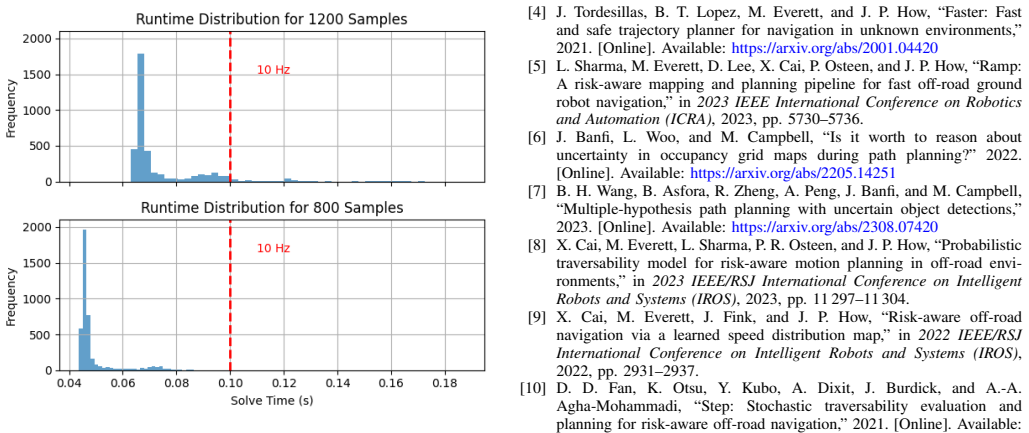
- At 800 samples the controller solves in 50 ms ± 10 ms on GPU hardware, meeting a 10 Hz control loop, so the approach is real-time deployable.
Reading between the lines
- The safety guarantee is bounded by what the mean elevation map can reveal: obstacles that create no occlusion in the elevation model (such as negative obstacles, ditches, or objects below the sensor's height threshold) will not trigger the predicted-uncertainty mechanism, so the 'unseen obstacle' claim should be read as 'hidden behind visible elevation features.'
- Because the exploration/exploitation balance is encoded in the hand-tuned triple (γ, c, σ), the claimed implicit balancing is really a tuned behavior; an adaptive schedule for these parameters could extend the method to changing environments without retuning.
- The same predicted-measurement trick should transfer to other sensing models (LiDAR, semantic cameras) and to multi-robot settings, since the uncertainty update only needs a model of what each candidate pose would observe.
- The sample-count trend suggests a corollary: with a free-space assumption, more planning samples select increasingly aggressive unsafe maneuvers, whereas with predicted uncertainty, samples are spent finding cautious alternatives—so the method's advantage should grow as compute increases.
Editorial analysis
A structured set of objections, weighed in public.
Referee Report
Summary. The paper presents VA-MPPI, a model predictive path integral controller that augments cost evaluation with a predicted visibility-based uncertainty reduction: for each candidate rollout, rays are cast over the current mean elevation map to count observable cells, a Gaussian splat spreads those counts, and an exponential decay reduces the local uncertainty map along the trajectory. The resulting trajectory-dependent uncertainty feeds a stochastic surface cost, and the authors claim that this implicitly balances exploration and exploitation without an explicit uncertainty objective. The method is evaluated in simulation in an urban alleyway and an off-road scenario against a deterministic MPPI that plans on the mean only and a prescient MPPI with a ground-truth map, with 100 repetitions per configuration; the paper reports large safety gains (e.g., 84% vs 8% success in the off-road 400-sample case) and a real-time ROS-based validation with solve times around 50 ms at 800 samples. The paper also provides trajectory visualizations and argues that the visibility-aware controller avoids unobserved space implicitly.
Significance. If the safety improvements are reproducible and attributable to the predicted information gain, the paper would make a worthwhile contribution: it presents an implicit dual-control formulation for visibility-aware ground-vehicle navigation, and the JAX implementation with real-time GPU uncertainty updates is a practical strength. The comparison with a prescient controller provides a useful upper bound, and the qualitative trajectory analysis is informative. However, the evidence as presented does not yet isolate the mechanism: the missing ablation against a controller that uses the current uncertainty map without predicted reduction, the ambiguity about whether rollout-time visibility uses a ground-truth or predicted map, and the fact that all hyperparameters are tuned on the tested scenarios prevent the reader from attributing the safety gain to the implicit dual-control effect. The stress-test concern therefore lands. The remaining steps—adding an ablation, clarifying the map used, and adding sensitivity and statistical analyses—are well-defined and within the scope of a revision.
major comments (5)
- [Section III.C vs Section III.A (Eqs. 9-12)] The prediction-time uncertainty update is described as sparse 2D ray casting over the mean elevation map in Section III.A, but Section III.C states that 'Visibility updates are computed using dense 3D ray-casting over a ground-truth map.' If this dense ground-truth ray casting is used for the rollout-time predicted visibility, the controller is being given ground-truth geometry in prediction, and the comparison is no longer a test of the proposed perception model. Please state explicitly which map is used for the predicted measurements in Eq. (7) and for the uncertainty update during rollouts, and, if the ground-truth map is used, re-run the experiments with predicted visibility based only on the current mean map.
- [Section IV, Eq. (20)] The only path through which uncertainty affects the cost is the stochastic surface cost, which samples xe ~ b(theta) from the current uncertainty map. Because unobserved cells are initialized with Sigma = 3.0 (Section III.C), a controller that simply treats the current uncertainty map as a risk layer would slow down and avoid unobserved space even without predicting any future information gain. No such 'risk-averse MPPI with static uncertainty' baseline is included. The reported safety gain therefore cannot be attributed to the implicit dual-control mechanism unless an ablation removes the predicted uncertainty update (Eqs. 9-12) and keeps the uncertainty map fixed along the rollout; please add this experiment.
- [Section III.A, Eq. (12)] The exponential update is introduced as an approximation of a recursive Bayesian elevation-map update, but no quantitative comparison is provided. The approximation error matters because the safety behavior depends on how aggressively uncertainty decays with observation count (parameters gamma and c). Please add a synthetic comparison of Eq. (12) against the exact recursive Bayesian update for a few representative range-measurement noise models, or at minimum a sensitivity sweep over gamma and c showing that the reported success rates are not a knife-edge artifact of the chosen values.
- [Sections III.A, III.C, Table II, and IV] The parameters gamma = 0.3, c, sigma, the initial uncertainty variance 3.0, and the cost weights omega_* are tuned on the exact two evaluation scenarios, and the success rates are measured on those same scenarios. This circularity means the reported gains partly reflect this tuning. Please add a held-out validation scenario or a parameter sensitivity analysis, and report the range of success rates over reasonable parameter perturbations rather than point estimates.
- [Section IV.A and Fig. 7] One hundred repetitions are reported, but only aggregate percentages are given, without confidence intervals or significance tests. Some cells are based on very few events (e.g., 4 of 9 visibility-aware failures in the Alleyway), so binomial confidence intervals are needed to support the claim that the safety improvement is statistically significant.
minor comments (6)
- [Section I.A, Section III.A] There are minor typographical errors: 'saftey' should be 'safety' in Section I.A, and 'threshhold' should be 'threshold' in Section III.A.
- [Eq. (18)] The second term, d30/2V30, appears to be a typographical error (likely d0^3/(2 V0^2) or similar); please check the expression.
- [Section III.C] Please define the radius around the robot within which the uncertainty map is initialized to zero, as well as the resolution at which the uncertainty map is stored.
- [Eq. (12)] Equation (12) mixes matrix and scalar notation: the left side uses a Hadamard product with an exponential of a count map, while the right side resembles a scalar closed-form; please align the notation.
- [References] Reference [49] duplicates [46] with a different page range, and reference [32] lacks complete citation details; please unify the bibliography.
- [Fig. 13] The caption refers to 1200 samples while the experimental sections use 400, 1000, and 4000 samples and the real-time run uses 800 samples; please clarify the sampling counts in Fig. 13.
Circularity Check
No significant circularity; the reported safety gains are empirical simulation outcomes and the hand-tuned uncertainty parameters are not fitted predictions, so no step reduces to its inputs by construction.
full rationale
VA-MPPI's central claims are empirical and do not reduce to definitional identities. The uncertainty update in Eq. (12) is presented as an exponential approximation of a Bayesian measurement update, with parameters c, gamma, and sigma explicitly described as tunable ('Experiments showed that setting these values too low, prevented the vehicle from exploring, while too high decreased its safety'). This is hyperparameter tuning, not a fitted parameter later renamed as a prediction; no train/test split or statistical fitting is described, so the reported success rates are not forced by a fitted quantity. The safety comparison is made against a deterministic mean-only baseline and a prescient oracle, meaning the VA-MPPI result is not identical to the cost function by construction unless one also assumes the uncertainty sampling mechanism, which is an implemented component rather than a retrofitted output. The paper invokes standard MPPI and Bayesian estimation results from external prior work, with no load-bearing self-citation by the present authors and no imported uniqueness theorem. The absence of an ablation isolating predicted versus static uncertainty, and the ambiguity between sparse mean-map ray-casting in Section III.A and dense ground-truth ray-casting in Section III.C, are real validation and internal-consistency concerns, but they are not circular reductions: the paper's equations do not silently assume the conclusions they claim to demonstrate. Therefore no circular step can be quoted, and the appropriate circularity score is 0.
Assumptions & free parameters
free parameters (5)
- γ (uncertainty decay coefficient) =
0.3
- c (observation count increment) =
Not specified
- σ (Gaussian splat std) =
1
- Initial uncertainty variance =
3.0
- Cost weights (ωt, ωdynamic, ωsurface, ωdist, ωacc, ωorientation) =
Not reported
assumptions (5)
- domain assumption Future measurements will reduce uncertainty along candidate trajectories via ray casting over the current mean elevation map.
- ad hoc to paper The exponential update in Eq. (12) is a sufficient approximation of a Bayesian elevation-map update for control.
- domain assumption Unobserved space is assumed free, with mean equal to robot elevation, and uncertainty sampled from N(µe, Σe).
- standard math MPPI importance-sampling update converges to the optimal control distribution as in Williams et al.
- domain assumption A 3-DOF bicycle model with Pacejka tire model and no measurement noise adequately represents the vehicle and perception for evaluation.
Cite this review
Pith. "Pith review of Implicit Dual-Control for Visibility-Aware Navigation in Unstructured Environments." pith.science (2026). https://pith.science/paper/ZEJQ3RV6
@misc{pith2026250704371,
  author       = {Pith},
  title        = {Pith review of: Implicit Dual-Control for Visibility-Aware Navigation in Unstructured Environments},
  year         = {2026},
  howpublished = {\url{https://pith.science/paper/ZEJQ3RV6}},
  note         = {Machine review of arXiv:2507.04371}
}
read the original abstract
Navigating complex, cluttered, and unstructured environments that are a priori unknown presents significant challenges for autonomous ground vehicles, particularly when operating with a limited field of view(FOV) resulting in frequent occlusion and unobserved space. This paper introduces a novel visibility-aware model predictive path integral framework(VA-MPPI). Formulated as a dual control problem where perceptual uncertainties and control decisions are intertwined, it reasons over perception uncertainty evolution within a unified planning and control pipeline. Unlike traditional methods that rely on explicit uncertainty objectives, the VA-MPPI controller implicitly balances exploration and exploitation, reducing uncertainty only when system performance would be increased. The VA-MPPI framework is evaluated in simulation against deterministic and prescient controllers across multiple scenarios, including a cluttered urban alleyway and an occluded off-road environment. The results demonstrate that VA-MPPI significantly improves safety by reducing collision with unseen obstacles while maintaining competitive performance. For example, in the off-road scenario with 400 control samples, the VA-MPPI controller achieved a success rate of 84%, compared to only 8% for the deterministic controller, with all VA-MPPI failures arising from unmet stopping criteria rather than collisions. Furthermore, the controller implicitly avoids unobserved space, improving safety without explicit directives. The proposed framework highlights the potential for robust, visibility-aware navigation in unstructured and occluded environments, paving the way for future advancements in autonomous ground vehicle systems.
Figures


Figures from the paper (8 more)


Forward citations
Cited by 1 Pith paper
-
A Formal gatekeeper Framework for Safe Dual Control with Active Exploration
A dual-control framework that only commits exploratory trajectories when they pass a safety-tube check and a mission-cost budget check, using set-membership identification to shrink parameter uncertainty.
Reference graph
Works this paper leans on
-
[1]
A. Feldbaum, “Dual control theory problems,” IFAC Proceedings Volumes, vol. 1, no. 2, pp. 541–550, 1963, 2nd International IFAC Congress on Automatic and Remote Control: Theory, Basle, Switzerland, 1963. [Online]. Available: https://www.sciencedirect.com/ science/article/pii/S1474667017696873
work page 1963
-
[2]
Dual effect, certainty equivalence, and sep- aration in stochastic control,
Y . Bar-Shalom and E. Tse, “Dual effect, certainty equivalence, and sep- aration in stochastic control,” IEEE Transactions on Automatic Control , vol. 19, no. 5, pp. 494–500, 1974
work page 1974
-
[3]
Active perception,
R. Bajcsy, “Active perception,” Proceedings of the IEEE , vol. 76, no. 8, pp. 966–1005, 1988
1988
-
[4]
Faster: Fast and safe trajectory planner for navigation in unknown environments,
J. Tordesillas, B. T. Lopez, M. Everett, and J. P. How, “Faster: Fast and safe trajectory planner for navigation in unknown environments,”
-
[5]
Ramp: A risk-aware mapping and planning pipeline for fast off-road ground robot navigation,
L. Sharma, M. Everett, D. Lee, X. Cai, P. Osteen, and J. P. How, “Ramp: A risk-aware mapping and planning pipeline for fast off-road ground robot navigation,” in 2023 IEEE International Conference on Robotics and Automation (ICRA) , 2023, pp. 5730–5736
work page 2023
-
[6]
Is it Worth to Reason about Uncertainty in Occupancy Grid Maps during Path Planning?
J. Banfi, L. Woo, and M. Campbell, “Is it worth to reason about uncertainty in occupancy grid maps during path planning?” 2022. [Online]. Available: https://arxiv.org/abs/2205.14251
work page Pith review arXiv 2022
-
[7]
Multiple-hypothesis path planning with uncertain object detections,
B. H. Wang, B. Asfora, R. Zheng, A. Peng, J. Banfi, and M. Campbell, “Multiple-hypothesis path planning with uncertain object detections,”
-
[8]
Probabilistic traversability model for risk-aware motion planning in off-road envi- ronments,
X. Cai, M. Everett, L. Sharma, P. R. Osteen, and J. P. How, “Probabilistic traversability model for risk-aware motion planning in off-road envi- ronments,” in 2023 IEEE/RSJ International Conference on Intelligent Robots and Systems (IROS) , 2023, pp. 11 297–11 304
work page 2023
Show all 56 references
-
[9]
Risk-aware off-road navigation via a learned speed distribution map,
X. Cai, M. Everett, J. Fink, and J. P. How, “Risk-aware off-road navigation via a learned speed distribution map,” in 2022 IEEE/RSJ International Conference on Intelligent Robots and Systems (IROS) , 2022, pp. 2931–2937
2022
-
[10]
Step: Stochastic traversability evaluation and planning for risk-aware off-road navigation,
D. D. Fan, K. Otsu, Y . Kubo, A. Dixit, J. Burdick, and A.-A. Agha-Mohammadi, “Step: Stochastic traversability evaluation and planning for risk-aware off-road navigation,” 2021. [Online]. Available: https://arxiv.org/abs/2103.02828
2021 arXiv
-
[11]
Learning risk-aware costmaps for traversability in challenging environments,
D. D. Fan, A.-a. Agha-mohammadi, and E. A. Theodorou, “Learning risk-aware costmaps for traversability in challenging environments,” IEEE Robotics and Automation Letters , vol. 7, no. 1, p. 279–286, Jan
-
[12]
How does it feel? self-supervised costmap learning for off-road vehicle traversability,
M. G. Castro, S. Triest, W. Wang, J. M. Gregory, F. Sanchez, J. G. R. III, and S. Scherer, “How does it feel? self-supervised costmap learning for off-road vehicle traversability,” 2023. [Online]. Available: https://arxiv.org/abs/2209.10788
2023 arXiv
-
[13]
Learning risk-aware costmaps via inverse reinforcement learning for off-road navigation,
S. Triest, M. G. Castro, P. Maheshwari, M. Sivaprakasam, W. Wang, and S. Scherer, “Learning risk-aware costmaps via inverse reinforcement learning for off-road navigation,” 2023. [Online]. Available: https: //arxiv.org/abs/2302.00134
2023 arXiv
-
[14]
Planning paths through unknown space by imagining what lies therein,
Y . Han, J. Banfi, and M. Campbell, “Planning paths through unknown space by imagining what lies therein,” in Proceedings of the 2020 Conference on Robot Learning , ser. Proceedings of Machine Learning Research, J. Kober, F. Ramos, and C. Tomlin, Eds., vol
2020
-
[15]
Planning paths through occlusions in urban environments,
Y . Han, Y . Xia, G.-J. Qi, and M. Campbell, “Planning paths through occlusions in urban environments,” 2022. [Online]. Available: https://arxiv.org/abs/2212.14138
2022 arXiv
-
[16]
Learning-based 3d occupancy prediction for autonomous navigation in occluded envi- ronments,
L. Wang, H. Ye, Q. Wang, Y . Gao, C. Xu, and F. Gao, “Learning-based 3d occupancy prediction for autonomous navigation in occluded envi- ronments,” in 2021 IEEE/RSJ International Conference on Intelligent Robots and Systems (IROS) , 2021, pp. 4509–4516
2021
-
[17]
Terrainnet: Visual modeling of complex terrain for high-speed, off-road navigation,
X. Meng, N. Hatch, A. Lambert, A. Li, N. Wagener, M. Schmittle, J. Lee, W. Yuan, Z. Chen, S. Deng, G. Okopal, D. Fox, B. Boots, and A. Shaban, “Terrainnet: Visual modeling of complex terrain for high-speed, off-road navigation,” 2023. [Online]. Available: https://arxiv.org/abs...
2023 arXiv
-
[18]
Reconstructing occluded elevation information in terrain maps with self-supervised learning,
M. Stolzle, T. Miki, L. Gerdes, M. Azkarate, and M. Hutter, “Reconstructing occluded elevation information in terrain maps with self-supervised learning,” IEEE Robotics and Automation Letters , vol. 7, no. 2, p. 1697–1704, Apr. 2022. [Online]. Available: http://dx.doi.org/10.1...
2022
-
[19]
Unrealnet: Learning uncertainty-aware navigation features from high-fidelity scans of real environments,
S. Triest, D. D. Fan, S. Scherer, and A.-A. Agha-Mohammadi, “Unrealnet: Learning uncertainty-aware navigation features from high-fidelity scans of real environments,” 2024. [Online]. Available: https://arxiv.org/abs/2407.08720
2024 arXiv
-
[20]
Uncertainty-driven planner for exploration and navigation,
G. Georgakis, B. Bucher, A. Arapin, K. Schmeckpeper, N. Matni, and K. Daniilidis, “Uncertainty-driven planner for exploration and navigation,” 2022. [Online]. Available: https://arxiv.org/abs/2202.11907
2022 arXiv
-
[21]
Pipe planner: Pathwise information gain with map predictions for indoor robot exploration,
S. Baek, B. Moon, S. Kim, M. Cao, C. Ho, S. Scherer, and J. hwan Jeon, “Pipe planner: Pathwise information gain with map predictions for indoor robot exploration,” 2025. [Online]. Available: https://arxiv.org/abs/2503.07504
2025 arXiv
-
[22]
Uncertainty-aware occupancy map prediction using generative net- works for robot navigation,
K. Katyal, K. Popek, C. Paxton, P. Burlina, and G. D. Hager, “Uncertainty-aware occupancy map prediction using generative net- works for robot navigation,” in 2019 International Conference on Robotics and Automation (ICRA) , 2019, pp. 5453–5459
2019
-
[23]
Co-slam: Joint coordinate and sparse parametric encodings for neural real-time slam,
H. Wang, J. Wang, and L. Agapito, “Co-slam: Joint coordinate and sparse parametric encodings for neural real-time slam,” in 2023 IEEE/CVF Conference on Computer Vision and Pattern Recognition (CVPR), 2023, pp. 13 293–13 302
2023
-
[24]
Nice-slam: Neural implicit scalable encoding for slam,
Z. Zhu, S. Peng, V . Larsson, W. Xu, H. Bao, Z. Cui, M. R. Oswald, and M. Pollefeys, “Nice-slam: Neural implicit scalable encoding for slam,” in 2022 IEEE/CVF Conference on Computer Vision and Pattern Recognition (CVPR), 2022, pp. 12 776–12 786
2022
-
[25]
Naruto: Neural active reconstruction from uncertain target observations,
Z. Feng, H. Zhan, Z. Chen, Q. Yan, X. Xu, C. Cai, B. Li, Q. Zhu, and Y . Xu, “Naruto: Neural active reconstruction from uncertain target observations,” in 2024 IEEE/CVF Conference on Computer Vision and Pattern Recognition (CVPR), 2024, pp. 21 572–21 583
2024
-
[26]
Perception-aware receding horizon nav- igation for mavs,
Z. Zhang and D. Scaramuzza, “Perception-aware receding horizon nav- igation for mavs,” in 2018 IEEE International Conference on Robotics and Automation (ICRA) , 2018, pp. 2534–2541
2018
-
[27]
Perception-aware path planning,
G. Costante, C. Forster, J. Delmerico, P. Valigi, and D. Scaramuzza, “Perception-aware path planning,” 2017. [Online]. Available: https: //arxiv.org/abs/1605.04151
2017 arXiv
-
[28]
Online optimal perception-aware trajectory generation,
P. Salaris, M. Cognetti, R. Spica, and P. R. Giordano, “Online optimal perception-aware trajectory generation,” IEEE Transactions on Robotics, vol. 35, no. 6, pp. 1307–1322, 2019
2019
-
[29]
Apace: Agile and perception-aware trajectory generation for quadrotor flights,
X. Chen, Y . Zhang, B. Zhou, and S. Shen, “Apace: Agile and perception-aware trajectory generation for quadrotor flights,” 2024. [Online]. Available: https://arxiv.org/abs/2403.08365
2024 arXiv
-
[30]
Perception-aware trajectory generation for aggressive quadrotor flight using differential flatness,
V . Murali, I. Spasojevic, W. Guerra, and S. Karaman, “Perception-aware trajectory generation for aggressive quadrotor flight using differential flatness,” in 2019 American Control Conference (ACC), 2019, pp. 3936– 3943
2019
-
[31]
Fisher information field: an efficient and differentiable map for perception-aware planning,
Z. Zhang and D. Scaramuzza, “Fisher information field: an efficient and differentiable map for perception-aware planning,” 2020. [Online]. Available: https://arxiv.org/abs/2008.03324
2020 arXiv
-
[32]
Probabilistic uncertainty quantification of prediction models with application to visual localization,
J. Chen, J. Monica, W.-L. Chao, and M. Campbell, “Probabilistic uncertainty quantification of prediction models with application to visual localization,” 2024. [Online]. Available: https://arxiv.org/abs/2305.20044
2024 arXiv
-
[33]
Raptor: Robust and perception- aware trajectory replanning for quadrotor fast flight,
B. Zhou, J. Pan, F. Gao, and S. Shen, “Raptor: Robust and perception- aware trajectory replanning for quadrotor fast flight,” IEEE Transactions on Robotics, vol. 37, no. 6, pp. 1992–2009, 2021
1992
-
[34]
Svpto: Safe visibility-guided perception-aware trajectory optimization for aerial tracking,
H. Wang, X. Zhang, Y . Liu, X. Zhang, and Y . Zhuang, “Svpto: Safe visibility-guided perception-aware trajectory optimization for aerial tracking,” IEEE Transactions on Industrial Electronics , vol. 71, no. 3, pp. 2716–2725, 2024
2024
-
[35]
Vision-based reactive planning for aggressive target tracking while avoiding collisions and occlusions,
B. Penin, P. R. Giordano, and F. Chaumette, “Vision-based reactive planning for aggressive target tracking while avoiding collisions and occlusions,” IEEE Robotics and Automation Letters , vol. 3, no. 4, pp. 3725–3732, 2018
2018
-
[36]
Panther: Perception-aware trajectory planner in dynamic environments,
J. Tordesillas and J. P. How, “Panther: Perception-aware trajectory planner in dynamic environments,” IEEE Access , vol. 10, pp. 22 662– 22 677, 2022
2022
-
[37]
Pampc: Perception- aware model predictive control for quadrotors,
D. Falanga, P. Foehn, P. Lu, and D. Scaramuzza, “Pampc: Perception- aware model predictive control for quadrotors,” in 2018 IEEE/RSJ International Conference on Intelligent Robots and Systems (IROS) , 2018, pp. 1–8
2018
-
[38]
Visibility-aware trajectory optimization with application to aerial tracking,
Q. Wang, Y . Gao, J. Ji, C. Xu, and F. Gao, “Visibility-aware trajectory optimization with application to aerial tracking,” 2021. [Online]. Available: https://arxiv.org/abs/2103.06742
2021 arXiv
-
[39]
Real-time perception- limited motion planning using sampling-based mpc,
H. Lu, Q. Zong, S. Lai, B. Tian, and L. Xie, “Real-time perception- limited motion planning using sampling-based mpc,” IEEE Transactions on Industrial Electronics , vol. 69, no. 12, pp. 13 182–13 191, 2022
2022
-
[40]
Visibility-aware navigation with batch projection augmented cross-entropy method over a learned occlusion cost,
H. Masnavi, J. Shrestha, M. Mishra, P. B. Sujit, K. Kruusam ¨ae, and A. K. Singh, “Visibility-aware navigation with batch projection augmented cross-entropy method over a learned occlusion cost,” IEEE Robotics and Automation Letters , vol. 7, no. 4, pp. 9366–9373, 2022
2022
-
[41]
Aggressive perception-aware navigation using deep optical flow dynamics and pixelmpc,
K. Lee, J. Gibson, and E. A. Theodorou, “Aggressive perception-aware navigation using deep optical flow dynamics and pixelmpc,” IEEE Robotics and Automation Letters , vol. 5, no. 2, pp. 1207–1214, 2020
2020
-
[42]
Probabilistic visibility-aware trajectory planning for target tracking in cluttered environments,
H. Gao, W. Pengying, S. Yao, K. Zhou, M. Ji, H. Liu, and C. Liu, “Probabilistic visibility-aware trajectory planning for target tracking in cluttered environments,” in 2024 American Control Conference (ACC) , 2024, pp. 594–600
2024
-
[43]
Negotiating visibility for safe autonomous navigation in occluding and uncertain environments,
J. Higgins and N. Bezzo, “Negotiating visibility for safe autonomous navigation in occluding and uncertain environments,” IEEE Robotics and Automation Letters , vol. 6, no. 3, pp. 4409–4416, 2021
2021
-
[44]
Stochastic model predictive control with active uncertainty learning: A survey on dual control,
A. Mesbah, “Stochastic model predictive control with active uncertainty learning: A survey on dual control,” Annual Reviews in Control, vol. 45, pp. 107–117, 2018. [Online]. Available: https://www.sciencedirect.com/ science/article/pii/S1367578817301232
2018
-
[45]
Perception-aware model predictive control for constrained control in unknown environ- ments,
A. D. Bonzanini, A. Mesbah, and S. Di Cairano, “Perception-aware model predictive control for constrained control in unknown environ- ments,” Automatica, vol. 160, p. 111418, 2024. [Online]. Available: https://www.sciencedirect.com/science/article/pii/S000510982300585X
2024
-
[47]
Safe motion planning in unknown environments: Optimality benchmarks and tractable policies,
L. Janson, T. Hu, and M. Pavone, “Safe motion planning in unknown environments: Optimality benchmarks and tractable policies,” 2018. [Online]. Available: https://arxiv.org/abs/1804.05804
2018 arXiv
-
[48]
An implicit and explicit dual model predictive control formulation for a steel recycling process,
A. Ghezzi, F. Messerer, J. Balocco, V . Manzoni, and M. Diehl, “An implicit and explicit dual model predictive control formulation for a steel recycling process,” European Journal of Control , vol. 74, p. 100841, 2023, 2023 European Control Conference Special Issue. [Online]. ...
2023
-
[49]
Active learning with dual model predictive path-integral control for interaction-aware autonomous highway on-ramp merging,
J. Knaup, J. D’sa, B. Chalaki, T. Naes, H. N. Mahjoub, E. Moradi-Pari, and P. Tsiotras, “Active learning with dual model predictive path-integral control for interaction-aware autonomous highway on-ramp merging,” in 2024 IEEE International Conference on Robotics and Automation...
2024
-
[50]
Stochastic nonlinear model predictive control with efficient sample approximation of chance constraints,
S. Streif, M. Karl, and A. Mesbah, “Stochastic nonlinear model predictive control with efficient sample approximation of chance constraints,” 2014. [Online]. Available: https://arxiv.org/abs/1410.4535
2014 arXiv
-
[51]
Aggressive driving with model predictive path integral control,
G. Williams, P. Drews, B. Goldfain, J. M. Rehg, and E. A. Theodorou, “Aggressive driving with model predictive path integral control,” in2016 IEEE International Conference on Robotics and Automation (ICRA) , 2016, pp. 1433–1440
2016
-
[52]
Information theoretic model predictive control: Theory and applications to autonomous driving,
——, “Information theoretic model predictive control: Theory and applications to autonomous driving,” 2017. [Online]. Available: https://arxiv.org/abs/1707.02342
2017 arXiv
-
[53]
Elevation mapping for locomotion and navigation using gpu,
T. Miki, L. Wellhausen, R. Grandia, F. Jenelten, T. Homberger, and M. Hutter, “Elevation mapping for locomotion and navigation using gpu,” in 2022 IEEE/RSJ International Conference on Intelligent Robots and Systems (IROS) . IEEE, 2022, pp. 2273–2280. Benjamin Johnson received ...
2022
-
[155]
PMLR, 16–18 Nov 2021, pp. 905–914. [Online]. Available: https://proceedings.mlr.press/v155/han21a.html
2021
-
[2021]
Available: https://arxiv.org/abs/2001.04420
[Online]. Available: https://arxiv.org/abs/2001.04420
2001 arXiv
-
[2022]
Available: http://dx.doi.org/10.1109/LRA.2021.3125047
[Online]. Available: http://dx.doi.org/10.1109/LRA.2021.3125047
2021
-
[2023]
Available: https://arxiv.org/abs/2308.07420
[Online]. Available: https://arxiv.org/abs/2308.07420
Reviewed August 6, 2026 · model on record in the stance chip above.
Discussion (0). Sign in to comment.