Miniband Generation by Surface Acoustic Waves
Pith reviewed 2026-05-19 06:15 UTC · model grok-4.3
The pith
Two surface acoustic waves form a tunable superlattice that generates flat bands with valley topology in 2D materials.
A machine-rendered reading of the paper's core claim, the machinery that carries it, and where it could break.
Core claim
The interference of two surface acoustic waves produces an acoustoelectric superlattice whose periodicity and potential strength are set by the waves' frequencies and power. Applied to massive monolayer graphene, changes in these parameters generate flat bands together with nontrivial valley Chern numbers whose Berry curvature is highly localized in momentum space.
What carries the argument
The acoustoelectric superlattice formed by the interference of two obliquely propagating surface acoustic waves, which supplies an externally tunable periodic potential that reshapes the electronic bands of the 2D material.
If this is right
- The electronic band structure of the 2D material can be adjusted in real time by changing the surface acoustic wave parameters.
- Flat bands and bands with nonzero valley Chern numbers can be created on demand at chosen energies.
- Berry curvature can be concentrated at specific points in the Brillouin zone through external control.
- The length scale of the periodic potential can be chosen continuously between moiré and optical regimes.
Where Pith is reading between the lines
- Dynamic modulation of the waves could allow switching between trivial and topological regimes in a single device without mechanical changes.
- The approach may be combined with transport measurements to test how localized Berry curvature affects edge conductance or Hall response.
- Similar control could be explored in other piezoelectric-supported 2D materials such as transition-metal dichalcogenides.
Load-bearing premise
The interference pattern must produce a clean, dominant periodic potential whose amplitude and spacing directly set the band structure without substantial damping or disorder corrections.
What would settle it
Measuring no flat bands and zero valley Chern numbers when the surface acoustic wave frequencies and power are varied would show that the claimed control over the band structure does not occur.
Figures




read the original abstract
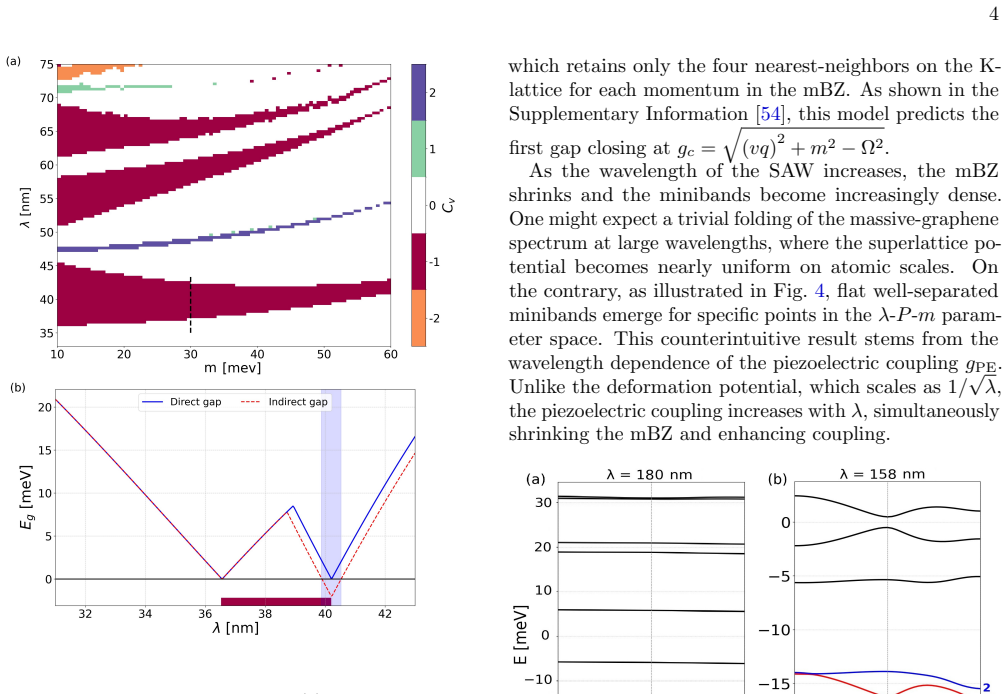
We introduce a new class of tunable periodic structures, formed by launching two obliquely propagating surface acoustic waves on a piezoelectric substrate that supports a two-dimensional quantum material. The resulting acoustoelectric superlattice exhibits two salient features. First, its periodicity is widely tunable, spanning a length scale intermediate between moir\'e superlattices and optical lattices, enabling the formation of narrow, topologically nontrivial energy bands. Second, unlike moir\'e systems, where the superlattice amplitude is set by intrinsic interlayer tunneling and lattice relaxation, the amplitude of the acoustoelectric potential is externally tunable via the surface acoustic wave power. Using massive monolayer graphene as an example, we demonstrate that varying the frequencies and power of the surface acoustic waves enables in-situ control over the band structure of the 2D material, generating flat bands and nontrivial valley Chern numbers, featuring a highly localized Berry curvature.
Editorial analysis
A structured set of objections, weighed in public.
Referee Report
Summary. The manuscript introduces a tunable acoustoelectric superlattice formed by two obliquely propagating surface acoustic waves on a piezoelectric substrate supporting a 2D material. Using massive monolayer graphene as an example, it claims that varying SAW frequencies and power enables in-situ control of the band structure, producing flat minibands with nontrivial valley Chern numbers and highly localized Berry curvature.
Significance. If the underlying calculations are sound, this approach offers external tunability of both superlattice periodicity and amplitude, providing a flexible alternative to moiré systems for engineering topological minibands in 2D materials.
major comments (2)
- [Abstract] Abstract: the claims of flat bands, nontrivial valley Chern numbers, and localized Berry curvature rest on unshown band-structure calculations; no equations, numerical methods, or data are referenced to verify that the modeled SAW potential produces these features.
- [Model] Model section: the assumption that SAW interference yields a clean, dominant periodic potential whose amplitude and periodicity directly set the miniband topology is load-bearing but unquantified; frequency-dependent attenuation and substrate scattering could reduce effective amplitude or add non-periodic components, potentially closing gaps or delocalizing Berry curvature.
minor comments (2)
- [Methods] Clarify the precise form of the acoustoelectric potential and the numerical diagonalization procedure used for the graphene Hamiltonian.
- [Results] Add a figure or table showing the Berry curvature distribution to support the claim of high localization.
Simulated Author's Rebuttal
We thank the referee for their careful reading and constructive comments, which have helped us improve the clarity and rigor of the manuscript. We address each major comment point by point below and indicate the revisions made.
read point-by-point responses
-
Referee: [Abstract] Abstract: the claims of flat bands, nontrivial valley Chern numbers, and localized Berry curvature rest on unshown band-structure calculations; no equations, numerical methods, or data are referenced to verify that the modeled SAW potential produces these features.
Authors: The abstract is a high-level summary. The explicit model for the SAW-induced potential (superposition of two oblique waves yielding a tunable 2D periodic potential), the continuum Hamiltonian for massive monolayer graphene, the numerical diagonalization procedure, and the computed miniband structures, valley Chern numbers, and Berry curvature are all presented in Sections III and IV, with supporting figures. To address the concern, we have revised the abstract to reference these sections and the associated calculations. revision: yes
-
Referee: [Model] Model section: the assumption that SAW interference yields a clean, dominant periodic potential whose amplitude and periodicity directly set the miniband topology is load-bearing but unquantified; frequency-dependent attenuation and substrate scattering could reduce effective amplitude or add non-periodic components, potentially closing gaps or delocalizing Berry curvature.
Authors: We modeled the ideal interference to demonstrate the principle of in-situ tunability. We have added a discussion in the revised Model section estimating SAW attenuation lengths (typically millimeters at GHz frequencies on common piezoelectric substrates), which greatly exceed the device scales and superlattice periods considered. We also include a brief analysis showing that weak non-periodic perturbations primarily broaden higher bands while preserving the low-energy gap and localized Berry curvature topology in the parameter range studied. Full device-scale simulations of scattering lie beyond the present scope. revision: partial
Circularity Check
No circularity in derivation chain
full rationale
The paper imposes an external acoustoelectric potential from the interference of two obliquely propagating surface acoustic waves whose amplitude and periodicity are set by tunable SAW frequency and power; this potential is an independent input. Standard band-structure methods (continuum or tight-binding Hamiltonian for massive monolayer graphene) are then applied to this potential to obtain minibands, flat bands, and valley Chern numbers via direct computation of Berry curvature. No step equates the output topology or flatness to a fitted parameter, self-defined quantity, or load-bearing self-citation; the topological invariants follow from the Schrödinger equation solution rather than being presupposed or renamed. The derivation remains self-contained and externally verifiable by numerical diagonalization under the stated potential.
Axiom & Free-Parameter Ledger
free parameters (2)
- SAW frequency
- SAW power
axioms (1)
- domain assumption The 2D material (massive monolayer graphene) can be described by a Dirac Hamiltonian with a mass term under an external periodic potential.
Reference graph
Works this paper leans on
-
[1]
T. Ozawa, H. M. Price, A. Amo, N. Goldman, M. Hafezi, L. Lu, M. C. Rechtsman, D. Schuster, J. Simon, O. Zil- berberg, and I. Carusotto, Reviews of Modern Physics 91, 015006 (2019), arXiv:1802.04173 [physics.optics]
work page internal anchor Pith review Pith/arXiv arXiv 2019
-
[2]
Z. Liu, X. Zhang, Y. Mao, Y. Y. Zhu, Z. Yang, C. T. Chan, and P. Sheng, Science 289, 1734 (2000)
work page 2000
- [3]
-
[4]
Ultracold atomic gases in optical lattices: mimicking condensed matter physics and beyond
M. Lewenstein, A. Sanpera, V. Ahufinger, B. Damski, A. Sen, and U. Sen, Advances in Physics 56, 243 (2007), arXiv:cond-mat/0606771 [cond-mat.other]
work page internal anchor Pith review Pith/arXiv arXiv 2007
- [5]
-
[6]
Moire bands in twisted double-layer graphene
R. Bistritzer and A. H. MacDonald, Proceedings of the National Academy of Science 108, 12233 (2011), arXiv:1009.4203 [cond-mat.mes-hall]
work page internal anchor Pith review Pith/arXiv arXiv 2011
-
[7]
R. Bistritzer and A. H. MacDonald, Phys. Rev. B 84, 035440 (2011), arXiv:1101.2606 [cond-mat.mes-hall]
work page internal anchor Pith review Pith/arXiv arXiv 2011
-
[8]
Y. Cao, V. Fatemi, A. Demir, S. Fang, S. L. Tomarken, J. Y. Luo, J. D. Sanchez-Yamagishi, K. Watan- abe, T. Taniguchi, E. Kaxiras, R. C. Ashoori, and P. Jarillo-Herrero, Nature (London) 556, 80 (2018), arXiv:1802.00553 [cond-mat.mes-hall]
work page internal anchor Pith review Pith/arXiv arXiv 2018
-
[9]
Y. Cao, V. Fatemi, S. Fang, K. Watanabe, T. Taniguchi, E. Kaxiras, and P. Jarillo-Herrero, Nature (London) 556, 43 (2018), arXiv:1803.02342 [cond-mat.mes-hall]
work page internal anchor Pith review Pith/arXiv arXiv 2018
- [10]
-
[11]
U. Zondiner, A. Rozen, D. Rodan-Legrain, Y. Cao, R. Queiroz, T. Taniguchi, K. Watanabe, Y. Oreg, F. von Oppen, A. Stern, E. Berg, P. Jarillo-Herrero, and S. Ilani, Nature (London) 582, 203 (2020), arXiv:1912.06150 [cond- mat.mes-hall]
-
[12]
T. Song, Q.-C. Sun, E. Anderson, C. Wang, J. Qian, T. Taniguchi, K. Watanabe, M. A. McGuire, R. St¨ ohr, D. Xiao, T. Cao, J. Wrachtrup, and X. Xu, Science 374, 1140 (2021)
work page 2021
- [13]
- [14]
-
[15]
B. A. Bernevig and D. K. Efetov, Physics Today 77, 38 (2024)
work page 2024
- [16]
- [17]
-
[18]
P. Stepanov, M. Xie, T. Taniguchi, K. Watanabe, X. Lu, A. H. MacDonald, B. A. Bernevig, and D. K. Efetov, Phys. Rev. Lett. 127, 197701 (2021), arXiv:2012.15126 [cond-mat.mes-hall]
- [19]
-
[21]
X. Wang and O. Vafek, Physical Review X 14, 021042 (2024), arXiv:2310.15982 [cond-mat.mes-hall]
-
[22]
Tuning superconductivity in twisted bilayer graphene
M. Yankowitz, S. Chen, H. Polshyn, Y. Zhang, K. Watan- abe, T. Taniguchi, D. Graf, A. F. Young, and C. R. Dean, Science 363, 1059 (2019), arXiv:1808.07865 [cond- mat.mes-hall]
work page internal anchor Pith review Pith/arXiv arXiv 2019
-
[23]
P. Stepanov, I. Das, X. Lu, A. Fahimniya, K. Watanabe, T. Taniguchi, F. H. L. Koppens, J. Lischner, L. Levitov, and D. K. Efetov, Nature (London) 583, 375 (2020), arXiv:1911.09198 [cond-mat.supr-con]
- [24]
-
[25]
J. M. Park, Y. Cao, K. Watanabe, T. Taniguchi, and P. Jarillo-Herrero, Nature (London) 590, 249 (2021)
work page 2021
- [26]
-
[27]
P. T¨ orm¨ a, S. Peotta, and B. A. Bernevig, Nat. Rev. Phys. 4, 528 (2022), arXiv:2111.00807 [cond-mat.supr-con]
-
[28]
P. T¨ orm¨ a, Phys. Rev. Lett. 131, 240001 (2023), arXiv:2312.11516 [cond-mat.supr-con]
- [29]
- [30]
- [31]
- [32]
- [33]
- [34]
-
[35]
Interaction of surface acoustic waves with electronic excitations in graphene
A. Hern´ andez-M´ ınguez, Y. T. Liou, and P. V. Santos, Journal of Physics D Applied Physics 51, 383001 (2018), arXiv:1811.00040 [cond-mat.mes-hall]
work page internal anchor Pith review Pith/arXiv arXiv 2018
- [36]
-
[37]
Q. Li, K. Hoogeboom-Pot, D. Nardi, M. M. Murnane, H. C. Kapteyn, M. E. Siemens, E. H. Anderson, O. Hell- wig, E. Dobisz, B. Gurney, R. Yang, and K. A. Nelson, Phys. Rev. B 85, 195431 (2012)
work page 2012
-
[38]
A. A. Maznev, R. Mincigrucci, F. Bencivenga, V. Unikan- danunni, F. Capotondi, G. Chen, Z. Ding, R. A. Duncan, L. Foglia, M. G. Izzo, C. Masciovecchio, A. Martinelli, G. Monaco, E. Pedersoli, S. Bonetti, and K. A. Nelson, Applied Physics Letters 119, 044102 (2021)
work page 2021
-
[39]
J. Zhou, Y. Zhang, D. Liu, F. Zhuo, L. Qian, H. Li, Y. Fu, and H. Duan, Engineering 20, 112 (2023)
work page 2023
-
[40]
K. Kim, M. Yankowitz, B. Fallahazad, S. Kang, H. C. P. Movva, S. Huang, S. Larentis, C. M. Corbet, T. Taniguchi, K. Watanabe, S. K. Banerjee, B. J. LeRoy, and E. Tutuc, Nano Letters 16, 1989 (2016)
work page 1989
-
[41]
Y. Cao, J. Y. Luo, V. Fatemi, S. Fang, J. D. Sanchez- Yamagishi, K. Watanabe, T. Taniguchi, E. Kaxiras, and P. Jarillo-Herrero, Phys. Rev. Lett. 117, 116804 (2016), arXiv:1607.05147 [cond-mat.mes-hall]
work page internal anchor Pith review Pith/arXiv arXiv 2016
- [42]
-
[43]
N. N. T. Nam and M. Koshino, Phys. Rev. B 96, 075311 (2017), arXiv:1706.03908 [cond-mat.mtrl-sci]
work page internal anchor Pith review Pith/arXiv arXiv 2017
- [44]
-
[45]
P. Lucignano, D. Alf` e, V. Cataudella, D. Ninno, and G. Cantele, Phys. Rev. B 99, 195419 (2019), arXiv:1902.02690 [cond-mat.mes-hall]
work page internal anchor Pith review Pith/arXiv arXiv 2019
-
[46]
B. Hunt, J. D. Sanchez-Yamagishi, A. F. Young, M. Yankowitz, B. J. LeRoy, K. Watanabe, T. Taniguchi, P. Moon, M. Koshino, P. Jarillo-Herrero, and R. C. Ashoori, Science 340, 1427 (2013), arXiv:1303.6942 [cond- mat.mes-hall]
work page internal anchor Pith review Pith/arXiv arXiv 2013
-
[47]
C. R. Woods, L. Britnell, A. Eckmann, R. S. Ma, J. C. Lu, H. M. Guo, X. Lin, G. L. Yu, Y. Cao, R. V. Gor- 7 bachev, A. V. Kretinin, J. Park, L. A. Ponomarenko, M. I. Katsnelson, Y. N. Gornostyrev, K. Watanabe, T. Taniguchi, C. Casiraghi, H. J. Gao, A. K. Geim, and K. S. Novoselov, Nature Physics 10, 451 (2014), arXiv:1401.2637 [cond-mat.mes-hall]
work page internal anchor Pith review Pith/arXiv arXiv 2014
-
[48]
J. Jung, A. M. Dasilva, A. H. MacDonald, and S. Adam, Nature Communications 6, 6308 (2015), arXiv:1403.0496 [cond-mat.mes-hall]
work page internal anchor Pith review Pith/arXiv arXiv 2015
-
[49]
J. Liu, C. Luo, H. Lu, Z. Huang, G. Long, and X. Peng, Molecules 27, 10.3390/molecules27123740 (2022)
- [50]
- [51]
- [52]
-
[53]
F. Escudero, A. Sinner, Z. Zhan, P. A. Pantale´ on, and F. Guinea, Physical Review Research 6, 023203 (2024), arXiv:2309.08671 [cond-mat.mes-hall]
-
[54]
In the Supplementary Information further details can be found regarding the transformation to the moving frame, about the derivation of the approximate ten-band description, as well as an extended discussion of the SAW potential and the Berry curvature of the minibands
-
[55]
Zhang, Bulk and Surface Acoustic Waves , 1st ed
G. Zhang, Bulk and Surface Acoustic Waves , 1st ed. (Jenny Stanford Publishing, Singapore, 2022)
work page 2022
- [56]
-
[57]
Y. Wang, A.-S. Walter, G. Jotzu, and K. Viebahn, Phys. Rev. A 107, 043309 (2023), arXiv:2301.05229 [cond- mat.quant-gas]
-
[58]
Band Structure Engineering of 2D Materials using Patterned Dielectric Superlattices
C. Forsythe, X. Zhou, K. Watanabe, T. Taniguchi, A. Pa- supathy, P. Moon, M. Koshino, P. Kim, and C. R. Dean, Nature Nanotechnology 13, 566 (2018), arXiv:1710.01365 [cond-mat.mes-hall]
work page internal anchor Pith review Pith/arXiv arXiv 2018
-
[59]
D. Barcons Ruiz, H. Herzig Sheinfux, R. Hoffmann, I. Torre, H. Agarwal, R. K. Kumar, L. Vistoli, T. Taniguchi, K. Watanabe, A. Bachtold, and F. H. L. Koppens, Nature Communications 13, 6926 (2022), arXiv:2207.14027 [cond-mat.mes-hall]
- [60]
- [61]
- [62]
-
[63]
P. Wei, S. Lee, F. Lemaitre, L. Pinel, D. Cutaia, W. Cha, F. Katmis, Y. Zhu, D. Heiman, J. Hone, J. S. Mood- era, and C.-T. Chen, Nature Materials 15, 711 (2016), arXiv:1510.05920 [cond-mat.mes-hall]
work page internal anchor Pith review Pith/arXiv arXiv 2016
-
[64]
C. Zhao, T. Norden, P. Zhang, P. Zhao, Y. Cheng, F. Sun, J. P. Parry, P. Taheri, J. Wang, Y. Yang, T. Scrace, K. Kang, S. Yang, G.-x. Miao, R. Sabiri- anov, G. Kioseoglou, W. Huang, A. Petrou, and H. Zeng, Nature Nanotechnology 12, 757 (2017), arXiv:1610.04878 [cond-mat.mes-hall]
work page internal anchor Pith review Pith/arXiv arXiv 2017
- [65]
-
[66]
A. H. Castro Neto, F. Guinea, N. M. R. Peres, K. S. Novoselov, and A. K. Geim, Rev. Mod. Phys. 81, 109 (2009), arXiv:0709.1163
work page internal anchor Pith review Pith/arXiv arXiv 2009
-
[67]
N. Bultinck, E. Khalaf, S. Liu, S. Chatterjee, A. Vish- wanath, and M. P. Zaletel, Physical Review X 10, 031034 (2020), arXiv:1911.02045 [cond-mat.str-el]
- [68]
- [69]
-
[70]
Z.-D. Song and B. A. Bernevig, Phys. Rev. Lett. 129, 047601 (2022), arXiv:2111.05865 [cond-mat.str-el]
-
[71]
Z.-Y. Xiao and S. Zhang, Physical Review Research 7, 013103 (2025), arXiv:2405.17808 [cond-mat.str-el]. 8 SUPPLEMENT AR Y MA TERIAL Moving frame We look for a unitary transformation that makes the Hamiltonian Hk(t) in Eq. (3) of the main text time-independent. With a general unitary operator Uk the Hamiltonian transforms as H ′ k = UkHkU † k + i ∂Uk ∂t U ...
discussion (0)
Sign in with ORCID, Apple, or X to comment. Anyone can read and Pith papers without signing in.