REVIEW 4 major objections 5 minor 77 references
Sat2City: 3D City Generation from A Single Satellite Image with Cascaded Latent Diffusion
T0 review · 4 major / 5 minor · reviewed 2026-08-06 · deepseek-v4-flash
Pith's one-line read A single satellite image can be turned into a detailed, colorized 3D city model in about one minute by cascaded latent diffusion over sparse voxel grids, with higher fidelity than prior city generation models.
desk verdict Sat2City's architecture and dataset are worth a look, but the paper does not actually demonstrate generation from a single satellite image: the experiments condition on height maps rendered from the target meshes and compare against unconditional baselines. read the letter →
The pith
A machine-rendered reading of the paper's core claim, the machinery that carries it, and where it could break.
The reading
What carries the argument
The carrying mechanism is a variational autoencoder with three latent bottlenecks over sparse voxel grids: a densified neck encodes overall occupancy, a sparse neck encodes surface geometry and records voxel pruning decisions, and a re-hash neck coarsens the appearance feature grid by repeated factors of two using trilinear interpolation to supply multi-scale context. Inverse sampling supervises per-vertex color implicitly: decoded color features are trilinearly sampled onto the colorized point cloud and an MLP predicts point colors, avoiding the smoothing and blending failures of direct color splatting. A cascaded latent diffusion pipeline denoises the three levels in sequence—dense geometry, sparse geometry, hierarchical appearance—conditioning each stage on the previous one and using the recorded pruning decisions to keep appearance aligned with the evolving surface.
What would settle it
Apply the trained model to a set of real satellite images with co-registered, colorized 3D city tiles, extract height maps, and compare generated geometries and appearances against the ground-truth tiles using Chamfer distance, EMD, and a user study; if the geometric metrics on real inputs fall to the level of the rendering-based baselines, or if the model visibly hallucinates or collapses city blocks, the claimed superiority and transferability are falsified.
Extended reading notes
Core claim
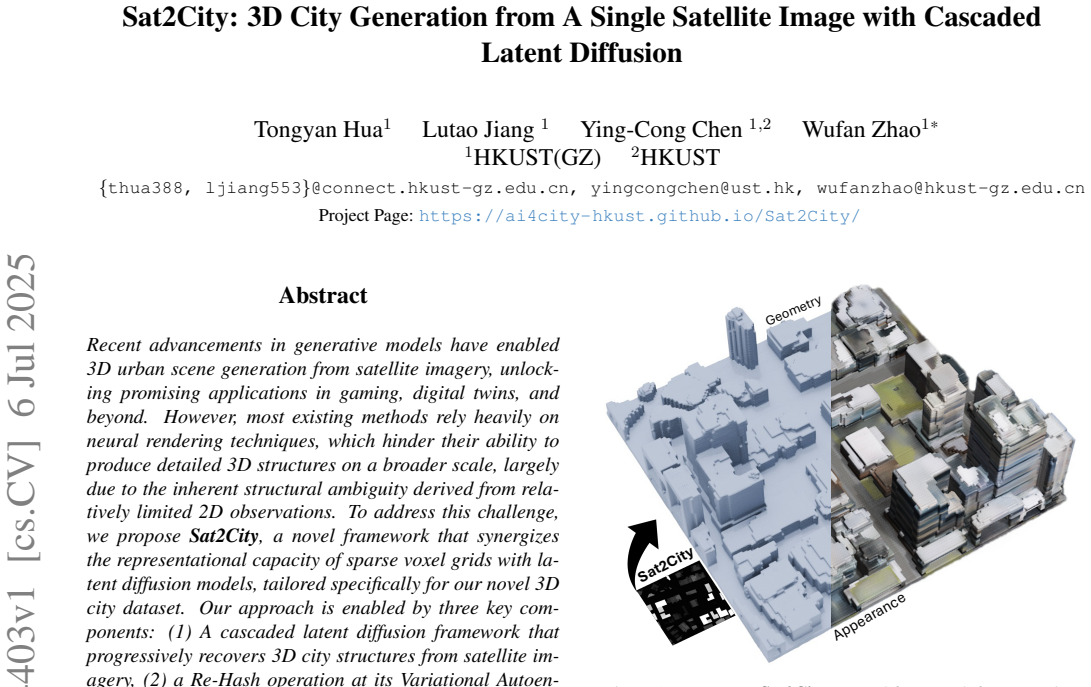
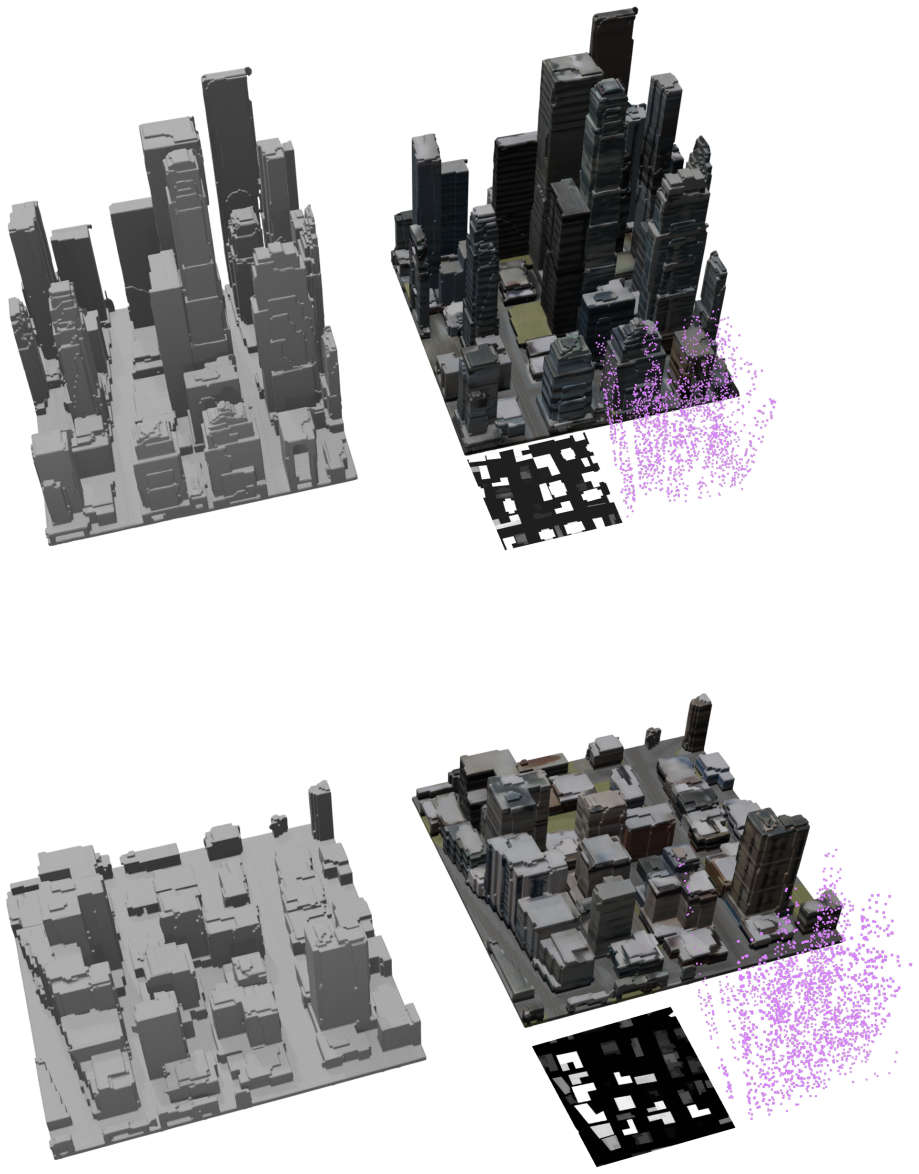
On its own terms, the paper's discovery is that city-scale 3D generation from a single satellite image can be performed as direct synthesis of explicit geometry and appearance, rather than as neural rendering of a latent scene. The authors show that a sparse voxel latent can carry both occupancy and color, provided appearance is encoded in multi-level coarsened feature grids and supervised implicitly through the original colorized point cloud. This design sidesteps the viewpoint-limited rendering artifacts of GAN- and neural-rendering-based city generators and the point-density scaling wall of point-cloud diffusion. Experiments on the new dataset report lower geometric MMD and higher coverage than the unconditional scene-generation baselines it compares against, and higher user-study scores than the rendering-based city generators.
Load-bearing premise
The load-bearing premise is that rendered height maps with contrast-scaling noise capture the same information content and noise structure as real satellite-derived elevation maps, so models trained on synthetic pairs will transfer to real satellite inputs; the paper states that real-world evaluation is still pending.
Editorial extensions
If this is right
- If the central claim holds, a single satellite image is enough conditioning to reconstruct explicit, colorized 3D city geometry, not merely novel 2D views.
- Because geometry and appearance are generated jointly as voxel attributes, downstream applications such as digital twins, games, and planning can consume the output mesh directly without multi-view reconstruction.
- The cascaded conditioning scheme implies that geometry errors can be corrected progressively: the dense occupancy stage filters false volumes, and sparse-stage pruning keeps appearance aligned to surfaces.
- The ablations indicate that multi-scale re-hashed appearance context is necessary for stable color optimization in sparse voxel VAEs, a design constraint for future 3D latent diffusion models.
- On the synthetic dataset, the method sets new quantitative reference points: lower geometric MMD and higher coverage than the unconditional scene-generation baselines, and higher user ratings than the rendering-based city generators.
Reading between the lines
- An untested but plausible implication is that the same cascade will transfer to real satellite-derived elevation maps, because the authors' preliminary real-data processing found smaller Chamfer distances between height-map-derived point clouds and colorized ground truth than on synthetic data; that comparison, however, is not itself evidence about generation quality.
- The Re-Hash plus inverse-sampling recipe could transfer to other sparse-voxel generation tasks where appearance must be smooth, such as texturing reconstructed meshes from sparse sensor data.
- A concrete next test would replace synthetic contrast-scaled height maps with height maps produced by monocular elevation estimation from real satellite imagery and measure whether the cascaded diffusion still prunes false occupancy correctly; the paper does not yet show this.
- If real-world fine-tuning is added, the automated data pipeline and roughly one-minute-per-scene inference could make city-scale digital twins inexpensive to build.
Editorial analysis
A structured set of objections, weighed in public.
Referee Report
Summary. The paper introduces Sat2City, a cascaded latent diffusion framework that generates 3D city geometry and appearance from a single satellite image. The method encodes a colorized point cloud into sparse voxel grids with a triplet-bottleneck VAE (dense, sparse, and Re-Hash multi-level appearance latents) and uses three sequentially conditioned diffusion stages to recover geometry and color. The authors also introduce a synthetic dataset of Blender-rendered cities paired with simulated height maps, and they report geometric (COV, MMD) and perceptual (user study) comparisons against existing city generation baselines. The central claim is that the framework generates detailed 3D structures from a single satellite image with superior fidelity.
Significance. The architectural contributions—cascaded latent diffusion, the Re-Hash multi-scale appearance bottleneck, and inverse sampling for per-vertex color supervision—are reasonable and potentially useful for large-scale 3D scene generation, and the synthetic dataset may be a valuable resource for the community. If the full satellite-to-3D pipeline were validated, the work would be a meaningful step toward practical city-scale generation. However, the experimental evidence as presented does not support the title and abstract claim of generation 'from a single satellite image': the evaluated conditioning input is a height map rendered from the same artist mesh that provides the reference point cloud, and the quantitative comparisons are against unconditional baselines. The real-world extension is explicitly left to future work in Supplementary Section 7. The paper therefore promises more than it currently delivers, and the load-bearing claims need additional validation before publication.
major comments (4)
- [§3.3 and Eq. (4)] The evaluated pipeline is not 'from a single satellite image.' Section 3.3 describes how height maps are rendered in Blender from the same artist mesh that supplies the reference point cloud, and Eq. (4) conditions the dense latent diffusion on the point cloud lifted from that height map. The satellite-to-height-map step appears only in Supplementary Section 7 and is not part of the model evaluated in Tables 2 and 3. This is a load-bearing gap between the stated contribution and the experiments. The authors should either evaluate the complete pipeline on real or held-out satellite images, or substantially revise the claims to say the method generates 3D cities from (noisy) height maps.
- [Table 2] The geometric comparison is confounded. NFD and BlockFusion are unconditional generators, while Sat2City is conditioned on a height map that is derived from the same mesh that defines the reference point cloud. A near-deterministic height-map-to-surface lifting could plausibly achieve COV(CD)=100.00 under this protocol, so the reported COV and MMD values do not demonstrate superior generative fidelity. The paper should compare against conditional baselines (e.g., a model conditioned on the same height map, or Sat2City with the conditioning corrupted or removed) and should report diversity metrics to show that the diffusion output is not simply reconstructing the condition.
- [Table 3] The appearance comparison against Sat2Scene* is not informative as evidence of superiority. Sat2Scene* is retrained on the proposed dataset at roughly 14 points per square meter, whereas Sat2Scene was designed for point cloud densities around 400 points per square meter. The resulting failure of Sat2Scene* can be attributed to a mismatch between the method's requirements and the data density, not to a fundamental superiority of Sat2City. If this comparison is kept, it should be framed as a stress test, and the authors should also present a density-matched setting or an alternative appearance baseline.
- [Supplementary Section 7] The real-world evidence reported in the supplementary does not validate the central claim. The Chamfer distance of 0.0977 is computed between point clouds derived from inferred height maps and colorized ground-truth point clouds, not between Sat2City's 3D outputs and ground truth on real satellite inputs. The text explicitly states that real-world evaluation remains pending. The 'Spoiler alert' paragraph describes a data collection pipeline but does not include any generated 3D city from an actual satellite image. Claims of generalizability to real satellite data are therefore unsupported by the presented experiments.
minor comments (5)
- [§1] There is a typo in the introduction: 'appeance' should be 'appearance'.
- [§4.1 / Table 2] The COV and MMD metrics are reported with inconsistent precision (e.g., 100.00 vs 60.00), and the table caption would benefit from explicitly stating that 'Ours' uses a conditional protocol while the baselines are unconditional; this distinction is currently only in the note.
- [Eq. (4)] The conditioning symbol c(Ph) is not defined in the main text; it should be clarified that c(·) denotes the point encoder and condition projection described in Supplementary Section 6.2.
- [Table 4 (Supplementary)] The user-study questions for GPQ and GSC are identical to those for TPQ and TSC, which undermines the intended distinction between appearance-only and geometry-only evaluation; the authors should provide distinct questions or explain the intended difference.
- [Supplementary Section 7] The heading 'Spoiler alert' is informal and out of place in a journal submission; consider renaming to something like 'Preliminary real-world data pipeline'.
Circularity Check
The headline 'superior fidelity' result is driven by an evaluation in which the conditioning height map is rendered from the same reference mesh that is used as ground truth; the comparison to unconditional baselines therefore measures reconstruction of the condition's source rather than independent 3D city generation from satellite imagery.
-
self definitional
[Section 3.3, Sat2City Dataset construction; Eq. (4) in Section 3.2]
"The height field is then simulated in blender by mapping the texture coordinates of the elevation axis (in this case, the y-axis) into grayscale, with the lowest and highest elevations being linearly assigned to 0 and 255, respectively."
The conditioning input Ph is rendered from the same artist mesh whose sampled point cloud is the reference for all geometric metrics. Eq. (4) conditions the dense geometry latent on c(Ph), so the target geometry is the source of the input. The model is therefore always asked to recover the mesh that generated its condition; the resulting COV(CD)=100.00 in Table 2 is the visible signature of this construction, and the favorable MMD values reduce to the dataset construction rather than to an independent generative capability.
-
fitted input called prediction
[Section 4.2, Table 2 and caption]
"Results for NFD and BlockFusion are obtained through unconditional generation methods [54], while our Sat2City framework operates as a conditional generation pipeline."
The comparison is asymmetric by construction: NFD and BlockFusion must generate without access to the test mesh, while Sat2City receives a height map rendered from that same mesh as its condition. The claimed 98.1% COV(CD) improvement and the 100.00 COV value are therefore a measure of how faithfully the model reconstructs the condition's source, not of superior city generation. The 'prediction' of geometry is statistically anchored to the reference by the target-derived condition, so the headline fidelity claim is forced by the evaluation protocol.
full rationale
The cascaded latent diffusion architecture itself is self-contained: Re-Hash, inverse sampling, and the triplet VAE are described with equations and are not circularly defined in terms of the evaluation. No load-bearing self-citation chain is present. However, the central claim 'generates detailed 3D structures from a single satellite image, achieving superior fidelity' is supported by a protocol whose condition is a Blender-rendered height map derived from the reference mesh, and the quantitative comparison is made against unconditional baselines. This makes the geometry metrics largely a reconstruction test of a target-derived input, not a test of generation from an independent satellite observation. The supplementary explicitly states that real-world evaluation remains pending and reports Chamfer distances for height-map-derived point clouds rather than for Sat2City outputs on satellite imagery, so the real-world transfer claim is not demonstrated in the paper. These issues warrant a circularity score of 6 because the headline superiority result reduces, in the reported evaluation, to conditioning on information taken from the reference outputs.
Assumptions & free parameters
free parameters (7)
- VAE loss weight lambda_0 =
20
- VAE loss weight lambda_1 =
50
- VAE loss weight lambda_2 =
0.03
- VAE loss weight lambda_3 =
50
- Dual-stage training switch epoch E =
10
- Re-Hash hierarchy depth n =
4
- Height map contrast-scaling noise strength =
not specified
assumptions (5)
- domain assumption The synthetic Blender city meshes are representative of real urban geometry and appearance distributions at city scale.
- domain assumption A single height-map-derived point cloud Ph carries sufficient information to condition the recovery of detailed 3D geometry and appearance.
- domain assumption Stage-wise training of the cascaded diffusion (training each Psi on ground-truth or decoded conditions) yields a valid joint distribution at inference when chained.
- domain assumption XCube's sparse voxel hierarchy and NKSR's surface-fitting decoder remain stable when extended to appearance decoding with the Re-Hash bottleneck.
- domain assumption The inverse sampling loss (Eq. 2) via trilinear interpolation at point locations provides a faithful and sufficient supervision signal for per-vertex color attributes.
Cite this review
Pith. "Pith review of Sat2City: 3D City Generation from A Single Satellite Image with Cascaded Latent Diffusion." pith.science (2026). https://pith.science/paper/AZIUGIO6
@misc{pith2026250704403,
  author       = {Pith},
  title        = {Pith review of: Sat2City: 3D City Generation from A Single Satellite Image with Cascaded Latent Diffusion},
  year         = {2026},
  howpublished = {\url{https://pith.science/paper/AZIUGIO6}},
  note         = {Machine review of arXiv:2507.04403}
}
read the original abstract
Recent advancements in generative models have enabled 3D urban scene generation from satellite imagery, unlocking promising applications in gaming, digital twins, and beyond. However, most existing methods rely heavily on neural rendering techniques, which hinder their ability to produce detailed 3D structures on a broader scale, largely due to the inherent structural ambiguity derived from relatively limited 2D observations. To address this challenge, we propose Sat2City, a novel framework that synergizes the representational capacity of sparse voxel grids with latent diffusion models, tailored specifically for our novel 3D city dataset. Our approach is enabled by three key components: (1) A cascaded latent diffusion framework that progressively recovers 3D city structures from satellite imagery, (2) a Re-Hash operation at its Variational Autoencoder (VAE) bottleneck to compute multi-scale feature grids for stable appearance optimization and (3) an inverse sampling strategy enabling implicit supervision for smooth appearance transitioning.To overcome the challenge of collecting real-world city-scale 3D models with high-quality geometry and appearance, we introduce a dataset of synthesized large-scale 3D cities paired with satellite-view height maps. Validated on this dataset, our framework generates detailed 3D structures from a single satellite image, achieving superior fidelity compared to existing city generation models.
Figures


Figures from the paper (13 more)


Reference graph
Works this paper leans on
-
[1]
Componerf: Text-guided multi-object compositional nerf with editable 3d scene lay- out
Haotian Bai, Yuanhuiyi Lyu, Lutao Jiang, Sijia Li, Haonan Lu, Xiaodong Lin, and Lin Wang. Componerf: Text-guided multi-object compositional nerf with editable 3d scene lay- out. arXiv preprint arXiv:2303.13843, 2023. 2
arXiv 2023
-
[2]
Persistent nature: A generative model of un- bounded 3d worlds
Lucy Chai, Richard Tucker, Zhengqi Li, Phillip Isola, and Noah Snavely. Persistent nature: A generative model of un- bounded 3d worlds. In Proceedings of the IEEE/CVF con- ference on computer vision and pattern recognition , pages 20863–20874, 2023. 3
work page 2023
-
[3]
Shapenet: An information-rich 3d model repository
Angel X Chang, Thomas Funkhouser, Leonidas Guibas, Pat Hanrahan, Qixing Huang, Zimo Li, Silvio Savarese, Manolis Savva, Shuran Song, Hao Su, et al. Shapenet: An information-rich 3d model repository. arXiv preprint arXiv:1512.03012, 2015. 4
arXiv 2015
-
[4]
Meshxl: Neural coordinate field for generative 3d foundation models
Sijin Chen, Xin Chen, Anqi Pang, Xianfang Zeng, Wei Cheng, Yijun Fu, Fukun Yin, Yanru Wang, Zhibin Wang, Chi Zhang, et al. Meshxl: Neural coordinate field for generative 3d foundation models. arXiv preprint arXiv:2405.20853 ,
-
[5]
Meshanything: Artist-created mesh generation with au- toregressive transformers
Yiwen Chen, Tong He, Di Huang, Weicai Ye, Sijin Chen, Ji- axiang Tang, Xin Chen, Zhongang Cai, Lei Yang, Gang Yu, et al. Meshanything: Artist-created mesh generation with au- toregressive transformers. arXiv preprint arXiv:2406.10163, 2024
arXiv 2024
-
[6]
Meshany- thing v2: Artist-created mesh generation with adjacent mesh tokenization
Yiwen Chen, Yikai Wang, Yihao Luo, Zhengyi Wang, Zilong Chen, Jun Zhu, Chi Zhang, and Guosheng Lin. Meshany- thing v2: Artist-created mesh generation with adjacent mesh tokenization. arXiv preprint arXiv:2408.02555, 2024. 2
arXiv 2024
-
[7]
Scene- dreamer: Unbounded 3d scene generation from 2d image collections
Zhaoxi Chen, Guangcong Wang, and Ziwei Liu. Scene- dreamer: Unbounded 3d scene generation from 2d image collections. IEEE transactions on pattern analysis and ma- chine intelligence, 2023. 3
work page 2023
-
[8]
Xinhua Cheng, Tianyu Yang, Jianan Wang, Yu Li, Lei Zhang, Jian Zhang, and Li Yuan. Progressive3d: Progres- sively local editing for text-to-3d content creation with com- plex semantic prompts. arXiv preprint arXiv:2310.11784 ,
Show all 77 references
-
[9]
Set-the-scene: Global-local training for generating controllable nerf scenes
Dana Cohen-Bar, Elad Richardson, Gal Metzer, Raja Giryes, and Daniel Cohen-Or. Set-the-scene: Global-local training for generating controllable nerf scenes. In Proceedings of the IEEE/CVF International Conference on Computer Vi- sion, pages 2920–2929, 2023. 2
2023
-
[10]
Streetscapes: Large-scale consistent street view generation using autore- gressive video diffusion
Boyang Deng, Richard Tucker, Zhengqi Li, Leonidas Guibas, Noah Snavely, and Gordon Wetzstein. Streetscapes: Large-scale consistent street view generation using autore- gressive video diffusion. In ACM SIGGRAPH 2024 Confer- ence Papers, pages 1–11, 2024. 1, 3
2024
-
[11]
Citycraft: A real crafter for 3d city generation
Jie Deng, Wenhao Chai, Junsheng Huang, Zhonghan Zhao, Qixuan Huang, Mingyan Gao, Jianshu Guo, Shengyu Hao, Wenhao Hu, Jenq-Neng Hwang, et al. Citycraft: A real crafter for 3d city generation. arXiv preprint arXiv:2406.04983, 2024. 2
2024 arXiv
-
[12]
Diffusion models beat gans on image synthesis
Prafulla Dhariwal and Alexander Nichol. Diffusion models beat gans on image synthesis. Advances in neural informa- tion processing systems, 34:8780–8794, 2021. 1, 2
2021
-
[13]
Syncity: Training-free gen- eration of 3d worlds
Paul Engstler, Aleksandar Shtedritski, Iro Laina, Christian Rupprecht, and Andrea Vedaldi. Syncity: Training-free gen- eration of 3d worlds. arXiv:2503.16420, 2025. 3
2025 arXiv
-
[14]
Disentangled 3d scene genera- tion with layout learning
Dave Epstein, Ben Poole, Ben Mildenhall, Alexei A Efros, and Aleksander Holynski. Disentangled 3d scene genera- tion with layout learning. arXiv preprint arXiv:2402.16936,
-
[15]
Blender - a 3d modeling and animation software, 2025
Blender Foundation. Blender - a 3d modeling and animation software, 2025. Version 4.2, accessed: 2025-02-19. 5
2025
-
[16]
Scenescape: Text-driven consistent scene generation
Rafail Fridman, Amit Abecasis, Yoni Kasten, and Tali Dekel. Scenescape: Text-driven consistent scene generation. Ad- vances in Neural Information Processing Systems, 36, 2024. 2, 3
2024
-
[17]
Gancraft: Unsupervised 3d neural rendering of minecraft worlds
Zekun Hao, Arun Mallya, Serge Belongie, and Ming-Yu Liu. Gancraft: Unsupervised 3d neural rendering of minecraft worlds. In Proceedings of the IEEE/CVF International Con- ference on Computer Vision, pages 14072–14082, 2021. 3
2021
-
[18]
Lrm: Large reconstruction model for single image to 3d
Yicong Hong, Kai Zhang, Jiuxiang Gu, Sai Bi, Yang Zhou, Difan Liu, Feng Liu, Kalyan Sunkavalli, Trung Bui, and Hao Tan. Lrm: Large reconstruction model for single image to 3d. arXiv preprint arXiv:2311.04400, 2023. 2
2023 arXiv
-
[19]
Benchmarking implicit neu- ral representation and geometric rendering in real-time rgb-d slam
Tongyan Hua and Lin Wang. Benchmarking implicit neu- ral representation and geometric rendering in real-time rgb-d slam. In Proceedings of the IEEE/CVF Conference on Com- puter Vision and Pattern Recognition , pages 21346–21356,
-
[20]
Neural kernel surface re- construction
Jiahui Huang, Zan Gojcic, Matan Atzmon, Or Litany, Sanja Fidler, and Francis Williams. Neural kernel surface re- construction. In Proceedings of the IEEE/CVF Conference on Computer Vision and Pattern Recognition , pages 4369– 4379, 2023. 3, 1
2023
-
[21]
Neural wavelet-domain diffusion for 3d shape generation
Ka-Hei Hui, Ruihui Li, Jingyu Hu, and Chi-Wing Fu. Neural wavelet-domain diffusion for 3d shape generation. In SIG- GRAPH Asia 2022 Conference Papers, pages 1–9, 2022. 3, 6
2022
-
[22]
A general frame- work to boost 3d gs initialization for text-to-3d generation by lexical richness
Lutao Jiang, Hangyu Li, and Lin Wang. A general frame- work to boost 3d gs initialization for text-to-3d generation by lexical richness. In Proceedings of the 32nd ACM Interna- tional Conference on Multimedia , pages 6803–6812, 2024. 2
2024
-
[23]
Eslam: Efficient dense slam system based on hybrid representation of signed distance fields
Mohammad Mahdi Johari, Camilla Carta, and Franc ¸ois Fleuret. Eslam: Efficient dense slam system based on hybrid representation of signed distance fields. In Proceedings of the IEEE/CVF Conference on Computer Vision and Pattern Recognition, pages 17408–17419, 2023. 3
2023
-
[24]
3d gaussian splatting for real-time radiance field rendering
Bernhard Kerbl, Georgios Kopanas, Thomas Leimk ¨uhler, and George Drettakis. 3d gaussian splatting for real-time radiance field rendering. ACM Trans. Graph., 42(4):139–1,
-
[25]
Nuiscene: Exploring efficient generation of unbounded out- door scenes
Han-Hung Lee, Qinghong Han, and Angel X Chang. Nuiscene: Exploring efficient generation of unbounded out- door scenes. arXiv:2503.16375, 2025. 3
2025 arXiv
-
[26]
Ground- ing image matching in 3d with mast3r
Vincent Leroy, Yohann Cabon, and J´erˆome Revaud. Ground- ing image matching in 3d with mast3r. In European Confer- ence on Computer Vision , pages 71–91. Springer, 2024. 6, 7
2024
-
[27]
Syntheocc: Synthesize 9 geometric-controlled street view images through 3d semantic mpis
Leheng Li, Weichao Qiu, Yingjie Cai, Xu Yan, Qing Lian, Bingbing Liu, and Ying-Cong Chen. Syntheocc: Synthesize 9 geometric-controlled street view images through 3d semantic mpis. arXiv preprint arXiv:2410.00337, 2024. 1, 3
2024 arXiv
-
[28]
Crossviewdiff: A cross-view diffusion model for satellite- to-street view synthesis
Weijia Li, Jun He, Junyan Ye, Huaping Zhong, Zhi- meng Zheng, Zilong Huang, Dahua Lin, and Conghui He. Crossviewdiff: A cross-view diffusion model for satellite- to-street view synthesis. arXiv preprint arXiv:2408.14765 , 2024
2024 arXiv
-
[29]
Sat2vid: Street-view panoramic video synthesis from a single satellite image
Zuoyue Li, Zhenqiang Li, Zhaopeng Cui, Rongjun Qin, Marc Pollefeys, and Martin R Oswald. Sat2vid: Street-view panoramic video synthesis from a single satellite image. In Proceedings of the IEEE/CVF International Conference on Computer Vision, pages 12436–12445, 2021. 1
2021
-
[30]
Sat2scene: 3d urban scene genera- tion from satellite images with diffusion
Zuoyue Li, Zhenqiang Li, Zhaopeng Cui, Marc Pollefeys, and Martin R Oswald. Sat2scene: 3d urban scene genera- tion from satellite images with diffusion. In Proceedings of the IEEE/CVF Conference on Computer Vision and Pattern Recognition, pages 7141–7150, 2024. 1, 2, 3, 6, 7
2024
-
[31]
Infinicity: Infinite-scale city synthesis
Chieh Hubert Lin, Hsin-Ying Lee, Willi Menapace, Menglei Chai, Aliaksandr Siarohin, Ming-Hsuan Yang, and Sergey Tulyakov. Infinicity: Infinite-scale city synthesis. In Proceedings of the IEEE/CVF International Conference on Computer Vision, pages 22808–22818, 2023. 1, 3
2023
-
[32]
World- craft: Photo-realistic 3d world creation and customization via llm agents
Xinhang Liu, Chi-Keung Tang, and Yu-Wing Tai. World- craft: Photo-realistic 3d world creation and customization via llm agents. arXiv preprint arXiv:2502.15601, 2025. 2
2025 arXiv
-
[33]
Urban architect: Steerable 3d urban scene generation with layout prior
Fan Lu, Kwan-Yee Lin, Yan Xu, Hongsheng Li, Guang Chen, and Changjun Jiang. Urban architect: Steerable 3d urban scene generation with layout prior. arXiv preprint arXiv:2404.06780, 2024. 1, 3
2024 arXiv
-
[34]
Geometry-aware satellite- to-ground image synthesis for urban areas
Xiaohu Lu, Zuoyue Li, Zhaopeng Cui, Martin R Oswald, Marc Pollefeys, and Rongjun Qin. Geometry-aware satellite- to-ground image synthesis for urban areas. InProceedings of the IEEE/CVF Conference on Computer Vision and Pattern Recognition, pages 859–867, 2020. 1
2020
-
[35]
Infinicube: Unbounded and con- trollable dynamic 3d driving scene generation with world- guided video models
Yifan Lu, Xuanchi Ren, Jiawei Yang, Tianchang Shen, Zhangjie Wu, Jun Gao, Yue Wang, Siheng Chen, Mike Chen, Sanja Fidler, et al. Infinicube: Unbounded and con- trollable dynamic 3d driving scene generation with world- guided video models. arXiv preprint arXiv:2412.03934 ,
-
[36]
Nerf: Representing scenes as neural radiance fields for view syn- thesis
Ben Mildenhall, Pratul P Srinivasan, Matthew Tancik, Jonathan T Barron, Ravi Ramamoorthi, and Ren Ng. Nerf: Representing scenes as neural radiance fields for view syn- thesis. Communications of the ACM , 65(1):99–106, 2021. 4
2021
-
[37]
Dreamfusion: Text-to-3d using 2d diffusion
Ben Poole, Ajay Jain, Jonathan T Barron, and Ben Milden- hall. Dreamfusion: Text-to-3d using 2d diffusion. arXiv preprint arXiv:2209.14988, 2022. 2
2022 arXiv
-
[38]
Sat2density: Faithful density learning from satellite-ground image pairs
Ming Qian, Jincheng Xiong, Gui-Song Xia, and Nan Xue. Sat2density: Faithful density learning from satellite-ground image pairs. In Proceedings of the IEEE/CVF International Conference on Computer Vision, pages 3683–3692, 2023. 1
2023
-
[39]
Xcube: Large-scale 3d generative modeling using sparse voxel hierarchies
Xuanchi Ren, Jiahui Huang, Xiaohui Zeng, Ken Museth, Sanja Fidler, and Francis Williams. Xcube: Large-scale 3d generative modeling using sparse voxel hierarchies. In Pro- ceedings of the IEEE/CVF Conference on Computer Vision and Pattern Recognition, pages 4209–4219, 2024. 2, ...
2024
-
[40]
Scube: Instant large-scale scene reconstruction using voxsplats
Xuanchi Ren, Yifan Lu, Hanxue Liang, Zhangjie Wu, Huan Ling, Mike Chen, Sanja Fidler, Francis Williams, and Jiahui Huang. Scube: Instant large-scale scene reconstruction using voxsplats. arXiv preprint arXiv:2410.20030, 2024. 2, 3, 4
2024 arXiv
-
[41]
High-resolution image synthesis with latent diffusion models
Robin Rombach, Andreas Blattmann, Dominik Lorenz, Patrick Esser, and Bj ¨orn Ommer. High-resolution image synthesis with latent diffusion models. In Proceedings of the IEEE/CVF conference on computer vision and pattern recognition, pages 10684–10695, 2022. 4
2022
-
[42]
Progressive distillation for fast sampling of diffusion models
Tim Salimans and Jonathan Ho. Progressive distillation for fast sampling of diffusion models. arXiv preprint arXiv:2202.00512, 2022. 1
2022 arXiv
-
[43]
Urbanworld: An urban world model for 3d city generation
Yu Shang, Jiansheng Chen, Hangyu Fan, Jingtao Ding, Jie Feng, and Yong Li. Urbanworld: An urban world model for 3d city generation. arXiv preprint arXiv:2407.11965, 2024. 2
2024 arXiv
-
[44]
Geometry-guided street-view panorama synthesis from satellite imagery
Yujiao Shi, Dylan Campbell, Xin Yu, and Hongdong Li. Geometry-guided street-view panorama synthesis from satellite imagery. IEEE Transactions on Pattern Analysis and Machine Intelligence, 44(12):10009–10022, 2022. 1
2022
-
[45]
3d neural field generation using triplane diffusion
J Ryan Shue, Eric Ryan Chan, Ryan Po, Zachary Ankner, Jiajun Wu, and Gordon Wetzstein. 3d neural field generation using triplane diffusion. In Proceedings of the IEEE/CVF Conference on Computer Vision and Pattern Recognition , pages 20875–20886, 2023. 6
2023
-
[46]
Meshgpt: Generating triangle meshes with decoder-only transformers
Yawar Siddiqui, Antonio Alliegro, Alexey Artemov, Ta- tiana Tommasi, Daniele Sirigatti, Vladislav Rosov, Angela Dai, and Matthias Nießner. Meshgpt: Generating triangle meshes with decoder-only transformers. In Proceedings of the IEEE/CVF Conference on Computer Vision and Patte...
2024
-
[47]
Denoising diffusion implicit models
Jiaming Song, Chenlin Meng, and Stefano Ermon. Denoising diffusion implicit models. arXiv preprint arXiv:2010.02502, 2020. 5
2010 arXiv
-
[48]
Direct voxel grid optimization: Super-fast convergence for radiance fields reconstruction
Cheng Sun, Min Sun, and Hwann-Tzong Chen. Direct voxel grid optimization: Super-fast convergence for radiance fields reconstruction. In Proceedings of the IEEE/CVF conference on computer vision and pattern recognition , pages 5459– 5469, 2022. 4
2022
-
[49]
Edgerunner: Auto-regressive auto-encoder for artistic mesh generation
Jiaxiang Tang, Zhaoshuo Li, Zekun Hao, Xian Liu, Gang Zeng, Ming-Yu Liu, and Qinsheng Zhang. Edgerunner: Auto-regressive auto-encoder for artistic mesh generation. arXiv preprint arXiv:2409.18114, 2024. 2
2024 arXiv
-
[50]
Cloudcompare (version 2.12.4) [gpl software], 2025
CloudCompare Development Team. Cloudcompare (version 2.12.4) [gpl software], 2025. Retrieved on 2025-02-19. 5
2025
-
[51]
Co- slam: Joint coordinate and sparse parametric encodings for neural real-time slam
Hengyi Wang, Jingwen Wang, and Lourdes Agapito. Co- slam: Joint coordinate and sparse parametric encodings for neural real-time slam. In Proceedings of the IEEE/CVF Con- ference on Computer Vision and Pattern Recognition, pages 13293–13302, 2023. 3
2023
-
[52]
Llama-mesh: Unifying 3d mesh generation with language models
Zhengyi Wang, Jonathan Lorraine, Yikai Wang, Hang Su, Jun Zhu, Sanja Fidler, and Xiaohui Zeng. Llama-mesh: Unifying 3d mesh generation with language models. arXiv preprint arXiv:2411.09595, 2024. 2
2024 arXiv
-
[53]
Pivotmesh: Generic 3d mesh generation via pivot ver- tices guidance
Haohan Weng, Yikai Wang, Tong Zhang, CL Chen, and Jun Zhu. Pivotmesh: Generic 3d mesh generation via pivot ver- tices guidance. arXiv preprint arXiv:2405.16890, 2024. 2 10
2024 arXiv
-
[54]
Blockfusion: Expandable 3d scene gen- eration using latent tri-plane extrapolation
Zhennan Wu, Yang Li, Han Yan, Taizhang Shang, Weixuan Sun, Senbo Wang, Ruikai Cui, Weizhe Liu, Hiroyuki Sato, Hongdong Li, et al. Blockfusion: Expandable 3d scene gen- eration using latent tri-plane extrapolation. ACM Transac- tions on Graphics (TOG), 43(4):1–17, 2024. 6
2024
-
[55]
Citydreamer: Compositional generative model of unbounded 3d cities
Haozhe Xie, Zhaoxi Chen, Fangzhou Hong, and Ziwei Liu. Citydreamer: Compositional generative model of unbounded 3d cities. In Proceedings of the IEEE/CVF Conference on Computer Vision and Pattern Recognition , pages 9666– 9675, 2024. 1, 2, 3, 6, 7
2024
-
[56]
Gaussiancity: Generative gaussian splatting for unbounded 3d city generation
Haozhe Xie, Zhaoxi Chen, Fangzhou Hong, and Ziwei Liu. Gaussiancity: Generative gaussian splatting for unbounded 3d city generation. arXiv preprint arXiv:2406.06526, 2024. 1, 3
2024 arXiv
-
[57]
Gamus: A geometry-aware multi-modal semantic segmentation benchmark for remote sensing data
Zhitong Xiong, Sining Chen, Yi Wang, Lichao Mou, and Xiao Xiang Zhu. Gamus: A geometry-aware multi-modal semantic segmentation benchmark for remote sensing data. arXiv preprint arXiv:2305.14914, 2023. 2
2023 arXiv
-
[58]
Instantmesh: Efficient 3d mesh generation from a single image with sparse-view large reconstruction models
Jiale Xu, Weihao Cheng, Yiming Gao, Xintao Wang, Shenghua Gao, and Ying Shan. Instantmesh: Efficient 3d mesh generation from a single image with sparse-view large reconstruction models. arXiv preprint arXiv:2404.07191 ,
-
[59]
Geospecific view generation – geometry-context aware high-resolution ground view infer- ence from satellite views, 2024
Ningli Xu and Rongjun Qin. Geospecific view generation – geometry-context aware high-resolution ground view infer- ence from satellite views, 2024. 1
2024
-
[60]
Sketch2scene: Au- tomatic generation of interactive 3d game scenes from user’s casual sketches
Yongzhi Xu, Yonhon Ng, Yifu Wang, Inkyu Sa, Yunfei Duan, Yang Li, Pan Ji, and Hongdong Li. Sketch2scene: Au- tomatic generation of interactive 3d game scenes from user’s casual sketches. arXiv preprint arXiv:2408.04567, 2024. 2, 3
2024
-
[61]
Pointflow: 3d point cloud generation with continuous normalizing flows
Guandao Yang, Xun Huang, Zekun Hao, Ming-Yu Liu, Serge Belongie, and Bharath Hariharan. Pointflow: 3d point cloud generation with continuous normalizing flows. In Proceed- ings of the IEEE/CVF international conference on computer vision, pages 4541–4550, 2019. 6
2019
-
[62]
Depth anything: Unleashing the power of large-scale unlabeled data
Lihe Yang, Bingyi Kang, Zilong Huang, Xiaogang Xu, Jiashi Feng, and Hengshuang Zhao. Depth anything: Unleashing the power of large-scale unlabeled data. In Proceedings of the IEEE/CVF Conference on Computer Vision and Pattern Recognition, pages 10371–10381, 2024. 2
2024
-
[63]
Procedu- ral generation of 3d scenes for urban landscape based on remote sensing images
Shuqin Yang, Haopu Yuan, Tianqi Wang, Rui Zhong, Cheng- gang Song, Ying Fu, Wenyi Ge, and Xia Yuan. Procedu- ral generation of 3d scenes for urban landscape based on remote sensing images. In 2024 IEEE International Con- ference on Advanced Video and Signal Based Surveillance ...
2024
-
[64]
Urbangiraffe: Representing urban scenes as compositional generative neural feature fields
Yuanbo Yang, Yifei Yang, Hanlei Guo, Rong Xiong, Yue Wang, and Yiyi Liao. Urbangiraffe: Representing urban scenes as compositional generative neural feature fields. In Proceedings of the IEEE/CVF International Conference on Computer Vision, pages 9199–9210, 2023. 1, 3
2023
-
[65]
Scene123: One prompt to 3d scene genera- tion via video-assisted and consistency-enhanced mae.arXiv preprint arXiv:2408.05477, 2024
Yiying Yang, Fukun Yin, Jiayuan Fan, Xin Chen, Wanzhang Li, and Gang Yu. Scene123: One prompt to 3d scene genera- tion via video-assisted and consistency-enhanced mae.arXiv preprint arXiv:2408.05477, 2024. 2, 3
2024 arXiv
-
[66]
Dreamscape: 3d scene creation via gaussian splatting joint correlation modeling
Xuening Yuan, Hongyu Yang, Yueming Zhao, and Di Huang. Dreamscape: 3d scene creation via gaussian splatting joint correlation modeling. arXiv preprint arXiv:2404.09227 ,
-
[67]
Lagem: A large geometry model for 3d representation learning and diffusion
Biao Zhang and Peter Wonka. Lagem: A large geometry model for 3d representation learning and diffusion. arXiv preprint arXiv:2410.01295, 2024. 2
2024 arXiv
-
[68]
3dshape2vecset: A 3d shape representation for neu- ral fields and generative diffusion models.ACM Transactions on Graphics (TOG), 42(4):1–16, 2023
Biao Zhang, Jiapeng Tang, Matthias Niessner, and Peter Wonka. 3dshape2vecset: A 3d shape representation for neu- ral fields and generative diffusion models.ACM Transactions on Graphics (TOG), 42(4):1–16, 2023. 2
2023
-
[69]
Clay: A controllable large-scale generative model for creat- ing high-quality 3d assets
Longwen Zhang, Ziyu Wang, Qixuan Zhang, Qiwei Qiu, Anqi Pang, Haoran Jiang, Wei Yang, Lan Xu, and Jingyi Yu. Clay: A controllable large-scale generative model for creat- ing high-quality 3d assets. ACM Transactions on Graphics (TOG), 43(4):1–20, 2024. 2
2024
-
[70]
3d- scenedreamer: Text-driven 3d-consistent scene generation
Songchun Zhang, Yibo Zhang, Quan Zheng, Rui Ma, Wei Hua, Hujun Bao, Weiwei Xu, and Changqing Zou. 3d- scenedreamer: Text-driven 3d-consistent scene generation. In Proceedings of the IEEE/CVF Conference on Computer Vision and Pattern Recognition, pages 10170–10180, 2024. 2, 3
2024
-
[71]
Cityx: Controllable procedural con- tent generation for unbounded 3d cities
Shougao Zhang, Mengqi Zhou, Yuxi Wang, Chuanchen Luo, Rongyu Wang, Yiwei Li, Xucheng Yin, Zhaoxiang Zhang, and Junran Peng. Cityx: Controllable procedural con- tent generation for unbounded 3d cities. arXiv preprint arXiv:2407.17572, 2024. 2
2024 arXiv
-
[72]
Scenex: Procedural control- lable large-scale scene generation via large-language models
Mengqi Zhou, Jun Hou, Chuanchen Luo, Yuxi Wang, Zhaox- iang Zhang, and Junran Peng. Scenex: Procedural control- lable large-scale scene generation via large-language models. arXiv preprint arXiv:2403.15698, 2024. 2
2024 arXiv
-
[73]
Gala3d: Towards text-to-3d complex scene generation via layout-guided generative gaussian splatting
Xiaoyu Zhou, Xingjian Ran, Yajiao Xiong, Jinlin He, Zhi- wei Lin, Yongtao Wang, Deqing Sun, and Ming-Hsuan Yang. Gala3d: Towards text-to-3d complex scene generation via layout-guided generative gaussian splatting. arXiv preprint arXiv:2402.07207, 2024. 2
2024 arXiv
-
[74]
Nice-slam: Neural implicit scalable encoding for slam
Zihan Zhu, Songyou Peng, Viktor Larsson, Weiwei Xu, Hu- jun Bao, Zhaopeng Cui, Martin R Oswald, and Marc Polle- feys. Nice-slam: Neural implicit scalable encoding for slam. In Proceedings of the IEEE/CVF conference on computer vi- sion and pattern recognition, pages 12786–1279...
2022
-
[75]
Implementation Details Our method is primarily implemented based on the sparse 3D structure provided by XCube [39] and the surface fit- ting network from NKSR [20]
More Technical details 6.1. Implementation Details Our method is primarily implemented based on the sparse 3D structure provided by XCube [39] and the surface fit- ting network from NKSR [20]. For V AE training, we use 4 Nvidia A800-SXM4-80GB GPUs, while only the diffusion of ...
-
[76]
Discussion Limitations. The evaluation of our approach on real-world datasets remains pending, as obtaining high-resolution col- orized point clouds precisely aligned with remote sensing elevation maps necessitates considerable resource alloca- tion and may encounter limitatio...
-
[77]
Very Poor
More About Evaluations 8.1. User Study Settings Table 4 presents our user study design, where participants were instructed to rate images based on the provided ques- tions. The evaluation follows a 10-point scale, where 1 indicates “Very Poor” and 10 represents “Excellent.” Fo...
Reviewed August 6, 2026 · model on record in the stance chip above.
Discussion (0). Sign in to comment.