REVIEW 4 major objections 4 minor 50 references
Robust Vehicle Rebalancing with Deep Uncertainty in Autonomous Mobility-on-Demand Systems
T0 review · 4 major / 4 minor · reviewed 2026-08-06 · deepseek-v4-flash
Pith's one-line read The paper introduces DURO, a neural-network uncertainty-interval predictor feeding a robust rebalancing model, claiming it beats deterministic forecasts and matches slower distributionally robust optimization.
desk verdict Sensible idea—learned uncertainty sets for robust rebalancing—but the paper never writes down the actual robust problem it solves: Equation (7) keeps the uncertain demand in the objective and drops the uncertainty constraints. read the letter →
The pith
A machine-rendered reading of the paper's core claim, the machinery that carries it, and where it could break.
The reading
What carries the argument
The load-bearing object is the per-region, per-time demand interval $(LB_k^i, UB_k^i)$, produced by a probabilistic graph-convolutional LSTM network whose output parametrizes a Poisson demand distribution trained by negative log-likelihood. The interval enters the downstream optimization module through a box constraint, while a polyhedral constraint with a budget parameter $\Gamma$ limits the total demand deviation from the forecast across all regions. This machinery replaces the manually chosen $\rho$ of classical robust optimization with a data-driven interval, preserving linear-programming tractability and avoiding the ambiguity set that makes DRO computationally heavy. The downstream module is a matching-integrated rebalancing model solved on a rolling horizon, which decides rebalancing flows and estimated matching simultaneously while penalizing unsatisfied trips.
What would settle it
Fix DURO's percentile and budget along with the robust baseline's deviation parameter using only data before June 27, then run the simulator on each remaining weekday in June and on several irregular-demand days, such as rainy days or holidays. If DURO's average waiting time and leaving rate are not consistently below the deterministic engines and within DRO's range once parameters are locked, the paper's performance claim would be refuted. A cheaper check is to compute the prediction-interval coverage of the network's intervals on those held-out days: coverage far below the intended 95 percent would show the uncertainty intervals are not faithful.
Extended reading notes
Core claim
On the paper's own terms, the central claim is that demand uncertainty for vehicle rebalancing can be quantified automatically by a neural network, and that the resulting prediction intervals, when plugged into a box-plus-budget robust optimization model, produce rebalancing decisions that beat deterministic forecast-based rebalancing and match distributionally robust optimization at a fraction of its computational cost. In the NYC morning-peak experiments, DURO's average passenger waiting time is lower than both deterministic engines, historical-average demand and neural point prediction, across all simulated parameter combinations. In the head-to-head with DRO on a reduced 30-region setting, the paper reports DRO attaining somewhat lower waiting times and leaving rates, but DURO achieving comparable results once its percentile and budget parameter are chosen, while solving far faster and at full scale. The paper further claims the framework is general, applying to any decision problem with uncertain parameters, not only to autonomous mobility-on-demand rebalancing.
Load-bearing premise
The central claim rests on the assumption that the performance measured on one regular weekday morning in Manhattan, with DURO's uncertainty parameters selected on that same morning, is representative of how the method would perform on other days and less regular demand patterns.
Editorial extensions
If this is right
- If the central claim holds, fleet operators no longer need to hand-craft robust optimization uncertainty sets: the neural network supplies per-region intervals, and only a percentile and a budget need to be set, both with clearer operational meaning than a raw deviation parameter.
- A fleet running DURO on the tested 63-region Manhattan case can make a rebalancing decision in under five seconds per interval, whereas DRO required more than five minutes even after restricting rebalancing to 30 high-demand regions.
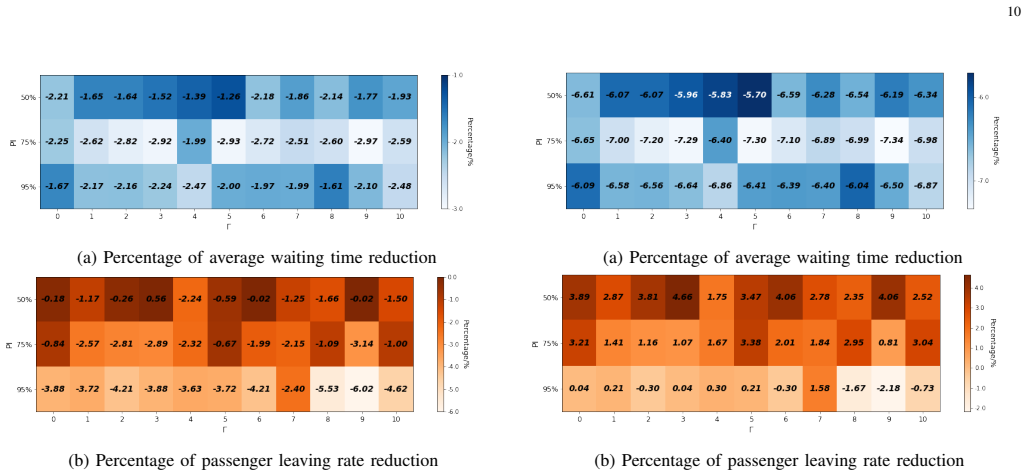
- DURO's average passenger waiting time is reported lower than both deterministic engines, historical-average demand and neural point forecast, across all simulated parameter combinations in the morning-peak test.
- In the direct comparison with DRO on the reduced 30-region setting, DURO is within a small performance gap once its percentile and budget parameter are chosen, and the paper frames this gap as an acceptable trade for the large computational saving.
- The framework is presented as general-purpose rather than AMoD-specific: any decision problem with uncertain parameters could use the same architecture of learned uncertainty intervals upstream of a robust optimization model.
Reading between the lines
- Beyond the paper, the same learned-interval-plus-robust-optimization pattern could be transplanted to other real-time decisions with uncertain inputs, such as ride-hailing pricing, charging-station dispatch, or warehouse task assignment, provided the downstream problem is a linear or convex program that accepts box-plus-budget uncertainty.
- Beyond the paper, the performance comparison would be more decisive on days when the historical average is a poor forecast; the paper itself notes its weekdays-only, regular-demand data may hide DURO's advantage, so testing on rainy days, holidays, or weekends is a natural next experiment.
- Beyond the paper, one could decouple the network's contribution from the distributional assumption by replacing the Poisson likelihood with Bayesian quantile regression, a direction the authors suggest, and comparing interval sharpness and final rebalancing metrics; this would show how much of the gain comes from learning versus from the chosen distribution.
- Beyond the paper, a validation-style experiment that fixes the percentile and budget on a validation set and then evaluates on unseen test days would quantify how much tuning effort actually remains in DURO, since the reported results use the best-performing parameters selected on the test morning.
Signed reviews
Editorial analysis
A structured set of objections, weighed in public.
Referee Report
Summary. The paper proposes DURO, a vehicle-rebalancing framework for autonomous mobility-on-demand systems in which a graph-LSTM neural network predicts distributional parameters of demand, the predicted distribution is turned into a box-plus-budget uncertainty set, and a robust optimization model is solved in a model-predictive-control loop. The authors benchmark DURO against deterministic optimization with historical-average and neural-network point forecasts, against classical robust optimization with a manually specified uncertainty set, and against a moment-based distributionally robust optimization model. Experiments on Manhattan taxi data from June 2019 report that DURO reduces passenger waiting time and leaving rate relative to deterministic baselines, is competitive with RO and DRO, and is substantially faster than DRO.
Significance. If the claimed results held, the paper would make a useful practical contribution: it couples a data-driven uncertainty-quantification module with robust optimization, avoids manual uncertainty-set tuning in RO, and avoids the computational cost of DRO. The idea of feeding neural-network-derived prediction intervals into a robust rebalancing model is timely and relevant. However, the supporting evidence is currently incomplete: the robust counterpart of the optimization model is not derived, the numerical comparison is based on a single 2-hour test window with parameters selected on that same window, and the DRO comparison is run under a different, reduced setting. These issues make the central claim 'on par with DRO, but with superior computational efficiency' not yet established. The paper does not provide code or machine-checked proofs, but the empirical workflow is clearly described and the authors honestly acknowledge in the conclusion that the regularity of their dataset obscures DURO's potential.
major comments (4)
- [Section III.C, Eq. (7)] Equation (7) is not a robust counterpart of the model with uncertainty set (6a)-(6b): it still contains the uncertain demand r_i directly in the objective, and no worst-case maximization, epigraph reformulation, or dual transformation is provided. Since the objective coefficient on r_i is positive through the unsatisfied-trip term gamma * T_i, the adversarial demand is not trivially the upper bound when the budget constraint (6b) is active. The actual optimization problem solved in the experiments is therefore undefined, and the numerical results in Table II and Figures 10-14 cannot be reproduced or audited. This is a load-bearing gap that must be fixed before the method can be evaluated.
- [Section IV.D, Figs. 10-13] The paper reports the best-performing parameter combination (PI=75%, Gamma=9 for DURO; the best rho for RO) chosen by evaluating on the same single test morning (June 27, 7:00-9:00) that is used for all comparisons. This is selection on the test set, and with only one 2-hour window there are no repeated trials or error bars to quantify variability. The claim that DURO consistently outperforms DOHV and DONN, and is competitive with RO, is therefore not supported by the presented evidence. The authors' own conclusion that the dataset's regularity 'obscure[s] the full potential of DURO' reinforces the need for evaluation on multiple days or repeated demand scenarios before drawing general conclusions.
- [Section IV.D.6, Table II, Fig. 14] The DRO comparison is not apples-to-apples. In Table II the DRO* entry rebalances only in 'a few regions' because of computational complexity, which does not represent the same control problem as the other engines. In the later DRO comparison the number of rebalancing regions is reduced from 63 to 30, the ambiguity set is augmented with neighboring 5-minute data to achieve feasibility, and DURO is run with only the 75% and 95% intervals because the 50% interval is infeasible. These changes mean the DRO results in Fig. 14 are obtained in a different experimental setting from the other benchmark results, and the conclusion that DURO is 'on par with DRO' is not justified by the reported evidence.
- [Section III.C, Constraints (3b) and (4a)-(4d)] The reformulation issue also affects the constraints: constraint (3b), y_sum <= r_i, contains the uncertain r_i, and the transition constraints (4a)-(4d) couple rebalancing and matching decisions across look-ahead intervals. Even if one accepted Eq. (7) as the objective, the robust version of the full feasible set must be specified, for example by enforcing the constraints for all r in the uncertainty set or by moving to a two-stage formulation. The paper does not state which robust semantics (here-and-now, adjustable, or constraint-wise) are being used, so the reported optimization results are unverifiable.
minor comments (4)
- [Global] There are multiple typos and formatting artifacts, including 'constrains' for 'constraints', 'X-ais' for 'X-axis', 'Possion' for 'Poisson', and the unresolved LaTeX macro 'glsabk:dro' in Section IV.D.6. These should be corrected before publication.
- [Section III.C, objective (5)] The objective (5) is written as a formula followed by a sentence that explains beta and gamma, but the equation itself is not numbered consistently with its reference in the text; the same applies to the display for (7). Please number all displayed equations and refer to them consistently.
- [Section IV.D.5] The sentence 'this result serves as the baseline for later comparison' appears to refer to Fig. 10, but the baseline terminology is ambiguous because later comparisons report percentage reductions relative to DOHV and DONN, not to the DURO parameter sweep. Clarify what the baseline is in each comparison.
- [Section V] The conclusion describes the uncertainty set of RO as 'momentum-based', while Section III.A uses the same phrase for the framework in [41]. This is likely a typo for 'moment-based' or 'momentum-based' in a different sense. Please align the terminology with the body of the paper.
Circularity Check
No circularity: DURO's uncertainty intervals are trained on historical demand and evaluated on future realized demand; the self-cited base model [12] is restated and is not the load-bearing evidence for the central claim.
full rationale
The derivation chain is not circular. The demand uncertainty intervals are produced by a graph-LSTM network trained on June 1-24 demand via negative log-likelihood, with validation on June 25-26 and testing on June 27; these intervals enter the robust rebalancing model as inputs, and the reported waiting times and leaving rates are generated by a simulator that uses realized demand only for passenger generation. No final-performance parameter is fitted inside the optimization, and the network is not trained on waiting time. The base matching-integrated rebalancing model and the static transition matrices are attributed to the authors' prior work [12], but the equations are restated in the manuscript, and [12] is an externally published reference rather than an unverified uniqueness theorem. The self-citations [12], [24], and [41] are background or component citations and do not carry the central claim that learned uncertainty sets improve robust rebalancing. The main caveats are methodological rather than circular: the best-performing PI and Gamma for DURO and rho for RO are selected on the same single test morning and the paper reports 'the result of the best-performing one' in Section IV.D, which is in-sample selection bias, not circularity. In addition, Equation (7) is presented as a reframed robust model but still contains the uncertain variable r_i with a positive objective coefficient and no worst-case or dual reformulation, so the actual solved optimization is underspecified; this is an auditability and correctness concern, not an equivalence between output and input by construction. The conclusion itself concedes that the dataset's regularity 'obscure[s] the full potential of DURO' (Section V), further confirming that the reported comparisons are limited by benchmark design rather than by circular derivation. Under the stated circularity definition, this is a normal non-circular finding.
Assumptions & free parameters
free parameters (7)
- Gamma (budget in polyhedral uncertainty constraint) =
9 (best for PI=75% on test day)
- PI (prediction interval percentile) =
75% (best)
- Beta (pickup distance weight) =
1
- Gamma penalty for unsatisfied requests =
100
- Rho (RO uncertainty parameter) =
varied; best case reported
- Neural network training hyperparameters =
not reported
- Static transition matrices P and Q =
estimated from historical data
assumptions (6)
- standard math The box-plus-budget robust optimization model can be reframed into the stated tractable form without loss.
- domain assumption Demand follows the chosen probabilistic distribution, and NLL-trained intervals are calibrated.
- domain assumption Static transition matrices P and Q adequately model occupied vehicle movement.
- domain assumption Passenger behavior is captured by a fixed 300-second maximum waiting time computed on 30-second matching steps.
- ad hoc to paper Adjacent 5-minute demand data can be pooled to make the DRO ambiguity set feasible.
- ad hoc to paper The best-performing parameter combination on the test day is a fair representation of each engine's capability.
Cite this review
Pith. "Pith review of Robust Vehicle Rebalancing with Deep Uncertainty in Autonomous Mobility-on-Demand Systems." pith.science (2026). https://pith.science/paper/4UNLYDQU
@misc{pith2026250704520,
  author       = {Pith},
  title        = {Pith review of: Robust Vehicle Rebalancing with Deep Uncertainty in Autonomous Mobility-on-Demand Systems},
  year         = {2026},
  howpublished = {\url{https://pith.science/paper/4UNLYDQU}},
  note         = {Machine review of arXiv:2507.04520}
}
read the original abstract
Autonomous Mobility-on-Demand (AMoD) services offer an opportunity for improving passenger service while reducing pollution and energy consumption through effective vehicle coordination. A primary challenge in the autonomous fleets coordination is to tackle the inherent issue of supply-demand imbalance. A key strategy in resolving this is vehicle rebalancing, strategically directing idle vehicles to areas with anticipated future demand. Traditional research focuses on deterministic optimization using specific demand forecasts, but the unpredictable nature of demand calls for methods that can manage this uncertainty. This paper introduces the Deep Uncertainty Robust Optimization (DURO), a framework specifically designed for vehicle rebalancing in AMoD systems amidst uncertain demand based on neural networks for robust optimization. DURO forecasts demand uncertainty intervals using a deep neural network, which are then integrated into a robust optimization model. We assess DURO against various established models, including deterministic optimization with refined demand forecasts and Distributionally Robust Optimization (DRO). Based on real-world data from New York City (NYC), our findings show that DURO surpasses traditional deterministic models in accuracy and is on par with DRO, but with superior computational efficiency. The DURO framework is a promising approach for vehicle rebalancing in AMoD systems that is proven to be effective in managing demand uncertainty, competitive in performance, and more computationally efficient than other optimization models.
Figures


Figures from the paper (7 more)




Reference graph
Works this paper leans on
-
[12]
Robust matching-integrated vehicle rebalancing in ride-hailing system with uncertain demand,
X. Guo, N. S. Caros, and J. Zhao, “Robust matching-integrated vehicle rebalancing in ride-hailing system with uncertain demand,” Transporta- tion Research Part B: Methodological , vol. 150, pp. 161–189, 2021
work page 2021
-
[1]
How machine learning informs ride-hailing services: A survey,
Y . Liu, R. Jia, J. Ye, and X. Qu, “How machine learning informs ride-hailing services: A survey,” Communications in Transportation Research, vol. 2, p. 100075, 2022
work page 2022
-
[2]
Reinforcement learning for rideshar- ing: An extended survey,
Z. T. Qin, H. Zhu, and J. Ye, “Reinforcement learning for rideshar- ing: An extended survey,” Transportation Research Part C: Emerging Technologies, vol. 144, p. 103852, 2022, review
work page 2022
-
[3]
Robo-taxi Fleet Coordination at Scale via Reinforcement Learning
L. Tresca, C. Schmidt, J. Harrison, F. Rodrigues, G. Zardini, D. Gam- melli, and M. Pavone, “Robo-taxi fleet coordination at scale via rein- forcement learning,” arXiv preprint arXiv:2504.06125 , 2025
work page Pith review arXiv 2025
-
[4]
T. Kuhnimhof and C. Eisenmann, “Mobility-on-demand pricing versus private vehicle tco: how cost structures hinder the dethroning of the car,” Transportation, vol. 50, no. 2, pp. 707–731, 2023
work page 2023
-
[5]
Analysis and control of autonomous mobility-on-demand systems,
G. Zardini, N. Lanzetti, M. Pavone, and E. Frazzoli, “Analysis and control of autonomous mobility-on-demand systems,” Annual Review of Control, Robotics, and Autonomous Systems , vol. 5, no. 1, pp. 633–658, 2022
work page 2022
-
[6]
Deep multi-view spatial-temporal network for taxi demand prediction,
H. Yao, F. Wu, J. Ke, X. Tang, Y . Jia, S. Lu, P. Gong, J. Ye, and Z. Li, “Deep multi-view spatial-temporal network for taxi demand prediction,” in Proceedings of the AAAI conference on artificial intelligence , vol. 32, no. 1, 2018
work page 2018
-
[7]
Traffic demand prediction based on dynamic transition convolutional neural network,
B. Du, X. Hu, L. Sun, J. Liu, Y . Qiao, and W. Lv, “Traffic demand prediction based on dynamic transition convolutional neural network,” IEEE Transactions on Intelligent Transportation Systems, vol. 22, no. 2, pp. 1237–1247, 2020
work page 2020
Show all 50 references
-
[8]
A dynamical spatial-temporal graph neural network for traffic demand prediction,
F. Huang, P. Yi, J. Wang, M. Li, J. Peng, and X. Xiong, “A dynamical spatial-temporal graph neural network for traffic demand prediction,” Information Sciences, vol. 594, pp. 286–304, 2022
2022
-
[9]
Approximate dynamic programming for planning a ride-hailing system using autonomous fleets of electric vehicles,
L. Al-Kanj, J. Nascimento, and W. B. Powell, “Approximate dynamic programming for planning a ride-hailing system using autonomous fleets of electric vehicles,” European Journal of Operational Research , vol. 284, no. 3, pp. 1088–1106, 2020
2020
-
[10]
Dynamic modeling and control of taxi services in large-scale urban networks: A macroscopic approach,
M. Ramezani and M. Nourinejad, “Dynamic modeling and control of taxi services in large-scale urban networks: A macroscopic approach,” Transportation Research Part C: Emerging Technologies , vol. 94, pp. 203–219, 2018, iSTTT22
2018
-
[11]
Data-driven distributionally robust electric vehicle balancing for mobility-on-demand systems under demand and supply uncertainties,
S. He, L. Pepin, G. Wang, D. Zhang, and F. Miao, “Data-driven distributionally robust electric vehicle balancing for mobility-on-demand systems under demand and supply uncertainties,” in 2020 IEEE/RSJ International Conference on Intelligent Robots and Systems (IROS) , 2020, pp...
2020
-
[13]
Ben-Tal, L
A. Ben-Tal, L. El Ghaoui, and A. Nemirovski, Robust optimization . Princeton university press, 2009, vol. 28
2009
-
[14]
Frameworks and results in distribution- ally robust optimization,
H. Rahimian and S. Mehrotra, “Frameworks and results in distribution- ally robust optimization,” Open Journal of Mathematical Optimization , vol. 3, p. 1–85, Jul. 2022
2022
-
[15]
Gradient-based learning applied to document recognition,
Y . LeCun, L. Bottou, Y . Bengio, and P. Haffner, “Gradient-based learning applied to document recognition,” Proceedings of the IEEE , vol. 86, no. 11, pp. 2278–2324, 1998. 13
1998
-
[16]
Long short-term memory,
S. Hochreiter and J. Schmidhuber, “Long short-term memory,” vol. 9, no. 8, p. 1735–1780, nov 1997
1997
-
[17]
Semi-supervised classification with graph convolutional networks,
T. N. Kipf and M. Welling, “Semi-supervised classification with graph convolutional networks,” arXiv preprint arXiv:1609.02907 , 2016
2016 arXiv
-
[18]
Spatio-temporal graph convolutional net- works: A deep learning framework for traffic forecasting,
B. Yu, H. Yin, and Z. Zhu, “Spatio-temporal graph convolutional net- works: A deep learning framework for traffic forecasting,” in Proceed- ings of the Twenty-Seventh International Joint Conference on Artificial Intelligence. International Joint Conferences on Artificial Intel...
2018
-
[19]
Gman: A graph multi-attention network for traffic prediction,
C. Zheng, X. Fan, C. Wang, and J. Qi, “Gman: A graph multi-attention network for traffic prediction,” 2019
2019
-
[20]
A review of demand forecasting models and methodological develop- ments within tourism and passenger transportation industry,
I. Ghalehkhondabi, E. Ardjmand, W. A. Young, and G. R. Weckman, “A review of demand forecasting models and methodological develop- ments within tourism and passenger transportation industry,” Journal of Tourism Futures, vol. 5, no. 1, pp. 75–93, 2019
2019
-
[21]
Spatiotemporal traffic forecasting: review and proposed directions,
A. Ermagun and D. Levinson, “Spatiotemporal traffic forecasting: review and proposed directions,” Transport Reviews, vol. 38, no. 6, pp. 786– 814, 2018
2018
-
[22]
The propagation of uncertainty through travel demand models: an exploratory analysis,
Y . Zhao and K. M. Kockelman, “The propagation of uncertainty through travel demand models: an exploratory analysis,” The Annals of regional science, vol. 36, pp. 145–163, 2002
2002
-
[23]
Uncertainty quantification of sparse travel demand prediction with spatial-temporal graph neural networks,
D. Zhuang, S. Wang, H. Koutsopoulos, and J. Zhao, “Uncertainty quantification of sparse travel demand prediction with spatial-temporal graph neural networks,” in Proceedings of the 28th ACM SIGKDD Conference on Knowledge Discovery and Data Mining, 2022, pp. 4639– 4647
2022
-
[24]
Uncer- tainty quantification of spatiotemporal travel demand with probabilistic graph neural networks,
Q. Wang, S. Wang, D. Zhuang, H. Koutsopoulos, and J. Zhao, “Uncer- tainty quantification of spatiotemporal travel demand with probabilistic graph neural networks,” 2023
2023
-
[25]
Beyond expectation: Deep joint mean and quantile regression for spatiotemporal problems,
F. Rodrigues and F. C. Pereira, “Beyond expectation: Deep joint mean and quantile regression for spatiotemporal problems,” IEEE transactions on neural networks and learning systems, vol. 31, no. 12, pp. 5377–5389, 2020
2020
-
[26]
Temporal latent auto-encoder: A method for probabilistic multivariate time series forecasting,
N. Nguyen and B. Quanz, “Temporal latent auto-encoder: A method for probabilistic multivariate time series forecasting,” in Proceedings of the AAAI Conference on Artificial Intelligence , vol. 35, no. 10, 2021, pp. 9117–9125
2021
-
[27]
J. R. Birge and F. Louveaux, Introduction to stochastic programming . Springer Science & Business Media, 2011
2011
-
[28]
Facility location: A robust op- timization approach,
O. Baron, J. Milner, and H. Naseraldin, “Facility location: A robust op- timization approach,” Production and Operations Management, vol. 20, no. 5, pp. 772–785, 2011
2011
-
[29]
Robust strategies for facility location under uncertainty,
N. G ¨ulpınar, D. Pachamanova, and E. C ¸ anako˘glu, “Robust strategies for facility location under uncertainty,” European Journal of Operational Research, vol. 225, no. 1, pp. 21–35, 2013
2013
-
[30]
Computing robust basestock levels,
D. Bienstock and N. ¨Ozbay, “Computing robust basestock levels,” Discrete Optimization, vol. 5, no. 2, pp. 389–414, 2008
2008
-
[31]
Robust approximation to multiperiod inventory management,
C.-T. See and M. Sim, “Robust approximation to multiperiod inventory management,” Operations research, vol. 58, no. 3, pp. 583–594, 2010
2010
-
[32]
Distributionally robust optimization under mo- ment uncertainty with application to data-driven problems,
E. Delage and Y . Ye, “Distributionally robust optimization under mo- ment uncertainty with application to data-driven problems,” Operations research, vol. 58, no. 3, pp. 595–612, 2010
2010
-
[33]
Adaptive distributionally robust optimization,
D. Bertsimas, M. Sim, and M. Zhang, “Adaptive distributionally robust optimization,” Management Science, vol. 65, no. 2, pp. 604–618, 2019
2019
-
[34]
Ridesourcing systems: A framework and review,
H. Wang and H. Yang, “Ridesourcing systems: A framework and review,” Transportation Research Part B: Methodological, vol. 129, pp. 122–155, 2019
2019
-
[35]
Shared-vehicle mobility-on-demand systems: a fleet operator’s guide to rebalancing empty vehicles,
K. Spieser, S. Samaranayake, W. Gruel, and E. Frazzoli, “Shared-vehicle mobility-on-demand systems: a fleet operator’s guide to rebalancing empty vehicles,” in Transportation Research Board 95th Annual Meet- ing, no. 16-5987. Transportation Research Board, 2016
2016
-
[36]
Vehicle rebalancing for mobility-on-demand systems with ride-sharing,
A. Wallar, M. Van Der Zee, J. Alonso-Mora, and D. Rus, “Vehicle rebalancing for mobility-on-demand systems with ride-sharing,” in 2018 IEEE/RSJ International Conference on Intelligent Robots and Systems (IROS), 2018, pp. 4539–4546
2018
-
[37]
Robotic load balancing for mobility-on-demand systems,
M. Pavone, S. L. Smith, E. Frazzoli, and D. Rus, “Robotic load balancing for mobility-on-demand systems,” The International Journal of Robotics Research, vol. 31, no. 7, pp. 839–854, 2012
2012
-
[38]
Control of robotic mobility-on-demand systems: a queueing-theoretical perspective,
R. Zhang and M. Pavone, “Control of robotic mobility-on-demand systems: a queueing-theoretical perspective,” 2014
2014
-
[39]
Data-driven distributionally robust vehicle balancing using dynamic region partitions,
F. Miao, S. Han, A. M. Hendawi, M. E. Khalefa, J. A. Stankovic, and G. J. Pappas, “Data-driven distributionally robust vehicle balancing using dynamic region partitions,” in Proceedings of the 8th International Conference on Cyber-Physical Systems, ser. ICCPS ’17. New York, NY...
2017
-
[40]
Rebalancing shared mobility-on- demand systems: A reinforcement learning approach,
J. Wen, J. Zhao, and P. Jaillet, “Rebalancing shared mobility-on- demand systems: A reinforcement learning approach,” in 2017 IEEE 20th International Conference on Intelligent Transportation Systems (ITSC), 2017, pp. 220–225
2017
-
[41]
Data-driven vehicle rebalancing with predictive prescriptions in the ride-hailing system,
X. Guo, Q. Wang, and J. Zhao, “Data-driven vehicle rebalancing with predictive prescriptions in the ride-hailing system,” IEEE Open Journal of Intelligent Transportation Systems , vol. 3, pp. 251–266, 2022
2022
-
[42]
Risk-aware operation modeling for ride-hailing fleet in order grabbing mode: A distributional reinforce- ment learning approach,
Y . Sun, Z. Ding, Z. Hu, and W.-J. Lee, “Risk-aware operation modeling for ride-hailing fleet in order grabbing mode: A distributional reinforce- ment learning approach,” IEEE Transactions on Smart Grid , pp. 1–1, 2023
2023
-
[43]
Data-driven robust taxi dispatch under demand uncertainties,
F. Miao, S. Han, S. Lin, Q. Wang, J. A. Stankovic, A. Hendawi, D. Zhang, T. He, and G. J. Pappas, “Data-driven robust taxi dispatch under demand uncertainties,” IEEE Transactions on Control Systems Technology, vol. 27, no. 1, pp. 175–191, 2017
2017
-
[44]
Data-driven distributionally robust vehicle balancing using dynamic region partitions,
F. Miao, S. Han, A. M. Hendawi, M. E. Khalefa, J. A. Stankovic, and G. J. Pappas, “Data-driven distributionally robust vehicle balancing using dynamic region partitions,” in Proceedings of the 8th International Conference on Cyber-Physical Systems , Conference Proceedings, pp. 261–271
-
[45]
Time series forecasting using a hybrid arima and neural network model,
G. Zhang, “Time series forecasting using a hybrid arima and neural network model,” Neurocomputing, vol. 50, pp. 159–175, 2003
2003
-
[46]
Data-driven robust optimization for contextual vehicle rebalancing in on-demand ride services under demand uncertainty,
Z. Guo, B. Yu, W. Shan, and B. Yao, “Data-driven robust optimization for contextual vehicle rebalancing in on-demand ride services under demand uncertainty,” Transportation Research Part C: Emerging Tech- nologies, vol. 154, p. 104244, 2023
2023
-
[47]
Graph neural network for traffic forecasting: A survey,
W. Jiang and J. Luo, “Graph neural network for traffic forecasting: A survey,” Expert Systems with Applications , vol. 207, p. 117921, 2022
2022
-
[48]
Lower upper bound estimation method for construction of neural network-based prediction intervals,
A. Khosravi, S. Nahavandi, D. Creighton, and A. F. Atiya, “Lower upper bound estimation method for construction of neural network-based prediction intervals,” IEEE Transactions on Neural Networks , vol. 22, no. 3, pp. 337–346, 2011
2011
-
[49]
Distributionally robust convex optimization,
W. Wiesemann, D. Kuhn, and M. Sim, “Distributionally robust convex optimization,” Operations research, vol. 62, no. 6, pp. 1358–1376, 2014
2014
-
[50]
Robust stochastic optimization made easy with rsome,
Z. Chen, M. Sim, and P. Xiong, “Robust stochastic optimization made easy with rsome,” Management Science, vol. 66, no. 8, pp. 3329–3339, 2020
2020
Reviewed August 6, 2026 · model on record in the stance chip above.
Discussion (0). Continue with ORCID to comment.