Multimode Purcell Filter for Superconducting-Qubit Reset and Readout with Intrinsic Purcell Protection
Pith reviewed 2026-05-19 06:57 UTC · model grok-4.3
The pith
A multimode resonator resets superconducting qubits in 220 ns and enables readout while an auxiliary mode protects their relaxation times despite direct coupling.
A machine-rendered reading of the paper's core claim, the machinery that carries it, and where it could break.
Core claim
The central claim is that the inherent multi-mode structure of a single coplanar waveguide resonator can be used for distinct operations: its fundamental mode for unconditional qubit reset achieving residual excitation below 1 percent in 220 ns, its second-order mode for readout, and an auxiliary mode for intrinsic Purcell protection that maintains measured relaxation times even with direct qubit-to-filter coupling in a flip-chip device, plus a leakage reduction unit that resets the second excited state in 62 ns leaving 6.1 percent residual population after readout error correction.
What carries the argument
Multimode Purcell filter formed by a coplanar waveguide resonator, with fundamental mode assigned to reset, second-order mode to readout, and auxiliary mode supplying the intrinsic Purcell protection.
If this is right
- Unconditional reset reaches below 1 percent residual excitation in 220 ns without added components.
- Leakage reduction clears the second excited state in 62 ns with low residual population.
- Qubit relaxation times stay intact despite direct filter coupling thanks to the auxiliary-mode protection.
- Hardware for reset and readout can be consolidated into existing resonator structures on the chip.
Where Pith is reading between the lines
- The approach may reduce overall circuit footprint when scaling to processors with many qubits.
- Similar mode-assignment strategies could be tested for other control operations such as gates or feedback.
- Experiments with multiple qubits sharing one multimode filter would test whether protection holds under increased loading.
- Faster reset could shorten error-correction cycle times if integrated into surface-code architectures.
Load-bearing premise
The auxiliary mode supplies enough intrinsic Purcell protection to keep qubit relaxation times from degrading even when the qubit couples directly to the filter.
What would settle it
Fabricate a control device in which the auxiliary mode is detuned or suppressed and measure whether qubit relaxation times shorten compared with the protected configuration.
Figures
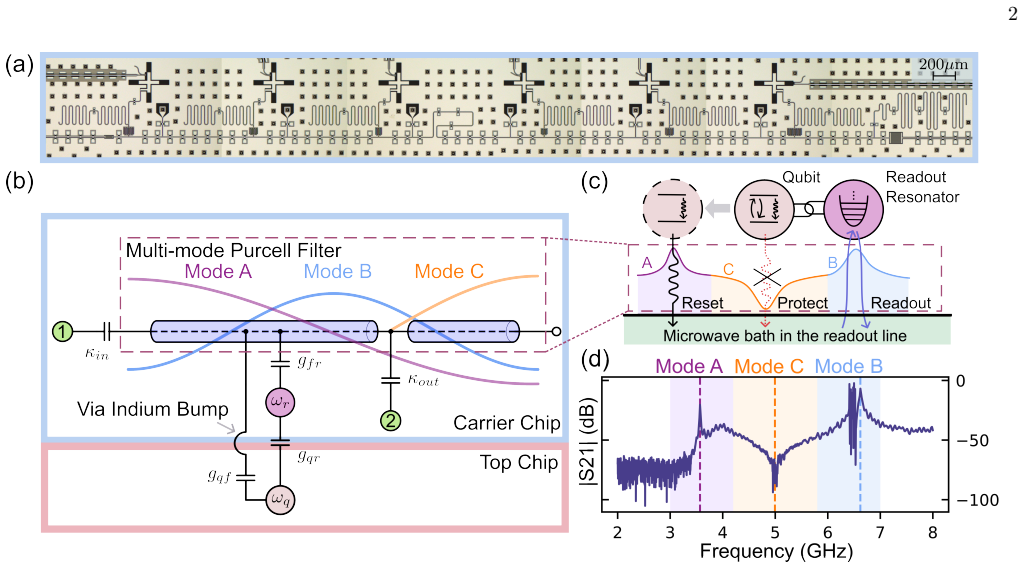


read the original abstract
Efficient qubit reset and leakage reduction are essential for scalable superconducting quantum computing, particularly in the context of quantum error correction. However, such operations often require additional on-chip components. Here, we propose and experimentally demonstrate a hardware-efficient approach to qubit reset and readout using a multi-mode Purcell filter in a superconducting quantum circuit. We exploit the inherent multi-mode structure of a coplanar waveguide resonator, using its fundamental and second-order modes for qubit reset and readout, respectively, thereby avoiding additional components. Implemented in a flip-chip architecture, our device achieves unconditional reset with residual excitation below 1\% in 220 ns, and a leakage reduction unit that selectively resets the second excited state within 62 ns with a residual $|f\rangle$ population of 6.1\%, accounting for the readout error. Despite the qubits being directly coupled to the filter in our configuration, the measured relaxation times are not degraded owing to intrinsic Purcell protection provided by an auxiliary mode. To our knowledge, this is the first experimental trial that exploits different-order modes of a microwave resonator for distinct qubit operations, representing a new direction toward scalable, hardware-efficient quantum processor design.
Editorial analysis
A structured set of objections, weighed in public.
Referee Report
Summary. The manuscript proposes and experimentally demonstrates a hardware-efficient multimode Purcell filter based on a coplanar waveguide resonator in a flip-chip architecture. The fundamental mode is used for unconditional qubit reset (residual excitation <1% in 220 ns), the second-order mode for readout, and an auxiliary mode is claimed to provide intrinsic Purcell protection that prevents degradation of qubit relaxation times despite direct qubit-filter coupling. A leakage-reduction unit selectively resets the |f⟩ state in 62 ns with 6.1% residual population (accounting for readout error). The work positions this as the first use of distinct resonator modes for separate qubit operations.
Significance. If the central experimental claims are substantiated, the approach reduces the number of on-chip components required for reset and readout, which is relevant for scaling superconducting processors toward quantum error correction. The multi-mode exploitation of a single resonator structure offers a compact alternative to separate filter elements and could improve integration density.
major comments (2)
- [Abstract / Results] Abstract (final paragraph) and corresponding results section: the assertion that 'measured relaxation times are not degraded owing to intrinsic Purcell protection provided by an auxiliary mode' is load-bearing for the overall claim of compatibility with direct coupling. No auxiliary-mode frequency, qubit-auxiliary coupling matrix element, calculated effective Purcell rate, or side-by-side T1 comparison on a control device lacking the auxiliary mode is reported. Without these data the quantitative suppression of decay from the direct coupling cannot be verified.
- [Methods / Results] Experimental methods / device characterization: the reported reset and leakage-reduction times (220 ns and 62 ns) and residual populations are given without accompanying error bars, full pulse sequences, or calibration details that would allow independent assessment of the unconditional-reset fidelity and the leakage-reduction unit performance.
minor comments (2)
- [Figures] Figure captions and axis labels should explicitly state whether the plotted populations include readout-error correction or are raw values.
- [Discussion] The manuscript would benefit from a brief comparison table placing the achieved reset times and residual excitations against prior single-mode or separate-filter implementations.
Simulated Author's Rebuttal
We thank the referee for their careful reading and constructive comments. We address the two major comments point by point below, indicating where revisions have been made or where limitations remain.
read point-by-point responses
-
Referee: [Abstract / Results] Abstract (final paragraph) and corresponding results section: the assertion that 'measured relaxation times are not degraded owing to intrinsic Purcell protection provided by an auxiliary mode' is load-bearing for the overall claim of compatibility with direct coupling. No auxiliary-mode frequency, qubit-auxiliary coupling matrix element, calculated effective Purcell rate, or side-by-side T1 comparison on a control device lacking the auxiliary mode is reported. Without these data the quantitative suppression of decay from the direct coupling cannot be verified.
Authors: We agree that quantitative support for the intrinsic Purcell protection claim strengthens the manuscript. In the revised version we report the auxiliary-mode frequency and the qubit-auxiliary coupling strength obtained from two-tone spectroscopy. We also add an explicit calculation of the effective Purcell rate using the multimode resonator formula, showing the suppression relative to the direct-coupling case. A side-by-side experimental comparison on a control device fabricated without the auxiliary mode is not available from the present device set; we therefore provide a theoretical estimate of the unprotected Purcell limit and compare it with the measured T1. The abstract and results section have been updated to include these details. revision: partial
-
Referee: [Methods / Results] Experimental methods / device characterization: the reported reset and leakage-reduction times (220 ns and 62 ns) and residual populations are given without accompanying error bars, full pulse sequences, or calibration details that would allow independent assessment of the unconditional-reset fidelity and the leakage-reduction unit performance.
Authors: We accept that error bars, complete pulse sequences, and calibration procedures improve reproducibility. The revised manuscript now includes statistical error bars on all reported times and residual populations. Full pulse sequences for both the unconditional reset and the leakage-reduction unit, together with the calibration routines used to extract the reported fidelities, have been added to the Methods section and the Supplementary Information. revision: yes
- Experimental T1 comparison against a control device fabricated without the auxiliary mode
Circularity Check
Experimental results with no derivation chain or self-referential predictions
full rationale
The manuscript is an experimental demonstration reporting measured reset times (220 ns, 62 ns), residual populations (<1%, 6.1%), and relaxation times that remain undegraded. No equations, first-principles derivations, or predictions appear in the provided text; the auxiliary-mode protection is asserted on the basis of direct T1 measurements rather than any fitted parameter renamed as a prediction or any self-citation chain. The work is therefore self-contained against external benchmarks, with all central claims grounded in hardware results instead of internal definitions or ansatzes.
Axiom & Free-Parameter Ledger
Forward citations
Cited by 1 Pith paper
-
Engineered broadband Purcell protection using a shared $\Pi$-filter for multiplexed superconducting qubits
A single shared Π-filter integrated in the feedline uses engineered microwave interference to suppress environmental admittance and deliver Purcell-limited qubit relaxation times above 1 ms across roughly 1.5 GHz whil...
Reference graph
Works this paper leans on
-
[1]
A. G. Fowler, M. Mariantoni, J. M. Martinis, and A. N. Cleland, Surface codes: Towards practical large-scale quantum computation, Physical Review A 86, 032324 (2012)
work page 2012
-
[2]
C. J. Axline, L. D. Burkhart, W. Pfaff, M. Zhang, K. Chou, P. Campagne-Ibarcq, P. Reinhold, L. Frun- zio, S. M. Girvin, L. Jiang, M. H. Devoret, and R. J. Schoelkopf, On-demand quantum state transfer and en- tanglement between remote microwave cavity memories, Nature Physics 14, 705 (2018)
work page 2018
-
[3]
P. Campagne-Ibarcq, E. Zalys-Geller, A. Narla, S. Shankar, P. Reinhold, L. Burkhart, C. Axline, W. Pfaff, L. Frunzio, R. J. Schoelkopf, and M. H. De- voret, Deterministic Remote Entanglement of Supercon- ducting Circuits through Microwave Two-Photon Tran- sitions, Physical Review Letters 120, 200501 (2018)
work page 2018
-
[4]
P. Kurpiers, P. Magnard, T. Walter, B. Royer, M. Pechal, J. Heinsoo, Y. Salath´ e, A. Akin, S. Storz, J.-C. Besse, S. Gasparinetti, A. Blais, and A. Wallraff, Deterministic quantum state transfer and remote entanglement using microwave photons, Nature 558, 264 (2018)
work page 2018
- [5]
-
[6]
P. Magnard, S. Storz, P. Kurpiers, J. Sch¨ ar, F. Marxer, J. L¨ utolf, T. Walter, J.-C. Besse, M. Gabureac, K. Reuer, A. Akin, B. Royer, A. Blais, and A. Wallraff, Mi- crowave Quantum Link between Superconducting Cir- cuits Housed in Spatially Separated Cryogenic Systems, Physical Review Letters 125, 260502 (2020)
work page 2020
-
[7]
L. D. Burkhart, J. D. Teoh, Y. Zhang, C. J. Ax- line, L. Frunzio, M. Devoret, L. Jiang, S. Girvin, and R. Schoelkopf, Error-Detected State Transfer and Entan- glement in a Superconducting Quantum Network, PRX Quantum 2, 030321 (2021)
work page 2021
-
[8]
Y. Zhong, H.-S. Chang, A. Bienfait, ´E. Dumur, M.-H. Chou, C. R. Conner, J. Grebel, R. G. Povey, H. Yan, D. I. Schuster, and A. N. Cleland, Deterministic multi- qubit entanglement in a quantum network, Nature 590, 571 (2021)
work page 2021
-
[9]
J. Niu, L. Zhang, Y. Liu, J. Qiu, W. Huang, J. Huang, H. Jia, J. Liu, Z. Tao, W. Wei, Y. Zhou, W. Zou, Y. Chen, X. Deng, X. Deng, C. Hu, L. Hu, J. Li, D. Tan, Y. Xu, F. Yan, T. Yan, S. Liu, Y. Zhong, A. N. Cleland, and D. Yu, Low-loss interconnects for modular supercon- ducting quantum processors, Nature Electronics 6, 235 (2023)
work page 2023
-
[10]
S. Storz, J. Sch¨ ar, A. Kulikov, P. Magnard, P. Kurpiers, J. L¨ utolf, T. Walter, A. Copetudo, K. Reuer, A. Akin, J.- C. Besse, M. Gabureac, G. J. Norris, A. Rosario, F. Mar- tin, J. Martinez, W. Amaya, M. W. Mitchell, C. Abel- lan, J.-D. Bancal, N. Sangouard, B. Royer, A. Blais, and A. Wallraff, Loophole-free Bell inequality violation with superconducti...
work page 2023
-
[11]
J. Qiu, Y. Liu, L. Hu, Y. Wu, J. Niu, L. Zhang, W. Huang, Y. Chen, J. Li, S. Liu, Y. Zhong, L. Duan, and D. Yu, Deterministic quantum state and gate tele- portation between distant superconducting chips, Science Bulletin 70, 351 (2025)
work page 2025
- [12]
-
[13]
M. D. Reed, B. R. Johnson, A. A. Houck, L. DiCarlo, J. M. Chow, D. I. Schuster, L. Frunzio, and R. J. Schoelkopf, Fast reset and suppressing spontaneous emis- sion of a superconducting qubit, Applied Physics Letters 96, 203110 (2010)
work page 2010
-
[14]
P. Magnard, P. Kurpiers, B. Royer, T. Walter, J.-C. Besse, S. Gasparinetti, M. Pechal, J. Heinsoo, S. Storz, A. Blais, and A. Wallraff, Fast and Unconditional All- Microwave Reset of a Superconducting Qubit, Physical Review Letters 121, 060502 (2018)
work page 2018
-
[15]
M. McEwen, D. Kafri, Z. Chen, J. Atalaya, K. J. Satzinger, C. Quintana, P. V. Klimov, D. Sank, C. Gid- ney, A. G. Fowler, F. Arute, K. Arya, B. Buckley, B. Bur- kett, N. Bushnell, B. Chiaro, R. Collins, S. Demura, A. Dunsworth, C. Erickson, B. Foxen, M. Giustina, T. Huang, S. Hong, E. Jeffrey, S. Kim, K. Kechedzhi, F. Kostritsa, P. Laptev, A. Megrant, X. ...
work page 2021
-
[16]
Y. Zhou, Z. Zhang, Z. Yin, S. Huai, X. Gu, X. Xu, J. Allcock, F. Liu, G. Xi, Q. Yu, H. Zhang, M. Zhang, H. Li, X. Song, Z. Wang, D. Zheng, S. An, Y. Zheng, and S. Zhang, Rapid and unconditional parametric re- set protocol for tunable superconducting qubits, Nature Communications 12, 5924 (2021)
work page 2021
- [17]
-
[18]
J. Ding, Y. Li, H. Wang, G. Xue, T. Su, C. Wang, W. Sun, F. Li, Y. Zhang, Y. Gao, J. Peng, Z. H. Jiang, Y. Yu, H. Yu, and F. Yan, Multipurpose architecture for fast reset and protective readout of superconducting qubits, Physical Review Applied 23, 014012 (2025)
work page 2025
-
[19]
Fault-Tolerant Quantum Computation for Local Leakage Faults
P. Aliferis and B. M. Terhal, Fault-Tolerant Quan- tum Computation for Local Leakage Faults (2006), arXiv:quant-ph/0511065
work page internal anchor Pith review Pith/arXiv arXiv 2006
-
[20]
F. Battistel, B. Varbanov, and B. Terhal, Hardware- Efficient Leakage-Reduction Scheme for Quantum Er- ror Correction with Superconducting Transmon Qubits, PRX Quantum 2, 030314 (2021)
work page 2021
-
[21]
X. Yang, J. Chu, Z. Guo, W. Huang, Y. Liang, J. Liu, J. Qiu, X. Sun, Z. Tao, J. Zhang, J. Zhang, L. Zhang, Y. Zhou, W. Guo, L. Hu, J. Jiang, Y. Liu, X. Lin- peng, T. Chen, Y. Chen, J. Niu, S. Liu, Y. Zhong, and D. Yu, Coupler-Assisted Leakage Reduction for Scal- able Quantum Error Correction with Superconducting Qubits, Physical Review Letters 133, 170601 (2024)
work page 2024
-
[22]
T. Thorbeck, A. McDonald, O. Lanes, J. Blair, G. Keefe, A. A. Stabile, B. Royer, L. C. G. Govia, and A. Blais, High-fidelity gates in a transmon using bath engineering for passive leakage reset (2024), arXiv:2411.04101
-
[23]
M. D. Reed, L. DiCarlo, S. E. Nigg, L. Sun, L. Frun- zio, S. M. Girvin, and R. J. Schoelkopf, Realization of three-qubit quantum error correction with superconduct- ing circuits, Nature 482, 382 (2012)
work page 2012
-
[24]
Google Quantum AI, Z. Chen, K. J. Satzinger, J. Ata- laya, A. N. Korotkov, A. Dunsworth, D. Sank, C. Quin- tana, M. McEwen, R. Barends, P. V. Klimov, S. Hong, C. Jones, A. Petukhov, D. Kafri, S. Demura, B. Bur- kett, C. Gidney, A. G. Fowler, A. Paler, H. Putterman, I. Aleiner, F. Arute, K. Arya, R. Babbush, J. C. Bardin, A. Bengtsson, A. Bourassa, M. Brou...
work page 2021
-
[25]
S. Krinner, N. Lacroix, A. Remm, A. Di Paolo, E. Genois, C. Leroux, C. Hellings, S. Lazar, F. Swiadek, J. Her- rmann, G. J. Norris, C. K. Andersen, M. M¨ uller, A. Blais, C. Eichler, and A. Wallraff, Realizing repeated quantum error correction in a distance-three surface code, Nature 605, 669 (2022)
work page 2022
-
[26]
Google Quantum AI, R. Acharya, I. Aleiner, R. Allen, T. I. Andersen, M. Ansmann, F. Arute, K. Arya, A. Asfaw, J. Atalaya, R. Babbush, D. Bacon, J. C. Bardin, J. Basso, A. Bengtsson, S. Boixo, G. Bortoli, A. Bourassa, J. Bovaird, L. Brill, M. Broughton, B. B. Buckley, D. A. Buell, T. Burger, B. Burkett, N. Bush- nell, Y. Chen, Z. Chen, B. Chiaro, J. Cogan,...
work page 2023
-
[27]
Google Quantum AI and Collaborators, R. Acharya, D. A. Abanin, L. Aghababaie-Beni, I. Aleiner, T. I. Andersen, M. Ansmann, F. Arute, K. Arya, A. As- faw, N. Astrakhantsev, J. Atalaya, R. Babbush, D. Ba- con, B. Ballard, J. C. Bardin, J. Bausch, A. Bengts- son, A. Bilmes, S. Blackwell, S. Boixo, G. Bortoli, A. Bourassa, J. Bovaird, L. Brill, M. Broughton, ...
work page 2025
-
[28]
M. F. Dumas, B. Groleau-Par´ e, A. McDonald, M. H. Mu˜ noz-Arias, C. Lled´ o, B. D’Anjou, and A. Blais, Measurement-Induced Transmon Ionization, Physical Review X 14, 041023 (2024)
work page 2024
- [29]
-
[30]
P. A. Spring, L. Milanovic, Y. Sunada, S. Wang, A. F. Van Loo, S. Tamate, and Y. Nakamura, Fast Multi- plexed Superconducting-Qubit Readout with Intrinsic Purcell Filtering Using a Multiconductor Transmission Line, PRX Quantum 6, 020345 (2025)
work page 2025
-
[31]
A. Yen, Y. Ye, K. Peng, J. Wang, G. Cunningham, M. Gingras, B. M. Niedzielski, H. Stickler, K. Serniak, M. E. Schwartz, and K. P. O’Brien, Interferometric Pur- cell suppression of spontaneous emission in a super- conducting qubit, Physical Review Applied 23, 024068 (2025)
work page 2025
-
[32]
J. Koch, T. M. Yu, J. Gambetta, A. A. Houck, D. I. Schuster, J. Majer, A. Blais, M. H. Devoret, S. M. Girvin, and R. J. Schoelkopf, Charge-insensitive qubit design de- rived from the Cooper pair box, Physical Review A 76, 042319 (2007)
work page 2007
-
[33]
A. A. Houck, J. A. Schreier, B. R. Johnson, J. M. Chow, J. Koch, J. M. Gambetta, D. I. Schuster, L. Frunzio, M. H. Devoret, S. M. Girvin, and R. J. Schoelkopf, Con- trolling the Spontaneous Emission of a Superconducting Transmon Qubit, Physical Review Letters 101, 080502 (2008)
work page 2008
- [34]
-
[35]
N. T. Bronn, E. Magesan, N. A. Masluk, J. M. Chow, J. M. Gambetta, and M. Steffen, Reducing spontaneous emission in circuit quantum electrodynamics by a com- bined readout/filter technique, IEEE Transactions on Applied Superconductivity 25, 1 (2015)
work page 2015
-
[36]
A. P. M. Place, L. V. H. Rodgers, P. Mundada, B. M. Smitham, M. Fitzpatrick, Z. Leng, A. Premkumar, J. Bryon, A. Vrajitoarea, S. Sussman, G. Cheng, T. Mad- havan, H. K. Babla, X. H. Le, Y. Gang, B. J¨ ack, A. Gye- nis, N. Yao, R. J. Cava, N. P. de Leon, and A. A. Houck, New material platform for superconducting transmon qubits with coherence times exceedi...
work page 2021
-
[37]
C. Wang, X. Li, H. Xu, Z. Li, J. Wang, Z. Yang, Z. Mi, X. Liang, T. Su, C. Yang, G. Wang, W. Wang, Y. Li, M. Chen, C. Li, K. Linghu, J. Han, Y. Zhang, Y. Feng, Y. Song, T. Ma, J. Zhang, R. Wang, P. Zhao, W. Liu, G. Xue, Y. Jin, and H. Yu, Towards practical quantum computers: Transmon qubit with a lifetime approaching 0.5 milliseconds, npj Quantum Informat...
work page 2022
-
[38]
M. Tuokkola, Y. Sunada, H. Kivij¨ arvi, L. Gr¨ onberg, J.-P. Kaikkonen, V. Vesterinen, J. Govenius, and M. M¨ ott¨ onen, Methods to achieve near-millisecond en- ergy relaxation and dephasing times for a superconduct- ing transmon qubit (2024), arXiv:2407.18778 [quant-ph]. 13
-
[39]
M. Bal, A. A. Murthy, S. Zhu, F. Crisa, X. You, Z. Huang, T. Roy, J. Lee, D. V. Zanten, R. Pilipenko, I. Nekrashevich, A. Lunin, D. Bafia, Y. Krasnikova, C. J. Kopas, E. O. Lachman, D. Miller, J. Y. Mutus, M. J. Reagor, H. Cansizoglu, J. Marshall, D. P. Pappas, K. Vu, K. Yadavalli, J.-S. Oh, L. Zhou, M. J. Kramer, F. Lecocq, D. P. Goronzy, C. G. Torres-Ca...
work page 2024
-
[40]
M. P. Bland, F. Bahrami, J. G. C. Martinez, P. H. Preste- gaard, B. M. Smitham, A. Joshi, E. Hedrick, A. Pakpour- Tabrizi, S. Kumar, A. Jindal, R. D. Chang, A. Yang, G. Cheng, N. Yao, R. J. Cava, N. P. de Leon, and A. A. Houck, 2D transmons with lifetimes and coherence times exceeding 1 millisecond (2025), arXiv:2503.14798 [quant- ph]
- [41]
- [42]
-
[43]
C. M. Caves, Quantum limits on noise in linear ampli- fiers, Physical Review D 26, 1817 (1982)
work page 1982
-
[44]
M. A. Castellanos-Beltran, K. D. Irwin, G. C. Hilton, L. R. Vale, and K. W. Lehnert, Amplification and squeez- ing of quantum noise with a tunable Josephson metama- terial, Nature Physics 4, 929 (2008)
work page 2008
-
[45]
C. Eichler, Y. Salathe, J. Mlynek, S. Schmidt, and A. Wallraff, Quantum-Limited Amplification and Entan- glement in Coupled Nonlinear Resonators, Physical Re- view Letters 113, 110502 (2014)
work page 2014
-
[46]
J. Y. Mutus, T. C. White, R. Barends, Y. Chen, Z. Chen, B. Chiaro, A. Dunsworth, E. Jeffrey, J. Kelly, A. Megrant, C. Neill, P. J. J. O’Malley, P. Roushan, D. Sank, A. Vainsencher, J. Wenner, K. M. Sundqvist, A. N. Cleland, and J. M. Martinis, Strong environmen- tal coupling in a Josephson parametric amplifier, Applied Physics Letters 104, 263513 (2014)
work page 2014
-
[47]
C. Macklin, K. O’Brien, D. Hover, M. E. Schwartz, V. Bolkhovsky, X. Zhang, W. D. Oliver, and I. Siddiqi, A near–quantum-limited Josephson traveling-wave para- metric amplifier, Science 350, 307 (2015)
work page 2015
-
[48]
R. Kaufman, T. White, M. I. Dykman, A. Iorio, G. Ster- ling, S. Hong, A. Opremcak, A. Bengtsson, L. Faoro, J. C. Bardin, T. Burger, R. Gasca, and O. Naaman, Josephson parametric amplifier with Chebyshev gain pro- file and high saturation, Physical Review Applied 20, 054058 (2023)
work page 2023
-
[49]
S. S. Elder, C. S. Wang, P. Reinhold, C. T. Hann, K. S. Chou, B. J. Lester, S. Rosenblum, L. Frunzio, L. Jiang, and R. J. Schoelkopf, High-Fidelity Measure- ment of Qubits Encoded in Multilevel Superconducting Circuits, Physical Review X 10, 011001 (2020)
work page 2020
- [50]
-
[51]
L. Chen, H.-X. Li, Y. Lu, C. W. Warren, C. J. Kriˇ zan, S. Kosen, M. Rommel, S. Ahmed, A. Osman, J. Bizn´ arov´ a, A. Fadavi Roudsari, B. Lienhard, M. Ca- puto, K. Grigoras, L. Gr¨ onberg, J. Govenius, A. F. Kockum, P. Delsing, J. Bylander, and G. Tancredi, Transmon qubit readout fidelity at the threshold for quantum error correction without a quantum-lim...
work page 2023
-
[52]
C. Wang, F.-M. Liu, H. Chen, Y.-F. Du, C. Ying, J.- W. Wang, Y.-H. Huo, C.-Z. Peng, X. Zhu, M.-C. Chen, C.-Y. Lu, and J.-W. Pan, 99.9%-fidelity in measuring a superconducting qubit (2024), arXiv:2412.13849 [quant- ph]
-
[53]
T. Jiang, J. Cai, J. Huang, N. Zhou, Y. Zhang, J. Bei, G. Cai, S. Cao, F. Chen, J. Chen, K. Chen, X. Chen, X. Chen, Z. Chen, Z. Chen, Z. Chen, W. Chu, H. Deng, Z. Deng, P. Ding, X. Ding, Z. Ding, S. Dong, B. Fan, D. Fan, Y. Fu, D. Gao, L. Ge, J. Gui, C. Guo, S. Guo, X. Guo, L. Han, T. He, L. Hong, Y. Hu, H.-L. Huang, Y.-H. Huo, Z. Jiang, H. Jin, Y. Leng, ...
work page internal anchor Pith review Pith/arXiv arXiv 2025
-
[54]
A. Zhang, H. Xie, Y. Gao, J.-N. Yang, Z. Bao, Z. Zhu, J. Chen, N. Wang, C. Zhang, J. Zhong, S. Xu, K. Wang, Y. Wu, F. Jin, X. Zhu, Y. Zou, Z. Tan, Z. Cui, F. Shen, T. Li, Y. Han, Y. He, G. Liu, J. Shen, H. Wang, Y. Wang, H. Dong, J. Deng, H. Li, Z. Wang, C. Song, Q. Guo, P. Zhang, Y. Li, and H. Wang, Demonstrat- ing quantum error mitigation on logical qub...
-
[55]
D. T. McClure, H. Paik, L. S. Bishop, M. Steffen, J. M. Chow, and J. M. Gambetta, Rapid Driven Reset of a Qubit Readout Resonator, Physical Review Applied 5, 011001 (2016)
work page 2016
- [56]
-
[57]
F. Swiadek, R. Shillito, P. Magnard, A. Remm, C. Hellings, N. Lacroix, Q. Ficheux, D. C. Zanuz, G. J. Norris, A. Blais, S. Krinner, and A. Wallraff, Enhancing Dispersive Readout of Superconducting Qubits through Dynamic Control of the Dispersive Shift: Experiment and Theory, PRX Quantum 5, 040326 (2024). 14
work page 2024
-
[58]
H. Yan, X. Wu, A. Lingenfelter, Y. J. Joshi, G. Anders- son, C. R. Conner, M.-H. Chou, J. Grebel, J. M. Miller, R. G. Povey, H. Qiao, A. A. Clerk, and A. N. Cleland, Broadband bandpass Purcell filter for circuit quantum electrodynamics, Applied Physics Letters 123, 134001 (2023)
work page 2023
-
[59]
P.-R. Han, F. Wu, X.-J. Huang, H.-Z. Wu, C.-L. Zou, W. Yi, M. Zhang, H. Li, K. Xu, D. Zheng, H. Fan, J. Wen, Z.-B. Yang, and S.-B. Zheng, Exceptional En- tanglement Phenomena: Non-Hermiticity Meeting Non- classicality, Physical Review Letters 131, 260201 (2023)
work page 2023
-
[60]
Z.-H. Liu, Y. Liu, G.-H. Liang, C.-L. Deng, K. Chen, Y.-H. Shi, T.-M. Li, L. Zhang, B.-J. Chen, C.-P. Fang, D. Feng, X.-Y. Gu, Y. He, K. Huang, H. Li, H.-T. Liu, L. Li, Z.-Y. Mei, Z.-Y. Peng, J.-C. Song, M.-C. Wang, S.-L. Wang, Z. Wang, Y. Xiao, M. Xu, Y.-S. Xu, Y. Yan, Y.-H. Yu, W.-P. Yuan, J.-C. Zhang, J.-J. Zhao, K. Zhao, S.-Y. Zhou, Z.-A. Wang, X. Son...
-
[61]
O. Naaman and J. Aumentado, Synthesis of Paramet- rically Coupled Networks, PRX Quantum 3, 020201 (2022)
work page 2022
-
[62]
E. A. Sete, J. M. Martinis, and A. N. Korotkov, Quan- tum theory of a bandpass Purcell filter for qubit readout, Physical Review A 92, 012325 (2015)
work page 2015
-
[63]
J. Heinsoo, C. K. Andersen, A. Remm, S. Krinner, T. Walter, Y. Salath´ e, S. Gasparinetti, J.-C. Besse, A. Potoˇ cnik, A. Wallraff, and C. Eichler, Rapid High- fidelity Multiplexed Readout of Superconducting Qubits, Physical Review Applied 10, 034040 (2018)
work page 2018
-
[64]
D. M. Pozar, Microwave Engineering, 4th ed
-
[65]
Sank, Fast, Accurate State Measurement in Supercon- ducting Qubits , Ph.D
D. Sank, Fast, Accurate State Measurement in Supercon- ducting Qubits , Ph.D. thesis (2014)
work page 2014
-
[66]
M. Boissonneault, J. M. Gambetta, and A. Blais, Dis- persive regime of circuit QED: Photon-dependent qubit dephasing and relaxation rates, Physical Review A 79, 013819 (2009)
work page 2009
-
[67]
X. Y. Jin, A. Kamal, A. P. Sears, T. Gudmundsen, D. Hover, J. Miloshi, R. Slattery, F. Yan, J. Yoder, T. P. Orlando, S. Gustavsson, and W. D. Oliver, Thermal and Residual Excited-State Population in a 3D Transmon Qubit, Physical Review Letters 114, 240501 (2015)
work page 2015
discussion (0)
Sign in with ORCID, Apple, or X to comment. Anyone can read and Pith papers without signing in.