REVIEW 4 major objections 7 minor 42 references
TeethGenerator: A two-stage framework for paired pre- and post-orthodontic 3D dental data generation
T0 review · 4 major / 7 minor · reviewed 2026-08-06 · deepseek-v4-flash
Pith's one-line read A two-stage framework, TeethGenerator, synthesises paired pre- and post-orthodontic 3D teeth models and shows that adding them to real data improves tooth-arrangement training.
desk verdict Useful two-stage generator for paired orthodontic 3D data with strong Stage I numbers, but the pre-orthodontic stage is under-validated and the headline claim outruns the evidence. read the letter →
The pith
A machine-rendered reading of the paper's core claim, the machinery that carries it, and where it could break.
The reading
What carries the argument
The load-bearing object is the two-stage generation pipeline. Stage I uses a VQ-VAE—a compressor that turns point clouds into discrete latent codes—built on a 3D U-Net with a point-voxel backbone (PVCNN), organising 32 teeth into a 2×2×8 grid that follows the FDI tooth-numbering system, so adjacency, bilateral symmetry, and occlusal relationships are encoded spatially. A diffusion model then learns the distribution of these latent codes. Stage II uses a Transformer whose attention is conditioned on whole-arch shape features, while per-tooth style features from a user-supplied style model are fed as inputs; the output is a 9-dimensional transformation per tooth (translation plus a 6-D rotation, decoded via a continuous rotation representation), trained with a point-distance loss plus a collision-avoidance loss. This transformation-parameter design is what guarantees that pre- and post-orthodontic models share identical tooth shapes.
What would settle it
If the generated pre-orthodontic models are no closer to held-out real pre-orthodontic models than two random halves of the real dataset are to each other under the same 1-NNA Chamfer metric, the distributional-alignment claim is refuted; likewise, if adding ten times more synthetic data to real training data does not improve a held-out test metric, the downstream value claim fails.
Extended reading notes
Core claim
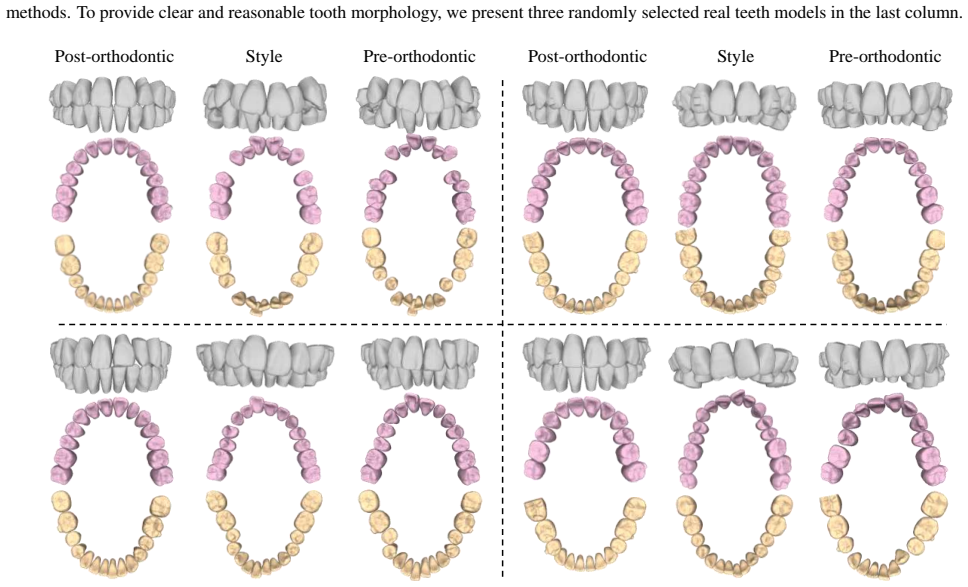
TeethGenerator claims that paired pre- and post-orthodontic 3D teeth models can be synthesised by splitting the problem into shape and style. Stage I encodes each arch of up to 32 teeth into a structured latent grid and trains a diffusion model there, producing post-treatment arches with varied tooth counts and morphologies. Stage II takes one such generated arch and a separate 'style model', extracts per-tooth style features and whole-arch shape features, and predicts per-tooth transformation parameters (three translation components and a six-dimensional rotation) that are applied around each tooth's centroid to produce the pre-treatment arch. Because the pre-treatment model is obtained by transforming, not resampling, the generated post-treatment teeth, each tooth's morphology and point correspondence are preserved. The paper's evidence for the claim is a set of distributional metrics comparing generated post-treatment models to real ones, plus a downstream experiment in which real plus synthetic data trains a tooth-arrangement network better than real data alone.
Load-bearing premise
The framework assumes that the paired training scans are a faithful record of clinically correct post-orthodontic outcomes, and that the style space learned from those pairs represents any style model a user might supply at inference.
Editorial extensions
If this is right
- Tooth-arrangement networks can be trained with far fewer real patient scans, since synthetic pairs can be generated at will once the two stages are trained.
- Underrepresented malocclusion categories, such as the rare anterior open bite in the real dataset, can be augmented with synthetic examples by choosing appropriate style models.
- Because Stage II outputs transformation parameters rather than new point clouds, the paired synthetic data inherit point correspondence between pre- and post-orthodontic models, which many alignment losses rely on.
- The reported downstream results imply that synthetic data should be used as a supplement to real data, with performance improving up to ten times the real training-set size before converging.
- The method can produce a pre-orthodontic counterpart for any generated post-orthodontic arch on demand, enabling creation of custom paired datasets for a specified style.
Reading between the lines
- Editorial inference: the same de-alignment-by-transformation idea could be applied to other structured multi-part anatomies, such as spinal vertebrae or hand and foot bones, where paired before-and-after scans are rare.
- Editorial inference: the paper does not test Stage II on style models that are far outside the training distribution; feeding a style model from an unseen malocclusion class would reveal whether the style encoder truly generalises or only interpolates.
- Editorial inference: the downstream benefit is demonstrated with one alignment backbone; showing the same synthetic set improves other tooth-arrangement networks would make the data-augmentation claim much broader.
- Editorial inference: a natural stress test is to train a tooth-arrangement network on synthetic data alone and measure performance on real test data; the paper reports mixed real-plus-synthetic results, so the synthetic-only transfer ceiling is unknown.
Editorial analysis
A structured set of objections, weighed in public.
Referee Report
Summary. The paper proposes TeethGenerator, a two-stage generative framework for synthesizing paired pre- and post-orthodontic 3D teeth models. Stage I trains a VQ-VAE and a latent diffusion model to generate post-orthodontic teeth point clouds directly, organized in a 2x2x8 FDI grid. Stage II trains a Transformer that takes a style (pre-orthodontic) model as condition and predicts per-tooth rigid transformation parameters applied to Stage I outputs, producing a pre-orthodontic model with identical tooth morphology. Experiments report 1-NNA and uniqueness metrics for Stage I against five 3D generation baselines (Table 1), ablations of voxelization strategy (Table 2), qualitative results for Stage II (Fig. 6), and downstream TANet tooth-alignment results when training with increasing amounts of synthetic data (Fig. 9). The paper concludes that the synthetic data closely matches the real data distribution and improves downstream alignment performance.
Significance. If the central claim holds, the framework addresses a real bottleneck: paired pre/post-orthodontic 3D datasets are scarce and expensive to acquire. The design is sensible: decoupling post-orthodontic morphology generation (Stage I) from pre-orthodontic style transfer (Stage II) preserves tooth identity and allows flexible conditioning. The paper includes credible Stage I comparisons against several general point-cloud generation baselines, ablations of the proposed grid/voxel structure, a downstream evaluation on a real alignment network, and a public code/dataset release commitment. However, the manuscript's headline claim about paired-data fidelity is currently supported only indirectly: Stage II has no quantitative evaluation, and the downstream experiment conflates data quantity with Stage II realism. These gaps are fixable by additional experiments and would materially strengthen the paper.
major comments (4)
- [Sec. 3.3 / Sec. 4.2] The pre-orthodontic outputs of Stage II are never evaluated quantitatively. The central claim that the synthetic paired data 'aligns closely with the distribution of real orthodontic data' depends on Stage II reality, yet Fig. 6 is only qualitative and Fig. 9 cannot isolate Stage II. I request quantitative distributional metrics for generated pre-orthodontic models (e.g., 1-NNA with CD/EMD against a held-out real pre-orthodontic set), a style-fidelity measurement (distance between the generated pre model and the conditioning style model), and an experiment with held-out or out-of-distribution style models to support the inference-stage claim in Sec. 3.3. It would also be valuable to verify that Stage II, trained on real post-orthodontic inputs, transfers to Stage I-generated inputs.
- [Sec. 4.3 / Fig. 9] The downstream experiment does not control for data quantity. The observed gains could come from simply adding more training examples, from Stage I's post-orthodontic distribution, or from Stage II's pre-orthodontic realism. Please include a synthetic-only training run, a matched-size control using duplicated or augmented real data, and results with more than one downstream backbone; report means and standard deviations over at least three seeds. Without these controls, the statement that the synthetic data 'promotes tooth alignment performance' is not uniquely attributable to the proposed paired generation.
- [Sec. 4.1 / Tables 1 and 2] The 1-NNA and UCD metrics are reported without error bars or significance tests, and the reference set for 1-NNA is not specified as a held-out split. If the reference set overlaps the training distribution, the reported 69.50/71.88/96.25 values may be optimistic. Specify the reference split and report variance across random seeds or diffusion sampling runs. This is important because the Stage I evaluation currently measures similarity to the distribution from which the model was trained, so a held-out reference set is needed to support the generalization claim.
- [Sec. 3.3 (inference stage)] The claim that 'the style model can be any arbitrary teeth model' is unsupported, because all experiments condition on style models drawn from the same real dataset used for training. The paper should evaluate on held-out styles (e.g., malocclusion categories or tooth-count configurations not seen in training) to substantiate the generalization claim, or explicitly limit the claim to in-distribution styles.
minor comments (7)
- [Fig. 9] The plot would benefit from axis labels, a legend, and error bars; currently the reader cannot determine the metric scale or the variability of the ADD, PA-ADD, and CSA values.
- [Eq. (8)] The uniqueness threshold r = 1 cm is a free parameter; please report sensitivity of UCD to this threshold or justify the choice with reference to clinical tooth-size variation.
- [Sec. 4.1] The filtering step from 1060 pairs to 720 training pairs is not described; please report the exclusion criteria and the malocclusion distribution of the final train/validation/test split.
- [Eq. (5)] The loss L_dis relies on dense point correspondence between pre- and post-orthodontic teeth; the paper should clarify how this correspondence is obtained for real data and whether it is exact after resampling 128 points per tooth.
- [Sec. 3.2] The mask prediction for valid teeth is mentioned but its supervision is not specified; please state the mask loss and how missing teeth are handled during VQ-VAE and diffusion training.
- [Fig. 2 caption] The caption and some in-line text contain garbled placeholders (e.g., '??????', '??hap?'), indicating a rendering or compilation issue that should be fixed before publication.
- [Introduction] The contribution claim of being 'the first pair-wise teeth generation framework' should be softened or supported by an explicit comparison with prior synthetic dental data work beyond general 3D generation baselines.
Circularity Check
No significant circularity: the method is an empirical, externally benchmarked generative pipeline; Stage II's conditioning on real style models is a transparent design choice, and the main weakness is missing quantitative validation of Stage II, not a circular reduction.
full rationale
The paper makes no first-principles derivation; it proposes a two-stage generative model and evaluates it against external baselines (PointFlow, DPM, PVD, LION, DiT-3D) and a downstream TANet task. Stage I trains a VQ-VAE and latent diffusion with standard reconstruction and denoising losses (Eqs. 2-4); the 1-NNA/UCD evaluation measures distributional similarity, a standard generative-model check, and does not reduce to a fitted parameter. Stage II is an explicit conditional generator: the style model is a stated input, and the loss (Eq. 5) supervises the predicted pre-orthodontic output toward that same style model. This is a conventional exemplar-conditioned regression, not a prediction smuggled out of a fit: at inference the transformation parameters are produced feedforward for a new style. The use of the authors' own dataset [36] is a self-citation, but the dataset is public real-patient data and the comparisons also involve external methods, so the central empirical claims do not rest on an unverified self-citation. The skeptical concern about the absence of a quantitative Stage II evaluation (no 1-NNA/pre-style fidelity metric, no held-out-style test) is a legitimate rigor gap and should be addressed, but it is not circularity: the paper does not define the pre-side output in terms of the evaluation target. No equation in the paper reduces by construction to its input, and no fitted parameter is renamed as a prediction. Score 0.
Assumptions & free parameters
free parameters (4)
- voxel resolution r =
4
- uniqueness threshold r =
1 cm
- minimum distance delta in collision loss =
not reported
- points per tooth N =
128
assumptions (4)
- domain assumption The 1060-pair dataset [36] provides reliable paired pre/post-orthodontic ground truth.
- domain assumption Chamfer distance and EMD based 1-NNA are valid measures of distributional similarity for clinical teeth arrangements.
- domain assumption The FDI 2x2x8 grid structure encodes relevant dental topology, including bilateral and occlusal symmetry.
- standard math Diffusion models and VQ-VAEs can represent the distribution of tooth morphologies in a compact latent space.
Cite this review
Pith. "Pith review of TeethGenerator: A two-stage framework for paired pre- and post-orthodontic 3D dental data generation." pith.science (2026). https://pith.science/paper/H4YVMUAW
@misc{pith2026250704685,
  author       = {Pith},
  title        = {Pith review of: TeethGenerator: A two-stage framework for paired pre- and post-orthodontic 3D dental data generation},
  year         = {2026},
  howpublished = {\url{https://pith.science/paper/H4YVMUAW}},
  note         = {Machine review of arXiv:2507.04685}
}
read the original abstract
Digital orthodontics represents a prominent and critical application of computer vision technology in the medical field. So far, the labor-intensive process of collecting clinical data, particularly in acquiring paired 3D orthodontic teeth models, constitutes a crucial bottleneck for developing tooth arrangement neural networks. Although numerous general 3D shape generation methods have been proposed, most of them focus on single-object generation and are insufficient for generating anatomically structured teeth models, each comprising 24-32 segmented teeth. In this paper, we propose TeethGenerator, a novel two-stage framework designed to synthesize paired 3D teeth models pre- and post-orthodontic, aiming to facilitate the training of downstream tooth arrangement networks. Specifically, our approach consists of two key modules: (1) a teeth shape generation module that leverages a diffusion model to learn the distribution of morphological characteristics of teeth, enabling the generation of diverse post-orthodontic teeth models; and (2) a teeth style generation module that synthesizes corresponding pre-orthodontic teeth models by incorporating desired styles as conditional inputs. Extensive qualitative and quantitative experiments demonstrate that our synthetic dataset aligns closely with the distribution of real orthodontic data, and promotes tooth alignment performance significantly when combined with real data for training. The code and dataset are available at https://github.com/lcshhh/teeth_generator.
Figures


Figures from the paper (5 more)




Reference graph
Works this paper leans on
-
[1]
Synthetic data from diffusion models improves imagenet classification
Shekoofeh Azizi, Simon Kornblith, Chitwan Saharia, Mo- hammad Norouzi, and David J Fleet. Synthetic data from diffusion models improves imagenet classification. InTrans- actions on Machine Learning Research, 2023. 2
work page 2023
-
[2]
Language models are few-shot learners
Tom B Brown. Language models are few-shot learners. NeurIPS, pages 1877–1901, 2020. 2
work page 1901
-
[3]
Decor- gan: 3d shape detailization by conditional refinement
Zhiqin Chen, Vladimir G Kim, Matthew Fisher, Noam Aigerman, Hao Zhang, and Siddhartha Chaudhuri. Decor- gan: 3d shape detailization by conditional refinement. In CVPR, pages 15740–15749, 2021. 2, 3
work page 2021
-
[4]
3d u-net: learn- ing dense volumetric segmentation from sparse annota- tion
¨Ozg¨un C ¸ ic ¸ek, Ahmed Abdulkadir, Soeren S Lienkamp, Thomas Brox, and Olaf Ronneberger. 3d u-net: learn- ing dense volumetric segmentation from sparse annota- tion. In Medical Image Computing and Computer-Assisted Intervention–MICCAI 2016: 19th International Conference, Athens, Greece, October 17-21, 2016, Proceedings, Part II 19, pages 424–432. Sprin...
work page 2016
-
[5]
Collaborative tooth motion diffusion model in digital orthodontics
Yeying Fan, Guangshun Wei, Chen Wang, Shaojie Zhuang, Wenping Wang, and Yuanfeng Zhou. Collaborative tooth motion diffusion model in digital orthodontics. In AAAI, pages 1679–1687, 2024. 1, 2, 3, 5
work page 2024
-
[6]
Learning Beyond Human Expertise with Generative Models for Dental Restorations
Jyh-Jing Hwang, Sergei Azernikov, Alexei A Efros, and Stella X Yu. Learning beyond human expertise with generative models for dental restorations. arXiv preprint arXiv:1804.00064, 2018. 2
work page Pith review arXiv 2018
-
[7]
Zero-shot text-guided object gen- eration with dream fields
Ajay Jain, Ben Mildenhall, Jonathan T Barron, Pieter Abbeel, and Ben Poole. Zero-shot text-guided object gen- eration with dream fields. In CVPR, pages 867–876, 2022. 2, 3
work page 2022
-
[8]
Kingma Diederik, Poole Ben, Norouzi Mohammad, J
Ho Jonathan, Chan William, Saharia Chitwan, Whang Jay, Gao Ruiqi, Gritsenko Alexey, P. Kingma Diederik, Poole Ben, Norouzi Mohammad, J. Fleet David, and Tim Salimans. magen video: High definition video generation with diffu- sion models. arXiv preprint arXiv:2210.02303, 2022. 2
Show all 42 references
-
[9]
Dc- face: Synthetic face generation with dual condition diffusion model
Minchul Kim, Feng Liu, Anil Jain, and Xiaoming Liu. Dc- face: Synthetic face generation with dual condition diffusion model. In Proceedings of the ieee/cvf conference on com- puter vision and pattern recognition , pages 12715–12725,
-
[10]
Automatic tooth arrangement with joint features of point and mesh rep- resentations via diffusion probabilistic models
Changsong Lei, Mengfei Xia, Shaofeng Wang, Yaqian Liang, Ran Yi, Yu-Hui Wen, and Yong-Jin Liu. Automatic tooth arrangement with joint features of point and mesh rep- resentations via diffusion probabilistic models. Computer Aided Geometric Design, 111:102293, 2024. 1, 2, 3
2024
-
[11]
Malocclusion treatment planning via pointnet based spatial transformation network
Xiaoshuang Li, Lei Bi, Jinman Kim, Tingyao Li, Peng Li, Ye Tian, Bin Sheng, and Dagan Feng. Malocclusion treatment planning via pointnet based spatial transformation network. In Medical Image Computing and Computer Assisted Inter- vention, pages 105–114, 2020. 3
2020
-
[12]
Magic3d: High-resolution text-to-3d content creation
Chen-Hsuan Lin, Jun Gao, Luming Tang, Towaki Takikawa, Xiaohui Zeng, Xun Huang, Karsten Kreis, Sanja Fidler, Ming-Yu Liu, and Tsung-Yi Lin. Magic3d: High-resolution text-to-3d content creation. In CVPR, pages 300–309, 2023. 2, 3
2023
-
[13]
iorthopredictor: model- guided deep prediction of teeth alignment
Y ANG Lingchen, SHI Zefeng, WU Yiqian, LI Xiang, ZHOU Kun, FU Hongbo, and Youyi Zheng. iorthopredictor: model- guided deep prediction of teeth alignment. ACM TOG, 39: 216, 2020. 3
2020
-
[14]
One-2-3-45: Any single image to 3d mesh in 45 seconds without per-shape optimiza- tion
Minghua Liu, Chao Xu, Haian Jin, Linghao Chen, Mukund Varma T, Zexiang Xu, and Hao Su. One-2-3-45: Any single image to 3d mesh in 45 seconds without per-shape optimiza- tion. NeurIPS, 36, 2024. 3
2024
-
[15]
Meshdiffu- sion: Score-based generative 3d mesh modeling
Zhen Liu, Yao Feng, Michael J Black, Derek Nowrouzezahrai, Liam Paull, and Weiyang Liu. Meshdiffu- sion: Score-based generative 3d mesh modeling. In ICLR. 3
-
[16]
Point- voxel cnn for efficient 3d deep learning
Zhijian Liu, Haotian Tang, Yujun Lin, and Song Han. Point- voxel cnn for efficient 3d deep learning. NeurIPS, 32, 2019. 4
2019
-
[17]
Wonder3d: Sin- gle image to 3d using cross-domain diffusion
Xiaoxiao Long, Yuan-Chen Guo, Cheng Lin, Yuan Liu, Zhiyang Dou, Lingjie Liu, Yuexin Ma, Song-Hai Zhang, Marc Habermann, Christian Theobalt, et al. Wonder3d: Sin- gle image to 3d using cross-domain diffusion. In CVPR, pages 9970–9980, 2024. 3
2024
-
[18]
Diffusion probabilistic models for 3d point cloud generation
Shitong Luo and Wei Hu. Diffusion probabilistic models for 3d point cloud generation. In CVPR, pages 2837–2845,
-
[19]
Dit-3d: Exploring plain diffusion transformers for 3d shape generation.NeurIPS, 36: 67960–67971, 2023
Shentong Mo, Enze Xie, Ruihang Chu, Lanqing Hong, Matthias Niessner, and Zhenguo Li. Dit-3d: Exploring plain diffusion transformers for 3d shape generation.NeurIPS, 36: 67960–67971, 2023. 6
2023
-
[20]
Fast marching far- thest point sampling
Carsten Moenning and Neil A Dodgson. Fast marching far- thest point sampling. Technical report, University of Cam- bridge, Computer Laboratory, 2003. 6
2003
-
[21]
Polygen: An autoregressive generative model of 3d meshes
Charlie Nash, Yaroslav Ganin, SM Ali Eslami, and Peter Battaglia. Polygen: An autoregressive generative model of 3d meshes. In International conference on machine learning, pages 7220–7229. PMLR, 2020. 3
2020
-
[22]
Improved denoising diffusion probabilistic models
Alexander Quinn Nichol and Prafulla Dhariwal. Improved denoising diffusion probabilistic models. In International conference on machine learning, pages 8162–8171. PMLR,
-
[23]
A time for change of tooth numbering systems
S Peck and L Peck. A time for change of tooth numbering systems. Journal of dental education, 57(8):643–647, 1993. 4
1993
-
[24]
Dreamfusion: Text-to-3d using 2d diffusion
Ben Poole, Ajay Jain, Jonathan T Barron, and Ben Milden- hall. Dreamfusion: Text-to-3d using 2d diffusion. In ICLR. 2, 3
-
[25]
Dreambooth3d: Subject-driven text-to-3d generation
Amit Raj, Srinivas Kaza, Ben Poole, Michael Niemeyer, Nataniel Ruiz, Ben Mildenhall, Shiran Zada, Kfir Aberman, Michael Rubinstein, Jonathan Barron, et al. Dreambooth3d: Subject-driven text-to-3d generation. In ICCV, pages 2349– 2359, 2023. 2
2023
-
[26]
Palette: Image-to-image diffusion models
Chitwan Saharia, William Chan, Huiwen Chang, Chris Lee, Jonathan Ho, Tim Salimans, David Fleet, and Mohammad Norouzi. Palette: Image-to-image diffusion models. In ACM SIGGRAPH 2022 conference proceedings, pages 1–10,
2022
-
[27]
Orthogan: High-precision image generation for teeth orthodontic visu- alization
Feihong Shen, JIngjing Liu, Haizhen Li, Bing Fang, Cheng- long Ma, Jin Hao, Yang Feng, and Youyi Zheng. Orthogan: High-precision image generation for teeth orthodontic visu- alization. arXiv preprint arXiv:2212.14162, 2022. 1, 2, 3
2022 arXiv
-
[28]
Ai models collapse when trained on recursively generated data
Ilia Shumailov, Zakhar Shumaylov, Yiren Zhao, Nicolas Pa- pernot, Ross Anderson, and Yarin Gal. Ai models collapse when trained on recursively generated data. Nature, 631 (8022):755–759, 2024. 2
2024
-
[29]
Meshgpt: Generating triangle meshes with decoder-only transformers
Yawar Siddiqui, Antonio Alliegro, Alexey Artemov, Tatiana Tommasi, Daniele Sirigatti, Vladislav Rosov, Angela Dai, and Matthias Nießner. Meshgpt: Generating triangle meshes with decoder-only transformers. In CVPR, pages 19615– 19625, 2024. 3
2024
-
[30]
Deep unsupervised learning using nonequilibrium thermodynamics
Jascha Sohl-Dickstein, Eric Weiss, Niru Maheswaranathan, and Surya Ganguli. Deep unsupervised learning using nonequilibrium thermodynamics. In ICML, pages 2256– 2265, 2015. 4
2015
-
[31]
Score-based generative modeling through stochastic differential equa- tions
Yang Song, Jascha Sohl-Dickstein, Diederik P Kingma, Ab- hishek Kumar, Stefano Ermon, and Ben Poole. Score-based generative modeling through stochastic differential equa- tions. In ICLR, pages 1–12, 2021. 4
2021
-
[32]
Vari- ational autoencoders for deforming 3d mesh models
Qingyang Tan, Lin Gao, Yu-Kun Lai, and Shihong Xia. Vari- ational autoencoders for deforming 3d mesh models. In CVPR, pages 5841–5850, 2018. 2, 3
2018
-
[33]
Lion: Latent point dif- fusion models for 3d shape generation
Arash Vahdat, Francis Williams, Zan Gojcic, Or Litany, Sanja Fidler, Karsten Kreis, et al. Lion: Latent point dif- fusion models for 3d shape generation. NeurIPS, 35:10021– 10039, 2022. 3, 6
2022
-
[34]
Neural discrete representation learning
Aaron van den Oord, Oriol Vinyals, and Koray Kavukcuoglu. Neural discrete representation learning. In NeurIPS, page 6309–6318, 2017. 2
2017
-
[35]
Tooth alignment network based on landmark constraints and hierarchical graph structure
Chen Wang, Guangshun Wei, Guodong Wei, Wenping Wang, and Yuanfeng Zhou. Tooth alignment network based on landmark constraints and hierarchical graph structure. IEEE TVCG, pages 1457–1469, 2022. 3
2022
-
[36]
A 3d dental model dataset with pre/post- orthodontic treatment for automatic tooth alignment [data set]
Shaofeng Wang, Changsong Lei, Yaqian Liang, Jun Sun, Xianju Xie, Yajie Wang, Feiei Zuo, Yuxing Bai, Song Li, and Yong-Jin Liu. A 3d dental model dataset with pre/post- orthodontic treatment for automatic tooth alignment [data set]. Zenodo. https://doi.org/10.5281/zenodo.11392406 ,
-
[37]
Tanet: To- wards fully automatic tooth arrangement
Guodong Wei, Zhiming Cui, Yumeng Liu, Nenglun Chen, Runnan Chen, Guiqing Li, and Wenping Wang. Tanet: To- wards fully automatic tooth arrangement. In ECCV, pages 481–497, 2020. 1, 2, 3, 6
2020
-
[38]
Learning pro- gressive point embeddings for 3d point cloud generation
Cheng Wen, Baosheng Yu, and Dacheng Tao. Learning pro- gressive point embeddings for 3d point cloud generation. In CVPR, pages 10266–10275, 2021. 2, 3
2021
-
[39]
Pointflow: 3d point cloud generation with continuous normalizing flows
Guandao Yang, Xun Huang, Zekun Hao, Ming-Yu Liu, Serge Belongie, and Bharath Hariharan. Pointflow: 3d point cloud generation with continuous normalizing flows. In ICCV, pages 4541–4550, 2019. 6
2019
-
[40]
3dstyle-diffusion: Pursuing fine-grained text-driven 3d stylization with 2d diffusion models
Haibo Yang, Yang Chen, Yingwei Pan, Ting Yao, Zhineng Chen, and Tao Mei. 3dstyle-diffusion: Pursuing fine-grained text-driven 3d stylization with 2d diffusion models. In Pro- ceedings of the 31st ACM International Conference on Mul- timedia, pages 6860–6868, 2023. 2
2023
-
[41]
3d shape genera- tion and completion through point-voxel diffusion
Linqi Zhou, Yilun Du, and Jiajun Wu. 3d shape genera- tion and completion through point-voxel diffusion. In ICCV, pages 5826–5835, 2021. 3, 6
2021
-
[42]
On the continuity of rotation representations in neural networks
Yi Zhou, Connelly Barnes, Jingwan Lu, Jimei Yang, and Hao Li. On the continuity of rotation representations in neural networks. In CVPR, pages 5745–5753, 2019. 5
2019
Reviewed August 6, 2026 · model on record in the stance chip above.
Discussion (0). Continue with ORCID to comment.