REVIEW 5 major objections 7 minor 66 references
LumiCRS: Asymmetric Contrastive Prototype Learning for Long-Tail Conversational Recommender Systems
T0 review · 5 major / 7 minor · reviewed 2026-08-06 · deepseek-v4-flash
Pith's one-line read LumiCRS claims that a three-layer combination of adaptive focal loss, prototype learning, and GPT-4o-driven dialogue augmentation fixes the long-tail bias of conversational recommenders, yielding roughly 10 percent relative gains in…
desk verdict LumiCRS is a coherent systems paper with credible 5–11% gains, but the augmentation pipeline's use of the full corpus for retrieval leaves an unclosed test-leakage gap that needs an artifact audit before the headline numbers can be trusted. read the letter →
The pith
A machine-rendered reading of the paper's core claim, the machinery that carries it, and where it could break.
The reading
What carries the argument
The central object is the head/body/tail segmentation of the movie catalogue, computed from training-sample mention counts, which defines which items need protection from overfitting, drift, or sparsity. Three mechanisms carry the argument: the Adaptive Comprehensive Focal Loss (ACFL), which combines adaptive class weights, dynamic focusing factors, Top-K hard-example mining, and adaptive sampling into one loss; prototype learning, which builds semantic, affective, and contextual prototypes for body and tail movies and uses a composite similarity score to pull in nearby support samples; and prototype-guided GPT-4o dialogue augmentation, which generates new multi-turn dialogues about tail movies, filters near-duplicates by semantic similarity, validates candidates with majority voting across five LLMs plus human review, and merges accepted dialogues into the training corpus.
What would settle it
Check the released augmented dialogues for overlap with the ReDial and INSPIRED test sets: if any generated or prototype dialogue shares a dialogue ID or a long n-gram with a test dialogue, the Tail-Recall and diversity gains are inflated. A second check is to retrain LumiCRS without the augmented dialogues while keeping ACFL and prototypes; if Tail-Recall@10 falls back to the DisenCRS level, the paper's claim that the three layers work jointly is weakened.
Extended reading notes
Core claim
The paper's central discovery is that long-tail bias in conversational recommender systems is best treated at three levels simultaneously rather than with any single re-weighting trick: a loss level (ACFL), a representation level (asymmetric contrastive prototype learning), and a data level (LLM-driven dialogue augmentation). With all three mechanisms in place, LumiCRS outperforms fifteen baselines on ReDial and INSPIRED: Recall@10 rises by about 6.6 to 8.3 percent relative, Tail-Recall@10 by about 10 percent, Coverage and Intra-List Diversity by 8 to 11 percent, Distinct-4 by about 10 percent, and human-rated long-tail relevance by 13.9 percent. The same three-layer design also reduces popularity bias, measured by Popularity-Weighted Precision, by more than 13 percent relative to the best single-loss alternative.
Load-bearing premise
The central claim rests on the assumption that the GPT-4o-generated dialogues merged into the training corpus are realistic, learnable, and strictly disjoint from the test dialogues, so the reported gains come from better long-tail modeling rather than leakage or distribution shift.
Editorial extensions
If this is right
- If the claims hold, the same three-layer recipe of tail-aware loss, prototype anchors, and LLM augmentation offers a general template for reducing popularity bias in other sparse conversational domains, not just movie recommendation.
- ACFL's dynamic focusing and Top-K selection is credited with keeping overall accuracy while amplifying hard tail instances; replacing it with cross-entropy drops Recall@10 by about 9 to 10 percent in the paper's ablations.
- Prototype-guided augmentation is the largest single contributor to dialogue fluency and tail coverage in the paper's ablations: disabling it degrades BLEU-2 by 28 to 36 percent and TailRel@10 by about 30 percent.
- Human evaluation gains on fluency, informativeness, persuasiveness, and long-tail relevance suggest that users perceive a difference between blockbuster-biased and long-tail-aware recommendations.
- Coverage and Intra-List Diversity gains of roughly 8 to 11 percent mean that the same model exposes a wider slice of the catalogue, which is a direct step toward fairer treatment of niche items.
Reading between the lines
- If this pattern generalizes, prototype-guided augmentation could be applied to other text-rich recommendation domains such as books, music, or games, with the composite similarity function reweighted for domain-specific metadata.
- One testable extension is to isolate the value of prototype selection by comparing against augmentation generated from randomly chosen tail dialogues rather than prototype-guided prompts; the paper compares against random and template augmentation but not against LLM generation without prototype guidance.
- The steep dependence of BLEU and TailRel on augmentation in the ablations suggests that a large share of the conversational quality gains may come from the data-side changes, implying that a cheaper system using only augmentation might capture part of the benefit, a configuration the paper does not directly test.
- Because the prototype module also stabilizes mid-frequency item representations, it may be transferable to cold-start recommendation settings beyond dialogue, where the bottleneck is sparse interaction history rather than conversational language.
Editorial analysis
A structured set of objections, weighed in public.
Referee Report
Summary. The manuscript proposes LumiCRS, a conversational recommender system designed to mitigate long-tail popularity bias on the ReDial and INSPIRED benchmarks. The framework combines three modules: an Adaptive Comprehensive Focal Loss (ACFL) that reweights, re-samples, and masks training examples; a prototype-learning component that clusters body- and tail-movie dialogues by semantic, emotional, and contextual similarity; and a GPT-4o-driven dialogue augmentation pipeline that generates and filters new tail-focused dialogues, which are then merged into the training corpus. The paper reports state-of-the-art results over the compared baselines across recommendation accuracy (relative Recall@10 gains of 6.6-8.3%), long-tail metrics (Tail-Recall@10 gains of 9.8-10.7%, Coverage and ILD gains of roughly 8-11%), and response generation (DIST-4 gains around 10%), supported by module ablations, a controlled loss-function comparison, hyperparameter sensitivity analyses, and a human evaluation on five Likert scales.
Significance. If the reported results are clean, the paper would make a useful empirical contribution: it demonstrates that a combination of loss-level rebalancing, prototype-based representation learning, and LLM-driven augmentation can improve both accuracy and diversity in conversational recommendation on two standard benchmarks. The manuscript includes several commendable elements: a controlled loss-only ablation (Table 8), module ablations (Figure 4, Tables 9-10), hyperparameter sensitivity and interaction analyses (Figures 8-11), a detailed human-evaluation rubric (Table 3), and a public code link. The main caveat is that the augmentation pipeline's data provenance is not fully specified; whether the reported gains survive a strict train/test audit is the deciding question for the paper's central claim.
major comments (5)
- [§4.2.2, §4.3, Tables 4-7] The pipeline transparency gap identified here is load-bearing for every reported gain. Section 4.2.2 builds the enriched subset S1 by ranking "all samples x in D" via FinalScore, and Section 4.3 merges accepted GPT-4o dialogues into the training corpus, but the manuscript never states that D and the prototype dialogues are restricted to the training split of ReDial and INSPIRED; Section 4.2.1 calls D "the full training set" while Section 4.2.2 calls it "the full corpus," and the two are never reconciled. If the corpus used for prototype selection, Top-K neighbor retrieval, and prompt construction includes test dialogues, then the relative improvements in Tables 4-7 (Recall@10 +6.6-8.3%, Tail-Recall@10 +9.8-10.7%, TailRel +13.9%) would be inflated by direct test-set exposure rather than by the method itself. Please state the exact provenance of prototypes, retrieved neighbors, and accepted augmentations, and provide an artifact-level check (for example, a code-path trace or an overlap analysis) demonstrating that no test dialogue or test-derived text entered the training set.
- [§4.1.1, Eq. (5), Algorithm 1] The Top-K hard-example mask is defined in the opposite direction from its stated purpose. Equation (5) sets tau_k = quantile(p_i, k) and M_i = 1{p_i >= tau_k}, so with the hyperparameter k = 25% used in Section 6.7, the mask selects the 75% of samples with the highest predicted probability of the true class, i.e., the easiest examples. The text and Algorithm 1, however, claim that "only the top (1-k)% hardest examples (i.e., those with lower predicted confidence) are selected for loss computation." Selecting harder examples would require the opposite inequality or a complementary quantile (for example, p_i <= quantile(p_i, 1-k)). As written, the formula and the claimed mechanism contradict each other, and the k% sensitivity analysis in Section 6.7 cannot be interpreted without resolving this.
- [§4.2.2, §4.3, Figure 3] The prototype set C is an undefined precondition for the entire augmentation and similarity-retrieval pipeline. Section 4.2.2 begins "Based on the previously constructed prototype set C = {x_c_m | m in M_tail union M_body}," but Section 4.2.1 constructs only the sample subsets D_body and D_tail; no clustering algorithm, cluster count, prototype-selection criterion, or per-movie prototype count is formally specified, and Figure 3B's reference to "clustering" is not backed by any procedure in the text. Since the GPT-4o prompts in Section 4.3 are built from prototype dialogues, this omission makes the augmentation module non-reproducible and also blocks the split-provenance audit requested above.
- [§5.3, Table 7] The human-evaluation protocol is under-specified in a way that affects the credibility of the TailRel +13.9% claim. Section 5.3 says the authors "randomly sample 1,000 system responses" and have 200 triple-annotated by experts, but it never states that these responses are generated on the held-out test conversations by every compared model under identical decoding conditions, nor that none of them comes from augmented or training data. The paper also states that correlations between automatic and human scores are computed to ensure reliability, but no such correlations are reported anywhere in Section 6.2 or elsewhere.
- [§5.2, Tables 4 and 6] The baseline inventory is inconsistent between the text and the result tables. Section 5.2 promises a comparison against 15 baselines including GPT-2, DialoGPT, and BART, but Table 4 (recommendation) omits these three models and instead includes COLA, which is never introduced in Section 5.2 and appears only in the ReDial columns of Tables 4 and 6. The claim of outperforming "fifteen strong baselines" on the recommendation task cannot be checked from the reported tables until the baseline list and the table rows are reconciled.
minor comments (7)
- [Title, §4.2, §6.1] The title and Section 6.1 advertise "Asymmetric Contrastive Prototype Learning," but Section 4.2 describes no contrastive objective, no asymmetry, and no contrastive loss; please either specify the contrastive component or adjust the terminology.
- [§6.3] Section 6.3 contains several textual errors, including "Replacement of ACFL cement with CE" and a duplicated "underscoring the role of ACFL"; the section should be re-read for typos.
- [Table 6] Table 6 reports DIST-2/3/4 values on INSPIRED that are several times larger than on ReDial for the same models (e.g., LumiCRS DIST-4 is 7.400 on INSPIRED but 1.710 on ReDial); please clarify whether the normalization or response length differs, since the metric definition is identical.
- [§6.7] Section 6.7 states without supporting results that the semantic/emotional weights and the interaction coefficient vary performance by less than 1.5%; please provide the underlying experiment or remove the claim.
- [§5.3, Tables 4-6] Tables 4-6 mark the best results with p < 0.05 but never report the test used, the number of random seeds, or the number of runs; please add this information.
- [Algorithm 1] Algorithm 1 has a stray semicolon in the line "Compute weighted sample loss:;" and uses a binary cross-entropy form l_j = -w_c * w_sample,j * a_j * f_j * [y_j log(p_j) + (1-y_j) log(1-p_j)] without explaining how this applies to the multi-class recommendation setting; the notation should be clarified.
- [References] Reference [48] is listed as "Preprint—under review" with no arXiv identifier, and reference [66] cites a placeholder-style identifier (arXiv:2504.12345); the authors should provide fully verifiable citations.
Circularity Check
No significant circularity found: LumiCRS's claims are empirical benchmark results with D explicitly defined as the training set; no prediction reduces by construction to its own input.
full rationale
LumiCRS is an empirical systems paper whose central claims are benchmark numbers (Tables 4-6) and ablations, not a theorem derived from its assumptions. The prototype/augmentation pipeline that could in principle leak test information is explicitly confined to training data: Section 4.2.1 defines D as 'the full training set', and Section 4.3 states that accepted GPT-4o dialogues are 'merged with the original corpus to create an expanded training set'. No passage exhibits a reduction of a reported metric to a fitted parameter or to the method's own definition. The loss, prototype module, and augmentation are proposed mechanisms tested against reproduced baselines; hyperparameter tuning and human-evaluation sampling are described without full provenance, which is a transparency gap rather than an exhibited circular step. The only self-citation ([35], Du et al. 2024, sharing co-authors Li and Peng) is a related-work citation for LLM-based CRS unification and is not load-bearing. Table 1 is a design checklist evaluating ACFL against capabilities it was constructed to satisfy, but the paper does not use that checklist as the evidence for the benchmark gains. Accordingly, no circularity step meets the quote-and-reduction bar.
Assumptions & free parameters
free parameters (7)
- ACFL hyperparameters (alpha, beta, gamma, k, epsilon, clip bounds, theta bounds) =
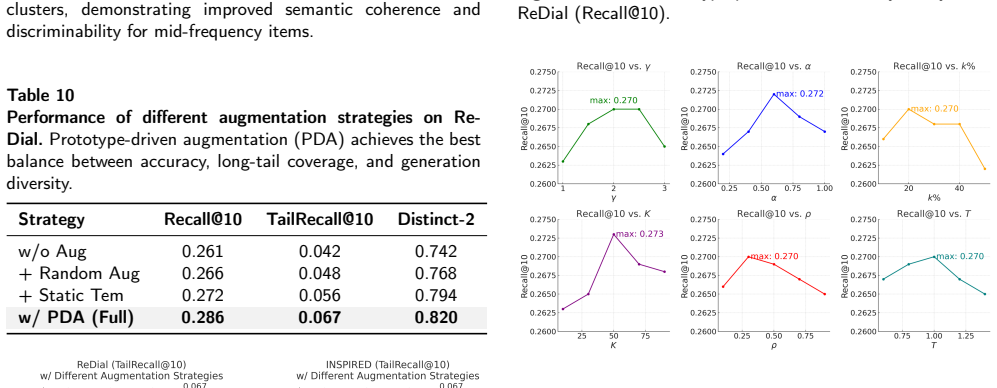
alpha=0.6, gamma=2.5, k=25%, beta not specified in paper
- Number of prototypes K =
K=50
- Augmentation ratio rho and temperature T =
rho=0.3, T=0.7
- Tail/body segmentation threshold theta (e.g., first quartile) =
not explicitly stated
- Weights w_sem, w_emo, w_mov, w_int in FinalScore =
not stated; paper says stable values from previous studies
- Similarity cutoff 0.85 for filtering generated dialogues =
0.85
- Class smoothing epsilon and max normalization N_max =
not stated
assumptions (4)
- domain assumption The popularity of a movie, defined as its mention count in the training set, is a sufficient basis for splitting items into head, body, and tail tiers.
- domain assumption GPT-4o-generated dialogues about body and tail movies, filtered by LLM voting, are distributionally safe to add to the training set.
- domain assumption The ReDial and INSPIRED test sets are fixed and untouched, and the reported gains are not an artifact of overlapping augmented data.
- standard math Standard pretrained model and fine-tuning assumptions.
Cite this review
Pith. "Pith review of LumiCRS: Asymmetric Contrastive Prototype Learning for Long-Tail Conversational Recommender Systems." pith.science (2026). https://pith.science/paper/3UAI52OM
@misc{pith2026250704722,
  author       = {Pith},
  title        = {Pith review of: LumiCRS: Asymmetric Contrastive Prototype Learning for Long-Tail Conversational Recommender Systems},
  year         = {2026},
  howpublished = {\url{https://pith.science/paper/3UAI52OM}},
  note         = {Machine review of arXiv:2507.04722}
}
read the original abstract
Conversational recommender systems (CRSs) often suffer from an extreme long-tail distribution of dialogue data, causing a strong bias toward head-frequency blockbusters that sacrifices diversity and exacerbates the cold-start problem. An empirical analysis of DCRS and statistics on the REDIAL corpus show that only 10% of head movies account for nearly half of all mentions, whereas about 70% of tail movies receive merely 26% of the attention. This imbalance gives rise to three critical challenges: head over-fitting, body representation drift, and tail sparsity. To address these issues, we propose LumiCRS, an end-to-end framework that mitigates long-tail imbalance through three mutually reinforcing layers: (i) an Adaptive Comprehensive Focal Loss (ACFL) that dynamically adjusts class weights and focusing factors to curb head over-fitting and reduce popularity bias; (ii) Prototype Learning for Long-Tail Recommendation, which selects semantic, affective, and contextual prototypes to guide clustering and stabilize body and tail representations; and (iii) a GPT-4o-driven prototype-guided dialogue augmentation module that automatically generates diverse long-tail conversational snippets to alleviate tail sparsity and distribution shift. Together, these strategies enable LumiCRS to markedly improve recommendation accuracy, diversity, and fairness: on the REDIAL and INSPIRED benchmarks, LumiCRS boosts Recall@10 and Tail-Recall@10 by 7-15% over fifteen strong baselines, while human evaluations confirm superior fluency, informativeness, and long-tail relevance. These results demonstrate the effectiveness of multi-layer collaboration in building an efficient and fair long-tail conversational recommender.
Figures


Figures from the paper (6 more)




Reference graph
Works this paper leans on
-
[1]
Yeongseo Jung, Eunseo Jung, and Lei Chen. Towards a unified conversational recommendation system: Multi-task learning via con- textualizedknowledgedistillation. arXivpreprintarXiv:2310.18119 , 2023
work page Pith review arXiv 2023
-
[2]
User-centric conversational recommendation with multi-aspectusermodeling
ShuokaiLi,RuobingXie,YongchunZhu,XiangAo,FuzhenZhuang, and Qing He. User-centric conversational recommendation with multi-aspectusermodeling. In Proceedingsofthe45thInternational ACMSIGIRConferenceonResearchandDevelopmentinInformation Retrieval, pages 223–233, 2022. Jinzhi Wang et al.:Preprint submitted to Elsevier Page 17 of 19 Contrastive-Prototype Long...
work page 2022
-
[3]
CR-Walker: Tree-Structured Graph Reasoning and Dialog Acts for Conversational Recommendation
Wenchang Ma, Ryuichi Takanobu, and Minlie Huang. Cr-walker: Tree-structured graph reasoning and dialog acts for conversational recommendation. arXiv preprint arXiv:2010.10333, 2020
work page Pith review arXiv 2010
-
[4]
Mingjie Qian, Yongsen Zheng, Jinghui Qin, and Liang Lin. Hutcrs: Hierarchical user-interest tracking for conversational recommender system.In Proceedingsofthe2023ConferenceonEmpiricalMethods in Natural Language Processing, pages 10281–10290, 2023
work page 2023
-
[5]
Yuxia Wu, Lizi Liao, Gangyi Zhang, Wenqiang Lei, Guoshuai Zhao, Xueming Qian, and Tat-Seng Chua. State graph reasoning for multimodal conversational recommendation.IEEE Transactions on Multimedia, 25:3113–3124, 2022
work page 2022
-
[6]
Dbpedia-a crystallization point for the web of data.Journal of web semantics, 7(3):154–165, 2009
ChristianBizer,JensLehmann,GeorgiKobilarov,SörenAuer,Chris- tian Becker, Richard Cyganiak, and Sebastian Hellmann. Dbpedia-a crystallization point for the web of data.Journal of web semantics, 7(3):154–165, 2009
work page 2009
-
[7]
Revcore: Review-augmented conversational recommendation
YuLu,Junwei Bao,YanSong,ZichenMa,Shuguang Cui,Youzheng Wu, and Xiaodong He. Revcore: Review-augmented conversational recommendation. arXiv preprint arXiv:2106.00957, 2021
arXiv 2021
-
[8]
Towards knowledge-based recom- mender dialog system
Qibin Chen, Junyang Lin, Yuqing Zhang, Ming Ding, Yukuo Cen, Hongyan Yang, and Jie Tang. Towards knowledge-based recom- mender dialog system. InProc. EMNLP-IJCNLP, pages 1803–1813, 2019
work page 2019
Show all 66 references
-
[9]
A semantic relation-aware deep neural network model for end-to-end conversa- tional recommendation.Applied Soft Computing, 132:109873, 2023
Jiajin Wu, Bo Yang, Dongsheng Li, and Lihui Deng. A semantic relation-aware deep neural network model for end-to-end conversa- tional recommendation.Applied Soft Computing, 132:109873, 2023
2023
-
[10]
Conceptnet5.5:An open multilingual graph of general knowledge
RobynSpeer,JoshuaChin,andCatherineHavasi. Conceptnet5.5:An open multilingual graph of general knowledge. InProceedings of the AAAI conference on artificial intelligence, volume 31, 2017
2017
-
[11]
Recommender system based on noise enhancement and multi-view graph contrastive learning
Duantengchuan Li, Jiayao Lu, Zhihao Wang, Jingxiong Wang, Xi- aoguang Wang, Fobo Shi, and Yu Liu. Recommender system based on noise enhancement and multi-view graph contrastive learning. Applied Soft Computing, 177:113220, 2025
2025
-
[12]
Hycorec: Hypergraph-enhanced multi-preference learning for alleviating matthew effect in conversa- tional recommendation
Yongsen Zheng, Ruilin Xu, Ziliang Chen, Guohua Wang, Mingjie Qian, Jinghui Qin, and Liang Lin. Hycorec: Hypergraph-enhanced multi-preference learning for alleviating matthew effect in conversa- tional recommendation. InProceedings of the 62nd Annual Meeting of the Association ...
2024
-
[13]
C 2-crs: Coarse-to-fine contrastive learning for conversational recommender system
Yuanhang Zhou, Kun Zhou, Wayne Xin Zhao, Cheng Wang, Peng Jiang, and He Hu. C 2-crs: Coarse-to-fine contrastive learning for conversational recommender system. InProceedings of the Fifteenth ACM International Conference on Web Search and Data Mining, pages 1488–1496, 2022
2022
-
[14]
Ganaie, and Arshad Iqbal
Khalid Anwar, Mohammed Wasid, Aasim Zafar, M.A. Ganaie, and Arshad Iqbal. Soft computing techniques in multi-criteria recom- mender systems: A comprehensive review.Applied Soft Computing, 169:112579, 2025
2025
-
[15]
Improving conversational recommendation systems’ quality with context-aware item meta information.arXiv preprint arXiv:2112.08140, 2021
Bowen Yang, Cong Han, Yu Li, Lei Zuo, and Zhou Yu. Improving conversational recommendation systems’ quality with context-aware item meta information.arXiv preprint arXiv:2112.08140, 2021
2021 arXiv
-
[16]
Broadening the view: Demonstration-augmented prompt learning for conversational recommendation
Huy Dao, Yang Deng, Dung D Le, and Lizi Liao. Broadening the view: Demonstration-augmented prompt learning for conversational recommendation. In Proceedings of the 47th International ACM SIGIR Conference on Research and Development in Information Retrieval, pages 785–795, 2024
2024
-
[17]
Improving conversational recommender systems via knowledge graph based semantic fusion, 2020
Kun Zhou, Wayne Xin Zhao, Shuo Bian, Yaliang Li, Ji-Rong Wen, and Jian-Yun Nie. Improving conversational recommender systems via knowledge graph based semantic fusion, 2020
2020
-
[18]
To- wards unified conversational recommender systems via knowledge- enhancedpromptlearning
Xiaolei Wang, Kun Zhou, Ji-Rong Wen, and Wayne Xin Zhao. To- wards unified conversational recommender systems via knowledge- enhancedpromptlearning. In Proceedingsofthe28thACMSIGKDD conference on knowledge discovery and data mining, pages 1929– 1937, 2022
1929
-
[19]
Fedrl:areinforcementlearningfederatedrecommender system for efficient communication using reinforcement selector and hypernet generator
Yicheng Di, Hongjian Shi, Ruhui Ma, Honghao Gao, Yuan Liu, and WeiyuWang. Fedrl:areinforcementlearningfederatedrecommender system for efficient communication using reinforcement selector and hypernet generator. ACM Transactions on Recommender Systems, 2024
2024
-
[20]
Federatedrecommendersystembasedondiffusionaugmentation and guided denoising
Yicheng Di, Hongjian Shi, Xiaoming Wang, Ruhui Ma, and Yuan Liu. Federatedrecommendersystembasedondiffusionaugmentation and guided denoising. ACM Transactions on Information Systems, 43(2):1–36, 2025
2025
-
[21]
Personalized consumer federated recommender system using fine-grained transformation and hybrid information sharing
Yicheng Di, Xiaoming Wang, Hongjian Shi, Chongsheng Fan, Rong Zhou, Ruhui Ma, and Yuan Liu. Personalized consumer federated recommender system using fine-grained transformation and hybrid information sharing. IEEE Transactions on Consumer Electronics, 2025
2025
-
[22]
Memocrs: Memory-enhanced se- quential conversational recommender systems with large language models
Yunjia Xi, Weiwen Liu, Jianghao Lin, Bo Chen, Ruiming Tang, Weinan Zhang, and Yong Yu. Memocrs: Memory-enhanced se- quential conversational recommender systems with large language models. InProceedingsofthe33rdACMInternationalConferenceon Information and Knowledge Management, ...
2024
-
[23]
Adapting user preference to online feedback in multi-round conversational recommendation
Kerui Xu, Jingxuan Yang, Jun Xu, Sheng Gao, Jun Guo, and Ji-Rong Wen. Adapting user preference to online feedback in multi-round conversational recommendation. In Proceedings of the 14th ACM international conference on web search and data mining, pages 364– 372, 2021
2021
-
[24]
Multi-view hypergraph contrastive policy learning for conversational recommendation
Sen Zhao, Wei Wei, Xian-Ling Mao, Shuai Zhu, Minghui Yang, Zujie Wen, Dangyang Chen, and Feida Zhu. Multi-view hypergraph contrastive policy learning for conversational recommendation. In Proceedings of the 46th international ACM SIGIR conference on research and development in...
2023
-
[25]
Towardsconversationalrecommendersystems
Konstantina Christakopoulou, Filip Radlinski, and Katja Hofmann. Towardsconversationalrecommendersystems. In Proceedingsofthe 22nd ACM SIGKDD international conference on knowledge discov- ery and data mining, pages 815–824, 2016
2016
-
[26]
Elevatingrecommendersystems:Cutting-edgetransferlearn- ing and embedding solutions.Applied Soft Computing, 166:112140, 2024
Aamir Fareed, Saima Hassan, Samir Brahim Belhaouari, and Zahid Halim. Elevatingrecommendersystems:Cutting-edgetransferlearn- ing and embedding solutions.Applied Soft Computing, 166:112140, 2024
2024
-
[27]
Social-aware graph contrastive learning for recom- mender systems.Applied Soft Computing, 158:111558, 2024
YuanyuanZhang,JunwuZhu,YonglongZhang,YiZhu,JialuoZhou, and Yaling Xie. Social-aware graph contrastive learning for recom- mender systems.Applied Soft Computing, 158:111558, 2024
2024
-
[28]
Efficientandflexiblelong-tailrecommendationusingcosinepatterns
YaqiongWang,JunjieWu,ZhiangWu,andGediminasAdomavicius. Efficientandflexiblelong-tailrecommendationusingcosinepatterns. INFORMS Journal on Computing, 37(2):446–464, 2025
2025
-
[29]
Man- aging popularity bias in recommender systems with personalized re- ranking
Himan Abdollahpouri, Robin Burke, and Bamshad Mobasher. Man- aging popularity bias in recommender systems with personalized re- ranking. In Proceedings of the 13th ACM Conference on Recom- mender Systems, pages 413–417. ACM, 2019
2019
-
[30]
Calibration of recommendations
Harald Steck. Calibration of recommendations. In Proceedings of the12thACMConferenceonRecommenderSystems ,pages154–162. ACM, 2018
2018
-
[31]
User exposure and popularity bias in recommender systems
Himan Abdollahpouri, Robin Burke, and Bamshad Mobasher. User exposure and popularity bias in recommender systems. In Pro- ceedings of the 25th Conference on User Modeling, Adaptation and Personalization, pages 225–229. ACM, 2017
2017
-
[33]
Maxwell Harper and Joseph A
F. Maxwell Harper and Joseph A. Konstan. The movielens datasets: History and context. ACM Transactions on Interactive Intelligent Systems, 5(4):19:1–19:19, 2015
2015
-
[34]
Towards deep conversational recommendations
RuiyiLi,SamiraEbrahimiKahou,HannesSchulz,VincentMichalski, Laurent Charlin, and Christopher Pal. Towards deep conversational recommendations. In Advances in Neural Information Processing Systems (NeurIPS) Workshops, 2018
2018
-
[35]
User linguistic style awareness and interest-driven conversational recommender sys- tems
Hongkai Du, Haozhou Li, Qinke Peng, and Laiyi Fu. User linguistic style awareness and interest-driven conversational recommender sys- tems. In 2024 IEEE 4th International Conference on Digital Twins and Parallel Intelligence (DTPI), pages 215–220, 2024
2024
-
[36]
Unifiedgenerativesearchandrecommendation,2025
TengShi,JunXu,XiaoZhang,XiaoxueZang,KaiZheng,YangSong, andEnyunYu. Unifiedgenerativesearchandrecommendation,2025. Jinzhi Wang et al.:Preprint submitted to Elsevier Page 18 of 19 Contrastive-Prototype Long-Tail CRS
2025
-
[37]
Graph retrieval-augmented llm for conversational recommendation systems, 2025
Zhangchi Qiu, Linhao Luo, Zicheng Zhao, Shirui Pan, and Alan Wee-Chung Liew. Graph retrieval-augmented llm for conversational recommendation systems, 2025
2025
-
[38]
Le, and Lizi Liao
Huy Dao, Yang Deng, Dung D. Le, and Lizi Liao. Broadening the view: Demonstration-augmented prompt learning for conversational recommendation. In Proceedings of the 47th International ACM SIGIR Conference on Research and Development in Information Retrieval (SIGIR ’24), pages ...
2024
-
[39]
Improving aggregate recommendation diversity using ranking-based techniques
Gediminas Adomavicius and YoungOk Kwon. Improving aggregate recommendation diversity using ranking-based techniques. IEEE Transactions on Knowledge and Data Engineering, 24(5):896–911, 2012
2012
-
[40]
Recommendations as treatments: Debi- asing learning and evaluation, 2016
TobiasSchnabel,AdithSwaminathan,AshudeepSingh,NavinChan- dak, and Thorsten Joachims. Recommendations as treatments: Debi- asing learning and evaluation, 2016
2016
-
[41]
Causal embeddings for rec- ommendation
Stephen Bonner and Flavian Vasile. Causal embeddings for rec- ommendation. In Proceedings of the 12th ACM Conference on RecommenderSystems,RecSys’18,page104–112.ACM,September 2018
2018
-
[42]
ProtoCF: Prototypical collaborative filtering for few-shot recommen- dation
Aravind Sankar, Junting Wang, Adit Krishnan, and Hari Sundaram. ProtoCF: Prototypical collaborative filtering for few-shot recommen- dation. In 15th ACM Conference on Recommender Systems (Rec- Sys ’21), page 10, Amsterdam, The Netherlands, 2021
2021
-
[43]
Preference prototype-aware learning for universal cross-domain recommendation
Yuxi Zhang, Ji Zhang, Feiyang Xu, Lvying Chen, Bohan Li, Lei Guo, and Hongzhi Yin. Preference prototype-aware learning for universal cross-domain recommendation. In Proceedings of the 33rd ACM International Conference on Information and Knowledge Management, CIKM ’24, page 329...
-
[44]
CL4Rec: Contrastive learning for sequential recommendation
Xu Xie, Fei Sun, Zhaoyang Liu, Shiwen Wu, Jinyang Gao, Bolin Ding, and Bin Cui. CL4Rec: Contrastive learning for sequential recommendation. In 44th Intl. ACM SIGIR Conf. on Research and Development in Information Retrieval (SIGIR ’21), page 11, Montréal, Canada, 2021
2021
-
[45]
Shijie Ma, Fei Zhu, Xu-Yao Zhang, and Cheng-Lin Liu. ProtoGCD: Unified and unbiased prototype learning for generalized category discovery.IEEETransactionsonPatternAnalysisandMachineIntel- ligence,47(7):6022–6038,2025.AlsoavailableasarXiv:2504.03755
2025 arXiv
-
[46]
Simrec: Graph- less collaborative filtering via knowledge distillation and contrastive learning
Ling Gao, Chunxiao Huang, Jiaxi Shi, and Yang Xu. Simrec: Graph- less collaborative filtering via knowledge distillation and contrastive learning. In Proc. The Web Conference (WWW), pages 3211–3221, 2023
2023
-
[47]
Convoaug:Llm-cognitiondata augmentation for conversational dense retrieval
HaoLi,ZhiyuanDou,KunMao,etal. Convoaug:Llm-cognitiondata augmentation for conversational dense retrieval. 2024
2024
-
[48]
Llm-aug: Large-language-model- driven data augmentation for long-tail recommendation
Qing Zhou and Shuo Liu. Llm-aug: Large-language-model- driven data augmentation for long-tail recommendation. 2024. Preprint—under review
2024
-
[49]
Asurveyoflong-tailitem recommendation methods
YifeiQin,ZhenkunHe,andYongchaoJin. Asurveyoflong-tailitem recommendation methods. Mathematical Problems in Engineering, 2021:1–34, 2021
2021
-
[50]
Adaptive logit adjustment loss for long-tailed visual recognition
Yan Zhao, Weicong Chen, Xu Tan, Kai Huang, and Jihong Zhu. Adaptive logit adjustment loss for long-tailed visual recognition. In Proceedings of the AAAI Conference on Artificial Intelligence, volume 36, pages 3472–3480, 2022
2022
-
[51]
Enhancing semantic seg- mentationwithadaptivefocalloss:Anovelapproach
Md Rakibul Islam, Riad Hassan, Abdullah Nazib, Kien Nguyen, Clinton Fookes, and Md Zahidul Islam. Enhancing semantic seg- mentationwithadaptivefocalloss:Anovelapproach. arXivpreprint, arXiv:2407.09828, 2024
2024
-
[52]
Taming the tail: Lever- aging asymmetric loss and padé approximation to overcome medical imagelong-tailedclassimbalance
Pankhi Kashyap, Pavni Tandon, Sunny Gupta, Abhishek Tiwari, Ritwik Kulkarni, and Kshitij Sharad Jadhav. Taming the tail: Lever- aging asymmetric loss and padé approximation to overcome medical imagelong-tailedclassimbalance. arXivpreprint,arXiv:2410.04084, 2024
-
[53]
Longtail classification through cost-sensitive loss functions
Varad Shinde, Nikhil Kumar Shrey, Subhajit Sidhanta, Harshil Bhar- gava,SupratikMukhopadhyay,LintaIslam,andYiminZhu. Longtail classification through cost-sensitive loss functions. InInternational ConferenceonLearningRepresentations(ICLR) ,2025. OpenReview ID: RwiUmrEHgR
2025
-
[54]
Distributionally robust loss for long-tailed multi-label image classification
Dekun Lin, Zhe Cui, Rui Chen, Tailai Peng, Xinran Xie, and Xiaolin Qin. Distributionally robust loss for long-tailed multi-label image classification. InEuropeanConferenceonComputerVision(ECCV) , 2024
2024
-
[55]
Adaptivelocationhierarchylearningforlong-tailed mobility prediction.arXiv preprint, arXiv:2505.19965, 2025
Yu Wang, Junshu Dai, Yuchen Ying, Yuxuan Liang, Tongya Zheng, andMingliSong. Adaptivelocationhierarchylearningforlong-tailed mobility prediction.arXiv preprint, arXiv:2505.19965, 2025
2025
-
[56]
Inspired: Toward sociable recommenda- tion dialog systems.arXiv preprint arXiv:2009.14306, 2020
Shirley Anugrah Hayati, Dongyeop Kang, Qingxiaoyang Zhu, Weiyan Shi, and Zhou Yu. Inspired: Toward sociable recommenda- tion dialog systems.arXiv preprint arXiv:2009.14306, 2020
2009 arXiv
-
[57]
Convolutionalneuralnetworksforsentenceclassification
YoonKim. Convolutionalneuralnetworksforsentenceclassification. In Proceedings of the 2014 Conference on Empirical Methods in Natural Language Processing (EMNLP), pages 1746–1751, 2014
2014
-
[58]
BERT: Pre-training of deep bidirectional transformers for language understanding
JacobDevlin,Ming-WeiChang,KentonLee,andKristinaToutanova. BERT: Pre-training of deep bidirectional transformers for language understanding. In Proceedings of the 2019 Conference of the North American Chapter of the Association for Computational Linguistics (NAACL-HLT), pages 4...
2019
-
[59]
Languagemodelsareunsupervisedmultitasklearners
AlecRadford,JeffWu,RewonChild,DavidLuan,DarioAmodei,and IlyaSutskever. Languagemodelsareunsupervisedmultitasklearners. OpenAI Technical Report, 2019
2019
-
[60]
InProceedings of the 58th Annual Meeting of the Association for Computational Linguistics: System Demonstrations, pages 270– 278, 2020
YizheZhang,SiqiSun,MichelGalley,Yen-ChunChen,ChrisBrock- ett,XiangGao,JianfengGao,JingjingLiu,andBillDolan.DialoGPT: Large-scalegenerativepre-trainingforconversationalresponsegener- ation. InProceedings of the 58th Annual Meeting of the Association for Computational Linguistic...
2020
-
[61]
BART: Denoising sequence-to-sequence pre-training for natural language generation, translation, and comprehension
Mike Lewis, Yinhan Liu, Naman Goyal, Marjan Ghazvininejad, Abdelrahman Mohamed, Omer Levy, Veselin Stoyanov, and Luke Zettlemoyer. BART: Denoising sequence-to-sequence pre-training for natural language generation, translation, and comprehension. In Proceedings of the 58th Annu...
2020
-
[62]
Towards knowledge-based recom- mender dialog system
Qibin Chen, Junyang Lin, Yuqing Zhang, Ming Ding, Yukuo Cen, Hongyan Yang, and Jie Tang. Towards knowledge-based recom- mender dialog system. In Proceedings of EMNLP-IJCNLP 2019, pages 1803–1813, 2019
2019
-
[63]
TREA: Tree-structure reasoning schema for conversational recommendation
Wendi Li, Wei Wei, Xiaoye Qu, Xian-Ling Mao, Ye Yuan, Wenfeng Xie, and Dangyang Chen. TREA: Tree-structure reasoning schema for conversational recommendation. In Proceedings of the 61st Annual Meeting of the Association for Computational Linguistics (ACL), Long Papers, pages 2...
2023
-
[64]
In Proceedings of the 16th ACM International Conference on Web Search and Data Mining (WSDM ’23), pages 231–239, Singapore, 2023
Xiaoyu Zhang, Xin Xin, Dongdong Li, Wenxuan Liu, Pengjie Ren, ZhuminChen,JunMa,andZhaochunRen.Variationalreasoningover incomplete knowledge graphs for conversational recommendation. In Proceedings of the 16th ACM International Conference on Web Search and Data Mining (WSDM ’23...
2023
-
[65]
Beyond whole dialogue modeling: Contextual dis- entanglement for conversational recommendation
Guojia An, Jie Zou, Jiwei Wei, Chaoning Zhang, Fuming Sun, and Yang Yang. Beyond whole dialogue modeling: Contextual dis- entanglement for conversational recommendation. In Proceedings of the 48th International ACM SIGIR Conference on Research and DevelopmentinInformationRetri...
2025
-
[66]
MSCRS: Multi-modal semantic graph prompt learning framework for conversational recommender systems, 2025
Yibiao Wei, Jie Zou, Weikang Guo, Guoqing Wang, Xing Xu, and Yang Yang. MSCRS: Multi-modal semantic graph prompt learning framework for conversational recommender systems, 2025. arXiv preprint (arXiv:2504.12345, 15 Apr 2025). Jinzhi Wang et al.:Preprint submitted to Elsevier P...
2025 arXiv
-
[2024]
Association for Computing Machinery
Reviewed August 6, 2026 · model on record in the stance chip above.
Discussion (0). Continue with ORCID to comment.