REVIEW 3 major objections 6 minor 11 references
An analysis of vision-language models for fabric retrieval
T0 review · 3 major / 6 minor · reviewed 2026-08-06 · deepseek-v4-flash
Pith's one-line read Structured text queries beat freeform queries for fabric image retrieval.
desk verdict A modest, useful empirical benchmark on zero-shot fabric retrieval; the structured-vs-freeform result is probably real as a practical matter, but the paper overclaims by attributing the gains to 'structure' when length and attribute vocabulary are not controlled. read the letter →
The pith
A machine-rendered reading of the paper's core claim, the machinery that carries it, and where it could break.
The reading
What carries the argument
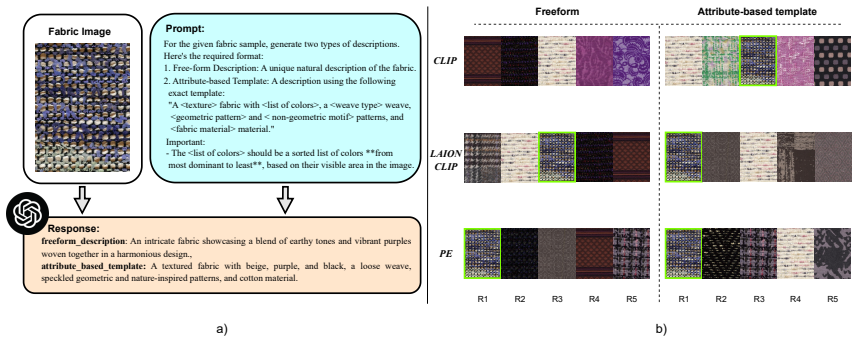
The load-bearing object is the attribute-based template: 'A <texture> fabric with <list of colors>, a <weave type> weave, <geometric pattern> and <non-geometric motif> patterns, and <fabric material> material.' The pipeline asks an MLLM to fill this template and also to write a freeform sentence for each image, then encodes each description with the text encoder of the model under test and ranks all images in a split by cosine similarity. The template carries the argument because it forces low-level visual attributes, such as color order, weave, pattern type, and material, into the query, and these are exactly the cues needed to separate near-identical fabric samples; freeform text does not reliably expose them.
What would settle it
Have human annotators write attribute-template and freeform descriptions for the same fabric images and rerun the same rank-based evaluation; if the template advantage disappears or reverses, the reported effect is an artifact of the automatic generator rather than of structured attributes. A simpler check is to corrupt the listed colors in the templates and verify that hit-rate drops, since retrieval that ignores attributes would be insensitive to the corruption.
Extended reading notes
Core claim
On the 12,181-image wool-fabric dataset used in the study, the paper's central finding is that automatically generated, attribute-structured descriptions consistently improve text-to-image retrieval over freeform descriptions for every evaluated model and across all four fabric classes. The improvement is largest for the lattice and printed classes, where visual similarity between samples is highest, and smallest for solid fabrics. Among CLIP, the large-scale CLIP variant, and the Perception Encoder, the Perception Encoder achieves the highest hit-rate at all reported ranks, an advantage the paper attributes to its larger training corpus and the use of intermediate feature representations for text-image alignment. The paper also reports that absolute zero-shot accuracy remains low, so these gains improve ranking behavior without solving fine-grained retrieval in this domain.
Load-bearing premise
The comparison assumes the machine-written descriptions are accurate and specific enough that the correct fabric can be identified from the text; if the generated attributes are wrong or generic, the ranking results reflect the caption generator rather than the retrieval models.
Editorial extensions
If this is right
- Structured attribute descriptions improve hit-rate for all three pretrained vision-language models, so query text formatting is a free performance lever in zero-shot fabric retrieval.
- The largest gains appear on lattice and printed classes, implying that visual complexity is where template-based queries matter most.
- The Perception Encoder's advantage at every rank suggests that choosing a model with richer intermediate embeddings can matter more than simply scaling the CLIP training set.
- Even the best combination leaves substantial room for improvement, so domain-adapted training or additional fine-tuning is needed before such retrieval is practically reliable.
Reading between the lines
- If the template effect is causal, the same attribute-filling recipe could be tested on other fine-grained manufactured goods such as leather, wood veneer, or ceramic tiles, where freeform captions are also too vague; the paper does not test this.
- Because all text queries come from a single MLLM, the structured-versus-freeform gap may partly reflect that generator's writing style; a human-written control or a second generator would separate annotation style from retrieval model capability.
- The comparison suggests a practical recipe for building industrial search benchmarks without manual captions: generate structured templates automatically, then use hit-rate at rank to rank embedding models; if adopted, retrieval evaluation could scale to other unlabeled image collections.
Editorial analysis
A structured set of objections, weighed in public.
Referee Report
Summary. This paper studies zero-shot text-to-image retrieval on fabric images using three pre-trained vision-language models (CLIP, LAION-CLIP, and Meta's Perception Encoder). The authors contribute an automatic annotation pipeline in which ChatGPT-4o-mini generates two types of descriptions from each fabric image: a freeform natural-language sentence and a structured attribute-based template that lists texture, colors, weave, patterns, and material. Experiments are conducted on the Fabric-Image-Data (FID) dataset, split into lattice, pattern, solid, and stripe classes, and retrieval is evaluated with Hit-Rate at rank 1, 5, 10, and 20. The central claim is that attribute-based template descriptions consistently improve retrieval accuracy over freeform descriptions across all models, with the largest gains on visually complex classes, and that the Perception Encoder gives the strongest performance. The paper concludes that zero-shot retrieval in this fine-grained domain remains challenging.
Significance. If the empirical result holds, the paper provides a practically useful finding for industrial fabric retrieval: query formulation matters substantially, and structured attribute descriptions can improve zero-shot retrieval without any model training. The automated annotation pipeline is a reasonable response to the lack of public paired fabric image-text data, and the comparison of three VLMs with two query-generation schemes is a useful contribution. However, the significance is tempered by the absence of statistical uncertainty quantification and by a confounded comparison between query types; these gaps leave the headline conclusion weaker than the wording 'significantly enhance' suggests. The paper's value is therefore more as an exploratory analysis than as a fully established mechanistic claim.
major comments (3)
- [Section 3, Experimental Setup; Results Discussion; Figure 2] The paper reports no error bars, confidence intervals, or significance tests for the H@K values shown in Figure 2. The abstract's claim that structured descriptions 'significantly enhance retrieval accuracy' and the Results Discussion's statement that they lead to 'consistently higher retrieval accuracy across all models' are not supported by any statistical evidence. Because the central conclusion rests on a comparison across query types and models, the authors should report per-image or per-description variability, for example bootstrap confidence intervals or paired tests over the query set, and adjust the wording to match the statistical strength of the results.
- [Section 3, Description Generation; Experimental Setup] The comparison between attribute-based templates and freeform descriptions is confounded: the two query types differ simultaneously in sentence structure, length, and vocabulary content. The template is a fixed slot-filling sentence that explicitly enumerates colors, weave, patterns, and material, while the freeform description is an unconstrained single sentence. As a result, higher H@K scores for template queries could be due to query length, lexical density, or distributional familiarity with noun-heavy captions, rather than to the 'structured' nature per se. The paper should include a control condition—for example, freeform descriptions length-matched to the template, or an attribute bag-of-words without the sentence frame—or explicitly weaken the causal interpretation in favor of a practical association.
- [Section 3, Description Generation] The description generation pipeline is not validated for accuracy or discriminative quality. The paper states that ChatGPT-4o-mini generates descriptions from the input prompt, but provides no human evaluation, attribute-level accuracy check, or analysis of whether the generated text uniquely identifies each target image among same-class distractors. If the model hallucinates attributes or produces generic text, the measured H@K reflects annotation quality rather than VLM retrieval ability, and the comparison between query types could be systematically distorted. At minimum, the authors should report a sample of generated descriptions and assess their coverage of salient visual attributes.
minor comments (6)
- [Section 3, Dataset] The dataset section lists a class named 'pattern' (768 images), while Figure 2 labels the same class as 'Printed Fabrics'; please reconcile these terms to avoid confusion.
- [Section 4, Conclusions] There is a typo in 'forText-to-Image' (missing space) in the first sentence of the Conclusions.
- [Throughout] The naming of 'Chat-GPT' and 'ChatGPT' is inconsistent; please standardize to 'ChatGPT' throughout.
- [Throughout] The model is referred to as both 'LAION-CLIP' and 'LAION CLIP'; please use a single consistent spelling.
- [Section 3, Description Generation] The sentence 'On average, the model generates each response in approximately 2.6 seconds' appears irrelevant to the retrieval analysis; please remove it or move it to an appendix.
- [Section 3, Experimental Setup] The paper does not report the exact numerical H@K values underlying Figure 2; providing a table with means would improve reproducibility and allow readers to verify the plotted differences.
Circularity Check
No significant circularity: the retrieval comparison is an empirical evaluation with no fitted parameters, self-citation chains, or definitional reductions.
full rationale
The paper's central claim is an empirical H@K comparison (Figure 2 and Results Discussion) between two automatically generated query types across three fixed pre-trained models. No parameter is fitted to the retrieval outcomes: ChatGPT-4o-mini generates the descriptions from the images using a fixed prompt, and the attribute template fields are selected from an image-independent question ('List the top 5 attributes to distinguish a fabric image'), so nothing in the query-generation step is defined in terms of the retrieval result. The only self-referential aspect is that queries are created from the target images themselves, but this is symmetric across the freeform and attribute conditions and is standard benchmark construction rather than a derivation that presupposes the conclusion. There are no load-bearing self-citations: references [2], [9], [10], and [11] are external resources, and no uniqueness theorem or prior author result is invoked to force the finding. The possible confound between template structure and query length is a validity concern about causal attribution, not circularity, so the circularity score is 0.
Assumptions & free parameters
assumptions (4)
- domain assumption ChatGPT-4o-mini-generated descriptions are accurate and discriminative enough to uniquely identify each fabric image within its class split.
- domain assumption The FID class splits form a suitable retrieval corpus for evaluating fabric text-to-image retrieval.
- domain assumption Cosine similarity between the VLM text and image embeddings is a valid ranking signal without any domain adaptation.
- domain assumption The three evaluated models, CLIP, LAION-CLIP, and Perception Encoder, are representative of current VLM retrieval performance.
Cite this review
Pith. "Pith review of An analysis of vision-language models for fabric retrieval." pith.science (2026). https://pith.science/paper/P7UFQAN5
@misc{pith2026250704735,
  author       = {Pith},
  title        = {Pith review of: An analysis of vision-language models for fabric retrieval},
  year         = {2026},
  howpublished = {\url{https://pith.science/paper/P7UFQAN5}},
  note         = {Machine review of arXiv:2507.04735}
}
read the original abstract
Effective cross-modal retrieval is essential for applications like information retrieval and recommendation systems, particularly in specialized domains such as manufacturing, where product information often consists of visual samples paired with a textual description. This paper investigates the use of Vision Language Models(VLMs) for zero-shot text-to-image retrieval on fabric samples. We address the lack of publicly available datasets by introducing an automated annotation pipeline that uses Multimodal Large Language Models (MLLMs) to generate two types of textual descriptions: freeform natural language and structured attribute-based descriptions. We produce these descriptions to evaluate retrieval performance across three Vision-Language Models: CLIP, LAION-CLIP, and Meta's Perception Encoder. Our experiments demonstrate that structured, attribute-rich descriptions significantly enhance retrieval accuracy, particularly for visually complex fabric classes, with the Perception Encoder outperforming other models due to its robust feature alignment capabilities. However, zero-shot retrieval remains challenging in this fine-grained domain, underscoring the need for domain-adapted approaches. Our findings highlight the importance of combining technical textual descriptions with advanced VLMs to optimize cross-modal retrieval in industrial applications.
Figures

Reference graph
Works this paper leans on
-
[1]
Y. Zhu, H. Yuan, S. Wang, J. Liu, W. Liu, C. Deng, H. Chen, Z. Liu, Z. Dou, J.-R. Wen, Large language models for information retrieval: A survey, arXiv preprint arXiv:2308.07107 (2023)
arXiv 2023
-
[2]
A. Radford, J. W. Kim, C. Hallacy, A. Ramesh, G. Goh, et al., I. Sutskever, Learning transferable visual models from natural language supervision, in: M. Meila, T. Zhang (Eds.), Proceedings of the 38th International Conference on Machine Learning, 2021
work page 2021
-
[3]
L. V. B. Beltrán, J. C. Caicedo, N. Journet, M. Coustaty, F. Lecellier, A. Doucet, Deep multimodal learning for cross-modal retrieval: One model for all tasks, Pattern Recognition Letters 146 (2021)
work page 2021
-
[4]
M. Wang, J. Wang, N. Zhang, J. Xiang, W. Gao, Fabric image retrieval based on decoupling of texture and color feature, Journal of Engineered Fibers and Fabrics 19 (2024) 15589250241246074
work page 2024
- [5]
-
[6]
M. Liu, S. Roy, W. Li, Z. Zhong, N. Sebe, E. Ricci, Democratizing fine-grained visual recognition with large language models, arXiv preprint arXiv:2401.13837 (2024)
arXiv 2024
- [7]
- [8]
Show all 11 references
-
[9]
R. Liu, Z. Yu, Q. Fan, Q. Sun, Z. Jiang, The improved method in fabric image classification using convolutional neural network, Multimedia Tools and Applications 83 (2024) 6909–6924
2024
-
[10]
Schuhmann, R
C. Schuhmann, R. Beaumont, R. Vencu, C. W. Gordon, et al., LAION-5b: An open large-scale dataset for training next generation image-text models, in: 36th Conference on Neural Information Processing Systems Datasets and Benchmarks Track, 2022
2022
-
[11]
Bolya, P.-Y
D. Bolya, P.-Y. Huang, P. Sun, J. H. Cho, A. Madotto, C. Wei, T. Ma, J. Zhi, J. Rajasegaran, H. Rasheed, et al., Perception encoder: The best visual embeddings are not at the output of the network, arXiv preprint arXiv:2504.13181 (2025)
2025 arXiv
Reviewed August 6, 2026 · model on record in the stance chip above.
Discussion (0). Sign in to comment.